A place where the stories converge
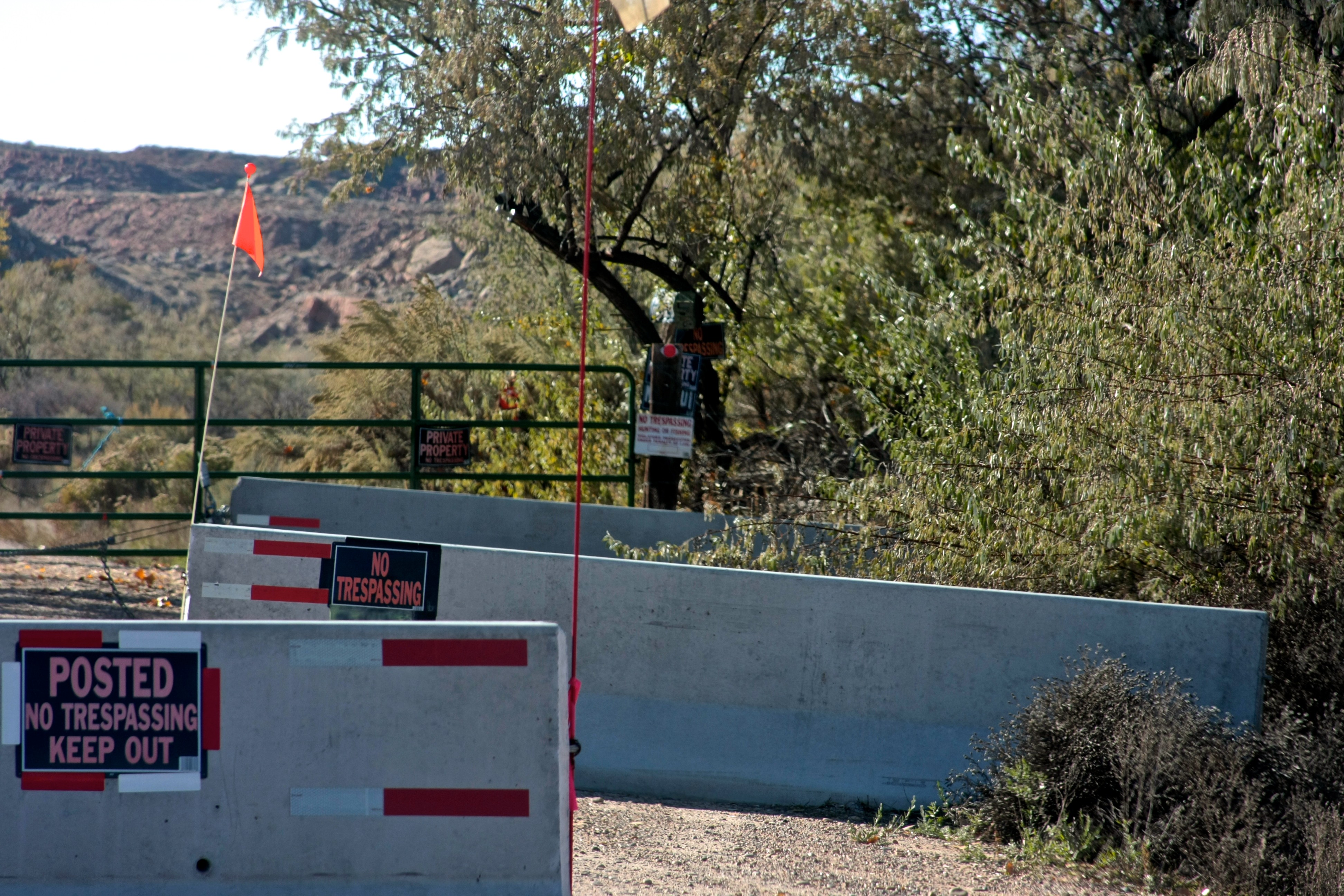
A gate, a rocky ridge, and pastureland: Skinwalker Ranch has a remarkably ordinary setting for an extraordinary reputation. The privately owned property lies in northeastern Utah’s Uintah Basin, south of Fort Duchesne. Its owners describe it as 512 acres; the original newspaper coverage called it 480. The difference is worth keeping visible rather than treating every description as a precise survey. What made the ranch famous was the convergence of stories usually told separately—flying objects, missing livestock, enormous animals, and disturbances that seemed to follow people home. This field note follows the public record and identifies the accounts that made the place a legend. Sources and media rights were reviewed September 16, 2026.
The name carries a different history
The name draws on Navajo, or Diné, traditions, while the surrounding region is the homeland of the Ute Indian Tribe of the Uintah and Ouray Reservation. These are distinct peoples and cultural contexts. Writing about popular fiction’s use of skinwalker stories, Cherokee scholar Adrienne Keene explains that the beliefs have a serious place within Navajo life and cannot be reduced to a generic monster story. Her essay is cultural commentary, not an investigation of the ranch. Here, the modern paranormal narrative is treated as its own subject. Repeated claims of an ancient tribal curse do not, by repetition alone, establish a documented history of this particular property or a belief shared by every local Indigenous person.
Sources: Magic in North America Part 1: Ugh.Fish & Wildlife Management
1994–1996: the Sherman family goes public
Terry and Gwen Sherman bought the ranch in 1994. In Zack Van Eyck’s June 30, 1996, Deseret News report, they described lights and differently shaped craft, apparent orange openings in the air, and cattle deaths and disappearances. They said two sightings had been videotaped. The article also recorded a less sensational detail: local sheriff’s personnel could not corroborate recent reports through their offices, and the family had not reported its own experiences to officials. This is the essential starting point for the modern story—a contemporary record of what the Shermans said, with the limits of outside corroboration present from the beginning.
Sources: Frequent fliers?
The wolf that would not fall
Among the most memorable animal stories is Terry Sherman’s account of an enormous wolf that seemed unaffected by repeated close-range rifle shots. HISTORY’s later retelling describes it as roughly three times an ordinary wolf’s size. It is an unsettling inversion of a familiar ranching problem: an animal that should be recognizable suddenly behaves as though normal rules do not apply. The account belongs to the ranch’s reported lore. The retelling does not supply an independently identified specimen or a continuous recording that would establish what the animal was or what happened to it.
Sources: How Skinwalker Ranch became a hotbed of paranormal activity
A light in the woods, three missing dogs
In the April 1997 newspaper follow-up, the Shermans said their three dogs chased a floating light into the woods the previous summer. They heard a yelp and later reported finding three burned patches. Later shorthand often turns this into a witnessed disintegration. The published account is narrower: a chase, a sound, missing animals, and marks on the ground. The gap between an observation and its interpretation is part of how the lore grows.
1996: Robert Bigelow puts the ranch under watch
Bigelow bought the property in September 1996 and installed researchers and surveillance equipment through his National Institute for Discovery Science, usually called NIDS. The attraction was straightforward: instead of chasing scattered sightings, investigators could monitor a place where extraordinary events were said to recur. In a 1998 interview, Bigelow said he spent more than a million dollars a year on NIDS research overall. He also said his staff had no evidence of government interest in the ranch at that time. The family’s agreement to remain quiet after the sale helped turn the property into a closed research site, with outsiders dependent on what its investigators chose to release.
Sources: Private UFO study takes a public turnNo UFOs or ETs have dropped in at spooky ranch
The early investigation’s quieter public record
In April 1997, NIDS spokesman John Alexander told the Deseret News that the researchers had no significant observations to report. Scientists and a veterinarian were maintaining an observation post. Later narratives describe dramatic encounters during the investigation. These accounts do not form a seamless story; retaining their dates and speakers is more useful than silently reconciling them.
2005: a book gives the mystery its shape
Hunt for the Skinwalker, by biochemist Colm Kelleher and journalist George Knapp, was published in December 2005. Its publisher describes a sustained investigation involving disappearing livestock, moving lights, unusual creatures, and apparently invisible disturbances. Kelleher brought a participant’s perspective; Knapp helped carry the story to a much larger audience. The book’s significance is also literary: it gathers events that might otherwise remain separate ranch stories into a sustained encounter with an elusive unknown. It is a central account of the investigation and its interpretations, rather than an independent replication of the reported phenomena.
Sources: Hunt for the Skinwalker
The watcher in the tree
One later account places Kelleher on the ranch on March 12, 1997, watching a large creature perched in a tree. HISTORY’s retelling of his book describes luminous eyes, a rifle shot, the creature’s disappearance, and a deep mark in the snow that he compared to a large raptor’s footprint. The scene predates Alexander’s cautious April statement. That chronological tension makes the source trail especially interesting: a dramatic retrospective account exists alongside a contemporary public declaration that the team had little to report.
Sources: How Skinwalker Ranch became a hotbed of paranormal activityNo UFOs or ETs have dropped in at spooky ranch
2008: the Pentagon connection becomes a contract
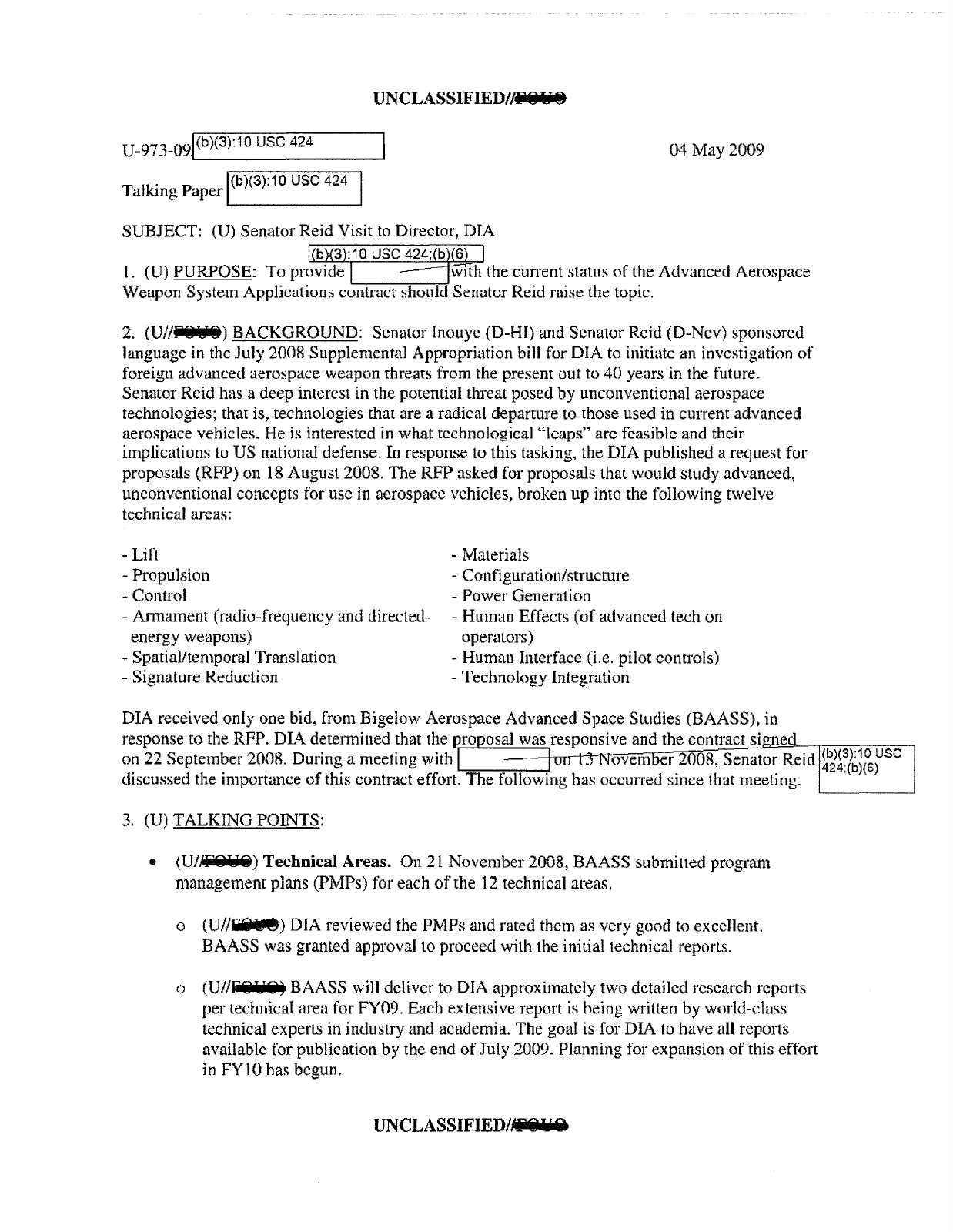
The government connection has firmer documentary footing than the creature stories. A DIA talking paper dated May 4, 2009, records a request for proposals issued on August 18, 2008, followed by a contract signed with the sole bidder, Bigelow Aerospace Advanced Space Studies, on September 22. BAASS was the contractor; AAWSAP was the Advanced Aerospace Weapon System Applications Program. The stated work concerned future aerospace threats and twelve technical areas, including propulsion, materials, power generation, and human effects. This later contract should be distinguished from Bigelow’s earlier private NIDS investigation. A real defense contract establishes an investigation and its official purpose; it cannot by itself validate a paranormal interpretation of events on the ranch.
Sources: Senator Reid Visit to Director, DIA
$22 million—and a request for more secrecy
The frequently repeated $22 million figure comes from two appropriations: $10 million in the 2008 supplemental and $12 million for fiscal year 2010. A released defense briefing packet records both. It also contains James Clapper’s recommendation against Senator Harry Reid’s request to place the work under Special Access protection, citing the lack of justification in the deliverables. The packet uses AAITP terminology while identifying the underlying contract as AAWSAP—one reason the program names in later accounts can be confusing. The money funded the broader program; these documents do not present it as an itemized $22 million expenditure solely at Skinwalker Ranch.
Sources: Senator Reid’s request for Special Access protection: briefing packet
Wormhole papers are not a discovered doorway
The released technical studies have titles well suited to the ranch’s reputation: traversable wormholes, negative energy, invisibility cloaking, and warp drives appear in the collection. They are research papers about possible technologies and scientific ideas. Their presence in an intelligence archive does not mean the government observed those technologies operating in Utah. The distinction is useful when a source pairs a dramatic paper title with an account of a glowing opening: a theoretical subject, a reported visual event, and an experimentally established mechanism are three different things. The document collection lets readers inspect what was actually written.
Sources: The AAWSAP documentation
The hitchhiker: when the story follows you home
Perhaps the ranch’s most disquieting idea is that leaving does not end the experience. In a 2022 EdgeScience article, Kelleher described the alleged “hitchhiker effect”: visitors and their families reporting lights, apparitions, and household disturbances after a ranch visit. He discussed possible models of contagion and connections to reports of illness, while acknowledging that the small number of observations prevented firm conclusions and that a causal link to illness was unknown. These are a participant’s collected reports and proposed interpretations, not an established transmissible phenomenon. As lore, the idea changes the boundaries of the place: the mystery is no longer contained by its fence.
Sources: The Pentagon’s secret UFO program, the hitchhiker effect, and models of contagion
KONA BLUE and the official retrospective
AARO’s historical report, released in March 2024, describes contractor investigations of paranormal claims at the Utah property, while stating that DIA did not specifically authorize that work. It also recounts the proposed Department of Homeland Security successor effort, KONA BLUE. According to AARO, the full Special Access Program was never established and no extraterrestrial craft or biological material was collected or transferred to it. This is the government office’s retrospective assessment. Read alongside the participants’ accounts, it documents disagreement over the meaning and value of the work, rather than official confirmation of the ranch’s extraordinary explanations.
Sources: Report on the historical record of U.S. government involvement with UAP, Volume IAARO historical report: searchable transcriptThe Pentagon’s secret UFO program, the hitchhiker effect, and models of contagion
2016: a new owner, a new investigation
Brandon Fugal acquired the ranch in 2016 through Adamantium Real Estate. The property’s official site describes an ongoing program of surveillance and experimentation, with Erik Bard as principal scientific investigator, Travis Taylor as senior science adviser, and Thomas Winterton as ranch manager. This is the current team’s own presentation of its work. The change of ownership matters to the chronology: the Sherman period, NIDS monitoring, the BAASS contract, and Fugal’s investigation are connected chapters with different people, records, and purposes. Treating them as one uninterrupted government experiment obscures those differences.
Sources: Skinwalker Ranch: official website
2020: the gates open to television
The Secret of Skinwalker Ranch premiered on HISTORY on March 31, 2020. Its first season established a recurring rhythm: an experiment, an unexpected observation, an equipment problem or unsettling event, then another question. The episode guide itself charts the progression from concerns about digging to aerial sightings and a cow’s death. Television made the researchers, the buildings, and the landscape familiar in a way earlier books could not. It also gave viewers an edited account of the investigation. An episode is a source for what was shown and said; assessing a proposed explanation requires the underlying observations and methods.
The Triangle, the mesa, and the portal hypothesis
The television era has its own geography. The Triangle is an experimental focus; the mesa is associated with claims of hidden structures; Homestead Two is a recurring setting for portal speculation. In HISTORY’s retrospective, executive producer Joe Lessard describes GPS canister drops, lasers, rockets, apparent aerial objects, and drilling that the team interpreted as encountering a curved obstruction. These are the production’s descriptions and interpretations. They explain why the landscape has become so compelling to viewers: each location seems to promise a different way into the same mystery. But an obstruction is not an identified buried craft, and an object disappearing from a camera view does not by itself demonstrate passage through a portal.
Sources: 7 of the most mind-bending moments on Skinwalker Ranch
What would turn a striking image into stronger evidence?
Critics focus on the distance between an evocative clip and a measured result. In The Skeptic, Nick Garratt argues that some apparently fast objects could be nearby insects and questions the show’s interpretation of ambiguous images. That is a proposed alternative, not a demonstrated explanation for every ranch observation. NASA’s broader UAP work stresses the need for better data and scientific analysis; it does not investigate this property. Applied here, the useful questions are concrete: are the original recordings available, are times and sensor settings documented, are comparison measurements provided, and can independent analysts reproduce the result? The sources assembled for this page do not establish an independently verified portal, anomalous creature, or extraterrestrial vehicle at the ranch.
Sources: The truth of Skinwalker Ranch… probably won’t shock youNASA’s unidentified anomalous phenomena studyReport on the historical record of U.S. government involvement with UAP, Volume I
A place to keep reading—and watching
The entrance photograph and DIA page reproduced here show two things that can be inspected directly: the setting and part of the paper trail. The photograph carries a Creative Commons Attribution-ShareAlike license; the memo is a U.S. government work. The official HISTORY clips linked below offer a view of the television investigation, but their availability online is not an open reuse license. No ranch-specific video with a sufficiently verified open license was selected for republication in this review. What remains is an unusually layered story: a family’s disturbing accounts, a privately funded search, an actual government contract, and a landscape whose unanswered questions now reach a worldwide audience.
Sources: Skinwalker Ranch entrance, October 18, 2013Senator Reid Visit to Director, DIAWatch: official Skinwalker Ranch clips