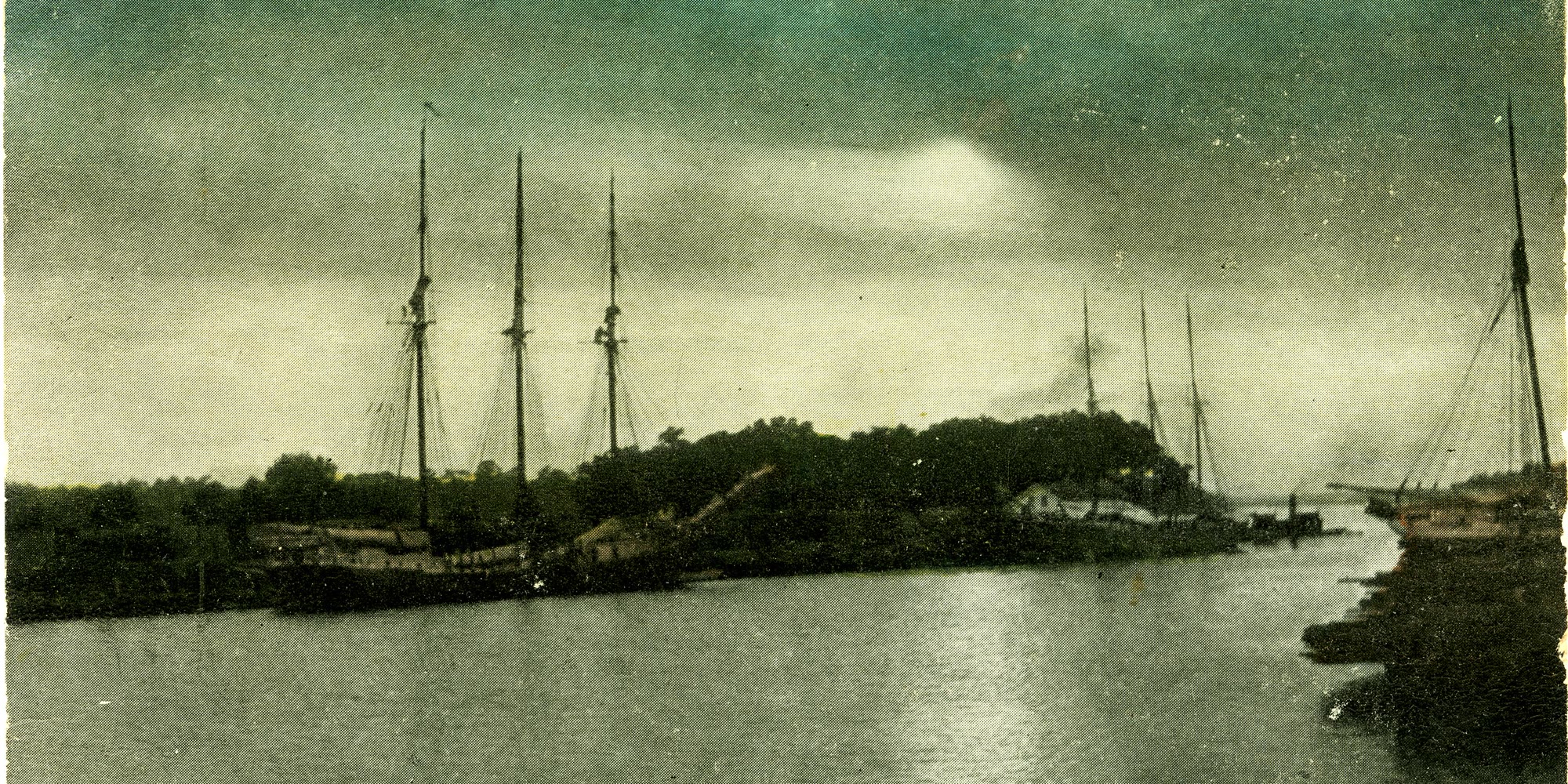
Hardheads, croakers and blue light
Thursday had ended at Walker Shipyard, but 42-year-old foreman Charles Hickson and 19-year-old Calvin Parker were not ready to go home. They tried the water below a grain elevator, caught a few hardhead catfish and croakers, then moved to an abandoned pier near the old Shaupeter shipyard between the railroad and U.S. 90 bridges. Dusk gathered over the industrial river. In the account Hickson gave deputies that night, a blue light appeared, circled and descended over the bayou. A low buzzing or zipping accompanied it. He placed the glowing oblong form twenty-five to forty yards away, hovering two or three feet above the ground; later summaries put it at roughly thirty to forty feet across and eight to ten feet high. The numbers were frightened visual estimates, but the blue reflection, the small sound and the opening at one end became the fixed stage of Pascagoula lore.
Sources: The Hickson Tapes — Sheriff’s Interview and Unwatched ConversationPas men ‘forced’ aboard UFO‘UFO Reports Swamp Mississippi’: Media Coverage of the 1973 Pascagoula Alien Abduction
Three things glided out
An opening seemed to lift at the end of the object. Three forms emerged without walking. Hickson described them as about five feet tall, pale or gray, wrinkled or skin-tight, with no visible necks, slit-like mouths and projections where a human nose and ears would be. Their feet were rounded; their hands ended in pincer-like forms. He could not remember eyes. One emitted a mechanical buzz while the others remained silent. Two came behind him, took his arms in their pincers and raised him without pressure or pain. Another moved toward Parker. The beings’ unforgettable strangeness came from motion as much as anatomy: they did not stride from the light but glided, carrying the men as though all five bodies had lost their weight.
Sources: The Hickson Tapes — Sheriff’s Interview and Unwatched ConversationPas men ‘forced’ aboard UFOHickson Oral History (1979)
The room with no seams
Hickson said he could move only his eyes. Inside, he remembered brilliant light without a visible bulb, no seats and no familiar machinery. The figures positioned him horizontally while something like a large eye moved around his body—front, underside, back and overhead—as if scanning him. He called to Parker but later told the oral-history interviewer that he could not hear his own voice. His first-night estimate for the episode was twenty to thirty minutes, although he wore no watch and admitted he did not know whether he remained conscious throughout. Parker said little in the sheriff’s formal interview. That night Hickson told deputies the younger man had passed out; decades later Parker described being conscious but paralyzed and supplied a fuller, partly different examination narrative. The distinction between the sparse 1973 record and Parker’s expanded recollection matters.
Sources: The Hickson Tapes — Sheriff’s Interview and Unwatched ConversationHickson Oral History (1979)Alien Abduction: 45 Years After Alleged UFO Encounter, Mississippi Man Breaks His SilenceMan Says 1973 UFO Incident Turned Life Upside Down
Back beside the river
Hickson’s next clear memory was Parker standing on the bank with a terror on his face unlike anything he had seen. A buzz sounded and the object was gone. Hickson tried to steady him. His first instinct was silence: nobody would believe them. He drank whiskey from a bottle in the car after the event, a detail officers noticed when they met him. Yet he became convinced that officials had to know. They tried Keesler Air Force Base and were directed to local law enforcement; they also stopped at The Mississippi Press, where no reporter was available. Near 11 p.m. they reached the Jackson County Sheriff’s Department. What might have remained a private, unbelievable story entered a room equipped with a tape recorder.
Sources: The Hickson Tapes — Sheriff’s Interview and Unwatched ConversationPas men ‘forced’ aboard UFOMan Says 1973 UFO Incident Turned Life Upside Down
Sheriff Diamond sets a trap
Sheriff Fred Diamond and Capt. Glenn Ryder suspected drink, a prank or a bid for attention. Hickson repeated the story while Parker sat largely silent. His language was rough, hesitant and full of blanks: he could describe the floating eye but not call it an instrument; he had seen something where eyes might be but could not swear there were eyes. Ryder later said he expected notoriety-seekers. The officers left the pair alone while the recorder continued, hoping the performance would collapse. Instead Parker said he needed a doctor or nerve pills, that his arms had frozen and that he was ‘about to go half crazy.’ Hickson tried to calm him while insisting people would not believe. When Hickson left the room, Parker prayed alone. The tape cannot identify what happened on the river. It preserves something rarer: the witnesses’ private emotional state only hours afterward.
Sources: The Hickson Tapes — Sheriff’s Interview and Unwatched Conversation1973 Recording of Hickson and Parker Discussing Their Reported Abduction‘They Didn’t Make It Up.’ Interview Recording Surfaces in Pascagoula CaseMan Says 1973 UFO Incident Turned Life Upside Down
The story escapes by morning
The promise of quiet did not survive the night. The Mississippi Press put ‘Pas men “forced” aboard UFO’ across its October 12 front page, and the wire services carried the story outward. Reporters and curiosity-seekers crowded the shipyard. Authorities around the Gulf Coast received a flood of new reports; some were jokes or admitted hoaxes, including a taxi driver’s tale of a pincer-handed being. An Ocean Springs alderman even proposed barring UFOs from traveling faster than twice the speed of light over U.S. 90. Beneath the carnival, Parker recoiled. He married later that year, changed jobs and moved when coworkers learned his name. Hickson chose the opposite route—television, lectures and eventually a 1983 book—turning one night on the river into the central story of his life.
Sources: Pas men ‘forced’ aboard UFO‘UFO Reports Swamp Mississippi’: Media Coverage of the 1973 Pascagoula Alien AbductionMan Says 1973 UFO Incident Turned Life Upside DownHickson Oral History (1979)
Investigators arrive in the 1973 flap
Pascagoula erupted during an autumn wave of reports across the American South. Engineer and APRO investigator James Harder and astronomer J. Allen Hynek reached Mississippi within days, interviewed the men and judged that they had undergone a real and frightening experience; that assessment concerned sincerity and experience, not proof of an extraterrestrial cause. A polygraph examiner later said Hickson was truthful about what he believed, a narrower claim than headlines suggested. Polygraph evidence is not scientifically reliable, and skeptic Philip Klass challenged the examiner’s credentials and changes in Hickson’s retellings. Project Blue Book had closed in 1969, so there was no Blue Book disposition waiting at the end—only police interviews, civilian inquiry, medical checks described in the press and a case that never acquired a decisive physical exhibit.
Sources: ‘UFO Reports Swamp Mississippi’: Media Coverage of the 1973 Pascagoula Alien AbductionFamous Alien Abduction in Pascagoula: Reinvestigating a Cold CaseMan Says 1973 UFO Incident Turned Life Upside Down
Two witnesses, two afterlives
Hickson kept talking until his death in 2011, including later claims of renewed contact that moved beyond the tightly documented first night. Parker spent decades resisting the role assigned to him. In 2013 he told the Associated Press that the encounter had turned his life upside down; in 2018 he published a full memoir, describing a more elaborate experience and estimating a much larger, eighty-foot craft. Those later details belong to Parker’s memory after forty-five years, not to the same-night baseline. The contrast became part of the case: one witness transformed the experience into a public mission, while the other fled the attention and eventually returned to tell the story in his own voice.
Sources: Man Says 1973 UFO Incident Turned Life Upside DownAlien Abduction: 45 Years After Alleged UFO Encounter, Mississippi Man Breaks His SilenceHickson Oral History (1979)
A witness across the water, forty-five years late
In 2019 Maria Blair said publicly that she and her husband Jerry had been waiting across the river that night for an offshore boat. Jerry slept while she watched a blue light move silently back and forth for roughly thirty minutes and rise near the area later identified with Hickson and Parker. At the time she took it for a plane or helicopter. Her account offers a possible independent observation of an unusual light, but it arrived after forty-five years of publicity and does not corroborate the beings, transport or examination. The same year Pascagoula unveiled a marker at Lighthouse Park. Parker stood with both families and wept. A story once feared as ruinous had become civic folklore fixed beside the river.
Sources: Pascagoula UFO: A New Witness Comes ForwardHistorical Marker Unveiled Honoring Possible Alien Abduction in Pascagoula
What remains in the room
The most durable artifact is not a photograph of a craft or a mark in the mud. It is the recording made by skeptical officers who expected a confession. Heard now, the tape is intimate and uncomfortable: two working men testing words for an experience that had no safe vocabulary, one trying to manage the other’s panic, then a frightened young man praying when left alone. Genuine fear can accompany misperception, altered consciousness, suggestion or an invented story that has become emotionally real; it does not authenticate crab-clawed visitors. But the tape closes off the easiest version of a casual joke. Pascagoula endures in that narrow, haunting space between sincerity and explanation.
Sources: 1973 Recording of Hickson and Parker Discussing Their Reported Abduction‘They Didn’t Make It Up.’ Interview Recording Surfaces in Pascagoula CaseFamous Alien Abduction in Pascagoula: Reinvestigating a Cold CaseMoonlight on the Pascagoula River, Scranton, Miss.
Sources & interviews
Pas men ‘forced’ aboard UFOThe Mississippi Press · October 12, 1973 · Contemporaneous front-page report preserved at Newspapers.comThe Hickson Tapes — Sheriff’s Interview and Unwatched ConversationJackson County Sheriff’s Department recording · October 11, 1973 · Transcript reproduced by NICAP from Ralph and Judy Blum1973 Recording of Hickson and Parker Discussing Their Reported AbductionHinds Community College Library · 3:22 audio excerpt from the Jackson County recordingHickson Oral History (1979)University of Southern Mississippi Special Collections · Mississippi Oral History Program · Interview by Orley B. Caudill‘UFO Reports Swamp Mississippi’: Media Coverage of the 1973 Pascagoula Alien AbductionJane Fort · University of Southern Mississippi Honors College thesis · 2024 · Study using 1973 newspapers and archival oral historyAlien Abduction: 45 Years After Alleged UFO Encounter, Mississippi Man Breaks His SilenceBrian Broom · Clarion Ledger · August 13, 2018 · Interview with Calvin Parker‘They Didn’t Make It Up.’ Interview Recording Surfaces in Pascagoula CaseBrian Broom · Clarion Ledger · July 13, 2020 · Full-recording provenance and interview with Capt. Glenn RyderMan Says 1973 UFO Incident Turned Life Upside DownJeff Amy · Associated Press · October 11, 2013 · Interview with Parker, Ryder and Hickson’s familyFamous Alien Abduction in Pascagoula: Reinvestigating a Cold CaseJoe Nickell · Skeptical Inquirer 36, no. 3 · May/June 2012 · Hypnagogia and suggestibility interpretationPascagoula UFO: A New Witness Comes ForwardHugh Keeton · WLOX · March 15, 2019 · Maria Blair’s first public account, forty-five years laterHistorical Marker Unveiled Honoring Possible Alien Abduction in PascagoulaTristan Ruppert · WLOX · June 22, 2019 · Marker dedication with Parker and the Hickson familyMoonlight on the Pascagoula River, Scranton, Miss.Cooper Postcard Collection · Mississippi Department of Archives and History · No known copyright restrictions · Wikimedia CommonsConnected files
Two Lost Hours on Route 3The earlier abduction narrative assembled largely through hypnosis, unlike Pascagoula’s hours-old police tape and conscious first-night account.The Varginha EncounterAnother case where unusual beings, frightened witnesses and a local story expanded into civic identity without decisive physical proof.Close Encounters, ExplainedHow the later fourth-kind category came to describe reports of involuntary transport and examination.J. Allen HynekThe astronomer who interviewed Hickson and Parker during the frantic first weekend and emphasized their frightening experience rather than a proven cause.Discuss this case
Compare notes with other readers: witness details, sources, and the parts that still do not add up.
Open the discussion