A field becomes a picture
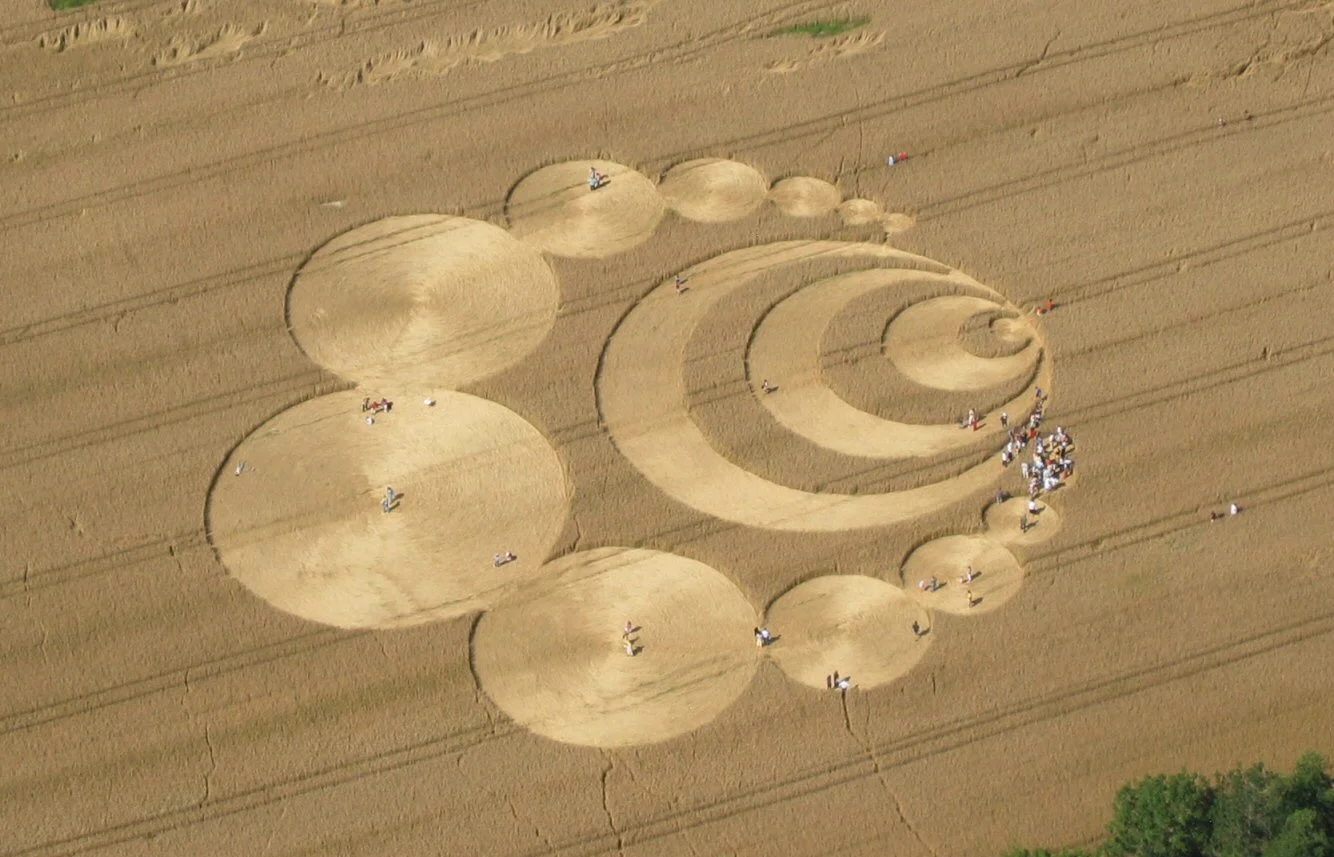
From above, the change is startling. Tractor tracks continue across a field as usual, but between them the crop has become a drawing: rings inside rings, a chain of diminishing discs, a spiral whose pattern only makes sense when the people walking through it shrink to dots. At ground level, the same formation becomes a corridor of standing stalks and a floor of flattened stems. These are physical marks in real fields. The argument begins with who made them, how, and what the marks are supposed to mean. Human circle-making is demonstrable, with confessed makers, public demonstrations, and accounts of working with boards and rope. That has never stopped a new anonymous design from becoming a fresh mystery. Crop-circle lore lives in the space between an astonishing object and an absent signature. The photographs in this article show actual field formations; their captions identify the locations and photographers. The famous historical cases are also linked to original reports and photographic archives, so a modern photograph need not stand in for a different event.
Sources: Creators of the ParanormalA circle-maker’s account: Mike J
Why Wiltshire became the center of the story
A geometric pattern beside Stonehenge arrives with a different atmosphere from one beside a shopping center. Southern England’s crop-circle country overlaps an older landscape of stone circles, burial mounds, chalk hills, and the immense earthwork at Avebury. In their Smithsonian essay, circle-maker Rob Irving and Peter Brookesmith describe a culture in which the new patterns were read through ancient sites, supposed earth energies, and sacred geometry. For visitors, a summer field could become the latest page of a much older book. The connection was imaginative and geographical; proximity to prehistoric monuments does not date the crop designs to prehistory.
Sources: Crop Circles: The Art of the Hoax
1678 and 1880: the ancestors people went looking for
The Mowing-Devil, a pamphlet licensed on August 22, 1678, supplies a wonderfully unruly ancestor. A Hertfordshire farmer refuses a mower’s price and says he would sooner have the Devil do the job. That night the oats appear aflame; by morning they have been mown with supernatural neatness. The woodcut shows a horned worker with a scythe. It is a moral tale about a bargain and its consequences, and its language of cutting matters: it is not a documented modern formation of bent cereal stems. A closer physical parallel appeared in Nature on July 29, 1880. J. Rand Capron described storm-damaged wheat at a Surrey farm, with separate patches that looked circular from a distance. His letter places flattened circular patches in the historical record without establishing a connection to later pictograms. These two sources are interesting precisely because they describe different things: a printed marvel and an observation of a storm-battered field. Combining them into a single centuries-long visitation story erases those differences.
Sources: The Mowing-Devil (1678)Storm Effects
1966: the saucer nest at Tully
The early UFO connection was more literal: a circle might be where a craft had been. Around 9 a.m. on January 19, 1966, George Pedley was driving a tractor near Tully, Queensland, when, he reported, a loud hiss drew his attention to an object rising from Horseshoe Lagoon on Albert Pennisi’s farm. The released RAAF file preserves reports of a circular nest approximately thirty feet across. An analysis included in the file quotes Pedley describing reeds bent beneath the water and swirled clockwise; another observer said the roots had been pulled up into a floating mass, leaving no stubble beneath it. These striking descriptions gave investigators more to discuss than a distant light. The official correspondence considered atmospheric turbulence, including waterspouts and whirlwinds, as possible explanations. The setting was a lagoon rather than an English wheat field, and the observed vegetation did not establish the identity of the reported object. Nevertheless, the image of a saucer leaving a circular nest became an important predecessor to the British story.
Sources: RAAF UFO file: the Tully nestsCrop Circles: The Art of the Hoax
The circles learn a new vocabulary
As the British phenomenon grew, the designs stopped looking like simple landing impressions. At Cheesefoot Head in June 1983, a central circle with four satellites became an influential five-part motif, the quintuplet. By July 1990, East Field near Alton Barnes and Alton Priors carried a roughly 150-meter pictogram: linked circles and straight elements stretched into something that looked almost like writing or machinery. Visitors paid to enter, and photographers turned the field into a widely circulating image. The retrospective archive at The Croppie tracks this change from isolated circles to pictograms and increasingly elaborate geometry. That evolution is a major part of the mystery’s appeal. A circular trace asks what landed there. A complicated diagram invites a different question: who is trying to communicate?
Sources: Ten Game Changing Crop Circles
1990: Operation Blackbird watches the wrong mystery
Operation Blackbird tried to turn anticipation into an experiment. Beginning on July 23, 1990, cameras and other sensors watched fields near Westbury. UPI reported more than $1.8 million in heat, light, and sound equipment, while acknowledging that catching a formation would require luck. Investigators Colin Andrews and Pat Delgado were already public figures through their book Circular Evidence. On July 25, a new pattern was visible below the watch site, and Andrews spoke enthusiastically to television reporters before a ground inspection. Then came the blue objects inside the circles. As The Croppie’s reconstruction relates, these were playing boards from a crop-circle game, subsequently misreported as Ouija boards. Crossed wooden sticks and a length of wire completed the scene. Reviewing the camera record, television producer John Macnish had also noticed small moving dots and a gradual process rather than an instantaneous transformation. The spectacle became an argument over who had recognized the hoax first, and when. Its enduring lesson concerns sequence: the announcement of a breakthrough had preceded the close examination of the field.
Sources: Do ‘little green men’ cause those circles?Operation BlackbirdTen Game Changing Crop Circles
1991: Doug, Dave, and the suspicious car mileage
In September 1991, Southampton artists Doug Bower and Dave Chorley told the newspaper Today that they had been making circles since 1978. They demonstrated their methods, and the paper reported that investigator Pat Delgado had accepted one of their creations before being told its origin. The confession came with a domestic subplot. In Today’s follow-up account, Bower’s wife had suspected an affair and checked his car mileage. He produced scrapbooks of formations; she said she was convinced when he could tell her where the next one would appear. Bird-recording equipment supplied an explanation for nighttime outings when police encountered them. These are the participants’ stories as presented in a newspaper selling a spectacular revelation, rather than an independently audited account of every excursion. Their practical demonstrations still established something consequential: people with simple tools could produce circles that others interpreted as extraordinary. The confession did not identify the makers of every formation elsewhere, or those that appeared years afterward.
Sources: The TODAY story: Day 2, September 10, 1991Creators of the Paranormal
A plank, a rope, and a T-shirt in Namibia
A first-person account published by Circlemakers.org under the name Mike J gives a smaller, stranger version of the same story. He describes joining friends in a Wiltshire field in July 1990, entering along tractor tramlines and using a rope held from the center to guide a plank around concentric circles. A passing moped sent them ducking into their own flattened crop. He estimated the outing’s work at thirty or forty minutes, and remembered broken stems and boot marks. A year later, while working on a film in Namibia, he received a package from his sister containing a crop-circle T-shirt. He and his collaborator recognized their design. This is a maker’s recollection, with pseudonyms and no independent record for every detail. It also captures how authorship can disappear as a pattern travels: the field becomes a photograph, the photograph becomes a symbol, and the symbol comes back as a mysterious souvenir.
Sources: A circle-maker’s account: Mike J
1996: the spiral beside Stonehenge
The confession did not end the spectacle. The Temporary Temples photographic archive records a formation beside Stonehenge on July 7, 1996, known as the Julia Set. It describes 151 circles along a spiral approximately 915 feet long. From the air, the circles taper and coil like a shell; on the ground, visitors move through components too large to take in at once. Later that month, Windmill Hill acquired the three-armed Triple Julia. Steve and Karen Alexander’s archive notes that its arms were not mathematically true Julia fractals, a useful distinction between a formation’s nickname and a technical description. Their ground photographs include a visitor on a bicycle, an unexpectedly ordinary measure of the scale. The paired aerial and ground views are worth following in the linked archive: one shows the whole emblem, while the other restores the distances a flattened photograph makes easy to underestimate.
Sources: 1996 photographic archive: Stonehenge and the Triple Julia
2001: Milk Hill’s 409 circles
The Milk Hill Galaxy became the great scale argument. Temporary Temples catalogs it on August 12, 2001, describing six sweeping arms made from 409 circles and an overall diameter of approximately 1,000 feet. Other chronologies place its appearance on the night of August 12–13; even this celebrated formation arrives with a small dating disagreement. In photographs, larger discs anchor the spiral while smaller circles crowd its curving branches. Enthusiasts ask how people could have laid out and flattened so much crop in a short summer night. The question is fair, but a precise construction-time claim needs evidence for the start time, finish time, number of workers, and whether work happened in stages. A photograph cannot supply those missing observations. Milk Hill’s documented visual complexity is impressive enough without converting estimates about its creation into measured facts. The original archive preserves multiple angles, including views close to the crop and views taking in the whole design.
Sources: 2001 photographic archive: Milk Hill and ChilboltonTen Game Changing Crop Circles
The video that seemed to show it happening
For anyone wondering why photographs never caught the act, the Oliver’s Castle tape offered an apparent answer. In August 1996, footage circulated showing bright balls moving above a field as a pattern seemed to appear beneath them. Filmmaker Peter Sørensen’s firsthand account describes a man calling himself Jonathan Wheyleigh, messages left at the Barge Inn, a promised tape, and the excitement of researchers hoping to see the phenomenon in motion. The story then became a pursuit of the cameraman. Sørensen reported that the trail led to John Wabe and a Bristol video-effects business, and that he recognized Wabe during a later television investigation. This is a particularly important source to read carefully: Sørensen opens with an explicitly fictional detective-story prologue before beginning his factual account. The invented dialogue is not testimony. The investigation undermined the tape’s value as evidence of an anomalous formation process, even as copies of its memorable images kept circulating.
Sources: The Case of the Vanishing Cameraman
Chilbolton: an apparent reply to Arecibo
In August 2001, formations beside the Chilbolton radio telescope in Hampshire appeared to move the conversation from geometry to correspondence. One was a face rendered through a pattern of standing crop; another resembled the graphical form of the message transmitted from Arecibo in 1974. Paul Vigay compared its binary layout with the original: the crop version changed the figure, biological information, and astronomical diagram, inviting readers to imagine a different species describing itself. This was a powerful narrative trick. Humanity had sent a calling card into space, and a field seemed to contain the return address. The SETI Institute’s response explained a fundamental timing problem. The radio transmission had been directed at M13, roughly 25,000 light-years away; a reply from its intended destination could not return in 27 years. SETI also questioned why visitors capable of reaching Hampshire would communicate through such a low-capacity medium. The resemblance establishes a relationship between two designs. It does not authenticate an extraterrestrial sender.
Sources: The Chilbolton ‘Arecibo message’ FormationIs the Latest Crop Circle a Message from E.T.?
Crabwood: the alien face and its warning
A year later, Crabwood near Winchester supplied an even more explicit image: an alien-looking face beside a disc of binary marks. Vigay first heard about it on August 15, 2002, and published a series of dated analyses. Reading standing and flattened crop as ones and zeros, investigators grouped the marks into characters. The resulting text began “Beware the bearers of FALSE gifts & their BROKEN PROMISES.” The rest described pain, remaining time, goodness, and opposition to deception before announcing a closing conduit. One damaged or irregularly encoded word resisted a clean reading; later retellings often make the message look more settled than Vigay’s notes do. The delicious complication is that Vigay remained suspicious of the formation itself. He thought the face looked like science fiction and considered the construction an elaborate hoax, while still doing the work of decoding it. Recognizing a message and believing its implied author were separate judgments. His updates preserve both the intellectual pleasure of the puzzle and his doubts.
Sources: The 2002 ‘Alien Face’ Formation
2008: a circle that really does say pi
Near Barbury Castle on June 1, 2008, a roughly 150-foot formation presented a more checkable message. As Marc West explained in Plus, its stepped spiral can be read against ten equal angular sectors. The first sweep covers three sectors; a small circle marks the decimal point; successive steps encode the following digits. The result is 3.141592654, pi rounded to nine decimal places. The arithmetic is part of what makes this example satisfying: a reader can inspect the diagram and follow the decoding without accepting an account of who designed it. The mathematical content is real, but pi is also human knowledge. A successful numerical reading tells us what the pattern represents, not where its intelligence originated. The linked explanation includes the aerial image and a sector diagram for comparison.
Sources: Pi appears in crop circle
Under the geometry: bent nodes and burst stems
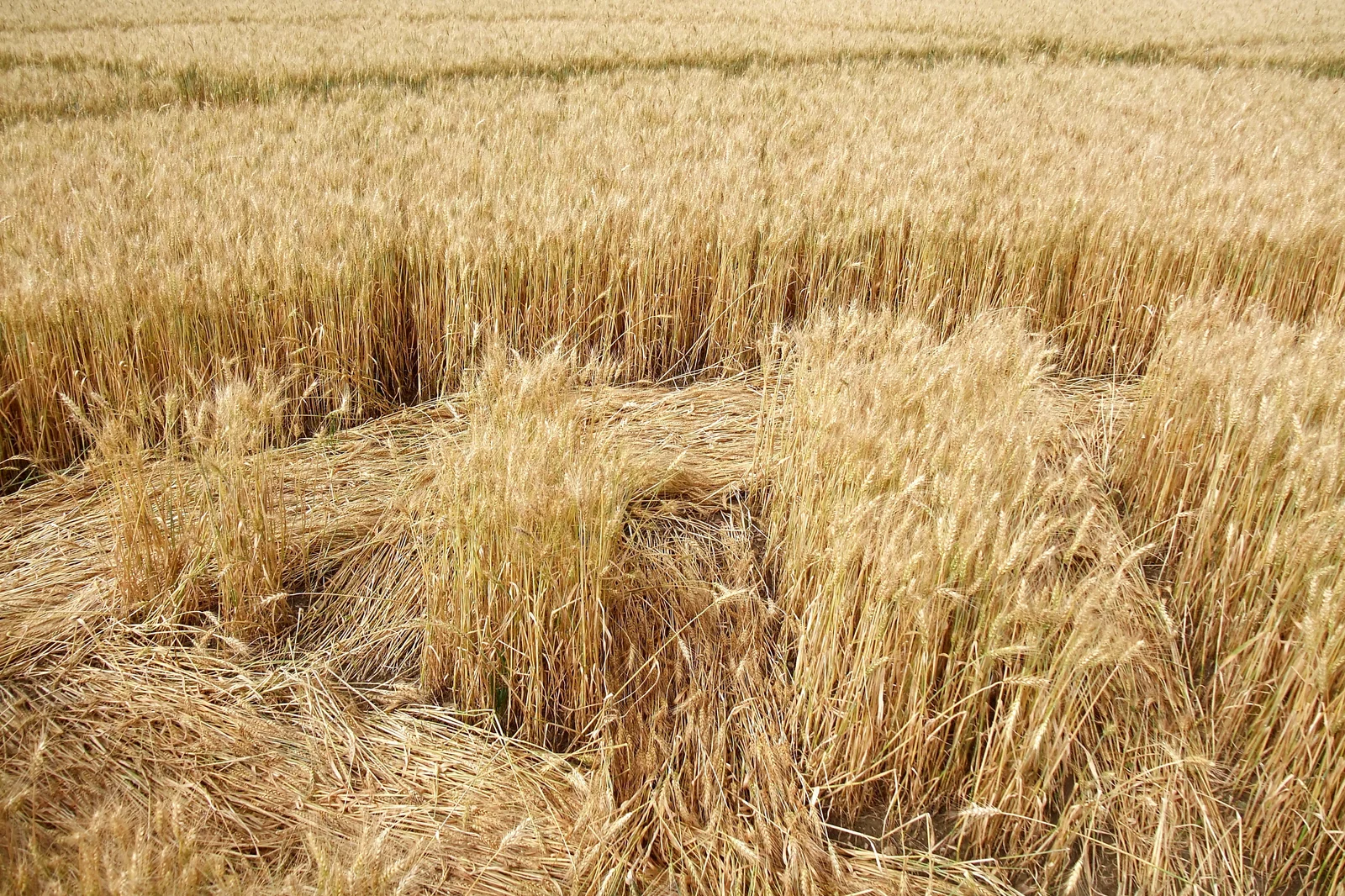
The strongest proponents’ arguments often concern what is inside a formation rather than its outline. W. C. Levengood’s 1994 paper reported anatomical differences in plants from crop formations, including changes to seeds and stem nodes, the jointlike structures along a cereal stalk. BLT Research went on to emphasize elongated nodes, cavities at nodes, altered seed development, and evidence it interpreted as heating by an unusual energy source. That is a more specific claim than simply declaring a design too beautiful for people to make. It requires comparisons: plants from the same field, at comparable maturity, sampled after known intervals. BLT’s own guidance warns that node bending can result from ordinary recovery as a flattened plant grows back toward light and against gravity. Levengood likewise cautioned that node size alone could not certify an anomalous formation. A bent stalk is an observation; deciding what bent it requires the surrounding experimental record.
Sources: Anatomical anomalies in crop formation plantsPlant abnormalities: node elongation, cavities, and bending
What the experiments can—and cannot—settle
The published dispute is more complicated than either “scientists proved it” or “nobody studied it.” In a 2014 paper, Eltjo Haselhoff and colleagues reviewed criticisms by Francesco Grassi, Claudio Cocheo, and Paolo Russo concerning sampling, controls, statistics, and a proposed radiating ball-of-light model. They also described their own manually flattened test circle: its node-length pattern did not reproduce the symmetry they had reported at Hoeven in 1999. The authors regarded the difference as significant, while disputing the critics’ analysis. Failure to reproduce one distribution in one comparison does not identify an alien cause, or establish a universal test for mysterious circles. Another BLT report offers a useful concrete correction: blackened maize from a 2002 Canadian formation was tested for possible charring, but analysis identified fungal material and found no carbon. Samples, dates, controls, and reproducible measurements do more explanatory work than the appearance of a scorched or strangely bent plant. The literature contains claims, objections, and limited experiments—not an authenticated extraterrestrial signature.
Sources: An Experimental Study for Reproduction of Biological Anomalies Reported in the Hoeven 1999 Crop CircleLaboratory report: Mission, British Columbia, 2002
A photographic field guide: look beyond the outline
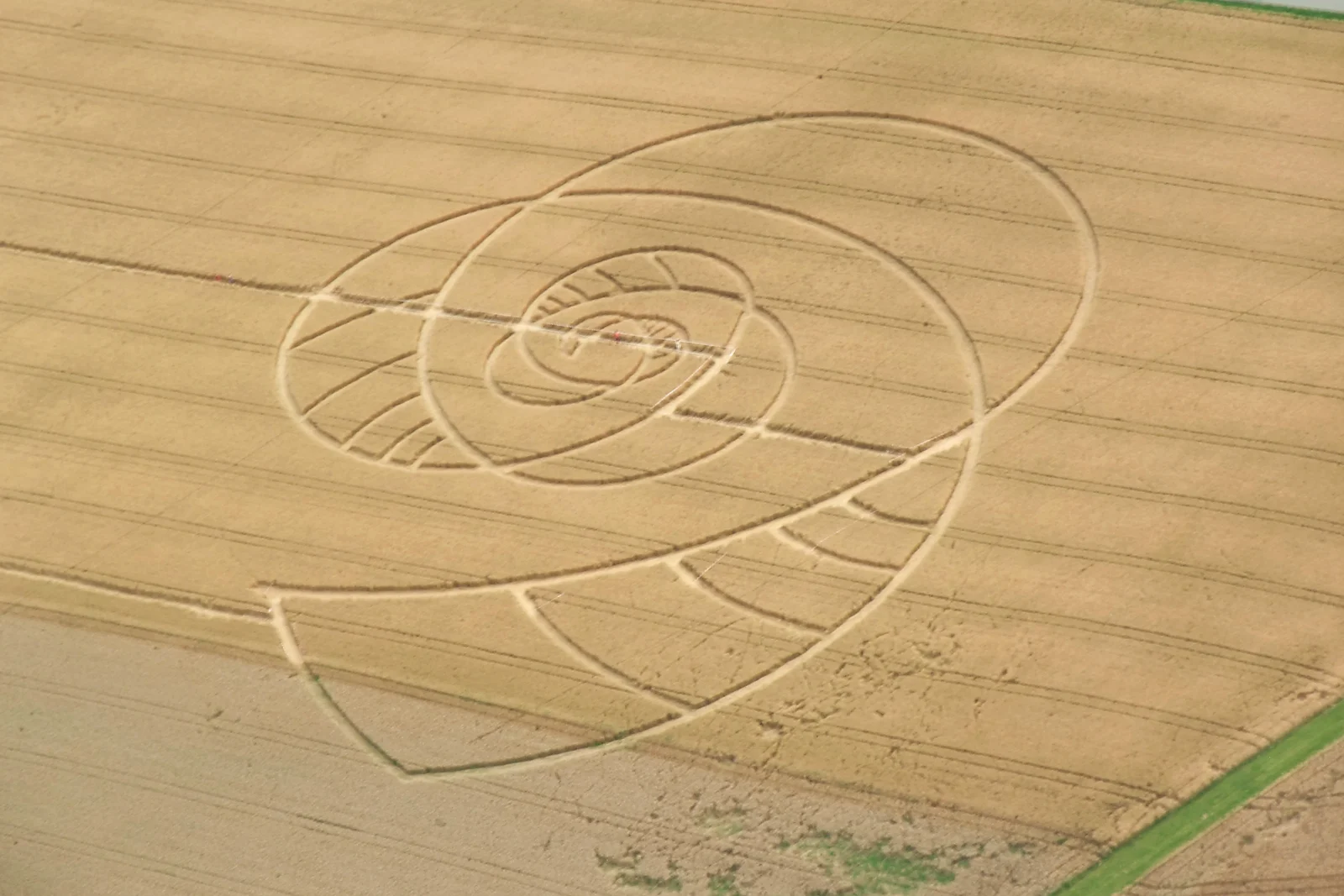
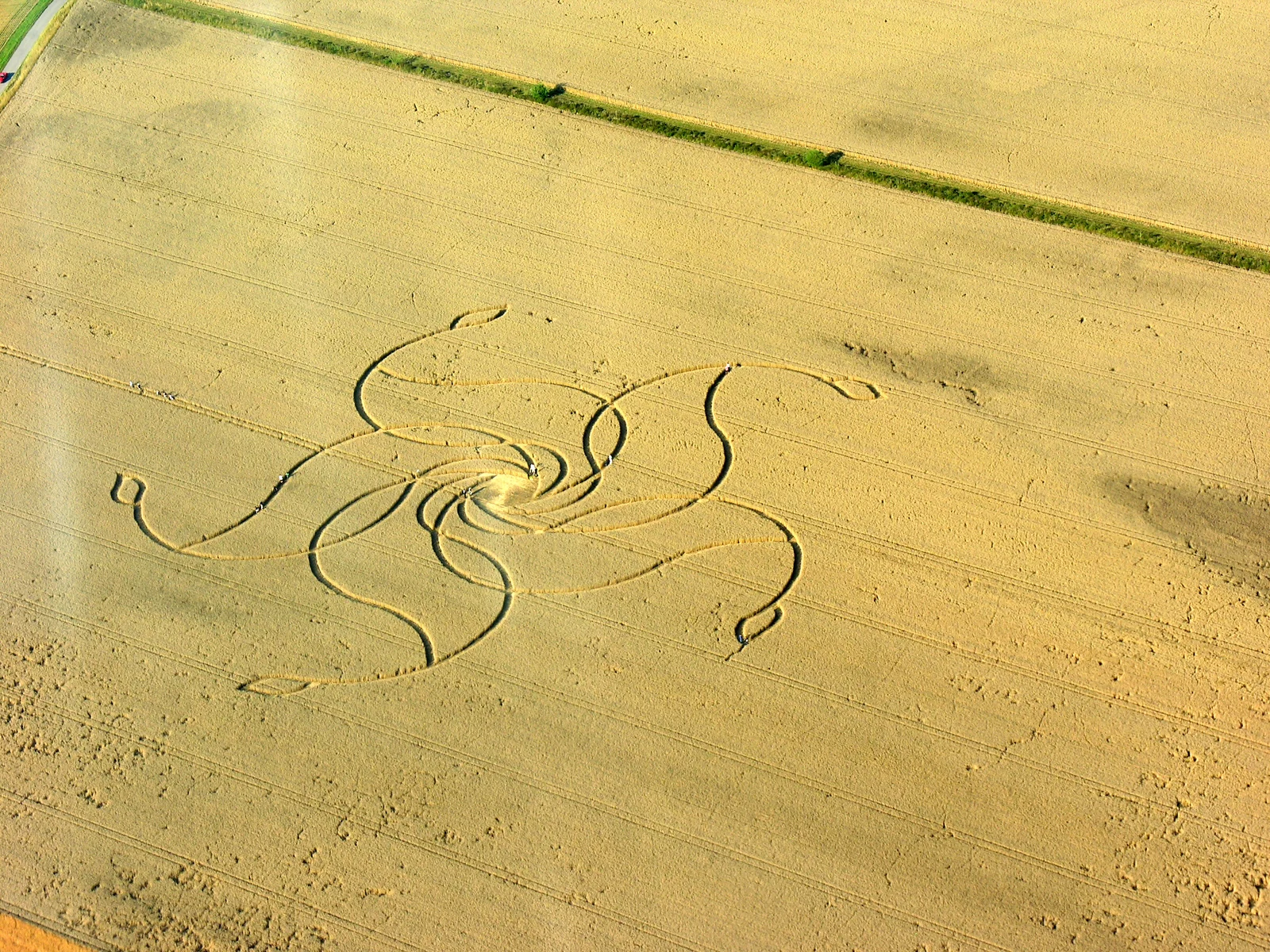
The following photographs make a small atlas of the phenomenon beyond its most famous English cases. Start with this Swiss formation between Steckborn and Hörhausen, photographed from the air on July 27, 2009. Photographer Kecko noted that it was already about fifteen days old and that the owner had added paths for visitors. That detail changes how an image should be read. Every visible line need not belong to the original design; a photograph can record the formation plus two weeks of human activity. The long paired curves also show how quickly the term crop circle becomes inadequate. Here the interest lies as much in linked arcs and the spaces left standing as in circular flattened patches.
Diessenhofen: the value of an aerial record
Hansueli Krapf photographed the Diessenhofen formation in Switzerland on July 15, 2008, as part of a sequence of aerial views. A series is more informative than a single spectacular crop: neighboring fields and repeated passes help establish context, while changing angles reveal how perspective alters the apparent proportions. Its publication record identifies the photographer and the date of the photographs. Those are firmer statements than an inferred time of construction. The source page links to the rest of the sequence for readers who want to explore it.
Ancona: the landscape around a circle
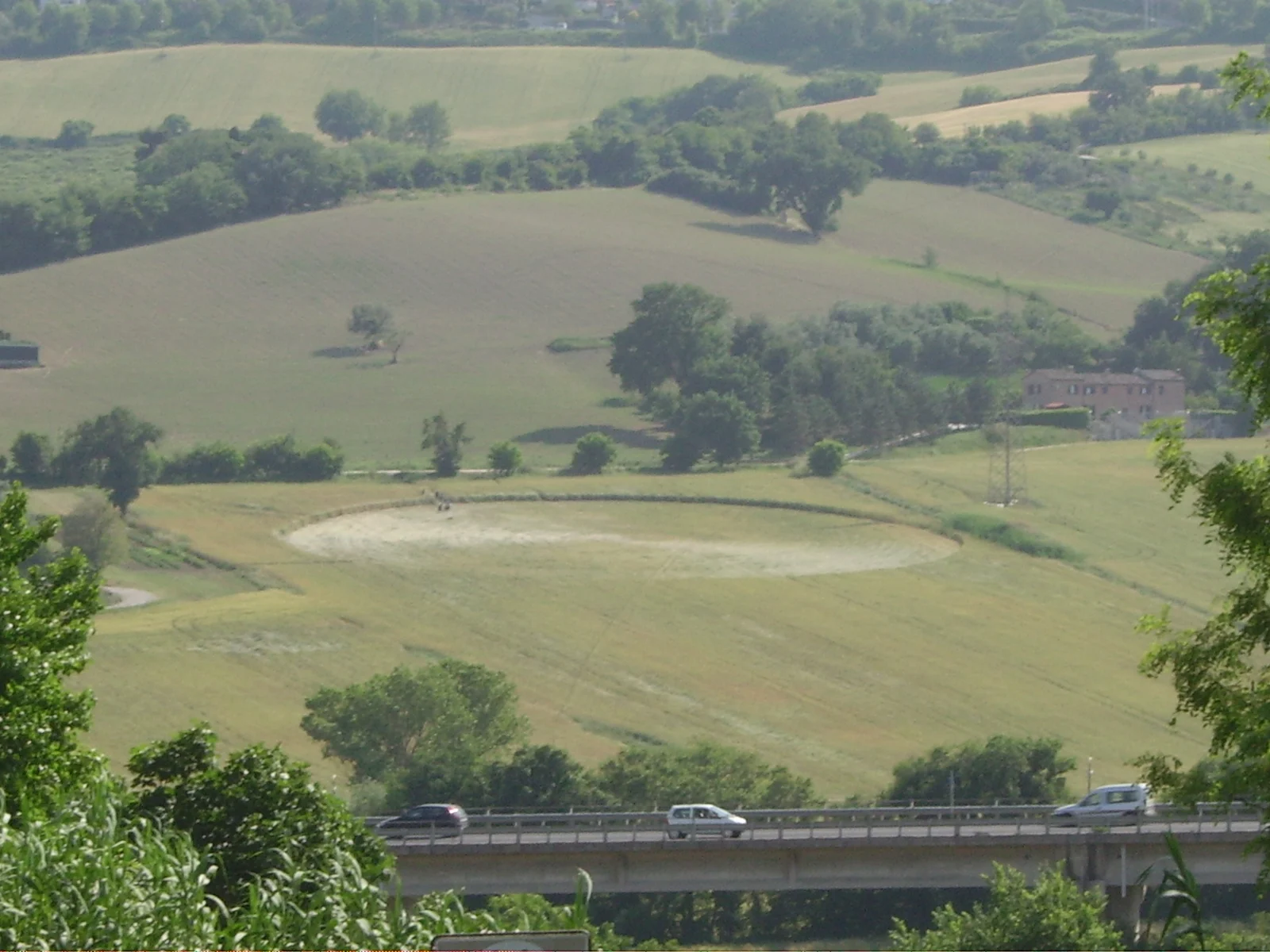
In this view near Ancona, Italy, the pale flattened area occupies only a small part of a landscape crossed by roads and bordered by trees. Photographer Beta16’s May 23, 2007 description says there had originally been four circles and that the others had been cut. The surviving photograph therefore records a landscape already changed since the fuller pattern existed. The harvest is part of crop-circle history: these are temporary objects, and the record often depends on somebody arriving with a camera before a field changes again.
Ancona again: standing inside the image
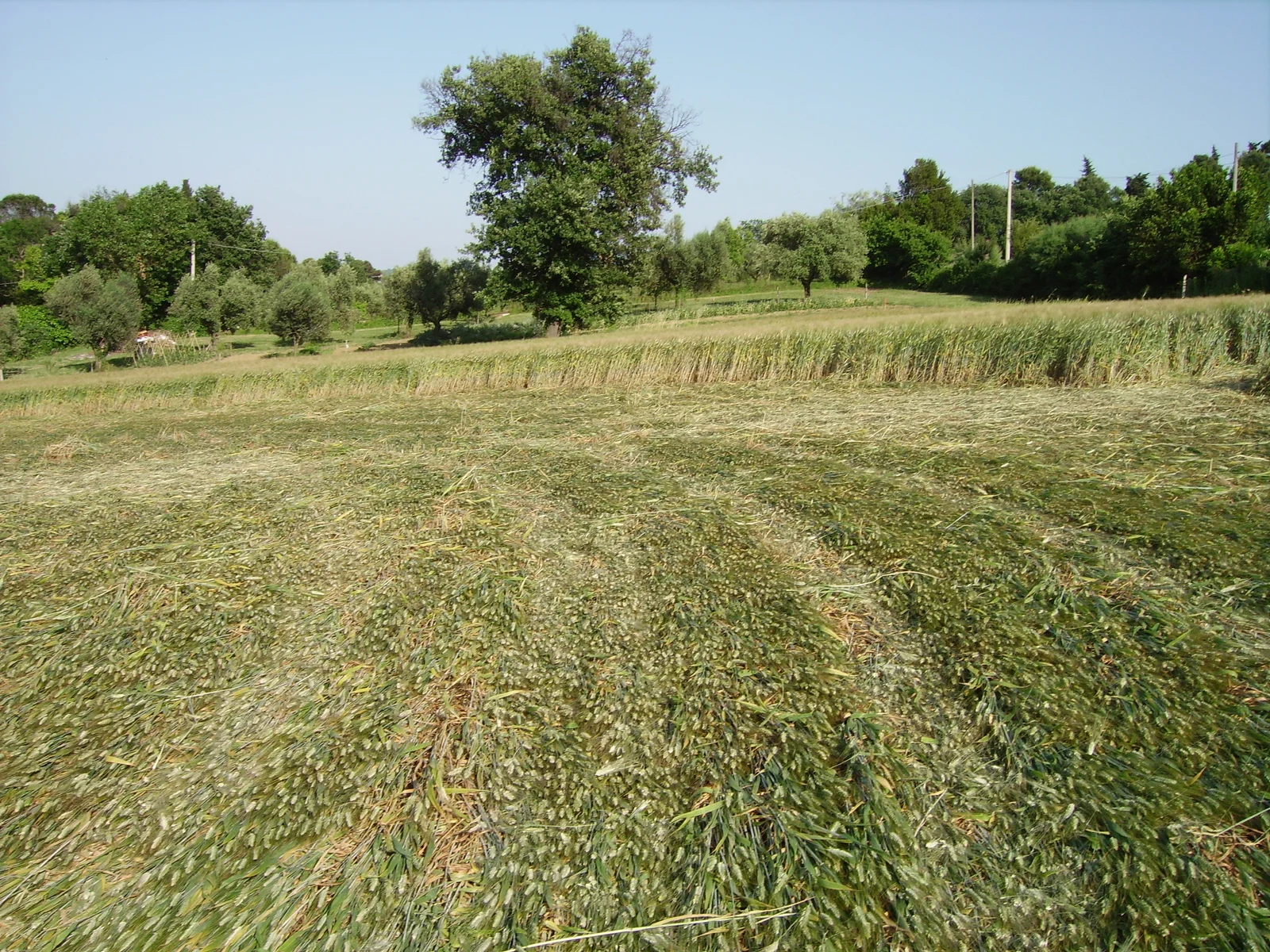
Beta16’s companion photograph brings the camera into the Ancona circle. From this height, an emblem becomes a surface: layers of stems, rough edges, and standing crop around a flattened interior. An aerial photograph invites a geometrical reading; a ground photograph lets us inspect texture. Neither perspective is sufficient for a diagnosis of the formation’s origin. Together they are a more substantial record than the overhead outline alone, and they restore something easily lost in the mythology: a crop circle is a place people can physically enter.
Dietzenbach: a familiar shape at field scale
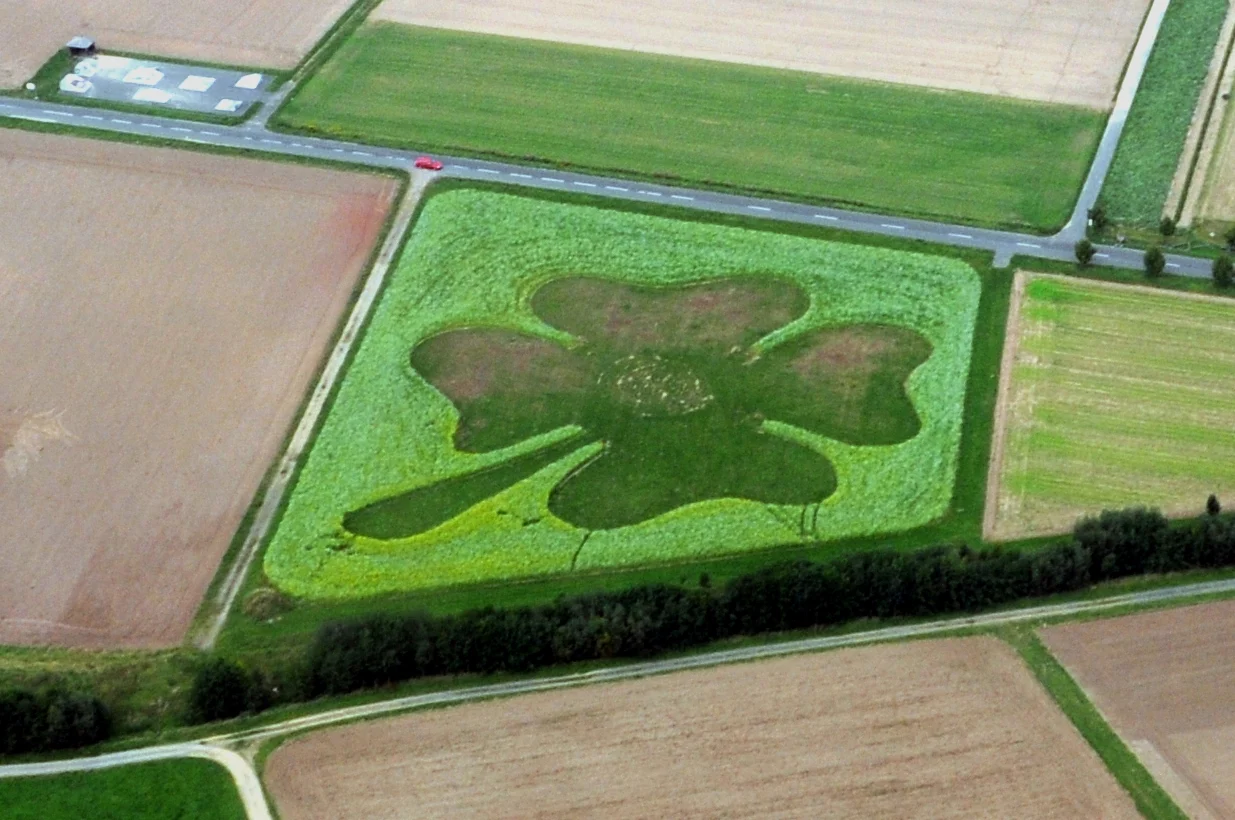
Fritz Geller-Grimm, supported by Rüdiger Wandke, photographed this clover-shaped field design at Dietzenbach, Germany, on August 29, 2008. It sits inside an ordinary agricultural rectangle, with roads and neighboring plots providing the scale. The motif is immediately readable, unlike the supposed scripts and cosmic diagrams attached to some British formations. This example belongs to the wider visual world of field patterns and land art; the photograph’s presence in a crop-circle archive does not make it a claim of unexplained authorship. That distinction is useful when browsing collections in which commissioned designs, anonymous formations, and alleged anomalies share the same label.
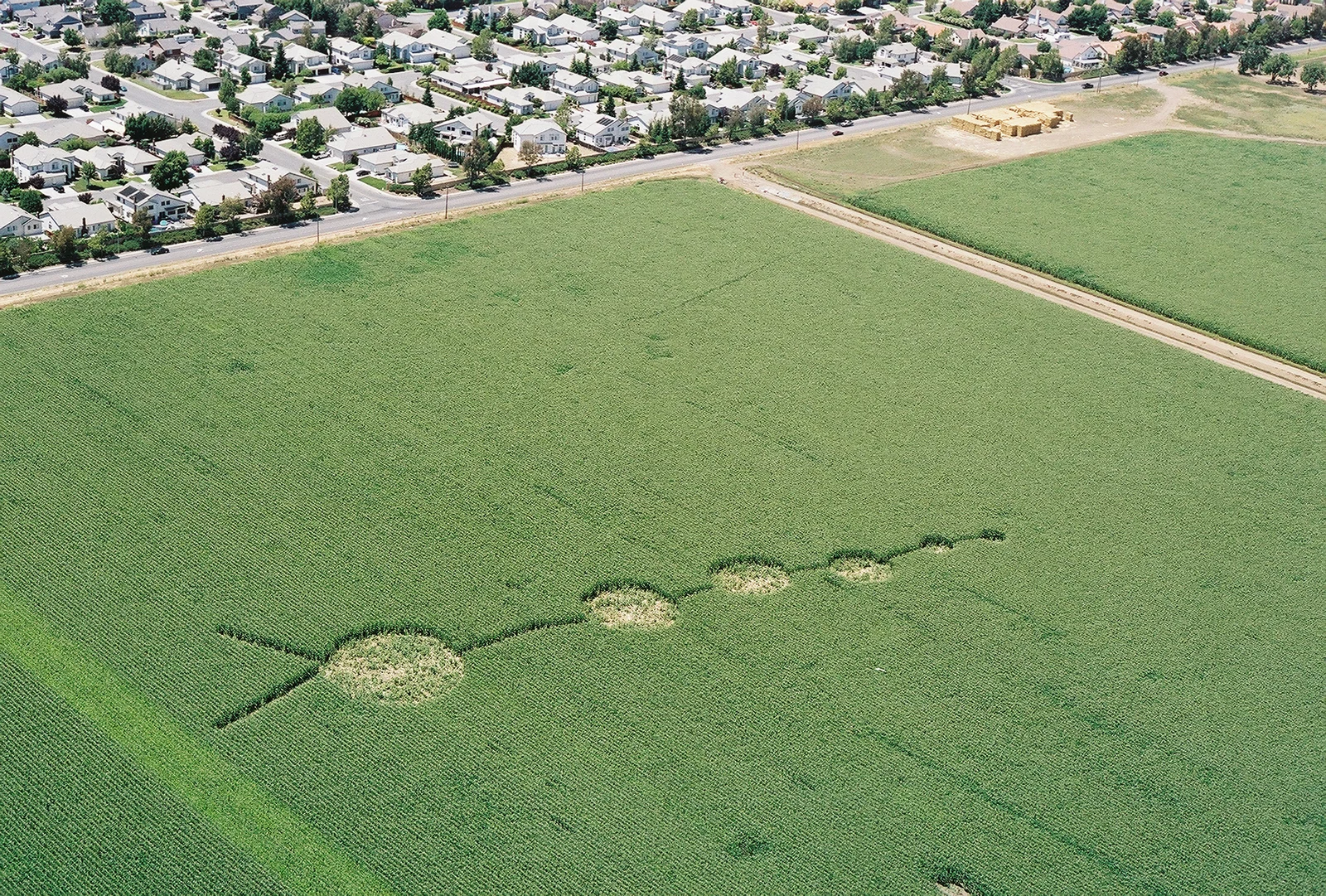
Vacaville: circles beside the neighborhood
Steve M. Windham’s aerial photograph, made with pilot Gene N. Windham, shows a formation at Vacaville, California: a chain of circular elements extends across a green field beside a residential area. It is a reminder that the photographic record reaches well beyond the chalk downs. The source identifies the location and credits but supplies an upload date rather than a securely documented exposure date, so none is assigned here. A photograph can locate a pattern in the ordinary world without solving its history.
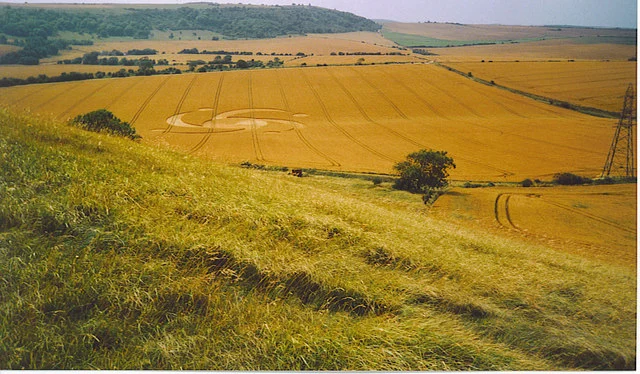
Steep Down: the view from another hill
Colin Smith’s July 2003 photograph looks across the South Downs toward a formation below Steep Down. His description identifies a central circle and four curling arms ending in smaller circles. The wider view preserves something that tightly framed aerial images often discard: how a pattern appears to someone looking across the countryside. The field remains enormous, the design relatively small, and the surrounding agricultural work entirely visible. A dramatic aerial image and a quiet distant landscape can be photographs of the same sort of object, with very different effects on a viewer.
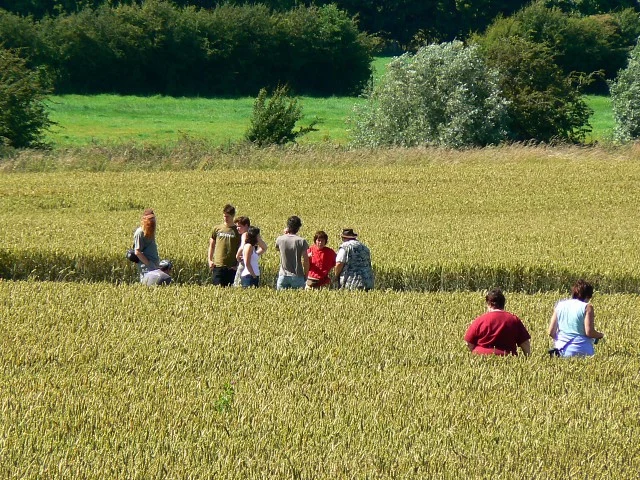
Avebury: the people become part of the picture
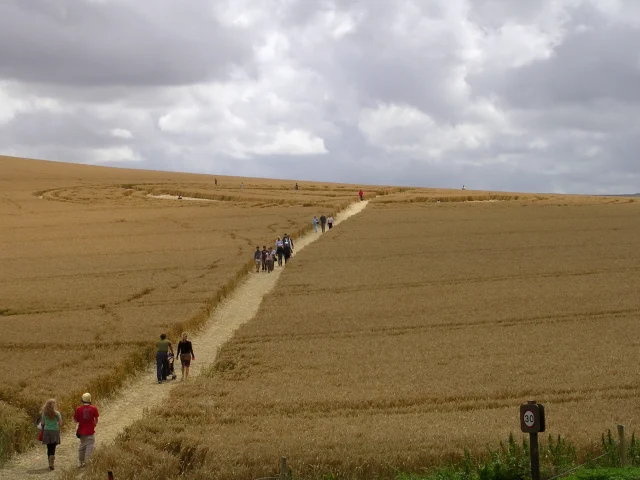
Brian Robert Marshall’s photograph near Avebury Manor on July 15, 2008, turns attention to the visitors. Heads and shoulders appear above the crop, while most of the geometry is hidden by the camera’s low position. This is the social life of a formation: people examining, discussing, and walking through the same place. Their presence also explains why documenting a newly discovered site quickly matters. Later photographs show a field that has acquired paths and disturbances as well as interpretations. What survives in an archive is a sequence of encounters with a changing object, rather than a perfectly preserved specimen.
A mystery can survive its makers
The circle-makers’ perspective adds one last twist. Irving and Brookesmith describe anonymous field art whose effect depends partly on withholding the artist’s name: viewers supply stories that a signed commission might never attract. The history above supports a narrower conclusion than either an all-purpose alien explanation or a complete roll call of hoaxers. Human authorship is established for many formations; individual anonymous works can still lack an identified maker. A decoded message proves a design contains information, while a surprising plant measurement requires a reproducible explanation. None of the cases examined here establishes extraterrestrial authorship. What remains is a remarkable archive of temporary art, contested observations, midnight adventures, and landscapes people keep returning to. The harvest erases the object. The photographs preserve it, and the argument starts again.
Sources: Crop Circles: The Art of the HoaxCreators of the ParanormalAn Experimental Study for Reproduction of Biological Anomalies Reported in the Hoeven 1999 Crop Circle
Sources & media
Crop Circles: The Art of the HoaxRob Irving and Peter Brookesmith · Smithsonian Magazine · December 15, 2009 · A circle-maker’s perspective on art and beliefThe Mowing-Devil (1678)The Public Domain Review · Folger Shakespeare Library pamphlet reproduction and historical contextStorm EffectsJ. Rand Capron · Nature 22, 290–291 · July 29, 1880 · Contemporary observationRAAF UFO file: the Tully nestsNational Archives of Australia · A703, 580/1/1 Part 5, item 645646 · Released file mirrored by The Black Vault · PDFTen Game Changing Crop CirclesThe Croppie · December 1, 2023 · Retrospective, with photographs of the early formationsOperation BlackbirdThe Croppie · November 1, 2024 · Reconstruction of the 1990 surveillance projectDo ‘little green men’ cause those circles?United Press International · July 24, 1990 · Reporting at the launch of Operation BlackbirdThe TODAY story: Day 2, September 10, 1991Today newspaper · Transcript preserved by Men Who Conned the World · The pair’s claims and the newspaper’s account of its demonstrationCreators of the ParanormalJoe Nickell · Skeptical Inquirer · 2016 · Includes Doug Bower and Dave Chorley’s public demonstrationsA circle-maker’s account: Mike JCirclemakers.org · First-person account of a July 1990 formation; some participants use pseudonyms1996 photographic archive: Stonehenge and the Triple JuliaSteve and Karen Alexander · Temporary Temples · Original aerial and ground photographs; proponents’ commentary2001 photographic archive: Milk Hill and ChilboltonSteve and Karen Alexander · Temporary Temples · Original photographic archive; dates and dimensions as cataloguedThe Case of the Vanishing CameramanPeter R. Sørensen · Written 1997, revised March 1999 · First-person investigation of the Oliver’s Castle video, following a clearly labeled fictional prologueThe Chilbolton ‘Arecibo message’ FormationPaul Vigay · August 2001 · A researcher’s comparison of the crop design and the radio messageIs the Latest Crop Circle a Message from E.T.?SETI Institute · 2001 response preserved on Paul Vigay’s website · Objections to the extraterrestrial-reply interpretationThe 2002 ‘Alien Face’ FormationPaul Vigay · August 17–22, 2002 · Dated observations, decoding updates, and doubts about the formationPi appears in crop circleMarc West · Plus, University of Cambridge mathematics outreach · July 1, 2008 · Explanation of the numerical designAnatomical anomalies in crop formation plantsW. C. Levengood · Physiologia Plantarum 92, 356–363 · 1994 · Paper reproduced by BLT ResearchPlant abnormalities: node elongation, cavities, and bendingBLT Research Team · The proponents’ account of their proposed physical indicators and natural plant recoveryAn Experimental Study for Reproduction of Biological Anomalies Reported in the Hoeven 1999 Crop CircleEltjo H. Haselhoff, Robert J. Boerman, and Jan-Willem Bobbink · Journal of Scientific Exploration 28(1), 17–33 · 2014 · Experiment and review of the methodological dispute · PDFLaboratory report: Mission, British Columbia, 2002BLT Research Team / Frontier Analysis · Testing blackened maize stalks for carbonizationSpotted an error, or know a better source? Write to hello@uap.fun.
Discuss this entry
Compare notes with other readers: witness details, sources, and the parts that still do not add up.
Open the discussion