Something has been here
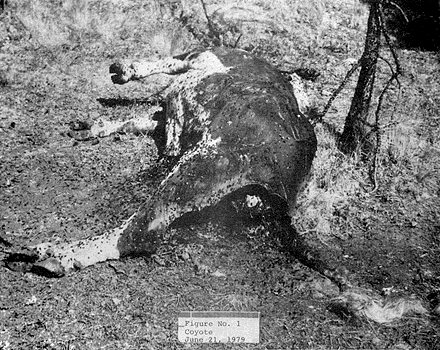
A dead animal in a pasture is a loss. A dead animal with its tongue gone, an eye missing, and a strangely neat opening in its hide can feel like a message. Across the cattle-mutilation literature, the same details return: valuable livestock, apparently selective removal of tissue, little visible blood, and nobody seen doing the work. The imagined visitor changes with the teller. It might be a midnight cult, a crew descending from an unmarked helicopter, or something conducting an examination from a flying saucer. The carcasses are real; whether they belong to one phenomenon is the difficult part. This story follows specific reports, the people who connected them, and investigations that reached sharply different conclusions. Four historical photographs below show actual animal remains, including a comparison case attributed to scavenging. They document the bodies and the investigators’ arguments, rather than establishing who or what caused every death.
Sources: Cattle Mutilations in ArkansasAnimal Mutilation: FBI records, Part 5Maggots, mutilations and myth: Patterns of postmortem scavenging of the bovine carcass
1967: the horse that became Snippy
One of the founding stories of cattle-mutilation lore concerns a horse. In September 1967, near Alamosa in Colorado’s San Luis Valley, an Appaloosa failed to return for water. Harry King found the remains on September 9. The startling contrast was the point: a head and neck stripped to bone above a body that appeared comparatively intact. As the Denver Public Library’s archival account records, witnesses described missing blood, dark patches interpreted as scorch marks, a flattened shrub, and circular indentations. Then came the fleeting details that make the story so hard to pin down: bones said to change color, a sweet unpleasant odor, and a burning or itching hand after something at the scene was handled. Even the animal’s identity became tangled. Later accounts call the dead horse Lady and assign the name Snippy to a parent; the library documents conflicting versions. Snippy is the name the legend kept. That confusion matters less than the transformation already underway: an animal’s unexplained death was becoming a story about visitors from the sky.
Sources: UFOs and a Horse Called Snippy
By the time the investigators arrived
The University of Colorado’s UFO study examined the horse case. Its report describes a scene already trampled by hundreds of visitors and a carcass badly aged for a useful postmortem. A veterinarian found indications of a severe hindleg infection and a possible knife cut at the neck, which the report suggested could have been an attempt to end the suffering of a sick horse. Birds could then reach flesh through the opening. Missing internal and nervous tissue was not extraordinary after weeks of decay. The supposed radiation anomaly also shrank on examination: the earlier observer described only slight activity, and the investigators measured normal background radiation. The report found no evidence of an abnormal cause. This was an explanation assembled from compromised remains, not an eyewitness reconstruction of the death. Already, the pattern that would haunt later investigations was present: the story traveled quickly; the body deteriorated while people argued about what it meant.
Sources: Condon Report, Case 32: Horse Death
The 1970s: a mystery in a battered cattle economy
The wider scare grew in a ranching world under severe pressure. Historian Michael J. Goleman treats the mutilation wave as part of a larger struggle over livelihoods, federal authority, and trust. As Livia Gershon’s account of his research explains, rising feed costs, inflation, restrictions on public-land grazing, and a federal meat-price freeze helped create the crisis ranchers called the Wreck. A missing breeding animal could embody much more than the price of one cow. Helicopter stories gave the suspicion a shape: machines without recognizable markings, lights over pastures, and aircraft reportedly pursuing people. Some ranchers fired at government helicopters; the Nebraska National Guard raised its training altitude. That history complicates the familiar cartoon of a farmer who sees aliens everywhere. For many participants, the frightening possibility was a thoroughly human operation with the resources to come and go unnoticed. Official reassurances entered a landscape in which official power was already distrusted.
Sources: Wave of Mutilation: The Cattle Mutilation Phenomenon of the 1970sThe 1970s Cow Mutilation Mystery
Altars, rumors, and a watched carcass
The same body could acquire a different explanation in another county. In Arkansas, officials circulated photographs of rough stone altars and a cow skull; one stone bore the inscription “Zytos wrath is upon you.” The Encyclopedia of Arkansas describes allegations of ritual activity alongside claims that the Missouri Monster, or Momo, was responsible. University of Arkansas anthropologist Paul Hooks questioned the organized-cult explanation. Another anthropologist, Nancy Owen, investigated the reports and favored scavenging. Washington County officers tried a more direct demonstration: they monitored the body of a donated, euthanized heifer in a ravine. After roughly thirty hours, the carcass displayed features being called mutilations, although the observers had seen only scavengers at work. The experiment did not reconstruct every reported death. It did show how a supposedly distinctive crime scene could develop without a clandestine visitor. Meanwhile, the rumors continued to circulate.
Sources: Cattle Mutilations in Arkansas
1976: Gabe Valdez follows the tripod marks
State policeman Gabe Valdez supplied a very different kind of record. Manuel Gomez contacted him on June 13, 1976, about a cow on his ranch east of Dulce, New Mexico. Valdez’s report describes a missing left ear, tongue, udder, and rectum, apparently precise cuts, and no blood visible on the hide. Around the animal he recorded triangular arrangements of impressions, smaller marks he believed followed it for about 600 feet, scorched grass, and a yellow oily material that laboratories failed to identify. He also reported a later radiation reading above background and wrote that the radiation might have been deliberately left to confuse investigators. These are the officer’s observations and interpretations, including his account of laboratory responses; the document does not establish a landing craft. Its strangest twist is that Gomez reportedly saw the left ear still attached on his first visit. Valdez thought something had returned. His proposed avenues included tissue testing and germ-warfare research. The investigator so closely associated with UFO country was also looking for a secret terrestrial operation.
1979: Washington listens, with limits
The FBI file is a remarkable artifact partly because of what sits side by side inside it: constituent pressure, jurisdictional discussions, official memoranda, and sensational newspaper clippings. On March 2, 1979, the Justice Department requested an investigation of fifteen reported incidents in Indian country in New Mexico, where federal jurisdiction could apply. The Bureau instructed its Albuquerque office to investigate on March 6. Senator Harrison Schmitt then chaired an April 20 conference at which explanations ranged from scavengers and pranksters to cults, extraterrestrials, and a concealed government agency. A June FBI memorandum records the discussion and the subsequent assignment of coordination to the district attorney’s office, supported by federal funding. This was real official attention, but the presence of a claim in an FBI folder is not a Bureau endorsement. An enclosed tabloid story and an agent’s memorandum are different kinds of evidence, even when both arrive in the same downloadable PDF.
Rommel’s answer—and the question he left aside
Retired FBI agent Kenneth Rommel led the separate, federally funded New Mexico inquiry. His June 1980 report covered 27 recent incidents, including 15 personal scene visits, and favored scavenger damage. He explicitly did not pursue every cause of death once satisfied that tissue loss was animal-induced. That distinction limits what the investigation can answer.
Sources: Operation Animal Mutilation: field investigations and photographsOperation Animal Mutilation: conclusionsAnimal Mutilation: FBI records, Part 5
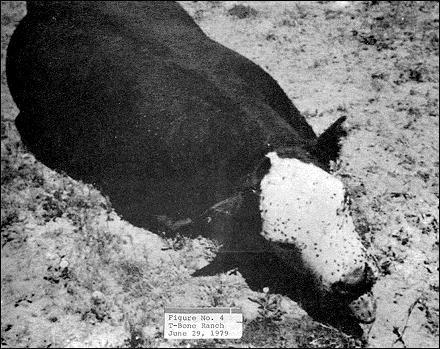
The same cow, three days apart
At T-Bone Ranch, Rommel documented cattle attributed to larkspur poisoning. Dr. Howard Smith photographed this carcass on June 29, 1979. Its tongue and ears remained present. The comparison offers something a solitary discovery photograph cannot: a sequence.
Sources: Operation Animal Mutilation: field investigations and photographs
What disappeared between photographs
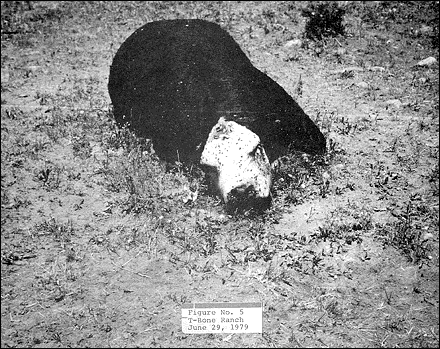
Forester Bill Wright returned on July 2. The tongue, right ear, and visible ground stain were now absent. Rommel attributed the changes to scavenging and the passage of time. The printed exhibit label repeats June 29; his accompanying text dates this second exposure July 2.
Sources: Operation Animal Mutilation: field investigations and photographs
What a veterinary explanation actually says
A useful distinction is between an animal being killed by a predator and its body being scavenged afterward. Evidence against the first does not rule out the second. In their 1989 Canadian Veterinary Journal review, P. Nick Nation and Elisabeth S. Williams compared Alberta mutilation reports with known patterns of carcass consumption and concluded that scavenging explained the reported damage. Their starting requirement for a human-intervention claim was to exclude postmortem scavenging. This asks a different question from whether a rancher recognizes an ordinary attack. The relevant comparison is a carcass exposed to birds, insects, mammals, weather, and elapsed time. A neat-looking opening deserves examination, but “surgical” is a conclusion requiring evidence about tissue margins, not just a description of how surprising the scene looks. The cause of death and the cause of missing tissue should remain separate questions until an investigation connects them.
Sources: Maggots, mutilations and myth: Patterns of postmortem scavenging of the bovine carcass
1980: Linda Moulton Howe gives the harvest a voice
Linda Moulton Howe brought a television journalist’s eye to the mystery. Her own production history dates the start of her investigation to September 1979 and the KMGH-TV broadcast of A Strange Harvest to May 25, 1980. She traveled through Colorado, Wyoming, and New Mexico, filming remains and interviewing ranchers and law officers who described an extraordinary operation. One production photograph records her filming rancher C. E. Potts’s dead bull near Walsenburg in October 1979. Howe’s account emphasizes the missing eye tissue and the claim that predators had left the animal alone for months. Her 1989 book An Alien Harvest explicitly joined livestock mutilations to human abductions and extraterrestrial life. The title captured the unsettling implication: somebody regarded the animals as a resource. Her work helped give the alien interpretation a recognizable advocate and an enduring visual vocabulary. That spring, a televised alien mystery and a New Mexico investigation favoring scavengers were reaching the public almost together. They would become reference points for opposing readings of the same landscape.
1996: the trail reaches Skinwalker Ranch
Before the television franchise, the Sherman family’s Utah ranch entered the newspaper record through stories about livestock and lights. In Zack Van Eyck’s June 1996 Deseret News report, Terry and Gwen Sherman described seven cattle dead or missing, strange odors, holes in eyes, and a cow whose tracks apparently ended in snow. Terry connected the losses with the unusual aircraft he said the family was seeing. One particularly disturbing account concerned a cow reportedly seen alive only minutes before it was found dead with a deep opening at its rear. The article also preserves an important mismatch: the Shermans had spoken with local UFO investigator Junior Hicks, but had not reported these events to officials. Their accounts were already elaborate before a corresponding law-enforcement file existed. The livestock story became one of the routes into the much larger mythology of Skinwalker Ranch, where apparent disappearances, anomalous lights, and unsettling animal behavior were interpreted as parts of the same presence.
1997: the calf in the daylight
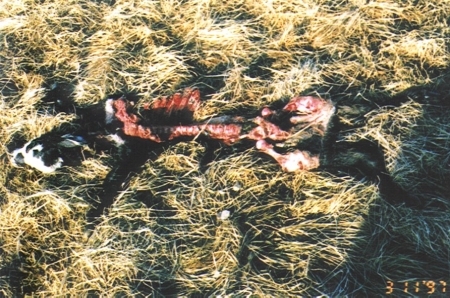
The National Institute for Discovery Science (NIDS) described an 87-pound calf tagged on March 10, 1997, in northeastern Utah, then found eviscerated roughly forty-five minutes later. The ranchers’ blue heeler reportedly fled and never returned. Investigators arrived that afternoon. The report attributes sharp-tool findings to veterinary and forensic examinations, while also recording possible chewing. NIDS tested the missing-blood claim by pouring slaughterhouse blood at the site; the stain remained visible after forty-eight hours. Their photograph preserves the aftermath, leaving the intervening forty-five minutes—and the perpetrator—unseen.
Sources: Unexplained Cattle Deaths and the Emergence of a TSE Epidemic in North America
A harvest of samples—or a warning?
NIDS later proposed covert disease surveillance, with the conspicuous bodies serving as a warning about the food supply. It also acknowledged ordinary causes in most of its northern New Mexico cases. The surveillance proposal remained a hypothesis, not an identified program. The narrative shift is revealing: the same selective-looking damage can be read as feeding, collecting, testing, or communicating. Each explanation supplies a motive for an absent actor. To choose among them requires evidence beyond the pattern that first suggested the story.
Sources: Unexplained Cattle Deaths and the Emergence of a TSE Epidemic in North America
2019: five bulls and a deputy’s whiteboard
At Silvies Valley Ranch in eastern Oregon, five valuable breeding bulls were found dead in the summer of 2019, with tongues and genital tissue reportedly removed. Reporter Anna King visited one carcass still lying on Forest Service ground. Ranch vice president Colby Marshall described the difficulty of finding cattle in the rugged country and the fear that anyone capable of overpowering a bull might also threaten a cowboy. Staff were told to ride in pairs. Deputy Dan Jenkins, who had inspected four animals, received suggestions from far beyond the county. His whiteboard accumulated theories: alien lifting beams, radiation, even the North Vietnamese army. The bizarre tips sat beside a concrete loss of breeding animals and an investigation with few useful leads at the time of King’s reporting. That collision between remote speculation and the next day’s ranch work is one reason the story persists. For a reader it is a puzzle; for the owner, something valuable has died on land they thought they understood.
Sources: Not One Drop Of Blood: cattle deaths in Eastern Oregon
2023: the pattern returns along a Texas road
In April 2023, the Madison County Sheriff’s Office announced a cattle-death investigation along the Old San Antonio Road corridor in Texas. WTAW preserved the announcement and reported five similar cases extending into Brazos and Robertson counties. The animals came from different locations, pastures, and herds. Investigators reported no obvious struggle, footprints, or tire tracks. This was not a single herd discovered in one mass event, although the compressed version of such a story can easily leave that impression. The announcement documented an investigation and unanswered questions at that time; it did not identify an alien, a cult, or a common perpetrator. Decades after the original wave, the same small set of observations still had the power to bring the entire mythology back into view.
Sources: Madison County Sheriff’s Office reports cattle deaths and mutilations
The photograph and the missing interval
The archive leaves us with several different mysteries, not one interchangeable pile of evidence. What killed an animal? What removed its tissue? How long elapsed before discovery? Who first described a cut as precise? A photograph can preserve an arrangement of remains, but cannot by itself answer those questions. A police report establishes what an officer recorded; an attributed laboratory finding deserves attention without automatically validating every theory attached to it. The enduring fascination lies in that missing interval between a living animal and a body in a pasture. The most extravagant explanations populate it with silent craft, unseen technicians, and an intention nobody can quite read. The strongest investigations try to recover the interval through observations and comparisons. Keeping both histories visible makes the cattle-mutilation story more interesting: the history of what happened to the animals, and the history of what people believed had come for them.
Sources: Animal Mutilation: FBI records, Part 5Wave of Mutilation: The Cattle Mutilation Phenomenon of the 1970s
Sources & media
UFOs and a Horse Called SnippyChris Root · Denver Public Library · October 20, 2020 · Archival newspaper coverage and the disputed naming of the horseCondon Report, Case 32: Horse DeathUniversity of Colorado · Scientific Study of Unidentified Flying Objects, 1968 · Investigators Ayer and Wadsworth · Transcription at Project 1947Wave of Mutilation: The Cattle Mutilation Phenomenon of the 1970sMichael J. Goleman · Agricultural History 85(3), 398–417 · 2011 · Historical interpretation; abstract indexed by PubMedThe 1970s Cow Mutilation MysteryLivia Gershon · JSTOR Daily · March 17, 2023 · Economic context and helicopter scares, summarizing Goleman’s researchCattle Mutilations in ArkansasKylee Taylor Cole · Encyclopedia of Arkansas · Local investigations, occult rumors, and a monitored carcass experimentGabe Valdez’s report on the Manuel Gomez cowNew Mexico State Police · Incident June 13, 1976; report December 15, 1976 · Original report scans and transcription at RR0Animal Mutilation: FBI records, Part 5Federal Bureau of Investigation · Released correspondence, memoranda, and press clippings · PDF mirror at The Black Vault; distinguish Bureau records from enclosed claimsOperation Animal Mutilation: field investigations and photographsKenneth M. Rommel Jr. · New Mexico First Judicial District Attorney’s Office · June 1980, chapter 4 · Report reproduced at RR0Operation Animal Mutilation: conclusionsKenneth M. Rommel Jr. · June 1980, chapter 6 · Scope and conclusions of the New Mexico inquiryMaggots, mutilations and myth: Patterns of postmortem scavenging of the bovine carcassP. Nick Nation and Elisabeth S. Williams · Canadian Veterinary Journal 30(9), 742–747 · September 1989 · Veterinary review of Alberta casesLinda Moulton Howe’s account of A Strange HarvestEarthfiles · Filmmaker’s own biography and production photographs · Primary source for her career and interpretation, not independent confirmation of alien involvementFrequent fliers?Zack Van Eyck · Deseret News · June 30, 1996 · Early interviews with Terry and Gwen ShermanUnexplained Cattle Deaths and the Emergence of a TSE Epidemic in North AmericaNational Institute for Discovery Science · 2003 · Investigators’ case accounts, photographs, and speculative disease-monitoring hypothesis · Original PDF preserved by the Internet ArchiveNot One Drop Of Blood: cattle deaths in Eastern OregonAnna King · Northwest News Network · September 16, 2019 · On-site reporting and rancher/deputy interviewsMadison County Sheriff’s Office reports cattle deaths and mutilationsBill Oliver · WTAW · April 21, 2023 · Reporting with a preserved screenshot of the sheriff’s announcementSpotted an error, or know a better source? Write to hello@uap.fun.
Discuss this entry
Compare notes with other readers: witness details, sources, and the parts that still do not add up.
Open the discussion