The morning the children ran to the tuckshop
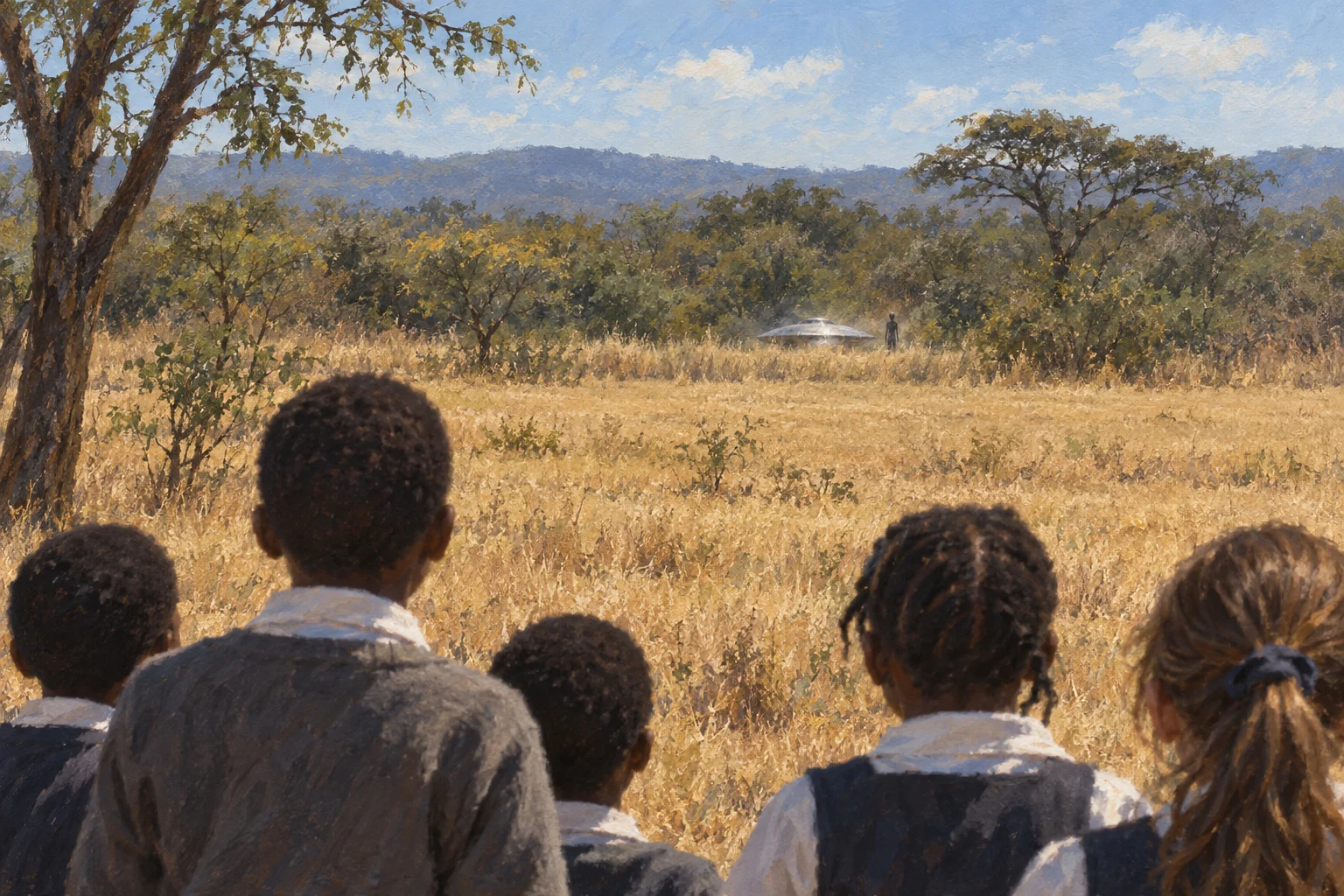
Shortly after 10 a.m. on September 16, 1994, Ariel Primary School’s teachers were in a staff meeting. Beyond the playing field lay grass, thorn bushes and trees. Cynthia Hind’s early account describes children rushing to tuckshop attendant Alyson Kirkman with a story about a strangely dressed little man. She suspected a diversion to get her away from the sweets and money, and stayed put. An ordinary suspicion met an extraordinary claim: the children were trying to explain what they thought they had seen.
A shining object, and movement in the grass
The sounds were as peculiar as the shapes. In archival interviews excerpted by WHYY, Haley compared what she heard to a flute; other children described buzzing. Candace initially considered sunlight reflecting from a house, then rejected that explanation because there were no houses at the spot. A silver object and small figures in close-fitting dark clothing became the recurring picture. Movement made the scene stranger still. Years later, Claire recalled a figure running diagonally in slow motion, then appearing back at its starting point and repeating the motion. That looping movement is an adult recollection; it should not silently become a detail recorded from every child on the first day.
Sources: Documentary Explores the UFO Sighting That Changed the Course of 62 Children’s Lives
The eyes were memorable; the pictures were different
Hind’s February 1995 report preserves an unruly scene. Guy G. described a black-and-green craft and a roughly metre-tall figure with long black hair, a shiny dark suit and elongated eyes low on its face. Tertia’s object was golden; Barry described lights disappearing and reappearing elsewhere. Headmaster Colin Mackie asked for drawings, and Hind explicitly noted differences between the craft, including unusual legs. Children could arrive at different moments and interpret things differently. The recurring enormous eyes are compelling precisely because the surrounding details refuse to settle into one tidy diagram.
Cynthia Hind’s case, before it became John Mack’s
Hind was central to getting the story beyond Ruwa. A former industrial-company director with a South African Women’s Air Force background, she had become a prominent investigator and publisher of African UFO reports. Gideon Reid’s later reconstruction places her telephone conversations with some children on the day after the sighting, followed by a school visit with BBC cameraman Tim Leach. She also helped connect the case to John Mack. The history matters: Mack did not arrive at an untouched scene. A local investigator, television crews, teachers, parents and classmates were already discussing the event before the famous American psychiatrist interviewed a selection of pupils.
Sources: A Closer Look at Encounters and the Ariel School Sighting
The psychiatrist who had written about Lawrence of Arabia
Mack brought an unusual kind of authority. Long before his alien-encounter research, he had trained in child psychiatry, established a psychiatry department at Cambridge Hospital and won a Pulitzer Prize for his biography of T. E. Lawrence. Harvard’s memorial recalls a physician who could get down on the floor with a child and a toy truck, and who treated listening as serious work. His interests also reached far beyond the consulting room: nightmares, international conflict and nuclear disarmament. These were not incidental credentials pasted onto a UFO story. They help explain both his rapport with frightened children and his fascination with accounts that seemed to connect private experience to the fate of humanity.
A message through the eyes
Mack and researcher Dominique Callimanopulos visited later in 1994. Her 1995 account says they interviewed twelve children over two days. She described reports of two beings, one remaining with an object while another moved through the grass with a bouncing gait. The most haunting passages concern a child called Elsa—a pseudonym—and ten-year-old Isabelle. Elsa associated the figure’s gaze with images of falling trees, disappearing air and people dying. Isabelle described an impression that humans were damaging Earth. Callimanopulos understood these as meaningful communications and found the children’s accounts consistent. Her essay is a participant’s report of those interviews, including their interpretation, rather than a finding that a message had travelled from an external mind. This is the point where Ariel’s lore expands from a playground sighting into a warning about the planet.
A Zimbabwean story with more than one vocabulary
The encounter did not arrive in a cultural vacuum. Sean Christie’s reporting for the Mail & Guardian describes children from different backgrounds reaching for different explanations: visitors from space for some, frightening beings from local folklore for others. The school was fee-paying, with a socially mixed pupil body; the familiar picture of children entirely insulated from modern UFO imagery is a poor guide. Christie also returned to the physical setting in 2014. The rough ground had become another sports field, and the school community had changed as families emigrated. His interview with a former pupil, identified as Sarah, unfolded in a Harare bar where friends were tired of hearing about aliens. For her, the story remained bound up with fear and the difficulty of being believed. Ruwa’s mystery had acquired another dimension: the people who shared it no longer shared a place.
The children return as adults
Randall Nickerson’s Ariel Phenomenon, released in 2022, makes that separation visible. Christopher Plain’s review follows former pupil Emily Trim back to Zimbabwe, meeting people from the school and looking through childhood drawings with another witness. The film returns the case to the people who had to live with it. Plain also notices what a sympathetic film can leave unresolved: some witnesses recall one figure, others several; objects multiply between accounts; interview dates are often unclear. An adult beside her childhood drawing is a powerful image, but the years between the two remain part of the evidence. WHYY later reported Nickerson’s statement that he had interviewed 43 former students, some only off-camera. That is a substantial follow-up effort, without being a complete public record of every original witness.
Sources: Review: Ariel Phenomenon Examines Students’ Claims of a UAP Close EncounterDocumentary Explores the UFO Sighting That Changed the Course of 62 Children’s LivesAriel Phenomenon — About the Film
The boy who said he started it
The 2023 Netflix series Encounters gave Ariel another audience through its episode Believers. It also included former pupil Dallyn’s claim that he had invented the story to create a distraction and avoid a class. In an interview with Factual America, director Yon Motskin explained that he found Dallyn unconvincing and initially considered leaving him out; an editor argued that the disagreement belonged in the film. The inclusion matters more than the director’s judgment. A retrospective admission of fabrication deserves scrutiny just as a retrospective assertion of contact does. Dallyn’s account challenges claims of lifelong unanimity, but his statement alone does not demonstrate how every other pupil formed an account. Ariel now contains an argument between former children, and an argument about how filmmakers choose which adults to believe.
Sources: Encounters — Series GuideEncounters — Interview with Director Yon Motskin
What the drawings and statements actually preserve
Hind’s July 1995 follow-up reproduces a site plan and markedly different drawings: a craft with several square openings, another beside a large-eyed figure, and two figures without facial features. Nine-year-old Fiona was unsure whether a dark shape was a person or simply a branch. Such hesitation belongs in the record alongside confident testimony. These materials document what children reported and drew. Their existence cannot, by itself, establish the identity or origin of the thing depicted.
Soil was tested; it did not settle the case
The investigation did include an attempt at physical evidence. Hind reported that Gunter Hofer collected soil within a week, with analysis by the Chemistry & Soil Research Institute and interpretation by Keith Viewing. She wrote that the anomalies were not of particular significance and proposed further work. Her published summary therefore supplies no diagnostic landing trace. It also does not support the stronger claim that nobody examined the ground. The distinction is small but consequential: an inconclusive test is still part of the case history.
Sixty-two reports are not sixty-two isolated interviews
The frequently repeated witness total should not be confused with a controlled interview sample. Callimanopulos explicitly reports twelve interviews. Reid criticizes Hind’s group questioning, interruptions and suggested descriptions, and the selective use of Mack’s later recordings. Children could hear one another, and media attention preceded the psychiatrist’s visit. Those conditions limit how confidently agreement can be treated as independent corroboration. Equally, a methodological weakness does not establish that a child knowingly lied. The unresolved question is how much of each account came from perception, conversation, questioning or later recollection.
Sources: Exploring African and Other Alien EncountersA Closer Look at Encounters and the Ariel School Sighting
The earlier fireball and the puppet proposal
Two days before the school report, a spectacular light display crossed southern African skies. Reid’s archival research identifies it as the reentry of a Zenit-2 rocket stage associated with Cosmos 2290. That offers a concrete explanation for an earlier night-sky event and context for the week’s UFO excitement; it does not directly explain figures reported at school in daylight. Reid separately proposes that puppets might account for fixed expressions, odd proportions and bouncing movements, drawing on regional outdoor performance traditions. This is a hypothesis about a possible stimulus. The cited paper does not establish that a particular troupe performed at Ariel that morning. Neither an extraterrestrial visitor nor a puppet show becomes a documented event merely because it can be made to fit selected details.
Sources: The Mysterious Events at Ariel School: The Puppet Hypothesis
How to follow the case without losing its chronology
Start with Hind’s two newsletters, then read Callimanopulos’s account of the later interviews. Compare those with the adult recollections and the critical analyses. This sequence keeps the initial visual reports, the environmental interpretation and the documentary afterlife in view as different stages of the record. The sources assembled here establish a lasting body of testimony and disagreement, without identifying what caused the encounter reports. That leaves plenty to explore: what caught the first child’s attention, why particular images endured, and why the same memory could become a private burden for one pupil and a public story for another.
Sources: The Children of Ariel School — Case No. 96Ariel School Report (Cont.) — Case No. 96Exploring African and Other Alien EncountersReview: Ariel Phenomenon Examines Students’ Claims of a UAP Close EncounterEncounters — Interview with Director Yon Motskin
- September 14, 1994
A widely seen night-sky display precedes the school report. Later archival research ties it to a Russian rocket-stage reentry.
- September 16, 1994 · Morning break
Pupils at Ariel School report unusual objects and figures beyond the playing field. Teachers are in a staff meeting.
- September 17–20, 1994
Hind begins speaking with pupils; Leach and Hind’s early reporting and interviews bring the case wider attention.
- Late 1994
Mack and Callimanopulos interview twelve children over two days. Published chronologies differ on exact visit dates; their work follows the initial reporting by roughly two and a half months.
- February–July 1995
Hind publishes the Ariel reports in UFO Afrinews nos. 11 and 12. Callimanopulos’s account appears in the Spring/Summer CenterPiece.
- September 2014
Christie revisits Ruwa and reports on the changed school and a former pupil’s continuing unease.
- 2022–2023
Ariel Phenomenon and the Encounters episode Believers revisit the witnesses, bringing their adult recollections and disagreements to new audiences.
- 2024–2025
Reid publishes a puppet hypothesis and a further critique of the investigation and its presentation on television.
Sources & interviews
The Children of Ariel School — Case No. 96Cynthia Hind · UFO Afrinews no. 11 · February 1995 · printed pp. 19–23; PDF pp. 12–14 · Early investigator accountAriel School Report (Cont.) — Case No. 96Cynthia Hind · UFO Afrinews no. 12 · July 1995 · printed pp. 7–13; PDF pp. 6–9 · Site plan, witness statements, drawings and soil-test summaryExploring African and Other Alien EncountersDominique Callimanopulos · CenterPiece, Spring/Summer 1995, pp. 10–11 · First-person report by Mack’s research associate, hosted by the John E. Mack InstituteJohn E. Mack — Faculty of Medicine Memorial MinuteHarvard Gazette · December 8, 2005 · Mack’s clinical career, Lawrence of Arabia biography and nuclear-disarmament workRemembering Zimbabwe’s Great Alien InvasionSean Christie · Mail & Guardian · September 4, 2014 · Reporting in Ruwa and an interview with a former pupil under a pseudonymDocumentary Explores the UFO Sighting That Changed the Course of 62 Children’s LivesLiz Tung · WHYY, The Pulse · October 23, 2023 · Randall Nickerson interview and attributed excerpts from archival filmReview: Ariel Phenomenon Examines Students’ Claims of a UAP Close EncounterChristopher Plain · The Debrief · May 20, 2022 · Emily Trim’s return, differences between accounts and the film’s missing interview datesAriel Phenomenon — About the FilmString Theory Films · Randall Nickerson’s documentary · Filmmakers’ own description of the projectEncounters — Series GuideAmanda Richards · Netflix Tudum · September 11, 2023 · Official guide; the Ariel School episode is titled BelieversEncounters — Interview with Director Yon MotskinFactual America · Matthew Sherwood · 2023 · Transcript at 15:18–17:28 discusses Dallyn’s claim and the decision to include itThe Mysterious Events at Ariel School: The Puppet HypothesisGideon Reid · Scepticisme scientifique 2, 2024 · English supplement · Archival rocket-reentry research and a proposed terrestrial explanationA Closer Look at Encounters and the Ariel School SightingGideon Reid · Skeptical Inquirer 49(6), November/December 2025 · Critique of interview methods, selective reporting and documentary framingSpotted an error, or know a better source? Write to hello@uap.fun.
Connected files
The Westall School MysteryAnother schoolyard sighting, in Australia, with disputed accounts of what pupils and teachers saw.The Night the Sky Waved BackBoianai’s reports of figures associated with an aerial object offer a different setting for apparent contact.Close EncountersHow the CE3 label describes a reported encounter with occupants, without deciding what they were.James FoxThe filmmaker whose The Phenomenon also brought the Ariel witnesses to a wider audience.Discuss this case
Compare notes with other readers: witness details, sources, and the parts that still do not add up.
Open the discussion