A cry from the corridor
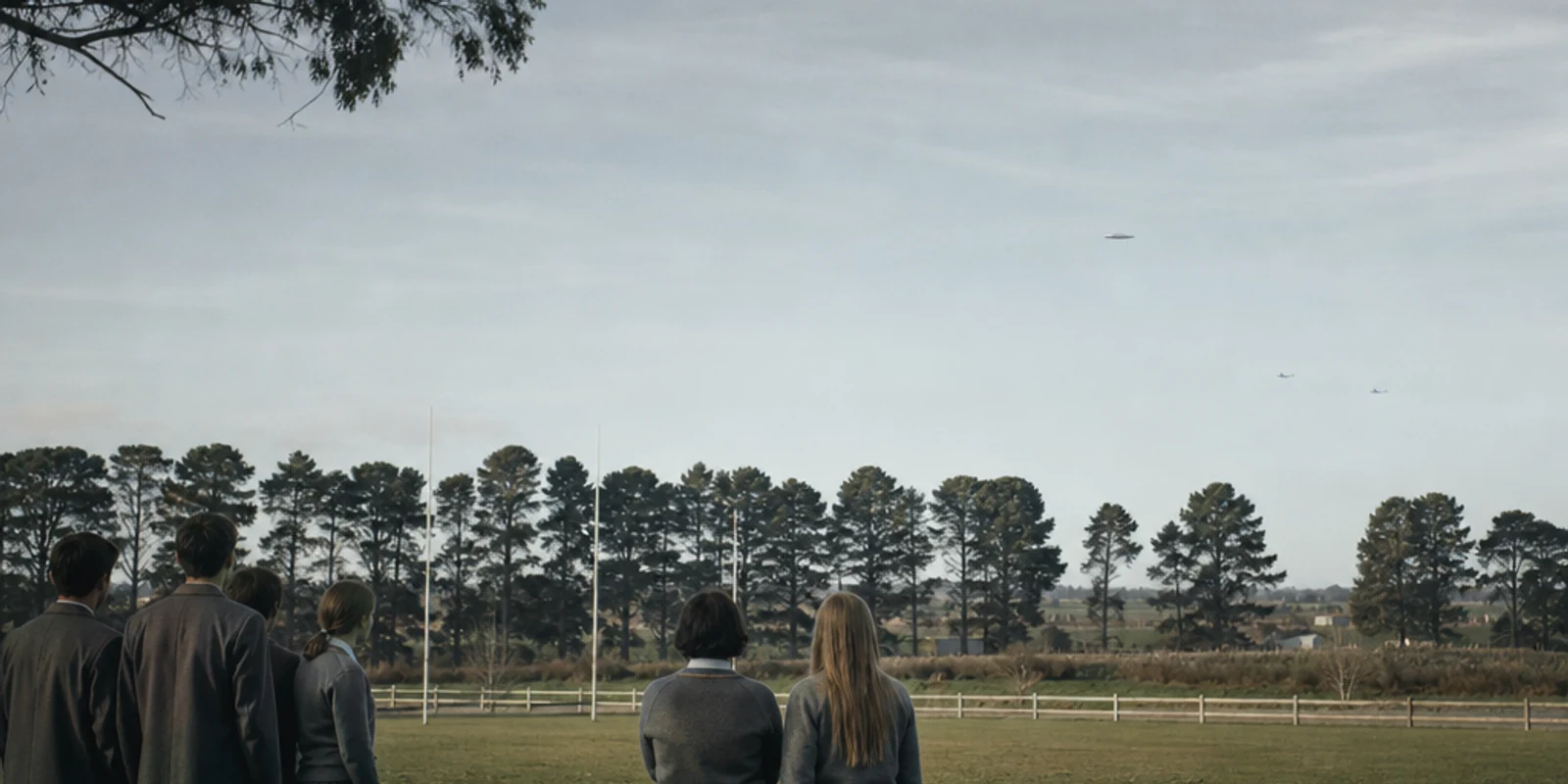
Late on the morning of Wednesday, April 6, 1966, students at Westall High School in Clayton South began pointing toward something in the autumn sky. A girl burst into science teacher Andrew Greenwood’s class with news of a flying saucer. Greenwood did not immediately release the class. When the recess bell sounded a few minutes later, he went outside and found much of the school gathered on the oval. The earliest records do not agree on an exact start time: a next-day witness form gives 10:20 a.m., while Greenwood later placed recess around 11:15. The stable core is simpler—a large school community watched one or more unfamiliar aerial objects in broad daylight.
Silver against blue-grey
Descriptions converged around a pale silver, grey, or white form, but not around every detail. Twelve-year-old Joy Tighe’s report described two circular objects, round above and flat below. Student Marilyn Eastwood told the local press of a round object with a hump and rounded features underneath. Greenwood saw something subtler: a silvery-grey, cigar-like streak with a central bulge, difficult to pick out until someone pointed to it. In his 1967 interview with physicist James E. McDonald, he compared its changing aspect to a plate seen nearly edge-on. The differences caution against turning many sight lines into one perfectly measured craft.
The oval fills
Excitement moved faster than any official response. Students poured from classrooms, climbed fences, and crowded the playing field. Some remembered one object; others two or three. Some heard a whirring sound, while Greenwood heard nothing from the group on the oval. He estimated the object at roughly two-thirds the length of a nearby light aircraft, but that comparison depended on uncertain distance. What witnesses consistently conveyed was not a quiet astronomical light. They believed a compact, metallic-looking thing was moving low enough, and strangely enough, to interrupt an entire school morning.
Planes enter the story
Greenwood and students reported small aircraft appearing near the object until as many as five were visible. To him, they seemed to play “cat and mouse”: the silver form hovered, moved rapidly, and reappeared elsewhere while the planes followed. The Dandenong Journal tried to identify the pilots through Moorabbin Airport, civil aviation authorities, and the Royal Australian Air Force, without finding anyone who acknowledged an unusual encounter. The aircraft are among the case’s strongest mysteries because they feature in contemporary testimony, yet no matching flight or military exercise has surfaced in the public record.
A race toward The Grange
When the object appeared to move behind a line of pines south of the school, dozens of students broke across fences and paddocks toward an area called The Grange. Later accounts describe a much closer drama there: an object near or on the ground, terrified children, and a vertical departure at extraordinary speed. Greenwood’s near-contemporaneous account is more restrained. He said the object remained airborne as far as he knew, and that he and another teacher searched the area only after it had disappeared. The landing story was already circulating, but he treated it as something children reported rather than something he witnessed.
Circles in the grass
Students and later visitors reported flattened grass in The Grange. The details vary sharply: one circle or several, pressed or swirled stalks, a discoloured edge, scorching, or merely wind-flattened vegetation. Tighe’s April 7 form records flattened waist-high grass about ten yards across, 600 yards from the school. Greenwood said he searched long grass for the sort of “nest” then associated with UFO stories and found none himself. No sample, calibrated measurement, authenticated photograph, or preserved site is available for modern testing. The marks are part of the early record, but their cause and even their exact appearance cannot now be reconstructed.
Silence at the assembly
Headmaster Frank Samblebe called a special assembly after students returned late from their pursuit. Witnesses remember being told that flying saucers did not exist and that they should stop discussing the incident. Local reporters encountered a school reluctant to grant interviews, producing the April 14 headline “Flying Saucer Mystery: School Silent.” Later recollections added suited officials, military vehicles, confiscated film, and threats. Some may preserve real encounters with authorities, but no released order documents a government silencing operation. Greenwood told McDonald in 1967 that the headmaster acted on his own at lunch and that visiting Air Force personnel arrived only days later.
Balloons and a towed target
The conventional explanations begin with real activity. The Age reported that the Weather Bureau launched a balloon from Laverton at 8:30 that morning and that a westerly wind might have carried it toward Clayton. Researcher Keith Basterfield later proposed a larger HIBAL radiation-sampling balloon scheduled from Mildura as another candidate. HIBAL used large silver balloons, a payload beneath a broad parachute, a chase plane, and ground-recovery teams—features that could explain parts of the sighting and reported official presence. But the relevant flight record is missing, and no document traces a specific balloon to Westall. A separate 1966 letter proposed a nylon target drogue towed among training aircraft; no dated exercise record confirms that either.
The morning becomes memory
For decades, Westall lived less in government files than in the memories of former students. Reunions, Rosie Jones and Shane Ryan’s documentary, local histories, and a flying-saucer playground at The Grange turned a discouraged schoolyard story into public heritage. The later testimony is valuable for its emotional continuity: many witnesses still describe wonder, fear, humiliation, and frustration at not being believed. It must also be read beside the 1966 reports and Greenwood’s 1967 interview. Details can strengthen, migrate, or merge across years of retelling. Westall remains compelling not because every account is identical, but because a documented daylight disturbance left so many people certain that ordinary explanations had not caught what they experienced.
What remains over Westall
The record establishes a large, sincere school sighting, immediate press interest, witness descriptions of one or more silver forms, reports of nearby light aircraft, and disputed ground marks. It does not establish a landing, extraordinary measured performance, a coordinated cover-up, or an extraterrestrial origin. Balloons and a target drogue are physically plausible candidates, but neither has been tied to the date and place by a complete chain of records. The responsible classification is unresolved: something unusual was reported over Westall, while the evidence needed to identify it has thinned into newspaper pages, one early form, one recorded teacher interview, and a community’s long memory.