A boat with a stranger inside
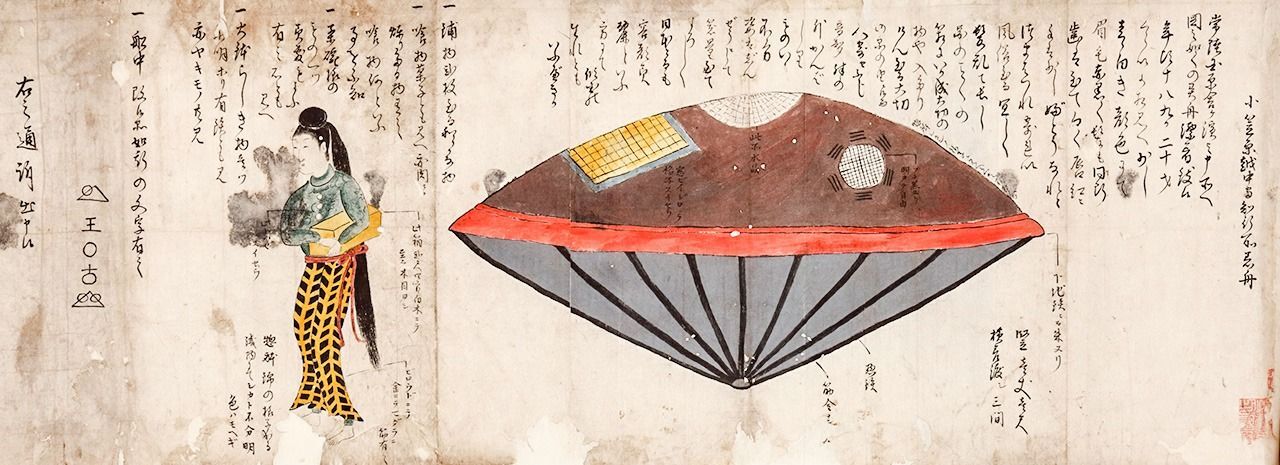
The story begins offshore, with something round enough to draw a crowd. In the account collected in Toen shōsetsu, coastal people take small boats out to an unfamiliar vessel and tow it to the beach. Through its glazed upper part they can see a woman. Her eyebrows and hair are reddish; something long and white hangs down her back. She has a box, and she will not let anyone near it. The scene is assigned to Hitachi Province in 1803, more than a century before flying saucers acquired their modern name. But the thing in this story does not descend from the sky. It floats in, is hauled ashore and eventually is pushed back out. Utsuro-bune means hollow boat: an old maritime mystery whose pictures would find a second life in UFO culture.
Sources: Utsuro-bune no banjo — Toen shōsetsu, volume 11“Utsurobune”: A UFO Legend from Nineteenth-Century Japan
The beach is precise on paper
Toen shōsetsu supplies an almost bureaucratic opening: around noon on the twenty-second day of the second month of Kyōwa 3, at a beach called Harayadori, in the territory of Ogasawara Etchū-no-kami, whose holding is valued at four thousand koku. That precision is part of the story’s appeal. It is also something to investigate, not simply accept. A named lord and a dated arrival can travel with a copied tale just as easily as a drawing can. The familiar English date “February 22, 1803” reproduces the month and day in the Japanese account; this page retains the original lunar-calendar wording rather than presenting it as a verified Gregorian date. What survives here is the date a text gives its story, not a timestamp independently attached to a recovered boat.
Glass above, iron below
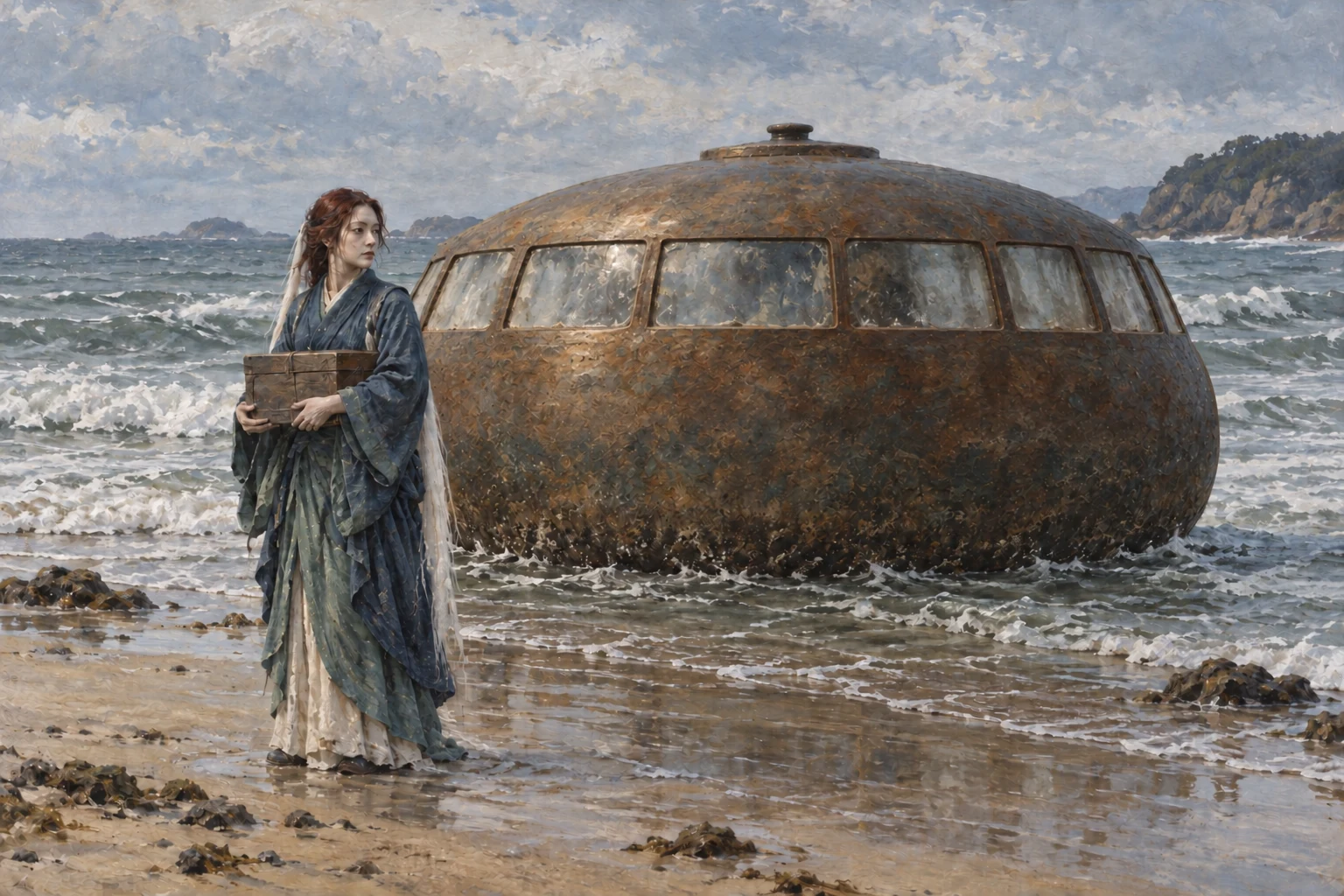
The vessel is compared to a round, lidded incense container, a little over three ken across—roughly five and a half metres. Its upper portion has glass panels sealed with resin; below, iron strips run in successive bands. The narrator reasons that the metal would protect it from rocks. This is a wonderfully tangible object: transparent above, armoured below, described through familiar materials even while its shape seems extraordinary. The people examine what is inside. There are two coverings or mats, water in a small container, something resembling confectionery and a food described as kneaded meat. Even the provisions have a textual snag: a note records different water quantities and a disagreement over the container in another copy. Long before modern arguments about the craft, the account itself preserves the untidy business of transmission.
The woman nobody could question
The woman’s strangeness is conveyed through small, puzzled observations. The account describes a pinkish face and red hair, but also a white, hair-like addition reaching down her back. Was it animal hair? Twisted thread? Nobody could say. Nor could the people ask where she came from: speech failed in both directions. As they debated, she is described as watching calmly and smiling. The result is an encounter full of interpretation but without her own explanation. Every identity later attached to her—castaway, princess, divine visitor, extraterrestrial—fills a silence already present in the earliest narrative considered here. No name, comprehensible statement or destination emerges from it.
What was in the box?
Her box is about two shaku square, approximately sixty centimetres on each side, and she keeps it close. An elder offers the story’s gruesome answer. Perhaps she is a foreign king’s daughter, married elsewhere, who took a lover. Perhaps the lover was executed and her royal birth spared her the same fate: instead, she was put in a hollow boat, her survival left to chance. In that case, he reasons, the box might contain the man’s head. He bolsters the guess with another tale of a woman arriving by boat with a freshly severed head on a board. The box is never opened in this account. Its supposed contents are a story told by a character trying to explain another story. That distinction preserves the scene’s real unease: the onlookers imagine something terrible while the woman remains unintelligible to them.
The cost of keeping her
The resolution is colder than the arrival. Reporting the matter to the authorities, the villagers reason, could bring considerable expense. There is a precedent for setting such a vessel adrift, so they put her back aboard, tow the boat out and release it. The narrator objects that a humane person would not have treated her this way. Nothing in the ending supplies a rescue, a return voyage or a sudden ascent into the clouds. The people rid themselves of a responsibility, and the account loses sight of its central figure. If there was a real woman behind the tale, her fate is absent from the record presented here. If the episode is invented, its ending still tells us what the storyteller found troubling: curiosity could stop at the point where care became costly.
Bakin looks toward Russia
The old writers were already trying to solve it. A marginal note by Bakin compares the white hair with an account of Russian women using hair powder; perhaps this woman came from a Russian dependency. Elsewhere, the narrative compares the boat’s symbols with writing reportedly seen on an English vessel at Uraga and speculates about Britain, Bengal or America. These suggestions pull in different directions. They are evidence of the compilers’ attempts to make sense of foreignness, rather than successful identifications. The final lines acknowledge that the circulated drawing and explanation are incomplete and ask for better information. The familiar picture of credulous villagers versus modern sceptics misses something interesting: uncertainty and criticism were already written into the tale.
An archive of a rumour
The best-known telling belongs to Toen shōsetsu, compiled in 1825 by the literary circle around novelist Kyokutei Bakin. An earlier collection, Komai Norimura’s Ōshuku zakki, is usually dated around 1815. Neither date should be confused with the alleged arrival. The National Archives preserves a related account in Hirokata zuihitsu, a collection associated with shogunate retainer Yashiro Hirokata. Its existence in a government archive does not make it an official finding about a landing: the institution describes the collection as miscellaneous writings about curiosities and rumours. Readers can also inspect a digitized Toen shōsetsu manuscript at Showa Women’s University, where the catalogue points to image 35 of 79. These are tangible historical objects. What they directly establish is that people copied, pictured and discussed the story.
Sources: “Utsurobune”: A UFO Legend from Nineteenth-Century JapanSpecial Exhibition of Original Utsuro-bune DocumentsToen shōsetsu, volume 11 — digitized manuscript
A real beach in the Ban family papers
Researcher Tanaka Kazuo found a useful geographical lead in the Banke document, kept by martial artist and ninjutsu researcher Kawakami Jin’ichi. Its place name, Hitachihara Sharihama, corresponds to Hasaki Sharihama in present-day Kamisu and appears on an Inō Tadataka map. It makes the setting more concrete than the elusive Harayadori. A real place, however, cannot authenticate everything a story says happened there. Kamisu’s 2024 account adds an awkward local detail: according to Hasaki’s town history, settlement at Sharihama developed in 1872 with seine fishing; in the Edo period the area was dunes. That need not exclude visitors from neighbouring shores, but it cautions against confidently reconstructing a busy resident fishing village on this particular beach in 1803.
Sources: “Utsurobune”: A UFO Legend from Nineteenth-Century JapanSharihama Beach & Utsuro-bune Boat: UFO Mystery of the Edo Period
The princess who became a silkworm
Another trail leads to Shōfukuji temple and Princess Konjiki, a figure in local sericulture lore. In that tradition a woman from India arrives over the water and eventually becomes silkworms, bringing the means of silk production. After a collector contacted Tanaka in 2010, he compared the woman in the Mito document with the temple’s sacred figure. Their unusual double-tiered front bows suggested a connection. His 2023 paper goes further: the pale face, reddish-dark hair and brows, fine white teeth and white covering in certain versions may encode a larva, pupa, cocoon and raw silk. Tanaka proposes a story shaped by the promotion of sericulture belief. This is an argued reading of imagery and language, not a deciphered confession by the tale’s author. He also explicitly leaves problems unresolved, including the origins of the vessel’s design and its strange characters.
Sources: Sharihama Beach & Utsuro-bune Boat: UFO Mystery of the Edo PeriodThe Sericulture Princess Konjiki Encrypted in “Hitachi Province Utsuro-bune UFO Legend” in the Japanese Edo Period
The older boat with a head aboard
The National Archives’ castaway exhibition places the 1803 story beside another unsettling account. Kaisei kanrosō tells of a hollow boat arriving at Yoshidaura in Mikawa in 1698, with a woman aboard and a man’s head displayed at the bow. Unable to communicate with her, people reportedly sent her to Nagasaki. The archive presents this as an older narrated episode, not proof of its occurrence. Its combination of boat, foreign woman, failed conversation and severed head is nevertheless striking beside the elder’s explanation in Toen shōsetsu. Utsuro-bune belongs to a family of stories. Identifying those recurring parts offers another way into the mystery: which details might come from a particular encounter, and which were already waiting in the storyteller’s repertoire?
Sources: Stories of Castaways: The Woman in the Hollow BoatUtsuro-bune no banjo — Toen shōsetsu, volume 11
New papers, two centuries later
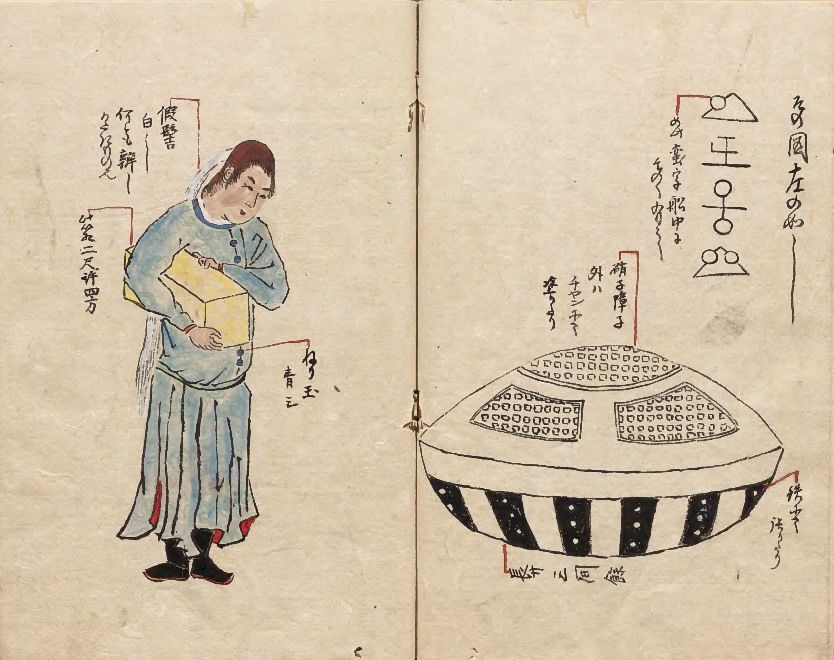
The manuscript trail is still growing. In January 2026, Kuki City described an Utsuro-bune drawing among roughly 4,900 Okada family documents donated the previous March. The family had served as village headmen in Nakazato. Their sheet depicts the boat as two bowls joined together, with windows, unfamiliar signs and a figure. The city’s account interprets it as news preserved from reports or hearsay, and leaves the underlying event unresolved. In September 2026, the National Archives announced newly identified material in its own holdings and displayed originals from September 9 to 23. Among them was Enkai kibun, attributed to the compiler Saitō Gesshin, with a more spherical boat and a woman drawn in a Japanese pictorial manner. A familiar mystery had acquired new witnesses to its circulation—even though they were papers, not people returning from the beach.
Sources: A Mysterious Utsuro-bune Discovered in Kurihashi’s Old DocumentsSpecial Exhibition of Original Utsuro-bune Documents
The stranger remains out of reach
Look between the two manuscript illustrations on this page. The hull changes, the clothing changes, and the same visual ingredients remain: a woman, an enclosed round craft, an unreadable message and a box. For a modern viewer, the saucer association is hard to resist. Yet the older narrative is just as concerned with failed translation, imagined foreign customs and the obligations owed to someone who cannot explain herself. The unresolved question is wider than the identity of a vehicle. Was a castaway transformed by retelling? Was an older legend given a convincing date and address? How did readers turn a drifting boat into an object from the sky? The surviving documents let us follow those transformations. They still do not let us hear the woman’s answer.
Sources: Utsuro-bune no banjo — Toen shōsetsu, volume 11Utsuro-bune illustration from Hyōryūki-shūUtsuro-bune illustration from Hirokata zuihitsu
What is established, and what is missing
The historical evidence consists of surviving texts and pictures, including examples catalogued by libraries and archives. The sources assembled here do not identify a recovered vessel, a preserved box or a named witness whose independent deposition establishes the beach encounter. The manuscripts substantiate the legend’s circulation; they leave its initiating event unverified. Describing this entry as a close encounter follows the narrated meeting with an occupant, without assigning an aerial-encounter classification to a drifting boat.
Sources: Utsuro-bune no banjo — Toen shōsetsu, volume 11Toen shōsetsu, volume 11 — digitized manuscriptA Mysterious Utsuro-bune Discovered in Kurihashi’s Old Documents
Several documents can repeat one report
The names, dates, provisions and repeated explanations are useful for comparing versions. They cannot be counted as separate witnesses simply because they occur on separate sheets. Toen shōsetsu itself speaks of a circulated copy and records a variant in the water supply. Kuki’s curators likewise describe their family document as a record based on transmitted news. An early date written inside a later manuscript is also distinct from proof that the surviving sheet was physically made on that date.
Sources: Utsuro-bune no banjo — Toen shōsetsu, volume 11A Mysterious Utsuro-bune Discovered in Kurihashi’s Old Documents
Foreign writing is not a translated message
The manuscript reproductions show geometric marks, but provide no reliable bilingual key. Toen shōsetsu’s comparison with an English ship is a suggestion within the account. It does not demonstrate that anyone read the symbols. The box presents the same evidentiary trap: a vivid proposed explanation is easy to remember as an observed fact. Neither the foreign princess’s identity nor the alleged severed head was established by the narrated inspection.
Sources: Utsuro-bune no banjo — Toen shōsetsu, volume 11Utsuro-bune illustration from Hirokata zuihitsu
Competing explanations remain at different stages
Bakin’s Russian comparison is an early conjecture. Tanaka’s silkworm reading is a developed hypothesis based on textual and visual correspondences. The extraterrestrial interpretation rests heavily on the craft’s resemblance to later saucer imagery. Those are different kinds of argument; none supplies the missing history of a specific woman or boat. Read the old account first, compare the illustrations, then follow the modern research. The order helps keep an attractive interpretation from quietly becoming part of the original report.
Sources: Utsuro-bune no banjo — Toen shōsetsu, volume 11The Sericulture Princess Konjiki Encrypted in “Hitachi Province Utsuro-bune UFO Legend” in the Japanese Edo PeriodUtsuro-bune illustration from Hyōryūki-shū
- 1698 · Earlier narrated incident
Kaisei kanrosō places a woman and a severed head aboard a hollow boat at Yoshidaura, Mikawa. It is a related tale, not corroboration of the Hitachi story.
- 1803 · Date assigned to the encounter
The Toen shōsetsu account places the arrival around noon on the twenty-second day of the second lunar month, Kyōwa 3.
- Around 1815
Ōshuku zakki preserves an early illustrated version; this is an approximate collection date, not a verified date for the beach event.
- 1825
The story appears in Toen shōsetsu, compiled by Bakin’s literary circle.
- 2010
A collector’s Mito document gives Tanaka a new lead for comparing the occupant with Princess Konjiki imagery.
- 2014
The Banke document comes to attention with a place name corresponding to Sharihama.
- March 2023
Tanaka publishes his detailed sericulture interpretation, while identifying questions that it leaves open.
- March 2025–January 2026
Kuki receives the Okada family papers and subsequently reports an illustrated Utsuro-bune sheet within them.
- September 9–23, 2026
The National Archives presents original Utsuro-bune materials, including the newly identified account in Enkai kibun.
Sources & interviews
Utsuro-bune no banjo — Toen shōsetsu, volume 11Kyokutei Bakin’s literary circle · 1825 · Japanese transcription of the public-domain account, with Bakin’s marginal note; modern annotations are separately identifiedStories of Castaways: The Woman in the Hollow BoatNational Archives of Japan · Digital exhibition · Hirokata zuihitsu, shelfmark 特095-0004, and the earlier Kaisei kanrosō accountToen shōsetsu, volume 11 — digitized manuscriptShowa Women’s University Library · Utsuro-bune appears at image 35 of 79; the copy’s precise date is unspecified“Utsurobune”: A UFO Legend from Nineteenth-Century JapanNippon.com · June 26, 2020 · Itakura Kimie’s interview with researcher Tanaka KazuoThe Sericulture Princess Konjiki Encrypted in “Hitachi Province Utsuro-bune UFO Legend” in the Japanese Edo PeriodTanaka Kazuo · Cultural Sciences 34, pp. 93–108 · Published March 1, 2023 · Japanese research paper; especially sections 9–10, pp. 97–99Sharihama Beach & Utsuro-bune Boat: UFO Mystery of the Edo PeriodKamisu City · Municipal newsletter no. 409 · March 1, 2024 · English edition, pp. 1–5, with manuscript and temple photographsA Mysterious Utsuro-bune Discovered in Kurihashi’s Old DocumentsKuki City · History bulletin no. 168 · January 16, 2026 · Okada family papers donated in March 2025Special Exhibition of Original Utsuro-bune DocumentsNational Archives of Japan · Official announcement via PR TIMES · September 9, 2026 · Enkai kibun and Hirokata zuihitsuUtsuro-bune illustration from Hyōryūki-shūUnknown Edo-period artist · Iwase Bunko Library, Nishio · Public-domain manuscript reproduction via Wikimedia CommonsUtsuro-bune illustration from Hirokata zuihitsuYashiro Hirokata collection · Nineteenth century · National Archives of Japan · Public-domain manuscript reproduction via Wikimedia CommonsSpotted an error, or know a better source? Write to hello@uap.fun.
Connected files
Nine Objects over Mount RainierThe 1947 encounter that helped give modern saucer imagery its name—a useful comparison with a much older round boat.The Night the Sky Waved BackAnother story centred on attempted communication with an unfamiliar craft’s occupants, preserved through a very different kind of record.Jacques ValléeA researcher whose interest in folklore offers a broader route into the changing cultural forms of encounter stories.Discuss this case
Compare notes with other readers: witness details, sources, and the parts that still do not add up.
Open the discussion