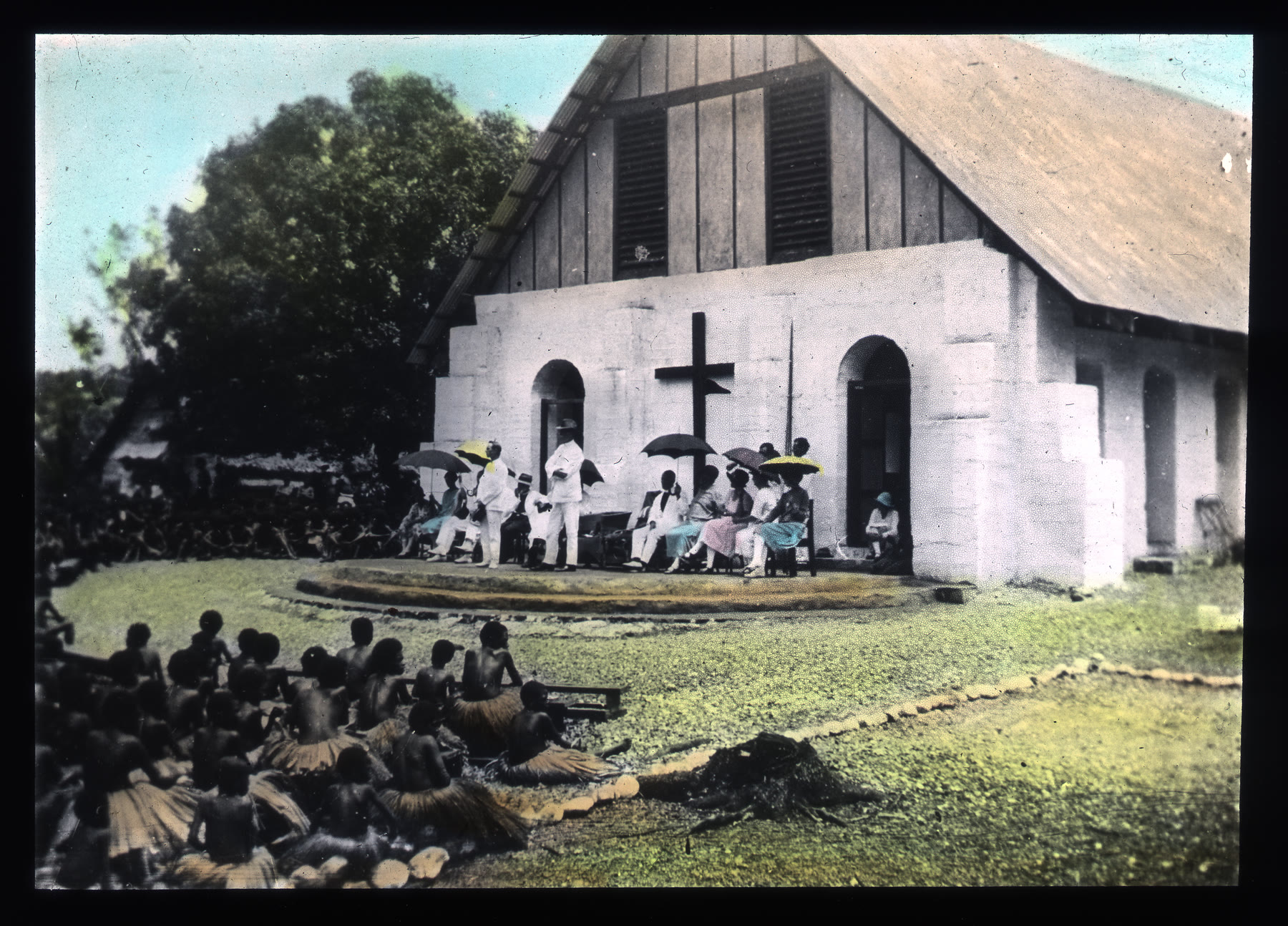
A mission facing Goodenough Bay
All Saints stood close to the beach at Boianai, looking across Goodenough Bay toward the hills of the Cape Vogel Peninsula. In 1959 this was Australian-administered Papua, and the mission was a small world of church services, classrooms, a hospital and launches moving between coastal outstations. Its priest, the Australian-born Rev. William Booth Gill, was already primed to watch the sky. Lights had been discussed around the mission for months; Gill had seen one against Mount Pudi in April, and assistant teacher Stephen Moi reported an ‘inverted saucer’ on June 21. Gill did not begin as a blank slate. In a letter written just before the famous nights, he wondered whether suggestion or electrical phenomena might explain the reports and signed himself ‘Doubting William.’
Sources: Flying Saucers Over Papua: A Report on Papuan Unidentified Flying ObjectsThe Boianai Visitants of 1959All Saints Church, Boianai, Papua New Guinea
6:45 p.m.: the white light above Venus
On Friday, June 26, Gill stepped to the mission-house door at 6:45 p.m. and saw a brilliant white light to the northwest. He later said he had been looking for Venus and saw it separately below the stranger light. His surviving data sheet has the pulse of notes made while the scene developed: at 6:50 he called Stephen Moi and Eric Langford; at 6:52 Moi arrived and agreed that it was not star-like. The light seemed to descend, dimming from white toward orange or deep yellow. Gill estimated an apparent diameter of five inches at arm’s length—an enormous angular size if the estimate was accurate—and put it roughly 300 to 500 feet above the water. Those were visual estimates without rangefinding, not measurements, but they capture how near and substantial the sight appeared to him.
Sources: Flying Saucers Over Papua: A Report on Papuan Unidentified Flying ObjectsFather Gill Sighting: CE-III, 25 Witnesses
‘One object on top—move—man?’
At 6:55 the terse log changes character: ‘One object on top, move—man? Now three men—moving, glowing, doing something on deck.’ Gill and the people gathering around him described a circular luminous body with a broad base, a narrower upper platform and leg-like forms beneath it. Figures appeared and vanished along the top—one, then two, then three or four—as if bending over equipment. At 7:10, beneath cloud Gill placed at about 2,000 feet, a thin electric-blue shaft shone upward at roughly forty-five degrees. The figures disappeared; the blue light remained for several minutes. The object passed into cloud at 7:20. Nothing in the account roared, whistled or hummed. Gill repeatedly emphasized the silence.
Sources: Flying Saucers Over Papua: A Report on Papuan Unidentified Flying ObjectsFather Gill Sighting: CE-III, 25 WitnessesAlien Visitors Appear at Boianai
Four hours of arrivals and disappearances
The night did not end with the first cloud. At 8:28 Gill recorded a light overhead that seemed to descend and grow. Another hovered over the sea, another appeared over Wadobuna village, and other luminous forms came and went through broken cloud, casting halos into it. At 9:10 the large light vanished with a red glow; it returned, then crossed the bay toward Giwa in white, red and blue. At 9:46 an object reappeared overhead and remained nearly stationary through 10:30. Heavy overcast swallowed the sky by 10:50 and rain arrived at 11:04. Cruttwell’s report counted thirty-eight people present at some point and twenty-five signatures, including five Papuan teachers and three medical assistants. That number is often flattened into ‘thirty-eight witnesses to every detail.’ The record does not establish that each person arrived at the same time, saw every phase or supplied an independent narrative.
Sources: Flying Saucers Over Papua: A Report on Papuan Unidentified Flying ObjectsFather Gill Sighting: CE-III, 25 Witnesses
From Doubting William to Convinced Bill
Before the first night, Gill had warned his friend David Durie that even a saucer-shaped report might be the unconscious work of illustrations seen in a magazine. On June 27 he enclosed his fresh notes with a very different letter: ‘Last night we at Boianai experienced about four hours of UFO activity,’ he wrote, ‘and there is no doubt whatsoever that they are handled by beings of some kind.’ He signed it ‘Convinced Bill.’ The conversion is one reason the correspondence is so compelling, and also a reason to read it carefully. A local wave of reports and Gill’s conversations about ‘visitation’ preceded the event. The papers preserve both his initial restraint and the interpretive frame already surrounding the mission.
Sources: Flying Saucers Over Papua: A Report on Papuan Unidentified Flying ObjectsThe Boianai Visitants of 1959
The wave returned
At about 6:00 p.m. on Saturday, a Papuan medical assistant—identified in later summaries as Annie Laurie or Annie Laura Borews—spotted the large object in approximately the same part of the still-bright sky. Gill came out at 6:02. Four figures again appeared on the upper section. One seemed to stand at a rail looking down while two bent and raised their arms near the center. Gill lifted one arm and waved. ‘To our surprise the figure did the same.’ Teacher Ananias Rarata raised both arms; two figures did likewise. Then Gill and Ananias waved together and all four appeared to answer. The mission boys gasped. For UFO lore, this is Boianai’s immortal instant: not merely lights overhead, but the sensation that the watchers had been noticed.
Sources: Flying Saucers Over Papua: A Report on Papuan Unidentified Flying ObjectsThe Boianai Visitants of 1959Father Gill Sighting: CE-III, 25 Witnesses
Torch dashes, dinner and evensong
Gill sent Eric Kodawa for a torch and aimed long flashes at the object. After a minute or two it seemed to sway sideways like a pendulum, then enlarge as if approaching before stopping. The figures dropped below the deck; two returned at 6:25 and the blue light flashed twice. Shouting brought no reply. At 6:30 Gill went to dinner. By 7:00 the object was still present but smaller, and the group went into church for evensong; afterward cloud had closed the view. Critics made the meal famous as an implausibly ordinary response. Gill later said the opposite: after four hours the previous night, the sight no longer felt supernatural. He took it for an American or Australian machine whose perfectly human crew might land and join them. It was, in his remembered phrase, ‘as ordinary as a Ford car.’
Sources: Flying Saucers Over Papua: A Report on Papuan Unidentified Flying ObjectsThe Boianai Visitants of 1959
The metallic bang on the third night
Sunday brought a thinner epilogue. Gill logged one high object at 6:45 p.m., three in a line at 9:00 and eight at 11:00. At 11:20 a sharp metallic bang struck—or seemed to strike—the mission-house roof. Four lights were then visible high around the station. Daylight inspection found no mark, dent or fallen fragment. The absent trace matters. Boianai produced pages of notes, names and gestures, but no photograph, recording, radar plot or physical sample. Even its one apparent impact left nothing to collect.
Sources: Flying Saucers Over Papua: A Report on Papuan Unidentified Flying Objects
Parliament asks, the Air Force arrives late
The papers escaped the bay quickly. Cruttwell received Gill’s eight-page account, copies reached Australian civilian UFO groups, and newspaper stories appeared in August. On November 24, parliamentarian E. D. Cash asked Minister for Air Frederick Osborne whether RAAF intelligence had investigated the mysterious objects over Papua and New Guinea. Osborne answered generally that all well-reported sightings were investigated and only about three percent remained unexplained; he did not say what had been done at Boianai. RAAF officers interviewed Gill on December 29, six months after the event. A February 1960 letter from Squadron Leader F. E. Lang said the directorate could reach no positive conclusion, did not believe the objects were manned space vehicles and thought at least three lights might have been Jupiter, Saturn and Mars distorted by refraction, cloud and tropical weather.
Sources: Unidentified Flying Objects — Question in the House of RepresentativesFlying Saucers Over Papua: A Report on Papuan Unidentified Flying ObjectsMore Documents on the Boiani CE3 Case Found at CUFOS
A forty-five-page legend
Cruttwell folded Boianai into a forty-five-page report dated March 1960, alongside scores of regional light reports, maps, sketches and speculation. He was Gill’s friend and a committed civilian UFO investigator, not a detached tribunal; his compilation is invaluable precisely because it preserves the early paperwork. Gill addressed a Melbourne audience in October 1959, and the National Library of Australia catalogs a later transcript of that recording. Researcher Bill Chalker interviewed him twice. J. Allen Hynek’s circle later treated the lesser lights as plausible stars or planets while arguing that the reported large platform did not fit that solution. Gill never claimed to know its origin. He maintained the experience while allowing that proposed explanations were serious attempts to understand it.
Sources: Flying Saucers Over Papua: A Report on Papuan Unidentified Flying ObjectsThe Gill Sightings, June 1959The Boianai Visitants of 1959More Documents on the Boiani CE3 Case Found at CUFOS
The visitants stay in Papua
Boianai endured because its strangest moment was intimate rather than violent: people on a tropical mission lawn waved, and figures in the dusk appeared to wave back. Papua New Guinean journalism still retells it as a local historical mystery, while later scholarship has read the event through psychology, colonial encounter and visionary experience. The surviving mission photograph carries none of the spectacle. It shows the steep roof and cross of All Saints among palms decades before 1959—the ordinary place from which an extraordinary social memory rose. That contrast is the case’s real atmosphere: church, dinner, rain, a torch in someone’s hand, and something luminous waiting beyond the bay.
Sources: Alien Visitors Appear at BoianaiAnatomy of a Vision: A Psychological Approach to the Papua New Guinea UFO Sightings, June 26–27, 1959Released UFO Files Document ‘Sightings’ in Papua New GuineaAll Saints Church, Boianai, Papua New Guinea
Sources & interviews
Flying Saucers Over Papua: A Report on Papuan Unidentified Flying ObjectsRev. Norman E. G. Cruttwell · March 1960 · Includes William B. Gill’s dated letters, observation log, sketches, witness totals and the RAAF reply · Scan via The Black VaultUnidentified Flying Objects — Question in the House of RepresentativesParliament of Australia · Hansard · November 24, 1959 · p. 2990The Gill Sightings, June 1959National Library of Australia catalogue · Transcript of Gill’s October 28, 1959 public address · Victorian UFO Research Society edition, 1978The Boianai Visitants of 1959Bill Chalker · The Oz Files / Project 1947 · Gill’s papers and two later interviews with the witnessFather Gill Sighting: CE-III, 25 WitnessesRichard Hall · NICAP case chronology · Based on Gill’s log and Cruttwell’s reportMore Documents on the Boiani CE3 Case Found at CUFOSKeith Basterfield · November 2, 2018 · Archival survey identifying Australian government files and contemporary press recordsAnatomy of a Vision: A Psychological Approach to the Papua New Guinea UFO Sightings, June 26–27, 1959David J. Halperin · International Association for Jungian Studies conference proceeding · Duquesne Scholarship Collection, 2022Alien Visitors Appear at BoianaiBarney Orere · Papua New Guinea Post-Courier · Local historical featureReleased UFO Files Document ‘Sightings’ in Papua New GuineaFinau Fonua · ABC Pacific · May 26, 2026 · Audio reportAll Saints Church, Boianai, Papua New GuineaUniversity of Newcastle Special Collections · Archdeacon A. N. Williamson Collection · Early twentieth century · Public Domain Mark · Wikimedia CommonsConnected files
The Westall School MysteryAnother Australian-region mass sighting where a large crowd strengthens the memory but does not turn shared testimony into independent instrumentation.The Varginha EncounterA later CE3 legend built from named witnesses, ordinary routines interrupted by a strange figure and a public story that grew around the first testimony.The Lights that Hunted ColaresA coastal community under recurring lights, this time followed by a military field operation, photographs and medical reports rather than one mission’s written log.Close Encounters, ExplainedThe classification system that later placed Boianai among close encounters of the third kind because witnesses reported associated figures.J. Allen HynekThe astronomer whose later inquiry separated potentially astronomical lesser lights from the report of the principal object.Discuss this case
Compare notes with other readers: witness details, sources, and the parts that still do not add up.
Open the discussion