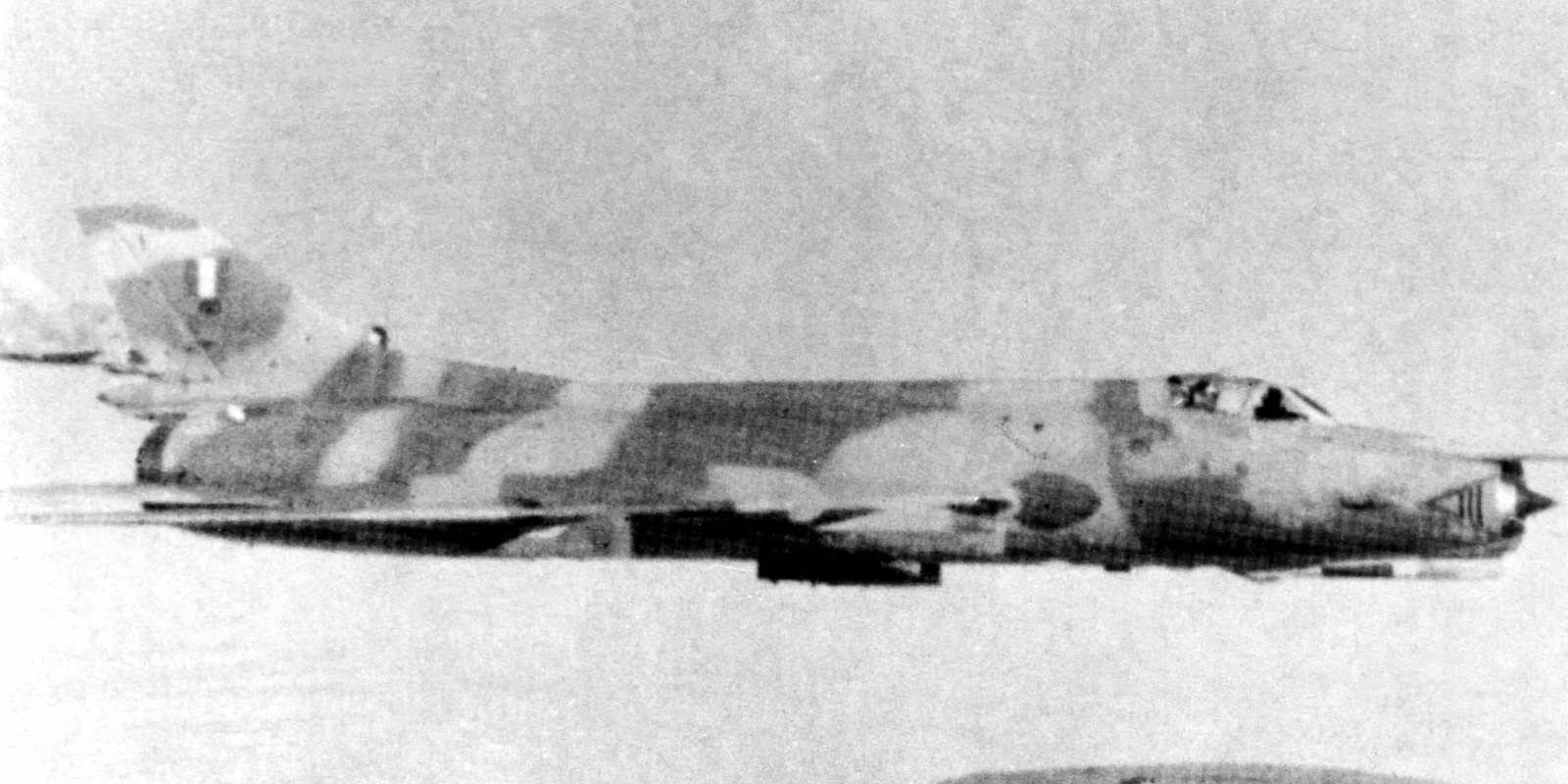
A base at the end of the pampa
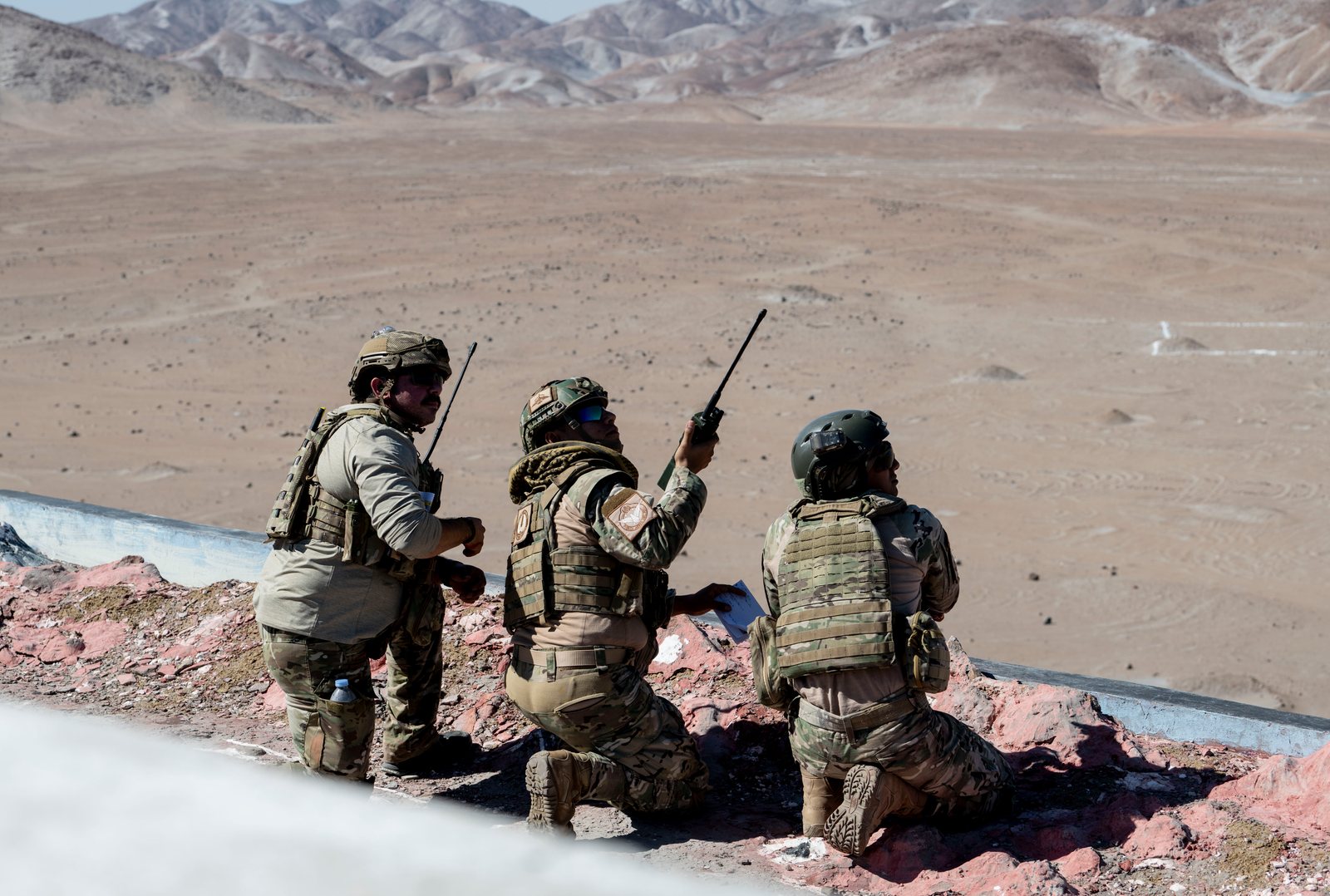
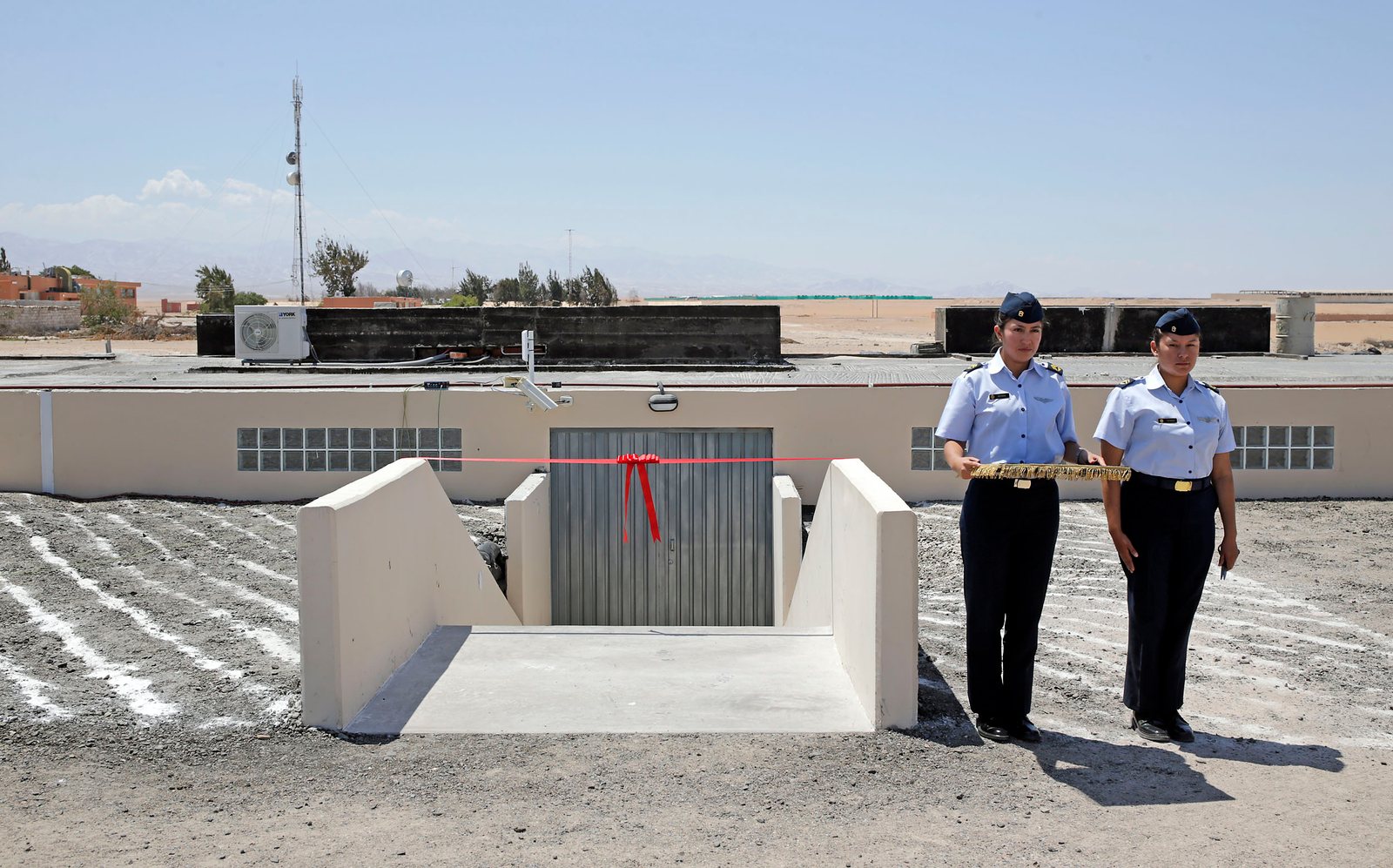
La Joya is not much of a place: a district of irrigated plots and bare desert on the pampa west of Arequipa, on the road that drops from the white city to the Pacific ports of Mollendo and Matarani, with the snow cone of El Misti floating on the horizon behind it. What matters about it is the air base. Base Aérea Mariano Melgar, which everyone calls La Joya, sits at about 1,200 metres on the flat, with a single four-kilometre runway, some 1,000 kilometres south of Lima and within reach of the Chilean border. In 1980 it was the home of Grupo Aéreo N° 4 and, in the words of Julio Chamorro, a young air-defence officer there at the time who would go on to found the Peruvian Air Force’s UFO office, “the most important member of the national defence system.” Chamorro remembered that year as one of “tension on the border with Chile”: the centenary of the War of the Pacific, which Peru had lost to Chile, had just passed, and both countries had spent the 1970s buying arms. The base had its own ghosts. On January 31, 1979, three A-37B attack jets of Escuadrón 412 with five men aboard took off from La Joya on a training flight toward Moquegua and Tacna and were never found; the officer who declared the emergency was Colonel Oswaldo Sarabia Peña, who commands the group in one version of the story that follows. And it had its own folklore. “The officers who worked at the La Joya base were used to sightings,” Chamorro told BBC Mundo decades later. “There was an event that repeated every December. We called it the Star of David, because we did not know what that powerful light was that pointed at us by day and by night. There was also the so-called lost city: far off you could see a lit-up city that moved away as you approached. It was so frequent that it stopped mattering.”
Sources: El ovni en La Joya: avión no recibió ningún ataque, el piloto de la FAP afirmó querer ser ‘abducido’ y autoridades no informaron del sucesoPerú reabrió la oficina de búsqueda de ovnis47 años sin rastro de aviones de la FAP que despegaron de La JoyaHace 44 años una aeronave peruana enfrentó a un OVNI en La JoyaIncidente ovni de la Joya - Arequipa
Sukhois in the sand
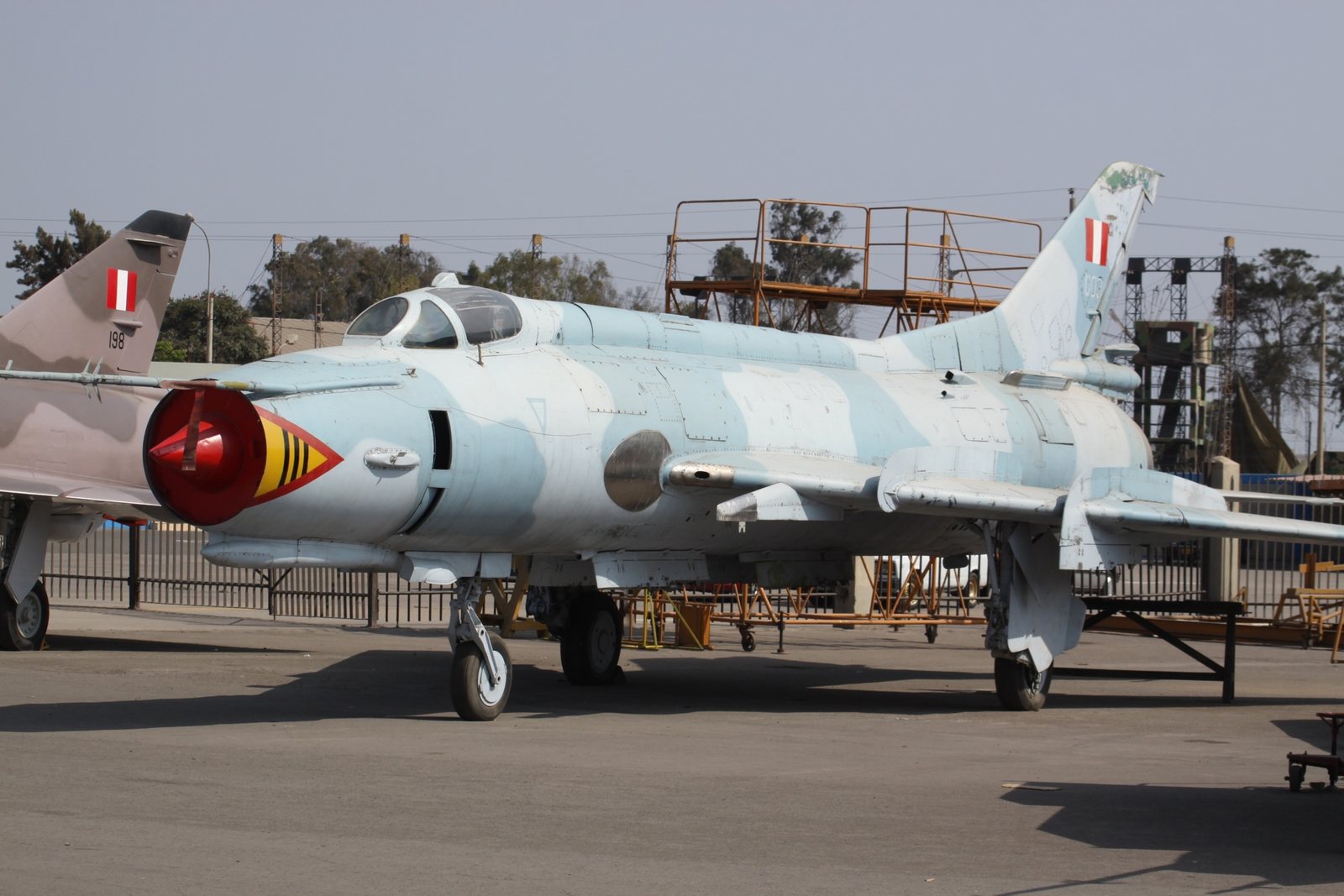
The reason La Joya was “restricted-access,” and the reason a stray balloon over it was treated as an act of war, stood on its aprons. In the mid-1970s Peru’s military government, refused modern fighters by Washington, sent its prime minister to Moscow, where the Soviets staged a Black Sea demonstration for him with hundreds of tanks and thousands of troops and offered terms that included payment partly in fish meal, copper and iron ore. The 1976 deal bought thirty-two Sukhoi Su-22 fighter-bombers and four two-seat trainers for about 250 million dollars, with rocket pods, bombs and Atoll air-to-air missiles. Nineteen officers and fifty-six NCOs trained in secret at Krasnoyarsk, learning enough Russian to talk to the tower; the jets arrived in crates at the port of Paita in June 1977, were assembled under Sukhoi engineers at El Pato, near Talara, and were unveiled on July 23, 1977 with a nonstop flight to Lima. They were the only Soviet variable-geometry fighter-bombers in South America. A second order in 1979, sixteen improved Su-22M “Fitter J” and three trainers, began arriving “during the first weeks” of 1980, and with them a new unit, Escuadrón Aéreo N° 411, was formed at La Joya in May of that year, so that the country would have a squadron of Sukhois at each end of its territory. When the story of April 1980 is told in Arequipa, the jet in it is “one of the four Su-22Ms just arrived from Talara.” The type carried two Nudelman-Rikhter NR-30 cannon in its wing roots, one on each side, each loaded with eighty 30 mm rounds. It had no radar of its own; a laser-based sight gave the pilot range and target diameter. The pilots who flew it were a small, chosen group, and one of the youngest was a lieutenant from Ica named Óscar Alfonso Santa María Huertas, born in 1957 into a family of fliers, in the Air Force at sixteen, an alférez at eighteen, five years at El Pato and then, “for his good shooting skills,” posted to La Joya. He had, by his own account, been selected at twenty to test-fly the new Sukhois and had a shelf of gunnery trophies. His call sign was Cianuro: Cyanide.
Sources: The Sukhoi Su-22 in Peruvian serviceIncidente ovni de la Joya - ArequipaClose Combat with a UFOOVNI caso La Joya: comandante retirado Oscar Santa MaríaOvnis en Perú: habla el ex piloto FAP que en 1980 persiguió a un ovni por el cielo de ArequipaHace 44 años una aeronave peruana enfrentó a un OVNI en La Joya
Quarter past seven
Friday, April 11, 1980 began like any other day, Santa María wrote thirty years later: at 7:15 in the morning about 1,800 military personnel and civilians were at the base, forming up for the day’s work under a sky “absolutely clear.” Then a chief of service pulled up in a van and got out to say that there was an object like some kind of balloon hanging in the air toward the end of the runway. Four pilots stepped outside to look. It was about five kilometres away and perhaps 600 metres up, round, motionless, and it “shone due to the reflection of the sun.” In his 2007 statement he put it at 1,800 feet; Arequipa’s press has settled on 600 metres. The radar could not see it. It did not answer calls on the international frequencies, and it seemed to be drifting toward the base. What everyone assumed was a spy balloon, and in that year the assumption had a nationality: “it was estimated that it could be a Chilean espionage balloon photographing the military installation,” the Arequipa historian José Ballón writes. Santa María’s own reasoning, set down in Leslie Kean’s 2010 book, was blunter. “This ‘balloon’ was in restricted air space without authorization, representing a grave challenge to national sovereignty… La Joya was one of the few bases in South America that possessed Soviet-made warfare equipment, and we were concerned about espionage.” Peru, he pointed out, had no balloons of any kind in 1980, and the weather balloons he knew flew above 45,000 feet trailing antennae and cables. “It had to come down.” Who gave the order depends on who is telling it. In Kean’s book, the unit’s second-in-command, Comandante FAP Carlos Vásquez Zegarra, ordered one of the alert pilots to bring the object down, and the squadron commander, Captain Oscar Alegre Valdez, turned to the lieutenant: “Oscar, you be the one to go.” A Peruvian magazine profile has Vásquez Zegarra as “the chief of the base” telling him to get into the Sukhoi and shoot down “that spy ship.” Ballón, working from Arequipa sources, has the base command under Colonel Oswaldo Sarabia Peña activating the anti-aircraft and ground defences and assigning “Cianuro” to intercept and destroy. To TV Perú in 2025 the pilot compressed it to five words: “Sal y destruye ese globo.” Go out and destroy that balloon. He was chosen, every version agrees, because he was the best shot on the base, and he was the youngest combat pilot there. Ballón times the take-off at 7:27. Santa María remembered it as eighteen seconds off the ground and a minute to firing position.
Sources: Close Combat with a UFOStatement of Comandante Oscar Alfonso Santa María HuertasHace 44 años una aeronave peruana enfrentó a un OVNI en La JoyaOVNI caso La Joya: comandante retirado Oscar Santa María¡Persiguió y disparó a un ovni en Arequipa! Habla el expiloto peruanoEl ovni y el piloto de ataqueOvnis en Perú: habla el ex piloto FAP que en 1980 persiguió a un ovni por el cielo de Arequipa
The wall of fire
He planned the pass in his head as he ran to the jet, never taking his eyes off the thing in the sky. The object was inside the base perimeter, and a burst of 30 mm shells that missed would fall on his own people, so he would attack from the north-west toward the south-east with the sun on his left and the desert under the target. After take-off he turned right, climbed to about 2,500 metres and rolled in. “Zeroing in on the balloon, I reached the necessary distance and shot a burst of sixty-four 30 mm shells, which created a cone-shaped ‘wall of fire’ that would normally obliterate anything in its path.” Thirty-two rounds from each cannon, the trigger held down until he was too close to keep firing; Ballón gives the range as 900 metres. The shells, he liked to say, were “the size of a soda bottle,” and a single one, an aeronautics expert told History Latinoamérica, “goes through a railway rail, a concrete wall,” and can destroy a tank. “Some of the projectiles deviated from the target, falling to the ground, and others hit it with precision. I thought that the balloon would then be torn open and gases would start pouring out of it. But nothing happened. It seemed as if the huge bullets were absorbed by the balloon, and it wasn’t damaged at all.” In the version he gave Panamericana, he was so sure of his aim that when the object began to move he took it for a hit: “First time something is not destroyed when the shells strike it. When I see the object start to move away, I thought I had put a hole in it, and the air was pushing it off.” It was not drifting. It was climbing, fast, and turning away from the base. “What is going on here?” he thought. “I have to get closer to it.”
Sources: Close Combat with a UFOEl ovni y el piloto de ataqueHace 44 años una aeronave peruana enfrentó a un OVNI en La JoyaEntrevista al ex piloto de la Fuerza Aérea Peruana, Óscar Santa María, que atacó a un ovniEl ovni en La Joya: avión no recibió ningún ataque, el piloto de la FAP afirmó querer ser ‘abducido’ y autoridades no informaron del sucesoStatement of Comandante Oscar Alfonso Santa María Huertas
The chase to Camaná
He lit the afterburner, told the tower he was following procedure and continuing the mission, and asked, because he already knew this was “an extremely unusual mission,” that they make sure the tape recorders were running. The Sukhoi went to about 950 kilometres an hour and the balloon stayed some 500 metres ahead of it, neither gaining nor losing, while he called out his position: three thousand metres and twenty kilometres from the base, six thousand metres and forty kilometres. Over Camaná, the coastal town eighty-four kilometres to the north-west, at 11,000 metres, the object stopped dead. He was close behind it, 1,500 feet in his 2007 statement, and had to veer to avoid it. He pulled up and to the right and set up again, closing to the thousand metres from which he could fire. “I locked on the target and was ready to shoot. But just at that moment, the object made another fast climb, evading the attack. I was left underneath it; it ‘broke the attack.’” He tried twice more. Each time the object sat still until he had it in his sight at the 400 to 700 metres his gunnery demanded, and each time it went straight up “seconds before I started to fire.” “Then it became a personal thing for me,” he wrote. “I had to get it.” To the Mexican journalist Yohanan Díaz Vargas he described the sensation more strangely: “When I reached a certain altitude to get it in my sights and fire, the object broke off the operation and placed itself at the same altitude, right beside my plane.” Or, as he put it on Peruvian television: “They were escaping my shot. It seemed they knew at what distance I was going to fire.” The three broken attacks had carried the object up to 14,000 metres. He decided on something bold: accelerate to Mach 1.6, climb above it and come down on it vertically, so that if it rose again it would rise into his gunsight. He went supersonic and started up, watching the object slide beneath him. “But to my surprise, the object ascended once again at a high speed and placed itself next to me in parallel formation!” Still climbing at Mach 1.2, he tried to get over it, and could not. At 63,000 feet, 19,200 metres, the thing stopped and hung there. He swept the wings to thirty degrees and extended the slats to keep the jet flying in the thin air, and thought about one more shot. “I could not remain as still as this ‘balloon.’” Then the low-fuel light came on.
Sources: Close Combat with a UFOStatement of Comandante Oscar Alfonso Santa María HuertasPeru: La Joya AFB, the Perfect UFO Case (1980)OVNIS en Perú: piloto Oscar Santa María revela detalles de lo vivido en 1980 en ArequipaEntrevista al ex piloto de la Fuerza Aérea Peruana, Óscar Santa María, que atacó a un ovniOvnis en Perú: habla el ex piloto FAP que en 1980 persiguió a un ovni por el cielo de Arequipa
A hundred metres
With just enough fuel to get home and no way to attack, he did the one thing left and flew closer to look. He came, he said, within about 100 metres. “I was startled to see that the ‘balloon’ was not a balloon at all. It was an object that measured about 35 feet (10 meters) in diameter with a shiny dome on top that was cream-colored, similar to a light bulb cut in half. The bottom was a wider circular base, a silver color, and looked like some kind of metal. It lacked all the typical components of aircraft. It had no wings, propulsion jets, exhausts, windows, antennae, and so forth. It had no visible propulsion system.” Over the years the dome became “pavonada,” the frosted or burnished grey-white of oxidised glass; the base “like an ashtray”; the whole thing “a dome of opaque white, like frosted glass, on a circle of metal.” He did not see it rotate. He saw no rivets. Nothing on it explained how it flew. “At that moment, I realized this was not a spying device but a UFO, something totally unknown. I was almost out of fuel, so I couldn’t attack or maneuver my plane, or make a high-speed escape. Suddenly, I was afraid. I thought I might be finished.” In Spanish, to Iker Jiménez’s radio audience, the fear was more domestic: “Uy, ahora qué hago”, and then the dread of turning his back on it to go home, “that it might occur to it to attack me.” He described the object to the tower and, “trying to hide my fear,” asked for another aircraft to come up and continue the attack. “They said no, it’s too high, just come back.” So he glided part of the way down on empty tanks, zigzagging to make himself a harder target, eyes on the mirrors. It did not follow. He had been airborne twenty-two minutes. When the tower asked what had happened to the balloon, he gave the answer Arequipa still repeats: “Nada, pues, que no es un globo.” Nothing, only that it isn’t a balloon.
Sources: Close Combat with a UFOStatement of Comandante Oscar Alfonso Santa María HuertasPeru: La Joya AFB, the Perfect UFO Case (1980)Ovnis en Perú: habla el ex piloto FAP que en 1980 persiguió a un ovni por el cielo de ArequipaEntrevista al ex piloto de la Fuerza Aérea Peruana, Óscar Santa María, que atacó a un ovniPiloto se ‘enfrentó’ a OVNI en Arequipa
Two more hours in the sun
His squadron was waiting on the ramp with questions. The armourer checked the empty cartridge cases and said, “Captain, it’s clear you’ve done some shooting.” Then everyone involved went into a briefing: operations, air defence, base defence and the general commanding the air wing, for the base had gone to full alert while he was up. The radar operators reported that the object had never registered on their screens even as they watched it in the sky with their own eyes, and they, like the men at formation, described it as round and metallic. Ballón’s Arequipa sources add detail unit by unit: the telecommunications squadron said the radars had only ever painted the Sukhoi; a crew at a Pechora anti-aircraft site said “the enormous metallic, circular structure” had passed over their position; the armament squadron counted sixty-four 30 mm rounds expended. Afterward Santa María sat with the intelligence officers and went through their catalogues of aircraft and espionage devices, and “found nothing that could maneuver in the way I described without any type of propulsion system.” The object was logged as unidentified. It was still there. “It remained in the same place where I left it for two more hours, visible to everyone on the base while it reflected the sun,” and then it was gone. The order that came out of the briefing was silence. “We were told that what happened at the meeting was to remain there only, and we were not to divulge it at any time.” The reasoning, as he reconstructed it for Díaz Vargas, was practical: “When we had decided it was a UFO, somebody said, ‘Uy, that pulls a crowd; if we say it’s a UFO the journalists, the researchers and the curious will come, and they will see exactly what we are protecting.’” The tower recorder had supposedly captured everything, “but afterward no order was given to keep it.” No internal report went up, he told El Comercio in 2009, so that the news would not become “known to people outside the military sphere” who might try to get into a base that held “Soviet war material unique in South America.” “They gave the order that nobody should speak of the case; I wrote my report and everything went quiet… traces were erased.” In Ballón’s account the object came back the next evening, Saturday April 12, lower over the base at dusk; Díaz Vargas has the pilot saying it returned “very luminous,” made “angular movements over the whole base” and stayed at least half an hour. Nobody was sent up. Julio Chamorro, whose air-defence post was on that base, has said for years that he watched the whole intercept with thousands of his comrades: “He was playing like cat and mouse.”
Sources: Close Combat with a UFOHace 44 años una aeronave peruana enfrentó a un OVNI en La JoyaEl ovni en La Joya: avión no recibió ningún ataque, el piloto de la FAP afirmó querer ser ‘abducido’ y autoridades no informaron del sucesoLa vez que un piloto de la FAP ‘derribó’ un ovni en una base aérea de Arequipa y un agente del Gobierno de Estados Unidos elaboró un informe confidencialObjetivo: derribar al ovni en PerúJulio Chamorro – Peru
The pilot who packed a bag
Santa María had not believed in extraterrestrial life before that morning; afterward he could think of little else. He bought every book and magazine on the subject he could find and read Yosip Ibrahim’s I Visited Ganymede in one sitting. For three months he kept a travel bag packed. “After lunch I went to my room and said to myself: ‘If they come for me, I’m going; they spared my life, we know each other.’ For three months I always carried my travel bag to go off with them.” He wanted, he explained, to learn their technology and bring it home to Peru. They did not come. He says he saw another object over La Joya three Christmases later, on a December 25. Otherwise the Air Force kept its word and he kept his: “the sighting was officially accepted,” he told a panel in Washington in 2013, and “I continued to fly for 20 more years without any problems.” He rose to comandante, a rank Kean equates with a U.S. colonel, took courses abroad, married, had a son who became an engineer and a daughter, and retired in 1997, going on to work as a flight-safety adviser and instructor with the airline Taca Perú. The dogfight became a story for friends, “a topic of conversation in passing at family gatherings. Almost forgotten.” He never took money for it. “There will be those who believe what I say, others will think I’m a charlatan,” he told a Peruvian magazine. “But what would I gain by lying? Nobody has ever paid me for my testimony.” By 2023, at sixty-six, he was spending up to three hours a day online reading about UFOs.
Sources: OVNI caso La Joya: comandante retirado Oscar Santa MaríaEl ovni en La Joya: avión no recibió ningún ataque, el piloto de la FAP afirmó querer ser ‘abducido’ y autoridades no informaron del sucesoOVNIS en Perú: piloto Oscar Santa María revela detalles de lo vivido en 1980 en ArequipaOscar Santa María Huertas testifies at the Citizen Hearing on Disclosure, May 2, 2013Ovnis en Perú: habla el ex piloto FAP que en 1980 persiguió a un ovni por el cielo de ArequipaClose Combat with a UFOHace 44 años una aeronave peruana enfrentó a un OVNI en La Joya
A cable to Washington
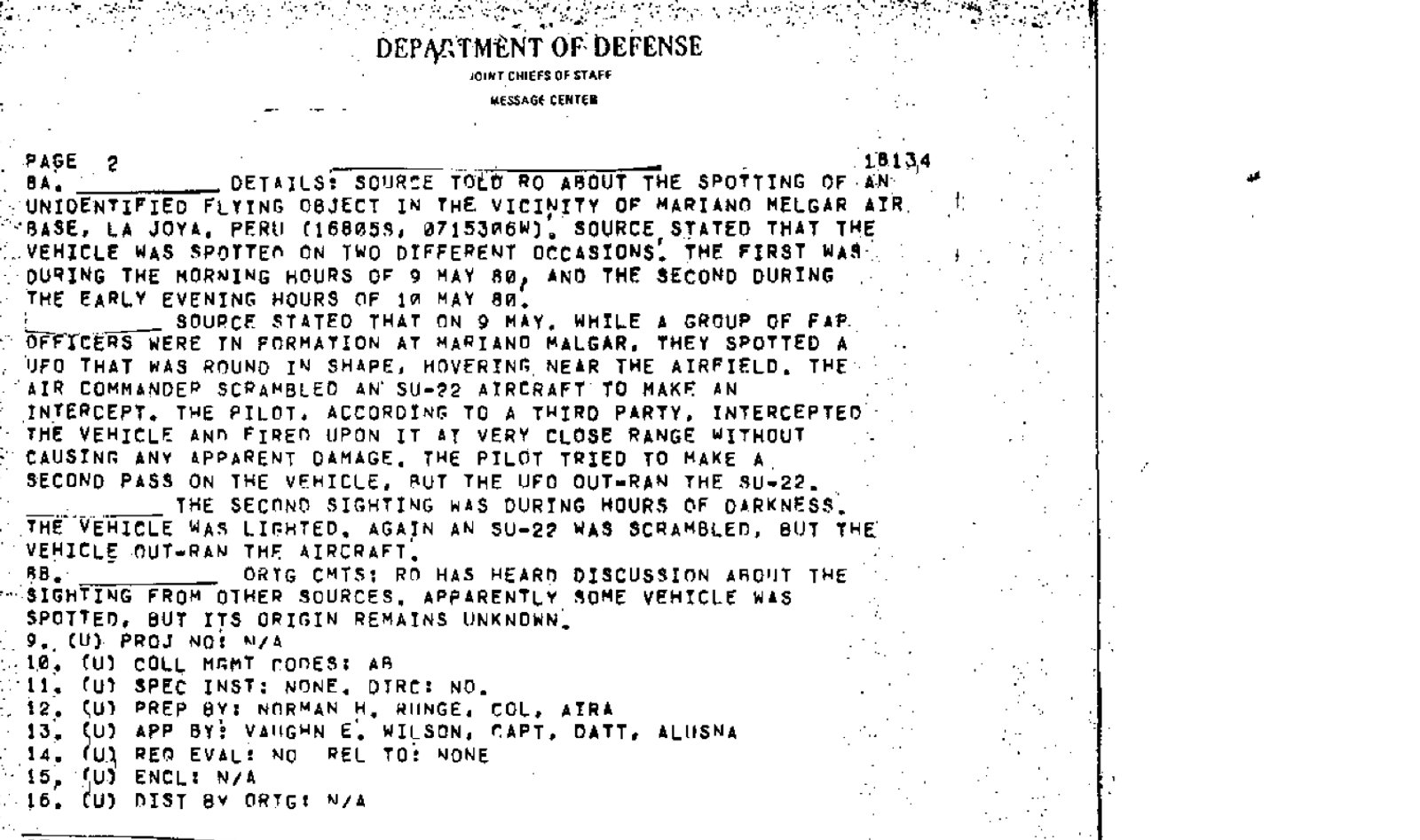
Someone did talk. On June 2, 1980, at 2052 Greenwich time, the U.S. Defense Attaché Office in Lima transmitted a routine-precedence intelligence information report to the Defense Intelligence Agency, with information copies to the U.S. Southern Command at Quarry Heights and the U.S. Air Forces Southern Command at Howard Air Force Base in Panama. The Joint Chiefs of Staff Message Center stamped it RECEIVED JUN 3 1980 and sent it round Washington: the Secretary of Defense’s office, the National Military Intelligence Center, the chiefs of the Army, Navy, Air Force and Marine Corps, the CIA, the State Department and the National Security Agency. Report IR 6 876 0146 80 was titled “UFO SIGHTED IN PERU,” carried a “DATE OF INFO” of May 10, 1980, and described itself as “AN INFO REPORT, NOT FINALLY EVAL INTEL.” Its source was “OFFICER IN THE PERUVIAN AIR FORCE WHO OBSERVED THE EVENT AND IS IN A POSITION TO BE PARTY TO CONVERSATION CONCERNING THE EVENT. SOURCE HAS REPORTED RELIABLY IN THE PAST.” The summary: “SOURCE REPORTED THAT A UFO WAS SPOTTED ON TWO DIFFERENT OCCASIONS NEAR PERUVIAN AIR FORCE (FAP) BASE IN SOUTHERN PERU. THE FAP TRIED TO INTERCEPT AND DESTROY THE UFO, BUT WITHOUT SUCCESS.” The details placed the object “IN THE VICINITY OF MARIANO MELGAR AIR BASE, LA JOYA, PERU,” with coordinates, and dated the two sightings to “THE MORNING HOURS OF 9 MAY 80” and “THE EARLY EVENING HOURS OF 10 MAY 80.” On the first morning, “WHILE A GROUP OF FAP OFFICERS WERE IN FORMATION AT MARIANO MALGAR, THEY SPOTTED A UFO THAT WAS ROUND IN SHAPE, HOVERING NEAR THE AIRFIELD. THE AIR COMMANDER SCRAMBLED AN SU-22 AIRCRAFT TO MAKE AN INTERCEPT. THE PILOT, ACCORDING TO A THIRD PARTY, INTERCEPTED THE VEHICLE AND FIRED UPON IT AT VERY CLOSE RANGE WITHOUT CAUSING ANY APPARENT DAMAGE. THE PILOT TRIED TO MAKE A SECOND PASS ON THE VEHICLE, BUT THE UFO OUT-RAN THE SU-22.” The second sighting “WAS DURING HOURS OF DARKNESS. THE VEHICLE WAS LIGHTED. AGAIN AN SU-22 WAS SCRAMBLED, BUT THE VEHICLE OUT-RAN THE AIRCRAFT.” The reporting officer added a comment of his own: “RO HAS HEARD DISCUSSION ABOUT THE SIGHTING FROM OTHER SOURCES. APPARENTLY SOME VEHICLE WAS SPOTTED, BUT ITS ORIGIN REMAINS UNKNOWN.” The report was prepared by Colonel Norman H. Runge, the air attaché, and approved by Captain Vaughn E. Wilson, the defence and naval attaché. It does not name the pilot. It gives no altitude, no count of rounds, no description beyond “round,” and no duration. It calls the thing a “vehicle” five times.
Sources: IR 6 876 0146 80 — UFO Sighted in PeruClose Combat with a UFOComandante Huertas Revisited
The wrong month
The cable and the pilot disagree about the calendar, and neither side has moved. Santa María has never wavered from Friday, April 11; the attaché wrote May 9 and 10. Kean, who compared the two in 2010, called it simply “the wrong date” and reported the pilot’s view that the information “was distorted, and some of the data imprecise, because the report was not filed until two months after the incident.” He was not interviewed by any American, he told her, and “clearly remembers that no U.S. officials were present during his briefing”: “We were very careful about guarding our own sensitive operations and military procedures.” To El Comercio he was wry: “When I went to Washington, in 2007, they handed me an intelligence report from 1980 that details in English everything that happened to me. They only get the month wrong. And to this day I ask myself: how did they find out over there, if we were given the order not to talk?” His own guess, offered to Díaz Vargas, was satellites or the quiet exchange of “strange events” between intelligence services. Under questioning in 2013 he made a different argument: in 1980 “the only encounter with a UFO was my encounter” at La Joya, so a memorandum written weeks later about that base could only be about him. Kevin Randle, reading the codes on the document, noted that the error could as easily have been the Peruvian officer’s as the attaché’s. What nobody has explained is the cable’s second night, when a lighted “vehicle” drew a second Su-22 scramble in the dark. Santa María knows of no other 1980 scramble; the nearest thing in the Peruvian accounts is the object’s return at dusk the following evening, when nobody took off. Later retellings have not helped. Peruvian television has credited the report to “NASA” and “the FBI,” neither of which appears on its distribution list; El Comercio’s archive column has the Pentagon sending an agent to Peru who filed a confidential report on October 5, 1980, a claim the June document contradicts and the pilot himself, who says no American ever spoke to him, does not support.
Sources: Close Combat with a UFOOvnis en Perú: habla el ex piloto FAP que en 1980 persiguió a un ovni por el cielo de ArequipaObjetivo: derribar al ovni en PerúOscar Santa María Huertas testifies at the Citizen Hearing on Disclosure, May 2, 2013Pilot Attacks UFOIR 6 876 0146 80 — UFO Sighted in Peru¡Persiguió y disparó a un ovni en Arequipa! Habla el expiloto peruanoLa vez que un piloto de la FAP ‘derribó’ un ovni en una base aérea de Arequipa y un agente del Gobierno de Estados Unidos elaboró un informe confidencialHace 44 años una aeronave peruana enfrentó a un OVNI en La Joya
A secret in the cafés
The order of silence held in the Air Force and failed almost everywhere else. “In Arequipa during the 1980s and 1990s the experience of the La Joya pilot was the biggest open secret in the clubs and cafés,” Ballón writes; families and friends “still remember in detail how and when they found out,” and local radio and the region’s own experts in such things turned it into “the local landmark between credulity and scepticism.” In the United States the story travelled by a different road, without a pilot’s name attached. The attaché’s report was released under the Freedom of Information Act and, by 1986, was being passed around in typed compilations by UFO information services; Timothy Good printed a short account and the document itself in Above Top Secret in 1987, and Clifford Stone reproduced it in his own collection of government papers. For fifteen years the La Joya case was a documents case, two teletype pages about an unnamed Peruvian who had fired at something round. Peru caught up in 2005, when the Lima tabloid El Chino gave the ufologist Mario Zegarra space to present “one of the top secret documents” he said the Air Force had shared with the Americans and not with its own government. Zegarra’s paraphrase gave the object a shape the cable never did, “resembling a weather balloon used for maritime navigation,” and it gave the pilot a name. Óscar Santa María had, by then, already begun to talk.
Sources: Hace 44 años una aeronave peruana enfrentó a un OVNI en La JoyaComandante Huertas RevisitedPeruvian Air Force Conceals UFO InformationIR 6 876 0146 80 — UFO Sighted in Peru
The X-Files of the FAP
What loosened his tongue was the Air Force itself. In the last weeks of 2001, under internal ordinance 55 of the commanding general Jorge Del Carpio, the Fuerza Aérea del Perú created an Oficina de Investigación de Fenómenos Aéreos Anómalos, the OIFAA, inside its Directorate of Aerospace Interests, with Comandante Julio Chamorro at its head and a team that included a space-law expert, an aeronautical engineer, a librarian, an anthropologist and the lawyer Anthony Choy. The Peruvian press promptly christened it “los X-Files peruanos.” It received four or five reports a week and put its witnesses through a seventeen-page questionnaire whose cover promised that “your identity will be considered confidential.” Inside the Air Force, the case with the most credibility was La Joya, and the office asked its pilot for his testimony. He gave it reluctantly, in writing. In February 2002 El Comercio, reporting the office’s creation, carried his first words to the press, and the weekly Somos followed; “the order to keep silent was given,” he said in 2007, “until the year 2002, when they authorised me to speak about this subject.” Chamorro left after two years and the office went dormant around 2005. On October 18, 2013 the Air Force revived it as the Departamento de Investigación de Fenómenos Aéreos Anómalos, the DIFAA, at Avenida Arequipa 5200 in Miraflores, with an advisory board of astronomers, an archaeologist, a sociologist, a physicist and a philosopher and Chamorro among its members. “Any aerial object that navigates within national airspace whose flight is illicit, anomalous and whose nature is not identifiable represents a threat to civil and military air security,” the defence minister, Pedro Cateriano, told BBC Mundo. Under the new department the 1980 intercept was filed, Díaz Vargas reported, as case 0007. No conclusion from either office has ever been published.
Sources: La vez que un piloto de la FAP ‘derribó’ un ovni en una base aérea de Arequipa y un agente del Gobierno de Estados Unidos elaboró un informe confidencialOvnis en Perú: habla el ex piloto FAP que en 1980 persiguió a un ovni por el cielo de ArequipaOVNI caso La Joya: comandante retirado Oscar Santa MaríaEntrevista al ex piloto de la Fuerza Aérea Peruana, Óscar Santa María, que atacó a un ovniPerú reabrió la oficina de búsqueda de ovnisPeru’s UFO investigations office to be reopenedPeru: La Joya AFB, the Perfect UFO Case (1980)
Washington, 2007
In November 2007 an email arrived from a journalist in the United States. Leslie Kean wrote that she had found his case in declassified Defense Department papers and invited him to a press conference at the National Press Club in Washington, organised with the filmmaker James Fox and moderated by Fife Symington, the former governor of Arizona who had recently admitted seeing the Phoenix Lights. Fourteen panelists from seven countries were coming: Belgium’s Major General Wilfried De Brouwer, the French space scientist Claude Poher, a Chilean army aviator, the British airline captain Ray Bowyer, the Ministry of Defence’s Nick Pope, the FAA’s John Callahan, Peru’s Anthony Choy, and General Parviz Jafari, who as an Iranian major in 1976 had tried and failed to fire a Sidewinder at a light over Tehran. Two nights before the event, Kean wrote, Jafari and Santa María shook hands for the first time in the rooftop restaurant of the Washington Hotel, both weary from long flights. Santa María spoke no English; when Jafari began telling his story, a Spanish-speaking couple at the next table confessed they had been eavesdropping and offered to translate. Then the Peruvian told his, prompted by questions. “Each could identify with the fear and awe expressed by the other.” Asked how he had felt as an object closed on his Phantom, Jafari said, “I doubled my scare.” Santa María drew his object on a sugar packet from the coffee service, which Kean kept. Somewhere in those days the organisers handed him a copy of the attaché’s cable, the first he had seen of it; “for all those who did not believe his story,” a Peruvian profile observed, “it was proof.” On November 12 he read his statement through an interpreter, ending: “A US Department of Defense document titled ‘UFO Sighted in Peru’ described the incident, stating that the vehicle’s origin remains unknown. It still gives me chills to think about it.” Comparing notes with the others, he came away with a distinction he has kept ever since. “Hey, Oscar,” he recalled them telling him, “you are the only one who can prove he fired; the other aircraft wanted to intercept UFOs with missiles, and their firing systems didn’t work.” His own explanation, in Kean’s book: “My equipment was mechanical, and perhaps that’s the reason it could not be shut down, so instead, the object had to jump away at the last minute.” Five days after the press conference he told Iker Jiménez’s Spanish radio audience that yes, he was convinced “this technology was not known for use on Earth,” and that when it came to combat pilots misjudging things in the air, “the possibility of our being wrong is very remote.”
Sources: Close Combat with a UFONational Press Club press conference, November 12, 2007: the panelists in the order in which they spokeStatement of Comandante Oscar Alfonso Santa María HuertasOVNI caso La Joya: comandante retirado Oscar Santa MaríaEl ovni y el piloto de ataqueEntrevista al ex piloto de la Fuerza Aérea Peruana, Óscar Santa María, que atacó a un ovniMaybe they’ll just go away
Cazadores de ovnis and a hearing for hire
The History Channel flew him to Los Angeles on February 18, 2008 for an episode of UFO Hunters called “UFO Dogfights,” which paired La Joya with Tehran and showed the Defense Department document on screen. When the episode reached Latin American cable that October as Cazadores de ovnis, Peru discovered its own pilot through a foreign programme: “Case was divulged by The History Channel and studied in the CIA,” La República headlined on October 14, 2008. Kean’s book followed in August 2010, with his chapter, “Close Combat with a UFO,” set beside Jafari’s “Dogfight over Tehran.” In the spring of 2013 he was back at the National Press Club for a week-long “Citizen Hearing on Disclosure” staged by Stephen Bassett’s Paradigm Research Group, at which six former members of Congress, paid 20,000 dollars each, heard sworn testimony on a mock-congressional dais. On the afternoon of May 1 the researcher Kevin Randle came out of the building to find Stanton Friedman on the pavement with a two-page document and a quiet retired comandante. Randle read the line “fired upon it at very close range without causing any apparent damage” and said, “We don’t know if he hit it.” “Why don’t you ask him,” Friedman said. “He’s standing right here.” Santa María told him that he had, indeed, hit it. The next day he testified through a translator, showing the cable, a sketch and a 1980 photograph of himself beside his Sukhoi. The shells, he told the panel, were about three centimetres wide and twenty-five long and “can destroy a truck, a single one,” and his training targets were three metres square against an object ten metres across. “The total 22 minutes of maneuvers is clearly etched in my brain,” he said. “I am convinced there is extraterrestrial life. I will never forget my experience.” He noted, with relief, that it had never retaliated. Peruvian television gave him a prime-time exclusive that November; History Latinoamérica built a documentary around him in 2015, with Chamorro vouching and the expert Alfonso Salazar explaining what a 30 mm round does to steel; the American whistleblower hearings of 2023 sent El Comercio, Correo and Infobae back to his door; TV Perú had him in a studio in March 2025. On May 3, 2026, in a Lima podcast, he noted that the previous April 11 had marked forty-six years, and told the whole thing again, in the first person, from the van at morning formation to the fuel light at 19,000 metres.
Sources: OVNI caso La Joya: comandante retirado Oscar Santa MaríaPiloto se ‘enfrentó’ a OVNI en ArequipaClose Combat with a UFOCitizen Hearing on Disclosure: a faux hearing about alien encountersPilot Attacks UFOPeruvian Jet Pilot Tells of Tangle With UFOOscar Santa María Huertas testifies at the Citizen Hearing on Disclosure, May 2, 2013El ovni en La Joya: avión no recibió ningún ataque, el piloto de la FAP afirmó querer ser ‘abducido’ y autoridades no informaron del sucesoOvnis en Perú: habla el ex piloto FAP que en 1980 persiguió a un ovni por el cielo de Arequipa¡Persiguió y disparó a un ovni en Arequipa! Habla el expiloto peruanoConfesiones, episodio 160: Oscar Santa María
What the cable establishes, and what it cannot
The document is the reason this case sits apart from most pilot stories, and it is worth being exact about what it is. It is an unevaluated information report from an accredited U.S. attaché, written within weeks of the event, sourced to a Peruvian Air Force officer who “observed the event” and “has reported reliably in the past,” with the reporting officer adding that he had heard the same story from others. It confirms that in the spring of 1980 a round object hovered near La Joya in daylight in front of officers at formation, that the air commander scrambled an Su-22, and that the Su-22 fired at very close range without visible effect and could not catch the object on a second pass. It also records a second, lighted sighting after dark and a second scramble that the pilot’s account does not contain. It does not name Santa María, and the pilot’s actions reach the attaché only “according to a third party.” It gives no altitude, no round count, no duration, no description beyond “round,” and it dates everything a month later than the pilot does. Kean makes much of its calling the object a “vehicle,” but the word is the report writer’s, not a finding. What it proves is that something was seen and fired at, and that a foreign intelligence officer thought it worth telling Washington that its origin “remains unknown.” Everything about the wall of fire, the three broken attacks, the parallel climb and the cream dome rests on one man’s memory, told consistently for a quarter of a century.
Sources: IR 6 876 0146 80 — UFO Sighted in PeruClose Combat with a UFOPilot Attacks UFOStatement of Comandante Oscar Alfonso Santa María Huertas
The ceiling
The number that stops aviation-minded readers is 63,000 feet. The Su-22’s published service ceiling is about 14,200 metres, or 46,590 feet, and a commenter on Randle’s blog asked within hours whether the jet could possibly have reached 19,200. Randle’s answer was a pilot’s: published capabilities “are not necessarily the limitations of that aircraft,” military jets can exceed the book “which might become useful in a combat environment,” and the MiG-25 that once shocked Western radars was found on landing to have wrecked its engines doing it. Another commenter noted that an afterburner zoom climb can briefly carry a fighter well above its service ceiling at a ruinous rate of fuel burn, “which is what he says happened.” The Peruvian accounts, oddly, agree with the sceptics about the aircraft while siding with the pilot about the altitude: La República wrote in 2008 that the type “can only reach 18,300 metres” and that at 19,000 it “lost power,” and Ballón writes that “having exceeded the aircraft’s ceiling it began to lose power and controllability.” Santa María’s own description is of a jet at the edge of flight, wings swept to thirty degrees, slats out, unable to hold position, fuel light on, and then a glide home. The altitude cannot be checked. There was no radar track of the Sukhoi above the base’s coverage in any account, no gun-camera film is mentioned anywhere, and the tower tape, he says, was not kept.
Sources: Pilot Attacks UFOComandante Huertas RevisitedPiloto se ‘enfrentó’ a OVNI en ArequipaHace 44 años una aeronave peruana enfrentó a un OVNI en La JoyaClose Combat with a UFOEl ovni en La Joya: avión no recibió ningún ataque, el piloto de la FAP afirmó querer ser ‘abducido’ y autoridades no informaron del suceso
Balloon
The first word anyone used for it was the sceptics’ word. The base called it a balloon; the attaché’s source described a round object hovering; Zegarra’s 2005 paraphrase made it “a weather balloon used for maritime navigation.” Robert Sheaffer, reviewing Kean’s book, reached for the 1948 Gorman dogfight, in which a North Dakota pilot “played cat-and-mouse with a lighted weather balloon known to have been launched nearby ten minutes earlier,” and concluded: “There is no reason to suspect that the ‘UFO dogfights’ in Iran and Peru were very different.” James Oberg, in his own review, attacked the book’s premise that pilots make the best witnesses, citing J. Allen Hynek’s finding that military pilots misidentified what they reported 88 percent of the time, and a Soviet study of 1982 scrambles “sparked by military balloons that rose to higher-than-expected altitudes.” Research balloons do float near 19 kilometres, and a thin envelope can take a 30 mm round without bursting. Against this stands nearly everything the pilot says he saw: an object that sat still until he was about to fire and then climbed vertically, three times; that stopped dead at 11,000 metres and again at 19,200; that placed itself beside a supersonic jet in formation; that showed a hard dome on a metal base at 100 metres, with no cables, antennae or gondola; that stayed over the base for two hours and then left. He has also pointed out that Peru flew no balloons in 1980 and that the weather balloons he knew lived above 45,000 feet, not at 600 metres. And he has left himself an exit that many witnesses do not. Asked in 2008 whether he could swear it was not from Earth, he said the specialists he had consulted judged it “a craft that uses a technology not known on Earth,” and then: “It could, in the last of cases, be from a terrestrial power that has them, uses them and does not make them public. But as they told me: Oscar, where did you see it, in space or on Earth? If it was on Earth, you can’t be sure it’s extraterrestrial.” No dedicated sceptical study of the case has ever been published.
Sources: Leslie Kean’s ‘UFOs’: a reviewUFO book based on questionable foundationPeruvian Air Force Conceals UFO InformationClose Combat with a UFOEl ovni y el piloto de ataqueEntrevista al ex piloto de la Fuerza Aérea Peruana, Óscar Santa María, que atacó a un ovni
Numbers that drift
Told for twenty-five years in two languages, the story has picked up variants, and most of them are the tellers’ rather than the pilot’s. The sixty-four rounds are constant in his own accounts; a 2013 translator made them “around sixty,” a Spanish blog made them thirty-eight, and Chamorro’s biography makes them “more than 80.” The jet carried 140 rounds in one interview and eighty per gun in the aircraft’s specifications. The object’s height is 600 metres in the book and 1,800 feet in the 2007 statement; the attack heading is north-east in Kean’s English and north-west in the Spanish versions; the flight lasted twenty-two minutes in almost every telling, twenty-eight on one 2008 radio programme, twenty-five to Díaz Vargas. The officer who gave the order is Vásquez Zegarra, Alegre Valdez or Sarabia Peña depending on the source, and none is confirmed by any Peruvian document, because no Peruvian document has been released. He was a teniente in 1980; El Comercio’s 2023 archive column made him a captain and had him “shoot down” the object. The agency that wrote the cable, the Defense Intelligence Agency’s attaché system, has become the CIA, NASA and the FBI in Peruvian broadcasts. A 2026 Spanish-language column placed the press conference in 2017. What survives the drift is a short, stable core: a formation of men, a shining round object off the runway, a scramble, a burst that did nothing, a chase the jet could not win, an object that lingered and left, an order of silence, and a cable to Washington that says the same, in a different month.
Sources: Peruvian Jet Pilot Tells of Tangle With UFOJulio Chamorro – PeruPeru: La Joya AFB, the Perfect UFO Case (1980)Incidente ovni de la Joya - ArequipaStatement of Comandante Oscar Alfonso Santa María HuertasClose Combat with a UFOEl ovni y el piloto de ataqueHace 44 años una aeronave peruana enfrentó a un OVNI en La JoyaLa vez que un piloto de la FAP ‘derribó’ un ovni en una base aérea de Arequipa y un agente del Gobierno de Estados Unidos elaboró un informe confidencial¡Persiguió y disparó a un ovni en Arequipa! Habla el expiloto peruano
Classification and evidence note
This archive files La Joya as a military encounter and, editorially, as a reported close encounter of the first kind, because the pilot describes closing to about 100 metres of a structured object without any effect on his aircraft; the label records his account, not a conclusion about what he met. The documentary record consists of the U.S. Defense Attaché Office report of June 1980, released under the Freedom of Information Act and reproduced by Timothy Good, Clifford Stone, Kevin Randle and The Black Vault; the pilot’s signed statement of November 12, 2007 and his chapter in Leslie Kean’s 2010 book; his filmed testimony of May 2, 2013; and Spanish-language interviews from 2007 to 2026. José Ballón’s 2024 account supplies Arequipa-sourced details, including Colonel Sarabia Peña and the unit reports, that no other source confirms. Nothing from the Peruvian Air Force, the OIFAA or the DIFAA has been published, no photograph or gun-camera film of the object exists, and no free photograph of Santa María could be found; the archive describes the 1980 photograph of him beside his Sukhoi rather than reproducing it. The cable’s dates of May 9 and 10 remain unreconciled with the pilot’s April 11. Sources were reviewed September 27, 2026; review again by September 2028 or if the DIFAA file on case 0007, the 2002 El Comercio interview, or any Peruvian Air Force record of the scramble is released.
Sources: IR 6 876 0146 80 — UFO Sighted in PeruClose Combat with a UFOStatement of Comandante Oscar Alfonso Santa María HuertasOscar Santa María Huertas testifies at the Citizen Hearing on Disclosure, May 2, 2013Hace 44 años una aeronave peruana enfrentó a un OVNI en La JoyaPeru: La Joya AFB, the Perfect UFO Case (1980)
- 1976
Refused F-5 fighters by Washington, Peru signs a 250-million-dollar deal in Moscow for thirty-six Su-22 fighter-bombers, payable partly in fish meal, copper and iron.
- 23 JUL 1977
The first Su-22s, assembled at El Pato near Talara, are presented with a nonstop flight to Lima; Peru becomes the only South American operator of the type.
- 31 JAN 1979
Three A-37B jets of Escuadrón 412 with five crew vanish on a training flight out of La Joya and are never found; Colonel Oswaldo Sarabia Peña declares the emergency.
- EARLY 1980
Sixteen improved Su-22Ms begin arriving from the Soviet Union; four are moved from Talara to La Joya.
- 11 APR 1980 · 7:15 AM
About 1,800 men at morning formation see a round, shining object hanging motionless some five kilometres off the end of the runway at about 600 metres; radar shows nothing and it does not answer the tower.
- 11 APR 1980 · ABOUT 7:27 AM
Lieutenant Óscar Santa María Huertas, call sign Cianuro, takes off, climbs to about 2,500 metres and fires a burst of sixty-four 30 mm rounds; some hit, none have any effect, and the object begins to climb away.
- 11 APR 1980 · MORNING
A 22-minute chase on afterburner to Camaná: the object stops dead at 11,000 metres, breaks three attacks by climbing at the last second, flies in formation with the jet and halts at 19,200 metres; the pilot closes to about 100 metres, sees a cream dome on a metal base, and glides home on his fuel light.
- 11 APR 1980 · LATE MORNING
The object hangs over the base for two more hours, then leaves; the wing’s general, operations, air defence and intelligence debrief the pilot, find nothing in their catalogues, log it as unidentified and order silence.
- 12 APR 1980 · DUSK
In José Ballón’s account, the object returns lower over the base at nightfall; Díaz Vargas has the pilot describing a luminous return the next day with ‘angular movements’ for half an hour. No jet is sent.
- 9–10 MAY 1980
The dates the U.S. attaché’s source gives for two sightings: a round object hovering near the airfield in the morning, and a lighted ‘vehicle’ after dark that out-runs a second Su-22.
- MAY 1980
Escuadrón Aéreo N° 411, the La Joya Sukhoi squadron, is formally constituted.
- 2–3 JUN 1980
The U.S. Defense Attaché Office in Lima transmits report IR 6 876 0146 80, ‘UFO Sighted in Peru,’ to the DIA; the Joint Chiefs’ message center stamps it received on June 3 and distributes it to the CIA, NSA, State Department and service chiefs.
- 1986–1987
The cable circulates in Freedom of Information Act compilations and appears in Timothy Good’s Above Top Secret; the pilot is unnamed.
- 1997
Santa María retires from the Air Force as a comandante after twenty more years of flying.
- LATE 2001
The Air Force creates the OIFAA under Comandante Julio Chamorro; La Joya is its most credible case and the pilot is asked for a written statement.
- FEB 2002
El Comercio, reporting the office’s creation, carries Santa María’s first words to the press; he says the order of silence was lifted that year.
- 27 MAY 2005
El Chino prints ufologist Mario Zegarra’s presentation of the ‘top secret’ document, paraphrased as describing a ‘weather balloon used for maritime navigation.’
- 10 NOV 2007
Santa María and General Parviz Jafari of Iran meet for the first time on a Washington hotel roof and compare their dogfights through a volunteer translator; he draws the object on a sugar packet.
- 12 NOV 2007
At the National Press Club he reads his statement before fourteen panelists from seven countries and is handed a copy of the 1980 cable: ‘It still gives me chills to think about it.’
- 17 NOV 2007
On Spain’s Milenio 3 he calls the shells ‘the size of a soda bottle’ and says he is convinced the technology ‘was not known for use on Earth.’
- FEB–OCT 2008
He flies to Los Angeles for History’s UFO Hunters episode ‘UFO Dogfights’; when it airs in Latin America, La República and the Peruvian press discover the case.
- AUG 2010
Leslie Kean publishes UFOs: Generals, Pilots, and Government Officials Go on the Record with his chapter ‘Close Combat with a UFO’; Sheaffer and Oberg reply with Gorman’s balloon and Hynek’s pilot statistics.
- 1–2 MAY 2013
Outside the National Press Club he tells Kevin Randle he did hit the object; the next day he testifies at the Citizen Hearing on Disclosure: ‘The total 22 minutes of maneuvers is clearly etched in my brain.’
- 18 OCT 2013
The Air Force relaunches its UFO office as the DIFAA; the 1980 intercept is filed as case 0007.
- 2015
History Latinoamérica airs a documentary on the case with Chamorro vouching for it, reviving national coverage.
- 16 AUG 2023
In the wave of coverage after the U.S. whistleblower hearings, El Comercio’s Somos interviews him at home in Surco, aged sixty-six: ‘They only get the month wrong.’
- 11 APR 2024
José Ballón’s anniversary article names Colonel Sarabia Peña, times the take-off at 7:27 and reports the radar, anti-aircraft and armament squadrons’ accounts.
- 3 MAY 2026
Forty-six years on, he tells the story again in the first person on the Lima podcast Confesiones.
Sources & interviews
IR 6 876 0146 80 — UFO Sighted in PeruU.S. Defense Attaché Office, Lima · Joint Chiefs of Staff Message Center · sent June 2 and received June 3, 1980 · pages 11–12 of the Defense Intelligence Agency’s second UFO document release, hosted by The Black VaultClose Combat with a UFOComandante Oscar Santa María Huertas (Ret.), chapter 10 of Leslie Kean, UFOs: Generals, Pilots, and Government Officials Go on the Record · Harmony Books · 2010 · with Kean’s introduction to the two ‘dogfight’ pilots and her note on the cable’s wrong date · Internet Archive lending copyStatement of Comandante Oscar Alfonso Santa María HuertasCoalition for Freedom of Information · National Press Club press conference, Washington, D.C. · November 12, 2007 · the signed statement distributed to the press · Wayback MachineNational Press Club press conference, November 12, 2007: the panelists in the order in which they spokeCoalition for Freedom of Information · organized by James Fox and Leslie Kean, moderated by Fife Symington · biographies of the fourteen panelists · Wayback MachineEntrevista al ex piloto de la Fuerza Aérea Peruana, Óscar Santa María, que atacó a un ovniPercy Taira · Expediente Oculto · November 19, 2007 · Spanish transcript of the Milenio 3 (Cadena SER) radio interview of November 17, 2007El ovni y el piloto de ataqueLuis Vásquez · Ruta de Ovnis radio interview of December 5, 2008, transcribed at OVNI Perú · thirty-two rounds per cannon, twenty-eight minutes, and ‘podría ser de una potencia terrestre’Piloto se ‘enfrentó’ a OVNI en ArequipaLa República (Lima) · October 14, 2008 · the Peruvian press discovers the case through The History ChannelLa vez que un piloto de la FAP ‘derribó’ un ovni en una base aérea de Arequipa y un agente del Gobierno de Estados Unidos elaboró un informe confidencialJean Pierre Andonaire Villegas · El Comercio archive · August 12, 2023 · the March 2009 interview and the founding of the OIFAAOvnis en Perú: habla el ex piloto FAP que en 1980 persiguió a un ovni por el cielo de ArequipaOscar García · Somos, El Comercio · August 16, 2023 · the interview at his home in Surco: ‘Cianuro,’ the tower exchange and the cable that ‘only gets the month wrong’El ovni en La Joya: avión no recibió ningún ataque, el piloto de la FAP afirmó querer ser ‘abducido’ y autoridades no informaron del sucesoInfobae Perú · January 25, 2024 · the Panamericana and Yohanan Díaz Vargas interviews, Julio Chamorro and Alfonso Salazar on History LatinoaméricaHace 44 años una aeronave peruana enfrentó a un OVNI en La JoyaJosé Ballón, Arequipa aviation historian · Diario Viral · April 11, 2024 · the 7:27 take-off, Colonel Oswaldo Sarabia Peña, the unit-by-unit reports and the ‘secreto a voces’47 años sin rastro de aviones de la FAP que despegaron de La JoyaJosé Ballón · Tomenota (Arequipa) · January 28, 2026 · the three A-37Bs lost from La Joya in January 1979OVNI caso La Joya: comandante retirado Oscar Santa MaríaPeriodismo Cósmico · March 21, 2017 · a Peruvian magazine profile: Ica 1957, the FAP at sixteen, ‘Carlos Vásquez Zegarra me ordenó,’ the packed bag and Yosip IbrahimPeru: La Joya AFB, the Perfect UFO Case (1980)Yohanan Díaz Vargas, translated by Scott Corrales · Inexplicata, the Journal of Hispanic Ufology · November 14, 2016 · ‘like that of an ashtray,’ 140 rounds aboard, 460 men at their stations and DIFAA case 0007Objetivo: derribar al ovni en PerúYohanan Díaz Vargas · El Universal (Mexico), ‘10 años de enigmas’ · 2018 · the interview at his Lima homePeruvian Jet Pilot Tells of Tangle With UFOShar Adams · The Epoch Times · May 3, 2013 · his testimony at the Citizen Hearing on Disclosure the day beforePilot Attacks UFOKevin D. Randle · A Different Perspective · May 24, 2013 · his conversation with the pilot outside the National Press Club and the service-ceiling argument in the commentsComandante Huertas RevisitedKevin D. Randle · A Different Perspective · May 25, 2013 · scans of the cable, the page references in Timothy Good and Clifford Stone, and the MiG-25 precedentOscar Santa María Huertas testifies at the Citizen Hearing on Disclosure, May 2, 2013National Press Club, Washington, D.C. · twenty-six-minute testimony and questioning, uploaded by the Eyes On Cinema channel (not the organizers)¡Persiguió y disparó a un ovni en Arequipa! Habla el expiloto peruanoTVPerú Noticias · March 24, 2025 · from the programme Hora Contacto: ‘Sal y destruye ese globo’Confesiones, episodio 160: Oscar Santa MaríaJorge Talavera · Confesiones podcast · May 3, 2026 · the pilot at sixty-nine, forty-six years onPeruvian Air Force Conceals UFO InformationEl Chino (Lima) · May 27, 2005 · translated by Scott Corrales and archived at RR0 · ufologist Mario Zegarra presents the ‘top secret’ documentPerú reabrió la oficina de búsqueda de ovnisBBC Mundo, reprinted by La Nación (Buenos Aires) · February 5, 2014 · Julio Chamorro’s ‘estrella de David’ and defence minister Pedro Cateriano on the DIFAAPeru’s UFO investigations office to be reopenedDan Collyns · The Guardian, via Raw Story · October 2013 · the relaunch of the Air Force’s anomalous-phenomena departmentThe Sukhoi Su-22 in Peruvian serviceLatin American Aviation Historical Society · July 30, 2019 · the Moscow purchase, Talara 1977, the Su-22M batch of 1980 and the formation of Escuadrón Aéreo 411 at La JoyaLeslie Kean’s ‘UFOs’: a reviewRobert Sheaffer · Debunker.com · 2010 · Gorman’s lighted weather balloon offered for Tehran and PeruUFO book based on questionable foundationJames Oberg · NBC News · August 26, 2010 · Hynek’s misperception rates for pilots and the Soviet balloon scrambles of 1982Incidente ovni de la Joya - ArequipaSpanish Wikipedia · the Su-22M, its two 30 mm cannon with eighty rounds each, and the Peru–Chile arms raceOVNIS en Perú: piloto Oscar Santa María revela detalles de lo vivido en 1980 en ArequipaIsabel González Lugo · Ojo · September 14, 2017 · ‘Ellos escapaban de mi tiro’ and the Christmas Day sightingMaybe they’ll just go awayBilly Cox · Sarasota Herald-Tribune, De Void · February 11, 2009 · the 2007 panel’s ‘dogfight’ pilots · Wayback MachineJulio Chamorro – PeruInternational Coalition for Extraterrestrial Research · biography of the OIFAA’s founder, who says he watched the intercept from the groundCitizen Hearing on Disclosure: a faux hearing about alien encountersJosh Dzieza · The Daily Beast · May 2, 2013 · the six former members of Congress and their $20,000 feesSpotted an error, or know a better source? Write to hello@uap.fun.
Connected files
The Tehran InterceptThe other pilot on the 2007 panel: Parviz Jafari’s Phantom lost its weapons panel as he tried to fire over Tehran, and the same attaché system wrote both cases up for Washington.The Lights that Hunted ColaresThree years earlier and a continent away, the Brazilian Air Force ran its own UFO operation; South America’s military files are the backbone of both stories.The Nimitz EncounterAnother fighter pilot describing an object that mirrored his moves and out-climbed him; Fravor’s Tic Tac and Santa María’s ‘light bulb cut in half’ share a smooth, featureless skin.Leslie KeanFound the case in declassified papers, brought the pilot to Washington in 2007 and gave him a chapter in her 2010 book.James FoxCo-organised the National Press Club press conference at which Santa María first told his story outside Peru.Discuss this case
Compare notes with other readers: witness details, sources, and the parts that still do not add up.
Open the discussion