Telephone calls after midnight
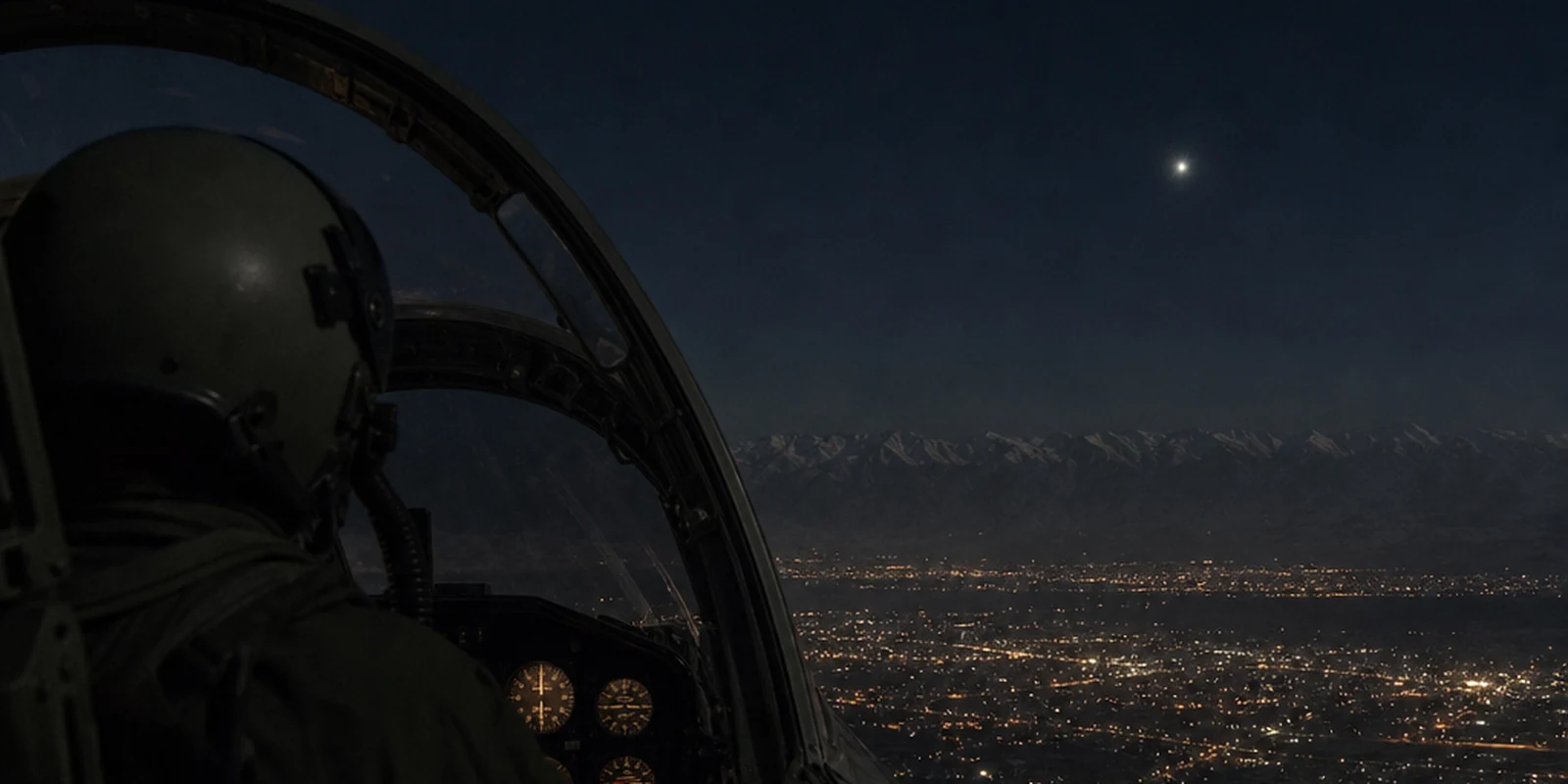
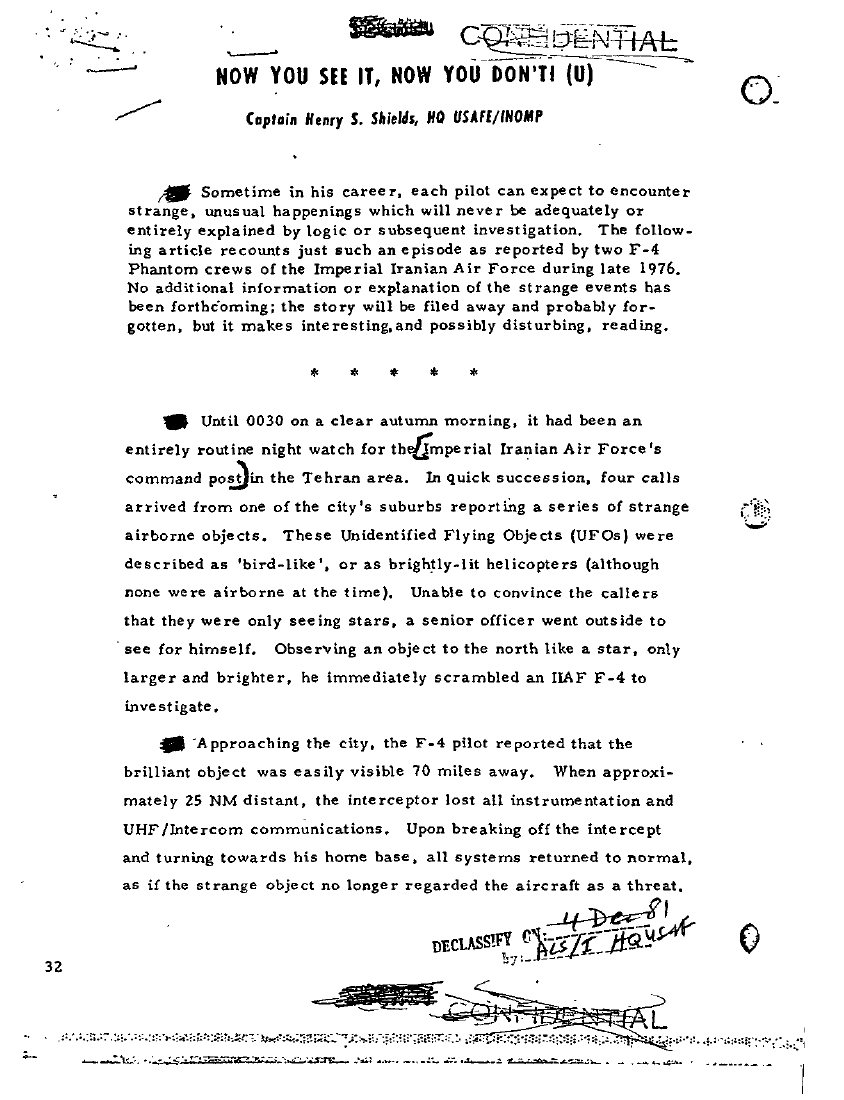
At about 12:30 a.m. on September 19, 1976, an Imperial Iranian Air Force command post received four calls from residents of Tehran’s Shemiran district. The descriptions were uncertain from the beginning: some callers compared the object to a bird, others to a helicopter carrying a light. No helicopters were reported airborne. The officer contacted Mehrabad Airport, then went outside and saw something he judged larger and brighter than a star. That brief sequence—ordinary explanations considered, a direct look, then a decision to investigate—opened one of the most dramatic military UFO reports of the Cold War.
The first Phantom turns away
An F-4 Phantom II left Shahrokhi Air Base at about 1:30 a.m. and headed toward a point roughly 40 nautical miles north of Tehran. The U.S. defense attaché report says the light was visible from 70 miles away. At an indicated range of about 25 nautical miles, the crew reported losing instrumentation, UHF radio, and the cockpit intercom. They abandoned the approach and turned back. According to the report, the systems returned when the aircraft moved away. The document does not name this crew; names attached to the first flight in later accounts should therefore be read as later identification, not text printed in the surviving message.
A second crew finds a return
Ten minutes later, a second F-4 launched. Its pilot was later publicly identified as Parviz Jafari. The rear-seat crew member reportedly acquired a radar lock at 27 nautical miles, twelve o’clock high, with a closure rate recorded as 150 nautical miles per hour. As the distance fell to 25 nautical miles, the return appeared to move away and hold that separation. The report compares its radar return with a 707 tanker, but that wording concerns return strength, not a measured physical diameter. Visually, the crew could not resolve a body through the brilliance. They described rapidly alternating blue, green, red, and orange lights arranged in a rectangular pattern.
The light that came toward them
South of Tehran, the crew reported a second bright light separating from the first and coming rapidly toward the aircraft. Jafari attempted to fire an AIM-9 missile. At that moment, the surviving account says, the weapons-control panel went out and both UHF and internal communications failed. He broke sharply into a turn and negative-G dive. The smaller light seemed to follow at three to four nautical miles, cut inside the turn, then return to the primary light in what the report called a perfect rejoin. The language records the crew’s perception during a fast night intercept; it is not an independent measurement of the light’s path or intention.
A descent toward the dark ground
Soon afterward, another light appeared to descend from the primary object. The crew expected an impact, yet reported that it slowed near the ground and illuminated an area two to three kilometers wide. They descended from 25,000 to 15,000 feet to watch and mark the position. On the approach to Mehrabad, they reported intermittent interference along a particular bearing; a civil airliner in the vicinity also reported a communications failure but no visual sighting. The F-4 crew additionally described a cylinder-like light near final approach. The tower did not initially see it, then reportedly picked it up after the pilot supplied a direction.
Daylight finds no landing trace
In daylight, the crew returned by helicopter to the dry lake bed where they believed the descending light had reached the ground. They found no object and no visible trace at the marked spot. West of the area, however, they detected a strong emergency-beacon signal near a small house. The residents said they had heard a loud noise and seen a lightning-like flash during the night. Later skeptical research identifies the signal as a type carried by U.S. C-141 transports and reports that such beacons had sometimes been released over the nearby mountains. The public report says radiation checks were planned; it does not include results.
The cable travels through Washington
The incident entered the American record through the U.S. Defense Attaché Office in Tehran. A message dated September 22 was distributed through military and intelligence channels, including the Joint Chiefs of Staff, Department of State, CIA, NSA, White House, and senior commands in Europe and the Middle East. A later Defense Intelligence Agency evaluation called the report outstanding and listed features it considered valuable for study: multiple viewpoints, trained witnesses, a reported radar contact, and similar electromagnetic effects. Wide distribution shows that the report circulated; it does not by itself show that every recipient opened a separate investigation or accepted an extraordinary explanation.
The pilot returns to the story
Jafari continued to describe the encounter after leaving active service, including at a 2007 National Press Club event in Washington. His later account supplied names, personal impressions, and a more vivid sense of the cockpit than the terse 1976 cable. It also arrived decades after the event. That makes it valuable as witness testimony and cultural history while requiring the usual separation between near-contemporaneous documentation and later memory. The case’s reputation grew from their overlap: the old message supplies a timed sequence, while Jafari gives the sequence a human voice.
Jupiter, meteors, and unreliable electronics
The strongest conventional reading does not depend on one explanation for every reported light. Philip J. Klass and later Brian Dunning argued that Jupiter could account for at least part of the persistent star-like object, while meteors could account for short, fast lights. Dunning’s review cites contractor interviews alleging a history of intermittent electrical trouble in the second F-4 and uncertainty about whether the first aircraft was ever presented for repair. It also notes that a radar set needing adjustment or operating in manual track could complicate the reported lock. Those claims are later investigative testimony rather than surviving Iranian maintenance logs, but they offer a serious alternative to deliberate electronic interference.
Why Tehran still holds the night
The public record preserves a compelling encounter without resolving it into a single object. It combines civilian calls, military crews, a reported radar return, communications failures, and an urgent weapons decision. Yet it lacks raw radar data, complete maintenance records, identified physical debris, photographs of the lights, and the promised follow-up test results. The mystery survives in that tension. Something prompted two intercepts over a capital city, and the people involved experienced it as immediate and dangerous. What the lights were—and whether all of the reported effects shared one cause—remains beyond what the available documents can establish.