
Thirty-two Marines and a five-thousand-dollar reward
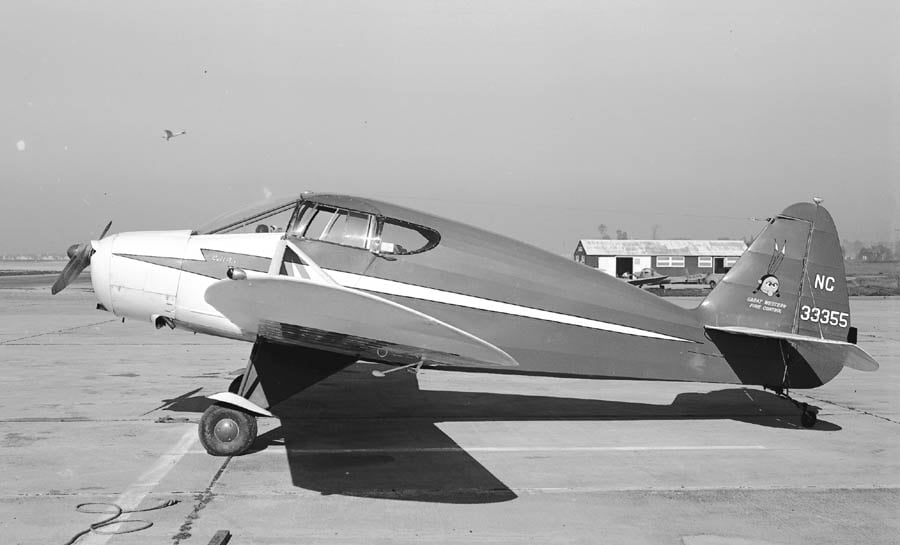
On December 10, 1946, a Marine Corps R5C transport, the Navy’s version of the Curtiss C-46, flew into the southwest side of Mount Rainier in a storm with thirty-two men aboard. The search had been called off after two weeks of December storms, and the families had posted a $5,000 reward. Pilots who worked the country around the mountain had fallen into the habit of spending an hour over the high plateau whenever they passed, and on Tuesday, June 24, 1947, Kenneth Arnold was one of them. He was thirty-two, six feet tall and two hundred pounds, a former University of Minnesota swimmer and footballer who sold fire-fighting equipment across the Northwest through his own company, Great Western Fire Control Supply of Boise. He flew to his customers in a CallAir A-2, a three-seat plane built in Afton, Wyoming, for mountain work, which he had bought in January for $5,000, the same sum as the reward. By his own count he had four thousand hours over mountain country since 1944 and had landed in 823 cow pastures; he flew Idaho Search and Rescue mercy flights, was a flying deputy of the Ada County sheriff’s aerial posse, and as a relief deputy U.S. marshal frequently flew federal prisoners to McNeil Island. That morning he had installed fire equipment for Central Air Service at Chehalis, and while talking with the firm’s chief test pilot, Herb Critzer, about where the Marine plane might lie, he decided to go and look. He took off for Yakima at about two o’clock.
Sources: The Coming of the SaucersA Curtis Commando R5C transport plane crashes into Mount Rainier, killing 32 U.S. Marines, on December 10, 1946Kenneth Arnold’s written report to the Army Air ForcesMemorandum for the Officer in Charge · Incident 4AF 1208 I
The flash
He climbed to about 9,500 feet, the height of the plateau from which Rainier rises, made one sweep along the ridges toward Ashford, saw nothing, and turned above the little town of Mineral to try again, settling at 9,200 feet. “The air was so smooth that day that it was a real pleasure flying,” he wrote three weeks later, and he trimmed the plane for Yakima and sat watching the sky. A DC-4 was fifteen miles off to his left and rear, at about 14,000 feet. He had been on course for two or three minutes when “a bright flash reflected on my airplane.” His first thought was that some lieutenant in a P-51 fighter had buzzed him. He searched the sky for the other aircraft and found nothing until he looked north of Rainier, where a chain of nine peculiar craft was coming down the mountains from the north on a heading of about 170 degrees, nearly due south, and near his own altitude. Every few seconds two or three of them would dip or change course “just enough for the sun to strike them at an angle that reflected brightly on my plane.” He assumed they were jets. As they neared Rainier he saw their outlines against the snow and noticed the detail he would repeat for the rest of his life: “I thought it was very peculiar that I couldn’t find their tails.” They flew, he wrote, “like many times I have observed geese to fly in a rather diagonal chain-like line as if they were linked together,” holding a definite direction but swerving in and out of the high peaks. In 1952 he added details that are not in his typed report: the objects had come from the vicinity of Mount Baker, more than a hundred miles to the north, and the first craft flew higher than the last, an echelon “backward from that practiced by our Air Force,” with a larger gap between the first four and the last five.
Sources: Kenneth Arnold’s written report to the Army Air ForcesThe Coming of the SaucersThe June 26, 1947 interview on KWRC radio, by Ted Smith
One minute and forty-two seconds
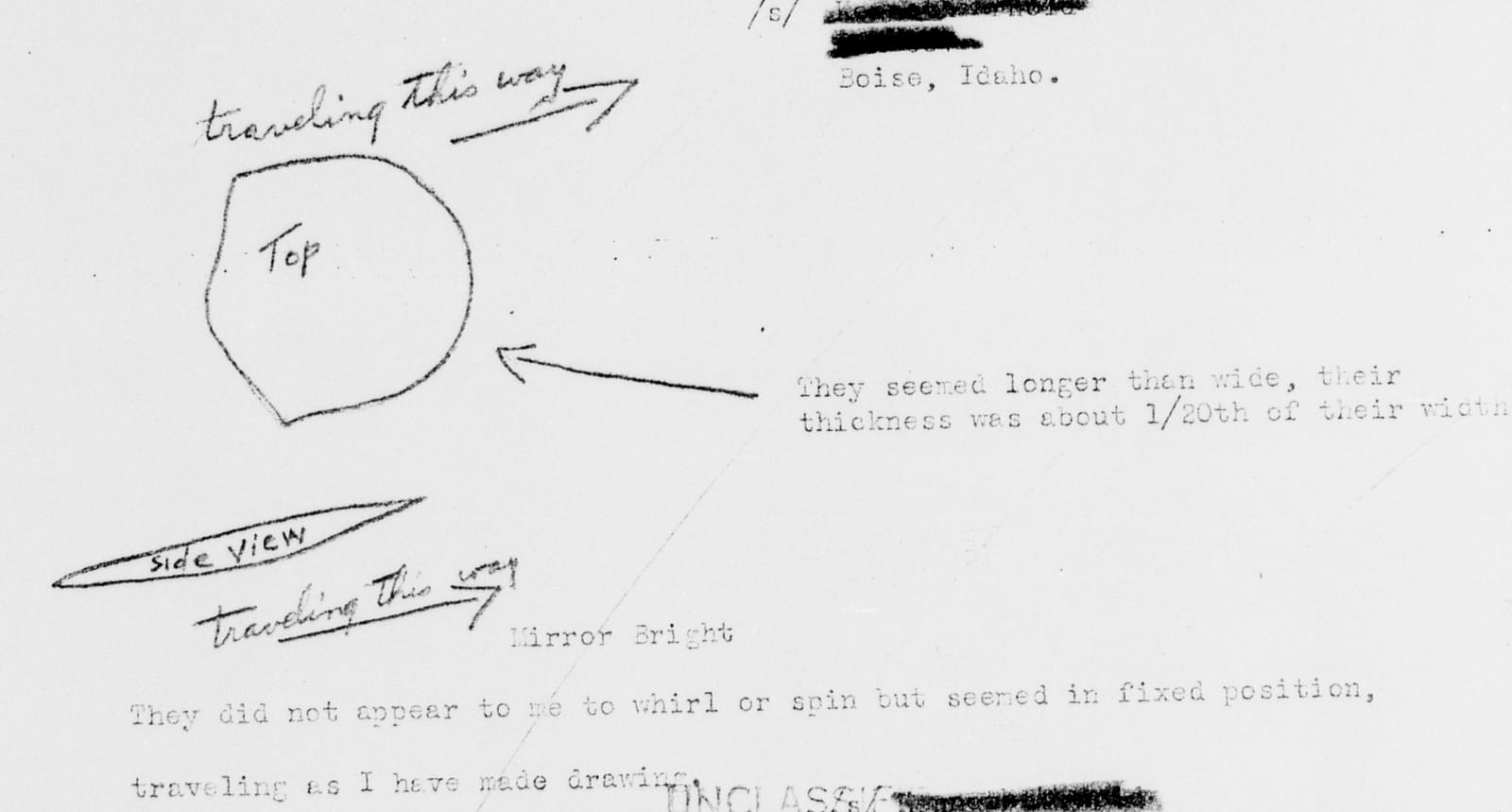
Pilots argue about speed, and Arnold had two markers to clock by. As the first object passed the southern edge of Rainier, the sweep second hand of the eight-day clock on his instrument panel read one minute to three. He watched the chain flip and flash down the hogback of the range. When the lead object cleared the southern end of a high snow-covered ridge between Rainier and Adams, the last was just entering its northern end; he flew over that ridge afterward and measured it at about five miles, so the chain was at least that long. As the last unit passed the southernmost crest of Mount Adams he looked at the clock again: one minute and forty-two seconds. His distance from their path, almost at right angles, he put at twenty to twenty-five miles, and he judged their size with a tool from his pocket. “In fact I compared a zeus fastener or cowling tool I had in my pocket with them—holding it up on them and holding it up on the DC-4,” he wrote, and they seemed smaller than the airliner, with a span about the width between its outboard engines. Because reporters had already suggested a reflection or mirage, he added that he had “turned my airplane sideways where I could open my window and observe them with a completely unobstructed view. (Without sun glasses)” Flying straight and level “they were just a black thin line,” and only when they flipped could he judge their size; when the sun caught them they looked completely round. The whole observation lasted two and a half or three minutes, and by Mount Adams he could follow them only by their flashes. His drawing for the Army showed a shape something like a heel, rounded in front with the flat, cut-off edge at the rear, and the note “They seemed longer than wide, their thickness was about 1/20th of their width,” and beside a side view like a knife blade the words “Mirror Bright.”
Sources: Kenneth Arnold’s written report to the Army Air ForcesProject Blue Book case file: Mt. Rainier, Washington, June 1947
Yakima, and the arithmetic at Pendleton
He kept searching for the Marine plane for another fifteen or twenty minutes, took a last look at Tieton Reservoir and headed for Yakima, where he landed at about four. He went straight to Al Baxter, the general manager of Central Aircraft there, and drew him pictures in his private office. Baxter, Arnold said on the radio two days later, told him “I guess I better change my brand,” and a helicopter pilot called in to listen said, as Arnold recalled it in 1952, “Ah, it’s just a flight of those guided missiles from Moses Lake.” Arnold had never heard of guided missiles at Moses Lake, but for a while it satisfied him. Flying on to Pendleton, Oregon, he pulled his map from its snap folder and tried to do the mathematics with a ruler while flying the airplane, and gave up. At Pendleton, he wrote, “there was quite a group of people to greet me. When I got out of my plane no one said anything. They just stood around and looked at me.” Word had gone ahead from Yakima. The pilots on the field sat down and started figuring, and “when it kept coming out in excess of seventeen hundred miles an hour I thought ‘Holy smoke, we’re taking the measurement of distance far too high up on both Mount Rainier and Mount Adams.’” They measured between the bases of the two mountains instead, 39.8 miles, and still had more than 1,350 miles an hour. On the air he said he had rounded it down to “around 1200 miles an hour,” allowing for error, and that even giving them three or four minutes “they’re still going more than 800 miles an hour.” The fastest aircraft any pilot conceded existed did about seven hundred. Several former Army pilots said they had been briefed before going overseas to expect objects of similar shape, and Sonny Robinson, a crop duster who had flown for the Army Air Forces, told him, “What you observed, I am convinced, is some type of jet or rocket propelled ship that is in the process of being tested by our government or even it could possibly be by some foreign government.” Arnold went to bed that night believing the objects were “guided missiles, robotly controlled.”
Sources: Kenneth Arnold’s written report to the Army Air ForcesThe Coming of the SaucersThe June 26, 1947 interview on KWRC radio, by Ted Smith
Seven sentences at the bottom of page one
The next morning he tried the FBI office in Pendleton, found it closed, and walked into the East Oregonian. Bill Bequette, a twenty-eight-year-old reporter, remembered it forty years later for the French sociologist Pierre Lagrange: “Both Nolan Skiff and I were in the office, which was small, when Mr. Arnold came in… That first meeting probably lasted no more than five minutes. Nolan jotted down a few notes, then wrote a short story, which I squeezed into the bottom of page one. Then I punched an even shorter (as I recall) version into the AP wire.” The story that ran on June 25 under the headline “Impossible! Maybe, But Seein’ Is Believin’, Says Flier” was 191 words long by the paper’s own count. It said Arnold “sighted nine saucer-like aircraft flying in formation at 3 p.m. yesterday, extremely bright – as if they were nickel plated – and flying at an immense rate of speed,” that he had clocked them from Rainier to Adams “at the amazing speed of about 1200 miles an hour,” and that a man from Ukiah he met in Pendleton that morning had seen the same objects from the mountains. It quoted him: “It seemed impossible, but there it is – I must believe my eyes.” Bequette went to lunch. “When I returned to the office after lunch, the receptionist’s eyes were as big as saucers – the kind we use under coffee cups! She said newspapers from all around the country and Canada had been calling.” He spent two hours with Arnold in his hotel room and phoned forty column inches to the Associated Press in Portland; the next morning almost every paper in the country had the story on page one. The Chicago Tribune had Arnold saying the objects “went by me like a rifle bullet,” and that “about half the fellows at the airport asked me what brand I had been drinking… but I don’t drink and I know what I saw.” On June 26 Ted Smith of Pendleton station KWRC sat him in front of a microphone, and a disc of that broadcast, which Arnold later sent to the magazine editor Ray Palmer, lay in Palmer’s papers until Lagrange found it in 1988. On it Arnold describes a chain “like the tail of a Chinese kite,” objects that flipped and flashed “just like a mirror,” and a shape “something like a pie plate that was cut in half, with a sort of a convex triangle in the rear.” He said he would confirm it “with my hands on a Bible because I did see it.”
Sources: Impossible! Maybe, But Seein’ Is Believin’, Says FlierThe Ultimate ArnoldSees Mystery Aerial ‘Train’ 5 Miles LongThe June 26, 1947 interview on KWRC radio, by Ted SmithFlying saucers still evasive 70 years after pilot’s report
The word
Nobody in Pendleton wrote “flying saucer.” The East Oregonian never used the phrase in its own staff-written stories; “flying disc” reached its pages in an AP story on June 27 and Bequette’s own copy on June 28, and “flying saucers” arrived on June 30 inside a wire story about a La Grande minister. The AP dispatch printed across the country on June 26 spoke of nine “saucer-like objects flying at ‘incredible’ speed,” and it was a headline writer at the Chicago Sun who put, over that dispatch, “Supersonic Flying Saucers Sighted by Idaho Pilot.” Arnold spent the rest of his life insisting the word had described motion, not shape. “When I described how they flew, I said that they flew like they take a saucer and throw it across the water,” he told Edward R. Murrow on CBS in April 1950. “Most of the newspapers misunderstood and misquoted that too. They said that I said that they were saucer-like; I said that they flew in a saucer-like fashion.” Murrow called it “an historic misquote,” Edward Ruppelt, the Air Force captain who later ran Project Blue Book, repeated it as fact in his 1956 book, and it appears in the Air Force’s own summary of the case. The 1947 record is less tidy. The skipping-saucer line does not appear in any document from that year; the first paper called them “saucer-like aircraft,” the Chicago Tribune had “shaped like a pie plate,” and Arnold’s own report to the Army, written in July, twice calls them “saucer like objects” and “saucer-like disks.” Bequette, asked in 1988, would not settle it: “I don’t remember whether or not Arnold used the words ‘saucer-shaped craft.’ I am inclined to credit his version… knowing the tendency of journalists to rephrase. I’m sure I didn’t coin ‘Flying Saucers.’” The Spokane Daily Chronicle, for a day, tried “flying piepans.” Saucers won.
Sources: Flying saucers still evasive 70 years after pilot’s reportSupersonic Flying Saucers Sighted by Idaho PilotKenneth Arnold and Flying SaucersTranscript of Ed Murrow–Kenneth Arnold telephone conversationKenneth Arnold’s written report to the Army Air ForcesProject Blue Book case file: Mt. Rainier, Washington, June 1947
The summer of the saucers
Arnold’s story broke a dam. Ted Bloecher, who read through more than 140 newspapers for his 1967 study, counted twenty reports for June 24 alone, all but two in the Pacific Northwest, against six the day before, and more than 850 for June and July, with the crest around July 7. A railroad engineer near Joliet, Illinois, had seen nine discs at ten to two that afternoon; a Richland man named Bernier wrote to a Portland paper that he had seen three objects heading toward Rainier half an hour before Arnold; a fire lookout at Diamond Gap reported flashes over Rainier at three; a Sidney B. Gallagher, somewhere in Washington, reported nine shiny discs flashing north at the same hour. On the Fourth of July a United Air Lines DC-3 out of Boise, Captain E. J. Smith and co-pilot Ralph Stevens, watched two groups of flat discs for more than ten minutes over Emmett, Idaho, after calling the stewardess forward without telling her what to look for; on July 7 a Phoenix man photographed a heel-shaped object late in the afternoon; on July 8 the Army announced it had a flying disc at Roswell. The explanations arrived as fast as the reports: reflections off his instrument panel, snow blindness, jet exhausts, meteorites, even the aluminum discs from bottle caps blown up a chimney. In Pendleton a woman ran out of a café crying that there went the man who saw the men from Mars; in Texas a preacher told his flock the end of the world was at hand; and Arnold told a wire-service reporter on June 27, “This whole thing has gotten out of hand. I want to talk to the FBI or someone. Half the people look at me as a combination of Einstein, Flash Gordon and screwball. I wonder what my wife back in Idaho thinks.” He bought a movie camera with a telephoto lens and swore never to fly without one. “After three days of this hubbub I came to the conclusion that I was the only sane one in the bunch,” he wrote; he thought “it wouldn’t be long before there would be one of these things in every garage,” so he cranked up his airplane and flew home to Boise. There Dave Johnson, the aviation editor of the Idaho Statesman, came to see him, and the doubt in Johnson’s eye told Arnold something he had not considered: if the Statesman’s military-aviation man did not know of any such missile, then whatever he had seen “did not belong to the good old U.S.A.” Johnson’s editors sent him up to bring back a saucer; on July 9, in a National Guard AT-6 trainer at 14,000 feet over Anderson Dam, he saw a black round object roll to a thin line and vanish, and got nothing on his film. A Gallup poll in August found nine Americans in ten had heard of flying saucers, more than had heard of the Marshall Plan.
Sources: Report on the UFO Wave of 1947Kenneth Arnold UFO sightingThe Coming of the SaucersFlying Saucers in Washington
Two officers in an A-26
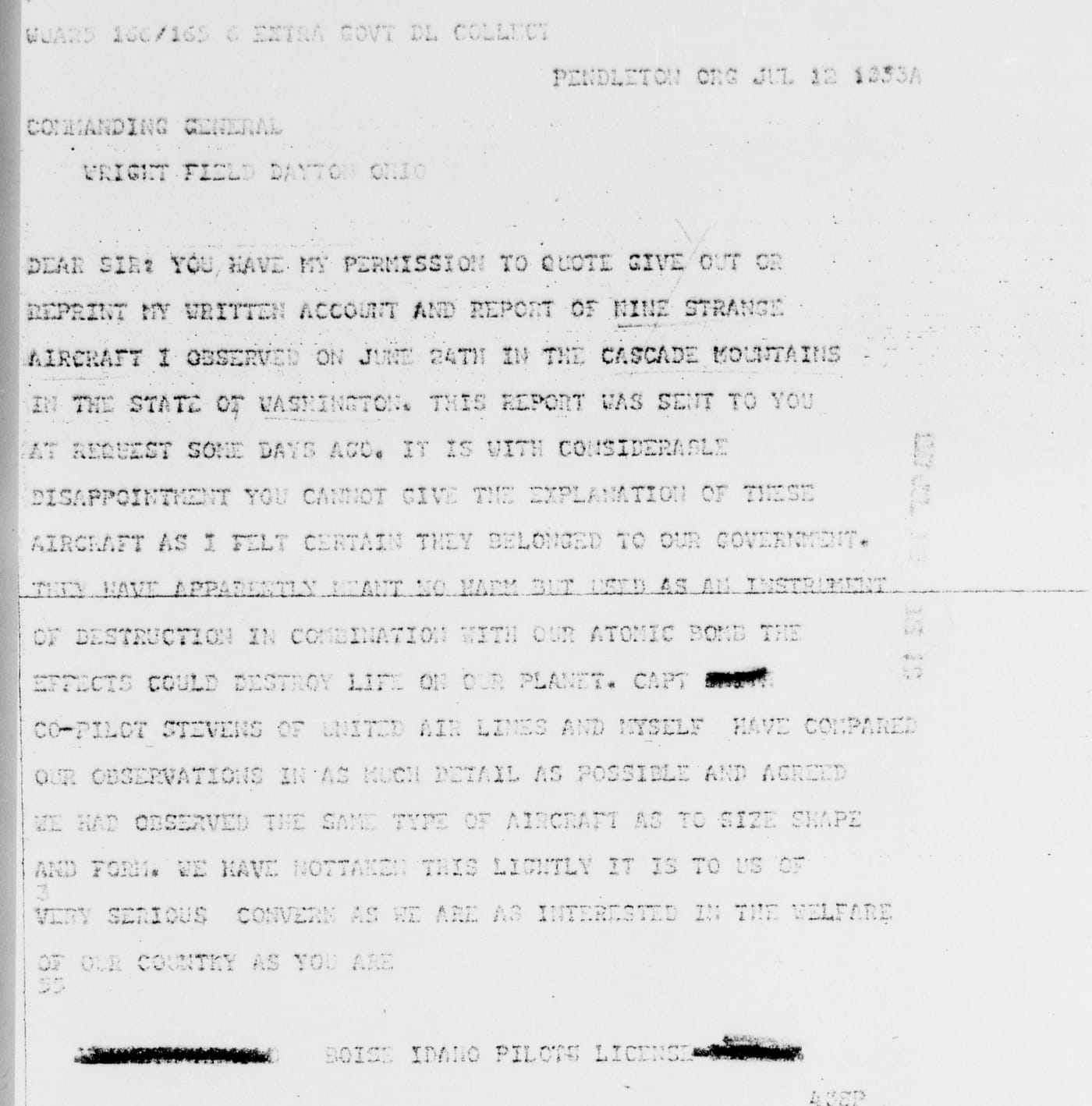
For nearly three weeks the Army and the FBI left him alone, and his July report complains of it: “Even though I openly invited an investigation by the Army and the FBI as to the authenticity of my story or a mental or a physical examination as to my capabilities, I have received no interest from these two important protective forces of our country.” In the days after the Fourth of July the Fourth Air Force’s intelligence office at Hamilton Field was told to open a file, and on July 12 Lieutenant Frank M. Brown and Captain William Davidson from that office flew to Boise in an A-26 bomber to see him. They took Arnold and his wife Doris to dinner at the Hotel Owyhee, went out to the airport at 9:30 to catch Captain Smith of United passing through, found Dave Johnson waiting there too, and then sat late in the Arnolds’ living room after the two little girls were put to bed, drawing pictures and going through the mail. Arnold handed them a carbon of the account he had already mailed to Wright Field, and that same day wired the commanding general there: “YOU HAVE MY PERMISSION TO QUOTE GIVE OUT OR REPRINT MY WRITTEN ACCOUNT AND REPORT OF NINE STRANGE AIRCRAFT… IT IS WITH CONSIDERABLE DISAPPOINTMENT YOU CANNOT GIVE THE EXPLANATION OF THESE AIRCRAFT AS I FELT CERTAIN THEY BELONGED TO OUR GOVERNMENT.” Used “AS AN INSTRUMENT OF DESTRUCTION IN COMBINATION WITH OUR ATOMIC BOMB,” he added, “THE EFFECTS COULD DESTROY LIFE ON OUR PLANET.” Brown’s memorandum of July 16 may be the kindest thing the government ever wrote about him: “It is the personal opinion of the interviewer that Mr. Arnold actually saw what he stated that he saw… if Mr. Arnold can write a report of the character that he did while not having seen the objects that he claimed he saw, it is the opinion of the interviewer that Mr. Arnold is in the wrong business, that he should be writing Buck Rogers fiction.” Brown had checked the distances against Army charts and found Arnold’s figures “could very possibly be facts.” He recorded that Arnold’s business was suffering because crowds waited at every stop on his route, and that Arnold now said, “If I saw a ten story building flying through the air I would never say a word about it,” having been made “practically a moron in the eyes of the majority of the population of the United States.” Five days later a park ranger found the wreck of the Marine transport on the South Tahoma Glacier at 9,500 feet, the height at which Arnold had begun his search a month before. One thing Arnold told neither the officers nor Doris: that one of the nine had looked different from the rest.
Sources: Kenneth Arnold’s written report to the Army Air ForcesMemorandum for the Officer in Charge · Incident 4AF 1208 IThe Coming of the SaucersProject Blue Book case file: Mt. Rainier, Washington, June 1947
Maury Island and the B-25
Among the mail was a letter on the stationery of the Venture Press from a Raymond A. Palmer of Evanston, Illinois, whom Arnold had never heard of; Palmer edited the pulp magazine Amazing Stories, and Arnold later wrote that had he known, he probably would not have answered. Palmer wanted Arnold’s story and then wanted more: two “harbor patrolmen” in Tacoma, Harold Dahl and Fred Crisman, claimed to have seen a group of saucers and to have fragments of one. Would Arnold go and look? Dave Johnson told him he would be silly not to take the expense money, so he wired for $200, and it was waiting at Western Union the next morning. He took off from a cow pasture near his home at 5:30 on July 29, checked into room 502 of the Winthrop Hotel, and that evening Dahl told him the wildest story he had ever heard. Six doughnut-shaped craft a hundred feet across had appeared over Maury Island on June 21, one of them in trouble; it shed light white metal that fluttered down like “thousands of newspapers,” then a hail of hot black slag that injured his son’s arm and killed the dog, which they buried at sea. The next morning a man in a black suit driving a 1947 Buick had bought Dahl breakfast and known everything. Arnold called in Captain Smith, and a Tacoma reporter, Ted Morello of the United Press, began receiving anonymous calls repeating, word for word, conversations held in room 502. Brown and Davidson flew up in a B-25 on July 31, listened, collected a box of the slag and left after midnight for Hamilton Field. Their bomber took off from McChord Field at about 1:30 in the morning of August 1, caught fire and crashed near Kelso; two enlisted men parachuted, one of them a soldier hitching a ride, and the two intelligence officers died. The anonymous caller told Morello the plane had been shot down with a twenty-millimeter cannon. The Army said the left engine had lost its exhaust collector ring, and a week later a Fourth Air Force spokesman announced that the fragments were slag of a kind found “in great quantity” wherever there were smelters. The FBI’s file records Dahl saying that if the authorities questioned him he would tell them it was a hoax, and Ruppelt later called Maury Island “the first, possibly the second-best, and the dirtiest hoax in the UFO history,” noting that neither man was a harbor patrolman. Arnold never accepted that. When he and Palmer published the affair in 1952, wrote the Seattle historian Walt Crowley, “they introduced the now-popular themes of sinister ‘men in black’ and a government conspiracy.”
Sources: The Coming of the SaucersThe Report on Unidentified Flying ObjectsKenneth Arnold and the F.B.I.Flying Saucers in Washington
The one that looked different
On the night of July 31, in the Winthrop, Davidson took a piece of paper from his pocket and drew a picture: “It was a disk, almost identical to the one peculiar flying saucer that had been worrying me since my original observation—the one that looked different from the rest and that I had never mentioned to anyone.” The drawing, Davidson said, came from a photograph the Fourth Air Force had just received from Phoenix, the pictures William Rhodes had taken on July 7, and it showed a heel or crescent shape. In 1952 Arnold wrote that he had noticed one craft “darker and of a slightly different shape” and had been meaning to tell someone; the crescent went on the cover of his 1950 pamphlet, The Flying Saucer As I Saw It, and by the time he stood up at the First International UFO Congress in Chicago on the thirtieth anniversary, in June 1977, the difference had grown: the second from last “was not reflecting and it seemed to turn its rear end toward me… it was a very wraith-like looking thing, but it wasn’t round at all,” while the others “were rather like a tadpole,” with a little peak at the rear. The objects, he told the hall, flew “just as readily on edge as they did on a level,” and “if there was a human being in them, they would have been made into hamburger at the first turn.” Kevin Randle, who has spent years on the 1947 reports, thinks the crescent shows “the firm hand of Ray Palmer.” The July 1947 drawing, made before Arnold met Davidson, does show a shape with a blunt front and a pointed rear, and the KWRC recording has the half pie plate with a convex triangle behind. What changed over thirty years was not the shape so much as the certainty.
Sources: The Coming of the SaucersHow It All Began · Kenneth Arnold’s speech at the First International UFO CongressKenneth Arnold and Flying SaucersThe June 26, 1947 interview on KWRC radio, by Ted SmithKenneth Arnold’s written report to the Army Air Forces
Sky jellyfish
He kept seeing them. Flying into La Grande at 6:55 on the morning of July 29, on his way to Tacoma, he watched twenty or twenty-five brass-colored objects that looked like ducks veer away from his plane, and said nothing to the papers; farmers below had seen a peculiar cluster of birds. By 1950 he told Murrow he had seen the objects on three other occasions and that, “being a natural-born American, if it’s not made by our science or our Army Air Forces, I am inclined to believe it’s of an extra-terrestrial origin.” Later he went further and stranger. Near Susanville, California, on a later flight, he reported one saucer “as solid as a Chevrolet car” and a second he could see pine trees through. In 1955 he told the La Grande Observer the things were probably alive, “sort of like sky jellyfish,” and in a 1962 magazine piece he argued that the objects “are groups and masses of living organisms that are as much a part of our atmosphere and space as the life we find in the oceans.” That autumn he ran for lieutenant governor of Idaho as a Republican and lost to the incumbent, William Drevlow, with about 46 percent of the vote; in 1964 he flew a plane painted “Au-H2O-64,” gold and water in chemical shorthand, for Barry Goldwater’s presidential campaign. His daughter Kim, born in 1954, grew up with ten thousand letters in boxes and a family secret her mother told her as a girl: after the Knife and Fork Club, a national lecture circuit, withdrew an offer of $100 a day, a man drove her father into the desert outside Boise and told him that his own brother worked for the government, that he had watched the government eliminate its own men, and that Arnold should stop talking about saucers. Doris Arnold kept a letter in her own hand fearing their plane would be shot down on the way to a UFO convention in Mexico. When Erik Lacitis of the Seattle Times reached him by telephone in 1977, Arnold said: “I made my report because I thought it was my duty. It was the only proper and American thing to do. I saw what I saw.” He died of cancer at Overlake Hospital in Bellevue on January 16, 1984, aged sixty-eight, and was cremated; his ashes went to Doris.
Sources: The Coming of the SaucersTranscript of Ed Murrow–Kenneth Arnold telephone conversationKenneth Arnold UFO sightingInterview of the Month – Kim Arnold‘Flying saucers’ became a thing 70 years ago Saturday with sighting near Mount Rainier
The prospector with the spinning compass
The corroboration Arnold’s defenders return to most often arrived by mail. On August 20, 1947, a Portland prospector named Fred M. Johnson wrote to Fourth Air Force intelligence at Hamilton Field, in his own spelling: “I can say am a prospector and was in the Mt Adams district on June 24th the day Kenneth Arnold of Boise Idaho claims he saw a formation of flying disc. And I saw the same flying objects at about the same time. Having a telescope with me at the time I can asure you they are real and noting like them I ever saw before… they were Round about 30 feet in dimater tapering sharply to a point in the lead end in an oval shape. with a bright top surface. I did not hear any noise as you would from a plane. But there was an object in the tail and looked like a big hand of a clock shifting from side to side like a big magnet.” Hamilton Field forwarded it to the FBI with the remark that Johnson might have read the papers and that “this headquarters does not intend to investigate this incident.” An FBI agent did. His September report describes five or six objects seen for forty-five to sixty seconds at about a thousand feet through the telescope, and adds the detail that made the case: Johnson carried a combination compass and watch, and “immediately before he sighted the disc the compass acted very peculiar, the hand waving from one side to the other, but that this condition corrected itself immediately after the discs had passed out of sight.” The agent found him “a very reliable individual” who had prospected the Northwest for forty years. The Air Force’s reviewers in 1949, Hynek among them, thought the compass implied “fantastically large magnetic fields” and that Johnson might have shaped his story to the newspapers, yet the case stayed unexplained, the first Unidentified in the files that would become Project Blue Book. The two accounts do not match cleanly: Johnson counted five or six, not nine, described something at the tail of each where Arnold could find no tails at all, and mentioned no chain or formation.
Sources: Fred Johnson’s letter of August 20, 1947 and the Fourth Air Force cover letterKenneth Arnold and the F.B.I.The Ultimate ArnoldFlying Saucers
The file marked mirage
The Army’s first professional reading came from J. Allen Hynek, the Ohio State astronomer retained in 1948 by Project Sign, the Air Force’s first UFO study, who found Arnold’s numbers “mutually contradictory.” If the objects were really twenty to twenty-five miles away and twenty times as long as thick, then to show any detail they “must have been of the order of 100 X 2000 feet in size”; if they were fifty feet long, as Arnold guessed, “the objects must have been closer than a mile.” Taking a “reasonable limiting size” of 20 by 400 feet put them within six miles, where the angular speed Arnold saw worked out to at most 400 miles an hour. “In all probability, therefore,” Hynek signed off, “objects were much closer than thought, and moving at definitely ‘sub-sonic’ speeds,” and may have been “some sort of known aircraft.” Someone at the Aero-Medical Laboratory added that an object doing 1,200 miles an hour would not have been visible to the naked eye at all. Sign’s successor, Project Grudge, went further in its 1949 report: the incident “cannot bear even superficial examination” and was “largely responsible for subsequent reports.” Yet the card filed under June 24, 1947 does not say aircraft; it says “Other (MIRAGE),” and describes “large circular objects heading west” that “appeared as mirror-like reflections which dipped and twisted at a very high rate of speed.” An undated Air Force summary in the same file, which recomputes the run from Rainier to Adams as 47 miles in 102 seconds, “equivilant to 1656.71 miles per hour,” explains the verdict: the “smooth and crystal clear” air Arnold enjoyed “is an indication of very stable conditions which are associated with inversions.” Ruppelt described two factions at Wright Field. One held that the limits of human eyesight proved the objects were jets doing about 400. The other held that a mountain pilot who “was as familiar with the area around the Cascade Mountains as he was with his own living room,” and who had watched the objects pass behind a peak, had fixed their distance, in which case they were about 210 feet long and doing 1,700. “In 1947 this was a fantastic story,” he wrote, “but now it is just another UFO report marked ‘Unknown.’” Bloecher thought it “curious that the case is listed as a ‘mirage’ rather than as ‘possible aircraft.’”
Sources: Project Blue Book case file: Mt. Rainier, Washington, June 1947Project ‘Saucer’ press digestThe Report on Unidentified Flying ObjectsReport on the UFO Wave of 1947The Ultimate Arnold
Menzel’s six answers
Nobody worked harder to explain Arnold than Donald Menzel, the Harvard astronomer who made debunking saucers a second career. In Flying Saucers, in 1953, he could not understand “why the simplest and most obvious explanation of all has been overlooked”: he had watched, from the observatory at Climax, Colorado, “the billowing blasts of snow, ballooning up from the tops of the ridges,” and “these rapidly shifting, tilting clouds of snow would reflect the sun like a mirror,” sweeping along the hogback like a wave. Failing that, a sharp layer of haze could reflect the sun almost like a mirror. In 1963, with Lyle Boyd, he preferred a mirage in which the mountain peaks seemed to float above the chain, or, less probably, orographic clouds; a University of Washington meteorologist had matched a 1956 photograph of wave clouds over Pigtail Peak to the weather maps of June 1947, but the calm air Arnold described, Menzel decided, argued for the mirage. In his last book, published in 1977, he suggested raindrops on the windshield: “He would doubtless insist that there was no rain at the altitude at which he was flying. But many queer things happen at different levels in the earth’s atmosphere.” The physicist Bruce Maccabee, the case’s most persistent defender, counted six Menzel explanations, blowing snow, a haze layer, a mirage, orographic clouds, wave clouds and raindrops, and answers all of them with the sentence in Arnold’s report about opening his window. Ruppelt had already put the snow to a Northwest pilot and got “a flat ‘Impossible’”: “It’s impossible to get powder snow low in the mountains in June. Personally, I believe Arnold saw some kind of aircraft and they weren’t from this earth.”
Sources: Flying SaucersThe World of Flying SaucersThe Ultimate ArnoldThe Report on Unidentified Flying Objects
Pelicans, fireballs and the Tatoosh Range
The skeptical essayist Martin Kottmeyer opened his 1997 survey of the case with the line that “Arnold’s must be the most solved case in ufology,” and catalogued the solutions before adding his own, a flock of swans, which he called “painfully banal and devoid of poetry or grandeur.” The British researcher James Easton took the birds to Pacific Northwest ornithologists and came back with a better species. Michael Price of Vancouver proposed “a flock of non, or failed-breeder, southbound White Pelicans,” whose “comparatively vast white underwing area would reflect a ton of light in exactly the pattern described by Arnold”; American white pelicans have wingspans near ten feet, soar in chains without flapping, and flash when they bank. Easton published in Fortean Times in 2000, and the scorn of the UFO historian Jerome Clark gave the language a word, “pelicanist,” for anyone who would rather have any explanation than none; the British Fortean writer John Rimmer took it as a pen name. Maccabee’s reply is that birds would not pass Rainier and then Adams a hundred seconds later. The same summer Philip Klass, the aviation journalist who had spent decades debunking saucers, promoted the science writer Keay Davidson’s idea that Arnold had seen a procession of meteor fragments, since fireball falls peak in June and around three in the afternoon; Maccabee answered that Arnold used a clock, that 1,700 miles an hour is far below any meteoric speed, and that a real meteor would have crossed from Rainier to Adams in about ten seconds. Steuart Campbell decided Arnold had confused Rainier and Adams with Pinnacle Peak and Lookout in the Tatoosh Range, five miles apart, so that the “objects” were mirages of distant peaks effectively standing still. In 2014 James McGaha and Joe Nickell revived the mountain-top mirage in Skeptical Inquirer. Kottmeyer also raised the awkward fact that nothing between Rainier and Adams tops 8,200 feet, so there is no peak at Arnold’s altitude for the objects to have disappeared behind; Arnold said only that they vanished momentarily behind “a jagged peak that just juts out from the base of Mount Rainier proper.”
Sources: Resolving ArnoldFlight of FantasyNew Research Suggests Kenneth Arnold’s UFOs Were Meteor-FireballsThe Arnold Sighting: A Failed ExplanationThe Ultimate Arnold
The arithmetic, and what survives
Maccabee’s defense rests on the clock. From the flank of Rainier to the summit of Adams is about forty-five miles; add the five-mile chain and the last object covered roughly fifty miles in 102 seconds, about 1,760 miles an hour, at a time when nothing had flown faster than about 700, and Chuck Yeager would not break the sound barrier until October. Arnold, he argues, deliberately underestimated. Against Hynek’s visual-acuity objection he points to the report itself: Arnold could see the engines on a DC-4 fifteen miles away and compared their spacing to the objects, which is a measurement of his eyesight nobody thought to take. The weak point is size. Arnold’s 1947 comparison gave something smaller than a DC-4; by 1950 he was telling Murrow the wingspan was “at least 100 feet”; the figures in the files run from the 45 to 50 feet Arnold gave the Air Force, to Ruppelt’s 210, to Hynek’s two thousand, and Maccabee himself suspects Arnold overestimated the distance to the DC-4, which would make the objects larger than eighty feet. What the record holds is thin and precise: no photograph; a typed account and a drawing in a sixty-one-page government file that anyone can now read online; a radio disc that was lost for forty years; a reporter’s forty-year-old memory of a five-minute interview; and a prospector’s letter. Martin Shough, a British analyst who spent years on the case, wrote in 2017: “I am resigned to never knowing what Arnold saw.” The Air Force still lists it as a mirage, Arnold’s own trade thought it was guided missiles, the pelicanists have their birds, and the flash that lit up a CallAir cockpit at one minute to three on a clear June afternoon has no agreed cause after seventy-nine years.
Sources: The Ultimate ArnoldTranscript of Ed Murrow–Kenneth Arnold telephone conversationProject Blue Book case file: Mt. Rainier, Washington, June 1947‘Flying saucers’ became a thing 70 years ago Saturday with sighting near Mount Rainier
- 10 DEC 1946
A Marine R5C transport with thirty-two men aboard flies into Mount Rainier in a storm; the search is abandoned after two weeks and the families post a $5,000 reward.
- 24 JUN 1947 · ABOUT 2:00 PM
After installing fire equipment at Chehalis, Kenneth Arnold takes off for Yakima in his CallAir, planning an hour’s search on the Rainier plateau.
- ABOUT 2:59 PM
At 9,200 feet near Mineral, a flash lights his plane; the first of a chain of nine tailless objects passes the southern edge of Rainier as the panel clock reads one minute to three.
- ABOUT 3:01 PM
The last object clears the southern crest of Mount Adams; the clock shows one minute and forty-two seconds. He opens his window to be sure.
- ABOUT 4:00 PM
Arnold lands at Yakima and tells Al Baxter of Central Aircraft; a helicopter pilot blames guided missiles from Moses Lake.
- EVENING
At Pendleton a crowd is waiting on the ramp. Pilots work the map: 1,700 miles an hour peak to peak, 1,350 base to base. Arnold rounds it down to “around 1200.”
- 25 JUN 1947
Nolan Skiff and Bill Bequette of the East Oregonian run 191 words at the foot of page one and put “nine saucer-like aircraft” on the AP wire; by afternoon papers across the continent are calling.
- 26 JUN 1947
The Chicago Sun headlines the story “Supersonic Flying Saucers Sighted by Idaho Pilot.” Ted Smith interviews Arnold on KWRC, where he describes “a pie plate that was cut in half.”
- 27–30 JUN 1947
Reporters collect explanations: instrument reflections, snow blindness, jet exhausts, meteorites, bottle caps up a chimney. Arnold tells a wire service the thing has “gotten out of hand” and flies home to Boise.
- 4 JUL 1947
United Air Lines Flight 105 out of Boise, Captain E. J. Smith, watches two groups of discs for more than ten minutes over Emmett, Idaho; Arnold meets the crew in Seattle the next day.
- 7–9 JUL 1947
The wave crests. William Rhodes photographs a heel-shaped object over Phoenix; Roswell announces and retracts a captured disc; Dave Johnson of the Idaho Statesman sees a black disc from an AT-6 and gets nothing on film.
- 12 JUL 1947
Lieutenant Brown and Captain Davidson fly to Boise in an A-26, dine with the Arnolds and sit in their living room until late. Arnold wires Wright Field permission to publish his report.
- 16 JUL 1947
Brown’s memorandum: Arnold “actually saw what he stated that he saw,” or else “should be writing Buck Rogers fiction.”
- 21 JUL 1947
A ranger finds the Marine transport’s wreckage on the South Tahoma Glacier at 9,500 feet.
- 29 JUL 1947
With $200 from Ray Palmer, Arnold flies to Tacoma and hears Harold Dahl’s Maury Island story in room 502 of the Winthrop Hotel.
- 1 AUG 1947
Brown and Davidson’s B-25 crashes near Kelso after leaving Tacoma with a box of slag; both officers die.
- 20 AUG 1947
Prospector Fred Johnson writes to Hamilton Field that he saw the same objects from the Mount Adams district, and that his compass needle swung.
- 1948–1949
Hynek finds Arnold’s figures “mutually contradictory” and proposes subsonic known aircraft; Project Grudge says the report “cannot bear even superficial examination.” The card is marked mirage.
- 7 APR 1950
On CBS, Arnold tells Edward R. Murrow the papers misquoted him: “they flew in a saucer-like fashion.”
- 1952
The Coming of the Saucers, written with Palmer, adds Mount Baker, the backward echelon and the one craft that looked different.
- 1953–1977
Menzel proposes blowing snow, haze, a mirage, wave clouds and finally raindrops on the windshield.
- NOV 1962
Arnold, who has argued in print that year that the saucers are living organisms, loses the race for lieutenant governor of Idaho.
- JUN 1977
At the First International UFO Congress in Chicago he describes the tadpole shapes and the wraith-like second-from-last object.
- 16 JAN 1984
Kenneth Arnold dies in Bellevue, Washington, aged sixty-eight.
- 1988
Pierre Lagrange finds the KWRC disc in Ray Palmer’s papers and interviews Bill Bequette.
- 1997–2000
The fiftieth anniversary brings Maccabee’s 1,760 miles an hour, Klass’s meteors, Kottmeyer’s swans and Easton’s pelicans.
Sources & interviews
Kenneth Arnold’s written report to the Army Air ForcesProject 1947 · transcription of Exhibit A to the Fourth Air Force memorandum, from the Project Blue Book files · July 1947Project Blue Book case file: Mt. Rainier, Washington, June 1947National Archives catalog · NAID 28929152 · 61 scanned pages: the record card, Hynek’s analysis, Arnold’s telegram and typed account, the investigator’s narrative and the clippings the Air Force keptMemorandum for the Officer in Charge · Incident 4AF 1208 IFrank M. Brown · Counter Intelligence Corps, Fourth Air Force · July 16, 1947 · Project 1947 transcriptionThe June 26, 1947 interview on KWRC radio, by Ted SmithPatrick Gross · ufologie.patrickgross.org · transcript and audio of the disc Pierre Lagrange found in Ray Palmer’s papers in 1988Impossible! Maybe, But Seein’ Is Believin’, Says FlierEast Oregonian · Pendleton, Oregon · June 25, 1947, page 1 · transcription at ufologie.patrickgross.orgSees Mystery Aerial ‘Train’ 5 Miles LongChicago Daily Tribune · June 26, 1947, page 1 · transcription at ufologie.patrickgross.orgSupersonic Flying Saucers Sighted by Idaho PilotChicago Sun · June 26, 1947, page 2 · the earliest known “flying saucers” headline, transcribed on its Wikimedia Commons file pageTranscript of Ed Murrow–Kenneth Arnold telephone conversationCBS radio · April 7, 1950 · CUFOS Associate Newsletter, February–March 1984 · Project 1947The Coming of the SaucersKenneth Arnold and Ray Palmer · privately published, Boise and Amherst, Wisconsin · 1952 · Internet Archive scanI Did See the Flying Disks!Kenneth Arnold · Fate, vol. 1 no. 1 · spring 1948 · transcription at ufologie.patrickgross.orgHow It All Began · Kenneth Arnold’s speech at the First International UFO CongressChicago, June 1977 · Proceedings edited by Curtis G. Fuller, Warner Books, 1980 · transcription at ufologie.patrickgross.orgProject ‘Saucer’ press digestNational Military Establishment · April 27, 1949 · Hynek’s “certain inconsistencies” and the Aero-Medical Laboratory’s objection · Project 1947 transcriptionFred Johnson’s letter of August 20, 1947 and the Fourth Air Force cover letterProject 1947 · the Mount Adams prospector who wrote to Hamilton FieldKenneth Arnold and the F.B.I.John A. Keel · Flying Saucer Review vol. 32 no. 5 · 1987 · the FBI file on Arnold and the prospector, released under the Freedom of Information Act · reproduced at ufologie.patrickgross.orgReport on the UFO Wave of 1947Ted Bloecher · 1967 · with an introduction by James E. McDonald · 853 cases from more than 140 newspapersThe Report on Unidentified Flying ObjectsEdward J. Ruppelt · Doubleday · 1956 · chapter 3, the two factions at ATIC · Project GutenbergFlying SaucersDonald H. Menzel · Harvard University Press · 1953 · chapter 1, “The saucers start to fly” · Internet ArchiveThe World of Flying SaucersDonald H. Menzel and Lyle G. Boyd · Doubleday · 1963 · the section “Mirage or wave clouds?” · Project GutenbergThe Ultimate ArnoldBruce Maccabee · MUFON International Symposium, 1997, revised 2002 · PDF at nicap.orgResolving ArnoldMartin Kottmeyer · The REALL News · June and July 1997 · the catalogue of explanations and the swan hypothesisFlight of FantasyJames Easton · Fortean Times 137 · August 2000 · republished on the author’s blog in 2023, with the birders’ repliesNew Research Suggests Kenneth Arnold’s UFOs Were Meteor-FireballsPhilip J. Klass · Skeptics UFO Newsletter 46 · July 1997 · archived copyThe Arnold Sighting: A Failed ExplanationBruce Maccabee · nicap.org · reply to the meteor hypothesisKenneth Arnold and Flying SaucersKevin Randle · A Different Perspective · June 2012 · with David Rudiak on the Chicago Sun headlineA Curtis Commando R5C transport plane crashes into Mount Rainier, killing 32 U.S. Marines, on December 10, 1946HistoryLink.org · essay 7820 · the lost transport, the reward and the July 1947 discovery of the wreckFlying Saucers in WashingtonWalt Crowley · HistoryLink.org · essay 2067 · Maury Island and the birth of the men in blackFlying saucers still evasive 70 years after pilot’s reportPhil Wright · East Oregonian, reprinted in The Spokesman-Review · June 25, 2017 · Bequette, Skiff and the words the paper never used‘Flying saucers’ became a thing 70 years ago Saturday with sighting near Mount RainierErik Lacitis · The Seattle Times · June 2017 · including his 1977 telephone interview with ArnoldInterview of the Month – Kim ArnoldPaola Harris · paolaharris.com · November 7, 2011 · Arnold’s daughter on the letters, the lecture circuit and the family secretKenneth Arnold UFO sightingWikipedia · the case, the corroborating reports and the naming of the saucer, with its press citationsSpotted an error, or know a better source? Write to hello@uap.fun.
Connected files
Kenneth ArnoldThe pilot behind the report: his life before Rainier, the book with Palmer and why the case still matters.The Roswell incidentTwo weeks into the wave Arnold started, an Army press officer announced a captured disc and the world’s papers ran it.The Men in BlackHarold Dahl’s visitor in the black suit and the 1947 Buick, told to Arnold in a Tacoma hotel room, is where the legend begins.Inside Project Blue BookThe Air Force’s study of the saucers, whose files begin with Arnold’s report and still carry the case as a mirage.Discuss this case
Compare notes with other readers: witness details, sources, and the parts that still do not add up.
Open the discussion