Three men at the door
They arrive after you have seen something. Two or three men in dark suits and hats, pale or oddly tanned, speaking in stilted phrases, driving a black sedan that looks too new for its age. They know what you saw. They tell you not to talk about it. Then they leave, and nobody at the Air Force, the FBI, or the phone company will admit to having heard of them. That is the Men in Black of UFO lore, a figure that first took shape in a Connecticut attic in 1953, was named in a West Virginia paperback in 1956, and had become an international shorthand for the sinister side of the saucer mystery long before Hollywood gave it sunglasses. This field note follows the story from its first telling to the theories that try to explain it, and keeps the documented record separate from the tales that grew around it. Sources and image rights were reviewed September 18, 2026.
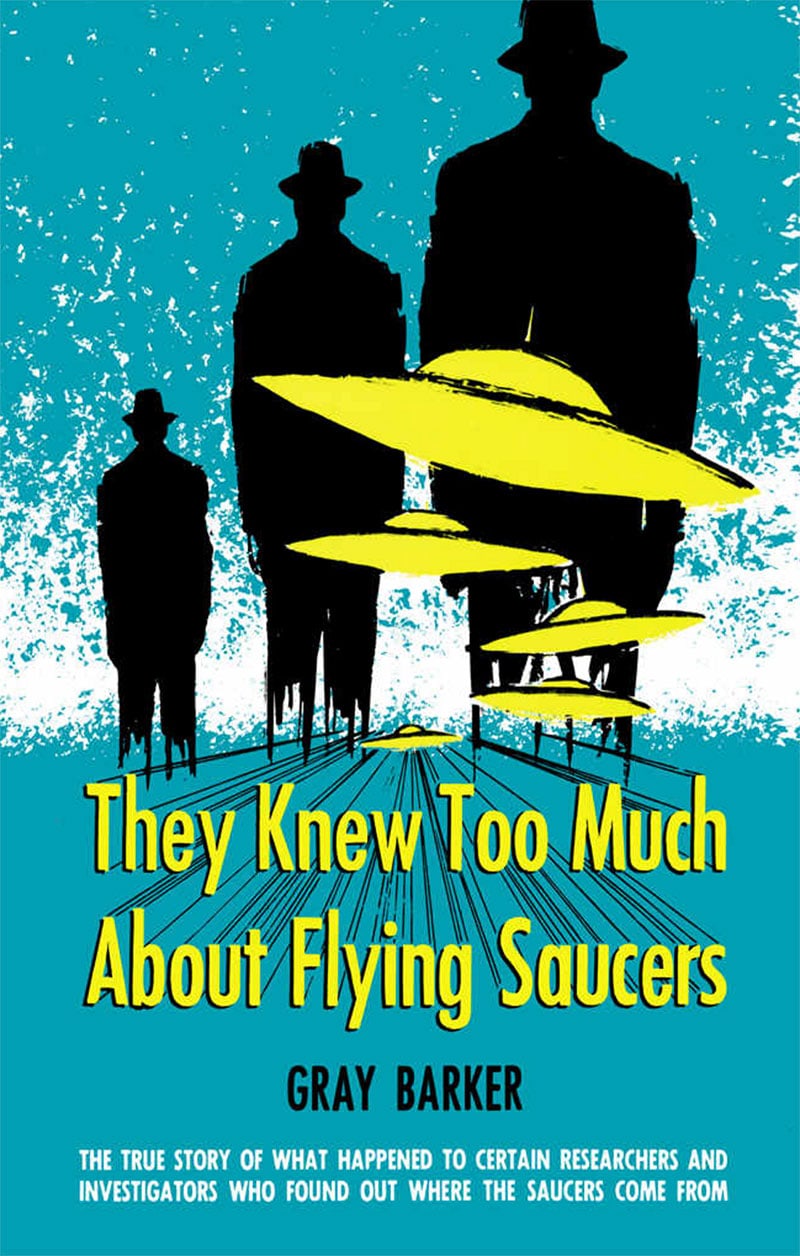
Sources: They Knew Too Much About Flying SaucersGray Barker and the Men in Black: They Knew Too Much About Flying Saucers
Maury Island, 1947: a stranger who knew too much
The earliest man in a black suit predates the term by years. Harold Dahl, a harbor patrolman and log salvager in Tacoma, Washington, said that on June 21, 1947, six doughnut-shaped objects hovered over his boat off Maury Island and one rained hot slag that killed his dog and burned his son’s arm. Early the next morning, Dahl told Kenneth Arnold, a man of about forty in a black suit knocked at his door and invited him to breakfast. He drove a 1947 Buick, looked “more the type of man who would be an insurance salesman,” and over eggs recited Dahl’s experience in detail before advising him that, if he loved his family, he should not discuss it. Dahl’s verdict at the time: “He sounded like some kind of a crackpot to me.” The story then turned deadly. Two Army Air Forces intelligence officers, Captain William Davidson and Lieutenant Frank Brown, flew to Tacoma to collect fragments, and their B-25 crashed near Kelso on August 1, 1947, killing both. FBI teletypes in the Bureau’s released files record the sequel: a laboratory found the fragments to be slag from a Tacoma smelter, and Dahl told agents he would call the story a hoax if questioned “because he did not want any further trouble.” Edward Ruppelt, who later ran Project Blue Book, called Maury Island “the dirtiest hoax in the UFO history.” Whether the breakfast stranger was invented, exaggerated, or real is unknowable now, but Gray Barker remembered him when Bender’s visitors came along, and the chain began.

Sources: The Coming of the SaucersFBI records on the 1947 flying discs, including the Maury Island teletypesThe Report on Unidentified Flying Objects
Bridgeport, 1953: Albert Bender closes the bureau
Albert K. Bender was a timekeeper at a shear factory who lived in an attic on Broad Street in Bridgeport, Connecticut, decorated, by his own delight, as a chamber of horrors. In April 1952 he founded the International Flying Saucer Bureau, a correspondence club that grew to several hundred members and published a quarterly called Space Review. In its October 1953 issue, Bender printed a “Statement of Importance” that ended the bureau: “The mystery of the flying saucers is no longer a mystery. The source is already known, but any information about this is being withheld by orders from a higher source.” It closed with a line that echoed for decades: “We advise those engaged in saucer work to please be very cautious.” On October 4, two of his lieutenants, August Roberts and Dominick Lucchesi, drove to Bridgeport to ask what had happened. Roberts took secret notes while feigning a stomach ache, and Barker later printed the exchange. Bender said he had written up his theory of the saucers and mailed it to a friend, and that three men then visited with his manuscript in hand. They were “pretty rough,” two talking while the third watched him without blinking. Asked what they wore, he answered: “They wore the same type of clothes and hats. Dark clothes and black hats.” One of them studied the wall map of bureau members and said, “God, but you’re all over the place!” Bender would not say whether they were from the government, only that he was “on your honor as an American” and would be jailed if he talked. In that first version, the visitors showed credentials, wore hats, and sounded like men.
Sources: They Knew Too Much About Flying SaucersBridgeport’s UFO legacy: Men in Black and the Albert K. Bender story
How Gray Barker gave the legend its shape
Gray Barker was a film booker in Clarksburg, West Virginia, who had drifted into saucer research after covering the Flatwoods Monster in 1952 and had become the bureau’s chief investigator. When Bender fell silent, Barker had a mystery of his own to sell. They Knew Too Much About Flying Saucers, published by University Books in New York in 1956, turned the Bridgeport interview, the Australian and New Zealand branch closures, and Maury Island into a single conspiracy told in breathless second person: “Three men in black suits with threatening expressions on their faces. Three men who walk in on you and make certain demands.” The book borrowed Donald Keyhoe’s idea of a “Silence Group” inside officialdom and ended with a warning to the reader: “They will be at your door, too, unless we all get wise and find out who the three men really are.” Barker was careful in one respect, admitting that “government men do not dress so conspicuously” and that he was not sure who the visitors were. He was less careful about facts. West Virginia University’s library, which holds related material, states the case plainly in a 2021 feature: Gray Barker invented the Men in Black. The claim is fair as far as the name and the mythology go, with the caveat that the raw material came from Bender and, before him, from Harold Dahl.
Sources: They Knew Too Much About Flying SaucersGray Barker and the Men in Black: They Knew Too Much About Flying SaucersA contactee canon: Gray Barker’s Saucerian Books
1962: the visitors become something else
Nine years later Bender told the story again, and it had changed. Flying Saucers and the Three Men, published by Barker’s own Saucerian Books in 1962, moved the visitors out of the Pentagon and into the occult. Now the trouble had begun with a stalker in a cinema whose eyes shone like flashlight bulbs, a bedroom glow that left a sulfurous smell, and a disembodied voice on World Contact Day in March 1953 telling him to stop delving into the mysteries of the universe. The three men in black, when they finally materialized in his attic, had glowing eyes, wore Homburg hats, and left a small metal disc that could summon them when Bender spoke the word “Kazik.” They carried him, he wrote, to a hidden base in Antarctica where saucers extracted a substance from seawater, and they revealed their true, monstrous form. Robert Bull’s 1997 BUFORA survey notes the central inconsistency: the 1962 book never mentions the manuscript Bender said had drawn the visitors in 1953. Bender married in 1954, moved to California, ran a motel, founded a society devoted to the film composer Max Steiner, and told Barker he would not write again on a subject as nonsensical as the saucers. He died in Los Angeles in March 2016 at ninety-four. Whether the second version was a memory, an embellishment, or a book written to order for his publisher is the question every later theory has to answer.
Sources: Men in Black: a preliminary reportBridgeport’s UFO legacy: Men in Black and the Albert K. Bender storyGray Barker, Albert Bender: “Men in Black” and the summer of 1954
The hoaxer’s confession
Barker’s reputation did not survive his friends. In 1998 John C. Sherwood, whom Barker had published as a teenager, revealed in the Skeptical Inquirer that Barker had coached him in 1968 to write as a fictional scientist, “Dr. Richard H. Pratt,” who claimed the “blackmen” had silenced him after he learned that saucers were time machines. The piece ran as fact in Ray Palmer’s magazine and Barker’s own outlets, and Barker wrote to Sherwood afterward: “Evidently the fans swallowed this one with a gulp.” Barker even asked other researchers for follow-up data on the missing Dr. Pratt. Four years later Sherwood published James Moseley’s judgment that Barker “pretty much took all of UFOlogy as a joke,” along with Barker’s private description of his paranormal titles as his “kookie books.” Moseley had his own confession: in 1957, at Barker’s house, the two of them used genuine State Department stationery to send George Adamski a letter from a nonexistent official, R. E. Straith, confirming his contacts. The FBI investigated and never caught them. Barker’s twenty-nine drawers of files, including the Straith correspondence and a Men in Black folder, are now the Gray Barker Collection at the Clarksburg-Harrison Public Library. Gabriel Mckee’s 2025 biography argues for a subtler verdict than fraud: Barker was a publisher and a hoaxer, but above all a myth-maker, and he may well have believed Bender at first.
Sources: Gray Barker: my friend, the myth-makerGray Barker’s book of bunkGeorge Adamski, R. E. Straith and the seven letters of mischiefThe Gray Barker UFO CollectionGray Barker’s legacy: Men in Black, the Philadelphia Experiment, and Mothman
1967: the Air Force warns its own bases
The one piece of official paper in the whole saga is real, and it is stranger than the skeptics usually allow. On March 1, 1967, Lieutenant General Hewitt T. Wheless, Assistant Vice Chief of Staff, sent a memorandum headed “Impersonations of Air Force Officers” to every major command. It began: “Information, not verifiable, has reached Hq USAF that persons claiming to represent the Air Force or other Defense establishments have contacted citizens who have sighted unidentified flying objects.” It cited two cases. In one, a man in civilian clothes who said he was from NORAD “demanded and received photos belonging to a private citizen,” widely read as a reference to the Santa Ana photographs of Rex Heflin. In the other, a man in an Air Force uniform gathered local police and witnesses in a schoolroom and “told them that they did not see what they thought they saw and that they should not talk to anyone about the sighting.” Anyone hearing of such reports was to notify the Office of Special Investigations at once. The photocopy reproduced here comes from John Keel’s files; Keel quoted the letter in The Mothman Prophecies but dated it February 15, so the document’s own date is used here. The memo does not say that the Men in Black exist. It says that someone was going around pretending to be the Air Force, that the Air Force could not verify who, and that it wanted to know. Keel, who had pushed the Pentagon on the subject, concluded for his part that he “could not honestly accuse” the service of running a wing of officers whose job was to squelch witnesses.
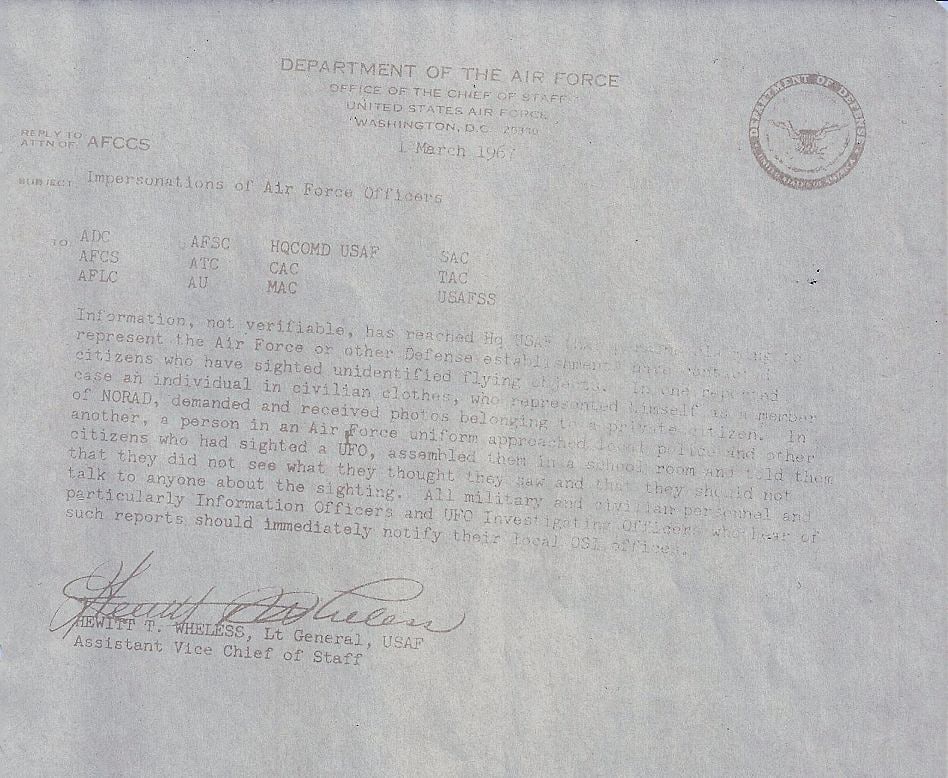
Sources: Organized harassment of individuals (7): the 1967 Air Force memo on impersonatorsThe Mothman Prophecies
Point Pleasant: Keel’s visitors in shiny old Cadillacs
John Keel coined the abbreviation “MIB” in a 1967 men’s-magazine article and made the figure famous in The Mothman Prophecies, his 1975 account of the year he spent chasing a winged creature, strange lights, and stranger callers around Point Pleasant, West Virginia. His best witness was Mary Hyre, the local correspondent for the Athens Messenger. In January 1967, she told him, a man about four and a half feet tall, wearing a short-sleeved shirt in freezing weather, walked into her office asking directions and edged closer and closer while staring through thick glasses. When her phone rang he picked up a ballpoint pen from her desk and examined it, she said, “as if he had never seen a pen before,” then cackled and ran into the night. In December a man with bulging eyes and long tapering fingers visited Hyre and then her niece Connie Carpenter, a Mothman witness, asking what Hyre would do if someone told her to stop writing about UFOs. Connie’s answer: “She’d probably tell them to drop dead.” Keel catalogued the tells that gave the visitors away. “They often arrived in old model cars which were as shiny and well kept as brand-new vehicles,” wore clothes out of fashion or not yet in it, carried brand-new wallets, and, in one Minnesota case, tried to drink a bowl of Jell-O. He also reported that his own phones rang with warnings and metallic voices. Folklorist David Clarke, who worked with Keel’s papers, notes that some of the contactee tales in Keel’s books were later exposed as hoaxes and that there is evidence Gray Barker himself placed at least one of the anomalous calls. A 2026 study in the journal Contemporary Legend treats the Point Pleasant visitors as a legend cycle mediated almost entirely through Keel and Hyre, in which each caller was different and only the halting, odd behavior stayed constant.
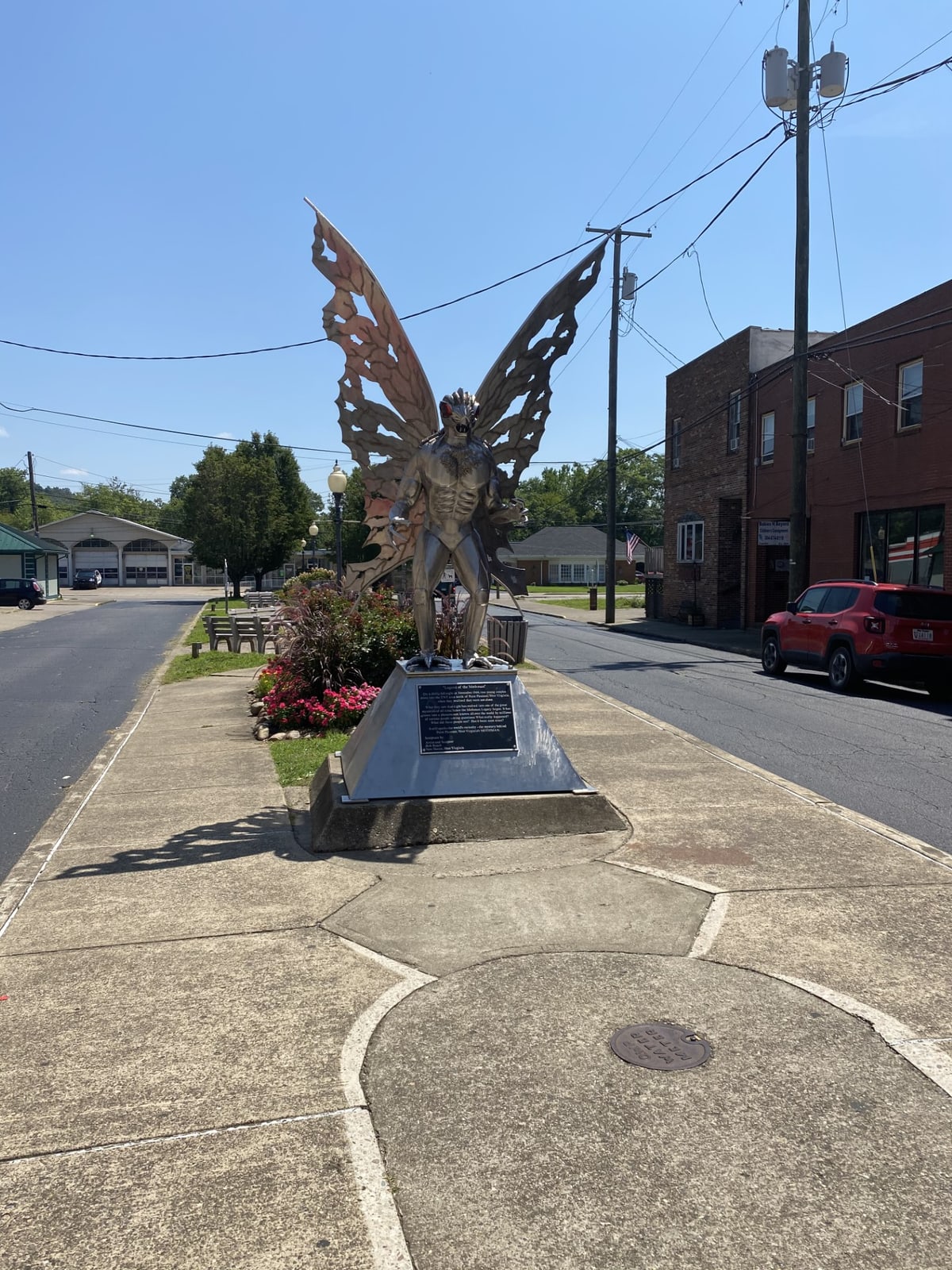
Sources: The Mothman PropheciesA new demonology: John Keel and The Mothman PropheciesThe Mothman: the migration of a local legend
Old Orchard Beach, 1976: the visitor who ran out of energy
The most unsettling single report belongs to Dr. Herbert Hopkins, a physician in Old Orchard Beach, Maine, who had been hypnotizing a young man named David Stephens about an abduction claim from the previous October. On the evening of Saturday, September 11, 1976, home alone, Hopkins took a call from a man who said he represented a New Jersey UFO research organization and asked to visit. Hopkins had barely put the phone down when the man was on the porch. He was completely hairless, without eyebrows or eyelashes, with dead-white skin and lips that appeared to be painted with lipstick, and he wore an immaculate black suit and grey gloves. He knew details of the Stephens case. He asked Hopkins to hold a coin in his palm, and the doctor watched it turn silver, then blue, then fade away. “Neither you nor anyone else on this plane will ever see that coin again,” the man said, and added that Barney Hill had died because he knew too much. He told Hopkins to destroy his tapes. His speech slowed, and he said, “My energy is running low. Must go now. Goodbye,” before walking stiffly out. Hopkins erased the recordings. The case was investigated by Shirley Fickett of Portland and published by psychiatrist Berthold Schwarz in Flying Saucer Review in 1977 and 1978, and it has been retold ever since as the moment the Men in Black stopped looking human. A dissenting account arrived in 2009, when Hopkins’s nephew wrote that his uncle was a fantasy-prone man who drank heavily and “sometimes just made things up.” Other relatives later disputed that description. The story rests on one witness either way.
Sources: They met the Men in Black, part two: the strange story of Dr. Herbert HopkinsHerbert John HopkinsThe sad truth behind an MIB story
A metal fragment in Ohio, a folklorist in a library
Two other reports show the range of the lore. On the night of July 13, 1967, Robert Richardson and a friend were driving near Whitehouse, Ohio, when a brilliant blue-white light blocked the road; they felt a bump, and then the road was empty. Richardson went back and found a small lump of metal, which he sent to the Aerial Phenomena Research Organization for analysis. According to APRO’s bulletin and Coral Lorenzen’s later books, two men visited him within days to ask questions, and a second, foreign-looking pair returned the following week demanding the fragment and hinting at harm to his wife. The Magonia catalogue that preserves the entry notes the dates differ between tellings and that no police record has surfaced. Thirteen years later the phenomenon reached a professional student of legend. In 1980 Peter Rojcewicz, then a folklore doctoral candidate at the University of Pennsylvania, was reading a UFO book in the library when he noticed a scuffed black shoe beside him. A gaunt, pale man in a black suit and string tie asked whether he had seen a flying saucer, then shouted, “Flying saucers are the most important fact of the century and you are not interested?” before touching his shoulder and saying, “Go well on your purpose.” The library seemed empty and silent as Rojcewicz walked out. He wrote the encounter into his 1987 paper in the Journal of American Folklore under a pseudonym and later described it to the Associated Press as an experience “in the crack” between the real and the imagined.
Sources: INTCAT 1967, July–December: the Richardson caseThe “Men in Black” experience and tradition: analogues with the traditional devil hypothesis“Men in Black” make visits in wake of UFOs
Signatures of a visitation
Across seventy years of reports, certain details recur so often that they have become the genre’s fingerprints. The car is a black sedan, usually a Cadillac, of a model years out of date yet spotless, sometimes with plates that no state has issued. The suit is black, the shirt white, the hat a fedora or Homburg long after hats went out of style. The skin is unnaturally pale or dark, the eyes unblinking, the hair absent or wig-like. Speech is monotone, formal, and slightly wrong, as if learned from a book. Ordinary objects puzzle them: a pen, a knife and fork, a bowl of Jell-O. They know what the witness saw before the witness has told anyone. They threaten, and the threat is never carried out. Nick Redfern, whose 2011 book The Real Men in Black compiles dozens of cases, put it this way: “They act odd, they look kind of weird and enigmatic, they wear clothes that went out of fashion 30-years ago.” Two readings of these signatures compete. One holds that they are exactly what an impostor with a limited wardrobe and a stolen script would produce. The other holds that they are the marks of something imitating a human being and not quite managing it. A third reading, favored by folklorists, notes that the details became fixed after Barker and Keel published them, so that later witnesses knew what a proper Man in Black should look like.
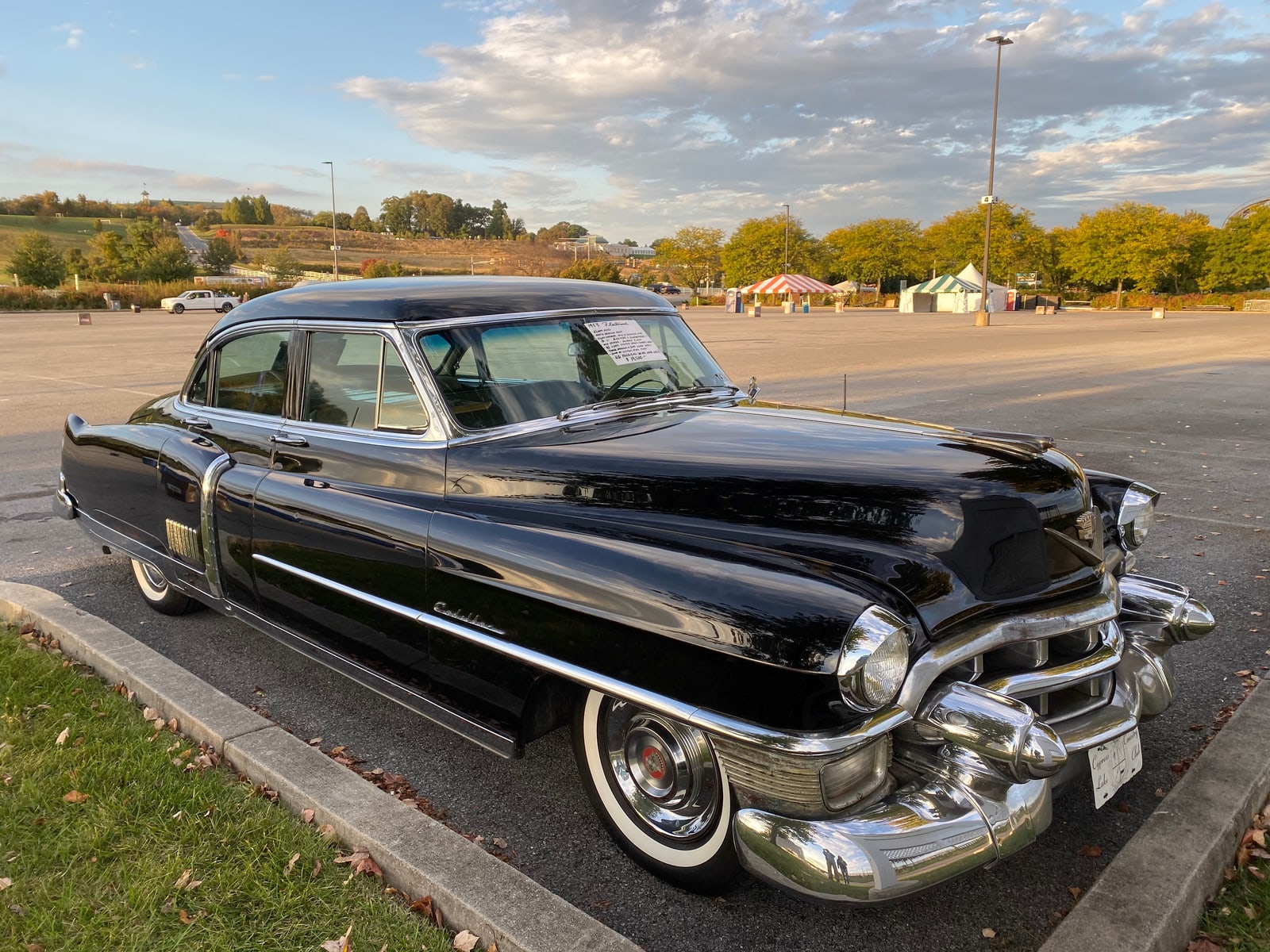
Sources: The Mothman PropheciesInterview with Nick Redfern: The Real Men in BlackMIB encounters
Theory one: government men
The oldest explanation is the one Bender first implied: the visitors were federal agents, and the saucer clubs were being watched. Parts of that are documented. In January 1953 the CIA convened a panel of scientists under H. P. Robertson, and its report singled out two civilian groups, the Civilian Flying Saucer Investigators and APRO, stating that “such organizations should be watched because of their potentially great influence on mass thinking” and that “the possible use of such groups for subversive purposes should be kept in mind.” The same report recommended a public program of “training and ‘debunking.’” Gerald Haines, writing the Agency’s own history in Studies in Intelligence in 1997, describes CIA officers quietly interviewing witnesses in the 1950s, the Agency refusing to confirm an officer’s employment when Donald Keyhoe asked, and officials agreeing that public knowledge of CIA interest “would make the problem more serious.” Haines adds that the panel, reporting at the height of McCarthyism, wanted the civilian groups monitored for subversive activities, and the Air Force’s own investigators really did call on Blue Book witnesses. The strongest modern example is Paul Bennewitz, the Albuquerque physicist whom Air Force Office of Special Investigations agent Richard Doty fed fabricated material in the early 1980s. On July 1, 1989, researcher William Moore stood before a MUFON audience and admitted he had helped, saying he would “play the disinformation game, get my hands dirty just often enough” to learn who was directing it. The case against the theory is the behavior. Real agents carry credentials that can be checked, do not marvel at ballpoint pens, and a government that wanted silence would not send men who guaranteed a story.
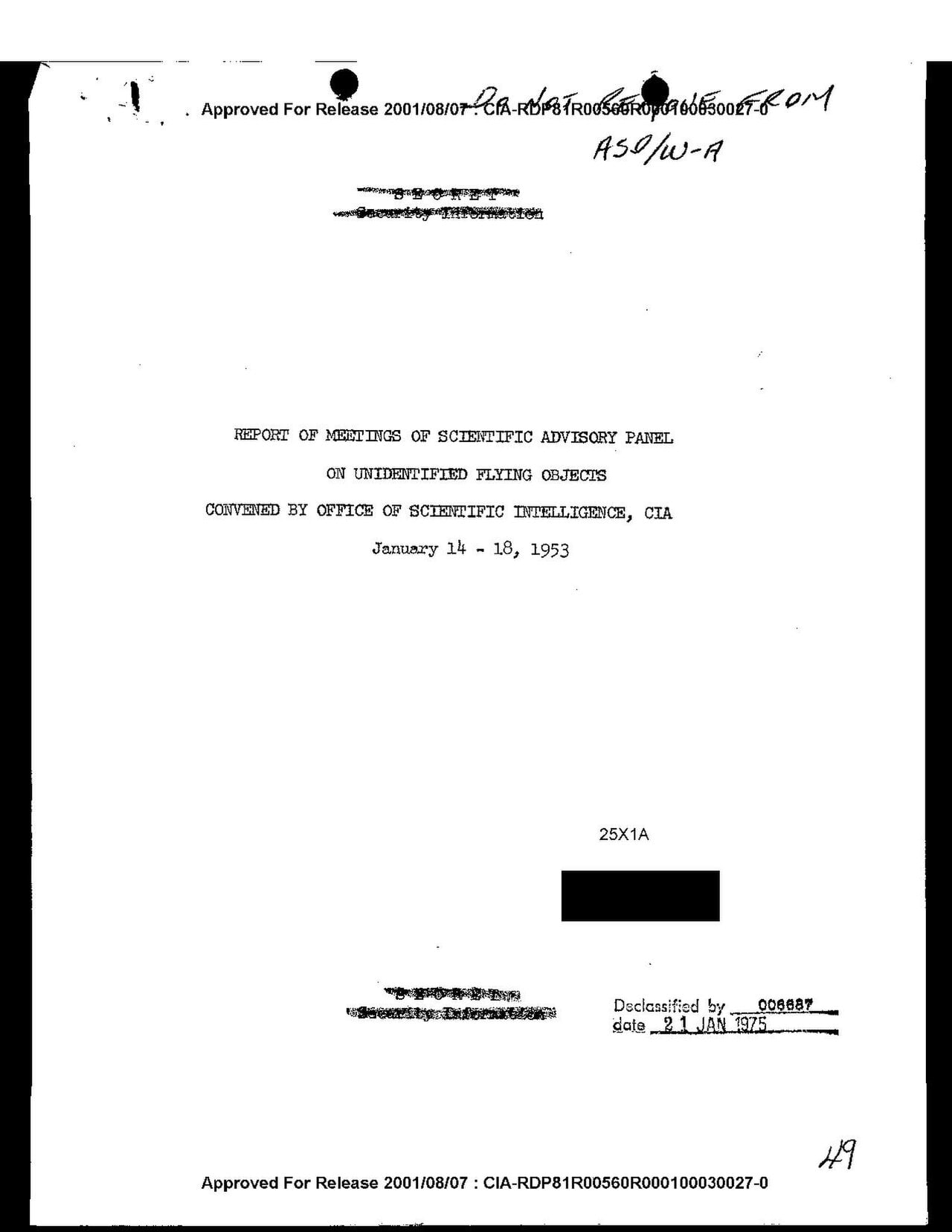
Sources: Report of the Scientific Advisory Panel on Unidentified Flying Objects, January 1953CIA’s role in the study of UFOs, 1947–90Bill Moore and the UFO disinformation accusationsThe Pentagon’s real Men in Black investigated Tom DeLonge’s UFO videos
Theory two: a story that learned to walk
The skeptical account does not need agents at all. Barker admitted hoaxes, Moseley admitted hoaxes, and Bender’s tale changed shape between 1953 and 1962 in ways that suited his publisher. Terence Hines, reviewing Mckee’s biography in 2026, credits Barker’s book with introducing the idea that anyone who knew too much would be visited by men in black, and Mckee shows how Barker fed the fiction back into ufology through his magazine, his press, and a stable of writers that included Keel and Timothy Green Beckley. Folklorists have a word for what happened next: ostension, the process by which people act out a legend they already know, so that real events begin to imitate the story. David Clarke argues that Keel’s reporting from Point Pleasant combined facts and ambiguous facts into new narratives that the media then presented as true accounts. Keel himself once became a Man in Black by accident: a Long Island witness received a warning call about a bearded stranger minutes before Keel arrived, and the neighbor who supposedly made the call denied it. The theory explains the origin of the literature well. It explains less well why later witnesses, some of them unfamiliar with Barker, described visitors with the same peculiar defects.
Sources: Gray Barker’s legacy: Men in Black, the Philadelphia Experiment, and MothmanA contactee canon: Gray Barker’s Saucerian BooksA new demonology: John Keel and The Mothman PropheciesMIB encounters
Theory three: the devil in a new suit
Rojcewicz’s 1987 paper proposed that the Men in Black are the latest form of a very old visitor. In European witch trials the devil appeared as a man in black who knew the accused’s secrets and demanded a pact; in folklore he is a shape-shifter, out of place in ordinary company, with something wrong about his feet, his eyes, or his speech. Rojcewicz argued that the UFO-era accounts share the structure and that folklorists should take seriously “the possibility that a real experience lies behind traditional belief,” while leaving open what kind of experience it is. Religion scholar Christopher Partridge has traced how evangelical writers absorbed the same material into a “demonic UFO hypothesis” in which the visitors are literal demons. Psychology offers a narrower tool for one class of case. Bender’s first manifestations were bedroom visits: a glow, a smell, a presence, a voice. Those are the classic features of the “intruder” hallucination of sleep paralysis, in which a sensed figure hovers in a dark room while the sleeper cannot move. The explanation fits Bender’s attic better than it fits Hyre’s office or Rojcewicz’s library, which is why the folkloric approach tends to treat the Men in Black as a family of experiences rather than a single event with a single cause.
Sources: The “Men in Black” experience and tradition: analogues with the traditional devil hypothesis“Men in Black” make visits in wake of UFOsAlien demonology: the Christian roots of the malevolent extraterrestrial in UFO religions and abduction spiritualitiesSleep paralysis: phenomenology, neurophysiology, and treatment
Theory four: ultraterrestrials and messengers of deception
Keel refused both the government reading and the spaceman reading. In The Mothman Prophecies he wrote that it was inconceivable to hardcore believers “that these men in black were residents of this planet associated with the UFOs,” and he built a framework in which the saucers, the Mothman, the poltergeists, and the callers were manifestations of a single intelligence he called ultraterrestrial, native to Earth and operating in a spectrum beyond human perception. His writing turned the Men in Black from clumsy agents into something closer to demons, and he said as much: to him, ufology was another name for demonology. Late in life Keel complicated his own legend. In a 1985 interview he insisted that “‘ultraterrestrials’ are a literary device, not a theory,” and in a letter to Fortean Times he wrote that what he had said in five books “is that we are the intelligence which controls the phenomena.” Jacques Vallée arrived at an adjacent position from a different direction. In Messengers of Deception, published in 1979, he proposed that the phenomenon behaves like a control system acting on human belief and that some of the manipulation is plainly human, carried out by groups with access to military, media, and government circles. A 1980 review in the British magazine Magonia complained that Vallée had adopted the paranoia inherent in intelligence-community thinking, which is a fair description of the book’s mood. Vallée did not name the Men in Black as its instrument, but he gave later writers a way to hold both theories at once: a real, unexplained phenomenon and human operators exploiting it.
Sources: The Mothman PropheciesA new demonology: John Keel and The Mothman PropheciesSecond look: Messengers of Deception
Theory five: not from here at all
The extraterrestrial theory is the one Bender settled on in 1962 and the one that popular culture would eventually adopt. Timothy Green Beckley’s 1990 compendium The UFO Silencers, introduced by Keel, gathers the cases in which the visitors seem least human: the hairless heads, the robotic gait, the monotone, the visitor who cannot hear unless he is facing the witness, the coin that dissolves, and Hopkins’s farewell about his failing energy. Beckley asks whether they are military agents, a secret government, or otherworldly entities, and notes that some “appear to be robots, and some wear lipstick and wigs.” Redfern, surveying the same material, concludes that “the real Men in Black may very well be the inhabitants of some other realm or dimension,” while allowing that the human-looking ones and the inhuman-looking ones may be two different things wearing one name. The difficulty is evidential. Every android-like report rests on a single witness, the flagship case was disowned by the witness’s own family, and Bender’s alien version was written for a publisher who admitted to inventing material. Nothing recovered from any visit, not a coin, a fragment, a photograph, or a license plate, has ever been examined by anyone outside the story.
Sources: The UFO Silencers: mystery of the Men in BlackInterview with Nick Redfern: The Real Men in BlackMen in Black: a preliminary report
From the pulps to the multiplex
The Men in Black were born in print and stayed there for forty years. Keel’s Saga article of October 1967 introduced them to a men’s-adventure readership; Beckley’s magazines kept them in circulation through the 1970s and 1980s; Barker returned to them in a 1983 book dedicated to Bender. In 1990 the comics writer Lowell Cunningham, who had heard the folklore from a friend after they spotted a black van, turned the silencers into the heroes of a small-press series in which a secret agency polices paranormal activity. The 1997 film adaptation kept the suits, added sunglasses and a memory-erasing flashlight, and made the phrase a household one. Jerome Clark of the Center for UFO Studies told Slate in 2012 that reports of the classic kind had tapered off in the fifteen years since the film, though not because of it, while Redfern disputed that any decline had occurred. The reports that do surface now tend to arrive on camera. In 2012 a research group released hotel lobby footage said to show two tall, identical, hairless men in black suits asking for a Niagara Falls hotel manager who had reported a triangular object in 2008. The clip appeared weeks before the third film opened, only the entrance footage was ever released, and the manager later joined the group that publicized it, which is why skeptics on Metabunk have filed it under promotion rather than evidence. Eight decades of retelling have not produced a Man in Black who could be interviewed twice.
Sources: Do UFO hunters still report “Men in Black” sightings?A contactee canon: Gray Barker’s Saucerian BooksClaim: Men in Black threatened a hotel manager in 2009
Where the record stands
Sorting the archive by what can be inspected is the most useful thing a reader can do. Documented: the FBI’s teletypes on Maury Island, the Robertson Panel’s recommendation that saucer clubs be watched, the CIA’s own history of its witness contacts, the 1967 Air Force memorandum on impersonators, Sherwood’s and Moseley’s confessions, and Moore’s 1989 admission about the Bennewitz operation. Reported by one person and never corroborated: Dahl’s breakfast companion, Bender’s three men in either version, Hopkins’s hairless visitor, Hyre’s pen-examining caller, Rojcewicz’s library stranger. Between those two piles sits everything that makes the legend endure: a real government that really did want the subject quiet, real hoaxers who really did invent visitors, and real witnesses who described the same wrong details decades apart. If the Men in Black were only agents, they would have left paperwork; if they were only fiction, they would have stopped visiting people who had never read Barker. Anyone who wants to test the theories can start with the same material this page used: the full texts of Arnold, Barker, and Keel, the released FBI and CIA files, and the Barker papers in Clarksburg, where the letters that built the myth are waiting in twenty-nine file drawers.
Sources: FBI records on the 1947 flying discs, including the Maury Island teletypesReport of the Scientific Advisory Panel on Unidentified Flying Objects, January 1953Organized harassment of individuals (7): the 1967 Air Force memo on impersonatorsGray Barker: my friend, the myth-makerThe Gray Barker UFO Collection
Sources & media
The Coming of the SaucersKenneth Arnold and Ray Palmer · 1952 · Full text at the Internet Archive · Harold Dahl’s account of the man in the black suitFBI records on the 1947 flying discs, including the Maury Island teletypesFederal Bureau of Investigation · Released under FOIA · Transcribed at Project GutenbergThe Report on Unidentified Flying ObjectsEdward J. Ruppelt · 1956 · Full text at Project Gutenberg · The former Blue Book chief on Maury IslandReport of the Scientific Advisory Panel on Unidentified Flying Objects, January 1953Central Intelligence Agency · The Robertson Panel report, reproduced as Appendix U of the Condon ReportThey Knew Too Much About Flying SaucersGray Barker · University Books · 1956 · Full text at the Internet Archive · The book that launched the legendBridgeport’s UFO legacy: Men in Black and the Albert K. Bender storyMichael Bielawa · Bridgeport History Center, Bridgeport Public Library · Local history of the IFSBMen in Black: a preliminary reportRobert Bull · BUFORA · August 1997 · Chapter-by-chapter summary of Bender’s 1962 book and the Jarrold and Fulton filesGray Barker, Albert Bender: “Men in Black” and the summer of 1954David Halperin · January 9, 2020 · A religious-studies scholar reads the Barker–Bender lettersOrganized harassment of individuals (7): the 1967 Air Force memo on impersonatorsJohnKeel.com · Doug Skinner · March 5, 2014 · Photocopy of the March 1, 1967 memorandum from John Keel’s filesThe Mothman PropheciesJohn A. Keel · 1975 · Full text at the Internet Archive · Keel’s own account of the Point Pleasant visitors and the Air Force letterThey met the Men in Black, part two: the strange story of Dr. Herbert HopkinsMicah Hanks · March 2022 · Retelling of the September 11, 1976 visit, with the coin and the closing wordsHerbert John HopkinsOld Orchard Beach Historical Society · Biographical entry for the physician in the 1976 caseThe sad truth behind an MIB storyMagonia Review · February 2009 · Summary of the account published by Hopkins’s nephewINTCAT 1967, July–December: the Richardson casePeter Rogerson · Magonia INTCAT catalogue · Entry citing the APRO Bulletin of July/August 1967 and Coral LorenzenThe “Men in Black” experience and tradition: analogues with the traditional devil hypothesisPeter M. Rojcewicz · Journal of American Folklore, volume 100 · 1987, pp. 148–160 · JSTOR“Men in Black” make visits in wake of UFOsAssociated Press · Deseret News · April 3, 1990 · Interview with folklorist Peter Rojcewicz about his own 1980 encounterThe UFO Silencers: mystery of the Men in BlackTimothy Green Beckley · Inner Light · 1990 · Scan at the Internet Archive · A believer’s compendium with an introduction by John KeelCIA’s role in the study of UFOs, 1947–90Gerald K. Haines · CIA, Studies in Intelligence · 1997 · The Agency’s own history of witness contacts and civilian-group monitoring · PDFGray Barker: my friend, the myth-makerJohn C. Sherwood · Skeptical Inquirer · May/June 1998 · Confession of the “Dr. Richard H. Pratt” hoaxGray Barker’s book of bunkJohn C. Sherwood · Skeptical Inquirer · May/June 2002 · James Moseley on Barker’s attitude to ufologyGeorge Adamski, R. E. Straith and the seven letters of mischiefJimMoseley.com · February 2014 · The 1957 State Department letter hoax, in the hoaxer’s own accountA contactee canon: Gray Barker’s Saucerian BooksGabriel Mckee · New York University Faculty Digital Archive · Bibliographic study of Barker as publisher and myth-maker · PDFGray Barker’s legacy: Men in Black, the Philadelphia Experiment, and MothmanTerence Hines · Skeptical Inquirer · March/April 2026 · Review of Gabriel Mckee’s biography The SaucerianThe Gray Barker UFO CollectionClarksburg-Harrison Public Library, West Virginia · Archive of Barker’s files, correspondence, and propsGray Barker and the Men in Black: They Knew Too Much About Flying SaucersWest Virginia University Libraries · May 25, 2021 · West Virginia and Regional History Center featureA new demonology: John Keel and The Mothman PropheciesDavid Clarke · In Folklore and the Paranormal, Aporetic Press · 2016 · Sheffield Hallam University open-access PDFThe Mothman: the migration of a local legendContemporary Legend, series 4, volume 4 · 2026 · Peer-reviewed folklore study of the Point Pleasant cycle · PDFBill Moore and the UFO disinformation accusationsCurt Collins · Blue Blurry Lines · December 2019 · Quotations from Moore’s July 1, 1989 MUFON speechThe Pentagon’s real Men in Black investigated Tom DeLonge’s UFO videosTim McMillan · Vice · December 20, 2019 · AFOSI’s modern role and the community’s nickname for itInterview with Nick Redfern: The Real Men in BlackHorrorNews.net · July 12, 2011 · The author of The Real Men in Black on the two categories of visitorDo UFO hunters still report “Men in Black” sightings?Slate · May 23, 2012 · Jerome Clark and Nick Redfern on whether reports have declined since the 1997 filmClaim: Men in Black threatened a hotel manager in 2009Metabunk · Discussion of the Niagara Falls hotel CCTV story and its release timingMIB encountersGareth J. Medway · Magonia Review · Catalogue of reported visits with seven candidate explanationsAlien demonology: the Christian roots of the malevolent extraterrestrial in UFO religions and abduction spiritualitiesChristopher Partridge · Religion, volume 34 · 2004 · Abstract at ScienceDirectSecond look: Messengers of DeceptionJohn Hind · Magonia · 1980 review, republished October 2013 · A contemporary critique of Vallée’s control-system thesisSleep paralysis: phenomenology, neurophysiology, and treatmentFrontiers in Human Neuroscience · 2017 · Research on the “intruder” hallucination · PDFThey Knew Too Much About Flying Saucers, 1956 coverUniversity Books · Wikimedia Commons · Public domain in the United States: no copyright renewal foundMaury Island meets Vashon Island, July 13, 2021Dicklyon · Wikimedia Commons · Photograph licensed CC BY-SA 4.0Mothman statue, Point Pleasant, August 10, 2020Csassen13 · Wikimedia Commons · Photograph released under CC0 1.01953 Cadillac Sixty Special Fleetwood sedan in black, Hershey, 2019Christopher Ziemnowicz (CZmarlin) · Wikimedia Commons · Photograph licensed CC BY-SA 4.0Robertson Panel report, declassified scanCentral Intelligence Agency · Wikimedia Commons · U.S. government work, public domainDiscuss this entry
Compare notes with other readers: witness details, sources, and the parts that still do not add up.
Open the discussion