What the Air Force was investigating
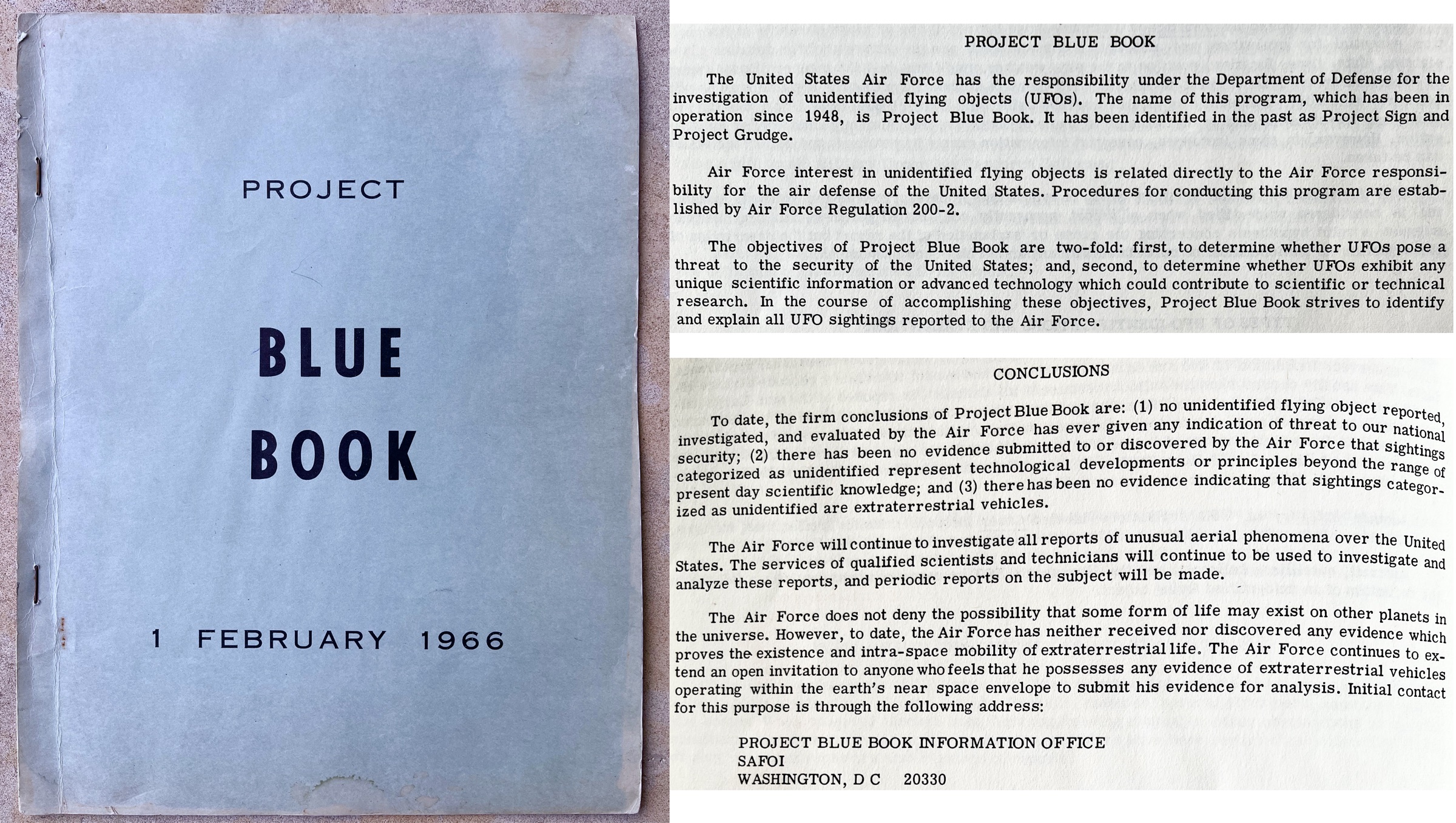
Project Blue Book was the U.S. Air Force’s program for investigating reports of unidentified flying objects, or UFOs. Military and civilian pilots, weather observers, and other members of the public were reporting lights and objects in the sky that they could not identify. Investigators tried to establish what people had seen, checking possible explanations such as aircraft, balloons, planets, and weather phenomena. Because the Air Force was responsible for defending U.S. airspace, it wanted to know whether any of these sightings represented a security threat. Its second stated goal was to determine whether the reports revealed new scientific knowledge or advanced technology.
Sources: Project Blue Book: objectives and investigative procedures
From Project Sign to Project Blue Book
The investigation began before Blue Book had its name. Following a wave of UFO reports in 1947, the Air Force established Project Sign that December. Project Grudge followed in 1949, and the program became Project Blue Book in March 1952. Based at Wright-Patterson Air Force Base in Ohio, Blue Book continued through 1969. The often-cited total of 12,618 reports covers the entire 1947–1969 effort, including the earlier programs.
Sources: Public interest in UFOs persists 50 years after Project Blue Book
How a sighting became a case
An investigation usually started with a report from a witness. Air Force questionnaires asked when and where the sighting occurred, what the object looked like, and how it moved. Under the procedures described in 1966, the nearest Air Force base handled the initial investigation and sent its findings to Blue Book staff at Wright-Patterson for further analysis when needed. The resulting case file could include letters, photographs, press clippings, and technical assessments. A summary sheet recorded the sighting and the Air Force’s conclusion.
Sources: Project Blue Book: objectives and investigative proceduresPublic interest in UFOs persists 50 years after Project Blue Book
Three ways a case could be classified
The Air Force’s 1966 guide distinguished three outcomes. An identified report had enough evidence for an explanation. Insufficient data meant essential details were missing, such as the time, location, or duration of a sighting. Unidentified meant the report appeared to contain the information needed for evaluation, but investigators could not match the object or its behavior to a known cause. A case lacking basic information was therefore different from one that remained unexplained after evaluation.
Sources: Project Blue Book: definitions of the three classifications
The reporting wave of 1952
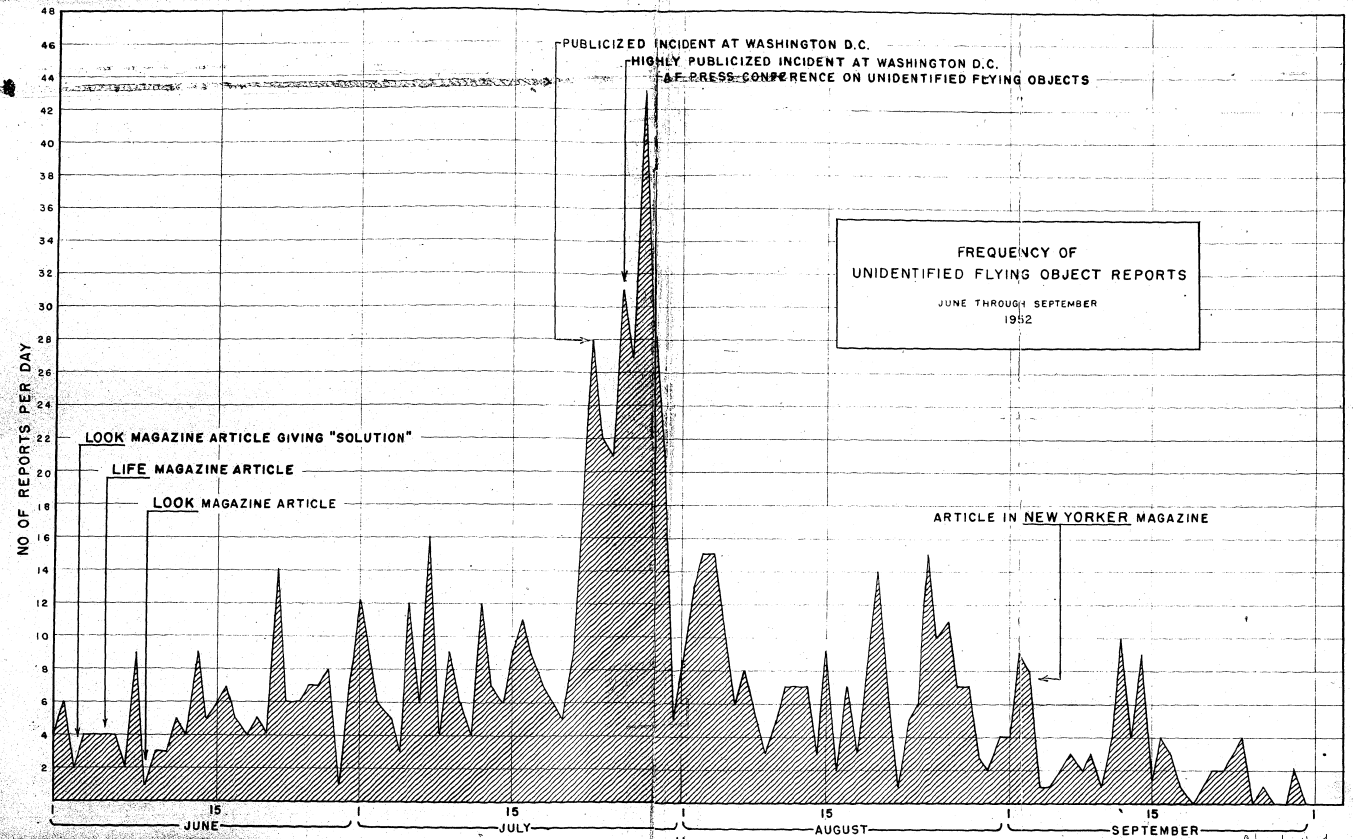
Blue Book’s first year included a surge of reports and national attention. In July 1952, unexplained radar contacts near Washington, D.C., prompted the Air Force to send jets to investigate. The incidents made headlines, and the Air Force suggested unusual atmospheric conditions as an explanation for the radar returns. The chart below tracks daily UFO reports from June through September, reaching a late-July peak of 43. Its annotations mark the Washington incidents, magazine coverage, and an Air Force press conference. It counts reports, regardless of how individual cases were later explained.
Sources: CIA’s role in the study of UFOs, 1947–90Appendix I to Project Blue Book Status Report No. 8
Looking for patterns across thousands of reports
Investigators also tried to learn from the reports as a group. Special Report No. 14, dated May 5, 1955, analyzed 3,201 reports with work by the Battelle Memorial Institute. Researchers recorded features such as shape, color, speed, brightness, and how long an object was visible. They then compared the identified and unidentified groups statistically. This was an attempt to find patterns across many observations, using witness reports rather than controlled experiments. The authors concluded that the reports were unlikely to represent technology beyond contemporary knowledge, although some cases remained unknown.
What the Air Force concluded
The Air Force’s final position addressed the questions that had justified the investigation. It reported no evidence that the UFO sightings it had examined posed a national-security threat. It also said the unidentified cases had not demonstrated technology beyond contemporary scientific knowledge or provided evidence of extraterrestrial vehicles. Those were the program’s overall conclusions; they did not mean that every sighting had received an explanation.
The 701 reports left unidentified
Of the 12,618 reports in the Air Force’s final tally, 701—about 5.6 percent—remained unidentified. These were the cases left in the unidentified category, separate from those classified as insufficient data. The tally describes unresolved reports, not a single explanation for all of them. Reading the files individually lets researchers examine what witnesses reported, which explanations were considered, and why investigators could not identify what had been observed.
Why the program ended
The Air Force commissioned a separate scientific study at the University of Colorado, led by physicist Edward Condon. The resulting Condon Report concluded that earlier UFO studies had not added to scientific knowledge. The Air Force cited that study, its review by the National Academy of Sciences, earlier studies, and its own investigative experience when it decided to end Blue Book. The closure was announced on December 17, 1969; operations stopped in January 1970.
Sources: What the Condon Report saidProject Blue Book: records and conclusionsPublic interest in UFOs persists 50 years after Project Blue Book
Where to explore the records
The Air Force transferred the records to the National Archives in 1975. After personal information was redacted, the collection opened for public research in 1976. The paper records were reproduced on 94 rolls of microfilm; films, sound recordings, and some photographs are held in separate collections. To explore a particular sighting, start with its date and location—the two details used in the Archives’ case index. A file’s witness accounts, supporting material, and summary sheet let you compare the original report with the Air Force’s assessment.
Sources: Project Blue Book: records, indexes, and research accessPublic interest in UFOs persists 50 years after Project Blue Book
Sources & media
Project Blue Book: records and conclusionsU.S. National Archives · Program records and Air Force fact sheetProject Blue Book: objectives and investigative proceduresU.S. Air Force · February 1, 1966 · PDFPublic interest in UFOs persists 50 years after Project Blue BookU.S. National Archives · Program history · December 5, 2019Records of Project Blue BookU.S. National Archives · Record Group 341Project Blue Book Special Report No. 14U.S. Air Force and Battelle Memorial Institute · May 5, 1955CIA’s role in the study of UFOs, 1947–90Gerald K. Haines · CIA, Studies in Intelligence · PDFThe Condon Report and the end of Blue BookUniversity of Colorado Boulder · June 9, 2021Project Blue Book report, February 1966Steve Jurvetson · Wikimedia Commons · CC BY 2.01952 UFO report frequency graphU.S. Air Force · Wikimedia Commons · Public domainSpotted an error, or know a better source? Write to hello@uap.fun.
Discuss this entry
Compare notes with other readers: witness details, sources, and the parts that still do not add up.
Open the discussion