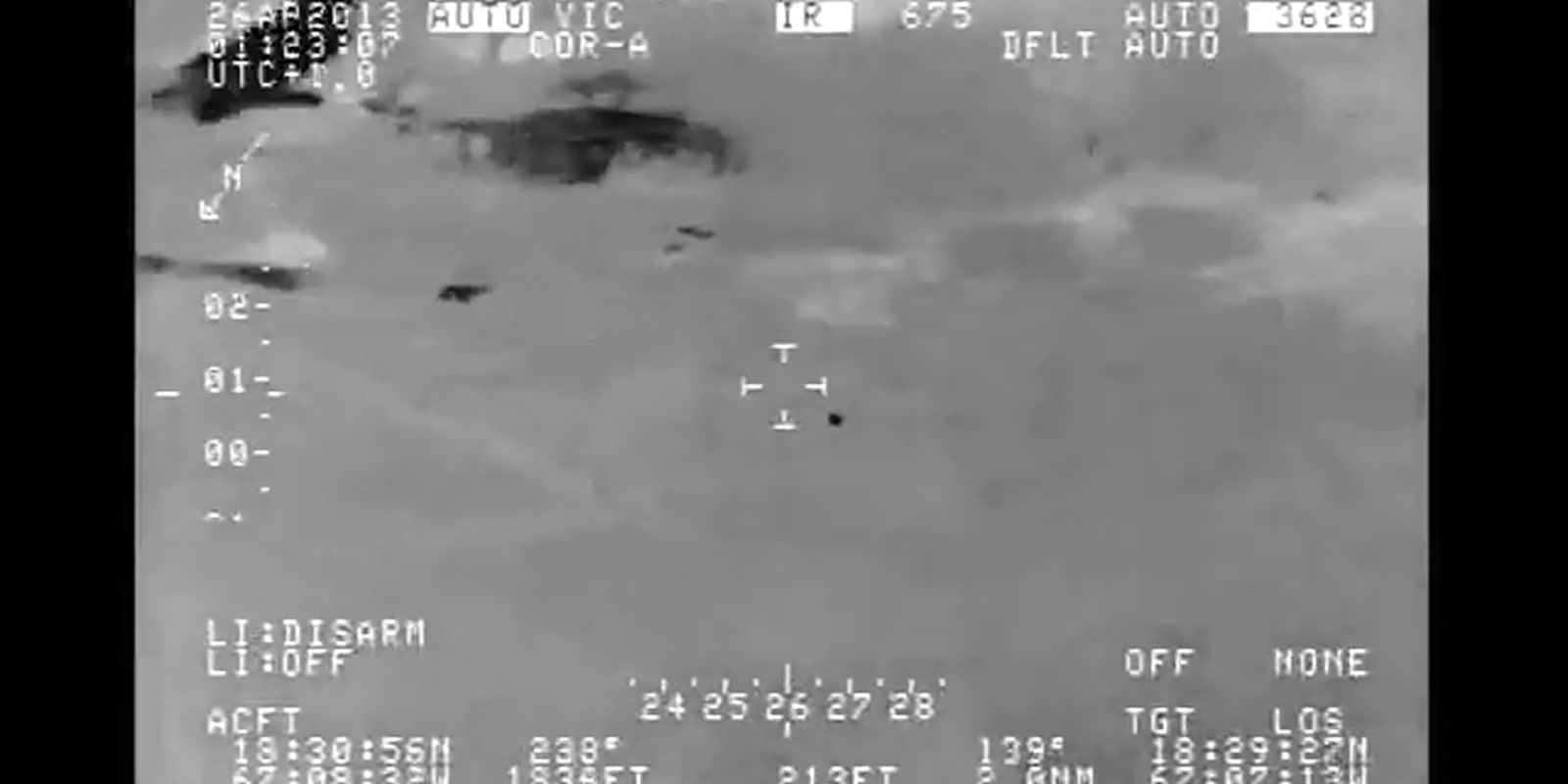
A warm light approaches the old bomber field
Rafael Hernández Airport occupies the immense runway of the former Ramey Air Force Base on Puerto Rico’s northwestern shoulder. Late on an April night in 2013, a U.S. Customs and Border Protection De Havilland Canada Dash 8 was climbing and turning around that airfield. According to the later SCU account, supplied through an unnamed source rather than a published crew statement, the aviators first noticed a pinkish-red light approaching from the ocean. The tower could not identify it. As the visible glow faded near shore, the aircraft’s infrared operator acquired a small hot target.
Sources: 2013 Aguadilla Puerto Rico UAP: detailed analysisThe Puerto Rico Object: case resolutionRafael Hernández Airport
One night, two dates
The camera overlay bears the UTC date April 26. SCU converted the beginning of the recording to about 9:22 p.m. Atlantic Standard Time on April 25; AARO’s 2025 report instead calls it 9:22 p.m. local time on April 26. The official DVIDS catalog also uses April 26. No public acquisition log settles whether the disagreement is a time-zone conversion, a metadata convention, or a later dating error, so this archive preserves both dates rather than forcing an exact one.
Sources: Puerto Rico Objects: official infrared video2013 Aguadilla Puerto Rico UAP: detailed analysisThe Puerto Rico Object: case resolution
The little black shape in the box
For three minutes and fifty-four seconds, the public video holds a tiny black-hot signature near its tracking box while monochrome roads, trees, buildings, fields, and coastline slide underneath. It has no resolved wings, rotor, exhaust, or navigational lights. The target sharpens, blurs, flickers, and occasionally seems to disappear. Because the sensor magnifies a small patch of ground from a moving, turning aircraft, the sequence offers a powerful sensation of speed without giving an ordinary viewer a reliable sense of range.
Sources: Puerto Rico Objects: official infrared videoThe Puerto Rico Object: case resolutionAlleged UFO captured by infrared camera over Aguadilla
The moment Aguadilla became a transmedium legend
Near the end, the target crosses a water-toned background and repeatedly loses contrast. To viewers following its apparent path, it seems to descend into the Atlantic, continue beneath the surface without a splash, rise again, and then become two equal dark signatures. That sequence gave Aguadilla its special place in modern lore: not merely a light or a distant shape, but what appeared to be continuous government footage of an object passing from air to sea and duplicating itself.
Sources: Puerto Rico Objects: official infrared video2013 Aguadilla Puerto Rico UAP: detailed analysisThe Puerto Rico Object: case resolution
The 161-page extraordinary reading
A six-author Scientific Coalition for UAP Studies team broke the recording into frames, compared the sensor telemetry with maps and radar material, and published its report in 2015. Its preferred reconstruction put the object at roughly three to five feet long, generally moving around forty to one hundred twenty miles per hour, with a median near eighty. The team read brief disappearances over land as occlusion by trees, then extended that near-surface geometry toward the coast. It concluded that the target entered the water with little disturbance, emerged, enlarged, and divided into two objects.
Sources: 2013 Aguadilla Puerto Rico UAP: detailed analysisAguadilla incident report and alternative-hypothesis responsesPuerto Rico Objects: official infrared video
A pair of lanterns enters the argument
Retired Argentine Air Force commodore Rubén Lianza reached the opposite reading. He argued that the apparent dash across the landscape came from parallax, that the flickering thermal shape resembled two heart-shaped hot-air lanterns traveling together, and that east-northeasterly wind could carry them from the resort side of the airport. In his geometry the targets remained several nautical miles from the camera and over land even while water filled the background. The romantic detail—a paired wedding-lantern release—was vivid, but no wedding party or launch was independently documented.
Sources: Alleged UFO captured by infrared camera over AguadillaAguadilla infrared footage: windborne-lantern analysis and debateAguadilla incident report and alternative-hypothesis responses
The Pentagon rebuilds the flight
AARO revisited the video with aircraft position, sensor azimuth, elevation, slant angle, and a Systems Toolkit reconstruction. Its model placed two objects near the airport’s northeastern side at about 656 feet, moving southwest in a straight line at approximately eight miles per hour. Recorded wind was about 9.8 miles per hour from the east-northeast. The Dash 8, meanwhile, climbed roughly 1,725 feet in an arc, and its range to the targets nearly tripled. In that reconstruction, motion parallax—not a low-level sprint—creates the spectacular ground speed.
Sources: The Puerto Rico Object: case resolution2013 Puerto Rico Object ReconstructionPuerto Rico Objects: official infrared video
It never reached the ocean
The most consequential line in AARO’s solution is geographic: its projected sight lines keep the objects over land throughout the recording, ending above the airport’s central parking apron. The ocean appears behind them because the airborne camera looks across the coastline. Frames once interpreted as a target passing behind a utility pole were subjected to pixel analysis; AARO said the signatures did not cross behind it. Without that foreground anchor, the low altitude, high speed, and water entry no longer follow from the pixels.
Sources: The Puerto Rico Object: case resolution2013 Puerto Rico Object ReconstructionAlleged UFO captured by infrared camera over Aguadilla
Two objects hiding as one
AARO identified separations at about 29.56, 40.76, and 47 seconds—well before the famous late split. It concluded that two small objects traveled close together from the beginning, repeatedly blending into one unresolved thermal blob. As the aircraft climbed, the viewing angle changed from shallow and side-on to steeper and more top-down, making their separation increasingly obvious. What looked like replication became a lesson in how sub-pixel targets can merge and part on a long-range infrared display.
Sources: The Puerto Rico Object: case resolutionPuerto Rico Objects: official infrared video2013 Puerto Rico Object Reconstruction
Why the targets vanish
The fading signatures also have an instrument-level explanation. AARO cites thermal crossover—the period after sunset when an object and its background can approach the same infrared temperature—along with increasing distance and scattered cloud near 3,000 feet. The recording began within two hours of sunset, the targets were smaller than three feet in AARO’s estimate, and the camera-to-target range grew substantially. Under those conditions a warm object may flicker out against land or water without entering either one.
Sources: The Puerto Rico Object: case resolutionPuerto Rico Objects: official infrared videoAlleged UFO captured by infrared camera over Aguadilla
From leaked mystery to official case study
For years the clip circulated through investigators and internet archives without an official public release, accumulating the reputation of a government video too strange to explain. DVIDS finally published the original sequence in November 2024, and AARO issued its resolution and animated reconstruction in March 2025. Aguadilla’s cultural afterlife now contains both stories at once: the celebrated transmedium passage built from SCU’s geometry, and the official two-lantern solution built from a different reconstruction of the same black-and-white frames.
Sources: Puerto Rico Objects: official infrared videoThe Puerto Rico Object: case resolution2013 Aguadilla Puerto Rico UAP: detailed analysis