New eyes over the Atlantic
In the summer of 2014, pilots of Strike Fighter Squadron 11—the Red Rippers—were flying F/A-18F Super Hornets from Naval Air Station Oceana and preparing to deploy with the Theodore Roosevelt strike group. Ryan Graves later told Congress that unfamiliar tracks began appearing after upgrades to the jets’ radar systems. At first the aviators treated them as software ghosts. Then the tracks kept returning, and crews began correlating some of them with infrared sensors and, eventually, visual sightings.
Sources: Written testimony of Ryan GravesUnidentified Anomalous Phenomena: implications on national security, public safety, and government transparency‘Wow, What Is That?’ Navy Pilots Report Unexplained Flying Objects
The contacts become weather
Graves and other aviators described the objects as a presence rather than a single dramatic visitation: contacts at 30,000 feet, 20,000 feet, and near sea level, sometimes persisting through the working day. The New York Times reported that five Roosevelt aircrew described appearances almost daily from summer 2014 to March 2015. Their preflight language changed accordingly. Unknown objects in the warning areas became another hazard to brief, alongside weather, fuel, and the choreography of fast jets sharing constrained airspace.
Sources: ‘Wow, What Is That?’ Navy Pilots Report Unexplained Flying ObjectsUnidentified Anomalous Phenomena: implications on national security, public safety, and government transparencyWritten testimony of Ryan Graves
The merge that found nothing
Lieutenant Danny Accoin described trying to close with one radar contact from a thousand feet below. His instruments said the target was there, but he could not find it with his eyes or helmet camera. Days later, he said, his radar and infrared camera both acquired another contact while he again failed to see it visually. For the squadron, that sequence was unnerving precisely because it crossed sensor channels: the mystery could no longer be dismissed as one dirty radar picture, yet it still refused to become an ordinary aircraft in the canopy.
Sources: ‘Wow, What Is That?’ Navy Pilots Report Unexplained Flying Objects
A cube inside a clear sphere
Late in 2014, two Super Hornets entered Warning Area W-72 east of Virginia Beach in close formation. According to the pilot’s account relayed by Graves, a dark gray or black cube sat inside a translucent sphere directly at the entry point. The object passed between the jets, which were roughly one hundred feet apart; Graves’s later oral testimony placed it within about fifty feet of the lead aircraft and estimated its diameter at five to fifteen feet. The mission ended immediately. Back at Oceana, the shaken pilot told Graves, “I almost hit one of those things.”
Sources: Unidentified Anomalous Phenomena: implications on national security, public safety, and government transparencyWritten testimony of Ryan Graves‘Wow, What Is That?’ Navy Pilots Report Unexplained Flying Objects
The safety report that vanished into procedure
The squadron submitted an aviation safety report after the near miss. Graves said there was no official acknowledgement and no useful follow-up mechanism. That silence mattered. A secret test program had once seemed possible to the pilots, but putting an unannounced vehicle at a known training-area entrance, between two fighters, made little operational sense to them. The question changed from “What new machine are we seeing?” to “Who is allowing it inside the range?”
Sources: Written testimony of Ryan GravesUnidentified Anomalous Phenomena: implications on national security, public safety, and government transparency‘Wow, What Is That?’ Navy Pilots Report Unexplained Flying Objects
Roosevelt sails into the puzzle
USS Theodore Roosevelt left Norfolk on January 8, 2015, for its Composite Training Unit Exercise. The carrier had emerged from a multibillion-dollar overhaul, and its strike group paired upgraded ships with the new E-2D Advanced Hawkeye and a network intended to assemble a richer shared air picture. This was not a sleepy corner of aviation: dozens of aircraft and ships were rehearsing threats before deployment. Somewhere inside that sensor-dense exercise, an aircrew designated Ripper 11 turned home from an air-to-air mission and found unknown contacts ahead.
Sources: Upgraded carrier Roosevelt starts pre-deployment exercisesEveryday Occurrences: a firsthand account of the Gimbal mission and debrief
Ripper 11 turns toward the strangers
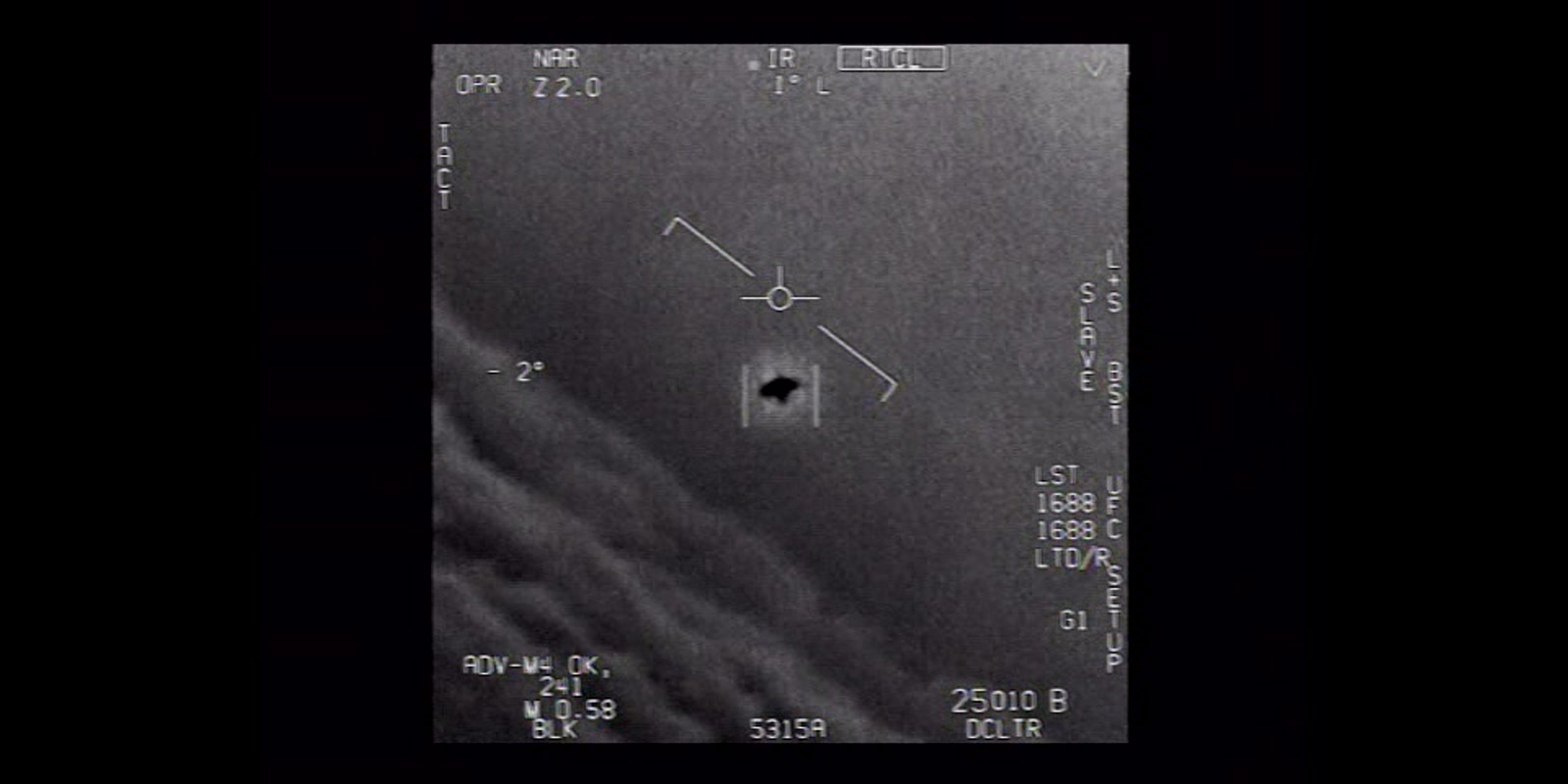
Graves, who says he was airborne elsewhere in the exercise and later attended the debrief, recalled that Ripper 11 initially wondered whether the contacts were part of a penetration test. The crew approached for identification and slewed the Advanced Targeting Forward-Looking Infrared pod toward a radar-correlated object. Night had fallen. Television mode was ineffective, and a safe unaided visual identification was no longer practical. The public record begins at that frustrating point: not with a clear craft, but with thirty-four seconds of a magnified infrared shape.
Sources: Everyday Occurrences: a firsthand account of the Gimbal mission and debriefGimbal: official U.S. Navy infrared footage
“There’s a whole fleet of them”
The Gimbal clip opens on a dark, bright-edged oblong above a faint cloud layer. The sensor is in black-hot mode, so hotter energy appears dark. As the azimuth readout walks from the left side of the jet toward its nose, cockpit voices animate the otherwise abstract display: “There’s a whole fleet of them. Look on the S.A.” Another voice says the contacts are going against a 120-knot wind. The camera shows only one signature; the fleet exists in the crew’s spoken reference to their situational-awareness display and in Graves’s recollection of the debrief, not in the released pixels.
Sources: Gimbal: official U.S. Navy infrared footageEveryday Occurrences: a firsthand account of the Gimbal mission and debriefUnidentified Anomalous Phenomena: implications on national security, public safety, and government transparency
“It’s rotating”
Near the clip’s end, the oblong seems to tip counterclockwise while the cloud field slides beneath it. “Look at that thing, dude,” one aviator says. “It’s rotating.” The moment supplied the file’s name and its mythology: a dark flying shape turning broadside without wings, control surfaces, or a visible plume. Graves later wrote that the fuller tactical picture included four or five nearby contacts and that Gimbal executed a rapid turn to remain with them. None of that maneuver or radar formation appears in the public thirty-four seconds, which cuts off just after the apparent rotation.
Sources: Gimbal: official U.S. Navy infrared footageEveryday Occurrences: a firsthand account of the Gimbal mission and debriefUnidentified Anomalous Phenomena: implications on national security, public safety, and government transparency
The little egg above the ocean
A second Roosevelt-era clip, GoFast, offers the opposite visual trick. Its tiny cold target races across ocean texture while the tracking box struggles, catches it, and locks. The crew erupts when the lock holds. The name suggests a sea-skimming projectile, but the display contains the geometry that later dismantled that first impression. NASA calculated the target near 13,000 feet—about 4.2 miles in front of the ocean background—and roughly 40 miles per hour in one reconstruction, making the apparent rush largely a product of the fighter’s motion and parallax.
Sources: Go Fast: official U.S. Navy infrared footageUAP Independent Study Team final report: GoFast analysisGoFast case resolution
A date hidden inside competing catalogs
The Defense Department’s 2020 statement says only that both East Coast videos were recorded in January 2015. The officially released Gimbal file is cataloged as January 21, while the New York Times originally placed Gimbal off Jacksonville on January 20 and described GoFast as a later event. Later public metadata groups both clips on January 21. Without the complete mission records, this archive treats January 2015 as secure and the exact sequence as unsettled rather than stitching two famous snippets into one sortie by assumption.
Sources: Statement on the release of the historical Navy videosGimbal: official U.S. Navy infrared footage‘Wow, What Is That?’ Navy Pilots Report Unexplained Flying ObjectsGo Fast: official U.S. Navy infrared footage
From unauthorized clips to official icons
Gimbal reached a mass audience in December 2017 alongside reporting on a Pentagon UFO program; GoFast followed publicly in 2018. The Navy later acknowledged the recordings, and on April 27, 2020, the Defense Department formally released all three famous cockpit videos—Gimbal, GoFast, and the 2004 Nimitz clip—to settle whether the circulating files were genuine. It said the phenomena in the videos remained characterized as unidentified. By then the voices, tracking boxes, and grainy shapes had become the visual grammar of the modern UAP era.
Sources: Statement on the release of the historical Navy videosGimbal: official U.S. Navy infrared footageGo Fast: official U.S. Navy infrared footage‘Wow, What Is That?’ Navy Pilots Report Unexplained Flying Objects