
Noon on a haymaking day
Friday, July 19, 1946, was haymaking weather in the far north of Sweden. The farmer Knut Lindbäck and his maid, eighteen-year-old Beda Persson, were at work on the shores of Lake Kölmjärv, a small forest lake some 24 kilometers west of Överkalix and not far below the Arctic Circle. At 11:45, with the sun broiling, a humming came out of the sky. “I looked up since I thought it was an airplane,” Lindbäck told the journalist Clas Svahn in 1984. “Instead, I spotted a rocket-like device diving towards the lake.” It was ash-gray and about two meters long, and it went into the water near the southwestern shore, about a kilometer and a half from where the two stood. A tall column of water rose, and then a second cascade, as if something had gone off after it struck. “That it was a solid object of that I am sure,” he said. It had a snub nose and a pointed stern. “I thought there were a few small wing-like protrusions on the side, but I am not sure. Everything happened so quickly!” Lindbäck got on his bicycle, rode round the lake and rowed out to the spot. Weed and water lilies had been torn up by the roots and thrown ashore, and the water was too muddy to see the bottom.
Sources: The Kölmjärv Ghost Rocket Crash RevisitedSpökraketerna 1946Spökraketerna
The dog ran away
Someone was much closer. On the north shore, a couple of hundred meters from the impact, stood the house of fourteen-year-old Frideborg Tagebo, whom Svahn tracked down in 1984. “The sound was horrible. I had never heard anything like it before — or since,” she told him. Her mother, washing clothes at the water’s edge, shouted to her to shut the windows because she thought a tornado was coming. “Our dog went crazy and ran away. Everything was terrible. When the thing eventually struck down, it was like a bomb had detonated.” In 1984 she drew what she had seen for Svahn. In an account published by the researcher Göran Jansson, she said it looked like a torpedo, came in broad end first with small wings at the front, and threw the water at least fifteen meters high; afterwards the lake bubbled from the bottom. A neighbor phoned the police. The first report to reach the Defence Staff, the headquarters of Sweden’s armed forces, came in at 6:10 that evening. It described a projectile a meter and a half to two meters long, gray-brown or gray, probably winged and narrower at one end, which had sounded like a motor and come down less than fifty meters from the shore. By nightfall police and Home Guard volunteers were posted round the lake, and trucks of army engineers were on the road from the garrison town of Boden.
Sources: The Kölmjärv Ghost Rocket Crash RevisitedSpökraketerna 1946Spökraketerna
A summer of spook bombs
Kölmjärv was not a bolt from a clear sky. For two months Sweden had been watching the heavens. On the night of May 23–24, 1946, two night watchmen at Landskrona in the south saw what the Stockholm daily Dagens Nyheter called a “wingless, cigar-shaped body of dimensions of a small airplane, which at regular intervals spurted bunches of sparks from its tail.” Within days similar things were reported from Gävle, Karlskrona and the Stockholm suburbs, and on May 28 the evening paper Aftonbladet put the word spökraket, ghost rocket, into a headline. Dispatches from Finland told of wingless projectiles over Helsinki and a “V-2” roaring over Tampere. Swedes had reason to think of rockets. On June 13, 1944, a stray German V-2 from the test range at Peenemünde, on the Baltic coast, had blown apart in the air over Bäckebo in the southern province of Småland; the military gathered the wreckage, and Henry Kjellson, the wreckage expert of the air force’s Air Administration, led the study of the pieces before they were flown to Britain in twelve crates. Now, a year after the war, the Soviet Union held Peenemünde and the Baltic shore. On June 12 the Defence Staff ordered every military unit to report sightings on a special form.
Sources: A Ghost Rocket Chronology, part oneSpökraketerna 1946SpökraketerSpökraketerna
The ninth of July
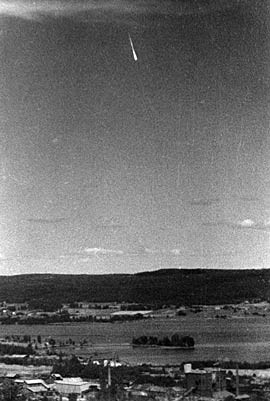
The wave broke at about 2:40 on the afternoon of July 9, when a brilliant object streaked down out of a clear blue sky over central Sweden and nearly 250 reports poured in. From a forest fire lookout tower outside Guldsmedshyttan, some 200 kilometers west of Stockholm, the Uppsala couple Erik and Åsa Reuterswärd managed to photograph it: a bright streak above a lake valley (the Defence Staff files log the picture at about 2:30). It became the only photograph of a ghost rocket that year, printed across Sweden and abroad, and in September London’s Daily Telegraph ran it under the headline “Mystery ‘rocket’ over Sweden.” The astronomer Bertil Lindblad, asked to study it, wrote that he could not rule out with full certainty that it was a meteor. Far to the north, near Sundsvall, neighbors gathered round a coffee table outside an airline pilot’s cabin said the thing gave off a light so blinding it seemed to dim the sun, and porous slag was collected from where it was thought to have fallen. The next day the Defence Staff formed a committee to investigate what it called space projectiles, rymdprojektiler, and asked the public for reports. Its chairman was Colonel Bengt Jacobsson, head of the Air Administration’s materiel department; the flight engineer Eric Malmberg was secretary, and Kjellson sat among its members.
Sources: Spökraketerna 1946SpökraketernaA Ghost Rocket Chronology, part oneA Ghost Rocket Chronology, part twoDe första UFO-bilderna
Four lakes in one day
The day before, witnesses on Norway’s largest lake, Mjøsa, had watched two winged objects about two and a half meters long come down near Feiring; a Norwegian air defense officer said the descriptions matched a V-1. And Kölmjärv had company on July 19. At about 11:15 that morning at Bölebyn, near Piteå, the Danielsson boys watched a glinting object like an Alfa-Laval milk churn cross the sky for twenty minutes. A year later, the family said, a letter came from Falun with a phone number that was always busy and a sketch labeled TEKARNIKSAM: maskinraket, machine rocket, spelled backwards. At about 11:30, eleven-year-old Kurt Larsson was fishing in a stream at the north end of Kattisträsket, near Överkalix, when a cascade fifteen meters high rose out of the water like a mine going off, and he ran home shouting “Hin håle är i träsket!”, the Devil is in the lake. A ten-meter pole found at least five meters of mud. In the afternoon a family and a telephone operator at Vassarajärvi, west of Gällivare, heard engine noise and saw something rip across the lake from the reeds; the local chief of staff reported it went in at about thirty degrees and ran two hundred meters under water. And at Lake Marmen near Söderhamn, far to the south, a captain’s report of July 23 said the projectile threw up a cascade about twenty meters high and turned the water black along its path.
Sources: SpökraketernaSpökraketerna 1946A Ghost Rocket Chronology, part one
A raft without nails
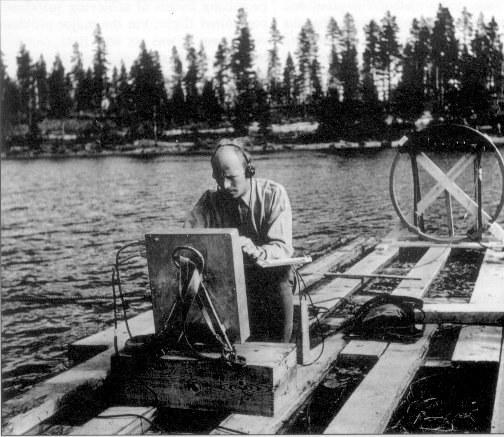
On Saturday, July 20, a thirty-year-old lieutenant of the Boden engineer regiment, Karl-Gösta Bartoll, got a handwritten order from his colonel: go at once by motorcycle to Överkalix and look into salvaging a “spökbomb,” a ghost bomb, said to have fallen into Kölmjärv. He was on the shore by 2:30 that afternoon. A national newspaper reported that a party of ten men had found the spot in water only 75 centimeters deep, where the projectile had punched a hole a meter wide so deep in the mud that an oar would not reach the bottom. Sweden’s defense research institute, FOA, sent two scientists with a radiation meter. They found nothing and flew home. Later they wrote that the thing was too small to have carried conventional fuel over the distances supposed, so it might be atomic-powered. Bartoll’s diary noted that an impact was considered very likely. His men built a raft by the shore, lashed with hemp rope, because, said the neighbor Rune Lindbäck, “they were very careful not to use iron nails which would have disturbed their sensitive instruments.” They strung wires across the lake, squared it off, and probed the mud every half meter; later a prospector from the Boliden mining company brought an ore detector. Bartoll recalled a patch of bottom some thirty meters across where all the vegetation had been torn up, which he reckoned would take up to thirty kilograms of dynamite to make. They took more than 3,500 bottom samples. They found a wood-gas generator and scrap iron. Draining the lake was costed at 20,000 kronor and rejected.
Sources: SpökraketernaThe Kölmjärv Ghost Rocket Crash RevisitedSpökraketerna 1946Spökraketer
Strangers in the woods
The search did not go undisturbed. After a few days, Bartoll said, a sentry spotted two men creeping through the woods near the crash site. They were seen several times, and he ordered his men to load live ammunition. “Finally, we dared not use our phones to report to headquarters in Boden, but sent our reports by an orderly-man,” he told Svahn in 1984. “In the end someone even cut off the telephone lines with cutting nippers.” Nobody was ever caught. Meanwhile the lake’s name was being scrubbed from the news. The day after the crash the Defence Staff asked editors to write only “southeastern Norrbotten,” and on July 22 a directive went out through TT, Sweden’s national news agency: no place names beyond north, central or south Sweden, no directions of travel, and, for a particular reason, no word on whether an impact had been on land or in water. On Sunday, July 28, Dagens Nyheter could not reach the lake because, it said, a thunderstorm had broken the telephone lines, and it printed persistent rumors from Överkalix that the bomb had been found: three meters long and painted with white letters. The Defence Staff called the rumors completely unfounded. On July 29 the committee was told that the Supreme Commander of the armed forces had classified every document on Kölmjärv as secret. The villagers were never told anything; Tagebo remembered the soldiers’ dreadful secrecy.
Sources: The Kölmjärv Ghost Rocket Crash RevisitedSpökraketerna 1946Spökraketerna
Men in civilian clothes
The rockets were a diplomatic affair from the start. On July 16 the U.S. military attaché in Stockholm cabled Washington, top secret, that the Swedish Defence Staff was studying three to four hundred incidents, that some highly placed officials believed them Russian experiments “either purely for research or for War of Nerves,” and that the staff was very nervous about sharing anything with the Americans and British “for fear Russians will cry ‘West Bloc’.” Two days later a British air intelligence officer and an army rocket expert flew in, in civilian clothes at the Swedes’ request; after their first briefing they cabled that “too many missiles have been observed and described to allow of explanation as meteorites,” though the only remains were pieces no bigger than an egg of porous yellow material and slag. London planned to send a Royal Air Force radar party to the Baltic island of Gotland, under cover of helping the Swedish air force with radar for its new Vampire jets, until the Swedish prime minister refused. On August 19 the American war hero General Jimmy Doolittle and the RCA chief David Sarnoff arrived in Stockholm, apparently on business, and Doolittle met the chief of the Swedish air force. On August 22 Lieutenant General Hoyt Vandenberg, head of the new Central Intelligence Group, the forerunner of the CIA, told President Truman that “the weight of evidence now points to Peenemunde,” and that the Soviets were probably running large-scale guided-missile tests around the Baltic, most of them launched from there and crossing Sweden toward the Gulf of Bothnia. In September Sarnoff was quoted in the New York Times as convinced that the ghost bombs were “no myth but real missiles.”
Sources: A Ghost Rocket Chronology, part oneA Ghost Rocket Chronology, part twoMemorandum for the President: “Ghost Rockets”UFOs: A History — 1946: The Ghost RocketsUFOs: a research guide
A good fat cigar
The summer’s second great night came on August 11, when more than three hundred reports came in, most of them in the fifteen minutes after 8:45 p.m. Lindblad himself watched the object from Ljugarn on Gotland and judged it a meteor. The committee was not so sure. Radar had begun watching on July 17; a coastal radar tracked something at about four hundred meters a second, faster than sound, and on August 5 a conscript at Mällsten, looking through a coastal artillery rangefinder, reported a wingless spindle about twenty meters long and trailing smoke rings. On the morning of August 14, flying a B 18 bomber near Malingsbo in Dalarna, Lieutenant Gunnar Irholm saw a dark-gray cigar crossing his course three or four kilometers away. He swung parallel and opened the throttles, got to within about a thousand meters, and watched it pull away at what he put at no less than six or seven hundred kilometers an hour and disappear into a rainstorm. Asked what it looked like, he told Svahn to picture a good fat cigar, pointed at both ends. On August 22, near Getå outside Norrköping, the Gothenburg photo dealer Gösta Skog filmed a smoking cigar sliding between the clouds on his Paillard-Bolex. The military received his party like princes and screened the film in a darkened room full of officers. It was completely white. “Det här har grämt mig i 40 år nu,” he told Svahn in 1986: this has galled me for forty years.
Not ready to dismiss
On October 10, 1946, the Defence Staff told the press that most of what had been reported between May and September was ordinary celestial phenomena. But not all of it. “Most of the observations are vague and must be treated very skeptically,” the statement said, as Reuters and the Times of London carried it. “In some cases, however, clear unambiguous observations have been made which cannot be explained as natural phenomena, Swedish aircraft, or imagination on the part of the observer.” The fragments, it added, were ordinary coke or slag. The committee’s final memorandum to the Supreme Commander, dated December 13, gave the numbers. There had been 973 reports up to December 1. About 530 came from July 9 and August 11 alone and were probably celestial. Of the rest, half described lights and half actual objects, most often wingless spindles; only seven percent of the objects had wings. About a hundred impacts had been reported and thirty finds examined, none of them from a projectile. At Kölmjärv, it said, two independent observers had seen a clear impact, and nothing had been found. The search had failed; yet the committee was not prepared to dismiss certain phenomena as popular imagination. An annex from the Defence Staff’s foreign department traced most tracks back to the Kandalaksha–Murmansk area of the Kola Peninsula, in the Soviet Arctic, and to the Baltic coast from Estonia to Pomerania, and surmised that the projectiles carried an advanced self-destruct system. Two versions of the memo were made. The one handed to the American and British attachés left out the passage on where the projectiles came from.
Sources: UFOs: A History — 1946: The Ghost RocketsSpökraketerna 1946A Ghost Rocket Chronology, part three
Twelve rockets over Greece
By autumn the rockets had drifted south. On September 5, in London, the Greek prime minister, Konstantinos Tsaldaris, announced that twelve had been seen over Greece on the night of September 1, the day of the plebiscite on the monarchy, by divisional commanders and British officers. Over Thessaloniki one flew high from northeast to west at a quarter past seven in the evening. On September 9 the physicist Paul Santorinis told Athens radio they were advanced Soviet guided weapons. Two decades later, in a 1967 lecture, he told a different story: “We soon established that they were not missiles,” he said; before his team could do more, the army, after conferring with foreign officials, ordered the inquiry stopped, and foreign scientists, from Washington he said, flew to Greece for secret talks with him. There were reports that autumn from the Netherlands, Belgium and Portugal as well. Writing from Stockholm in October, the American columnist Marquis Childs reported that some people there called the things, half in jest, “Russian hail.”
Sources: The Greek Ghost Rockets of 1946A Ghost Rocket Chronology, part twoA Ghost Rocket Chronology, part threeUFOs: A History — 1946: The Ghost Rockets
A hole in the bottom
The ghost rockets did not stop with 1946. On July 18, 1948, Sweden’s Supreme Commander, General Helge Jung, saw a projectile himself from his summer house, Fogelhäll, on Fågelbrolandet south of Värmdö in the Stockholm archipelago, and on August 6, sailing, he saw another. The navy’s submarine salvage vessel Belos was sent to search the bay of Våmfjärden, and on October 5 Jung wrote in his diary that divers had found a hole in the bottom. The dive logs say only: search for object, no result. That autumn officers of the U.S. Air Forces in Europe visited Swedish air intelligence, and on November 4, 1948, they sent home a top secret message. Asked about flying saucers, the Swedes had answered that some reliable and fully qualified people had concluded that “these phenomena are obviously the result of a high technical skill which cannot be credited to any presently known culture on earth.” A Swedish technical expert had seen one crash or land in a lake near his home, and while the Americans were visiting a naval salvage team was at work there; divers had found a previously uncharted crater on the lake floor. The Swedes, the message said, believed it had been made by a flying saucer.
Sources: AFU Newsletter no. 40SpökraketerUSAFE Item 14, TT 1524
Before the saucers
When Kenneth Arnold saw nine shining objects over Mount Rainier in June 1947, few remembered Sweden. “Few people recalled the reports of ‘ghost rockets’ over Sweden during the summer of 1946,” Ted Bloecher wrote in his study of the 1947 wave, and it was only at its crest, on July 6 and 7, that anyone made the connection. The Swedish files went into the military archives. In the 1980s Clas Svahn, then a reporter on the Norrbottens-Kuriren, and Anders Liljegren of the Archives for UFO Research found them, and Svahn went looking for the witnesses. Lindbäck died in 1985. Bartoll, who died in 2010, never wavered in his interviews: something had gone into the lake. “Jag är helt övertygad om att något har slagit ner i sjön Kölmjärv – tyvärr så hittade vi det aldrig,” he says in Jansson’s account: he was completely convinced something had struck the lake, and sadly they never found it. In 2012 UFO-Sverige took sonar and divers to Nammajaure, a lake in Lapland where two hikers had seen a rocket-like object sink in 1980. One of them, Bo Berg, later became Sweden’s war archivist, the keeper of the very files on the ghost rockets. The search went into Kerstin Übelacker and Michael Cavanagh’s 2015 documentary Ghost Rockets. Then, in August 2026, the Pentagon’s fifth release of UAP files included the Swedish ghost rockets. Svahn told TT that the only thing that could be said for sure was that they were physical objects.
Sources: Report on the UFO Wave of 1947SpökraketernaSpökraketerna 1946Spökraketen i NammajaureSpökraketerGhost Rockets (Spökraketerna)Ufo-experten om ”spökraketerna” i Sverige: Genuint gåtfulltSvenska ”spökraketer” i amerikanska Pentagonfiler
What survives
The core of the record is the Defence Staff’s own file, some 2,000 pages of reports, minutes and correspondence now in the Swedish Military Archives, summarized at length by Göran Jansson and drawn on by Clas Svahn; a few annexes and the reports from Swedish intelligence agents are missing. The Kölmjärv witnesses are known through the first wire and newspaper reports of July 1946 and through Svahn’s interviews of 1984. The American side survives in the attaché cables and the Central Intelligence Group memorandum to Truman, the British in Foreign Office and Air Ministry files at the National Archives. The only photograph of the wave shows the July 9 streak; Gösta Skog’s film came back blank and has never been found, and a handful of military photographs record the search, among them the picture of Bartoll on his raft. Nothing recovered from Kölmjärv has ever been analyzed, because nothing was recovered.
Sources: Spökraketerna 1946SpökraketernaThe Kölmjärv Ghost Rocket Crash RevisitedMemorandum for the President: “Ghost Rockets”UFOs: a research guide
How the details moved
Even the lake moves. The first report put the impact less than fifty meters from shore; Lindbäck, a kilometer and a half away, placed it near the southwest shore, and Dagens Nyheter placed the lake fifteen kilometers north of Överkalix rather than 24 west. The water was 75 centimeters deep in one newspaper and about two meters in Lindbäck’s memory. The hole in the bottom was a meter wide in 1946 and a torn-up patch some thirty meters across in Bartoll’s recollection. The witnesses heard no explosion according to the news agency, a smashing sound according to Lindbäck, and a bomb going off according to Tagebo, who was fourteen in Svahn’s account and sixteen in Jansson’s. The search lasted almost two weeks in Bartoll’s 1984 interview and three weeks in his later account and in the documents, ending on August 12; the bottom samples number 3,500 in the archive-based accounts and 35,000 in Svahn’s. A Swedish UFO magazine in 1973 dated the crash to July 20 and had frogmen searching the lake; Bartoll had no divers at all. The Daily Telegraph placed the famous photograph “in the islands just outside Stockholm”; it was taken near Guldsmedshyttan.
Sources: The Kölmjärv Ghost Rocket Crash RevisitedSpökraketerna 1946SpökraketernaUFO-Information no. 2, 1973A Ghost Rocket Chronology, part two
Explanations on offer
In 1946 the favorite answer was Soviet tests of captured German weapons, launched from Peenemünde or from Estonian islands, and the Swedish committee, Vandenberg’s Central Intelligence Group and many British intelligence officers leaned that way. No evidence for it has emerged, and the Soviets are not known to have fired any V-2 that year. Meteors explain the two great nights well: Lindblad could not rule out a meteor on July 9 and judged the August 11 fireball, which he saw himself, a meteor; the August 11 peak falls on the Perseid maximum, and Swedish skeptics call the Reuterswärd photograph a daylight meteor. The British scientist R. V. Jones compared the scare to prewar rumors of German car-stopping rays, and the sociologist Robert Bartholomew later wrote about the wave as a case of epidemic hysteria. An American air attaché suggested the Defence Staff had let an unintentional hoax run for the sake of its budget; the U.S. naval attaché concluded in April 1947 that it was very doubtful any missile had landed in Sweden. None of these accounts easily covers the daylight reports of solid objects: a pilot who chased one, and a farmer, a maid and a fourteen-year-old who watched something plunge into Kölmjärv, leaving torn water lilies and a churned bottom.
Sources: Spökraketerna 1946The Swedish Ghost RocketsDe första UFO-bildernaA Ghost Rocket Chronology, part twoA Ghost Rocket Chronology, part threeRedefining epidemic hysteria: an example from SwedenMemorandum for the President: “Ghost Rockets”
Classification note
This archive files Kölmjärv as a crash report because its core is an object seen to fall into a lake by independent witnesses, followed by an official search for wreckage. It carries no close-encounter code: the nearest witness was a couple of hundred meters away, no one reported the object on or near the ground, and the case belongs to a wave of aerial sightings. The later stories of a recovered rocket with white lettering and of divers in the lake are treated as rumor and lore, not testimony.
Sources: The Kölmjärv Ghost Rocket Crash RevisitedSpökraketerna 1946
- 13 JUN 1944
A stray German V-2 blows apart over Bäckebo in southern Sweden; the wreckage is shipped to Britain.
- 23–28 MAY 1946
Night watchmen at Landskrona see a wingless cigar spurting sparks; as reports spread, Aftonbladet coins the word spökraket, ghost rocket.
- 12 JUN 1946
The Defence Staff orders all military units to report sightings.
- 9 JUL 1946
A brilliant daylight object brings nearly 250 reports; Erik and Åsa Reuterswärd photograph it near Guldsmedshyttan.
- 10 JUL 1946
The Defence Staff forms its committee on space projectiles.
- 16 JUL 1946
The U.S. military attaché cables Washington about 300 to 400 incidents.
- 18 JUL 1946
Two winged objects come down in Lake Mjøsa in Norway; British investigators fly to Stockholm.
- 19 JUL 1946 · 11:45 AM
Knut Lindbäck and Beda Persson see a rocket-like object plunge into Lake Kölmjärv; other impacts are reported at Kattisträsket, Vassarajärvi and Marmen.
- 20 JUL 1946
Lieutenant Karl-Gösta Bartoll reaches the lake; newspapers are asked to write only “southeastern Norrbotten.”
- 22 JUL 1946
The Defence Staff’s press directive bans place names and word of land or water impacts.
- 29 JUL 1946
The Supreme Commander classifies the Kölmjärv documents; rumors that the bomb has been found are denied.
- 11 AUG 1946
More than 300 reports in one evening, at the Perseid maximum.
- 12 AUG 1946
The Kölmjärv search ends without result.
- 14 AUG 1946
Lieutenant Gunnar Irholm chases a gray cigar in a B 18 bomber over Dalarna.
- 19–22 AUG 1946
Doolittle and Sarnoff arrive in Stockholm; Vandenberg tells Truman the evidence points to Peenemünde; Gösta Skog’s film comes back white.
- 1–9 SEP 1946
Twelve “rockets” are reported over Greece; Paul Santorinis calls them Soviet weapons.
- 10 OCT 1946
The Defence Staff says most reports were celestial, but some clear observations remain unexplained.
- 13 DEC 1946
The committee’s final memorandum counts 973 reports and about 100 impacts, with nothing recovered.
- JUL–OCT 1948
General Helge Jung sees two projectiles; divers searching Våmfjärden find a hole in the bottom.
- 4 NOV 1948
A top secret U.S. Air Forces in Europe message reports Swedish experts’ view that the phenomena come from no known culture on earth.
- 1984
Clas Svahn re-interviews the Kölmjärv witnesses and Bartoll.
- 7 AUG 2026
The Pentagon’s fifth UAP release includes material on the Swedish ghost rockets.
Sources & interviews
The Kölmjärv Ghost Rocket Crash RevisitedClas Svahn and Anders Liljegren · AFU Newsletter no. 27 · 1984, pp. 1–5 · with the 1984 witness interviews and the 1946 wire and newspaper reports · NICAP transcriptionSpökraketerna 1946Göran Jansson · UFO-Sverige · January 2005 · a 70-page study of the Defence Staff files in the Swedish Military Archives (Krigsarkivet), with Bartoll’s report and the committee minutes · PDFSpökraketernaClas Svahn · UFO-Sverige · Verkligheten bakom Ufopodden i P3 · with his interviews of Lindbäck, Tagebo, Bartoll, Irholm, Skog and MalmbergSpökraketerRiksarkivet (Swedish National Archives) · Arkivpodden episode 33 · April 27, 2023 · the war archivist Bo Berg in conversationA Ghost Rocket Chronology, part oneJoel Carpenter · Project 1947 · quoting Swedish newspapers and U.S. and British cables of 1946A Ghost Rocket Chronology, part twoJoel Carpenter · Project 1947 · July–September 1946, with the British Air Ministry and U.S. attaché cablesA Ghost Rocket Chronology, part threeJoel Carpenter · Project 1947 · late 1946 and 1947, with the U.S. naval attaché’s final opinionMemorandum for the President: “Ghost Rockets”Lt. Gen. Hoyt S. Vandenberg, Director of Central Intelligence · August 22, 1946, forwarded to President Truman by Adm. William D. Leahy on August 23 · CIA Reading RoomUSAFE Item 14, TT 1524U.S. Air Forces in Europe, Directorate of Intelligence · top secret message of November 4, 1948 · Project 1947 transcriptionAFU Newsletter no. 40Archives for UFO Research, Norrköping · on General Helge Jung’s 1948 sightings and the salvage search in Våmfjärden · archived copyUFOs: A History — 1946: The Ghost RocketsLoren E. Gross · third edition, 1988 · with the Reuters and Times reports of the Defence Staff statement of October 10, 1946 · Internet ArchiveThe Greek Ghost Rockets of 1946Thanassis Vembos · November 8, 2012De första UFO-bildernaFolkvett no. 1, 2003 · Vetenskap och Folkbildning (the Swedish skeptics’ association)The Swedish Ghost RocketsBrian Dunning · Skeptoid episode 628 · June 19, 2018Redefining epidemic hysteria: an example from SwedenRobert E. Bartholomew · Acta Psychiatrica Scandinavica vol. 88 · 1993Report on the UFO Wave of 1947Ted Bloecher · 1967 · PDF hosted with the James E. McDonald papersSpökraketen i NammajaureUFO-Sverige · on the 2012 sonar and diving search for a “rocket” seen to sink in a Lapland lake in 1980Ghost Rockets (Spökraketerna)Kerstin Übelacker and Michael Cavanagh · Momento Film · 2015 documentary · IMDb recordUfo-experten om ”spökraketerna” i Sverige: Genuint gåtfulltTT · Ny Teknik · August 10, 2026 · with Clas Svahn on the Pentagon’s fifth UAP releaseSvenska ”spökraketer” i amerikanska PentagonfilerKatri Artta Svarfvar · TT · Göteborgs-Posten · August 8, 2026UFOs: a research guideThe National Archives (UK) · 2013 · lists the Foreign Office and Air Ministry files on the 1946 Scandinavian missilesUFO-Information no. 2, 1973UFO-Sverige · 1973 · on lake-crash reports in Scandinavia, including Kölmjärv and the Røros search · Internet ArchiveKölmjärvSvenska Wikipedia · lake in Överkalix Municipality, NorrbottenSpotted an error, or know a better source? Write to hello@uap.fun.
Connected files
The Shag Harbour LightsAnother object seen to plunge into water, another official search by divers, and nothing brought up.Nine Objects over Mount RainierThe sighting that began the flying saucer era a year later, when only a few remembered the ghost rockets.The Acorn in the WoodsA fireball, a crash site cordoned off by the military, and a Soviet-hardware explanation that has never settled the story.Kenneth ArnoldThe pilot whose 1947 report eclipsed the Scandinavian rockets and gave the world the flying saucer.Discuss this case
Compare notes with other readers: witness details, sources, and the parts that still do not add up.
Open the discussion