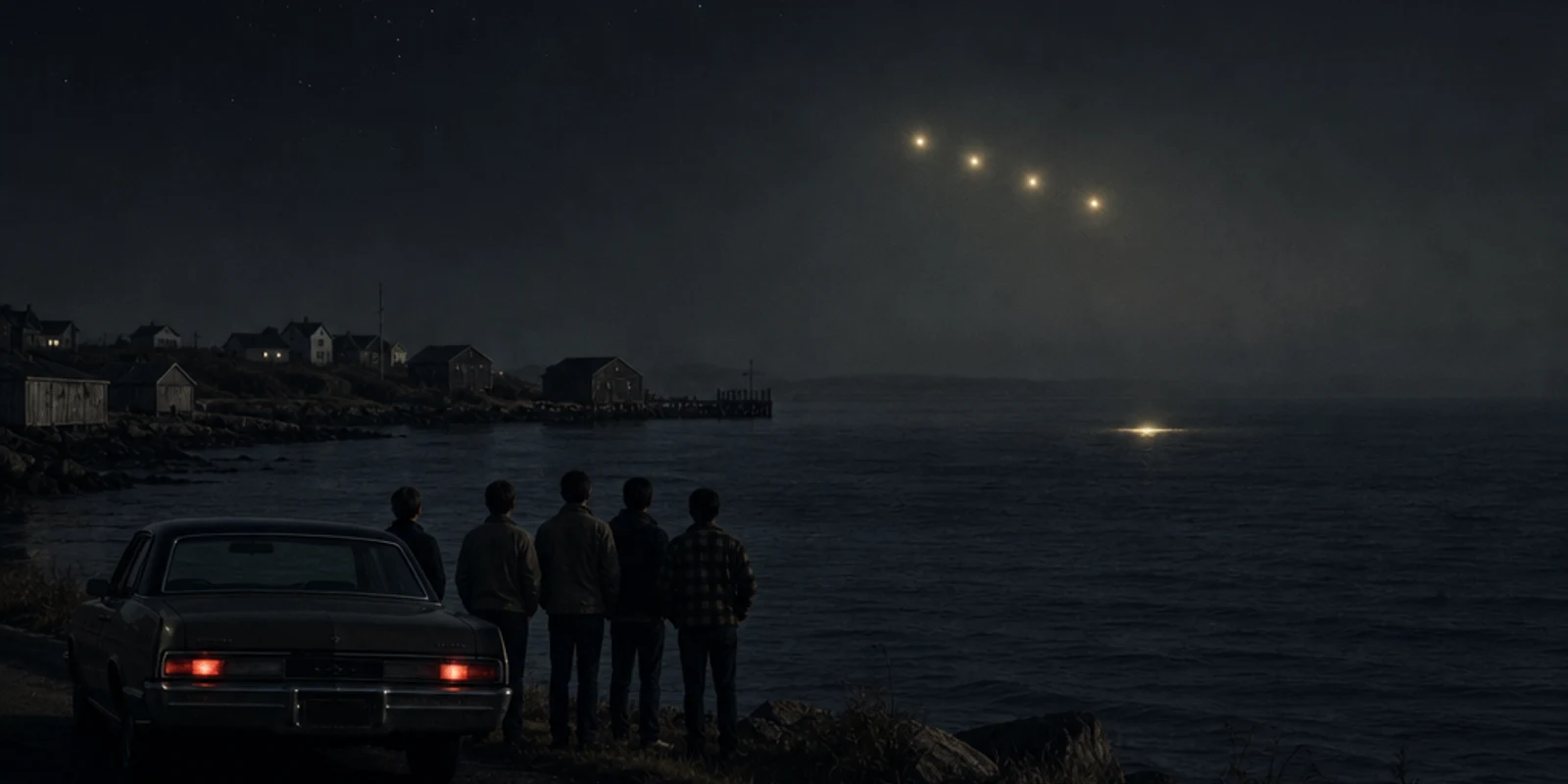
Four lights over a moonless road
Late on Wednesday, October 4, 1967, seventeen-year-old Laurie Wickens was driving friends along Highway 3 after a dance when they noticed lights over the coast. Wickens later remembered four lights in a row, blinking one after another and then together. Other nearby witnesses reported three or four reddish, orange, yellow, or white lights. The formation appeared to tip downward at roughly forty-five degrees and descend toward the water off Shag Harbour. Some witnesses remembered a whistle, rush, bang, or flash; those sensory details were not shared by everyone.
Sources: Canada’s best-documented UFO sighting still intrigues, 50 years onCase 34: Canadian Naval Maritime CommandThe Shag Harbour UFO
A plane going into the sea
Nobody in Wickens’s car began with a story about extraterrestrials. They thought they had watched an aircraft go down. Wickens reached a payphone and called the Royal Canadian Mounted Police at Barrington Passage. The first questions included whether he had been drinking, but other calls arrived almost immediately. The RCMP called him back and sent officers toward the harbour. The practical question that night was not what kind of UFO had appeared; it was whether people were trapped in a wreck offshore.
Sources: The man who phoned in Canada’s most famous UFO sighting became the face of the mysteryCanada’s best-documented UFO sighting still intrigues, 50 years onCase 34: Canadian Naval Maritime Command
The light that remained
From shore, responding Constable Ron O’Brien said he saw a light floating roughly half a mile offshore, drifting with the tide until it disappeared before a boat could reach it. The Colorado study’s later telephone inquiry recorded a more cautious sequence: witnesses saw lights descend, then a yellow or white light appeared on the water, while apparently nobody it contacted had directly watched a solid body cross the surface. That distinction matters. The archive establishes reported lights in the sky and on the sea; the dramatic word “impact” was an interpretation built from their timing, a reported flash, and sounds heard from different positions.
Sources: Could Be Something Concrete In Shag Harbor UFO—RCAFCase 34: Canadian Naval Maritime CommandThe man who phoned in Canada’s most famous UFO sighting became the face of the mystery
Fishing boats race into the dark
Local fishermen did not wait for the mystery to acquire a name. Boats pushed out in the darkness looking for survivors, joined by Canadian Coast Guard Cutter 101 from Clark’s Harbour. Searchers found no person, body, luggage, oil slick, or aircraft debris. Captain Bradford Shand told contemporary reporters that he encountered an unusual patch of foam at least eighty feet wide and yellowish in the darkness. Later tellings stretched the foam into a long, bubbling trail and added a sulphur smell, but no sample was preserved for chemical testing and the earliest reports do not tie every detail directly to the floating light.
Sources: Could Be Something Concrete In Shag Harbor UFO—RCAFThe Shag Harbour UFOThe man who phoned in Canada’s most famous UFO sighting became the face of the mystery
A rescue becomes a UFO file
The Rescue Coordination Centre checked for overdue or missing aircraft and found none that matched the report. Government traffic then used the plain administrative label “UFO Report”: the reported object remained unidentified. An October 6 memorandum by National Defence operations director Col. W. W. Turner said preliminary work had discounted aircraft, flares, floats, and other known objects. Yet the underlying search language cited by later analysts was weaker—possible leads had been checked with nil results. A failed search for flare remnants is not the same as a controlled test proving that no flare could have produced the lights.
Sources: 1967 Shag Harbour UFO Sighting and Related ResearchThe man who phoned in Canada’s most famous UFO sighting became the face of the mysteryThe Shag Harbour UFO
Seven divers over a flat sand bottom
Maritime Command sent Fleet Diving Unit Atlantic to search the suspected site. Beginning Friday, October 6, Navy divers worked through the weekend in water reported as roughly nine to twenty metres deep, with good visibility over a flat sand bottom. Contemporary reporting followed the expanding team and the possibility that metal-detection equipment might be used. The official result was stark: no object, wreckage, or relevant debris. By October 9, the search was over, leaving an unusual event with an unusually concrete response—and nothing recovered to identify what had triggered it.
Sources: The man who phoned in Canada’s most famous UFO sighting became the face of the mysteryCanada’s best-documented UFO sighting still intrigues, 50 years onCase 34: Canadian Naval Maritime Command
Case 34 calls Nova Scotia
The U.S. Air Force-sponsored Colorado UFO project also examined the event as Case 34. Investigator Norman Levine telephoned Canadian naval and RCMP contacts while the story was fresh. His summary preserved disagreements in colour, number, sound, and whether an entry into the water was actually seen; it also recorded that no aircraft was missing and no unusual radar target was reported by the nearby station. After the diver search found nothing, the project made no site visit and concluded that further investigation was not justified because Canadian authorities had already searched promptly and thoroughly.
Sources: Case 34: Canadian Naval Maritime CommandCanada’s UFOs: The search for the unknown
The submerged journey added decades later
The most elaborate version of Shag Harbour arrived long after the five-day official file had gone quiet. Beginning in the 1990s, researcher Chris Styles gathered interviews alleging that an object travelled underwater toward Government Point near Shelburne, was monitored by Canadian and American vessels, and was joined by a second craft before both escaped. Those claims gave the case its secret-base and underwater-saucer mythology. They depend on anonymous or off-record recollections made decades later. The public official record documents the Shag Harbour search and its null result, not a second object, a week-long naval standoff, recovered metal, or an underwater escape.
Sources: Canada’s best-documented UFO sighting still intrigues, 50 years onThe Shag Harbour UFOShag Harbour UFO Incident
The flare and fireball problem
Marine distress flares offer the strongest developed ordinary explanation: several lights can descend at an angle, a flare can continue burning at the surface, and tiny spent material helps explain why boats and divers found no wreck. A fragmenting meteor or fireball fits a descending line and some reports of sound or flash. Neither candidate is a perfect reconstruction. A meteor does not linger on the water, while one small flare is difficult to reconcile with a light reportedly visible long enough for calls and police response. Unknown distance, uncertain timing, differing witness accounts, and the absence of a recovered object prevent the record from fixing scale or duration precisely.
Sources: The Shag Harbour UFOCase 34: Canadian Naval Maritime CommandCould Be Something Concrete In Shag Harbor UFO—RCAF
The harbour keeps its mystery
Shag Harbour became more than an entry in a federal file. A local interpretive centre, anniversary gatherings, roadside markers, and the advocacy of Wickens and other residents turned the night into community history. Wickens never claimed to know what the lights were. His enduring statement was narrower: he saw something come down and could not identify it. That restraint is the case’s most compelling inheritance. A fishing village responded to what looked like disaster, officials documented an unidentified report without recovering its cause, and the dark Atlantic supplied no final object to place behind the lights.
Sources: The man who phoned in Canada’s most famous UFO sighting became the face of the mysteryShag Harbour UFO Incident1967 Shag Harbour UFO Sighting and Related Research