A prospector on the Shield
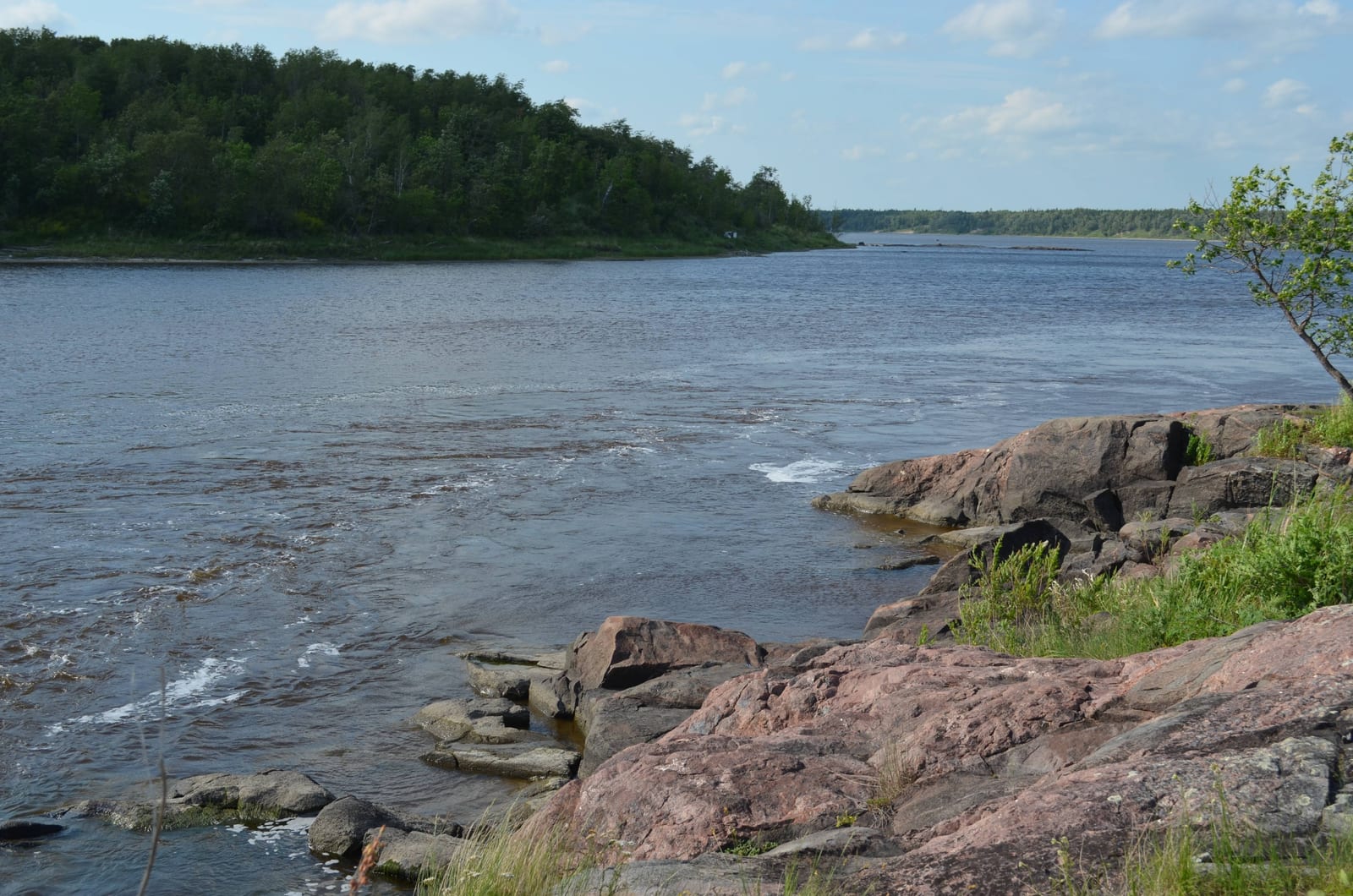
Stefan Michalak was fifty years old in the spring of 1967, a Polish-born industrial mechanic who spent his weekends chipping at the pink granite of southeastern Manitoba in search of quartz and silver. He had trained as a junior officer in the Polish Army, fought as a Home Army partisan during the German occupation, slipped out of Communist Poland in 1948 and spent a decade on a Saskatchewan farm working to bring his wife Maria and their children over. They were reunited in 1957; a second son, Stan, was born the next year, and the family settled in Winnipeg. On Friday, May 19, the start of the Victoria Day long weekend, Michalak travelled about 150 kilometres east along the Trans-Canada Highway to Falcon Lake, on the southern edge of Whiteshell Provincial Park, and took a room at the motel. He had been prospecting the area the year before and wanted to check a promising vein.
Sources: Stefan MichalakFalcon Lake incident is Canada’s ‘best-documented UFO case,’ even 50 years laterToo Close an Encounter: The Michalak case, Falcon Lake, 1967
Geese at a quarter past twelve
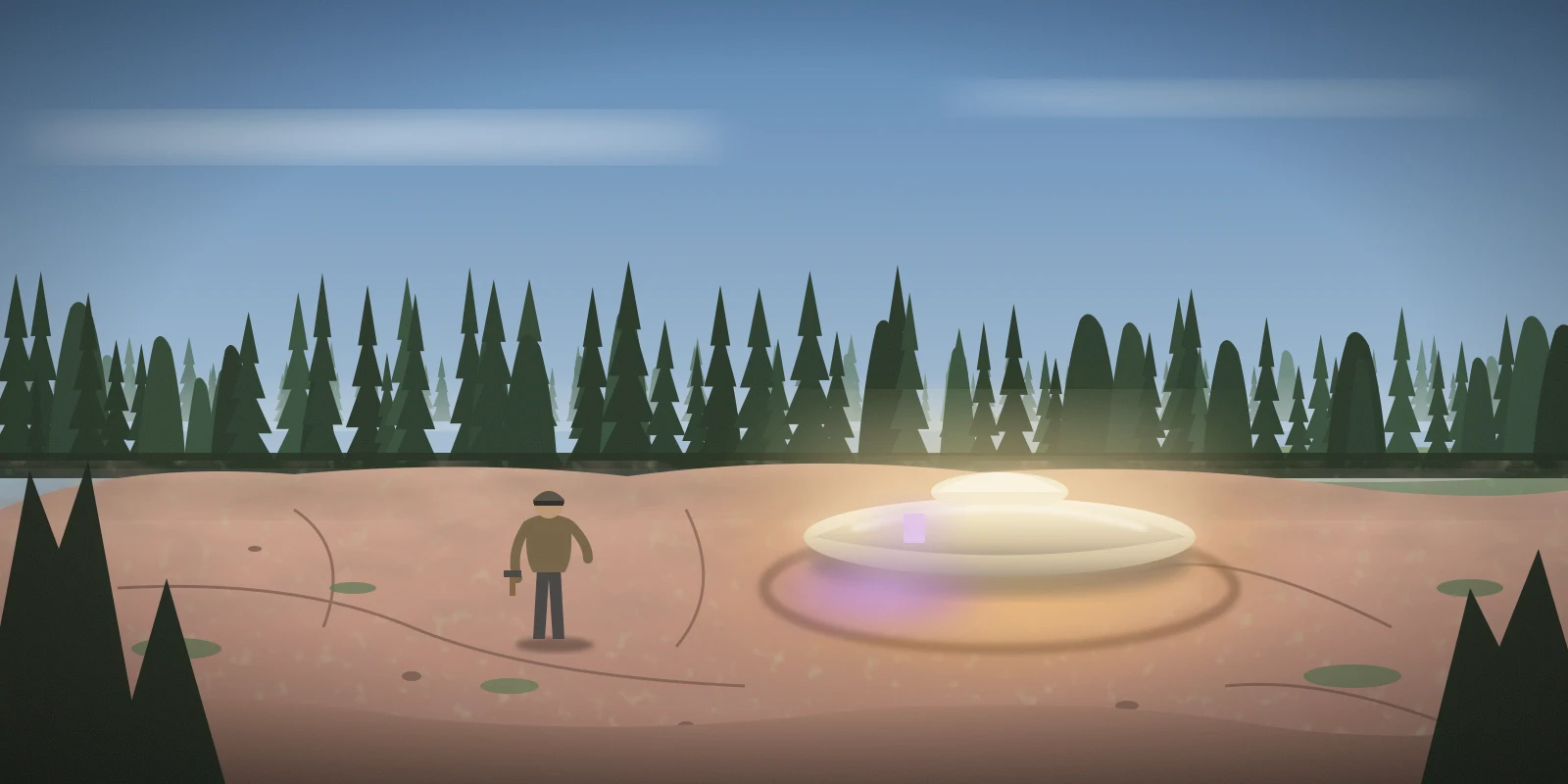
He left the motel at 5:30 on the morning of Saturday, May 20, under a clear sky, walked north into the bush and by nine o’clock had found the quartz vein beside a marshy stream. He ate lunch at eleven and went back to the rock with his hammer and chisel. At about 12:15 p.m. a flock of geese nearby broke into a clatter of honking. Michalak looked up and saw two objects gliding down out of the southwest, low over the trees, both glowing scarlet, both shaped, he said, like cigars with bumps on them. The farther one stopped and hovered—the Condon Committee recorded ten or twelve feet above the ground—while its companion kept descending. After a few minutes the hovering object rose again and shrank away to the west, its color running from red to orange to grey before it vanished. The nearer object settled onto a flat outcrop of rock about 160 feet from where he stood.
Sources: Too Close an Encounter: The Michalak case, Falcon Lake, 1967Case 22 — North Central, Spring 1967Falcon Lake incident is Canada’s ‘best-documented UFO case,’ even 50 years later
The color of hot stainless steel
On the ground the object looked less like a cigar than a dome. Michalak’s later estimates put it at roughly thirty-five to forty feet across and ten or twelve feet thick, with a three-foot cupola on top. As it sat there its glow faded from red to grey until it took on the sheen of what he called “hot stainless steel,” wrapped in a golden light. He assumed it was an American experimental aircraft that had come down on the wrong side of the border, so he did what a mechanic and a former intelligence man would do: he sat back in the trees for about half an hour and sketched it. He noticed waves of warm air rolling off the hull, a strong smell of sulphur, the whir of what sounded like a fast electric motor, and a hissing as though air were being drawn in or expelled. Intense light poured from openings around the dome, and he was glad of the welding goggles he wore to protect his eyes when chipping rock.
Sources: Too Close an Encounter: The Michalak case, Falcon Lake, 1967Case 22 — North Central, Spring 1967UFO Sighter Suffers Chest Burn — Foul Smell Persists
‘Okay, Yankee boys, having trouble?’
Then a door about two feet wide and three feet high opened in the side, spilling out a violet light. Michalak walked to within sixty feet and heard two voices from inside, humanlike, one pitched higher than the other, muffled by the machinery. Assuming Americans, he called out: “Okay, Yankee boys, having trouble? Come on out and we’ll see what we can do about it.” The voices stopped. He tried Russian, then German, Italian, French and Ukrainian, then English again; later retellings add his native Polish. Nothing answered but the whir and hiss. Curiosity won. He walked up to the opening and looked in through the goggles at a maze of lights on what seemed to be a panel, beams running horizontally and diagonally, and a cluster of lights flashing in random sequence “like on a computer.” He saw no one. The wall of the craft, he judged, was about eighteen inches thick. When he stepped back, three panels slid across the opening and sealed it “like a camera shutter.”
Sources: Too Close an Encounter: The Michalak case, Falcon Lake, 1967Case 22 — North Central, Spring 1967Falcon Lake incident is Canada’s ‘best-documented UFO case,’ even 50 years later
The glove, the grid and the blast
Michalak reached out and touched the hull with his gloved hand. The surface was highly polished, like colored glass, and threw the sunlight back in what he called “silvery spectra.” When he pulled his hand away the fingertips of the glove had burned and melted. The object then shifted—in later tellings it began to rotate counter-clockwise—and brought into view a panel he had not seen before: a grid about nine inches high and six inches wide, pierced with a uniform pattern of round holes each about a sixteenth of an inch across. A blast of hot gas shot from the holes into his chest. It pushed him backward and set his outer shirt and undershirt on fire. He tore the burning clothes off and stamped them out—the cap on his head was scorched through—and felt a rush of air as the craft lifted, according to the Condon report on a compass bearing of 255 degrees, and was gone at tremendous speed. What remained was the stink of burning electrical insulation mixed with sulphur, a patch of smouldering moss he stamped out, and a compass whose needle, when he went back for his gear, spun erratically for several minutes before it settled.
Sources: Too Close an Encounter: The Michalak case, Falcon Lake, 1967Case 22 — North Central, Spring 1967Falcon Lake incident is Canada’s ‘best-documented UFO case,’ even 50 years later
A circle swept clean
He walked over to where the object had rested. The rock was swept bare of twigs and stones, and around it lay a ring of pine needles, dirt and leaves about fifteen feet across, as if something had blown the ground clean and piled the debris at the edge. As he stood there the nausea arrived, then a headache, then cold sweats and dizziness. He gathered what he could carry and started for the highway, vomiting repeatedly and stopping to gather his strength. He reached the Trans-Canada about a mile from where he had gone in and, at about three o’clock, flagged down a passing RCMP car. What happened next is the first fork in the record. Michalak’s own account has the constable saying “Sorry, but I have other duties to perform” and driving on. Constable G. A. Solotki’s report says that he stopped, that Michalak spoke of two spaceships and a burned shirt and warned him not to come close for fear of spreading radiation, that he offered help and was refused, and that the man looked to him like someone with a hangover, though he smelled no alcohol. Either way, Michalak was left on the road.
Sources: Too Close an Encounter: The Michalak case, Falcon Lake, 1967UFOs at LAC: The Falcon Lake incident, part 1Falcon Lake incident
The long way home
Back at the motel he would not go inside, worried that he was contaminated, and waited among the trees. The park office was closed. By four o’clock the pain drove him into the coffee shop, where he was told the nearest doctor was in Kenora, Ontario, forty-five miles east. He telephoned the Winnipeg Tribune news desk asking for help getting to a doctor; the short-staffed Saturday desk declined. So he waited for the 8:45 p.m. bus, called his wife to say there had been an accident, and asked her to send their elder son to meet him. He was in Winnipeg by about 10:15 and at Misericordia Hospital shortly after, where he told the doctors only that he had been hit by exhaust from an aeroplane. They found superficial burns, gave him a sedative and sent him home. Nine-year-old Stan was allowed in to see him the next day. “He looked pale, haggard,” Stan recalled fifty years later. “When I walked into the bedroom there was a huge stink in the room, like a real horrible aroma of sulphur and burnt motor … it was coming out of his pores.”
Sources: Too Close an Encounter: The Michalak case, Falcon Lake, 1967Falcon Lake incident is Canada’s ‘best-documented UFO case,’ even 50 years laterUFOs at LAC: The Falcon Lake incident, part 1
‘I was burned by UFO’
On Monday, May 22, the Tribune ran the story under that headline with a photograph of Michalak holding his drawing of a domed disc, and by the next day the wire services had carried it across the country. “I’ve lost 12 pounds in the last two days and I’ve been laughed at,” he told a Canadian Press reporter, “but I thought it was my duty to report what I had seen.” He said he could still feel “a sort of foul smell coming from inside me.” His nineteen-year-old son Mark described the marks on his father’s chest as a checkerboard: “One square has a number of dots in it while the next one is bare.” The family doctor, R. D. Oatway, who saw him within a day or two of his return, recorded a band-like headache, a hot forehead, nausea, a feeling of blacking out, singed hair and “numerous reddish, slightly irregular, oval-shaped, slightly raised lesions” across the chest and abdomen, consistent with a first-degree burn. Michalak kept a diary of his weight: 180 pounds before the weekend, 158 a week later. He vomited, fainted for the first time in his life, and his wife and son swore the sulphur smell came off his skin for days. Within days the RCMP, the Royal Canadian Air Force, the Aerial Phenomena Research Organization and a queue of reporters had all been to the family bungalow in River Heights. “It just flipped our lives over,” Stan said.
Sources: UFO Sighter Suffers Chest Burn — Foul Smell PersistsToo Close an Encounter: The Michalak case, Falcon Lake, 1967Falcon Lake incident is Canada’s ‘best-documented UFO case,’ even 50 years laterFalcon Lake incident
A site that would not be found
The problem for the investigators was the forest. RCMP and RCAF aircraft flew the area on May 25 and ground parties went in on May 31 and June 1; they found Michalak’s discarded shopping bag and an old saw but no landing circle. Squadron Leader Paul Bissky of the RCAF, a self-described unbeliever in “that stuff,” led the military side and began to doubt his witness when a Falcon Lake bartender said he had served Michalak four or five beers the night before. Roy Craig and Mary Lou Armstrong of the University of Colorado’s Condon Committee arrived in early June with John Fried of Life magazine, hiked in behind Michalak for a day, and failed too. “It seemed as if the place had disappeared from the face of the earth,” Michalak wrote. He guarded his directions, he later admitted, because he had struck a promising nickel showing nearby and did not want to lose it. In late June—Rutkowski gives June 30, the RCAF file June 25—he went back with a new acquaintance, Gerald Hart, and after six hours found the ring of debris, the remnants of his shirt, and his tape measure. Hart, it turned out, was known to the RCMP as a tax resister who had written a popular book on avoiding income tax, and the officials’ suspicion of the new partnership shows in their reports. When they followed Michalak in on July 2 and again on July 28, Bissky wrote that the site lay within fifty yards of where the ground party had searched on June 1, screened by heavy bush, and that on the rock was “the outline of an approximate 15 foot diameter circle … cleared to the rock surface by a force such as made by air at very high velocity.”
Sources: Too Close an Encounter: The Michalak case, Falcon Lake, 1967Case 22 — North Central, Spring 1967Falcon Lake incident
Radium in the crack
The soil and shirt fragments Michalak brought out of the bush changed the case. The RCMP crime laboratory measured radium in the sample and called it “a possible serious health hazard”; Ottawa briefly considered closing that part of the park. Stewart Hunt of the federal Radiation Protection Division went in to check. He found one contaminated smear across the crown of the rock, about half an inch by eight inches along one side of a crack, plus a little lichen beside it, the whole thing under a hundred square inches: real, but no danger to anyone. Under ultraviolet light the site samples fluoresced the way radium luminous paint does, while samples from Michalak’s basement did not. Hunt had also swept the basement for loose contamination and found none, though he was appalled to see that the mechanic had been handling the material with his bare hands, and he drove out to a waste-burial site to make sure no hospital radium had been dug up. A defence department minute sheet put the puzzle plainly: the radium amounted to about a third of what a wristwatch dial carries, and the quantity “does not explain how this ‘smear’ got on the rock … This is what is bothering the scientific people.” A Whiteshell Nuclear Research Establishment whole-body count on May 30 had already shown nothing above background in Michalak himself, and a radiologist found no sign of radiation injury in the burns or his blood. Bissky, for his part, was left with two facts that bothered him. Nothing in the surrounding trees had been touched by a forty-foot object coming and going, and yet, he conceded, “there are certain facts, such as Mr. Michalak’s illness and burns and the very evident circle remaining at the site, which are unexplainable.”
Sources: Too Close an Encounter: The Michalak case, Falcon Lake, 1967Case 22 — North Central, Spring 1967UFOs at LAC: The Falcon Lake incident, part 2
Rye whisky and a barbecue grill
Bissky did not leave it there. After the July 28 site visit he steered Michalak into the same Falcon Lake bar and reported the results like an experiment: the witness declined beer but accepted “several rye ‘Presbyterians,’” bought a round, loosened up after the third drink and became “quite gay, telling numerous stories,” and when asked about a discrepancy in the direction the object had flown off “just shrugged his shoulders and laughed it off.” From this Bissky reasoned that Michalak “may have had a private party on his own the night of 19 May,” with hallucinations the next day. Privately he went further, telling Rutkowski years later that a woman at Falcon Lake had claimed Michalak pounded on her cabin door at two in the morning and that he had burned himself falling on a hot barbecue grill—a story that never reached the official reports with any evidence attached, and that the woman would not tell publicly. Stan Michalak’s answer, half a century on, was that nobody hallucinates a forty-foot machine at noon from the night before’s beer. Bissky himself, weighing what he had seen on the rock, allowed that “if it was a hoax, its execution was quite elaborate.”
Sources: Too Close an Encounter: The Michalak case, Falcon Lake, 1967UFOs at LAC: The Falcon Lake incident, part 2
A question in the House
By late June the case had reached Parliament. On June 29, 1967, Manitoba MP Edward Schreyer, the future premier, tried to ask about the government’s UFO investigation and was cut off by the Speaker. On November 6, Defence Minister Léo Cadieux told the House that “it is not the intention of the Department of National Defence to make public the report of the alleged sighting.” A written question went unanswered; another MP was refused the file in 1968 and finally allowed to read it in February 1969 with a few pages removed. Meanwhile Michalak was still sick. On September 21, 1967, at work, his throat closed, his face “turned violet,” his hands swelled “like a balloon” and he fainted; the doctors called it an allergic reaction, his first. The chest lesions faded and flared on their own schedule, and in August 1968 he went to the Mayo Clinic in Rochester, Minnesota, at his own expense, for two weeks of tests. The clinic recorded lesions recurring at roughly 112-day intervals and blackout spells in which his eyesight “begins to dim until everything goes black,” and diagnosed neurodermatitis and simple fainting. Its psychiatrist noted that the lesions “have been diagnosed as obviously factitial”—self-inflicted—yet could find “no overt evidence of significant mental or emotional illness,” and, as Rutkowski summarized the report, described a pragmatic, down-to-earth man who did not make up stories. When the psychiatrist and UFO researcher Berthold Schwarz later wrote to Mayo, the clinic replied on April 1, 1969, that it had never had a patient by that name. Michalak produced his bills, and once he signed a release the records arrived at once.
Sources: Too Close an Encounter: The Michalak case, Falcon Lake, 1967Insoluble MiseriesFalcon Lake incident is Canada’s ‘best-documented UFO case,’ even 50 years laterFalcon Lake incident
Silver in the fissure
On May 19, 1968, a year almost to the day after the encounter, Michalak returned to the outcrop with a friend and pried out of a fissure in the landing circle, two inches under the lichen, two W-shaped bars of metal about four and a half inches long and a scatter of smaller pieces. They were radioactive. The National Research Council’s R. J. Traill examined them and reported “pieces of thin sheet silver that have been twisted, crumpled, partly melted and dropped into or otherwise placed in contact with nearly pure quartz sand while still hot,” afterward coated with loosely adhering crushed pitchblende, altered to uranophane, the kind of uranium ore that occurs naturally in the region. One bar was 93 percent silver, the other 96, with copper and cadmium, a composition like commercial sterling or sheet silver. Astronomer Peter Millman suggested someone had dipped the silver in ore to manufacture a relic. Bissky, who examined the pieces at Michalak’s home with a civilian Geiger counter, found them about as active as the dial of a service wristwatch, and wrote the line that has followed the case ever since: “Should this be a hoax, someone is going to considerable effort to perpetrate same.” The Condon investigator thought it improbable that the earlier searches could have missed the bars had they been there. Rutkowski still holds one of them. It remains, he says, “quite energetic”—enough that it has to be kept shielded.
Sources: Too Close an Encounter: The Michalak case, Falcon Lake, 1967Case 22 — North Central, Spring 1967UFOs at LAC: The Falcon Lake incident, part 2Falcon Lake incident
From Unsolved Mysteries to the Mint
Michalak never claimed to have met aliens. To the end he said he had probably seen a secret military machine, and when asked what it was he would answer, in effect, that he did not know. He wrote up his account in Polish that first year as a forty-page booklet, My Encounter with the UFO, and complained afterward that “others have made money from my experience, but not me.” He refused to embroider the story or to change it, whether awake or, in one late-1960s session, under hypnosis—a session one of the hypnotists later denied had happened, though the tape survives. In 1992 NBC’s Unsolved Mysteries flew the family to South Dakota to re-create the encounter. Asked on set whether the saucer was the most incredible thing that had ever happened to him, Michalak said “Oh, no, it wasn’t,” and told the crew about the Nazi camps; one of them later asked what being burned by a flying saucer was next to that. He died in Winnipeg on October 28, 1999, at eighty-three. On the fiftieth anniversary Stan Michalak and Rutkowski published When They Appeared, and in April 2018 the Royal Canadian Mint issued a twenty-dollar coin in its “Canada’s Unexplained Phenomena” series, billed as the first shaped coin with glow-in-the-dark elements: an egg-shaped ounce of silver on which a figure sprawls beneath a lifting craft, the craft and its exhaust glowing red, purple and yellow under a black light. Four thousand were struck, at $129.95 apiece. An early proof, Stan said, had glow-in-the-dark alien eyes; the Mint decided to stay faithful to the story. In November 2019 the burned shirt, the scorched cap, the Mayo Clinic identification badge and some 30,000 items—20,000 civilian sighting reports and 10,000 pages of government files—were unveiled at the University of Manitoba Archives, where Stan summed up the reaction his father kept for the rest of his life: “What the hell is that?”
Sources: Too Close an Encounter: The Michalak case, Falcon Lake, 1967Obituary: Stefan MichalakFalcon Lake incident is Canada’s ‘best-documented UFO case,’ even 50 years laterMint’s newest coin showcases famous Falcon Lake UFO encounter in Manitoba1 oz. Pure Silver Glow-in-the-Dark Coin — Canada’s Unexplained Phenomena: The Falcon Lake IncidentExtra-terrestrial collection touches downThe University of Manitoba’s archive of the paranormal just became a little more extraordinaryFalcon Lake incident
One witness, many examiners
Everything about the object itself comes from Stefan Michalak: the two descending shapes, the door, the voices, the grid, the blast. No second person saw the craft. A fire-watch tower with a view of the area logged nothing that afternoon, hundreds of golfers on a course under the reported departure bearing reported nothing, and three radar sites recorded nothing unusual. The Condon investigator also watched the story grow in the telling: asked by APRO in the first days whether his compass had been affected, Michalak said “I couldn’t tell you … I hadn’t looked before,” which became definite spinning in later accounts, and his earliest statements had him keeping clear of the hatch, not peering in at flashing panels. Against that stand his consistency over the next thirty-two years, the absence of any financial motive, a Mayo Clinic psychiatric assessment that found no sign of a fabricator, and the sober judgment of investigators who wanted to disbelieve him. Later reports of red or hat-shaped objects around Falcon Lake that weekend, some sketched decades afterward, add atmosphere rather than corroboration.
Sources: Case 22 — North Central, Spring 1967Too Close an Encounter: The Michalak case, Falcon Lake, 1967UFOs at LAC: The Falcon Lake incident, part 2
The burns and the shirt
That Michalak was burned is not in dispute. Hospital and family-physician records describe first-degree burns in irregular, oval, raised patches across the upper abdomen, with singed hair; RCMP officers likened them to an exceptionally severe sunburn, and a photograph taken by APRO’s Barry Thompson on May 23 shows blotchy marks rather than a neat lattice, though his son was describing a checkerboard to reporters within days. The famous grid appears on the undershirt and in photographs from January 1968, when the marks returned as evenly spaced dots; Wikipedia and skeptical writers note that the 1968 pictures are often mistaken for the original injury, and the Condon investigator could not square the undershirt’s patterned burn, which sits high on the back, with a blast to the chest. A radiologist found no radiation damage; the RCMP laboratory could not say what had made the burns. Rutkowski reports that dermatologists judged the pattern chemical, “more like an actual exhaust such as Michalak had described,” not radiation. Whether the recurring lesions were an allergic reaction—John Alexander’s suggestion—or self-inflicted—as Mayo’s diagnosis had it—or something else, is the case’s open wound.
Sources: Falcon Lake incidentCase 22 — North Central, Spring 1967Insoluble MiseriesReview: When They Appeared — Falcon Lake 1967
The ground trace and the radiation
The circle cleared to bare rock was seen and photographed by RCAF and RCMP officers and by the federal radiation team; its origin was never established, and the surrounding trees showed no damage, though a civilian group reported one small tree bent at the base with a brown-ringed hole burned through each leaf. The radioactivity was real but small: a smear no bigger than a hundred square inches on one side of a crack, which the federal inspector judged consistent with radium luminous paint, while a provincial mines official who checked the site later that year found nothing at all. Later analyses of samples held by civilian researchers found natural uranium, and in 1994 fallout cesium, but no radium signature, suggesting the early radium readings may have been mistaken. The site had been open to anyone for a month before officials reached it, and a year before the silver appeared.
Sources: Too Close an Encounter: The Michalak case, Falcon Lake, 1967Case 22 — North Central, Spring 1967UFOs at LAC: The Falcon Lake incident, part 2
Interpretations
The Condon Committee filed Falcon Lake as Case 22 and left it unexplained, while its investigator wrote that attempts to establish the reality of the event “revealed many inconsistencies and incongruities.” Donald Menzel and Ernest Taves dismissed it in 1977 as “a badly executed hoax,” on the grounds that the site could not be found and the illness looked like insect bites, and modern skeptics point to the beers, the hangover the constable suspected, the nickel showing Michalak was protecting, and the tidy geometry of the 1968 marks. The Department of National Defence still lists it as unsolved. Michalak’s own preferred explanation, a secret vertical-takeoff aircraft, has been revived by Palmiro Campagna, a former defence engineer who notes that every sensation described—hot exhaust, burning insulation, whirring motors—reads as machinery. Rutkowski, who has lived with the file since the 1970s, will say neither alien nor secret craft, only that a hoax would have to “rival some of the greatest hoaxes ever perpetrated,” by a man who injured himself, gained nothing and endured decades of ridicule. His son puts it more bluntly: “If Dad hoaxed this—remember we’re talking about a blue-collar, industrial mechanic—if he hoaxed it then he was a freakin’ genius.”
Sources: Case 22 — North Central, Spring 1967UFOs at LAC: The Falcon Lake incident, part 2Too Close an Encounter: The Michalak case, Falcon Lake, 1967Falcon Lake incident is Canada’s ‘best-documented UFO case,’ even 50 years laterFalcon Lake incident
Classification and evidence note
This archive classifies Falcon Lake as a reported close encounter of the second kind because the witness described physical effects on his body, clothing and the ground; the label describes the account, not its cause. The evidence consists of Michalak’s 1967 manuscript and consistent later testimony, contemporary medical records, RCMP, RCAF and federal health reports now held at Library and Archives Canada, which counts more than 9,000 digitized pages on the case, the Condon Committee case file, and physical artifacts at the University of Manitoba including the burned clothing and one radioactive silver fragment. Its limits are the single witness, the month-long gap before anyone else saw the site, and the lack of any independent observation of the object. Sources were reviewed September 27, 2026; review again by September 2028 or when further federal or archival records are published.
Sources: UFOs at LAC: The Falcon Lake incident, part 1UFOs in CanadaThe University of Manitoba’s archive of the paranormal just became a little more extraordinary
- 19 MAY 1967
Stefan Michalak travels from Winnipeg to Falcon Lake for the long weekend and takes a room at the motel on the Trans-Canada Highway.
- 20 MAY 1967 · 5:30 AM
He walks north into the bush and by nine o’clock is working a quartz vein beside a marshy stream.
- ABOUT 12:15 PM
Startled geese draw his eye to two glowing red objects descending; one hovers and departs, the other lands on a flat granite outcrop about 160 feet away.
- NEXT 30 MINUTES
He sketches the object as it cools to the sheen of hot stainless steel, noting warm air, a sulphur smell, whirring and hissing.
- AFTER HALF AN HOUR
A door opens; he hears two voices, hails the ‘Yankee boys’ in six languages, looks inside at panels of light, and touches the hull, melting his glove.
- MOMENTS LATER
A grid of small holes vents hot gas into his chest, igniting his shirt; the craft lifts off and vanishes, leaving a fifteen-foot ring of blown debris.
- ABOUT 3:00 PM
Sick and vomiting, he reaches the highway; an RCMP constable stops but drives on. He waits for the 8:45 PM bus.
- ABOUT 10:15 PM
His son meets him in Winnipeg and takes him to Misericordia Hospital, where superficial burns are treated.
- 22–24 MAY 1967
The Winnipeg Tribune prints ‘I was burned by UFO’; wire stories carry his account nationwide as RCMP officers and APRO’s Barry Thompson visit and photograph the burns.
- 25 MAY–4 JUN 1967
RCMP, RCAF and Condon Committee investigators and a Life magazine correspondent search by air, by helicopter and on foot; the site is not found.
- 30 MAY 1967
A whole-body count at the Whiteshell Nuclear Research Establishment shows nothing above background radiation.
- LATE JUN–2 JUL 1967
Michalak and Gerald Hart relocate the landing circle; officials collect soil that the RCMP laboratory reports as radioactive.
- 29 JUN 1967
MP Edward Schreyer’s question about the investigation is cut off in the House of Commons.
- 28 JUL 1967
Squadron Leader Paul Bissky’s party documents the cleared circle; federal inspector Stewart Hunt limits the contamination to a small smear along a crack.
- 21 SEP 1967
Michalak collapses at work with a swollen face and hands and a closing throat, the first of the allergic attacks that follow him for years.
- 6 NOV 1967
Defence Minister Léo Cadieux tells the House the department will not release its report.
- JAN 1968
The chest marks return as an even grid of dots; the photographs become the case’s most reproduced, and most disputed, image.
- 19 MAY 1968
Michalak recovers two W-shaped bars of radioactive silver from a fissure in the landing circle.
- AUG 1968
Two weeks of tests at the Mayo Clinic end with diagnoses of neurodermatitis and fainting spells, and a psychiatrist’s finding of no significant mental illness.
- 1968–1969
The Condon Committee lists Falcon Lake as Case 22, unexplained; the National Research Council identifies the bars as sheet silver coated in pitchblende.
- 4 NOV 1992
Unsolved Mysteries broadcasts a re-creation with the Michalak family and Chris Rutkowski.
- 28 OCT 1999
Stefan Michalak dies in Winnipeg at eighty-three, his account unchanged.
- MAY 2017
Stan Michalak and Rutkowski publish When They Appeared on the fiftieth anniversary.
- APR 2018
The Royal Canadian Mint issues a glow-in-the-dark $20 silver coin depicting the encounter, limited to 4,000 pieces.
- NOV 2019
The burned shirt and cap, Michalak’s papers and some 30,000 Canadian UFO reports and government documents are unveiled at the University of Manitoba Archives.
Sources & interviews
Case 22 — North Central, Spring 1967University of Colorado UFO Project (Condon Committee) · Scientific Study of Unidentified Flying Objects · 1968 · Roy Craig’s field investigation of the Michalak reportToo Close an Encounter: The Michalak case, Falcon Lake, 1967Chris Rutkowski · Ufology Research of Manitoba report, 1994 · quotes RCAF, RCMP, Department of Health and Welfare, Mayo Clinic and National Research Council documentsInsoluble MiseriesChris Rutkowski · written after the November 1992 Unsolved Mysteries broadcast · corrections to the medical claims that circulate about the caseObituary: Stefan MichalakChris Rutkowski · Ufology Research of Manitoba · 1999UFO Sighter Suffers Chest Burn — Foul Smell PersistsThe Edmonton Journal · Canadian Press · May 24, 1967 · archival transcriptUFOs at LAC: The Falcon Lake incident, part 1Library and Archives Canada · Discover LAC podcast, episode 53 · May 2019 · with Stan Michalak, Chris Rutkowski and Palmiro CampagnaUFOs at LAC: The Falcon Lake incident, part 2Library and Archives Canada · Discover LAC podcast, episode 54 · 2019 · the RCMP, RCAF and radiation investigations in the federal filesFalcon Lake incident is Canada’s ‘best-documented UFO case,’ even 50 years laterDarren Bernhardt · CBC News · May 19, 2017 · interview with Stan Michalak and Chris RutkowskiMint’s newest coin showcases famous Falcon Lake UFO encounter in ManitobaElisha Dacey · CBC News · April 3, 20181 oz. Pure Silver Glow-in-the-Dark Coin — Canada’s Unexplained Phenomena: The Falcon Lake IncidentRoyal Canadian Mint · 2018 · product record and issue notesFalcon Lake incidentWikipedia · summary of the RCMP reports, contemporary newspaper coverage, the 1968 grid photographs, the Mayo Clinic opinion and skeptical readingsUFOs in CanadaThe Canadian Encyclopedia · the 1967 “three physical cases” and the federal UFO files at Library and Archives CanadaExtra-terrestrial collection touches downGrace Anne Paizen · The Manitoban · November 18, 2019 · the Falcon Lake artifacts and Rutkowski’s files arrive at the University of Manitoba ArchivesThe University of Manitoba’s archive of the paranormal just became a little more extraordinaryEmma McPhee · University Affairs · February 25, 2020Stefan MichalakPolish Exiles of WW2 · family-written biography · Polish Army, Home Army partisan, escape in 1948, reunion in Canada in 1957Review: When They Appeared — Falcon Lake 1967John B. Alexander · Journal of Scientific Exploration 33(2) · 2019Connected files
The Shag Harbour LightsFive months later, in Canada’s centennial year, another object went into the official record—this time into a Nova Scotia harbour, with RCMP officers watching.The Fire on FM 1485Another witness burned by heat from a low object, with lasting medical effects, a suspected military craft and no official answer.The Socorro ArroyoA lone, credible witness, a landed craft on bare ground, a scorched trace and an investigation that could neither confirm nor dismiss it.Close encounters, explainedWhy burns, ground rings and a spinning compass make Falcon Lake a textbook second-kind case.Discuss this case
Compare notes with other readers: witness details, sources, and the parts that still do not add up.
Open the discussion