The speeder and the flame
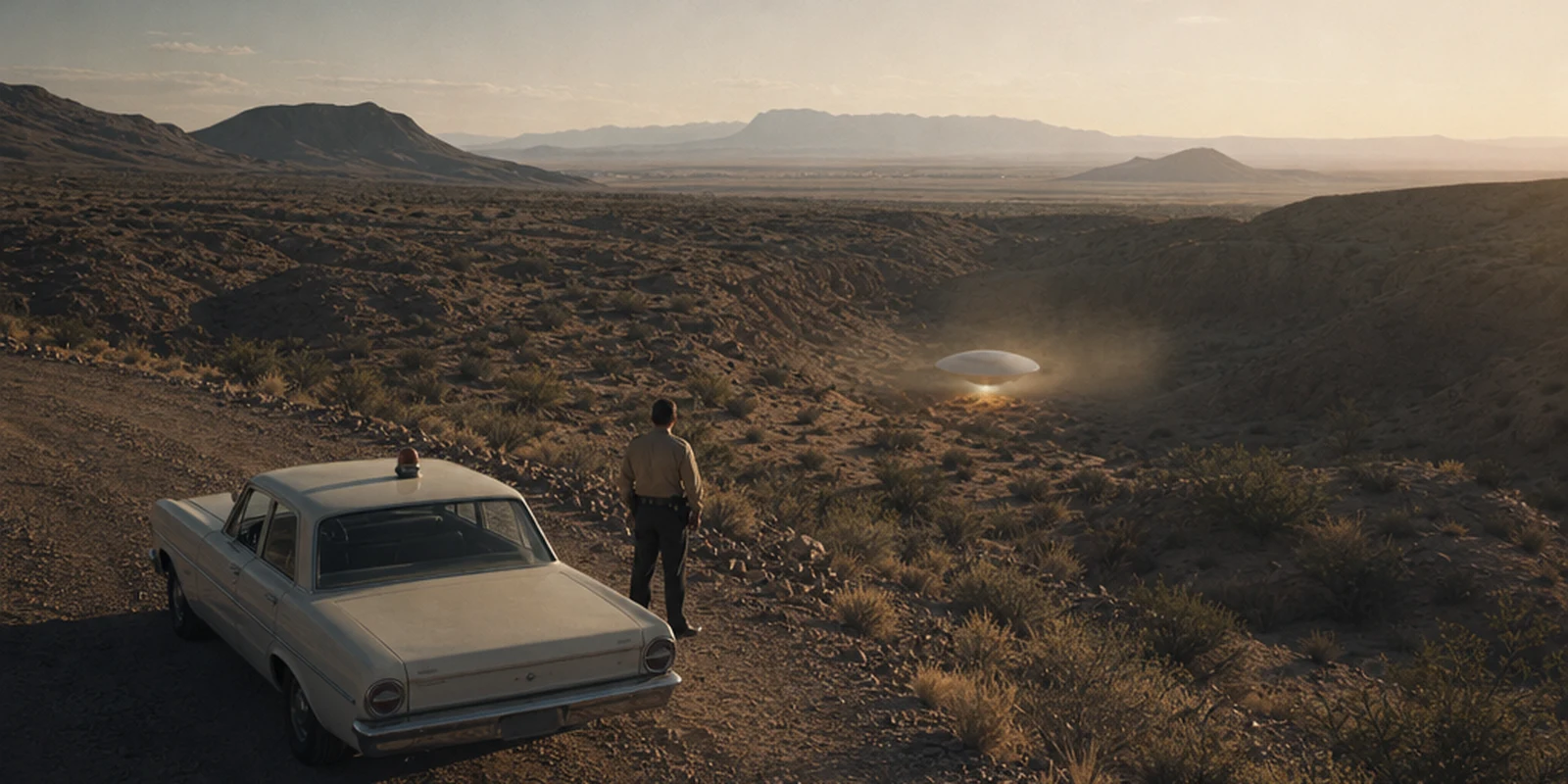
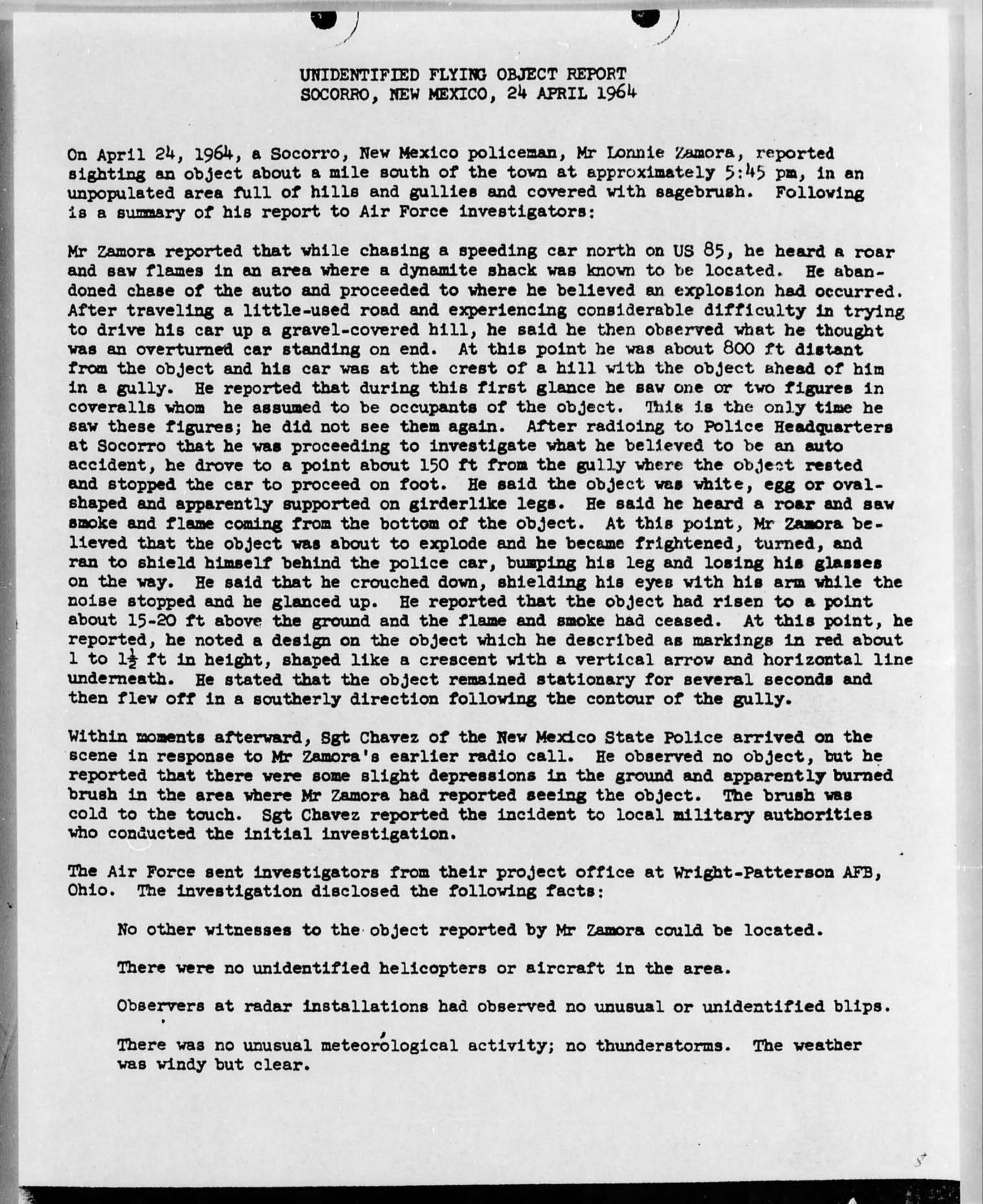
Late Friday afternoon on April 24, 1964, Socorro police officer Lonnie Zamora was pursuing a speeding car south from the courthouse when a roar pulled his attention toward the desert. He saw a narrow blue-orange flame beyond low ground to the southwest. A dynamite-storage shack stood in that direction, so he abandoned the chase and turned onto a rough gravel track to investigate a possible explosion. Loose stone defeated his patrol car twice before he crested the rise on a third attempt. What began as routine police work had carried him out of town and into one of the most closely documented encounters in Project Blue Book’s files.
Something white in the arroyo
From the ridge, Zamora noticed a bright white or aluminum-colored form below, roughly 150 to 200 yards away. His first thought was an overturned car with people beside it. He reported one or two small white shapes near the object, but his language remained cautious. In a radio interview recorded within days, he would not confidently call them people: he had seen something like white coveralls, briefly and at a distance. The object itself appeared smooth, oval or egg-like, about the bulk of a car. As he drove closer, the arroyo rim hid it from view, and he radioed that he was checking a wreck.
The roar returns
Zamora stopped on the mesa, left his car, and started down. A sudden roar—loud, rising in pitch, unlike a steady jet—made the scene dangerous rather than merely strange. He saw a pale blue flame with orange near its lower end beneath the object and believed it might explode. He ran, struck the rear of his patrol car, lost his glasses, and continued over the edge of the rise with the car between himself and the source. His official account is unusually candid about fear: he ducked, covered his face, and waited for the sound to stop.
Silence over the desert
When the roar ended, Zamora lifted his head. He said the object had risen to roughly the level of his car, perhaps 20 to 25 feet above its starting place. The flame was gone. After a brief high whine came complete silence. He watched the pale shape move away low across the ground, clear the nearby dynamite shack, then climb toward the western mountains until it became too small to follow. Back at the radio, he asked dispatcher Nep Lopez to look outside and described the departing thing with the most ordinary comparison available: “It looks like a balloon.” Lopez’s window faced the wrong direction.
Chavez arrives after the departure
New Mexico State Police Sgt. M. S. “Sam” Chavez reached Zamora minutes later. He did not see the object. He did see a shaken officer, several disturbed patches of soil, and brush that appeared burned or smoldering. Other local officers soon arrived, followed that evening by Army Capt. Richard T. Holder of White Sands Missile Range and FBI agent D. Arthur Byrnes Jr., who happened to be working in Socorro. Their notes and measurements converted a fleeting personal account into a multi-agency paper trail before crowds could fully overrun the place.
Four marks and scorched plants
Investigators recorded four shallow impressions arranged around the reported position, smaller round marks, and damaged vegetation. The impressions displaced soil but did not reveal what made them. Accounts differ on whether brush was still hot: early local reporting said some plants were smoldering, while an Air Force narrative records Chavez finding a charred branch cold to the touch. No authenticated fragment of a vehicle was recovered. Project Blue Book later reported normal radiation, no foreign material in soil, and no propellant chemicals in analyzed vegetation. By Sunday, hundreds of visitors had trampled the arroyo, sharply limiting any later reconstruction.
Blue Book looks for an earthly vehicle
The Air Force treated Socorro as a problem to identify, not as proof of visitors from elsewhere. Investigators checked weather and research balloons, helicopters, civilian and military aircraft, White Sands and Holloman activity, lunar-vehicle contractors, radar stations, local weather, soil, vegetation, and radiation. The nearest down-range moving-target radar had closed for the day before the encounter; other stations reported no unusual return. The checks produced no matching vehicle. Project Blue Book classified the case as unidentified, while explicitly stating that its findings gave no indication of extraterrestrial origin or a national-security threat.
The officer behind the report
Official and local accounts repeatedly describe Zamora as sober, conscientious, and reluctant to embellish. His near-contemporaneous radio interview is more useful than later legend because it preserves uncertainty: the white shapes were not certainly people, he did not see doors, and he could not say whether supports retracted. The incident brought reporters, investigators, sightseers, and ridicule. Zamora continued working for the city and largely withdrew from retelling the story. His restraint became central to the case’s endurance; the record contains a frightened witness, but not a witness selling certainty.
Surveyor, balloons, and a campus prank
Conventional explanations have never been absent. A test article related to NASA’s Surveyor lunar program was flown beneath a helicopter at White Sands that day, but the documented test was far from Socorro, earlier in the day, and the hardware neither resembled Zamora’s smooth oval nor could depart under its own power. Balloon proposals can fit his radio comparison and some motion, but have difficulty with the sustained roar, reported flame, and compact form. The most discussed alternative is a prank by New Mexico Tech students. A 1968 note from university president Stirling Colgate said he had a good indication that a former student engineered a hoax; decades later he summarized it as a candle in a balloon. No participant, design, photograph, or complete operational account has surfaced, and skeptical writers acknowledge the difficulty of explaining how pranksters disappeared before Chavez arrived.
A symbol multiplied by retelling
Zamora reported a red marking on the object, and investigators deliberately guarded its exact form so it could test later claims. The surviving archive contains more than one rendering, while popular accounts often reproduce a neat insignia as though it were fixed and independently photographed. It was not. The mark exists through Zamora’s recollection, notes, and drawings made in the investigation’s wake. That makes it part of the testimony, not a recovered emblem. The same caution applies to alleged additional witnesses: the contemporary newspaper relayed an unidentified traveler’s remark about a low “funny looking helicopter,” but Blue Book reported that it could locate no corroborating witness to the close encounter.
The case that would not leave Socorro
Local newspapers photographed the disturbed ground and published before the Air Force investigation was complete. J. Allen Hynek arrived as Blue Book’s scientific consultant and continued to regard the report as a serious puzzle. In a 1966 intelligence journal, project chief Hector Quintanilla called Socorro the best-documented case on record and admitted that the investigators remained puzzled. The city later built a visitor site in the wrong place, commissioned a mural, and absorbed the encounter into local identity. The actual arroyo offers no preserved artifact—only a landscape, archived pages, and the memory of an officer who went looking for an accident.
What remains in the dust
The record establishes that Zamora made an immediate report, that Chavez and other officials examined fresh disturbances soon afterward, and that federal investigators failed to match the account to a known operation. It does not establish that the ground marks came from the reported object, that the distant white shapes were occupants, or that a nonhuman craft landed in New Mexico. A hoax remains possible but unproved; a secret or misperceived vehicle remains possible but unidentified. “Unresolved” is therefore the narrow, durable conclusion: the event generated evidence of a report and a response, while the identity of its cause escaped both.