Debris on a sheep ranch
In early July 1947, rancher W. W. “Mac” Brazel brought a discovery to the attention of the sheriff in Roswell, New Mexico. Scattered material on the ranch he managed led Major Jesse Marcel, the intelligence officer at Roswell Army Air Field, and counterintelligence officer Sheridan Cavitt to investigate. In a July 9 newspaper interview, Brazel dated his initial discovery to June 14 and described rubber, foil, paper, and sticks. That account places the discovery before the July headlines that made it famous.
A flying disc, then a balloon
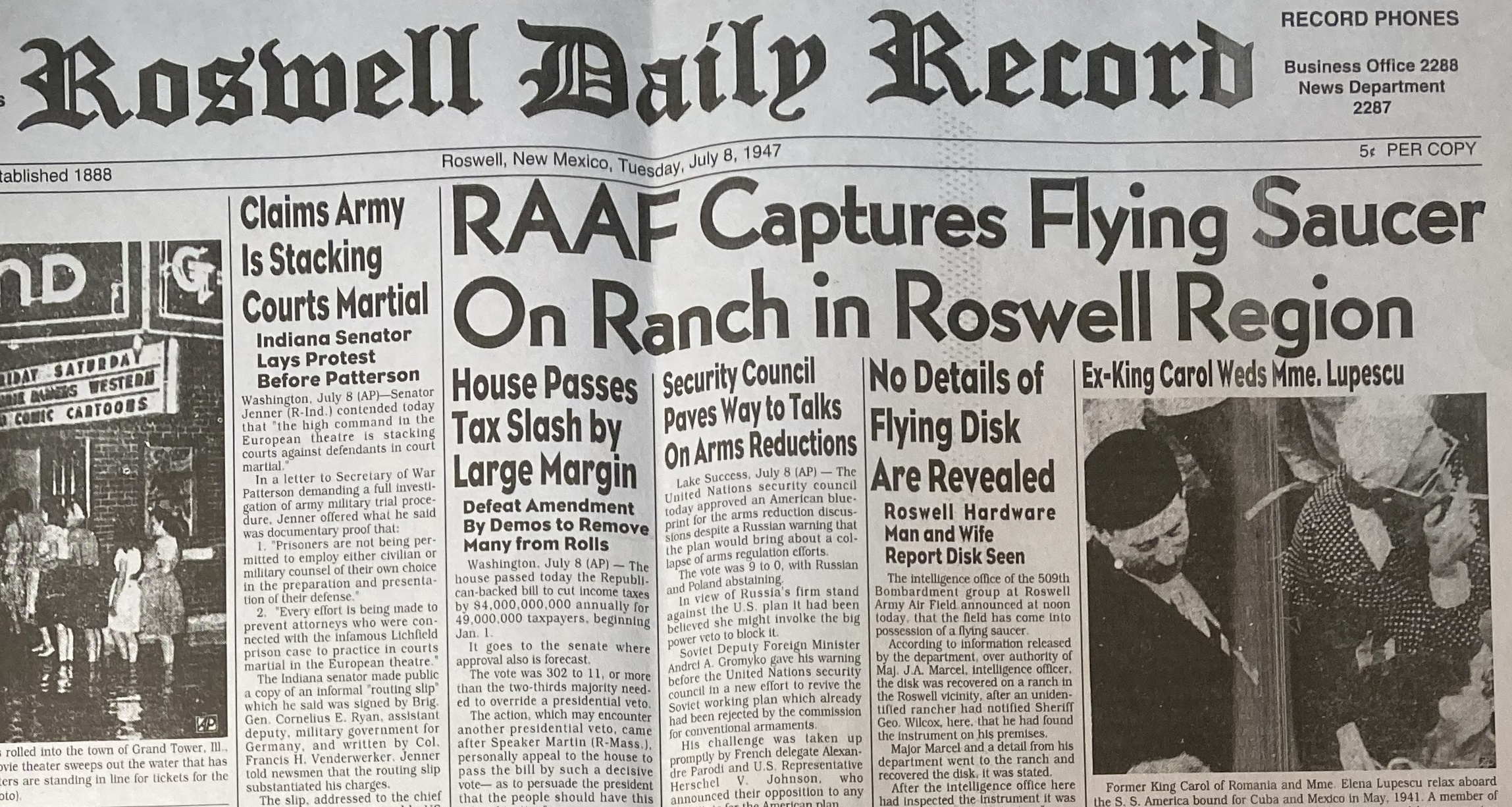
On July 8, the base’s public information office announced the recovery of a flying disc. The material was taken to Fort Worth, Texas, where Brig. Gen. Roger Ramey presented a balloon explanation. Photographs show Marcel, Ramey, and other officers with foil-like material and broken supports. The next day’s newspapers carried the revised account. The University of Texas at Arlington preserves the Fort Worth Star-Telegram photographs and negatives, allowing readers to examine what was displayed to the press.
The story returns decades later
Renewed interest followed researcher Stanton Friedman’s contact with Marcel in 1978 and the publication of Charles Berlitz and William Moore’s The Roswell Incident in 1980. Marcel’s later interviews describe unfamiliar fragments with properties he considered extraordinary. These recollections were recorded more than thirty years after the recovery. Other people subsequently offered accounts involving bodies and a wider military operation. Mortician W. Glenn Dennis’s 1990 filmed interview, now held by the National Archives, is one example of that later testimony.
The metal that wouldn’t break
In interviews recorded in 1978 and 1979, Marcel described thin metal fragments that resisted bending and lightweight supports he said could not be broken. He also recalled markings he compared to hieroglyphics and material that would not burn when exposed to his cigarette lighter. These details give the debris story much of its strangeness: ordinary-looking fragments, remembered as behaving in extraordinary ways. They remain later witness claims. The interviews record Marcel’s recollections, without providing material samples or independent tests that establish those properties.
The mortician and the mysterious nurse
In an affidavit dated August 7, 1991, Dennis claimed that the base had asked him about its options for very small sealed caskets and about preserving bodies exposed to the desert. He described visiting the infirmary, being threatened into leaving, and later meeting a nurse who told him she had assisted doctors examining unusual bodies. According to Dennis, she was subsequently transferred, and a letter he sent her came back marked deceased. His account places the body descriptions in the nurse’s words, rather than his own observation of an autopsy. It is an unverified story recorded more than four decades after the alleged events.
Majestic 12: the alleged secret committee
Another strand of the lore arrived through a purported classified document that surfaced in the 1980s. It described Majestic 12, a secret group supposedly created under President Truman to study the Roswell incident. The suggestion of a hidden committee gave the recovery story a larger machinery of secrecy. The FBI investigated the document as a possible leak of classified information and concluded that it was fake. Its presence in the bureau’s files documents that investigation; it does not authenticate the committee or its alleged work.
The alien-autopsy film
In 1995, Ray Santilli and Gary Shoefield promoted a grainy film as footage of a Roswell alien autopsy. Santilli acknowledged staging it in 2006, claiming it reconstructed a deteriorated original. That supposed original remains unverified. The released film is a fabrication, and belongs to the history of Roswell’s mythology.
The classified balloon project
Responding to a congressional inquiry, the Air Force reviewed its records in 1994. It identified Project MOGUL, a secret effort to detect Soviet nuclear tests using balloon-carried acoustic equipment, as the most likely source of the debris. The work used balloon trains and radar reflectors made from ordinary materials. The conclusion rests on a historical comparison of documents, equipment descriptions, and interviews with surviving participants.
What the records search found
A separate General Accounting Office report in July 1995 identified two government records originating in 1947: a base unit history and an FBI teletype. Both refer to balloon equipment. The auditors also found that some administrative records and outgoing messages had been destroyed, but could not determine who destroyed them, when, or under what authority. Those gaps limit the surviving record. The audit did not establish that the missing material concerned an extraterrestrial recovery.
Why there are two Air Force reports
The 1997 follow-up, The Roswell Report: Case Closed, addressed the later claims about bodies. The Air Force proposed that accounts had combined events from different years, including high-altitude dummy recoveries and accidents involving service personnel in the 1950s. Those events occurred after 1947. The report therefore offered an explanation based on mistaken chronology and recollection, rather than claiming that test dummies accompanied the original debris. Keeping the debris question separate from the later body stories is essential to following the dispute.