Seven marks on the midnight scope
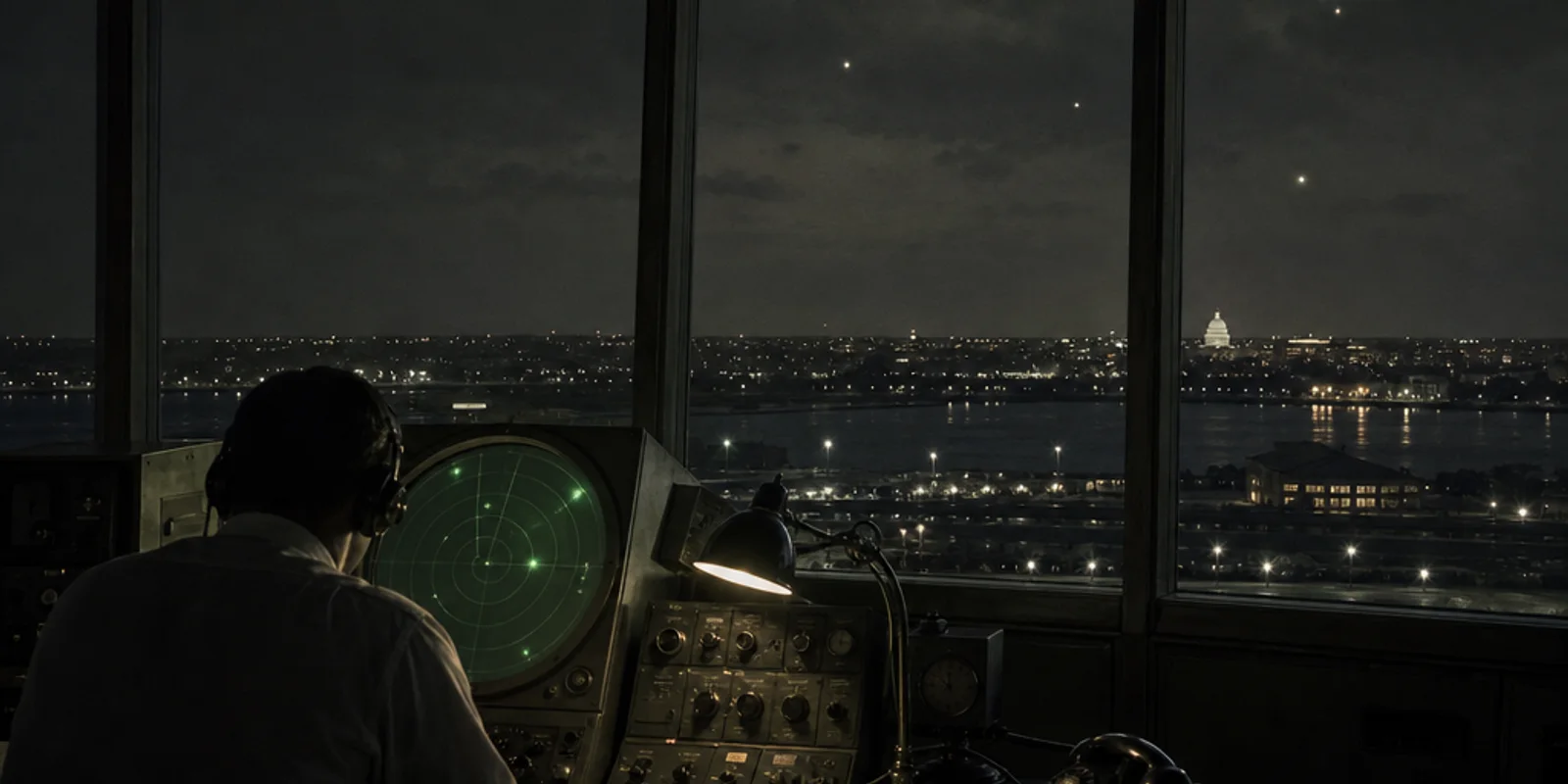
Near 11:40 p.m. on Saturday, July 19, controller Edward Nugent noticed seven returns on the long-range radar at Washington National Airport. They sat south and east of the city, away from the traffic he expected. He called senior controller Harry Barnes over with a half-joking line about a “fleet of flying saucers.” The joke did not last. Barnes’s report says the returns moved at roughly 100 to 130 miles per hour; some were weak, others stronger. Maintenance personnel checked the equipment and reported that it was operating satisfactorily. National’s shorter-range tower radar also received unidentified returns, while personnel at nearby Andrews Air Force Base began reporting lights in the same broad area.
Lights beyond the glass
The night became more than a story told by one screen. At National, tower controller Howard Cocklin recalled seeing a whitish-blue light outside as an unknown return appeared on radar. Capital Airlines pilot S. C. “Casey” Pierman, departing the airport, reported a succession of fast lights that he compared to falling stars without tails. Barnes later said Pierman’s calls sometimes coincided with returns near his aircraft. At Andrews, witnesses offered different descriptions: an orange object, a color-changing light, brief meteor-like streaks. Those accounts do not combine into one clean portrait. What they preserve is a control system alive with calls—controllers comparing scopes, pilots searching dark sky, and military posts trying to decide whether anything had entered the capital’s airspace.
Interceptors arrive to an empty sky
F-94 Starfire interceptors had to come from New Castle, Delaware, because the runway at Andrews was under repair. By the time the first flight reached Washington, the principal returns had faded. The crews found no object to inspect. Barnes and Project Blue Book director Edward Ruppelt later wrote that returns appeared again after the fighters departed, a sequence that fed the enduring idea that the lights were reacting to radio traffic. The surviving reports do not demonstrate intention. They do capture the frustration of watching a possible track vanish before an aircraft could reach it. Near daybreak, the first weekend’s activity ended without a photograph, recovered object, or close identification.
The second Saturday
One week later, on July 26, the scopes filled again. The Air Force’s surviving summary describes as many as twelve unidentified returns on the Air Route Traffic Control radar, including several early returns that controllers called generally solid and aircraft-like, though unusually slow. The same report also distinguishes later weak, sporadic, and unstable returns. A Civil Aeronautics Administration inspector in the air reported five glowing objects ranging from orange to white. Commercial crews radioed about lights. National’s tower recorded one particularly good slow-moving target. This time Maj. Dewey Fournet, the Pentagon liaison to Project Blue Book, and Navy radar specialist Lt. John Holcomb reached the radar center and watched part of the episode themselves.
Four lights beyond the nose
Two flights of F-94s were sent toward the reported targets. The official summary says one crew flew through a cluster of returns without seeing anything. Another pilot reported four lights, then later a single light ahead that went out before he could close. In his public account, Lt. William Patterson said he had tried to make contact with the low “bogies,” saw several bright lights, and found that even at maximum speed he gained no ground. The story later acquired an especially dramatic exchange in which the lights were said to surround his jet. That wording comes through later retellings rather than the surviving Air Force summary, which is more restrained and notes that the official interceptor reports had not yet reached its authors.
The city wakes to an invasion
By Sunday morning, the capital’s dark radar room had become a national spectacle. Newspapers pushed the Korean War and the presidential campaign aside for headlines about saucers, sky ghosts, and jets chasing lights over Washington. President Harry Truman had an aide call Ruppelt for an explanation; Ruppelt said unusual atmospheric conditions might account for the radar returns but that the incidents had not yet received a complete investigation. The setting amplified every detail: the White House and Capitol inside the defended airspace, Cold War nerves already taut, and the government’s own specialists unable to offer the public a single immediate answer.
The Pentagon answers
On July 29, Air Force intelligence chief Maj. Gen. John Samford faced reporters at the Pentagon. He acknowledged that credible observers sometimes reported incredible things, while saying the sightings presented no known threat. The Air Force’s principal explanation joined two ordinary mechanisms: stars and meteors for many visual reports, and temperature inversions capable of bending radar energy and returning images of objects on or near the ground. Two days later Samford repeated the no-threat conclusion in a filmed statement now preserved by the National Archives. The explanation quieted the immediate storm, but many of the controllers rejected the idea that every return they had watched was weather clutter.
A spike captured on paper
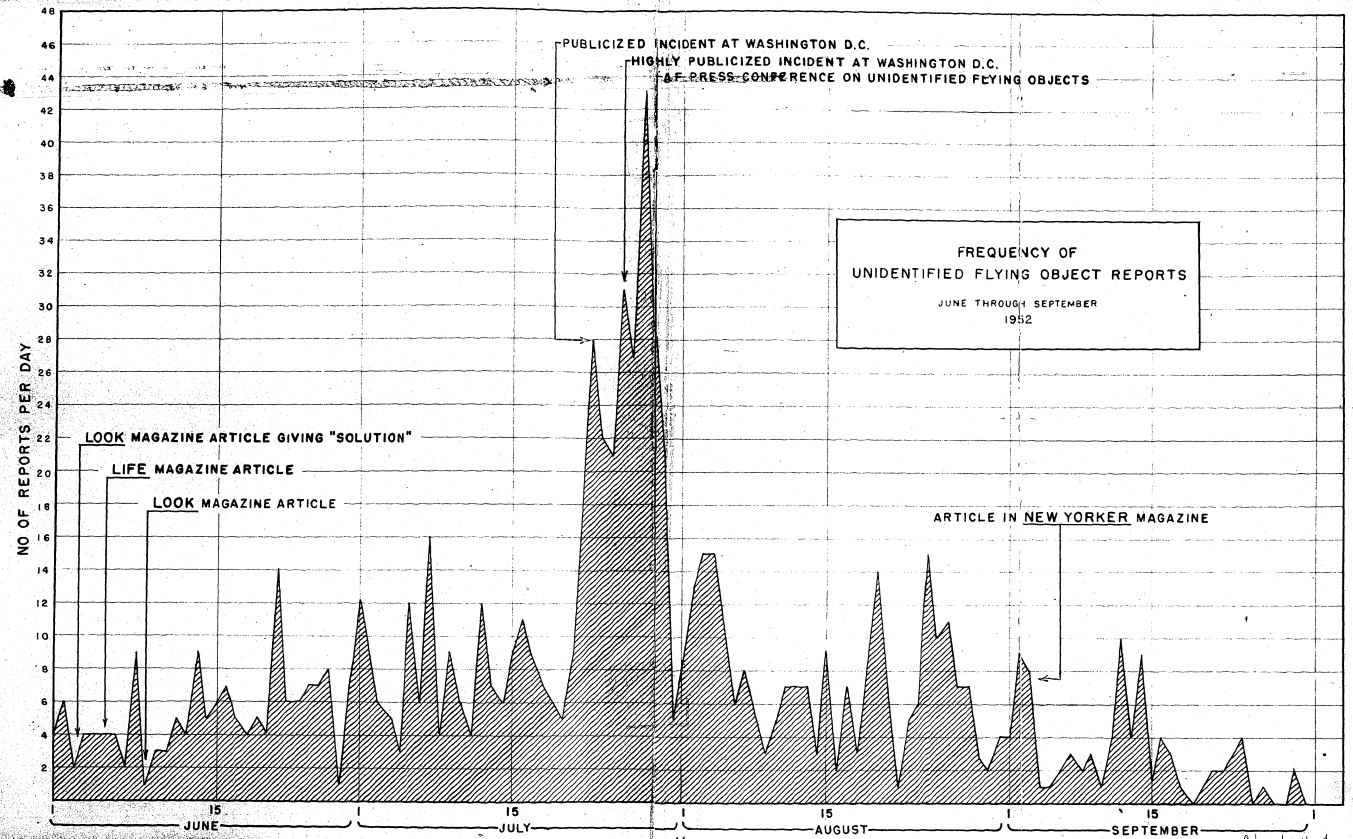
The Washington weekends became the crest of the 1952 reporting wave. An Air Force chart prepared for Project Blue Book marked the publicized incidents, the press conference, and the steep rise and fall in daily reports. The graph is a record of attention rather than a radar plot: it shows how quickly sightings multiplied around a story already filling front pages. Ruppelt later titled his account “The Washington Merry-Go-Round.” The phrase endured because the incident seemed to circle through the same stations—scope, cockpit, headline, official denial, and back again—without delivering the decisive close encounter everyone expected.
From Blue Book to the CIA
The summer’s flood of reports carried the question beyond Project Blue Book. The CIA formed a study group and, in January 1953, convened the scientific committee later known as the Robertson Panel. Its members reviewed selected cases, including the Washington area reports, and found no direct physical threat or evidence requiring new scientific concepts. They worried instead that a torrent of reports could clog defense communications or be exploited during a real attack. That conclusion helped move the official story away from mysterious visitors and toward a different Cold War fear: that uncertainty itself could become a vulnerability.
The mystery left on the scope
Later analysis sharpened the conventional case without making the eyewitness history disappear. The government-funded Condon study found the weather conducive to anomalous radar propagation and judged the radar returns most likely to be false echoes, while assigning most visual reports to stars or meteors. It also noted that a few descriptions remained too incomplete to identify. The official files themselves preserve uneven observations: strong and weak returns, pilots who saw lights and crews who saw nothing, reports that broadly correspond and others that do not. Nothing in the record establishes extraterrestrial craft. What remains compelling is the human scene—experienced operators, urgent radio calls, fighters launched into darkness, and a capital waiting for something solid to emerge from the glow.