A telephone call about four-thousand-mile-an-hour targets
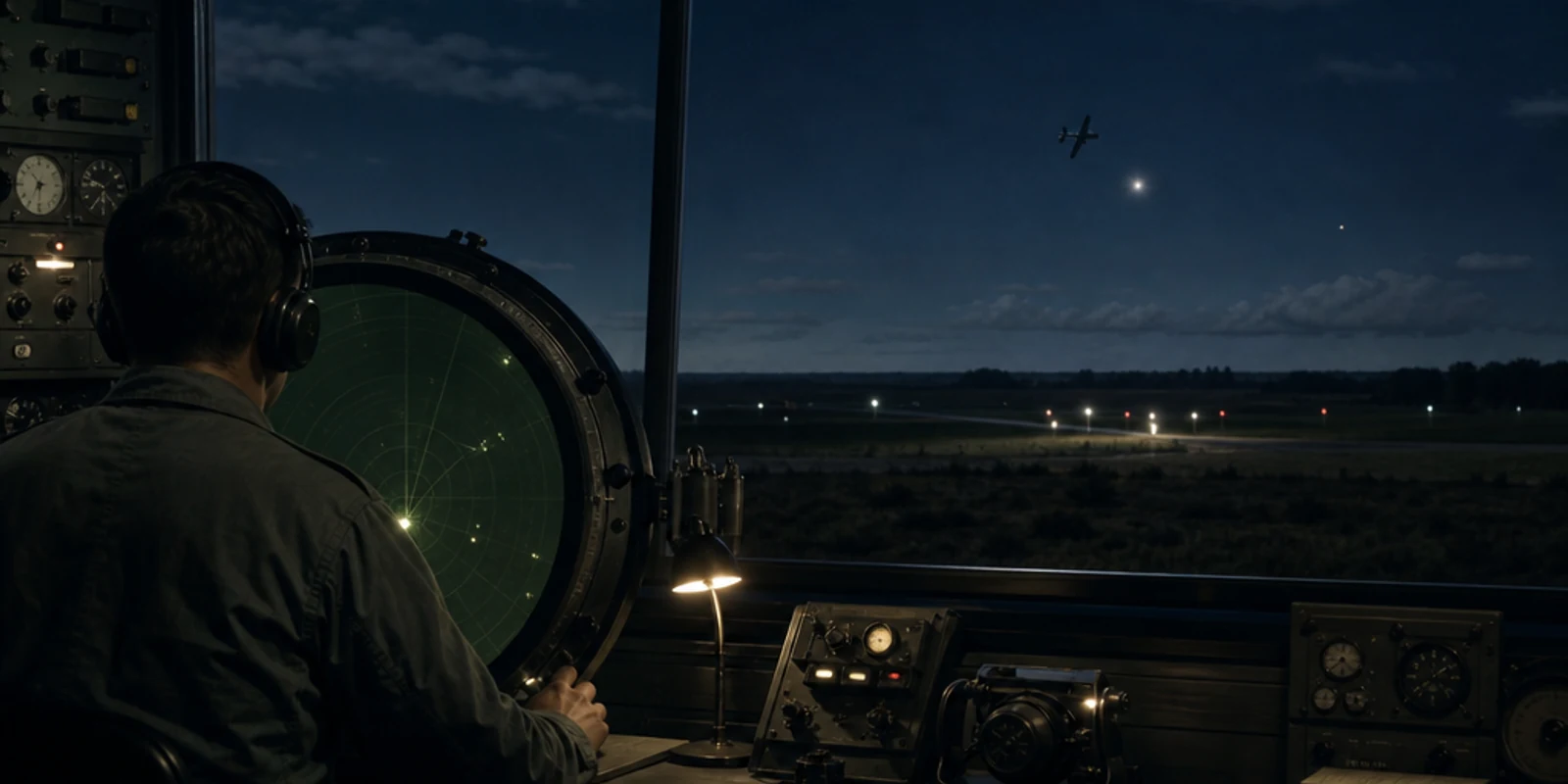
On the clear night of August 13, 1956, radar operators at two American-tenanted RAF stations watched a routine shift fracture into a chain of extraordinary reports. Bentwaters Ground Controlled Approach called the Radar Air Traffic Control Center at Lakenheath, roughly forty miles to the northwest, and asked whether its scopes showed targets moving at about 4,000 miles per hour. The surviving records do not contain a radar film or plotter log from every station. What they preserve is a hurried sequence of operator estimates, visual reports, telephone relays, intelligence forms, and an interception order written into the machinery of Cold War air defence.
Sources: Teletype BOI-485The Lakenheath Radar/Visual UFO CaseHistory, documents, and witness archive for the Lakenheath case
The first tracks at Bentwaters
The Bentwaters report begins between 21:20 and 22:00 Zulu. One return crossed the scope from east-southeast toward west-northwest at a speed estimated above 4,000 miles per hour. A second episode involved twelve to fifteen returns moving northeast, spreading across six or seven miles and apparently merging into one enormous blip before stopping, moving, and stopping again. A third fast return crossed east to west. Operators said the echoes resembled ordinary aircraft targets and that equipment checks disclosed no malfunction. Yet their speed calculations do not always agree with the stated ranges and sweep times, and Lakenheath did not report seeing these earliest tracks on its own scopes.
Sources: Air Intelligence Information Report IR-1-56Project Blue Book report: Bentwaters–Lakenheath, EnglandThe Lakenheath Radar/Visual UFO Case
A star, a beacon, and an empty search
Not every strange thing that night remained strange. Bentwaters tower chief Lawrence Wright watched an amber point low in the southeast for about an hour; its slow rise and changing colour fit Mars seen through thin cloud. First Lieutenants Charles Metz and Andrew Rowe searched from a T-33 for roughly forty-five minutes and found no unknown aircraft. They reported a bright star near the eastern horizon and the Orford coastal beacon flashing through haze. These identifications belong to the case rather than outside it: while radar operators were reporting dramatic tracks, a deliberate aerial search returned empty and at least one prolonged visual observation had an astronomical answer.
Sources: Air Intelligence Information Report IR-1-56Astronomical comments on the Lakenheath caseHistory, documents, and witness archive for the Lakenheath case
The white light over the field
At 22:55 Zulu, the Lakenheath teletype records a new Bentwaters contact approaching from thirty miles east at an estimated 2,000–4,000 miles per hour. The return vanished two miles east of the station, reappeared three miles west, and continued off the scope. That gap might reflect the blind region above a ground radar or an anomalous return. The episode became harder to dismiss because the report paired it with two visual accounts: tower personnel said a bright light crossed east to west at tremendous speed near 4,000 feet, and the pilot of an aircraft at that altitude said a bright light streaked beneath him. The record asserts simultaneity, but supplies no names, signed aircrew statement, radar photograph, or precise visual geometry for independent reconstruction.
Sources: Teletype BOI-485Case 2: Lakenheath, EnglandThe Lakenheath Radar/Visual UFO Case
The target that stopped southwest of Lakenheath
After the warning call, Lakenheath controllers searched with moving-target indication engaged. They reported an echo twenty to twenty-five miles southwest that appeared stationary even though the filter should have suppressed very slow ground returns. A second radar set reportedly confirmed it at the same location. The target then moved north-northeast at a calculated 400–600 miles per hour, halted for several minutes, and set off again without a visible build-up of speed. Other returns appeared nearby, while ground observers described small white lights that stopped, turned, and diminished to points. The teletype treated radar and visual observations as mutually reinforcing; later reviews found their timing and identity much less secure.
Sources: Teletype BOI-485The Lakenheath Radar/Visual UFO CaseHistory, documents, and witness archive for the Lakenheath case
A Venom enters the story
An RAF de Havilland Venom night fighter was scrambled from Waterbeach. In the contemporary American teletype, controllers first vector it toward a target six miles east of Lakenheath. The pilot reportedly sees a bright white light, loses it, and is directed toward another return. He then reports radar contact and a lock. As the fighter passes, the ground scope appears to show the unknown slipping behind it. The pilot allegedly acknowledges the pursuit, circles without shaking the target, asks for assistance, and calls it the clearest radar target he has ever seen. A second Venom launches; the first returns low on fuel, the second makes no contact, and all remaining targets disappear by about 03:30 Zulu.
Sources: Teletype BOI-485Case 2: Lakenheath, EnglandThe Lakenheath Radar/Visual UFO Case
The aircrew remembered a different interception
Decades later, researchers located members of the 23 Squadron crews. Navigator John Brady’s log and recollection place his scramble near 02:00. He remembered three or four passes at roughly 7,000 feet and a faint radar paint that seemed stationary. Pilot David Chambers saw nothing. Brady denied a gun lock, a visual sighting, violent evasion, or a ten-minute tail chase, and thought the return resembled a meteorological balloon with a radar reflector. A second crew also recalled an unimpressive stationary contact. Their testimony confirms that RAF fighters searched for something and obtained at least weak airborne-radar returns, but directly challenges the case’s most cinematic scene.
Sources: Interview with RAF navigator John BradyHistory, documents, and witness archive for the Lakenheath caseLakenheath–Bentwaters incident
How one night became two incompatible classics
The contradiction cannot be solved by quietly choosing the more dramatic version. The teletype was transmitted three days after the event and names the USAF controllers who supplied it, but its Venom dialogue was relayed from the ground rather than signed by the RAF aircrew. Brady and Chambers spoke forty-four years later, when memory had aged but personal logs helped identify the sortie. The Americans may have combined radio calls, scope interpretation, and separate targets into a pursuit narrative; the aircrew may have forgotten details; or more than one episode may have become entangled. The most defensible history keeps both records visible and refuses to promote reported gun lock into uncontested fact.
Sources: Teletype BOI-485Interview with RAF navigator John BradyHistory, documents, and witness archive for the Lakenheath case
Blue Book closes the card; Colorado opens it again
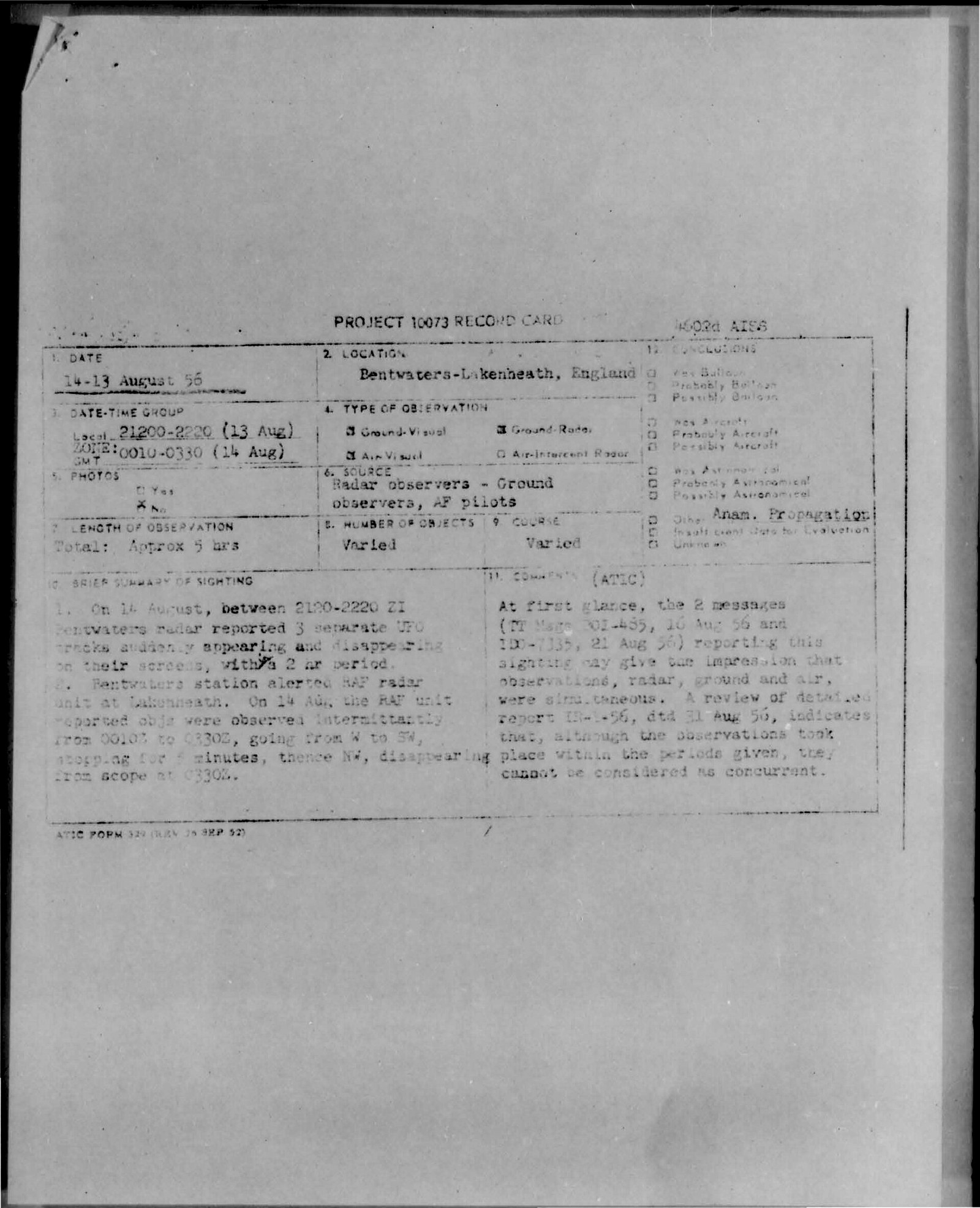
The Project 10073 record card grouped the Bentwaters and Lakenheath reports under anomalous propagation and warned that the radar, ground, and airborne observations could not be considered concurrent after the fuller Bentwaters report was reviewed. Twelve years later, the Air Force-sponsored University of Colorado study reached an unusually different tone. Radar specialist Gordon Thayer called Lakenheath the most puzzling case in the radar-visual files and considered a mechanical device of unknown origin the most probable reading, while explicitly allowing for witness fallibility and conventional explanations. His analysis relied heavily on the contemporary messages and retired watch supervisor Forrest Perkins’s later letter—before the interceptor crews themselves were interviewed.
Sources: Project Blue Book report: Bentwaters–Lakenheath, EnglandCase 2: Lakenheath, EnglandThe Lakenheath Radar/Visual UFO Case
Four ordinary explanations, none for the whole night
The serious conventional case is a mosaic rather than one neat answer. Mars plausibly explains Wright’s long-lived southeastern light. Perseid meteors can explain brief streaks and were conspicuous that night, though Ian Ridpath noted that ordinary radar would not normally track their high ion trails. Balloons fit the slow cluster, prevailing winds, and the weak stationary returns recalled by the Venom navigators. Anomalous propagation or moving-target-indicator faults can create false, vanishing, or displaced echoes, especially the apparent gap over Bentwaters. These mechanisms substantially reduce the mystery, but no preserved meteorological profile, equipment fault report, balloon release record, and synchronized plot reconstructs every reported track.
Sources: Air Intelligence Information Report IR-1-56Interview with RAF navigator John BradyAstronomical comments on the Lakenheath case
What remains on the green scope
Lakenheath–Bentwaters endures because it is both stronger and messier than its legend. Military personnel filed prompt reports; separate radar rooms were involved; aircraft actually launched; and the Air Force preserved a substantial file. But the speeds were scope estimates, the visual-radar matches were asserted rather than instrumentally synchronized, and the famous chase is contradicted by the crew most likely to have flown it. The case is not a clean demonstration of an impossible machine. It is a night when genuine air-defence work, atmospheric and astronomical clutter, weak radar contacts, institutional relay, and unresolved observations became inseparable—and when the archive itself began telling two stories.
Sources: Project Blue Book report: Bentwaters–Lakenheath, EnglandCase 2: Lakenheath, EnglandHistory, documents, and witness archive for the Lakenheath case