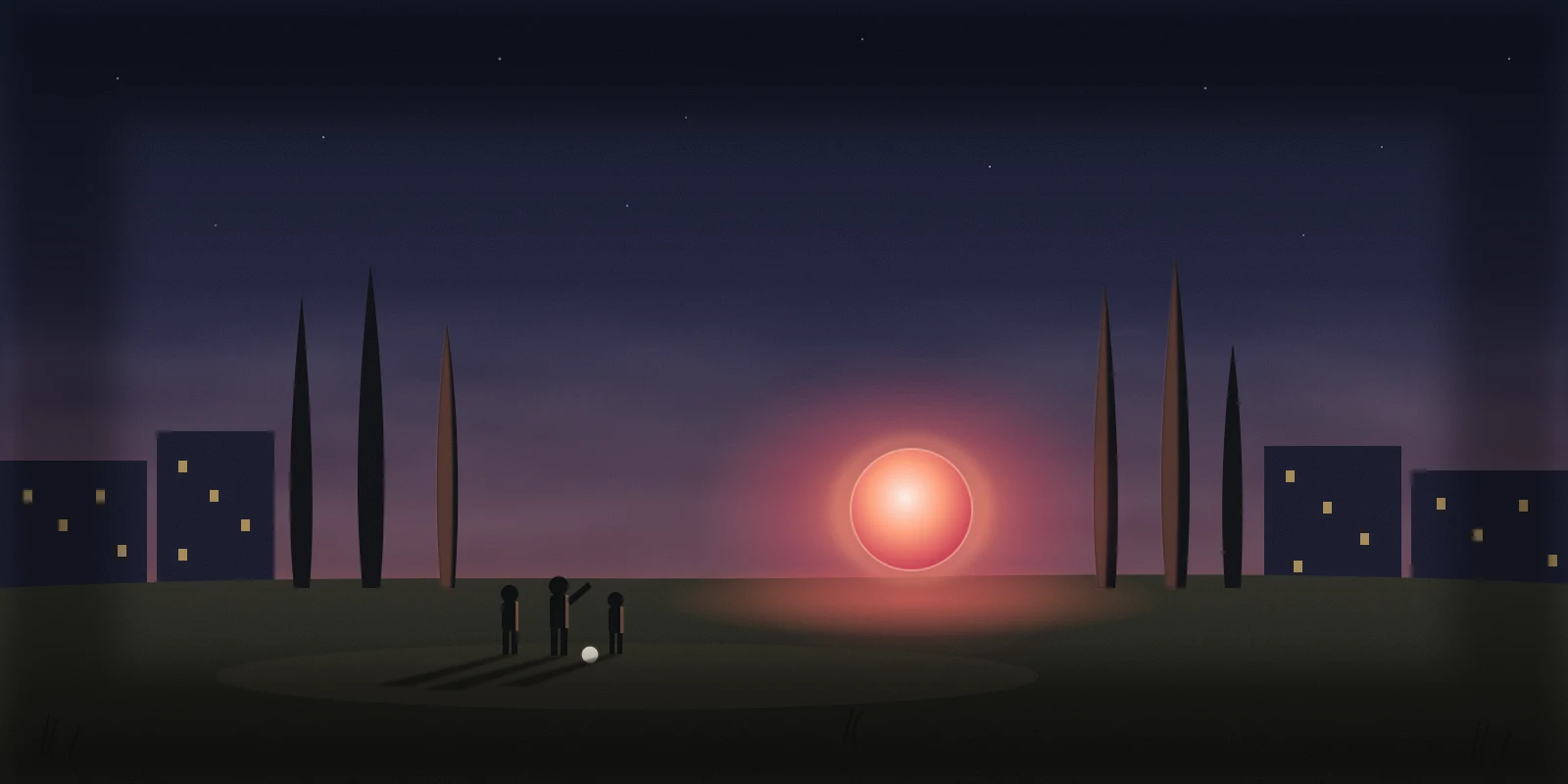
A park built on a dump
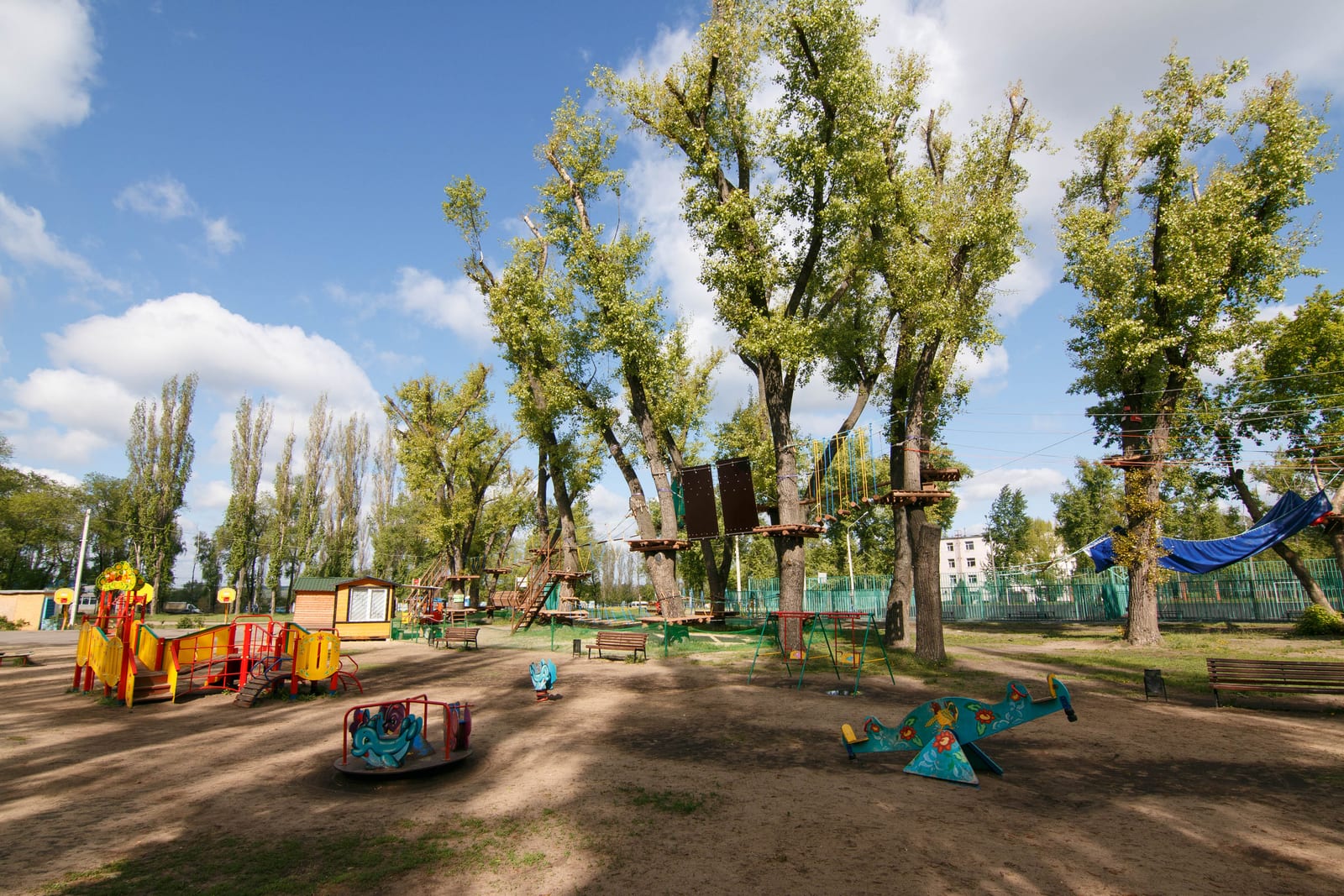
Voronezh in 1989 was an industrial city of more than 800,000 people some 500 kilometres south of Moscow, a place of machinery, chemicals and electrical plants, with a synthetic-rubber works and a power station on the Left Bank, the factory side of the Voronezh reservoir, whose smokestacks fed the district a steady diet of smoke. The neighbourhood called Mashmet was the sort of district the local punk band Sektor Gaza would sing about: dew covered in coal ash, no morning mists, only the reek of smoke. On its edge lay a stand of poplars and trampled grass that the maps called Yuzhny Park, the South Park, and everybody else called Kozliny, the Goat Park, though nobody remembered any goats. It had been a rubbish tip, covered over with soil and planted, and by the late 1980s it was where the boys of Schools No. 82 and No. 33 went to kick a ball around after class. A twelve-storey apartment block stood about 200 metres from its poplars, and the Mashmet bus stop, where people waited for the ride home, was close enough for the whole district to see whatever happened on the grass.
Sources: НЛО в Воронеже: что на самом деле произошло в 1989 году и что сейчас говорят очевидцыUFO Chronicles of the Soviet Union: A Cosmic SamizdatО высадке НЛО в воронежском парке стали трубить во всем мире 35 лет назадFootball with aliens (Футбол с пришельцами) — the Kommuna item of October 3, 1989, with Alexander Mosolov’s memoir of how it came to be written
The autumn of the psychics
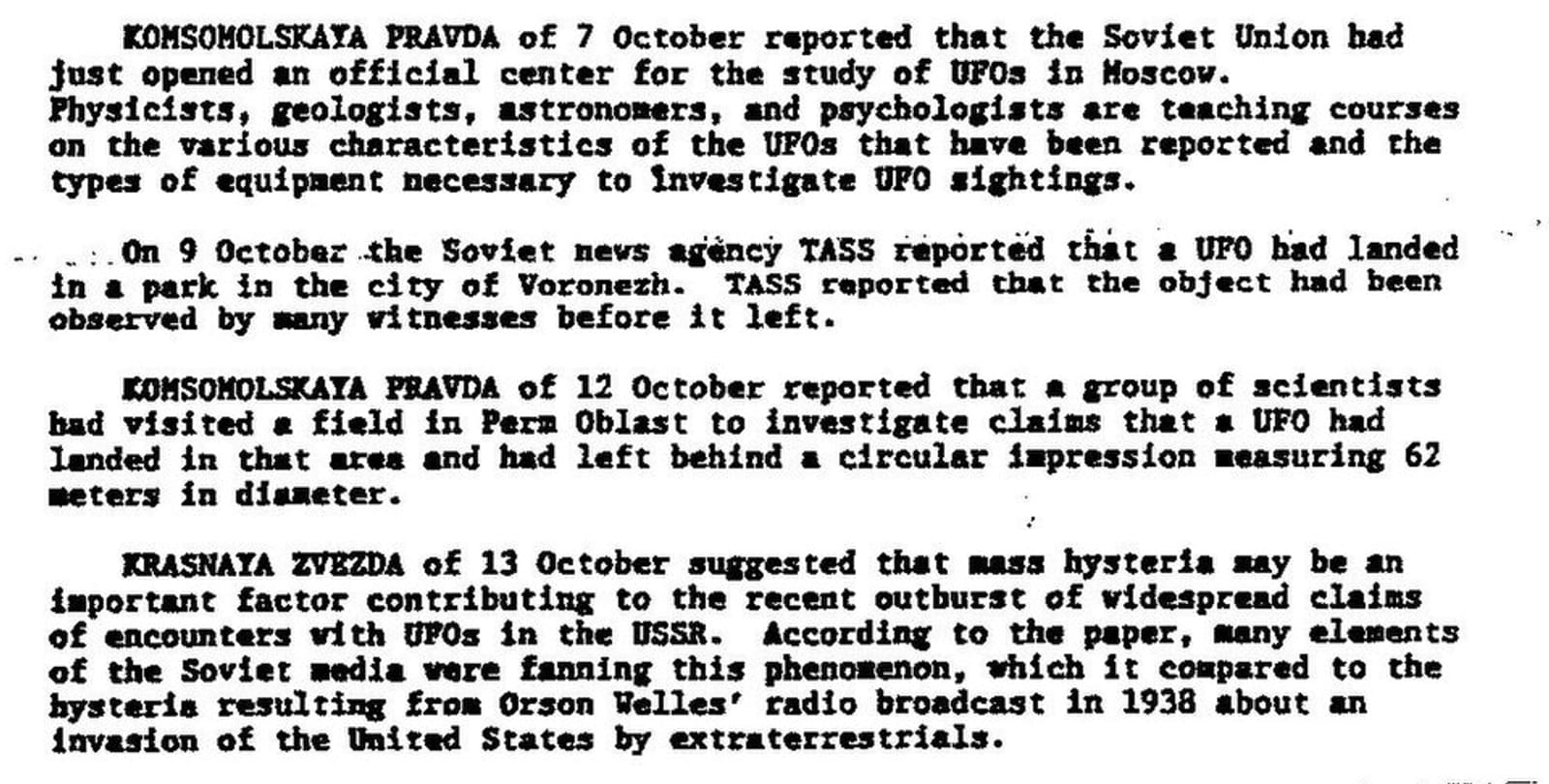
The story landed in a country that had, for a season, decided anything was possible. Glasnost had loosened the Soviet press, and editors discovered that readers who had been fed five-year plans for decades would pay for the paranormal. That autumn the whole country was “healing itself” in front of the televised séances of the hypnotist Anatoly Kashpirovsky and charging jars of water before Allan Chumak’s silent broadcasts. That summer the newspaper Sotsialisticheskaya Industriya had run the story of a dairy worker from Perm, in the Urals, Lyubov Medvedeva, who met a creature “resembling a man, but taller than average with short legs” with “only a small knob instead of a head”; a ufologist had blamed a burned patch of ground near Moscow on a saucer nobody saw, and TASS itself had to point out that a haystack had caught fire. On October 7, Komsomolskaya Pravda, the Communist youth league’s daily and the biggest-selling paper in the country, announced that a permanent centre for the study of UFOs had opened in Moscow. Paul Kurtz, chairman of the American skeptics’ committee CSICOP, would title his report on the season “Paranormal Pandemonium in the Soviet Union.” Into this weather, on a warm evening at the end of September, a few boys went to the Goat Park to play football.
Sources: Tass Says UFO Landing in Soviet Union Confirmed«НЛО вернулся и завис над парком»: как 35 лет назад заметка в газете «Коммуна» прославила Воронеж на весь мирParanormal Pandemonium in the Soviet UnionForeign Press Note — USSR: Media Report Multitude of UFO SightingsOn the borders of ‘Ummo’: the so-called UFO landing in Voronezh, Russia, 1989
Half past six
What happened next is known first through a short item in Kommuna, the Voronezh regional Party newspaper, on October 3, 1989. It named Vasya Surin of School No. 82, Zhenya Blinov of School No. 33 and Yulia Sholokhova, and it said they and “about forty adults” had witnessed the landing of a UFO on September 27 in the park by the Mashmet stop. “The boys were playing football in the park,” it went on. “The day was drawing toward evening. At half past six the boys saw a pink glow in the sky, and then a sphere of a red-burgundy colour. The sphere, about ten metres across, circled at a height of some twelve metres from the ground, and one could see the grass being pressed flat beneath it. Soon the sphere flew off.” A few minutes later it came back and hung over the park. Adults had run up by then. “In the lower part of the sphere a hatch opened, and a being appeared, about three metres tall, in a silvery overall and ‘boots’ of a bronze colour, with some sort of disc on its chest and with three eyes.” The being looked over the ground, slammed the hatch, and the sphere began to descend, “catching a poplar as it did so, which has stayed leaning ever since.”
Sources: Football with aliens (Футбол с пришельцами) — the Kommuna item of October 3, 1989, with Alexander Mosolov’s memoir of how it came to be writtenИнцидент с НЛО в ВоронежеUFO Chronicles of the Soviet Union: A Cosmic Samizdat
The robot and the rectangle
Then, according to Kommuna, the UFO landed and the hatch opened again. Two came out, “one of them, apparently, a robot.” The alien said something, and a glowing rectangle about thirty by fifty centimetres appeared on the ground; it said something else and the rectangle went out. “The alien poked about on the robot’s chest, and it walked off like a mechanism.” At that moment one of the boys screamed in fright. The alien looked at him and the boy froze, unable to move, “and the alien’s eyes glowed as it did.” Now everyone who was watching screamed, and the sphere and the being vanished. Five minutes later they were back, and the three-eyed one now had a “pistol” at its side, a tube half a metre long. A youth of about sixteen was walking nearby. “The alien pointed the ‘pistol’ at him and the lad disappeared.” The alien climbed into the sphere, which gathered speed and flew away, “and at once the vanished youth appeared again.” One of the schoolboys, filmed by a television crew that autumn, gave a version with the details children notice: “He was three-eyed as well, and his fingers were like a goose’s. He was dressed in a silver suit and bronze boots. The alien went up to the robot and keyed in a code on its chest. And the robot walked off along the path. It walked and walked. Meanwhile the alien went over to some spot and said something in its own language. And out of the ground came some sort of rectangular figure, with little lamps blinking on it.” Kommuna closed by noting that residents of Putilin Street had watched UFOs more than once between September 23 and 29, and that ufologists call such a burst of activity a “flap.”
Sources: Football with aliens (Футбол с пришельцами) — the Kommuna item of October 3, 1989, with Alexander Mosolov’s memoir of how it came to be written37 лет исполнилось дня встречи воронежцев с инопланетянами в «Южном парке»Визит века. Как 30 лет мир следил за НЛО в Воронеже
‘Here, look!’
The item carried the byline of Alexander Mosolov, an engineer at the Voronezh aviation plant who had chased anomalous phenomena with a circle of enthusiasts since 1978, and who lived in the part of town where the boys had their encounter. He later insisted he never wrote a word of it; the article was Oleg Stolyarov’s, worked up from his notes, and Mosolov’s own account of those days, set down afterward, explains how his name came to be on it. On September 30, “on the tenth day of my regular leave,” the mother of one of the boys’ schoolmates introduced him to the witnesses, fifth- to seventh-graders, and Vasya Surin told the story first. Vasya’s mother said she had not believed her son until, a few days after he first spoke of aliens, she and the neighbours watched an object glowing reddish fly over their building and the park. In the dark the boys led Mosolov across the park to a slightly leaning pyramidal poplar. Three metres from the trunk they said, “Here, look!” and he made out a dent as if a hemisphere fifteen centimetres across had been pressed into the soil, with another a metre and a half away. Fifty metres off they showed him a patch of lawn where the grass looked and felt “as if it had been rolled by something.” “Here the sphere flew very low, lower than the trees, it probably wanted to land, it even let out some sort of platform underneath, like a support,” they told him. Walking back toward the twelve-storey block, he asked a knot of neighbours whether they had seen anything unusual the day before. A boy of about fourteen answered at once: “I saw it! Yesterday some sort of ball, elongated, flew in from the direction of the power station. It gave off a strong hum, and lights blinked on it, many-coloured, there were lots of them round the edges.” A woman with a lapdog added that “a few days ago there was some sort of running about over toward the park,” with children shouting that aliens were flying. Mosolov did the arithmetic: “yesterday” was September 29, a different night, no landing. “Doubt creeps in,” he wrote. “Isn’t this too often?” Yet the boys had convinced him. “They look you straight in the eye, anxious and hopeful: will they be understood? Children who have agreed to play a prank give themselves away, they snort with laughter, they wink at each other. Here it was something else entirely.” Unable to gather his group over the weekend, he went to Kommuna, gave his rough notes to Stolyarov, a journalist there interested in UFOs, and asked for a short notice with the group’s address so that adult witnesses might come forward. He did not expect a quick publication. His group met on the morning of October 3; Kommuna, he wrote, “exceeded all expectations,” and Football with Aliens was in that day’s paper.
Sources: Football with aliens (Футбол с пришельцами) — the Kommuna item of October 3, 1989, with Alexander Mosolov’s memoir of how it came to be writtenНЛО в Воронеже: что на самом деле произошло в 1989 году и что сейчас говорят очевидцыИнцидент с НЛО в ВоронежеUFO Chronicles of the Soviet Union: A Cosmic Samizdat
TASS is authorized to state
TASS kept a special correspondent in Voronezh, Vladimir Lebedev, and on Monday, October 9, the official news agency of the Soviet Union put the park on the wire. “Scientists have confirmed that an unidentified flying object recently landed in a park in the Russian city of Voronezh,” the dispatch began. “They have also identified the landing site and found traces of aliens who made a short promenade about the park.” Residents had seen a large shining ball or disc hover over the park, land, and release “one, two or three” humanlike creatures and a small robot. “The aliens were three or even four meters tall, but with very small heads,” TASS quoted witnesses as saying. “They walked near the ball or disc and then disappeared inside.” Onlookers “were overwhelmed with a fear that lasted for several days.” Genrikh Silanov, whom the dispatch styled head of the Voronezh Geophysical Laboratory, was quoted on the evidence: a circle twenty metres across found “by means of biolocation,” four dents four to five centimetres deep and fourteen to sixteen across at the corners of a rhombus, and two pieces of rock. “At first glance, they looked like sandstone of a deep-red color. However, mineralogical analysis has shown that the substance cannot be found on Earth.” Residents had also reported a “banana-shaped” object. The Associated Press moved it within hours; so did UPI and Reuters. The New York Times put it on the next morning’s front page under the headline “A Tass Bulletin: Knobby Aliens Were Here,” and reported that the agency’s night duty officer, reached by telephone, had said it was neither a hoax nor a joke: “It is a serious dispatch.” A TASS officer told the AP, “It is not April Fools’ today.” In The Washington Post, David Remnick called TASS “perhaps the world’s grimmest press organ” and the craft an “unidentified flying fruit.” Jacques Vallée, the French-born astronomer and computer scientist who had been studying UFO reports since the 1960s, read the wire on his fax machine in California and noticed that the Times had rendered biolocation as “bilocation.” The Russian word simply meant dowsing. The real story, he thought, was that a Soviet laboratory was investigating a UFO landing with a divining rod, and nobody in the Western press had caught it.
Sources: Tass Says UFO Landing in Soviet Union ConfirmedSoviets report UFO landingA Tass Bulletin: Knobby Aliens Were HereBack in the UFOOn the borders of ‘Ummo’: the so-called UFO landing in Voronezh, Russia, 1989UFO Chronicles of the Soviet Union: A Cosmic Samizdat
The reader must know everything
The next day TASS relayed a fuller account from Sovetskaya Kultura, the Party’s culture daily and, that Tuesday, the only major national paper willing to print anything about the visitors. Its Voronezh correspondent, E. Efremov, gave the Kommuna narrative almost line for line, placed “several tens of people” at the bus stop when the sphere appeared, and vouched for the witnesses: “Children and eyewitnesses of the abnormal phenomenon have been questioned by police workers and journalists. There are no discrepancies in the description of the sphere itself or the actions of the ‘aliens.’ Moreover, all the children who became witnesses to this event are still afraid, even now.” The paper said its coverage was motivated by “the golden rule of journalism: the reader must know everything.” The Times’s Esther Fein got Voronezh on the telephone. Lieutenant Sergei Matveyev of the district militia, as the Soviet police were called, said he had seen the object on September 27: “It was not an optical illusion.” He had not seen aliens, but “it was certainly a body flying in the sky,” silent, very fast and very low. “I thought I must be really tired,” he said, “but I rubbed my eyes and it didn’t go away. Then I figured, in this day and age, anything is possible.” Vladimir Moiseyev, director of the regional health department, admitted that no witness had asked for medical help and that, two weeks on, nobody had examined the children, though “certainly we are planning to.” A duty officer at the Interior Ministry named Larin said no extra patrols were assigned, the department being short-handed, but troops would be sent “if they appear again.” Lebedev, sounding insulted that anyone would doubt him, said there had been about three landings between September 23 and 29, and that he had walked the site himself: “I could see holes of a clear shape that resembled the footprints of an elephant.” That very day, he added, Silanov had the children draw what they had seen, isolated from one another, and “all drew a banana-shaped object that left behind in the sky the sign of the letter X,” a description Silanov matched to a 1976 article in the defunct American magazine Saga. That evening Vremya, the main nightly news, showed a child’s drawing of a smiling stick figure inside a glowing two-legged sphere and, without comment, put Vasya Surin on camera. “We were scared,” said the boy, who looked about eleven. “It hovered over this tree. Then the door opened and a tall person of about three meters looked out. He didn’t have a head, or shoulders either. He just had a kind of hump. There he had three eyes, two on each side and one in the middle.” The alien had two holes instead of a nose, Vasya said, and could not turn its head, so it had to swivel its middle eye. Vremya was cooler than TASS had been, and pointed out that no adult had come forward even though a large apartment house overlooked the site.
Sources: On the borders of ‘Ummo’: the so-called UFO landing in Voronezh, Russia, 1989U.F.O. Landing Is Fact, Not Fantasy, the Russians InsistRare Thrill for Tass: Joshing Over Its U.F.O. ReportUFO in Voronezh — Vremya, broadcast of October 11, 1989Paranormal Pandemonium in the Soviet Union
‘Don’t believe all you hear from Tass’
The retreat began almost at once, and it began with the scientist. Within a day or two Silanov was telling the Associated Press from Voronezh: “Don’t believe all you hear from Tass. We never gave them part of what they published.” The line, Kurtz noted, then went dead. The rock that could not be found on Earth was, Silanov now said, a form of hematite, an iron ore found across the Soviet Union. When Sotsialisticheskaya Industriya asked him and a member of his department about the report that the landing had been “confirmed as a fact by specialists,” they answered: “We protest this wording!” The story Silanov and his colleagues told in their own book the next year is stranger than either version. He had picked up the brownish-red pebbles in the park on October 3. The next morning Oleg Stolyarov, a geologist before he was a journalist, came by the spectral-analysis laboratory to look at them: the test for iron was negative, and under the microscope the stuff showed a plainly man-made structure with rounded grains of natural quartz. Stolyarov mentioned the “unusual samples” in Kommuna on October 7, and by the time the presenters of Central Television’s morning show 120 Minutes read out the TASS item on October 10, the lab had its spectrum. High in lead and zinc, the samples were ordinary red-lead paint, spilled on that spot at some point and dried as hard as stone. The TASS text, the book observed, had been written “judging by everything, on the basis of the Voronezh newspapers,” and the conclusion about extraterrestrial origin “was attributed to G. Silanov.” He went on Voronezh television on October 11 to report the result and warn journalists against hasty publications. “But it was too late,” the book says. “The information about the ‘extraterrestrial’ origin of the find had already gone off round the world.” Central Television, which had been first to broadcast the TASS item, hurriedly disowned it the next day: “The sensation did not take place.” Komsomolskaya Pravda would later call the television report of a mineral of unearthly origin “a classic fake”: Kommuna had never written about minerals at all. On October 21 Kommuna itself published a third piece, The Phenomenon Demands Comprehension, in which Stolyarov conceded that the “forty adults” of his first item “did not correspond to reality”; only children had seen the aliens. The same article reported that more than thirty people had telephoned the newsroom about lights in the sky, among them a State Bank economist, a boiler-room operator and an assistant prosecutor of the Zheleznodorozhny district. Lebedev, fifty-nine and twenty years at TASS, had already told UPI that he had seen no landing himself and had built his report on about ten youngsters aged twelve and thirteen: “I think there is a certain portion of truth, but it is not excluded that there is also fantasizing.”
Sources: On the borders of ‘Ummo’: the so-called UFO landing in Voronezh, Russia, 1989Paranormal Pandemonium in the Soviet UnionНЛО в Воронеже (UFOs in Voronezh)НЛО в Воронеже: что на самом деле произошло в 1989 году и что сейчас говорят очевидцы«НЛО вернулся и завис над парком»: как 35 лет назад заметка в газете «Коммуна» прославила Воронеж на весь мирCorrespondent waffles on UFO reportAnother UFO visit in Soviet UnionИнцидент с НЛО в Воронеже
The girls on the shed roof
The football match was not even the first landing. When Mosolov’s group went looking for witnesses it found that the wave in the Goat Park had begun four days earlier, on the far side of the park from Vasya Surin’s building, among girls who did not play football. Natasha Krylova, a fifth-grader at School No. 33, and her friends Lena Sorokina, Natasha Voropaeva, Sveta Ryzhkova and Yulia Sholokhova had their own place, the roof of a shed, and on September 23, after eight in the evening, they were sitting there chatting. “We see a white spot appear in the sky from the direction of the synthetic-rubber plant,” Natasha told the investigators. “It was a ball the size of the moon, with black ‘sticks’ on it and little lights. It flew toward the park, hung over the ground a while, and then set down. After some time there appeared what looked like people, only very tall. There were three of them: two the same height, and the third taller still. We didn’t see them come out of anything, they somehow just appeared. They wore blue cloaks and did not walk but sort of glided above the ground. Their shoulders didn’t stand out. They didn’t talk.” The figures moved a little toward the path but never reached the birch. Alyosha Panin, coming out of his building, met the girls running toward him with the news that “some kind of beings” had landed in the park. “I went closer to the kindergarten gate and saw the beings and their ‘saucer’ with four little legs,” he told the group. “The legs were splayed in different directions, grey or black, and the ‘saucer’ was pale. From underneath, where the hatch was, came a bright light. Two beings were moving toward me, and a third stood by the ‘saucer,’ guarding it, I suppose. It was half the height of the saucer. And the light in the hatch kept dimming and dimming. When I saw they were coming at me I wasn’t frightened, but my head began to ache a little. Then I heard the girls scream. I stood there and stood there, and there was nobody, they had vanished.” The children backed off and crept back; there was a hum, “and something white is flying in the air, and then it vanished with a rustle.” Adults named by the girls as standing near the object, the book notes, turned out to have seen nothing at all. Roma Torshin, another fifth-grader from No. 33, said that he too had an adventure on September 23, walking home through the park at about nine: a big reddish sphere with a black hatch, five metres or so across, put out four “legs” before it settled, a ramp came down, and a “robot” the height of a grown man’s chest rolled down it in a bronze suit and black boots like cuffed jackboots; then an alien about two metres tall with an oval head, three eyes, no visible mouth or nose and a face the dark brown of a cutlet, “only the skin was smooth.” When they went back inside and the craft shot upward, “stars poured” from its underside. He stood twenty-five metres away, terrified and unable to run. Vova Startsev told of a daylight landing at about half past two, when he, Lyosha Nikanorov and Sergei Makarov had skipped a foreign-language lesson: a pink sphere that changed colour, a letter Ж on its side and two antennae, four supports, a ladder, two people and a robot that they carried out and revived by pressing on its chest, “like artificial respiration,” after which it walked like a human; one of the visitors came toward him with a hand outstretched and he climbed a tree and shook. The group could never establish how many local children had seen something, because after a day or two it became impossible to tell witnesses from well-informed enthusiasts: the schoolchildren, “even those previously unknown to each other,” had formed a “society of UFO lovers” that seemed to have absorbed two neighbouring schools in full.
Sources: НЛО в Воронеже (UFOs in Voronezh)НЛО в Воронеже: что на самом деле произошло в 1989 году и что сейчас говорят очевидцы
More witnesses than the wire carried
The wires had reduced the story to “a UFO seen by a bunch of kids,” as Vallée later complained, but the Soviet regional press held more. On October 7 Kommuna printed a follow-up, What Was It?, in which Yuri Vokhrimenko described a red sphere seen from his balcony on the evening of September 27, at about the time the boys were in the park, and a former pilot, B. G. Yatsunov, reported one at 8:10 p.m. on September 29. Silanov told the paper there had been at least three landings, the earliest on September 21 at 8:30 p.m., when boys from Mendeleyev Street saw a sphere land and two humanoids and a robot climb out. Selskaya Zhizn, the rural daily, on October 11 named three seventh-graders from that first night and a roll of adults who had seen a red sphere on various evenings: an economist, Valentina Agibalova, and her daughter Tatiana, a deputy prosecutor; a power-station employee, Inna Nikitina; a pensioner; a graduate student; a chief engineer. A geodesist, V. A. Kugatov, had watched something like a giant airship cross the sky at 10:30 on the morning of September 24. The doctors’ paper, Meditsinskaya Gazeta, collected their statements. Vokhrimenko’s sphere “flew at the speed of a small plane.” Agibalova’s “hovered over the left riverbank and then vanished,” and came back. Nikitina watched “a fairly large flattened sphere, shaped like an orange” for five to ten minutes near the mining-equipment plant, and “experienced a feeling of intense fear for which I could not account.” Yuli Sviridov saw from a fourth-floor balcony “a big, bright red sphere” with “a crimson halo along the edges” moving between the houses. The strangest statement came from a fifty-six-year-old factory worker, M. N. Polyakov, being driven to the southern suburbs at the end of September: the headlights died, the radio cut out in the middle of a song, the engine stopped, the cigarette lighter would not work and the matches would not strike. His driver pointed behind the car at a pinkish-yellow sphere over the road, with a growth on its underside like a burl on a tree, from which a trembling beam crept along the ground “full of bluish sparkles.” He felt fear and could not move his arm. “Was I like a rabbit hypnotized by a cobra?” When the beam moved off the dashboard lit, the radio resumed, and the driver, asked about the ball, said, “What ball?” and then, “Did we stop?” Later that night Polyakov got a shock from a tram handrail and another from his own keyhole, dreamed strangely all night and “exactly at noon suddenly felt fine.” Lieutenant Matveyev’s statement to the group was more modest than the wire version: at about seven in the evening, in cloud and near-darkness, a white object with a faint “neon” glow and no beams crossed toward the reservoir at perhaps 200 to 250 metres, fast and utterly silent, and seemed to begin descending; he watched it for about five seconds and did not see it land. Mosolov’s summary for Vallée was blunt: “Over thirty people have witnessed the landings in Voronezh. Thousands have seen the objects in flight.”
Sources: UFO Chronicles of the Soviet Union: A Cosmic SamizdatНЛО в Воронеже (UFOs in Voronezh)U.F.O. Landing Is Fact, Not Fantasy, the Russians Insist
The dowsing rod and the eleven tons
The physical case was Silanov’s. TASS had promoted him to head of a “Voronezh Geophysical Laboratory”; he ran the spectral-analysis laboratory of the Voronezh geological and geophysical expedition and belonged to the anomalous-phenomena section of the Popov Radio-Engineering Society, the engineers’ club that gave Soviet ufology its respectable cover. He had prospected for metals in Siberia with a dowsing frame, a piece of wire bent into an L, and he walked the park with it on the morning of October 3, before the section’s full survey the next day. Inside a circle some twenty metres across the frame gave “a definite response,” and a device of his own for measuring human “bioenergy” read nil there, an effect he said he had met at other landing sites. He then dowsed the path the beings had walked, and reported that the boys, unaware of his findings, later pointed out exactly the same route. Under the poplar with the bent crown the group found depressions about fifteen centimetres across and a little over five deep, arranged in a rhombus just under four metres on its long axis, with two prints sixty centimetres apart at each corner and a few more that fitted no pattern; “suspiciously many,” the book admits, ten in all. Where one leg had come down on a thick root it had slipped and torn a deep scar in the bark. Digging in the prints felt like striking stone: the soil was “extraordinarily compacted.” Yuri Lozotsev, a lecturer in structural mechanics whom Vallée spells Lozovtsev, calculated the force needed to make such prints at eleven and a half tons, a little under three tons a leg, and the group’s magnetometer, Mosolov and Vyacheslav Martynov, chief engineer at an aeronautical plant, told the local youth paper, went off the scale at the site. Martynov measured thirty to thirty-seven microroentgens an hour on the trace against a background of ten to fifteen. Silanov’s spectrograph found lead four times the background in the landing soil, zinc three times, tin twice, zirconium five times at a bore hole, and phosphorus nearly a hundred times, though the book concedes that the statistics to judge such numbers “we unfortunately do not have.” Mosolov told Bloknot in 2024 that the police forensic team laid black photographic paper along fifteen metres of ground and found it fogged for five metres from the poplar. Literaturnaya Gazeta, the writers’ weekly, less impressed, listed the ufologists’ three instruments: a magnetometer “whose indications varied with the change of the witnesses,” a twisted wire that turned at the landing spot and then, it was noticed, in several other places round about, “very encouraging, since the extraterrestrials could land everywhere they wished,” and the bioenergy meter that read zero. Locals told the paper the poplar had leaned “forever,” and that the holes had been dug some years before; the French group S.O.S. OVNI heard from its Soviet contacts that the prints predated the landing.
Sources: НЛО в Воронеже (UFOs in Voronezh)UFO Chronicles of the Soviet Union: A Cosmic SamizdatOn the borders of ‘Ummo’: the so-called UFO landing in Voronezh, Russia, 1989О высадке НЛО в воронежском парке стали трубить во всем мире 35 лет назадTass Says UFO Landing in Soviet Union Confirmed
‘No verifiable proof’
The city did what Soviet cities did with a scandal: it formed a commission. On October 9 the ufologists were received by Viktor Atlasov, chairman of the city executive committee, in effect the mayor, who asked how he could help; the Party committee’s science department then sent a car for Silanov and delivered him to the rector’s office of Voronezh State University, where he had to give a full lecture on anomalous phenomena to men who had never studied one. An hour later, on October 12, the commission went to the park under Igor Surovtsev, a deputy pro-rector of the university: physicists, chemists, biologists, soil scientists, nuclear specialists, forensic experts from the regional police, psychologists and staff of the sanitary-epidemiological station. They questioned the children one at a time and compared the versions, took soil and litter from the site and from distant corners of the park, measured gamma and microwave backgrounds, pulled the children’s medical cards and talked to their district doctors, and sent a query to the airport. The acting commander of the Voronezh aviation detachment, B. A. Chobur, replied that between September 2 and 30 the airfield’s radio and radar equipment had registered no unidentified flying object within 200 kilometres, while everyone understood, the book says, that radar might simply not “take” such an object. Agence France-Presse carried the first verdict on October 28: “There exists no verifiable proof of a landing by aliens in Voronezh.” Sixteen radiometric analyses, nineteen ground checks, nine tests for micro-organisms and twenty spectro-chemical measurements had found no anomaly in the earth or the vegetation; the elevated caesium in the soil proved nothing, since “after Chernobyl, this kind of phenomenon has been found in many areas.” In mid-December Surovtsev sat in a Voronezh studio for a two-hour programme, UFOs over Voronezh, which drew such an audience that it was repeated by request. “We could find no material evidence of the landing of an object,” he said. The gamma survey matched the city average; the soil pollution was the ordinary industrial kind; a spectral analysis for forty-two elements showed no “hurricane” excesses. Two things had given the commission pause. Surface contamination with radioisotopes came to one curie per square kilometre, well below the fifteen at which land becomes dangerous, and the commission attributed it to the fallout that had crossed the region after Chernobyl in 1986. And in one of the depressions the ufologists took for a landing leg, micro-organisms were suppressed about tenfold, which had alarmed the biologists until they found earthly explanations. Photographic plates had fogged under the poplar, in one print and by a bore hole. Pozner’s crew from Central Television, Kurtz noted after seeing the segment on CNN, “could find no other ‘witnesses’ except the children,” and closed with the suggestion that the creative imagination of children explained it all.
Sources: НЛО в Воронеже (UFOs in Voronezh)Paranormal Pandemonium in the Soviet UnionВизит века. Как 30 лет мир следил за НЛО в ВоронежеИнцидент с НЛО в ВоронежеНЛО в Воронеже: что на самом деле произошло в 1989 году и что сейчас говорят очевидцы
The world laughs, then books a ticket
For a week the giants of Voronezh were the most famous visitors in the Soviet Union. Kurtz’s office was swamped by calls from the AP, CNN and the BBC; the aviation journalist and arch-skeptic Philip Klass quipped that Gorbachev should call a press conference and proudly announce that “at a time when everyone seems to want to leave the Soviet Union, at least someone was attempting to get into it!” James Oberg, the NASA engineer who tracked Soviet space activity, checked the tracking data and found nothing. Pravda, the Party’s own daily, which had ignored the story until then, ran a parody, as Le Monde relayed it, in which three Martians measuring 3.02, 3.09 and 3.36 metres, each with three eyes and four ears, landed before 357 adults queueing at a vodka shop and announced, in a metallic voice, “Glasnost… Hurrah!” The cosmonaut Konstantin Feoktistov, a native of Voronezh, wrote in Moskovskie Novosti, the flagship weekly of glasnost, that the visitors had delivered an ultimatum: finish perestroika by the year 2000 or “we will incinerate the Earth.” Komsomolskaya Pravda went further and printed its correspondent Pavel Mukhortov’s “interview” with the visitors, who told him they came from “the constellation Libra—Red Star.” The Times’s editorial page praised the aliens for their manners: they “didn’t lecture, proselytize, or find fault with local mores,” and, recalling its own 1920 mockery of Robert Goddard’s rockets, concluded, “As surely as rockets can never fly in space, Tass has broken the story of the century.” TASS reported back to its readers on how the American networks had “played up the space adventure, frequently poking fun,” and quoted a New York media critic asking, “Where are the pictures?” One disillusioned Party member explained the appetite to TIME’s correspondent: “They’ve been feeding us rubbish about the dream of Communism for years, and we now see they were lying. At least this gives us something new to dream about.” Then the crews came: a team from Central Television led by the presenter Vladimir Pozner, A Current Affair announcing that it would send a film crew, reporters from the United States, Spain, India and Japan, the Japanese filming the site under snow. A cooperative called Stalker, one of the private businesses perestroika had lately legalized, sold tours of the “land of the aliens” for fifty-nine rubles, with a two-ruble lecture by specialists and witnesses, and warned clients: “We cannot guarantee a meeting with aliens, for that is a matter of chance.” Sergei Gorbachev, a boy from School No. 33 who never believed his classmates, remembered the foreigners handing out chewing gum and pens.
Sources: Paranormal Pandemonium in the Soviet UnionSkeptics UFO Newsletter, No. 1On the borders of ‘Ummo’: the so-called UFO landing in Voronezh, Russia, 1989Инцидент с НЛО в ВоронежеThe Voronezh VisitorsRare Thrill for Tass: Joshing Over Its U.F.O. ReportWhy ‘Aliens’ ‘Landed’ in Russia 25 Years Ago«НЛО вернулся и завис над парком»: как 35 лет назад заметка в газете «Коммуна» прославила Воронеж на весь мир«Они были у яркой тарелки». Иностранные журналисты нашли очевидцев посадки НЛО в ВоронежеНЛО в Воронеже: что на самом деле произошло в 1989 году и что сейчас говорят очевидцы
Vallée in Moscow
In January 1990, with the help of Novosti, the Soviet news agency that worked the foreign press and arranged the meetings, Jacques Vallée flew to Moscow with Martine Castello, a science reporter for Le Figaro, to look at the Soviet wave for themselves. Four members of the “Voronezh collective” came up to Moscow with maps, drawings and a videotape: Mosolov, Martynov, Lozotsev, and a Voronezh television journalist who began by interviewing Vallée and Castello for the folks back home. “We began with the schoolchildren,” Mosolov told them. “We separated them. We found out that many of them did not know the others. We had them make separate drawings, and we videotaped them.” The drawings, spread on the table, showed a sphere or disc resting on four legs, “and indeed we found four imprints in the ground,” Lozotsev said. The beings had no neck, their heads sat on their shoulders, “they look like a target at a firing range.” Asked about the three eyes, the men admitted that “some of them did, but others saw two eyes and something else on the forehead, which could have been a device of some sort.” Across four landings the witnesses had described three kinds of visitor: three-metre giants with two whitish eyes and a red, pupil-less one between them; box-shaped robots, one with antennae instead of a head; and small beings with grey-green faces in blue overcoats like loose raincoats. Vallée pressed on two things. The first was the symbol some children had drawn on the craft and on the giants’ belts, which he had seen on French television in October: the insignia of Ummo, the Spanish contact hoax of the 1960s and 1970s, a vertical bar between two curved brackets, like a stylized )+(. Boris Shurinov, a Moscow ufologist in the room, explained that he had published that symbol in a report circulated in Voronezh years earlier, and that the boy who drew it, Roma Torshin, had not been with the others at the landing; to any Russian, the design was simply the Cyrillic letter Ж.
Sources: UFO Chronicles of the Soviet Union: A Cosmic SamizdatOn the borders of ‘Ummo’: the so-called UFO landing in Voronezh, Russia, 1989Визит века. Как 30 лет мир следил за НЛО в Воронеже
A rod, a rocket and a telephone call
The other thing Vallée pressed on was biolocation. In a Novosti studio he watched Silanov on tape, “carefully holding in his hand a bent, L-shaped metal rod,” pacing the grass while it swung left or right. “I failed to see any calibration, any reliable baseline to their measurements,” he wrote. “I still don’t.” He asked Lozotsev whether the children could be trusted. The early sightings, with adult witnesses and traces, were hard to deny, Lozotsev said, “but in the following days there were other reports from children and we do not trust those reports. For example, the press stated that a sixteen-year-old boy had suddenly seen an object appear close to a tree… that may have been an invention.” Vladimir Migulin of the Academy of Sciences, the establishment’s official skeptic, told Vallée the Voronezh witnesses “may be mentally ill, you know. Or else they are lying,” and that the whole thing matched a rocket launch from Volgograd second by second. Vladimir Azhazha, the dean of Soviet ufologists, was shocked: launches from Volgograd went east, and Voronezh lay to the northwest. Halfway through dinner at Azhazha’s flat the telephone rang. Voronezh was calling: an object had projected beams that melted the asphalt in front of block No. 5 of the Novovoronezh nuclear power station, thirty kilometres south of the city, and the group had taken samples. Vallée and Castello left “convinced that a genuine series of extraordinary phenomena had taken place in Voronezh,” that the Ummo symbol was “a spurious addition,” and “as confused as ever” about the rod.
Sources: UFO Chronicles of the Soviet Union: A Cosmic SamizdatOn the borders of ‘Ummo’: the so-called UFO landing in Voronezh, Russia, 1989Визит века. Как 30 лет мир следил за НЛО в Воронеже
What the boys say now
In 1990 the Voronezh group published its 176-page collection, UFOs in Voronezh, at the authors’ own expense, and it is a more careful book than the wire stories would suggest. Its authors went back over the children’s estimates with a tape measure. When a witness’s three-metre giant was checked against the branches and the height of the fence beside it, the visitors “shrank” by almost a third, to a little over two metres. “There were no three-metre aliens in the park!” the book concludes, adding that the “third eye” had already been cleared up as a misperception, something on the forehead that the children read as an eye. The surveys of the district’s children, Komsomolskaya Pravda later summarized, had spheres landing in the Goat Park almost daily through late September and early October, crewed by beings brown and green, in silver overalls and blue cloaks, dwarfs and giants, some of whom climbed down to the ground by way of the poplar. Thirty years later one of those boys, Sergei Makarov, told Komsomolskaya Pravda, “I saw them. But sometimes, when I remember it, the whole thing feels like a fairy tale.” Alexei Panin, sent by his sister to the shop for jam, came home an hour and a half late with his “eyes popping out like a crayfish’s,” saying only “There, there!” “We saw only silhouettes,” he says now, “because the saucer was bright and they stood in front of it.” Denis Murzenko told a Discovery crew around 2000 that he had seen a very tall man who vanished. A decade after the events the children’s magazine Pioner tracked down Yulia Sholokhova, who had moved away, and Elena Sorokina, who still lived in the block by the site; the two, who had not spoken in years, told the same story, but only Sorokina remembered the vanishing boy. Gorbachev, the classmate with the chewing gum, was never persuaded: “Honestly, I didn’t believe their stories, even though our own beat officer claimed he had seen some flying ball.” The district, he added, was a rough one, and “few of those boys are alive now.” Mosolov, still the case’s keeper, now dates the football game to September 23 rather than 27, says the wave ran on through the winter into the spring of 1990, and believes the visitors came to avert a catastrophe at Novovoronezh.
Sources: НЛО в Воронеже (UFOs in Voronezh)НЛО в Воронеже: что на самом деле произошло в 1989 году и что сейчас говорят очевидцы«Они были у яркой тарелки». Иностранные журналисты нашли очевидцев посадки НЛО в ВоронежеО высадке НЛО в воронежском парке стали трубить во всем мире 35 лет назадВизит века. Как 30 лет мир следил за НЛО в Воронеже
Trees, a clearing and a path
The park was tidied in the late 2010s with lighting, benches, a pool and an Orthodox church, and the poplars still stand over a playground. In 2019 a seller in Samara offered soil from the landing site online for 500,000 rubles, and that November the Spanish writer Javier Sierra opened a season of his series Otros Mundos on the grass, walking it with Mosolov and Panin, as Japanese and Italian crews had before him. A monument was proposed and never built; in 2024 a former mayoral candidate asked the city for a saucer-shaped ufology museum, arguing that “the people of Voronezh should know who saved the city from destruction,” and no reply was reported. On the thirty-seventh anniversary, Vesti Voronezh found the spot “as inconspicuous as it could be: trees, a clearing and a path nearby.”
Sources: НЛО в Воронеже: что на самом деле произошло в 1989 году и что сейчас говорят очевидцы«НЛО вернулся и завис над парком»: как 35 лет назад заметка в газете «Коммуна» прославила Воронеж на весь мир«Они были у яркой тарелки». Иностранные журналисты нашли очевидцев посадки НЛО в ВоронежеМесто высадки инопланетян. В Воронеже предложили открыть музей уфологииЭкс-кандидат в мэры предложил установить в Воронеже памятник инопланетянам37 лет исполнилось дня встречи воронежцев с инопланетянами в «Южном парке»
Who saw what
Every account of occupants comes from children. Kommuna’s “forty adults” were retracted by the paper within three weeks, and the TASS correspondent conceded that “a dozen youngsters aged 12 to 13” were his source. What adults reported, in numbers and on the record, were lights: red or burgundy spheres over the Left Bank on several evenings, a militia lieutenant’s silent ball crossing the park area at speed on September 27, a former pilot’s object two nights later. Kurtz read the file as “two separate incidents,” an unidentified light in the sky and a children’s story about aliens grafted onto it. The investigators themselves drew a line through their witnesses: Lozotsev stood by the first landings and disowned the later ones, and the vanishing sixteen-year-old, the most cinematic detail in the case, was doubted by the Voronezh group, who told Vallée it had been “in the newspapers” but was perhaps invented, and was remembered a decade later by only one of two schoolgirls. The ufologists’ own book, checking estimates against fences and branches, cut the giants to a little over two metres and explained the third eye away. Against this stands the consistency that Efremov in Sovetskaya Kultura and Mosolov both claimed for the core group, the separate landing reported by different boys six days earlier, and Mosolov’s observation that the children showed none of the tells of a prank.
Sources: Another UFO visit in Soviet UnionCorrespondent waffles on UFO reportParanormal Pandemonium in the Soviet UnionНЛО в Воронеже (UFOs in Voronezh)UFO Chronicles of the Soviet Union: A Cosmic SamizdatOn the borders of ‘Ummo’: the so-called UFO landing in Voronezh, Russia, 1989О высадке НЛО в воронежском парке стали трубить во всем мире 35 лет назад
The traces
The poplar leaned; the depressions existed; the rest is measurement and memory. Mosolov saw two hemispherical dents fifteen centimetres across on September 30. TASS, quoting Silanov, gave four dents at the corners of a rhombus inside a twenty-metre circle. The group’s own survey found ten prints in a rhombus under four metres long, and its book admits the number is “suspiciously many.” Vallée’s diagram from the collective shows four rectangular imprints, an area of flattened grass, a radioactive “epicentre” and two smooth holes about forty centimetres deep. Lebedev saw “footprints of an elephant.” Literaturnaya Gazeta was told the tree had always leaned and the holes were old; S.O.S. OVNI was told the prints predated the landing. The two red pebbles went from “cannot be found on Earth” to hematite in forty-eight hours, and to dried red-lead paint in the investigators’ own laboratory. The city commission’s soil, leaf and grass analyses found nothing it could not explain. The eleven-and-a-half-ton figure is an inference from print depth that assumes an object rested its full weight on four points, as Lozotsev himself allowed.
Sources: Football with aliens (Футбол с пришельцами) — the Kommuna item of October 3, 1989, with Alexander Mosolov’s memoir of how it came to be writtenTass Says UFO Landing in Soviet Union ConfirmedНЛО в Воронеже (UFOs in Voronezh)UFO Chronicles of the Soviet Union: A Cosmic SamizdatOn the borders of ‘Ummo’: the so-called UFO landing in Voronezh, Russia, 1989U.F.O. Landing Is Fact, Not Fantasy, the Russians InsistParanormal Pandemonium in the Soviet Union
Radiation, magnetism and radar
Martynov’s thirty to thirty-seven microroentgens an hour over a background of ten to fifteen is the group’s one quantified anomaly, and the commission’s answer was caesium from Chernobyl, three years and a few hundred kilometres away, at one curie per square kilometre, a level found across the region. The magnetometer that “went off the scale” was, in the Literaturnaya Gazeta account, the one whose readings changed with the witnesses. The airport’s radars logged no unknown within 200 kilometres in September. The Academy of Sciences’ explanation, a rocket launch from Volgograd, runs into Azhazha’s objection about launch azimuths and into the two weeks of low-level sightings, and Migulin gave Vallée no details. Robert Sheaffer offered a humbler candidate for the first “pink shining in the sky”: half past six on September 27 was about sunset, when Venus would have been brilliant in a clear sky.
Sources: UFO Chronicles of the Soviet Union: A Cosmic SamizdatНЛО в Воронеже (UFOs in Voronezh)Визит века. Как 30 лет мир следил за НЛО в ВоронежеИнцидент с НЛО в ВоронежеParanormal Pandemonium in the Soviet UnionOn the borders of ‘Ummo’: the so-called UFO landing in Voronezh, Russia, 1989Psychic Vibrations: the Voronezh landing
The letter Ж
The symbol on the craft is the detail that divided the believers. Vallée saw, on French television, the two-legged glowing egg with an insignia that Soviet television had broadcast in October, and recognized the Ummo mark, and Castello, then writing a book on Ummo, came to Moscow partly to chase it. What the collective told them was that only one boy, Roma Torshin, had drawn it, that he had not been present with the others, and that a Voronezh ufologist had shown him the San José de Valderas “Ummo saucer” photograph beforehand; Vallée’s own figure captions note that Torshin’s and Blinov’s drawings of the object carry no insignia at all. Life.ru and the Russian ufological press still cite the mark as evidence, on the grounds that a Soviet schoolboy could not have known Ummo. Skeptics answer that he did not need to: the sign is the ordinary Cyrillic letter Ж, which every Voronezh child learns to write in first grade.
Sources: UFO Chronicles of the Soviet Union: A Cosmic SamizdatOn the borders of ‘Ummo’: the so-called UFO landing in Voronezh, Russia, 1989Визит века. Как 30 лет мир следил за НЛО в Воронеже
Interpretations
Azhazha called it “the landing of the century” and something from “parallel worlds” rather than another planet. Vallée left Moscow certain that extraordinary phenomena had occurred in Voronezh and that the Western press had missed the real story, a state laboratory dowsing for aliens. Kurtz filed it as a glasnost artefact, a Soviet press imitating the worst sensationalist habits of the Western tabloids, and Shurinov, who watched the case from inside Soviet ufology, wrote that it “collapsed like a house of cards,” leaving journalists “vis-à-vis kids burning with the desire for being interviewed.” Feoktistov, Pozner and Krasnaya Zvezda reached for children’s imagination and mass hysteria, the army paper comparing the season to Orson Welles’s 1938 War of the Worlds broadcast. TIME’s Howard Chua-Eoan saw editors testing how far new freedoms went in a country whose old dream had died. The park is now a footnote with a long shadow: the Belgian critic Wim Van Utrecht argues that when the triangles appeared over Eupen, in eastern Belgium, seven weeks later, the giants of Voronezh had already primed the world’s newsrooms.
Sources: On the borders of ‘Ummo’: the so-called UFO landing in Voronezh, Russia, 1989UFO Chronicles of the Soviet Union: A Cosmic SamizdatParanormal Pandemonium in the Soviet UnionИнцидент с НЛО в ВоронежеForeign Press Note — USSR: Media Report Multitude of UFO SightingsWhy ‘Aliens’ ‘Landed’ in Russia 25 Years Ago
Classification and evidence note
This archive files Voronezh as a reported close encounter of the third kind because the witnesses described occupants leaving a landed object; the label records the account, not a conclusion about its cause. What survives is the Kommuna text of October 3 and its retraction of October 21, the TASS and Sovetskaya Kultura dispatches as carried by the Western wires, the Vremya film of October 11 with the children on camera, the FBIS press note, Vallée’s transcriptions of the Soviet regional press and of the collective’s statements, the commission’s televised verdict, and the investigators’ 1990 book with its children’s statements and trace measurements. The TASS photographs of the leaning poplar and of Vasya Surin, the children’s drawings and the collective’s videotape remain under copyright or in private hands, and the archive describes them rather than reproducing them. Sources were reviewed September 27, 2026; review again by September 2028 or when the Voronezh collective’s videotape, the children’s drawings or the Kommuna archive are published in full.
Sources: Инцидент с НЛО в ВоронежеUFO Chronicles of the Soviet Union: A Cosmic SamizdatUFO in Voronezh — Vremya, broadcast of October 11, 1989Foreign Press Note — USSR: Media Report Multitude of UFO SightingsFootball with aliens (Футбол с пришельцами) — the Kommuna item of October 3, 1989, with Alexander Mosolov’s memoir of how it came to be written
- AUG 1989
Sightings around the Left Bank begin, according to what Mosolov later told Vallée; nothing is reported at the time.
- 21 SEP 1989 · 8:30 PM
Seventh-graders from Mendeleyev Street report a sphere landing in the park and two humanoids and a robot climbing out, the earliest of Silanov’s ‘at least three’ landings.
- 23 SEP 1989 · AFTER 8 PM
Five girls on a shed roof watch a white ball ‘the size of the moon’ settle in the park and three tall figures in blue cloaks glide over the grass; Roma Torshin, walking home, meets a robot and a two-metre alien with a face ‘like a cutlet.’
- 23–29 SEP 1989
Residents of Putilin Street repeatedly see unidentified objects, the ‘flap’ noted in Kommuna’s first item.
- 24 SEP 1989 · 10:30 AM
A geodesist, V. A. Kugatov, watches something like a giant airship cross the sky at speed.
- 27 SEP 1989 · 6:30 PM
Boys playing football see a pink glow, then a dark-red sphere that circles, leaves, returns, brushes a poplar and lands; a three-eyed giant, a robot, a glowing rectangle, a paralysed boy and a vanishing teenager follow.
- 27 SEP 1989 · THE SAME EVENING
Lieutenant Sergei Matveyev sees a silent luminous ball sweep past the park; Vokhrimenko, Agibalova and her daughter, and Sviridov report red spheres over the Left Bank.
- 29 SEP 1989
A former pilot reports an object at 8:10 PM; a fourteen-year-old sees an elongated, humming ball with coloured lights come from the direction of the power station.
- 30 SEP 1989
Mosolov meets the boys, is shown the leaning poplar, two dents and a patch of rolled grass, and hears of the previous night’s separate sighting.
- 3 OCT 1989
Kommuna prints Football with Aliens, naming Vasya Surin, Zhenya Blinov and Yulia Sholokhova and ‘about forty adults’; Silanov walks the park with his dowsing frame and pockets two red pebbles.
- 4 OCT 1989
The Popov Society’s anomalous-phenomena section surveys the site: ten prints in a rhombus, a torn poplar root, compacted soil; in Silanov’s laboratory the pebbles show a man-made structure under the microscope.
- 7 OCT 1989
Kommuna’s What Was It? adds adult witnesses, Silanov’s interview and the ‘unusual samples’; Komsomolskaya Pravda announces a UFO study centre in Moscow.
- 9 OCT 1989
TASS reports that scientists have confirmed the landing; the AP, UPI and Reuters carry it worldwide within hours.
- 10 OCT 1989
The New York Times runs ‘Knobby Aliens Were Here’ on its front page; Central Television’s 120 Minutes reads out the TASS item; Sovetskaya Kultura publishes the full narrative under ‘the golden rule of journalism’; Silanov’s spectrograph identifies the pebbles as red-lead paint.
- 11 OCT 1989
Silanov’s ‘Don’t believe all you hear from Tass’ reaches the American papers; he warns journalists on Voronezh television; Matveyev and Lebedev speak to the Times; Vremya puts Vasya Surin on camera and notes the lack of adult witnesses.
- 12 OCT 1989
Surovtsev’s city commission questions the children and samples the park; TASS photographs the site; Komsomolskaya Pravda prints Pavel Mukhortov’s ‘interview’ with aliens from ‘the constellation Libra—Red Star.’
- 13 OCT 1989
Krasnaya Zvezda, the army daily, blames mass hysteria and compares the season to Orson Welles’s 1938 War of the Worlds broadcast.
- 14 OCT 1989
The New York Times editorial: ‘As surely as rockets can never fly in space, Tass has broken the story of the century.’
- 17 OCT 1989
TASS photographs Vasya Surin and the poplar the children say the sphere bent.
- 21 OCT 1989
Kommuna retracts the forty adults in The Phenomenon Demands Comprehension; UPI reports the TASS correspondent’s admission that a dozen schoolchildren were his source.
- 28 OCT 1989
AFP reports the city commission’s first verdict, ‘no verifiable proof of a landing by aliens in Voronezh,’ and a new cooperative, Stalker, selling 59-ruble tours of ‘the land of the aliens.’
- 22 NOV 1989
A CIA Foreign Broadcast Information Service note logs the TASS dispatch in its survey of the Soviet UFO press.
- 29 NOV 1989
The Belgian wave begins over Eupen; critics later argue the Voronezh coverage had primed the press.
- MID-DEC 1989
Surovtsev delivers the commission’s verdict on a two-hour Voronezh television programme, repeated by viewer demand: ‘no material evidence of the landing of an object.’
- JAN 1990
Vallée and Castello meet the Voronezh collective in Moscow, watch the dowsing tape, argue over the Ж symbol and take a call about melted asphalt at the nuclear plant.
- 1990
The collective publishes UFOs in Voronezh at its own expense, with the children’s statements, the trace measurements and the verdict that ‘there were no three-metre aliens in the park.’
- 1992
Vallée’s UFO Chronicles of the Soviet Union puts the case before Western readers with the adult statements the wires never carried.
- ABOUT 2000
A Discovery crew films in the park; Denis Murzenko describes a very tall man who vanished.
- 2019
A seller in Samara lists soil from the landing site online for 500,000 rubles.
- NOV 2019
Javier Sierra films the opening of Otros Mundos’ second season in Yuzhny Park with Mosolov and Alexei Panin.
- OCT 2024
A former mayoral candidate asks the city for a monument and a saucer-shaped museum in the park; no reply is reported.
- 27 SEP 2026
Vesti Voronezh marks thirty-seven years at a site that is still ‘trees, a clearing and a path nearby.’
Sources & interviews
Football with aliens (Футбол с пришельцами) — the Kommuna item of October 3, 1989, with Alexander Mosolov’s memoir of how it came to be writtenKommuna (Voronezh) · October 3, 1989 · full Russian text reproduced with Mosolov’s account of his September 30 visit to the park · archived repostTass Says UFO Landing in Soviet Union ConfirmedJohn Iams · Associated Press · October 9, 1989 · the TASS dispatch as the West first read it, with Genrikh Silanov’s ‘cannot be found on Earth’ rockSoviets report UFO landingUnited Press International · October 9, 1989 · the ‘large shining disk’ wording and Silanov’s four dentsBack in the UFODavid Remnick · The Washington Post · October 10, 1989 · the ‘unidentified flying fruit’ and the Komsomolskaya Pravda UFO photographsA Tass Bulletin: Knobby Aliens Were HereEsther B. Fein · The New York Times · October 10, 1989 · front page · the TASS night duty officer: ‘It is a serious dispatch’U.F.O. Landing Is Fact, Not Fantasy, the Russians InsistEsther B. Fein · The New York Times · October 11, 1989 · telephone interviews with Lieutenant Sergei Matveyev, health director Vladimir Moiseyev and TASS correspondent Vladimir LebedevRare Thrill for Tass: Joshing Over Its U.F.O. ReportEleanor Blau · The New York Times · October 12, 1989 · TASS reports on the American ridicule and A Current Affair’s film crewThe Voronezh VisitorsEditorial · The New York Times · October 14, 1989On the borders of ‘Ummo’: the so-called UFO landing in Voronezh, Russia, 1989Patrick Gross · UFOs at Close Sight · compilation of the TASS dispatches of October 9 and 10, 1989, the St. Louis Post-Dispatch, Le Monde, Literaturnaya Gazeta and Boris Shurinov’s account of the January 1990 meeting with Jacques ValléeUFO Chronicles of the Soviet Union: A Cosmic SamizdatJacques Vallée with Martine Castello · Ballantine Books · 1992 · chapters 4 and 5, ‘The Voronezh Collective’ and ‘The Voronezh Investigations’ · full text at the Internet ArchiveParanormal Pandemonium in the Soviet UnionPaul Kurtz · Skeptical Inquirer 14(3) · Spring 1990 · pp. 255–262 · Silanov’s retraction, the October 28 AFP report on the city commission and the ‘Stalker’ toursAnother UFO visit in Soviet UnionUnited Press International · October 21, 1989 · the TASS correspondent’s admission that ‘a dozen youngsters aged 12 to 13’ were his sourceSkeptics UFO Newsletter, No. 1Philip J. Klass · December 1989 · p. 5 · the satirical item on Voronezh and Komsomolskaya Pravda’s ‘interview’ with the visitorsWhy ‘Aliens’ ‘Landed’ in Russia 25 Years AgoLily Rothman · TIME · October 9, 2014 · with Howard G. Chua-Eoan’s October 1989 reporting on glasnost and the Soviet pressForeign Press Note — USSR: Media Report Multitude of UFO SightingsForeign Broadcast Information Service · November 22, 1989 · CIA Freedom of Information Act reading room document DOC_0000042346, mirrored at the Internet Archive · surveys the Soviet UFO coverage of 1989, including the TASS Voronezh dispatchUFO in Voronezh — Vremya, broadcast of October 11, 1989Soviet Central Television evening news · Gosteleradiofond archive channel on YouTube · the child witnesses interviewed in the parkНЛО в Воронеже (UFOs in Voronezh)F. Kiselev, Yu. Lozotsev, V. Martynov, A. Mosolov and G. Silanov · Voronezh, 1990 · 176 pages, published at the authors’ expense · the investigators’ own account, with the children’s statements, the trace measurements and the commission chairman’s verdict · full textCorrespondent waffles on UFO reportUnited Press International · October 10, 1989 · Vladimir Lebedev on his ten young sources: ‘a certain portion of truth’Psychic Vibrations: the Voronezh landingRobert Sheaffer · Skeptical Inquirer 14(3) · Spring 1990 · pp. 253–254 · Venus at sunset and the commission’s October verdict · full issue PDFИнцидент с НЛО в ВоронежеRussian Wikipedia · cites Kommuna, Komsomolskaya Pravda, the 1990 Voronezh books and the FBIS note · the Surovtsev commission, the radar check and Konstantin Feoktistov’s jokeVoronezh UFO incidentWikipediaНЛО в Воронеже: что на самом деле произошло в 1989 году и что сейчас говорят очевидцыVladimir Mazenko · Komsomolskaya Pravda · January 7, 2021 · Mosolov, Alexei Panin, Sergei Makarov and a skeptical classmate thirty years onВизит века. Как 30 лет мир следил за НЛО в ВоронежеLife.ru · October 20, 2019 · the Atlasov commission, its televised verdict and the TASS photographs of the poplar and of Vasya Surin«НЛО вернулся и завис над парком»: как 35 лет назад заметка в газете «Коммуна» прославила Воронеж на весь мирSergei Popov · TV Guberniya, the Kommuna group · October 16, 2024 · the October 21, 1989 follow-up and the callers to the newsroomО высадке НЛО в воронежском парке стали трубить во всем мире 35 лет назадBloknot Voronezh · September 27, 2024 · Mosolov on the holes and the photographic paper, and Pioner magazine’s re-interview of Yulia Sholokhova and Elena Sorokina«Они были у яркой тарелки». Иностранные журналисты нашли очевидцев посадки НЛО в ВоронежеRegina Khartyunova and Yuri Vakhtin · Vesti Voronezh · November 22, 2019 · Javier Sierra’s Otros Mundos crew in Yuzhny Park and Alexei Panin’s recollection37 лет исполнилось дня встречи воронежцев с инопланетянами в «Южном парке»Alina Skobtseva · Vesti Voronezh · September 27, 2026 · a 1989 schoolboy’s televised account and the unmarked site todayЭкс-кандидат в мэры предложил установить в Воронеже памятник инопланетянамVesti Voronezh · October 29, 2024 · ‘the people of Voronezh should know who saved the city from destruction’Место высадки инопланетян. В Воронеже предложили открыть музей уфологииAiF Voronezh · October 30, 2024 · Andrei Zgonnikov’s proposal for a monument and a saucer-shaped museum in the parkConnected files
The Belgian UFO WaveSeven weeks after TASS’s dispatch went round the world, the triangles appeared over Eupen; one Belgian critic argues the giants of Voronezh had already primed the press.The Socorro ArroyoVallée saw in the Soviet television drawing the proportions of Zamora’s ‘silvery egg,’ down to an insignia on its side; both cases also left four imprints in the ground.The Phantom on the Flatwoods HillAnother towering figure met at dusk by frightened children, a nation’s press on the doorstep within days, and a lasting argument about what a group actually saw.Jacques ValléeThe astronomer turned computer scientist who flew to Moscow in January 1990 to question the Voronezh investigators about their dowsing rod and their drawings.Close encounters, explainedWhy occupants, a landing and traces in the ground place Voronezh in Hynek’s third kind, whatever one makes of the witnesses.Discuss this case
Compare notes with other readers: witness details, sources, and the parts that still do not add up.
Open the discussion