Three lights beside the road
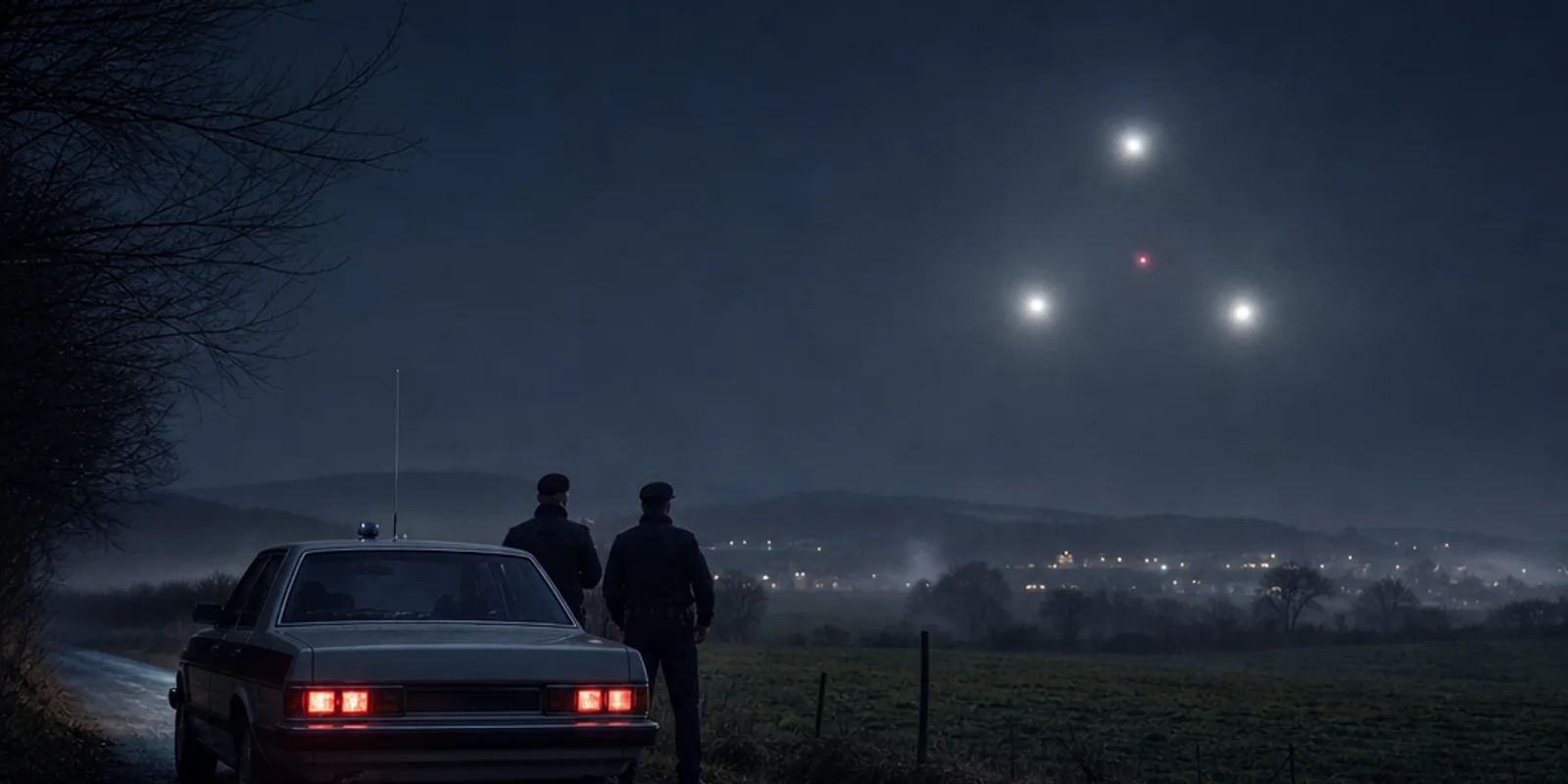
At about 5:20 p.m. on November 29, 1989, two members of the Eupen gendarmerie, Heinrich Nicoll and Hubert von Montigny, were driving toward Kettenis when a brilliant light drew their attention to a field. In the account assembled by Belgian investigators, they maneuvered their patrol car to meet its path and watched it stop, turn, and move back toward Eupen. They later described a dark, flat, triangular mass: a white light near each corner and a red light pulsing near the center. The officers followed, reported by radio, and repeatedly reacquired lights over the next several hours. Their experience became the opening scene of Belgium’s most famous UFO wave.
A long watch over Eupen
The patrol’s story did not end with one glimpse. The officers contacted their station, checked with nearby aviation authorities, and continued toward Lake Gileppe. There they reported a bright object hanging over the landscape, sending out narrow shafts or smaller lights, while other gendarmerie patrols and civilian groups supplied their own observations. Exact descriptions and timings vary among the early report, later interviews, and SOBEPS’s reconstruction. That matters: the celebrated image of one seamless three-hour pursuit is a synthesis of several viewpoints, not a single continuous film or instrument record.
A wave gathers around the first night
Reports spread across French- and German-speaking Belgium during the winter of 1989–1990. Many witnesses described slow, low lights arranged as triangles; others reported a dark shape between them, a faint hum, hovering, or sudden departure. SOBEPS—the Belgian Society for the Study of Space Phenomena—opened files, interviewed witnesses, solicited further reports, and eventually published two large volumes. Police testimony gave the story unusual public credibility. Media attention also changed the observing environment: people watched the sky, remembered earlier lights, and submitted reports days or weeks after the event. The resulting archive is rich, but it is not a census of simultaneous, independently documented craft.
The Air Force chooses to cooperate
The Belgian Air Force did not announce an extraterrestrial conclusion. It did, however, treat unidentified traffic as an airspace question. Col. Wilfried De Brouwer, then chief of operations on the Air Staff, became the service’s public voice. The Air Force exchanged information with the gendarmerie and SOBEPS, checked proposed aircraft explanations, and devised a stricter trigger for interception: corroboration from observers and radar before launching fighters. Earlier scrambles had failed to put pilots in visual contact with an unknown object. The policy set the stage for the night that would define the wave.
March 30: lights south of Brussels
At 11:00 p.m. on March 30, 1990, the Control Reporting Center at Glons received a call from gendarme Albert Renkin at Ramillies. He described three unusually bright lights toward Thorembais-Gembloux, changing among red, green, and yellow while holding a triangular arrangement. Glons asked the Wavre gendarmerie for confirmation. Patrols reported lights, and controllers received intermittent radar contacts in the same broad area. The official chronology records uncertainty at every step—visual reports, radar returns that appeared and vanished, and positions that did not always match—yet the combined picture was sufficient to order two F-16s from Beauvechain Air Base into the air.
Two fighters enter the dark
The F-16s took off shortly after midnight. Guided by Glons, they made repeated approaches during roughly the next hour. The surviving Air Force chronology lists thirteen airborne radar contacts and three brief lock-ons. One recorded sequence seemed extraordinary when read literally: a target changing speed and altitude faster than a conventional aircraft should. But the pilots never saw a corresponding object, even when their instruments suggested one was nearby. Ground witnesses continued to describe lights while the jets crossed the sky, and the different systems did not produce one continuous, mutually confirmed track.
The instrument drama outlives the chase
The fighters landed after 1:00 a.m.; gendarmes near Wavre reported the remaining lights fading or separating by about 1:30. No aircraft, debris, photograph, or physical trace closed the night. The dramatic radar values nevertheless became the wave’s technical centerpiece. At a July 1990 press conference, De Brouwer presented the operation and selected radar material while emphasizing that the evidence did not establish abnormal air activity. Later engineering analysis associated with Lt. Col. Salmon examined the F-16 data and found that tracking and filtering behavior could create apparent extreme maneuvers without requiring a craft to perform them.
A photograph becomes the icon
A dark triangle with four glowing points soon became the wave’s visual emblem. Known as the Petit-Rechain photograph, it seemed to give solid form to the witnesses’ descriptions and was studied for years. In July 2011, Patrick Maréchal told Belgian television that he and a friend had made it with a painted piece of polystyrene, small lights, and a string. The confession removed the most famous image from the evidentiary record. It did not retroactively erase what police and civilians reported months earlier; it did show how one staged photograph could harden a complicated wave into a single, misleading picture.
Helicopters, stars, and a country looking up
The serious conventional case is cumulative rather than singular. Renaud Leclet and colleagues argued that military helicopters could explain a number of low, slow triangular-light reports, especially when traffic, wind, or distance masked engine noise. Other analyses point to Venus or bright stars for stationary lights, aircraft and advertising projectors for some clusters, atmospheric radar echoes, and social reinforcement after extensive coverage. These proposals do not prove that every report had the same cause. They challenge the assumption that thousands of later reports must describe one vehicle or one phenomenon.
What remains after the triangle dissolves
The Belgian wave is best preserved as a layered historical event. On one layer are sincere witnesses, including on-duty police, describing unfamiliar lights and apparent structures. On another are official actions: calls, patrols, radar operators, scrambles, and a public military briefing. A third layer contains later analysis, disputed interpretation, and a famous hoax. The archive establishes that unusual reports prompted a real national response. It does not establish that one enormous craft crossed Belgium, that the F-16 data measured impossible flight, or that the source was extraterrestrial. Some individual observations remain unresolved because the surviving evidence cannot identify them more narrowly.