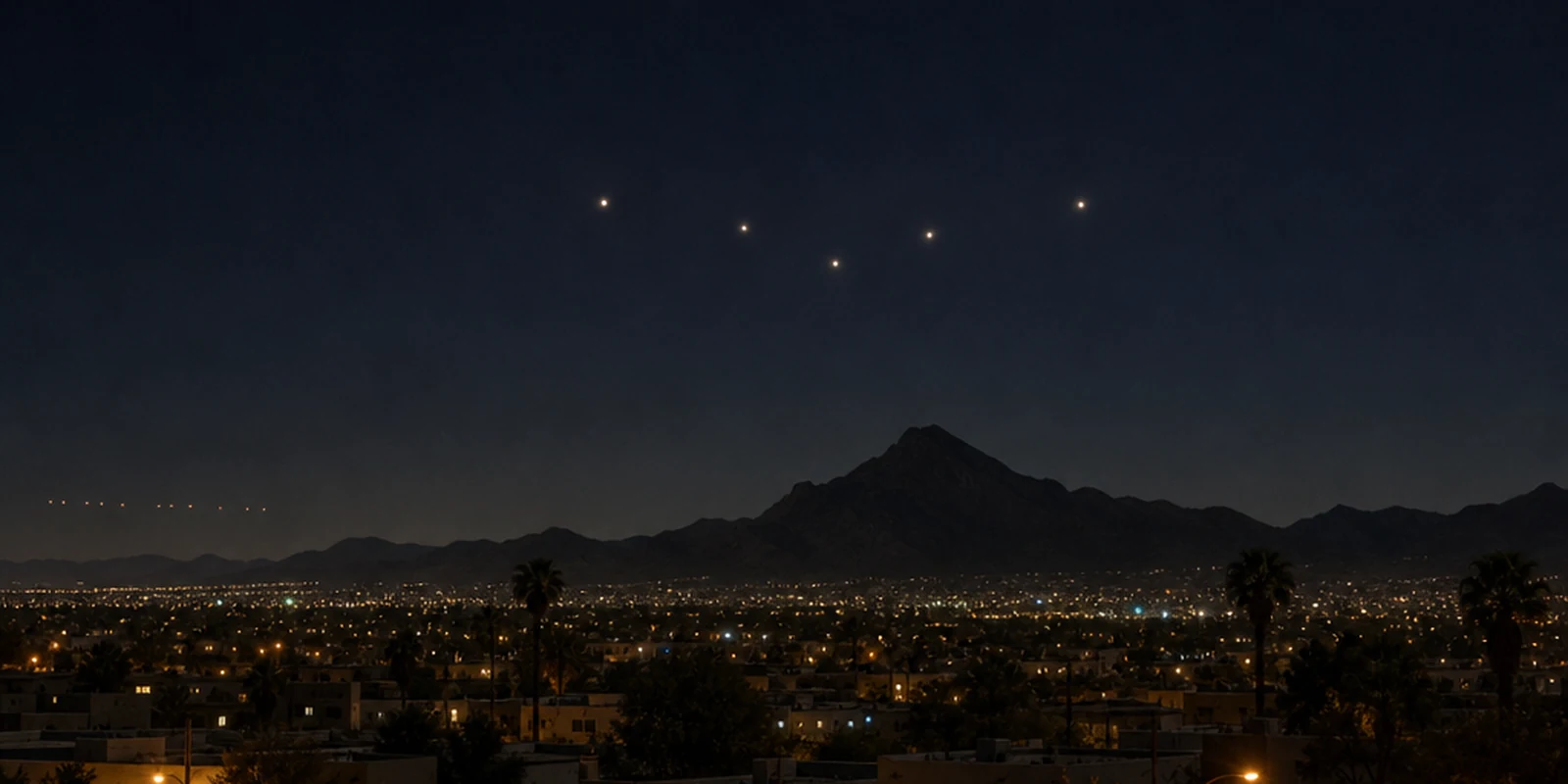
A clear night with more eyes on the sky
On Thursday, March 13, 1997, Arizona’s evening sky was already an attraction. Comet Hale–Bopp was approaching its celebrated spring appearance, and residents were looking upward. Then reports began to move south: lights near Henderson, Nevada; a formation around Paulden and Prescott Valley; more witnesses across the Phoenix basin; later reports toward Casa Grande and Tucson. The accounts did not describe one perfectly uniform spectacle. Some people saw separate lights. Others perceived a vast V, boomerang, or carpenter’s square with darkness between the points. Many remembered silence. By night’s end, several different observations had begun merging into one name: the Phoenix Lights.
The V comes down the state
The first major episode unfolded during the eight o’clock hour. The National UFO Reporting Center’s later reconstruction placed an early report near Henderson at 6:55 p.m. Pacific time and a Paulden report at 8:17 p.m. Mountain Standard Time. Around 8:30, people in the Phoenix area watched a shallow V of lights move generally south. The broad route and timing suggested a traveling formation, yet estimates of height, speed, and size varied radically. Without a known distance, five points in a dark sky could appear to outline anything from separate high aircraft to one enormous low object. That ambiguity became the encounter’s emotional center.
Under an object—or beneath an impression
Tim and Bobbi Ley and members of their family supplied the best-known close witness narrative. Speaking to CNN in June 1997, they described lights approaching from the north and what seemed to be a silent V passing over their Phoenix neighborhood. Tim estimated that one side crossed overhead while the other extended blocks away; Bobbi emphasized the overwhelming apparent size and the awe of hearing nothing. Their account conveys the experience that made the case endure. It also records perception, not a measured span or altitude. The family’s later computer reconstruction was an illustration built from memory, not a photograph of the object.
A telescope breaks the silhouette apart
Not every observer perceived a single body. Amateur astronomer Mitch Stanley said he trained a ten-inch telescope on the leading lights from Scottsdale and resolved them as individual airplanes. His father reportedly called news and city contacts soon afterward, but the observation attracted little notice while the giant-craft story spread. Two local journalists also described the same moving V differently: one felt that a boomerang-shaped darkness joined the lights, while the other saw no connection. Stanley’s telescopic view is important evidence for conventional aircraft in formation, though the public record still lacks a contemporaneous flight manifest that maps every early report to a named airplane.
A second show above the southwest horizon
Around 10:00 p.m., Phoenix residents encountered a different display. Bright amber-white lights appeared in a line or arc southwest of the city, seemed to hang or descend, and vanished one by one. This episode produced the familiar videotapes and still frames reproduced for decades. The geometry was not the same as the earlier traveling V, and the lights occupied a different part of the sky. Treating the entire evening as one continuous craft obscures that separation. Much of the later dispute became easier to follow once investigators asked two questions instead of one: what crossed Arizona earlier, and what glowed beyond Phoenix later?
The military answer arrives late
Initial statements that no local military aircraft were operating fed suspicion. In July, reporters found a more specific record. Davis–Monthan Air Force Base spokesman Lt. Keith Shepherd confirmed that visiting A-10s from Maryland’s 175th Fighter Wing had been training in Arizona. Maryland Air National Guard spokesman Capt. Drew Sullins said eight A-10s used high-intensity parachute flares over the Barry M. Goldwater range southwest of Phoenix and jettisoned remaining flares before returning to Tucson. Seen at distance, slowly descending flares could appear to hover; terrain could hide each light as it fell. That account strongly fits the later row and its direction, but military spokespeople did not present it as a measurement of every report from the earlier north-to-south passage.
A governor makes the mystery a joke
Public concern persisted into June. Governor Fife Symington announced that the state had found the responsible party, then presented chief of staff Jay Heiler in an alien costume. The room laughed, and the press conference became part of the case’s folklore. Symington later said he intended to calm a mounting frenzy, not demean witnesses. The performance nevertheless reinforced a lasting suspicion that officials preferred ridicule to an answer. It also created a dramatic reversal when Symington disclosed a decade later that he considered himself one of the witnesses.
Symington’s second account
In a 2007 first-person commentary, Symington wrote that he had watched a massive delta-shaped form move silently near Squaw Peak, now called Piestewa Peak. He distinguished what he saw from the distant lights and from flares, invoking his experience as a pilot and former Air Force officer. His statement is significant because it comes from the sitting governor of 1997, and because he acknowledged concealing the experience while publicly joking about the event. It is also retrospective testimony recorded ten years later. The delay does not make it false, but it means his account should be read alongside—not substituted for—the descriptions and reporting preserved in 1997.
Planes, flares, and a night that became a legend
The strongest conventional reconstruction separates the evening into a formation of aircraft during the eight o’clock hour and illumination flares around 10:00. It accounts for Stanley’s telescopic identification, the movement of lights relative to one another, the route toward Davis–Monthan, the confirmed Maryland A-10 training, and the later lights’ position toward the bombing range. Witnesses who perceived a low solid body remain unconvinced, especially when their apparent scale and silence seemed incompatible with jets. Those impressions cannot be recreated from the surviving videos, which mostly document the later display. The case therefore contains a persuasive explanation for much of the night without erasing what observers sincerely experienced.
What survives over Phoenix
No recovered object, physical trace, continuous radar track, or authenticated close photograph establishes a giant vehicle over Arizona. What survives is a layered social and observational record: contemporaneous calls, hundreds of recollections, local reporting, videotapes of the later lights, confirmed military activity, a neglected telescope observation, and a governor’s delayed disclosure. The Phoenix Lights endure because the ordinary and the uncanny occupy the same frame. Aircraft and flares can explain lights; they do not automatically reproduce the immense silent shape some people remember. The archive can preserve both facts without turning the gap between them into proof of an extraterrestrial craft.