A call from the highway
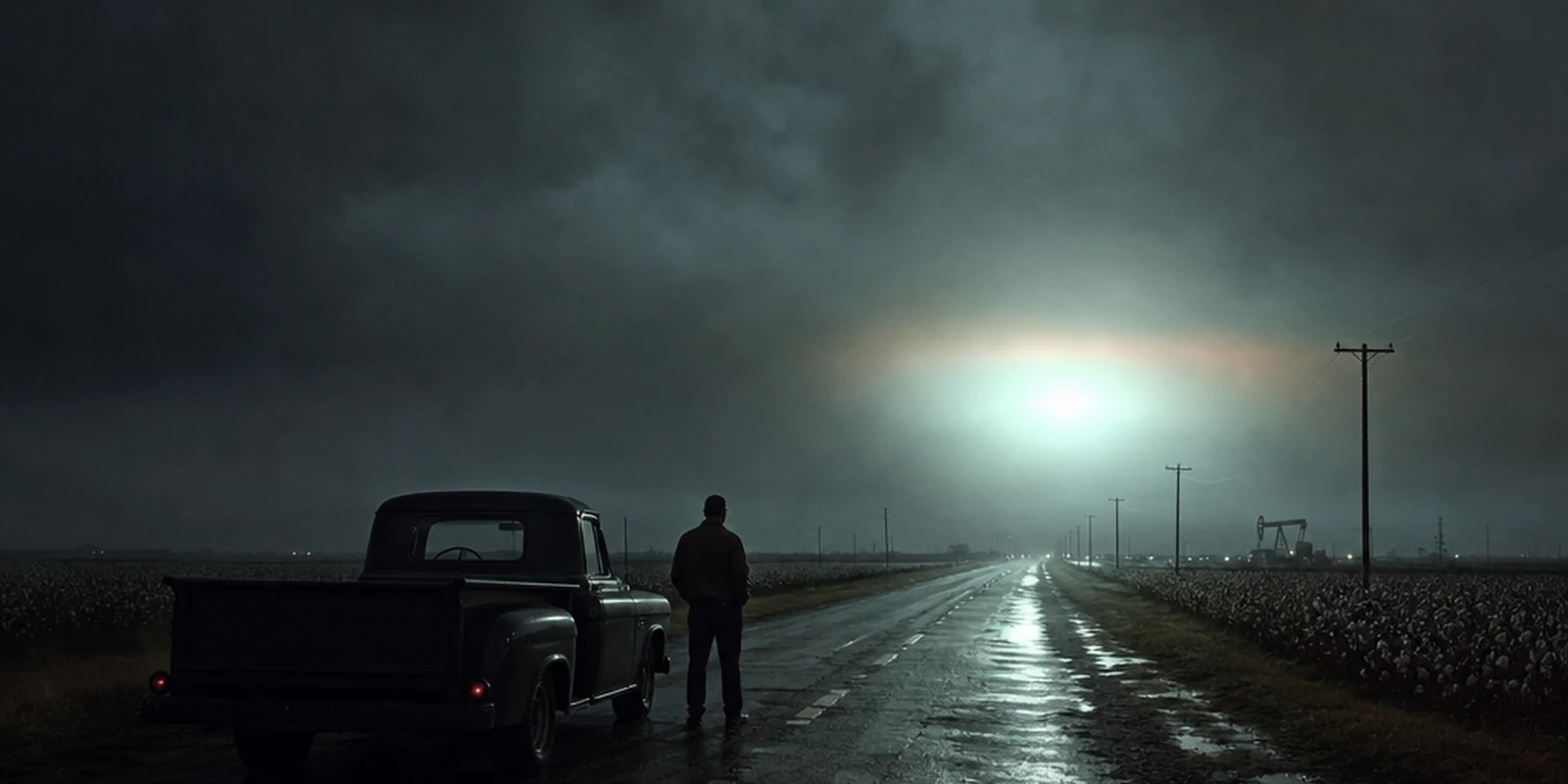
Late on Saturday, November 2, 1957, patrolman A. J. Fowler was working the desk at the Levelland police station when Pedro Saucedo called from the road. Saucedo said that he and Joe Salaz had been driving west of town when a flash appeared in a field and their truck lost its engine and lights. In the signed account copied into later histories, he described a brilliantly lit, torpedo-like form passing low with heat, wind, and a thunderous sound. He dropped to the ground while Salaz remained in the cab. After the light moved toward Levelland, Saucedo said, the truck restarted.
Sources: Project Blue Book report: Vicinity Levelland, TexasThe Levelland, Texas, SightingsThe World of Flying Saucers: Stormy Weather in Texas
The switchboard begins to fill
Fowler initially suspected a joke or a frightened driver. Then similar calls arrived from different roads around town. A motorist identified in early accounts as Jim Wheeler described a brilliant egg-shaped light near the highway and said his vehicle stopped until it rose away. Jose Alvarez, farmer Frank Williams, truck driver Ronald Martin, and James Long were associated with variations of the same pattern: an intense light low over or near a road, an engine or headlights failing, and normal operation returning after the light departed. Names, times, distances, and object sizes are not perfectly consistent across the case file, newspaper stories, and later retellings, but the recurring vehicle-interference claim was present from the first days.
Sources: Project Blue Book report: Vicinity Levelland, TexasThe Levelland, Texas, SightingsAmericana: Dinner Time
Newell Wright stops east of town
One of the most detailed written accounts came from Newell Wright, a nineteen-year-old Texas Technological College freshman. Driving east of Levelland shortly after midnight, he reported that his engine sputtered, the ammeter swung toward discharge, and the headlights dimmed before the car rolled to a stop. After looking under the hood, he noticed a large oval form ahead, flat on the bottom and glowing blue-green. He said it remained for several minutes, rose almost vertically, and vanished; the car then started. Wright did not call during the night. His statement says that he told his parents first and reported the experience the following afternoon because he feared ridicule.
Sources: Project Blue Book report: Vicinity Levelland, TexasThe Levelland, Texas, Sightings
Law officers take to the roads
As the calls accumulated, Fowler notified Hockley County sheriff Weir Clem and officers searched roads radiating from Levelland. Clem and deputy Pat McCulloch reported a brilliant red oval or flash crossing low ahead of their patrol car and lighting the pavement for roughly two seconds. Other officers saw brief lights rather than a landed object. Fire marshal Ray Jones later reported a streak of light while his headlights dimmed and his engine sputtered without fully stopping. The officials’ observations gave the story public weight, but they were shorter and more distant than the motorists’ close roadway accounts.
Sources: Project Blue Book report: Vicinity Levelland, TexasThe Levelland, Texas, Sightings
A town wakes to a national story
By Fowler’s later count, the station received fifteen calls connected with the disturbance, and he remembered the callers as intensely excited. Wire stories carried the mystery beyond West Texas within days. TIME soon summarized at least seven people reporting a bright egg-shaped phenomenon and fading engines or lights. The reports arrived during the first month of the space age: Sputnik 1 had entered orbit in October, and Sputnik 2 launched the same night as the Levelland events. That atmosphere encouraged attention and imitation, but it does not by itself explain what any particular motorist experienced before the national coverage began.
Sources: Project Blue Book report: Vicinity Levelland, TexasAmericana: Dinner TimeThe World of Flying Saucers: Stormy Weather in Texas
Seven hours on the ground
Project Blue Book sent an investigator from nearby Reese Air Force Base to Levelland on November 5. The visit lasted about seven hours and reached only a subset of the people named in the expanding story. The Air Force file nevertheless grew to eighty-one pages, preserving questionnaires, statements, internal memoranda, weather arguments, press clippings, later correspondence, and the final record card. The breadth of that file should not be confused with a complete real-time investigation: no camera, calibrated field instrument, preserved vehicle component, or physical sample recorded the reported effect as it happened.
Sources: Project Blue Book report: Vicinity Levelland, TexasProject BLUE BOOK — Unidentified Flying ObjectsThe Levelland, Texas, Sightings
The Air Force chooses weather
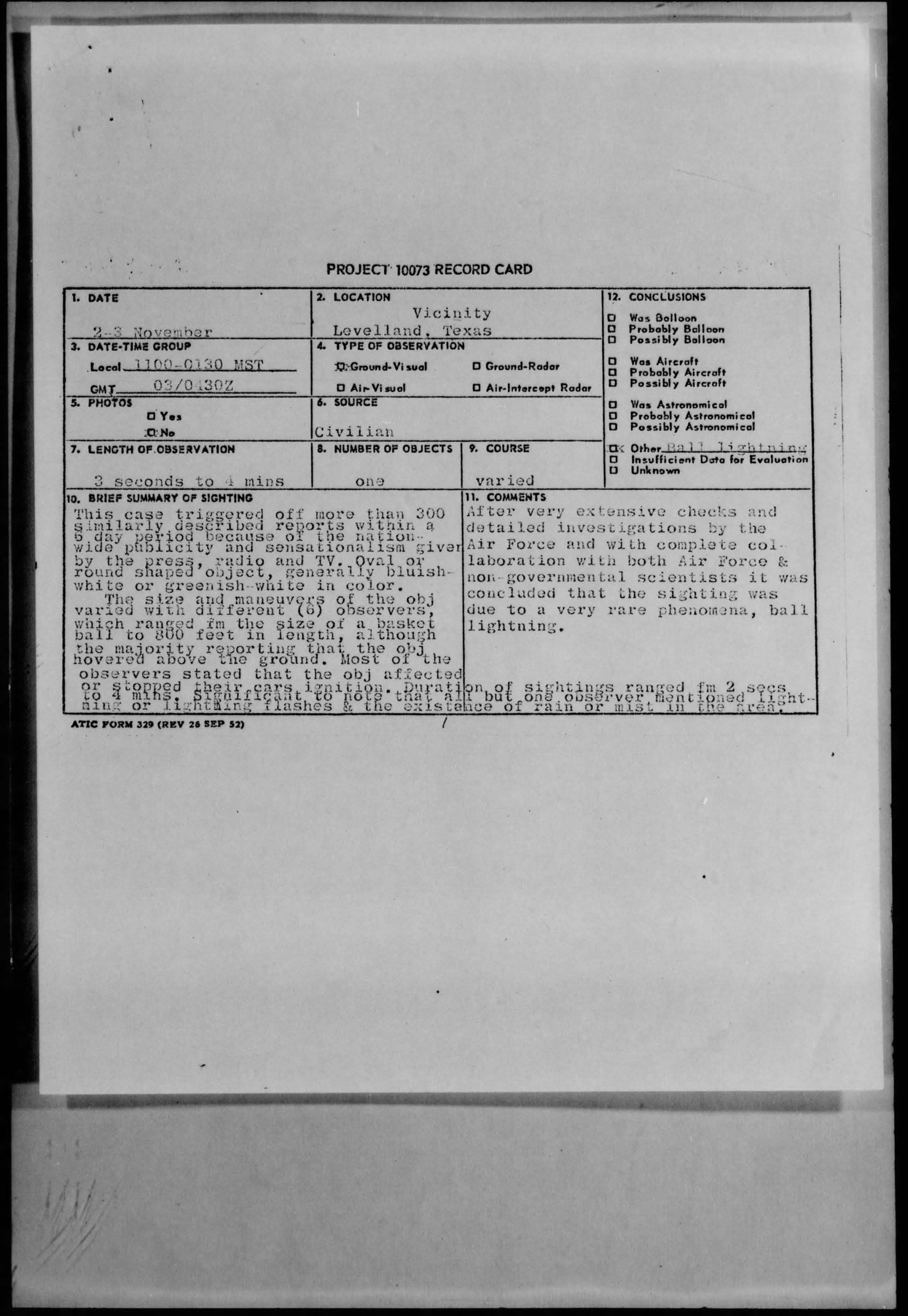
The final Blue Book record card placed Levelland under “Other” and named ball lightning rather than leaving the case unidentified. An investigative summary described low overcast, limited visibility, drizzle or light rain, and heavy thunderstorms shortly before the reports. It proposed that a rare electrical phenomenon produced the lights and that moisture on distributor parts—possibly aided by atmospheric ionization—stalled the vehicles; one motor stoppage was attributed to a faulty distributor. The card also noted wide differences in reported size, color, and maneuver and treated publicity as a driver of hundreds of additional reports.
Sources: Project Blue Book report: Vicinity Levelland, TexasThe World of Flying Saucers: Stormy Weather in Texas
The weather argument changes sides
The conventional explanation had a prominent defender in Harvard astronomer Donald Menzel. Writing in 1963 after access to Air Force files, he argued that unusual wet and electrical weather, ball lightning, damp ignition systems, and the amplifying effects of publicity formed a coherent account. J. Allen Hynek, the Air Force’s astronomical consultant, moved the other way. He later wrote that he had accepted ball lightning too quickly and said observers reported mist and overcast but no lightning. Atmospheric physicist James McDonald told a House committee in 1968 that his weather check found no nearby thunderstorm and only a trace of rain. Their disagreement is partly about meteorology and partly about how much confidence to place in interviews conducted years later.
Sources: The World of Flying Saucers: Stormy Weather in TexasThe Levelland, Texas, SightingsSymposium on Unidentified Flying Objects
What ball lightning can—and cannot—settle
Ball lightning is a reported luminous atmospheric phenomenon, usually described as a small sphere appearing near thunderstorms and lasting seconds. Its underlying cause remains uncertain. That makes it a serious historical alternative, not a precise reconstruction of Levelland. The hypothesis fits luminous colors, brief appearances, explosive sounds, and the Air Force’s account of unsettled weather. It fits less neatly with witness estimates of enormous length, repeated road-level encounters over miles, and the claimed timing of several vehicle recoveries. Those difficult details are also estimates and memories, not measurements, so they cannot simply be treated as fixed technical specifications.
Sources: Ball lightningProject Blue Book report: Vicinity Levelland, TexasThe World of Flying Saucers: Stormy Weather in Texas
The mystery without a photograph
Levelland endures because its central motif repeated: a light approaches, a machine fails, the light leaves, and power returns. The public record documents that motorists and officials made such reports and that the Air Force investigated them. It does not preserve a photograph of the phenomenon, a continuous police log available for independent analysis, a tested vehicle part, a weather instrument at each encounter site, or a physical trace linked to an object. The story therefore remains unusually rich in testimony and unusually poor in recoverable physical data.
Sources: Project Blue Book report: Vicinity Levelland, TexasProject BLUE BOOK — Unidentified Flying ObjectsThe Levelland, Texas, Sightings
A case argued in every era
The encounter became a landmark in the literature of alleged electromagnetic effects. Menzel used it to demonstrate how weather and excitement could build a saucer story; Hynek used it to argue that repeated close reports deserved better investigation; McDonald put the vehicle failures into the congressional record. Contemporary coverage gave the night a memorable image—glowing eggs on dark highways—while the official card fixed “ball lightning” beside it. Levelland’s cultural legacy is not a verified machine on a road but a durable argument about witnesses, weather, and what an investigation owes an extraordinary claim.
Sources: The World of Flying Saucers: Stormy Weather in TexasThe Levelland, Texas, SightingsSymposium on Unidentified Flying Objects