A woman on the dome
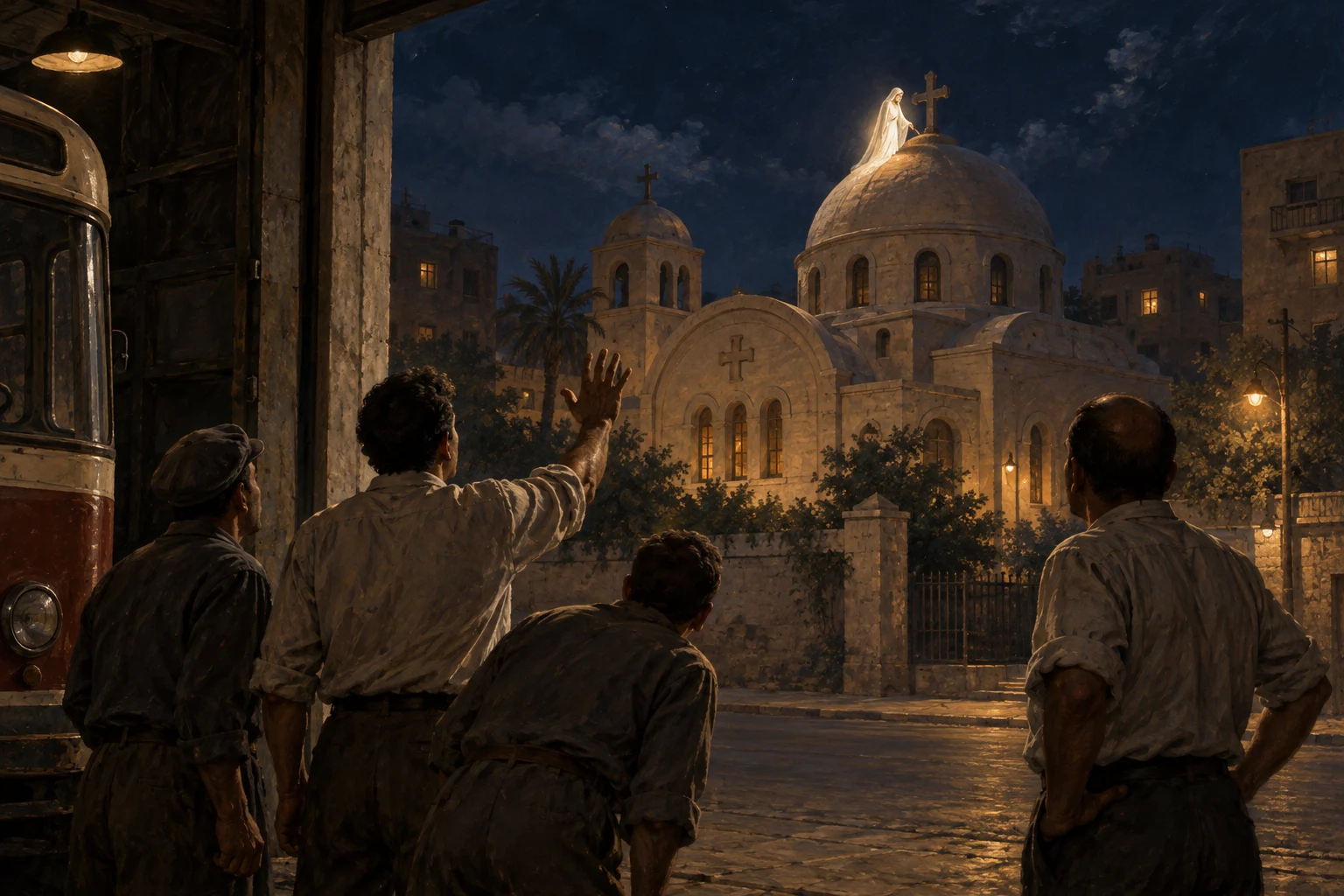
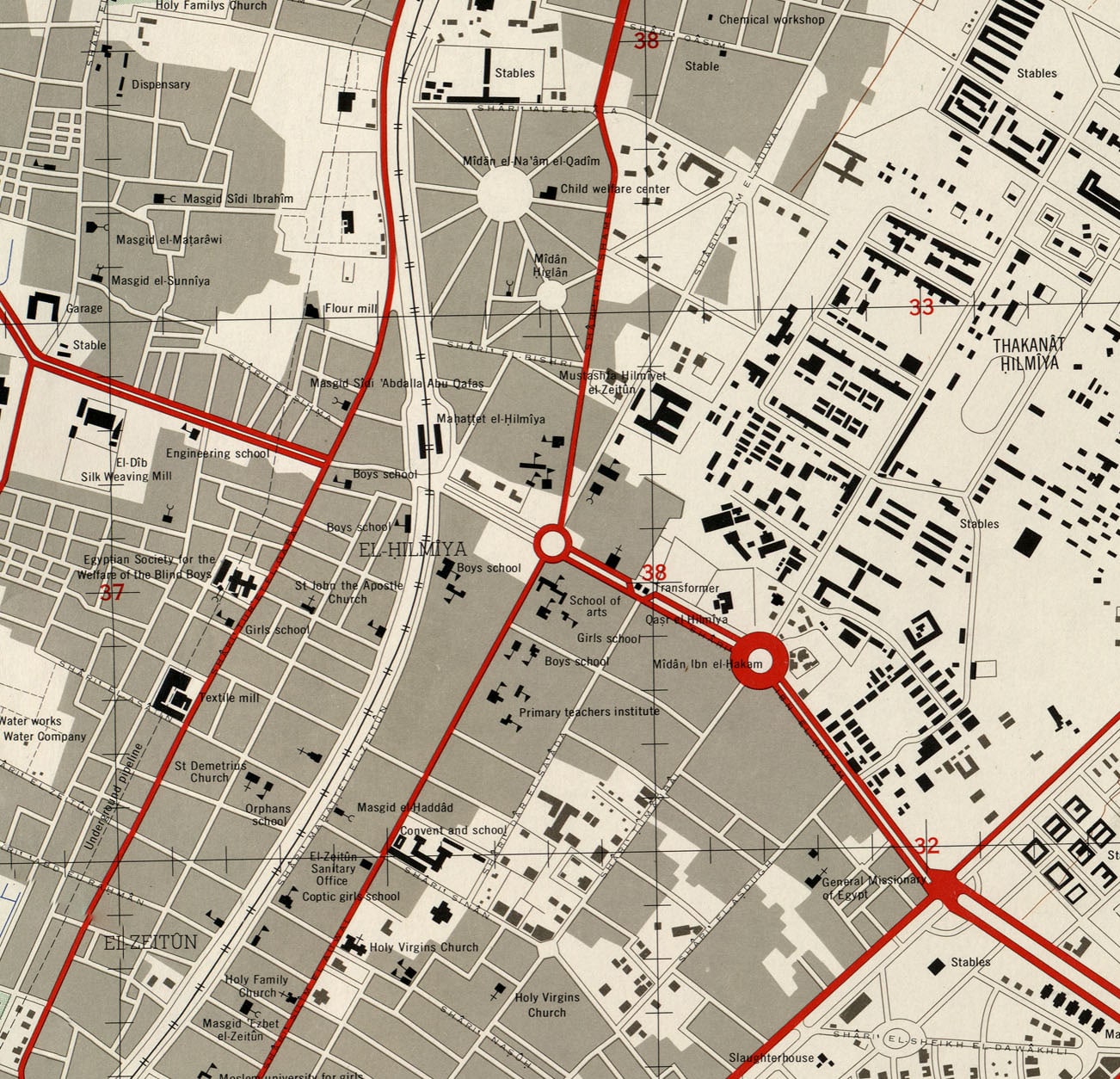
On Tuesday evening, April 2, 1968, the night staff of the Public Transport Authority garage in Zeitoun were at the gate facing the Church of the Virgin Mary across Tumanbay Street. The first list of their names, printed in the Coptic weekly Watani a month later, gives four: Hassan Awwad, the watchman Abdel Aziz Ali, the driver Ma’moun Afifi and Yaqout Ali; later accounts describe all of them as Muslims. At about 8:30, according to the Ministry of Tourism report Watani published, a beam of light drew their eyes to the main dome. On it, beside the cross, they made out a young woman in white, kneeling on a curved roof too steep for anyone to stand on. Al-Ahram’s version of May 6 came from another driver, Farouk Atwa, who said he was signing the attendance register when passers-by began shouting. “I saw a lady dressed in white standing on the northern dome, as if about to throw herself down,” he said. “I shouted, ‘Be careful! Wait!’—but she didn’t move.” In Watani’s account the emergency police were called. Someone in the crowd now forming cried that it was the Virgin. Atwa looked again and thought it was a nun; then, he said, a flock of white doves flew up from above her, and after a few minutes she was gone.
Sources: Watani, May 5, 1968Al-Ahram, May 6, 1968Scraps and Photos from English and French Newspapers on the Apparitions of Virgin Mary at Zeitoun
The lamps they smashed
The church’s caretaker, Ibrahim, ran to the parish priest, Father Constantine Moussa, about an hour and a half after sunset, crying that the Virgin had appeared above the dome. Moussa sent his son Nabil, a university student, then went out himself and saw what he described to Al-Ahram as “a luminous half-figure” outside the dome. “Some of the garage workers tried to shine a spotlight on the vision,” he said, “but it only made her glow brighter.” The test was in print from the start: Watani’s front page of April 21 already declared that what people saw was not a reflection of light, and that the lamp had been smashed. In Watani’s fuller telling of May 5 the doubters turned spotlights on the figure, then smashed the nearby street lamps, and when the power to the whole area was cut “the heavenly figure remained, glowing brighter still.” A Coptic woman told the anthropologist Cynthia Nelson that it was the local police chief who had called the figure a reflection of the streetlights and begun breaking the lamps, until he grew frightened. Watani’s April 21 issue added a man who turned a motorcycle headlamp on the dome and found that the figure only grew clearer. Moussa said he saw her full-length on April 9, and on April 10 holding an olive branch, with white doves above her.
Sources: Al-Ahram, May 6, 1968Watani, May 5, 1968The Virgin of ZeitounAl-Ahram Center press-cutting file on the Zeitoun apparitions, April 21 – May 13, 1968
Ten months after the Naksa
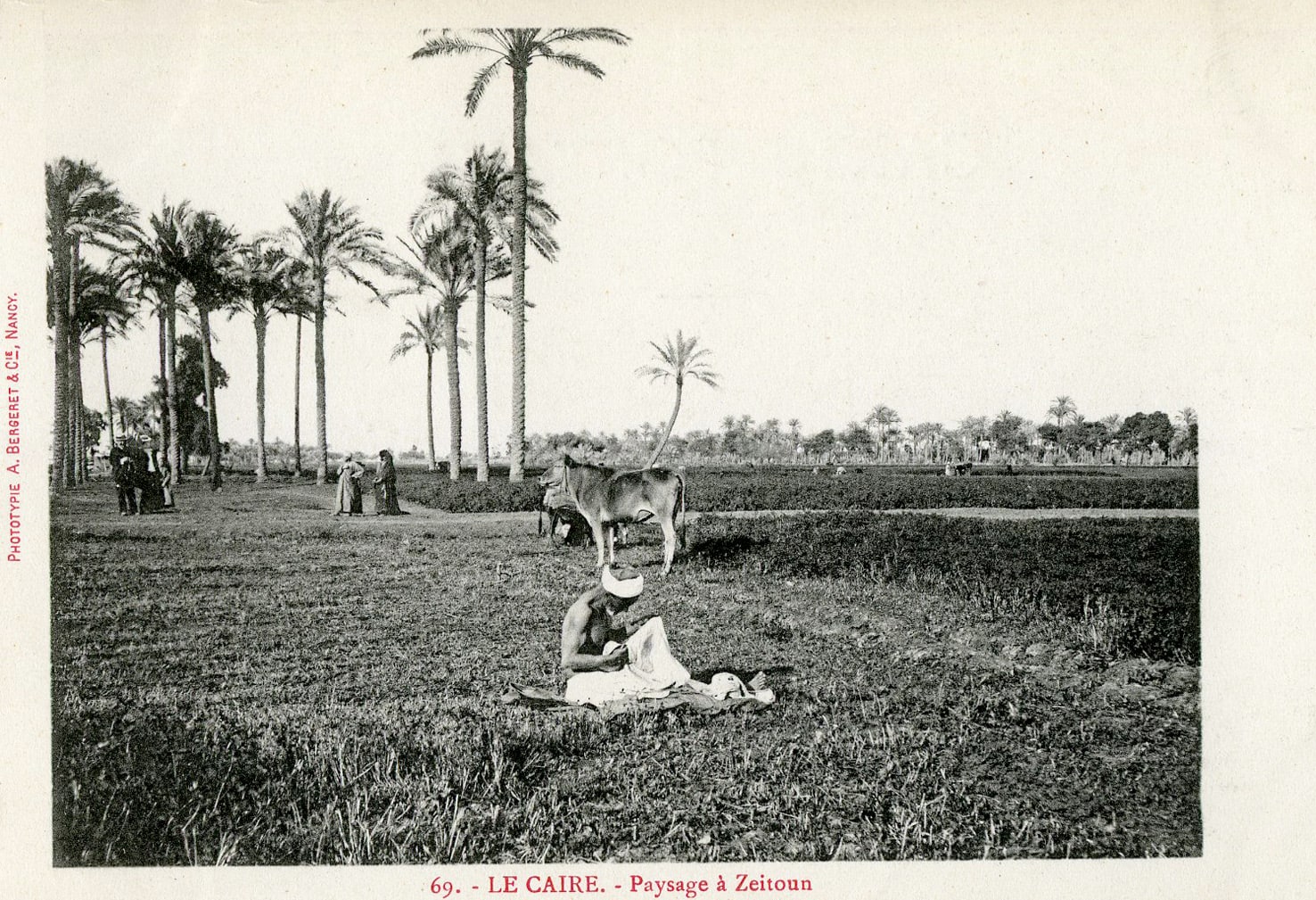
Egypt in April 1968 was a country in mourning. In June 1967 Israel had destroyed its air force on the ground, taken Sinai, and taken East Jerusalem with its Christian holy places, closed now to Egyptian pilgrims. Watani’s April 21 issue reported a prequel from the last night of the war: on June 10, 1967, during the blackout, the empty church filled with light for about two minutes while garage workers shouted at the priest to turn off the lights, and he found the switches already off. Egyptians called the defeat al-Naksa, the setback. Zeitoun, whose name means olive, had been palm groves and fields on the road from Cairo to Matariya when a French postcard publisher photographed it early in the century; by 1968 it was a crowded district of apartment blocks and church schools between the railway and Heliopolis. Coptic tradition places it on the route of the Holy Family’s flight into Egypt, which was said to have rested under a sycamore at Matariya nearby. The church itself was built in 1924 or 1925 by the Khalil Ibrahim family, Coptic landowners, on a plot of their estate. Its founding legend, recorded only later, comes in several versions. In the one Nelson heard, the landowner had been building a villa when the Virgin appeared to him in a dream, told him to build her a church instead, and promised to return in fifty years and appear there for a year. Nelson’s informant added that April 2, 1968, fell on the fortieth day after the death of the landowner’s daughter.
Sources: The Virgin of ZeitounAl-Ahram Center press-cutting file on the Zeitoun apparitions, April 21 – May 13, 1968Al-Akhbar, May 7, 1968Statement of the Papal Residence on the apparitions at ZeitounMiracles: A Parascientific Inquiry into Wondrous PhenomenaOur Lord’s Mother Visits Egypt in 1968 & 1969
Doves that never beat their wings
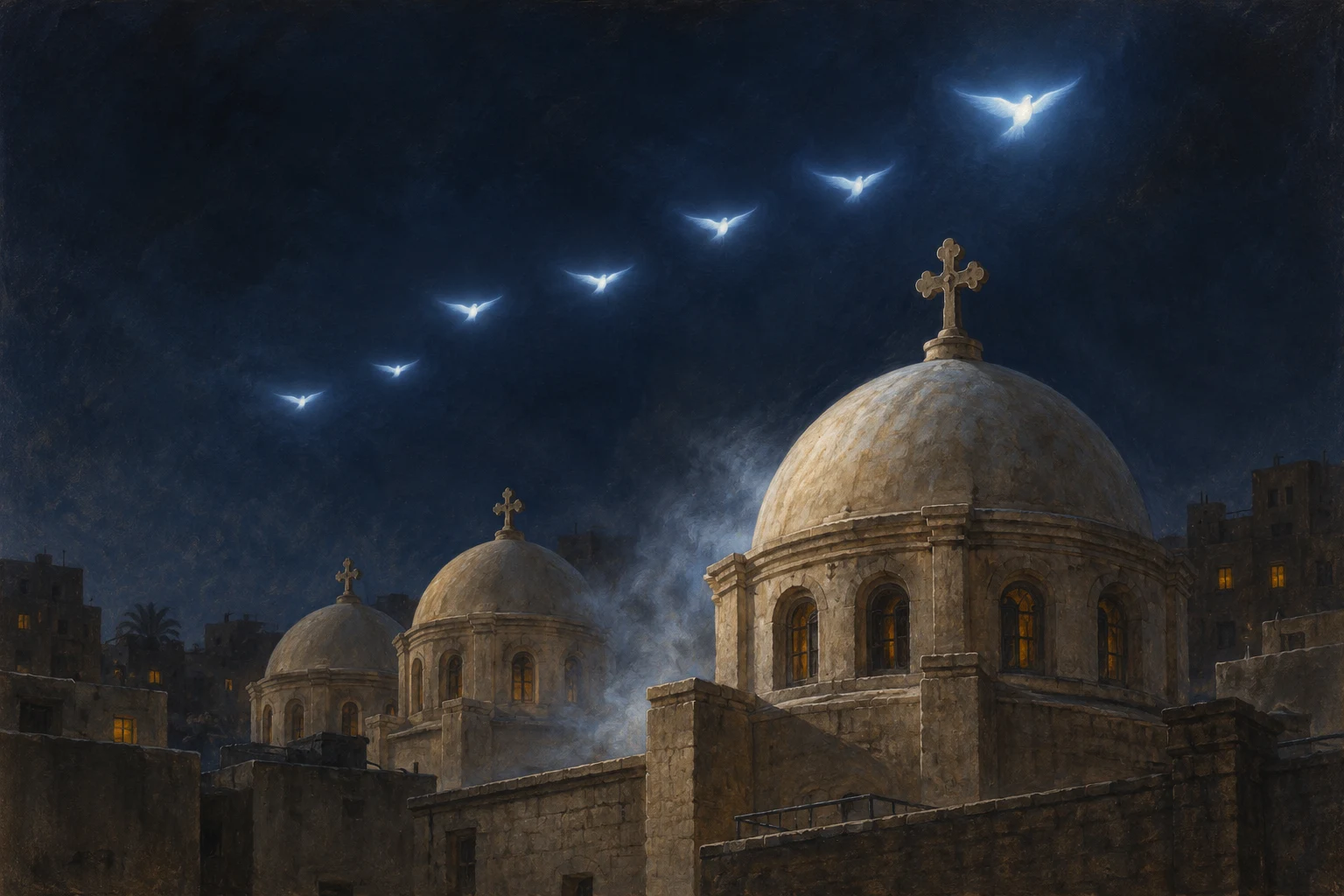
What the crowds came to see in the weeks that followed was not always a woman. Witnesses described a figure in blue-white light, sometimes full-length and walking along the domes, sometimes a bust in a golden halo, bowing toward the cross or raising a hand over the crowd. She never spoke. Before she came, they said, flashes lit the church like a fluorescent tube switching on or like sheet lightning, sometimes a quarter of an hour ahead. Clouds of what smelled like incense poured from the domes. Small lights crossed the sky like shooting stars, and on some nights a light seemed to form in the shape of a woman out of a thin line of brilliance, “like the light you see when you open the door to a lighted room,” as the Protestant oil engineer Wadie Tadros Shumbo told the Benedictine Jerome Palmer. Strangest of all were the birds. Bishop Gregorios, who led the patriarchate’s committee documenting the apparitions, described them to Palmer: “They do not flap their wings; they glide. In a flash they appeared; and disappear the same way.” Sometimes seven flew in the shape of a cross; one that flew lower “gets larger and larger,” and close up there were no feathers, “just something lighted.” Watani asked the zoo’s chief inspector, Abdel Moneim El-Muniri, whether any pigeon could fly at night. None could, he said, let alone at such speed, or in shapes like the number 7, which was how several witnesses described the formations.
Sources: The Virgin of ZeitounOur Lady Returns to EgyptThe Virgin Mary Appears in EgyptWatani, May 12, 1968Watani, June 2, 1968Our Lord’s Mother Visits Egypt in 1968 & 1969
Watani breaks the story
For almost two weeks the apparitions were a neighborhood affair. Watani, the Coptic weekly founded by Antoun Sidhom, ran the first front-page report on April 14 under the headline “Thousands see the Virgin in a halo of light appearing over the dome of Zeitoun Church.” The big dailies, Watani’s Antoun Naguib Matar complained later, were busy that week with the case of a woman said to have eaten her husband’s arm. A BBC correspondent told Nelson that Lebanese papers had carried the story first. Watani’s April 21 issue devoted pages to the first night and its witnesses, and the same day Al-Gomhuria became the first national daily to take it up, quoting Pope Kyrillos VI, the Coptic patriarch, calling it a herald of victory. Al-Ahram sent its reporter Ezzat al-Saadani, who on April 27 described crowds waiting nightly for the Virgin’s “phantom” and counted twenty-four appearances. Not everyone was reverent. The weekly Akher Sa’a treated the figure on May 1 as a spiritualist materialization, ectoplasm rather than miracle. Television presenter Hamdi Qandil was the first to put it on the air.
Sources: Watani, May 12, 1968Al-Ahram Center press-cutting file on the Zeitoun apparitions, April 21 – May 13, 1968Al-Gomhuria, April 21, 1968The Virgin of Zeitoun
The patriarchate speaks
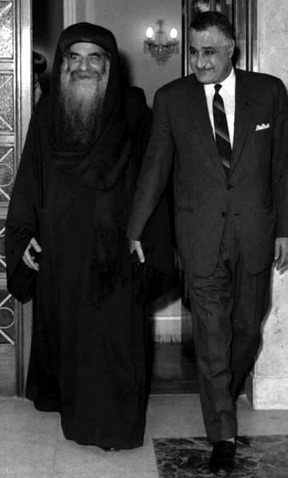
On Saturday, May 4, twelve Coptic bishops and priests faced about 150 journalists at the patriarchate under a large photograph of President Gamal Abdel Nasser. Bishop Athanasius of Beni Suef read a statement in Arabic and English declaring that the apparitions of the Virgin, “Mother of Light,” had continued since April 2, sometimes for as long as two hours and fifteen minutes, as at dawn on April 30, “when She appeared continuously from 2:45 am till 5:00 am.” Athanasius had seen that one himself: two doves rising from the church, then a luminous figure “like a cloud of light” that flared up like a fluorescent lamp, light blue in color. Bishop Gregorios, asked by an Associated Press reporter about the war, called it a heavenly sign that God was with Egypt, and said the Virgin grieved for what had happened in Jerusalem. Bishop Samuel put it more gnomically: “The silent message is stronger than the spoken message.” Pope Kyrillos did not attend, and The New York Times noticed that only the words “papal residence” appeared at the foot of the mimeographed statement. A week later, in an interview printed in Al-Akhbar on May 11, he said that he had signed it and appointed three bishops to represent him, and that he had kept away from Zeitoun so that the people could see it for themselves. A second handout at the press conference, headed “Ministry of Tourism, Information Department,” was titled “Virgin Mary Appears Daily.”
Sources: Statement of the Papal Residence on the apparitions at ZeitounScraps and Photos from English and French Newspapers on the Apparitions of Virgin Mary at ZeitounAl-Akhbar, May 5, 1968Al-Akhbar, May 11, 1968The Virgin of Zeitoun
The government’s miracle
The state did not merely tolerate Zeitoun. The Ministry of Tourism’s report, printed in Watani on May 5 and sent, the paper said, to every Egyptian embassy and tourist office, began: “Cairo today lives in the midst of a miracle.” By its count the Virgin had appeared twenty-seven times. Francis Johnston’s 1980 devotional history quotes what is almost certainly the same document, a report from the Director of General Information and Complaints to the tourism minister, Hafez Ghanem: it was “an undeniable fact that the Blessed Virgin Mary has been appearing on the Coptic Orthodox Church at Zeitoun in a clear and bright luminous body, seen by all present in front of the church, whether Christian or Moslem.” The Coptic Catholic patriarch, Cardinal Stephanos I, told Watani that it was “a true apparition, beyond any doubt,” vouched for by a nun of known precision, Paula de Mofallo. Watani also claimed that a Vatican representative had seen it and reported to Paul VI; the Associated Press quoted the nunciature denying that the apostolic delegate had confirmed anything. In 1968 Nasser’s link to Zeitoun was indirect: Watani reported that he had personally ordered care for a blind man later said to have been healed there. A later layer has him seeing the Virgin himself. The Coptic writer Rafiq Habib told Egypt Independent in 2010 that “even President Gamal Abdel-Nasser went there to see it,” and the anthropologist Angie Heo describes him submitting eyewitness testimony to the papal committee. No source from 1968 to 1973 says he saw anything.
Sources: Watani, May 5, 1968When Millions Saw MaryAl-Ahram Center press-cutting file on the Zeitoun apparitions, April 21 – May 13, 1968The Virgin Made Visible: Intercessory Images of Church Territory in EgyptThe ghost of the Virgin Mary in Egypt: a history
A human tidal wave
Once the patriarchate spoke, the crowds became what Al-Ahram’s headline on May 7 called a human tidal wave. Al-Saadani reported that ninety-two trains had run to Zeitoun at ten-minute intervals, each built for about 900 passengers and carrying more than 1,500. Families staked out the pavement by early evening; a furniture renter brought a cartload of 200 chairs at three piasters an hour and had all but eight rented within the first hour; soda factories sent trucks, and about 150,000 bottles were sold a night; sixty-seven lupin sellers worked the street corners. A neighbor, Ismail Tark, complained that the crowds had broken his fence six times, and that night, the paper noted, the Virgin did not appear. Watani’s May 5 issue put the nightly crowd at over 40,000, and its May 12 issue at over 100,000 on each of the two previous nights. The governor of Cairo and the security chief inspected the site, traffic was to be banned from Tumanbay Street from six in the evening, and the trees around the church were cut down so everyone could see the domes; the garage was eventually cleared away. Nelson watched the vigil turn into a mulid, a saint’s festival, with kiosks selling photographs of the apparition and vendors selling incense as blessing. Then, on May 20 by her account, rumors of an apparition at St. Michael’s Church in Shubra sent 10,000 people surging toward its doors, and fifteen were killed. Afterward the authorities cordoned off Zeitoun and charged admission: ten piasters for the area, fifteen more for a chair, a hundred to enter the church, the proceeds shared between church and state.
Sources: Al-Ahram, May 7, 1968Les prodigieux phénomènes de Zeitoun (Égypte) (de 1968 à 1971)Watani, May 5, 1968Watani, May 12, 1968Al-Ahram, May 6, 1968Al-Akhbar, May 7, 1968The Virgin of ZeitounOur Lord’s Mother Visits Egypt in 1968 & 1969
The anthropologist in the crowd
Cynthia Nelson, an American anthropologist teaching at the American University in Cairo, went to Zeitoun to watch the watchers. On April 15 she found 1,000 to 1,500 people, mostly from the urban middle and upper classes and in Western dress, who broke into shouts when a white-shirted figure appeared in a church window, until they realized it was only a man. In late April she stood beside a chemistry honors student who had seen the Virgin on April 12: “She was like a statue, hands folded in front, head veiled and bent.” That night Nelson saw a light through the palm fronds herself and at once explained it to herself as reflected light. But, she wrote, “the source of the light was a mystery, for the streetlights had been disconnected all around the church for several days.” On June 1 she stayed from ten at night until two in the morning and saw intermittent flashes. Perhaps headlights, she asked? The crowd told her no cars or buses had been allowed near the church for two weeks; its response to the flashes was “electric.” A Muslim-Marxist sociologist told her that the lights reminded him of glowing vapors he had seen over tombs in Upper Egypt as a boy, but he would not go to look; a Coptic-Marxist critic at Al-Ahram called the whole affair “a living myth debased by light.” Nelson’s own reading, published in 1973, was that the Virgin symbolized “the disillusionment with secular political explanations and a turning toward the religious.”
Sources: The Virgin of Zeitoun
Photographs from the garage roof
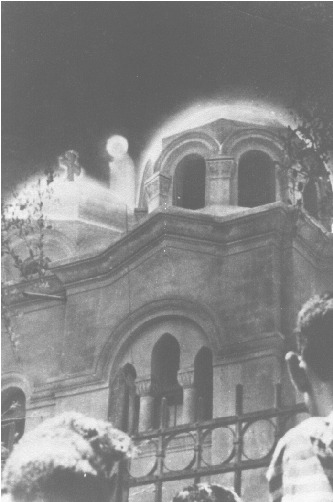
Wagih Rizk Matta, a professional photographer who lived in Zeitoun, set up his camera on the garage roof facing the domes. In his own account, from his Arabic book Light from Heaven, his left arm had been crushed in a car accident on June 27, 1967, and surgeons had told him it would never move again. He had first seen her at 2:45 in the morning of April 9, a light “so strong that the eye couldn’t bear it.” On his first night with the camera she did not come; on the next she did, and he stood frozen like the people around him, one covering his eyes, another falling to the ground, a third hiding his face behind the man in front. On April 13 at about 3:40 in the morning he took two exposures, and only at home did he realize that he had worked the camera with his left hand. One frame ran on the front page of Al-Ahram on May 5, captioned with the assurance that the paper’s photography department had examined the original film and found no trace of montage. To Pearl Zaki, a devotee who wrote a diary of the nights, the outline was not obvious; the Syrian philosopher Sadiq Jalal al-Azm, in his 1969 Critique of Religious Thought, described it as “a spot of intense white light that resembled an elongated balloon.” Al-Azm also noted that Watani had announced on its front page that it had refused, under repeated pressure, to publish a photograph it was sure did not represent reality. Other photographers, among them Ali Ibrahim and the engineer Fawzi Mansour, produced pictures of their own. In a 1996 book by believers, the physicist John Jackson, as Travis Dumsday summarizes him, judged Rizk’s picture most likely doctored, while finding no sign of tampering in two others; Vern Miller of the Brooks Institute of Photography decided that Rizk’s photograph of the “birds” showed something real whose shapes had been altered to look like birds.
Sources: The photos of Mr. Wagih Rizk and the story of the great miracle the Virgin did to himReal photos of the apparitionOur Lord’s Mother Visits Egypt in 1968 & 1969Critique of Religious ThoughtOur Lady of ZeitounThe Marian Apparitions at Zeitoun: An Evidential InquiryMarian apparitions at El-Zeitoun and social psi
A finger, a shirt and a vanishing nun
Healing stories gathered around the church from the start, and the patriarchate set up a committee of three physicians and three psychiatrists to record any cure. Its psychiatrist, William El-Khouly, told Rose al-Youssef on May 13 that he had gone several times and not seen her, though he thought mass suggestion could not account for thousands of witnesses. The most famous healing in English-language retellings belongs to Farouk Mohammed Atwa, the garage driver, said to have pointed up at the figure with a bandaged finger that was to be amputated next day for gangrene, and to have been found healed when the bandages came off. That version appears in Pearl Zaki’s 1977 book and in Johnston’s, who even gave Watani’s April 21 issue as his source. The 1968 papers tell it differently. Al-Ahram’s interview with Atwa mentions no finger. Watani’s April 21 issue gave the finger to a different man, Sayed Hassan Ahmed: a thorn under his nail, three failed operations, a doctor proposing to cut off the first joint, and after seeing the Virgin a shirt found covered in printed crosses and a finger that stopped hurting. Palmer, in 1969, still credited the cure to “Sayed Hassan.” Folklore added more. Zaki repeats a story, which Sider later dismissed as an unchecked rumor, of two Muslim doctors who gave a lift to a young nun on the desert road from Alexandria; when they opened her door at Zeitoun the crowd saw only a dove fly out of the car.
Sources: Al-Ahram, May 6, 1968Al-Ahram Center press-cutting file on the Zeitoun apparitions, April 21 – May 13, 1968Our Lady Returns to EgyptOur Lord’s Mother Visits Egypt in 1968 & 1969When Millions Saw MaryLes prodigieux phénomènes de Zeitoun (Égypte) (de 1968 à 1971), suite
The fading lights, 1969–1971
By summer 1968, D. Scott Rogo wrote, the apparitions were already waning, though the flashes and the “doves” continued. The crowds thinned, according to Johnston, to about 10,000 a night by the end of the year. Rogo listed the dates in 1969 when the full figure was seen, about a dozen of them, among them April 2, the first anniversary. Zaki recorded her own sighting of August 12, 1968: two flashes “like a big flame,” then the great dome “engulfed in a brilliant blue white light, as if it were melting.” The Egyptian Gazette reported that more than a quarter of a million people came to the twelve-hour ceremony, and that on April 4 the figure had been seen for thirty minutes, nodding to the crowd. On the second anniversary, in 1970, Watani counted about 50,000. In August 1970 Al-Fida reported fresh sightings over the eastern dome, along with a papal letter complaining that, two and a half years on, the committee had only leased the garage land and sublet half of it to the Suez Canal Authority. Bishop Samuel, one of the bishops at the May 1968 press conference, said, according to Fate, that the apparitions had ceased in July 1970; Johnston put the last of that year on September 12. A week after that, he wrote, two of the “birds” were seen by a Catholic nun who had spent 108 nights in all at Zeitoun. From October the street reopened to traffic. Then, on the night of May 29, 1971, came a final vision, reported months later on the front page of the National Enquirer.
Sources: Miracles: A Parascientific Inquiry into Wondrous PhenomenaWhen Millions Saw MaryScraps and Photos from English and French Newspapers on the Apparitions of Virgin Mary at ZeitounWatani, April 5, 1970Al-Fida, August 3, 1970The Virgin Mary Appears in EgyptOur Lord’s Mother Visits Egypt in 1968 & 1969
From Marian vision to UFO case
Zeitoun reached ufology through its lights rather than its theology. In the mid-1970s Fortean Times praised a Cleveland archive, the Page Research Library, for collecting “the crucial data” on the apparitions, and the parapsychologist D. Scott Rogo put them beside the Mothman sightings of West Virginia in The Haunted Universe in 1977: “Actually Mothman is like a hellish version of Zeitoun.” His theory was that a crowd’s collective will could project an image, of the Virgin in Cairo or of a flight of UFOs over the countryside. By 1982, in Miracles, he called Zeitoun “the strongest proof ever obtained demonstrating the existence of the miraculous.” The French ufologist Jean Sider went further in two 1985 articles for Lumières dans la Nuit. Some witnesses, he noted, had made out details of the domes through the figure, and the giant pigeons “ne battaient jamais des ailes,” never beat their wings. The figure, by his sources, glided a few tens of centimeters above the roof with her feet never visible, and once a ball of red light trailed a white streak that took the Virgin’s shape. Even Paramount allied with Disney, he wrote, could not have staged such a show. To him the case suggested an intelligence “étrangère à nos activités humaines,” alien to human activity, projecting holographic images matched to each believer’s expectations, and he asked whether it might be the same one that “manipulates” the UFO phenomena. The British researcher Hilary Evans was more cautious: the figure was seen by great numbers “though not by everyone who was present,” photographed “though the photographic image is never well-defined,” and Zeitoun, for all its witnesses, was “no less ambiguous than any other case.”
Sources: Fortean Times, issues 1–30The Haunted UniverseMiracles: A Parascientific Inquiry into Wondrous PhenomenaLes prodigieux phénomènes de Zeitoun (Égypte) (de 1968 à 1971)Les prodigieux phénomènes de Zeitoun (Égypte) (de 1968 à 1971), suiteVisions, Apparitions, Alien Visitors
Earthquake lights
In 1989 the seismologist John Derr and the neuroscientist Michael Persinger, who had spent years linking UFO reports to seismic strain, published a short paper in Perceptual and Motor Skills arguing that Zeitoun had been a geophysical event. They took the dates of the lights from Johnston, Palmer, Zaki and the British writer Kevin McClure, and the earthquakes within 500 kilometers from the U.S. Geological Survey’s catalogue. About a year after the first sighting, beginning abruptly with a magnitude 6.8 shock on March 31, 1969, a swarm of thirty-eight earthquakes struck the Gemsa area at the southern tip of Sinai, some 400 kilometers to the southeast, a tenfold jump in the region’s activity. Month by month, they found a correlation of 0.56 between earthquakes and luminous phenomena in the same or the preceding month. Photographed, they wrote, the phenomena “appeared as irregular blobs of light,” small fast “doves” and longer coronal glows over the church’s highest points; strain before earthquakes made the light, and “psychological factors determine more elaborate details.” Joe Nickell and the sociologists Robert Bartholomew and Erich Goode adopted the idea. Others found it hard to swallow. The Bords pointed out that the apparitions had been strongest from April to summer 1968 and were waning by 1969, the year of the swarm. Brian Dunning of Skeptoid called it explaining one unknown with another, and asked why earthquakes 400 kilometers away would produce a human figure over one church for hours at a time, and nowhere else.
Sources: Geophysical Variables and Behavior: LIV. Zeitoun (Egypt) Apparitions of the Virgin Mary as Tectonic Strain-Induced LuminositiesLooking for a MiracleMass Delusions and Hysterias: Highlights from the Past MillenniumUnexplained Mysteries of the 20th CenturyIlluminating Our Lady of Zeitoun
Lights over other churches
Zeitoun became a template. In April 1969 about sixty schoolboys reported the Virgin at a Syrian Orthodox church in Beirut, Nelson noted. From March 1986 crowds watched lights over the towers of St. Demiana’s church in the Shubra district of Cairo, and Pope Shenouda III, Kyrillos’s successor, recognized them that June. From August 2000 into 2001 lights and luminous doves were reported over St. Mark’s Church in Assiut, and in December 2009 a glowing form appeared in the small hours over the Church of the Virgin in Warraq, on the Nile in Giza. The anthropologist Angie Heo observed that in these later apparitions, as at Zeitoun, the Virgin is seen with her arms outstretched, blessing a crowd from a church roof. One cab driver, Heo recorded, called the Warraq lights “a trick, a big laser show in the sky.” In May 2018 Pope Tawadros II led celebrations at Zeitoun marking fifty years since the apparitions, and Bishop Bishoy told the congregation that the Virgin had appeared to them alone because theirs was the true church.
Sources: The Virgin of ZeitounUnexplained Mysteries of the 20th CenturyOur Lady of Shoubra (Papadoublo), 1986The Virgin Made Visible: Intercessory Images of Church Territory in EgyptThe ghost of the Virgin Mary in Egypt: a historyOur Lady of Zeitoun
What was written down, and when
Zeitoun has a richer contemporary paper trail than most cases in this archive, but almost all of it was written by people who believed. The core is the Egyptian press of April and May 1968: Watani from April 14, Al-Gomhuria and Watani on April 21, Al-Ahram from April 27, and the flood of coverage after the patriarchate’s statement of May 4, preserved in an Al-Ahram Center cuttings file and, in English translation, on the church-linked Our Lady of Zeitoun site. The foreign press added The New York Times, wire stories and brief items in Le Figaro, Le Monde and La Croix, which Sider notes soon vanished under the news of May 1968 in France. Nelson’s Worldview essay of 1973 is the only secular eyewitness study, and Palmer’s book rests on interviews made in Egypt in 1969. A second layer came later: Zaki’s diary (1977), the French investigator Michel Nil’s interviews of 1978, Johnston’s booklet (1980), and a 1986 questionnaire of Christian eyewitnesses, up to 111 of whom answered any one question (65 on average), published in 1996. No government report has been found in an archive; its words survive only as quoted by Watani and Johnston, and no American or British diplomatic report on the apparitions has surfaced.
Sources: Al-Ahram Center press-cutting file on the Zeitoun apparitions, April 21 – May 13, 1968Watani, May 5, 1968Scraps and Photos from English and French Newspapers on the Apparitions of Virgin Mary at ZeitounLes prodigieux phénomènes de Zeitoun (Égypte) (de 1968 à 1971), suiteThe Virgin of ZeitounOur Lady Returns to EgyptMarian Apparitions in Cultural Contexts: Applying Jungian Depth Psychological Concepts to Mass Visions of the Virgin Mary
How the story grew
Against Watani’s counts of 40,000 and then 100,000, Zaki wrote that on some nights a quarter of a million people gathered, Johnston turned that into crowds “of up to 250,000” nightly, and his title made it millions. (The Egyptian Gazette did report more than a quarter of a million at the first anniversary.) The first witnesses changed number and jobs, from the four Transport Authority employees Watani named and the driver Atwa in Al-Ahram, to “two Moslem mechanics” in Rogo and construction workers in later retellings. The first night moved from 8:30 in the evening to “around midnight” in Nelson. The cured finger changed owners and acquired gangrene. The contemporary test with spotlights and broken street lamps became, in Zaki, an official search of a fifteen-mile radius for projectors, and in some recent online retellings a blackout fifteen miles wide; no 1968 source mentions either. Nasser’s visit was added later still. Even the end date is uncertain: Bishop Samuel said July 1970, Johnston and the 1989 seismic paper say May 1971.
Sources: Watani, May 5, 1968Watani, May 12, 1968Al-Ahram Center press-cutting file on the Zeitoun apparitions, April 21 – May 13, 1968Our Lord’s Mother Visits Egypt in 1968 & 1969When Millions Saw MaryScraps and Photos from English and French Newspapers on the Apparitions of Virgin Mary at ZeitounThe Virgin of ZeitounMiracles: A Parascientific Inquiry into Wondrous PhenomenaThe ghost of the Virgin Mary in Egypt: a historyThe Virgin Mary Appears in Egypt
Who saw what
Not everyone saw the Virgin. The patriarch himself stayed away from Zeitoun, and Nelson noted that he had not personally seen the apparition; El-Khouly, the committee’s psychiatrist, did not see her; the Muslim scholar Muhammad al-Ghazali later wrote that he spent a night there watching the sky and saw nothing at all. Among those who did, descriptions ranged from a precise young woman with downcast eyes to a vague column of glow. The questionnaire published in 1996 gives a rough picture of the believing witnesses eighteen years later. Of those who answered, 90 percent said the figure was human with a definite shape, 57 percent called it bright white and 16 percent light blue, about half compared it to a full moon, 74 percent placed it in, on or above a dome, and 81 percent said it moved. Only 3 percent mentioned the doves, which had filled the 1968 press. Witnesses beside each other sometimes disagreed. Nil recorded a Muslim woman who saw the figure while the Coptic priest at her side saw nothing.
Sources: The Virgin of ZeitounAl-Ahram Center press-cutting file on the Zeitoun apparitions, April 21 – May 13, 1968Our Lady of ZeitounMarian Apparitions in Cultural Contexts: Applying Jungian Depth Psychological Concepts to Mass Visions of the Virgin MaryMarian apparitions at El-Zeitoun and social psi, part 5Les prodigieux phénomènes de Zeitoun (Égypte) (de 1968 à 1971)
The explanations
No explanation has been demonstrated. The first, offered on the first night, was reflected light; but the streetlights were soon disconnected and traffic banned, and nobody has identified a source. A hoax by projection would have needed equipment operating unseen above a packed street for months; no projector was ever found, though no contemporary record of a systematic search has turned up either. Skeptics such as Skeptoid’s Dunning argue that many of the famous pictures are illustrations or composites and that no film of the figure exists. The cultural reading, set out by Nelson and taken up by Michael Carroll and others, is that a defeated country primed by its media and its faith saw the Virgin in ambiguous lights. The Marian encyclopedia Marie de Nazareth notes that the figure resembled the Virgin of Catherine Labouré’s 1830 vision, the image on the Miraculous Medal, which Catholic missions had made familiar in Egypt. Derr and Persinger’s earthquake lights offered a physical source for the lights, but their timing has been questioned. The ufological reading treats the doves, flashes and glowing clouds as the same kind of luminous phenomena reported in UFO waves, and leaves their origin open.
Sources: The Virgin of ZeitounIlluminating Our Lady of ZeitounCairo-Zeitoun: the apparitions of the Virgin Mary (1968–1971)Geophysical Variables and Behavior: LIV. Zeitoun (Egypt) Apparitions of the Virgin Mary as Tectonic Strain-Induced LuminositiesUnexplained Mysteries of the 20th CenturyLes prodigieux phénomènes de Zeitoun (Égypte) (de 1968 à 1971), suiteOur Lady of Zeitoun
Classification and evidence note
The archive files Zeitoun as a mass sighting. It rests on contemporary newspaper testimony, much of it from the Coptic press and gathered by church committees; on a government report known only through quotation; on one sympathetic but secular eyewitness study; on photographs whose provenance and integrity are disputed; and on later devotional books and surveys that add details absent in 1968. The lights themselves are attested by dozens of named witnesses, Muslim and Christian, in the contemporary press, and by observers like Nelson who doubted the interpretation but could not explain the light. The UFO reading began in the 1970s and rests on the luminous phenomena, not on any claim of craft or occupants.
Sources: Watani, May 5, 1968The Virgin of ZeitounWhen Millions Saw MaryGeophysical Variables and Behavior: LIV. Zeitoun (Egypt) Apparitions of the Virgin Mary as Tectonic Strain-Induced Luminosities
- 1924–1925
The Khalil Ibrahim family builds the Church of the Virgin Mary in Zeitoun.
- 5–10 JUN 1967
The Six-Day War; Egypt loses Sinai, and East Jerusalem falls to Israel.
- 10 JUN 1967
By a later church account, the empty church fills with light during the wartime blackout.
- 27 JUN 1967
Wagih Rizk Matta’s left arm is crippled in a car accident, by his account.
- 2 APR 1968
About 8:30 p.m., garage workers across the street see a woman in white on the church dome.
- 9–10 APR 1968
Father Constantine Moussa sees the full figure, then the figure with an olive branch.
- 13 APR 1968
About 3:40 a.m., Rizk photographs the apparition from the garage roof.
- 14 APR 1968
Watani breaks the story on its front page.
- 21 APR 1968
Watani’s detailed report; Al-Gomhuria is the first national daily to cover it.
- 27 APR 1968
Al-Ahram reports nightly crowds and twenty-four appearances.
- 30 APR 1968
Bishop Athanasius watches the figure from 2:45 to 5:00 a.m.
- 4 MAY 1968
The patriarchate declares the apparitions real at a press conference.
- 5 MAY 1968
Al-Ahram prints Rizk’s photograph; Watani prints the Ministry of Tourism report.
- 7 MAY 1968
Al-Ahram describes ninety-two trains and 150,000 bottles of soda a night.
- 20 MAY 1968
Fifteen die in a stampede at St. Michael’s Church in Shubra, by Nelson’s date.
- 1 JUN 1968
Cynthia Nelson watches flashes at Zeitoun with traffic banned from the area.
- 31 MAR 1969
A magnitude 6.8 shock opens an earthquake swarm in the Gemsa area, 400 kilometers away.
- 2–4 APR 1969
More than a quarter of a million mark the first anniversary; on April 4 the figure is reported for thirty minutes.
- 1969
Jerome Palmer interviews witnesses and publishes Our Lady Returns to Egypt.
- JUL–SEP 1970
Bishop Samuel says the apparitions ceased in July; Johnston dates the last of 1970 to September 12.
- 29 MAY 1971
A final vision, according to Johnston.
- SEP 1973
Nelson publishes “The Virgin of Zeitoun” in Worldview.
- 1977
D. Scott Rogo calls Mothman “a hellish version of Zeitoun.”
- 1985
Jean Sider presents Zeitoun as a UFO-type manipulation in Lumières dans la Nuit.
- 1986
Lights over St. Demiana’s in Shubra; Zeitoun eyewitnesses answer a questionnaire.
- FEB 1989
Derr and Persinger publish their tectonic strain explanation.
- DEC 2009
Lights over the Church of the Virgin in Warraq revive the Zeitoun story.
- MAY 2018
The Coptic Church celebrates fifty years since the apparitions at Zeitoun.
Sources & interviews
Al-Ahram Center press-cutting file on the Zeitoun apparitions, April 21 – May 13, 1968Scans of Watani (April 21), Al-Ahram (April 27 – May 11), Al-Akhbar, Al-Gomhuria, Akher Sa’a (May 1), the Beirut papers Al-Hadaf, Al-Amal and Lisan al-Hal, and Rose al-Youssef (May 13), each stamped with its source and date · in Arabic · zeitun-eg.orgWatani, May 5, 1968The Coptic weekly’s special issue, printing the Ministry of Tourism information department’s report with the first named witnesses, the papal statement and Cardinal Stephanos I’s testimony · English translation with page scans, Our Lady of Zeitoun archiveAl-Akhbar, May 5, 1968The Patriarchate’s press conference of May 4: Bishop Athanasius’s dawn sighting, Bishop Gregorios on Jerusalem, the lay witnesses · English translation with page scans, Our Lady of Zeitoun archiveAl-Ahram, May 6, 1968“Eyewitness accounts – they lived the first night”: the driver Farouk Atwa and Father Constantine Moussa; the documentation committee of doctors and psychiatrists · English translation with page scans, Our Lady of Zeitoun archiveAl-Ahram, May 7, 1968Ezzat al-Saadani’s report on the night crowd after the papal statement: the trains, the chair renters, the soda trucks and the lupin sellers · English translation with page scans, Our Lady of Zeitoun archiveAl-Akhbar, May 7, 1968Police measures in Tumanbay Street, the palm tree removed, and Father Constantine Moussa on the church’s founding in 1925 · English translation with page scans, Our Lady of Zeitoun archiveAl-Akhbar, May 11, 1968Pope Kyrillos VI interviewed for Akhbar al-Youm on the statement he signed and why he stayed away from Zeitoun · English translation with page scans, Our Lady of Zeitoun archiveAl-Gomhuria, April 21, 1968The first national daily to take up the story, with Pope Kyrillos VI’s “herald of victory” · English translation with page scans, Our Lady of Zeitoun archiveWatani, May 12, 1968Antoun Naguib Matar on how Watani broke the story on April 14; the zoo’s chief inspector on the night “doves”; witnesses’ letters · English translation with page scans, Our Lady of Zeitoun archiveWatani, June 2, 1968Bishop Gregorios on a cloud of incense over the church at three in the morning · English translation with page scans, Our Lady of Zeitoun archiveWatani, April 5, 1970The second anniversary at Zeitoun, with Pope Kyrillos VI at the church at dawn · English translation with page scans, Our Lady of Zeitoun archiveAl-Fida, August 3, 1970New sightings over the eastern dome, and a papal letter complaining about the garage land · English translation with page scans, Our Lady of Zeitoun archiveScraps and Photos from English and French Newspapers on the Apparitions of Virgin Mary at ZeitounTranscriptions of Thomas F. Brady, “Visions of Virgin Reported in Cairo,” The New York Times, May 5, 1968; Eric Pace’s August 1968 New York Times report on exorcisms at the church; The Egyptian Gazette, May 5, 1968 and April 11, 1969; Progrès Dimanche, May 5, 1968 · zeitun-eg.org, archived copyStatement of the Papal Residence on the apparitions at ZeitounCoptic Orthodox Patriarchate, Cairo · dated May 4, 1968, and read to the press that day by Bishop Athanasius · English text, Miracle HunterThe photos of Mr. Wagih Rizk and the story of the great miracle the Virgin did to himExcerpted from Wagih Rizk Matta’s Arabic book Light from Heaven · zeitun-eg.orgReal photos of the apparitionSt. Mary’s Coptic Orthodox Church, Zeitoun · the church’s own gallery of the 1968 photographs by Wagih Rizk, Ali Ibrahim, Fawzi Mansour and others, with their datesThe Virgin of ZeitounCynthia Nelson (American University in Cairo) · Worldview vol. 16, no. 9, September 1973, pp. 5–11 · an anthropologist’s field notes from April–June 1968Our Lady Returns to EgyptJerome Palmer, O.S.B. · Culligan Publications, San Bernardino, 1969 · interviews made in Egypt in 1969, including Bishop Gregorios on the luminous birds · Internet ArchiveThe Virgin Mary Appears in EgyptJerome Palmer · Fate vol. 24, no. 8, August 1971 · Internet ArchiveOur Lord’s Mother Visits Egypt in 1968 & 1969Pearl Zaki · Dar El Alam El Arabi, Cairo, 1977 (other editions dated 1978 and 1982 are cited) · a devotional diary of the nights at Zeitoun · PDF, Miracle HunterWhen Millions Saw MaryFrancis Johnston · Augustine Publishing, Chulmleigh, Devon, 1980 · the most widely read devotional account, with the government report and the 1970–71 sightings · page images on zeitun-eg.orgThe Haunted UniverseD. Scott Rogo · Signet, 1977 · where Zeitoun is set beside Mothman and the UFO waves · Internet ArchiveMiracles: A Parascientific Inquiry into Wondrous PhenomenaD. Scott Rogo · Dial Press, New York, 1982; the Internet Archive copy is the 1983 Contemporary Books edition · chapter “Miracles at Garabandal, Spain; and Zeitoun, Egypt” · Internet ArchiveVisions, Apparitions, Alien VisitorsHilary Evans · Aquarian Press, Wellingborough, 1984, p. 111 · Internet ArchiveLes prodigieux phénomènes de Zeitoun (Égypte) (de 1968 à 1971)Jean Sider · Lumières dans la Nuit nos. 251–252, May–June 1985, pp. 22–27 · first part · Internet ArchiveLes prodigieux phénomènes de Zeitoun (Égypte) (de 1968 à 1971), suiteJean Sider · Lumières dans la Nuit nos. 253–254, July–August 1985, pp. 20–25 · second part, with the manipulation thesis · Internet ArchiveGeophysical Variables and Behavior: LIV. Zeitoun (Egypt) Apparitions of the Virgin Mary as Tectonic Strain-Induced LuminositiesJohn S. Derr and Michael A. Persinger · Perceptual and Motor Skills vol. 68, no. 1, February 1989, pp. 123–128Looking for a MiracleJoe Nickell · Prometheus Books, Buffalo, 1993 · “Mystery at Zeitoun,” pp. 185–187 · Internet ArchiveUnexplained Mysteries of the 20th CenturyJanet and Colin Bord · Contemporary Books, Chicago, 1989 · on the waning of the apparitions after 1968 and on the Shoubra sequel · Internet ArchiveMass Delusions and Hysterias: Highlights from the Past MillenniumRobert E. Bartholomew and Erich Goode · Skeptical Inquirer vol. 24, no. 3, May–June 2000 · archived copyIlluminating Our Lady of ZeitounBrian Dunning · Skeptoid podcast episode 766, February 9, 2021Marian apparitions at El-Zeitoun and social psiEric Ouellet · Parasociology blog, part 3 (October 31, 2011), on the luminous birds and Vern Miller’s analysis of the “birds” photographMarian apparitions at El-Zeitoun and social psi, part 5Eric Ouellet · Parasociology blog, April 2013 · on Kamell, Jackson and Jackson’s 1996 eyewitness questionnaire and the photograph analysesMarian Apparitions in Cultural Contexts: Applying Jungian Depth Psychological Concepts to Mass Visions of the Virgin MaryV. C. Musso · PhD thesis, Centre for Psychoanalytic Studies, University of Essex, 2017 · a case study of Zeitoun that surveys the sources and the 1996 questionnaire resultsCritique of Religious ThoughtSadiq Jalal al-Azm · Dar al-Tali’a, Beirut, 1969; English translation, Gerlach Press, Berlin, 2014 · chapter on the apparition of the Virgin and “the eradication of the traces of aggression”The Marian Apparitions at Zeitoun: An Evidential InquiryTravis Dumsday · St Vladimir’s Seminary Press, Yonkers, 2024 · weighs the photographs and the tectonic strain theory · Internet ArchiveThe Virgin Made Visible: Intercessory Images of Church Territory in EgyptAngie Heo · Comparative Studies in Society and History vol. 54, no. 2, April 2012, pp. 361–391 · on Zeitoun, Assiut and WarraqThe ghost of the Virgin Mary in Egypt: a historyPakinam Amer · Egypt Independent · January 1, 2010 · written after the Warraq lights of December 2009Cairo-Zeitoun: the apparitions of the Virgin Mary (1968–1971)Marie de Nazareth Marian encyclopedia · a devotional summary drawing on Michel Nil’s 1978 interviews, Wagih Rizk’s account and WataniFortean Times, issues 1–30Collected early issues of The News and Fortean Times, 1973–1979, with the notice of the Page Research Library’s Zeitoun dossier · Internet ArchiveOur Lady of Shoubra (Papadoublo), 1986Miracle Hunter · the St. Demiana apparitions in Cairo and their approval by Pope Shenouda III on June 21, 1986Our Lady of ZeitounWikipedia (English) · including summaries of Sadiq Jalal al-Azm’s Critique of Religious Thought (1969) and of Muhammad al-Ghazali’s accountSpotted an error, or know a better source? Write to hello@uap.fun.
Connected files
The Sun That Danced at FátimaThe other great Marian mass sighting in this archive, also read by ufologists as a luminous aerial phenomenon, and also explained by some through the crowd’s expectations.The Lights of HessdalenRecurring lights over one small place, studied as a natural luminous phenomenon of the earth, the idea Derr and Persinger applied to Zeitoun.The Silver Threads over FlorenceAnother crowd in a city looking up at the sky, and another case where newspaper coverage carried the story.The Night the Sky Waved BackFigures in a light above a mission, watched by a congregation and a priest who wrote down what they saw.John KeelThe Mothman writer whose ideas Rogo and Sider used to put Zeitoun beside the UFO waves.Discuss this case
Compare notes with other readers: witness details, sources, and the parts that still do not add up.
Open the discussion