
Four in the morning on Lenin Prospekt
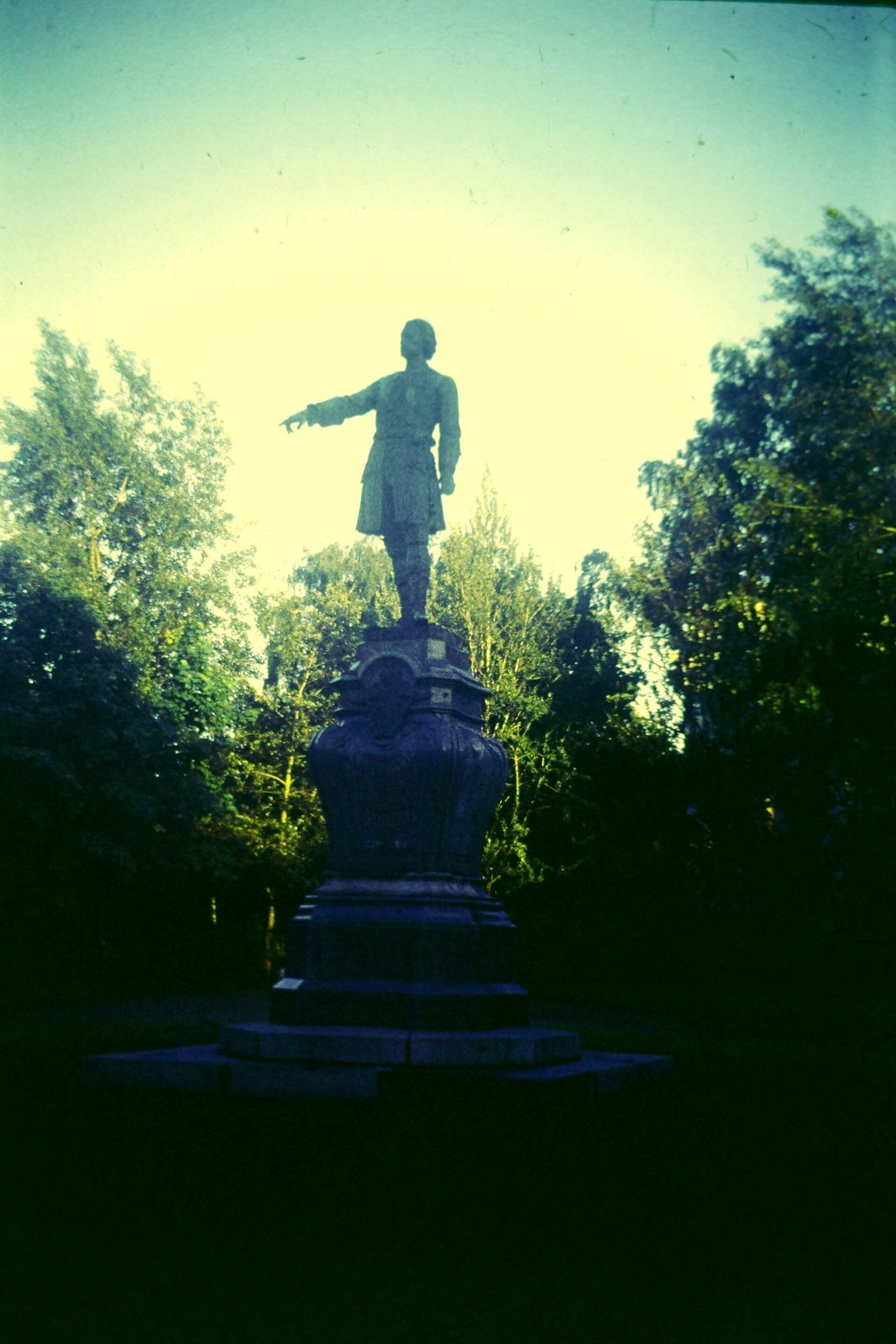
Petrozavodsk in 1977 was the capital of the Karelian Autonomous Soviet Socialist Republic, a city of more than two hundred thousand people on the western shore of Lake Onega, about 300 kilometers northeast of Leningrad and less than 200 from the Finnish border. Peter the Great had founded it as an ironworks, and his statue stood on the embankment pointing out over the water. The night of September 19–20 was cold. Earlier there had been wet snow; by four in the morning the sky had cleared, ice crystals drifted in the air and there was frost on the flowers and the grass. Violetta Ivanovna Menkova, a doctor on night duty with the city ambulance service, had picked up a patient on Meretskov Street and was riding to the city hospital along Antikainen Street with her driver, Vyacheslav Savin, and the feldsher, or paramedic, Valentina Svistunova. Menkova happened to look up. The sky was black and full of stars, she wrote in a statement telegraphed to the Academy of Sciences on September 23, and among them was one especially bright star giving off a glow.
Sources: Сообщения очевидцев (Eyewitness reports)Необычное явление в природе (An unusual natural phenomenon)
Like a jellyfish, only more transparent
The star sat inside some kind of thin cloud, and curved rays ran from it “like white threads.” It was four o’clock. Menkova’s first thought was a satellite that would vanish in a moment, but it did not vanish, and she pointed it out to Savin and Svistunova. As they turned down Lenin Prospekt toward the lake, the star kept moving slowly; it seemed high, in the upper atmosphere, and close at the same time. Over Lake Onega it appeared to freeze and begin to sink, while the cloud around it spread. “You could compare it to a jellyfish,” she wrote, “only still more transparent, to a parachute, a cap with the star shining in its center.” Then something separated from the star like a beam of light, and at the end of the beam appeared “a little saucer or an oval ring,” glowing, which sank and disappeared. “It was all so inexplicable, unreal, fantastic that the thought came of a ship that had flown from another planet,” she wrote. Northern lights, a meteorite, a satellite: nothing fit, “and it became frightening. We did not want to drive in that direction, and at the same time it was very curious, we wanted to look.” There was no sound at all. By the time they reached the hospital the star was moving off and sinking lower, the cloud stretching into a tail and then a misty trail. They watched for seven or eight minutes.
The other ambulance
Menkova’s was not the only ambulance on the streets. Vladimir Alekseevich Belyaev, driving another crew, had pulled into a yard at 37-b Anokhin Street on a call at about four. At 4:05 or 4:10, he wrote, the sky above the roof opposite began to brighten, a strange halo appeared, and then a glowing point the size of a streetlamp, from which came “jets of some thin substance” that filled most of the sky. When the fireball reached the handle of the Big Dipper the jets stopped, the sky around it darkened, and it went straight down, still shining and shrinking, until it dropped behind the building. Driving out onto Lenin Prospekt he saw, above the clouds beyond the lake, an irregular oval “formed as if by the trail of a jet plane,” pink on top and brightly lit below. Back at the ambulance station, the feldsher Valentina Khramtsova, napping on a couch after a call, was woken after four by “very loud, unnatural laughter and shouting” in the street. It was Menkova and her colleagues, who could not calm down. Svistunova told her, word for word as Khramtsova remembered it: “Most likely it was something very big, like a jellyfish with something moving inside it. This monster was bearing down on our car, and we were very frightened.” Khramtsova ran outside in time to see an oval ring over the lake, like a bent jet contrail, with a fiery spot in its middle.
A city awake
Dozens of other people in Petrozavodsk were awake at four in the morning, and many of their accounts later reached the Academy. A militia patrol on the Shuya highway stopped to watch a point swell into a vast circle; the driver, Alexander Egorov, said it was “about the diameter of an atomic explosion,” and that the bright ball that came out of it trailed three strips, “as if it had three engines.” His commander, Alexander Antropov, had once worked on the Virgin Lands near Baikonur: “I have seen the trail of a launching rocket, but this was nothing like it.” He thought it was a comet. The two argued; while the thing stood still, Antropov said, Egorov talked nonsense, and once it flew off he called it a rocket. At the freight station, the switchwoman A. P. Guseva shouted over the loudspeaker, “Duty officer, look at the sky!” Dockers unloading a freighter at the river port were on their meal break; the crane operator Andrei Akimov, twenty-six, an amateur painter, went home and painted the stages in color. Vasily Barkhatov, an airport worker and former pilot, timed it: a light like Venus climbing on a heading of 240 degrees, stopping at about fifty degrees up, spreading a blue-white “jellyfish, umbrella, parachute” of light for ten or twelve minutes, then leaving on a heading of 30 degrees. “In its beauty the glow was indescribable.” As Tamara Tikhonova, a secretary, stepped out of a phone booth on Lenin Prospekt, she felt something large flash past at the level of her left eye; she watched a round object go out over the lake, turn fiery and “fall into the sky,” leaving a lit hole from which two glowing exhausts emerged. She went home afraid she had lost her mind, and at 5:20 a.m. called an ambulance with chest pains. Khramtsova was the feldsher who came, and told her the ambulance crews had seen a fiery ball; Tikhonova kept her own sighting to herself, but was relieved to know she was sane.
Sources: Сообщения очевидцев (Eyewitness reports)Исследование Петрозаводского университета (The Petrozavodsk University study)Феномен 20 сентября 1977 г. Описание явления. Предварительный анализ данных
From Helsinki to the White Sea
Petrozavodsk was the center of the story but not of the sky. The reports the Academy gathered over the following months came from the Finnish coast to the White Sea and south into Estonia. At Pulkovo airport outside Leningrad, the dispatcher B. N. Blagirev saw at about 3:55 a.m. a fireball low in the north, a little bigger than the planet beside it, its rays split into sectors that rippled like a sign whose bulbs light in turn, “nothing like the northern lights.” A Tu-154 airliner at 12,000 meters reported a dark cone inside the ball; the radar showed the airliner and nothing else. The night-shift chief added that two incoming crews, from Moscow and Minsk, had seen lights on the way in. At Sortavala on Lake Ladoga, three aerologists and a meteorologist at the weather station watched from 4:10 for about fifteen minutes as a star rushed in from the northeast, slowed and hung, grew a blue-white ellipse with veins that recalled “the tentacles of an octopus,” and finally seemed to suck the glow into itself, which then took the shape of a fish’s tail. A train crew near Podporozhye saw a shell spread across half the horizon. At Lekhta near the White Sea, an expedition of IZMIRAN, the Academy’s institute for terrestrial magnetism, saw three star-like points swell one after another while a strong aurora was in progress. In Helsinki a blinding flash came at 3:06 Finnish time, which was 4:06 in Moscow. At his dacha near Namoevo, the philosopher and poet Yuri Linnik had turned a large school refractor, magnifying eighty times, on a violet “amethyst lens” at about three in the morning; he counted exactly sixteen nozzles in it sending down red rays (“I am sure there were exactly sixteen!”) and called the thing a cosmic organism.
Sources: Сообщения очевидцев (Eyewitness reports)Феномен 20 сентября 1977 г. Описание явления. Предварительный анализ данныхЗагадка природы (A riddle of nature)Над Хельсинки вспыхнуло небо (The sky flared over Helsinki)Дополнение к отчету от 20 октября 1977 г. (Supplement to the report of October 20, 1977)The Petrozavodsk Phenomenon, chapter 1: the January 1978 expedition and the holes in the windows
Molniya from Petrozavodsk
Nikolai Petrovich Milov, the Karelia correspondent of TASS, the Soviet state news agency, heard about the ambulance crews that same morning. Before the day was out he sent Moscow a service telegram marked “Molniya” (“lightning”), the agency’s top priority, under the heading “An unusual natural phenomenon.” His version was more dramatic than anything the witnesses put in writing. It merged Menkova’s and Belyaev’s crews into one, renamed the doctor Valentina, and had a huge star “impulsively sending sheaves of light to earth,” hanging over the city “like a sea jellyfish” and “showering the city with a multitude of the finest streams of rays, which created a picture of pouring rain.” The crew, he wrote, had been seized by “a feeling of fear and doom,” and the driver had stopped the car and switched off the engine for safety. Other drivers, he added, had watched the same picture for ten to twelve minutes, and a soldier on guard at an air unit had seen the sky glowing red two hours earlier. He quoted Yuri Arsenievich Gromov, director of the Karelian hydrometeorological observatory: the weather service had never observed anything like it. Milov phoned the Pulkovo observatory near Leningrad, where someone told him the scientists had registered a strange phenomenon that morning but would not comment yet.
Sources: Необычное явление в природе (An unusual natural phenomenon)Инопланетяне и султанчик кактуса (Aliens and the cactus tuft)Сообщения очевидцев (Eyewitness reports)
Into the papers, and out again
On September 23 the item appeared in some central newspapers as “Unidentified natural phenomenon,” a title that Lev Gindilis, the astronomer who ran the Academy’s informal inquiry, thought hinted at flying saucers, whether by accident or design. It kept the jellyfish and the pouring rain and the witnesses’ ten to twelve minutes, and it added a calming line from Vladimir Krat, director of the Pulkovo observatory, about a bright fiery ball that had streaked across the sky from south to north and that the Pulkovo astronomers had seen too. Gindilis and his co-compiler believed that without Krat’s comment it could never have run. Which papers carried it is itself disputed: they list the provincial edition of Pravda, Izvestia, Selskaya Zhizn and Sotsialisticheskaya Industriya; the 2000 history by Yulii Platov and Boris Sokolov, who later coordinated the state program, names only Izvestia; Milov names Sotsialisticheskaya Industriya and Komsomolskaya Pravda. Milov, writing in 2010, told the inside story as he heard it from a well-placed friend. On the afternoon of September 22, he wrote, Leonid Zamyatin, the head of TASS, rang the Defense Ministry on the Kremlin’s internal phone line and was told by a deputy minister with a marshal’s rank: “The item is harmless in itself, but publishing it at this moment is undesirable.” Zamyatin then sent the newspapers a Molniya of his own killing the story, so that only the outlying editions of a few central papers, already on the presses far from Moscow, printed it. The marshal’s reason, in Milov’s account, was a launch explosion at the Plesetsk cosmodrome that same day, but the launch catalogue kept by the astronomer Jonathan McDowell lists no Plesetsk launch on September 22.
Sources: Неопознанное явление природы (Unidentified natural phenomenon)Вместо предисловия (In place of a preface)Изучение неопознанных летающих объектов в СССР (The study of unidentified flying objects in the USSR)Инопланетяне и султанчик кактуса (Aliens and the cactus tuft)General Catalog of Artificial Space Objects: launch list, entry 1977-091
“True copy”
Felix Zigel, the Moscow Aviation Institute astronomer who had spent a decade trying to get Soviet science to take UFOs seriously, telephoned Gindilis on the evening of September 22. Gromov, meanwhile, had done something unusual: he sent the witnesses’ statements to Moscow on the observatory’s official teletype, each certified “true copy,” which gave them, Gindilis wrote, a fully official status. On September 24 the local paper, Leninskaya Pravda, ran its own interview with Belyaev and Menkova under the headline “A ‘cosmic visitor’ over Petrozavodsk,” mentioning a woman in a phone booth and another hurrying to the pharmacy, and guessing at a meteorite. Within a week the Academy’s presidium, its governing board, wanted a briefing for the leadership. Rumor had it that the question had come from the very top; Gindilis later guessed at Yuri Andropov, the KGB chairman, who had led the Komsomol, the Communist youth league, in Karelia and the partisans there during the war, and called it “only my hypothesis.” His first note, with data as of September 30, named Kosmos-955 as a tempting explanation but deliberately left out the Plesetsk launch site, because it was meant to carry no secrecy stamp. On October 20 he, D. A. Menkov and I. G. Petrovskaya finished a fifty-two-page report marked “For official use.” That autumn the Foreign Ministry also asked the Academy about UFOs, ahead of a debate at the United Nations, where Grenada was pressing for a UN body to study them.
Sources: The Petrozavodsk Phenomenon, chapter 1: Lev Gindilis’s account of the inquiry, September–December 1977Сообщения очевидцев (Eyewitness reports)Феномен 20 сентября 1977 г. Предварительный анализ (data as of September 30, 1977)Феномен 20 сентября 1977 г. Описание явления. Предварительный анализ данныхДополнение к отчету от 20 октября 1977 г. (Supplement to the report of October 20, 1977)Grenadian Unidentified Flying Object Resolution
Holes in the glass
In October came the detail that would travel furthest. On the fifth floor of 70 Oktyabrsky Prospekt, in the flat of the writer and archaeologist A. Linevsky, whose windows faced the lake, the outer pane had a nearly round hole five centimeters across and the inner pane an elliptical hole nine by seven, their edges smooth “as if melted,” the centers lined up on a slope of thirty degrees; the round plug from the inner pane had dropped out intact. The October report noted that the angle could be made to point at the light’s position. When Petrovskaya spoke to the owner, however, it turned out the holes had appeared on the night of October 5–6, two weeks after the phenomenon. Others turned up, about fifteen damaged panes in five buildings near Lenin Prospekt and the lake, some undated and one possibly older than the phenomenon. The strangest came on New Year’s night: at about four in the morning on January 1, 1978, residents of 12 Dzerzhinsky Street heard a dull bang, felt the building shudder and saw a flash, and found seven panes holed in four flats along a diagonal, with freshly broken linden branches in line with them. V. V. Kovalevsky of the Institute of Geology suggested a powerful energy source of the ball-lightning type. With the help of the local authorities the panes were taken out in midwinter and the glass was carried to Moscow. The Interior Ministry’s research institute, which examined the Linevsky panes and their plug, reported on April 12, 1978, that the holes had been made by metal balls fired from a slingshot, and considered the question settled; the State Optical Institute found no trace of melting and blamed a weak shock wave. Gindilis thought the slingshot report a brush-off and wrote that the matter was quietly buried. Even Zigel conceded that every hole had been found on some other date than September 20 and that nothing tied them to the phenomenon.
Sources: The Petrozavodsk Phenomenon, chapter 1: the January 1978 expedition and the holes in the windowsФеномен 20 сентября 1977 г. Описание явления. Предварительный анализ данныхОб аномальных отверстиях в оконных стеклах г. Петрозаводска (On the anomalous holes in window glass in Petrozavodsk)Исследование ВНИИ МВД (The study by the Interior Ministry’s research institute)Заключение Государственного оптического института (Findings of the State Optical Institute)Главный Петрозаводский объект (The main Petrozavodsk object)
The astronomers slept through it
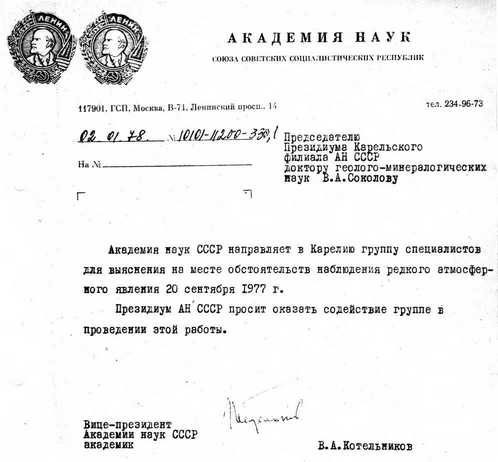
On January 2, 1978, the Academy’s vice-president, Vladimir Kotelnikov, wrote to the Karelian branch that the Academy was sending “a group of specialists” to establish on the spot the circumstances of “a rare atmospheric phenomenon of September 20, 1977.” Gindilis, Petrovskaya, A. N. Makarov of the Academy’s physics and astronomy department and Boris Sokolov, then a lieutenant colonel attached to the Academy’s Section of Applied Problems who spoke for the Defense Ministry, spent about a week in Petrozavodsk. They briefed the military council of the local army; when Gindilis explained that the Pulkovo astronomers had not been observing on that cloudy night and that Krat had heard of the event by phone from the airport, a general remarked good-naturedly, “I see, so the astronomers slept through it.” At Petrozavodsk airport, after Gindilis had interviewed the staff, a militiaman asked him without explanation to come to the station, where a woman, apparently from the buffet, was brought in to identify him and, plainly embarrassed, failed to. Who wanted that, he never found out. Earlier checks had already come back: radiometer readings in Lake Onega and the bay in October showed no change in radioactivity since 1973, and a clinical psychologist who interviewed nine witnesses in November found them entirely normal and truthful. The fieldwork went on through 1978. For Petrozavodsk University, A. G. Mezentsev and then N. L. Telepnev went back to fifty-nine witnesses with a theodolite and had them point out where the light had been; the angles put it eleven to nineteen kilometers away at a height of six to seven and a half kilometers, nowhere near the edge of space.
Sources: Letter from V. A. Kotelnikov, vice-president of the USSR Academy of Sciences, to V. A. Sokolov of the Karelian branchThe Petrozavodsk Phenomenon, chapter 1: the January 1978 expedition and the holes in the windowsProtocol on the radioactivity of the water of Lake OnegaOn the psychological state of the witnessesИсследование Петрозаводского университета (The Petrozavodsk University study)
A secret program called Setka
The jellyfish’s lasting effect was bureaucratic. According to Platov and Sokolov, the Academy president, Anatoly Alexandrov, wrote to Leonid Smirnov, the deputy premier who chaired the Military-Industrial Commission, which oversaw the Soviet arms industry, and the commission’s scientific-technical council met in the Kremlin under Lieutenant General B. A. Kiyasov. Kiyasov summed up Alexandrov’s letter in one sentence: the Academy of Sciences “can no longer ignore, nor can it explain, anomalous phenomena similar to the one observed in September 1977 in Petrozavodsk.” The letter asked for a joint study with the Defense Ministry. Council members said such reports reached the army too, sometimes with equipment malfunctions. Platov and Sokolov also wrote that official inquiries had come from neighboring northern European states asking whether a dangerous military experiment was under way, though they produced no such letter. The result was two research themes, named Setka (“net”), in the secret defense plan from 1978: “Setka MO” for the Defense Ministry, on how the phenomena affected equipment and personnel, and “Setka AN” for the Academy, on their physical nature, with Academician Vladimir Migulin of IZMIRAN in charge. Official papers avoided the word “UFO” in favor of “anomalous phenomenon.” The program ran without a break until 1990. Platov places the decisive council meeting in October 1977; Gindilis’s diary has the academicians meeting at the Space Research Institute on November 1 and the decisive session at the Military-Industrial Commission on December 21. Gindilis himself was then dropped from the work, in part, he believed, because of a denunciation accusing him of being a Freemason.
Sources: Изучение неопознанных летающих объектов в СССР (The study of unidentified flying objects in the USSR)History of State UFO Research in the USSRThe Petrozavodsk Phenomenon, chapter 1: Lev Gindilis’s account of the inquiry, September–December 1977
The cosmodrome that did not exist
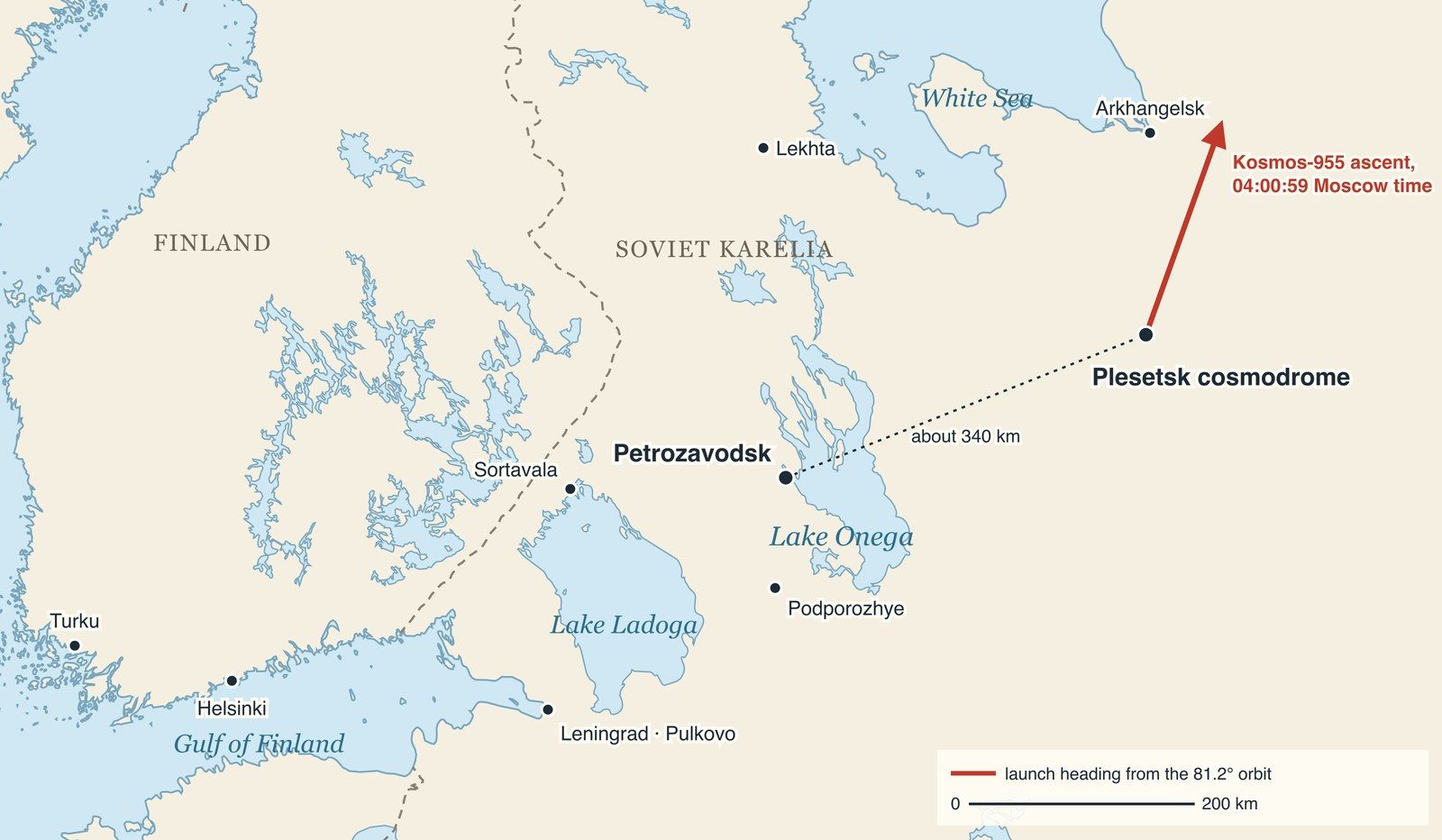
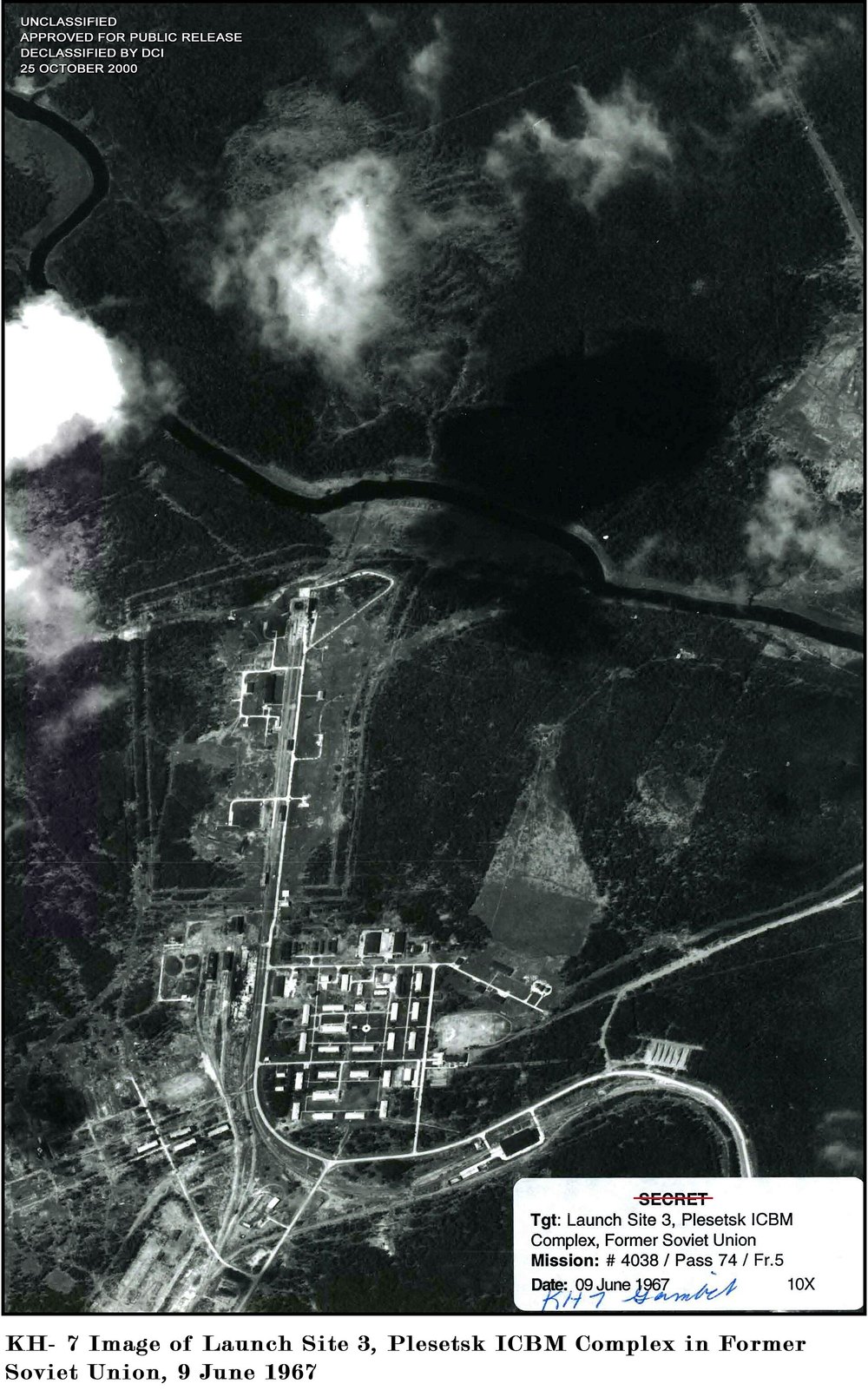
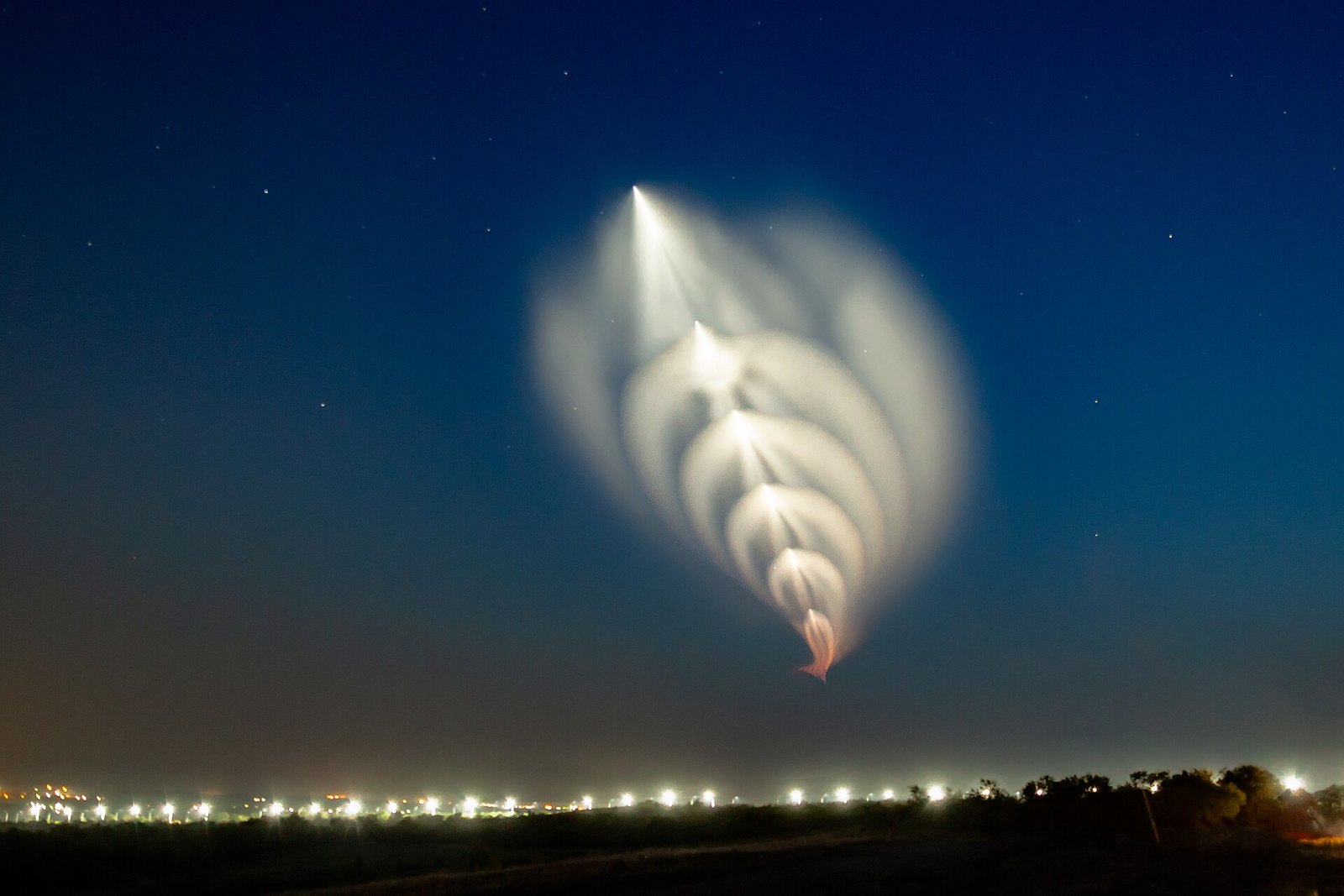
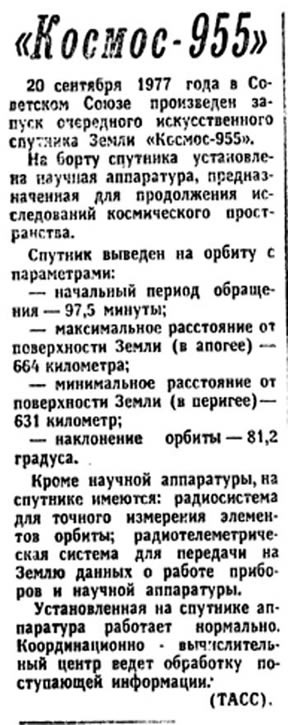
Plesetsk, in the forests of Arkhangelsk Oblast some 340 kilometers east-northeast of Petrozavodsk, launched more satellites than anywhere else in the world in the 1970s and officially did not exist. American reconnaissance satellites had photographed it in the 1960s, and Moscow first acknowledged it in Pravda in 1983, when an article conceded that its launches had made a substantial contribution to the legend of flying saucers. At 01:00:59 universal time on September 20, 1977, which was 4:00:59 a.m. in Moscow and Petrozavodsk, a Vostok rocket lifted off from pad 43/4 there carrying a Tselina-D electronic-intelligence satellite, announced by TASS only as Kosmos-955, a satellite with scientific apparatus “for the continued study of outer space.” The orbit was inclined 81.2 degrees, so the rocket climbed toward the north-northeast. In Houston, the space analyst James Oberg read the jellyfish story, phoned a friend who kept Soviet satellite records, and matched the time. “The identification is 100 percent certain,” he told The Zetetic, now the Skeptical Inquirer, that autumn. The New York Times reported the rocket explanation on September 30, and in October Science News headlined “Soviet UFO due to secret launch.” In Finland, Matti Kivinen of the Nurmijärvi geophysical observatory had already told reporters it was probably a rocket body or satellite and rejected flying-saucer talk.
Sources: General Catalog of Artificial Space Objects: launch list, entry 1977-091«Космос-955»Soviet “UFOs” identified as satellite launchingsSoviet “jellyfish UFO”The UFO EnigmaНад Хельсинки вспыхнуло небо (The sky flared over Helsinki)The Great Soviet UFO Coverup
How a rocket becomes a jellyfish
Oberg’s explanation, and the one Platov and Sokolov later gave from inside the program, is about light and height. A rocket climbing through the thin air above about a hundred kilometers leaves a cloud of exhaust gas and particles that spreads fast, at up to two kilometers a second in one Plesetsk launch the program photographed. At four in the morning the ground was in darkness, but the sun, still below the horizon for anyone on the ground, could shine on a cloud that high, so a vast luminous bell appeared out of a black, starry sky, silent, its streamers lit from behind. Oberg thought the “tentacles” were the trails of the booster’s separate engines. Seen from hundreds of kilometers away, a climbing rocket barely changes direction and seems to grow, stop and hang, then shrink as it moves away. The program’s coordinators wrote that rocket launches and high-altitude balloons accounted for more than nine-tenths of the roughly three thousand reports the Soviet program collected, and they singled out the Petrozavodsk phenomenon as the first and most famous rocket case. They added that “several additional effects” had been due to an unsuccessful test launch of a ballistic missile in the same region at practically the same time; they gave no date, type or source, and McDowell’s catalogue, whose record of Soviet missile tests is not complete, lists none from Plesetsk that day.
Sources: History of State UFO Research in the USSRИзучение неопознанных летающих объектов в СССР (The study of unidentified flying objects in the USSR)Soviet “jellyfish UFO”Soviet SaucersThe Great Soviet UFO CoverupGeneral Catalog of Artificial Space Objects: launch list, entry 1977-091
“Neither I nor my colleagues were thrilled”
Migulin, the academician put in charge of Setka AN, was never an enthusiast. “Neither I nor my colleagues were thrilled,” he told the weekly Nedelya in 1985, when he gave its readers his explanation: a rare coincidence of the Kosmos-955 launch, a strong magnetic storm, and an experiment by his own institute that was beaming low-frequency radio at the ionosphere. To Jacques Vallée, who interviewed him in Moscow during the glasnost years, he was blunter: it had turned out to be a secret rocket launch, and the real explanation had not been released. TASS had announced Kosmos-955 in its usual formula, with the date and the orbit and its apparatus “working normally,” but no word of where or at what hour it had been launched, and Oberg argued that Moscow was content to let the West wonder about UFOs rather than ask about Plesetsk.
Sources: Жажда чуда (A thirst for miracles)UFO Chronicles of the Soviet Union: A Cosmic Samizdat«Космос-955»The Great Soviet UFO Coverup
The jellyfish grows
The story did not wait for the explanation. Gordon Creighton translated the TASS item for the Flying Saucer Review in January 1978 under the heading “A Russian ‘Jellyfish,’” and Fate ran “Jellyfish in the Sky.” In a November 1977 talk to staff of the Novosti press agency, translated in the MUFON UFO Journal, the ufologist Vladimir Azhazha had the object trace a giant figure eight over Pulkovo and send a shaft flying along Lenin Prospekt. To the American journalist Henry Gris, the science-fiction writer Alexander Kazantsev called it a spaceship from another planet, and Milov told of holes the size of a hen’s egg in the windows and of four color photographs taken by a civil engineer; Kazantsev said the color slides had been confiscated. In Gris’s 1984 version for the National Enquirer, which moved the jellyfish to September 1983, panic had broken out in the streets and troops had sealed off the railway station. Akimov’s painting became a measurement: Milov scaled the jellyfish against a 116-meter freighter in the picture and got 105 meters, a figure Gindilis and Kolpakov’s 1999 collection footnoted as “completely untenable conclusions.” Zigel counted forty-eight UFOs that night from Copenhagen to the Altai, and reproduced an essay by Linnik reporting roses blooming a second time in his garden and concluding that since the night of September 20, 1977, he was inclined to think UFOs “bring good to our planet.” Pravda’s science editor answered in 1980 with “The Legend of the Aliens.” For later Soviet ufologists the night was year zero: from it, Marina Popovich wrote, “we count our official encounters at symposiums, conferences, etc.” Petrozavodsk papers still mark its anniversaries, and a local journalist’s retelling has taxi drivers fleeing what they took for a neutron bomb and breaking into a wine shop on the way, because wine was said to be good against strontium.
Sources: A Russian “Jellyfish”Jellyfish in the SkyAre We Alone in the Universe?URSS e UFORussians probing UFO mysteries after rash of bizarre sightingsСообщения очевидцев (Eyewitness reports)Ложь и правда о Петрозаводском феномене (Lies and truth about the Petrozavodsk phenomenon)Главный Петрозаводский объект (The main Petrozavodsk object)UFO Over Planet EarthЯркая звезда в виде медузы вспыхнула над Петрозаводском (A bright star like a jellyfish flared over Petrozavodsk)Загадочный «Петрозаводский феномен» отпраздновал свое 40-летие (The mysterious “Petrozavodsk phenomenon” turns forty)
What survives
Few UFO cases of the 1970s left a paper trail this complete. Gindilis and Yuri Kolpakov published it in full in 1999 as The Petrozavodsk Phenomenon, which is online: the witnesses’ own statements, some telegraphed within three days and certified by Gromov; the TASS teletype; the Karelian, Sortavala and central newspaper items; the Academy’s reports of September 30 and October 20, 1977, and January 1978; the university’s theodolite study, the radioactivity protocol and the psychologist’s notes; the Interior Ministry and State Optical Institute reports on the windows; and copies of many witness drawings. Akimov’s paintings are not among them. The launch is documented in the TASS notice and in McDowell’s catalogue. No photograph from the Soviet side is on record: one Ladoga witness’s three frames did not come out, and the confiscated pictures exist only in Gris’s interviews. Platov and Sokolov, and the Finnish astronomer Pekka Teerikorpi, say Finnish witnesses photographed the display, but those pictures have not been published with the case.
Sources: Сообщения очевидцев (Eyewitness reports)Феномен 20 сентября 1977 г. Описание явления. Предварительный анализ данныхДополнение к отчету от 20 октября 1977 г. (Supplement to the report of October 20, 1977)Исследование Петрозаводского университета (The Petrozavodsk University study)Исследование ВНИИ МВД (The study by the Interior Ministry’s research institute)Заключение Государственного оптического института (Findings of the State Optical Institute)General Catalog of Artificial Space Objects: launch list, entry 1977-091«Космос-955»URSS e UFOHistory of State UFO Research in the USSRSoviet “UFOs” identified as satellite launchings
The contradictions
Times run from about 2 a.m. to dawn. The Academy’s October report described three phases: scattered sightings from about 3 to 4 a.m., a main display beginning between 4:00 and 4:05 and seen almost simultaneously across the region for ten to fifteen minutes, and a glow that lingered until daylight. The TASS item gave the witnesses’ ten to twelve minutes, Menkova watched for seven or eight, the Podporozhye train crew for fifteen or twenty, and Gris’s sources gave fourteen minutes or a good quarter of an hour. Directions disagree as much: Krat’s fireball went south to north, the Sortavala meteorologists had theirs come from the northeast toward the southwest, and Barkhatov’s turned through 150 degrees. Milov’s dispatch, the version the world read, merged two ambulance crews, renamed the doctor and supplied the pouring rain, the sense of doom and the stopped engine; neither Menkova’s nor Belyaev’s own statement mentions rain. Krat’s printed comment had the Pulkovo astronomers watching, while Gindilis was told they had not been observing at all. Which newspapers printed the TASS item, the date of the Kremlin meeting, and whether Helsinki airport radar tracked the object, as UPI reported and the Academy repeated, are all disputed.
Sources: Феномен 20 сентября 1977 г. Описание явления. Предварительный анализ данныхНеопознанное явление природы (Unidentified natural phenomenon)Сообщения очевидцев (Eyewitness reports)Загадка природы (A riddle of nature)Необычное явление в природе (An unusual natural phenomenon)The Petrozavodsk Phenomenon, chapter 1: the January 1978 expedition and the holes in the windowsИзучение неопознанных летающих объектов в СССР (The study of unidentified flying objects in the USSR)The Petrozavodsk Phenomenon, chapter 1: Lev Gindilis’s account of the inquiry, September–December 1977Феномен 20 сентября 1977 г. Предварительный анализ (data as of September 30, 1977)Загадочный «Петрозаводский феномен» отпраздновал свое 40-летие (The mysterious “Petrozavodsk phenomenon” turns forty)URSS e UFO
The case for the rocket
The timing is the strongest argument: the launch at 4:00:59 Moscow time falls inside the Academy’s own window of 4:00 to 4:05 for the start of the main display, and the Helsinki flash followed five minutes later. The rest fits a sunlit exhaust cloud: silent, apparently standing still and swelling, and seen almost at once from Turku to the White Sea. Teerikorpi pointed out in 1982 that the appearance and direction matched Plesetsk launches often seen from Finland, and that two men near Turku who thought the light was ten meters across and three hundred meters away were looking at something hundreds of kilometers off. The same people who ran Setka, with access to the launch data, called it a rocket. Soviet launches produced other “jellyfish” and “airships” over the following years; Platov names a Kosmos launch on the night of June 14, 1980, seen as a dirigible over much of European Russia.
Sources: General Catalog of Artificial Space Objects: launch list, entry 1977-091Феномен 20 сентября 1977 г. Описание явления. Предварительный анализ данныхНад Хельсинки вспыхнуло небо (The sky flared over Helsinki)Soviet “UFOs” identified as satellite launchingsHistory of State UFO Research in the USSRSoviet “jellyfish UFO”
What the rocket does not explain
Gindilis never accepted that Kosmos-955 explained everything, and the objections come from the Academy’s own files. His first note listed them: a westward component in the motion, the object’s apparent size against its expected distance, the strong lighting of the ground, the Helsinki radar report, and a long hover seen at Leppäsyrjä, a village in Karelia. Three Pulkovo night-shift reports put the start of the main phase at 3:55 to 3:57; Gindilis and Kolpakov argued that controllers working live air traffic would not be seven to nine minutes off, so the display began before the launch, though a skeptic would answer that witnesses’ clocks are rarely that good. Linnik’s amethyst lens came an hour earlier, and the soldier’s red glow two hours earlier. The university’s theodolite study put the light six to seven and a half kilometers up, though Teerikorpi’s point about misjudged distance cuts against any such triangulation. There was a strong magnetic storm and aurora that night, which may account for some of the earlier and later glows, as Migulin suggested. In their article written for Priroda (Nature), the Academy’s popular-science monthly, in 1978 and not published at the time, Gindilis and Kolpakov conceded that a short phase at about two hundred kilometers was most likely connected to the launch, but argued that it could not account for the rest. On the windows, Gindilis and Petrovskaya objected that the slingshot answer could not explain the smooth round plug that fell intact from the inner pane at 70 Oktyabrsky Prospekt. Platov’s missing ballistic missile remains an assertion without a record.
Sources: Феномен 20 сентября 1977 г. Предварительный анализ (data as of September 30, 1977)Феномен 20 сентября 1977 г. Описание явления. Предварительный анализ данныхДополнение к отчету от 20 октября 1977 г. (Supplement to the report of October 20, 1977)Петрозаводский феномен (The Petrozavodsk phenomenon)Исследование Петрозаводского университета (The Petrozavodsk University study)Soviet “UFOs” identified as satellite launchingsЖажда чуда (A thirst for miracles)Исследование ВНИИ МВД (The study by the Interior Ministry’s research institute)History of State UFO Research in the USSRСообщения очевидцев (Eyewitness reports)
Classification and evidence note
This archive files Petrozavodsk as a mass sighting, a label that describes what was reported rather than its cause: dozens of people in the city and many more across a wide region saw a distant light, and no one reported a landing, an occupant or a physical trace that can be tied to the night itself. The resolution is partly explained. The main display at about four in the morning matches the launch of Kosmos-955 so closely in time and character that the Soviet program’s own coordinators accepted it, and this archive agrees that the launch is the best explanation for what most witnesses saw. The scattered earlier reports, some of which may be aurora, and the holes in the windows, which were all found on other dates, were never satisfactorily tied to it. The quotations here are translated from the Russian statements and documents reproduced by Gindilis and Kolpakov and from Milov’s memoir.
Sources: History of State UFO Research in the USSRФеномен 20 сентября 1977 г. Описание явления. Предварительный анализ данныхДополнение к отчету от 20 октября 1977 г. (Supplement to the report of October 20, 1977)Об аномальных отверстиях в оконных стеклах г. Петрозаводска (On the anomalous holes in window glass in Petrozavodsk)
- 9 JUN 1967
An American KH-7 satellite photographs a launch site at Plesetsk, which the Soviet Union does not acknowledge.
- 17 SEP 1977
Three nights earlier, by militia commander Alexander Antropov’s later account, a patrol sees a lingering half-sphere of light at about the same hour.
- 20 SEP 1977 · ABOUT 2 AM
A soldier on guard at an air unit near Petrozavodsk reports a red glow in the sky.
- 20 SEP 1977 · ABOUT 3 AM
Yuri Linnik watches an “amethyst lens” through a school refractor near Namoevo.
- 20 SEP 1977 · ABOUT 3:55 AM
Pulkovo airport dispatcher B. N. Blagirev sees a pulsing fireball low in the north.
- 20 SEP 1977 · 4:00:59 AM
A Vostok rocket lifts off from Plesetsk carrying Kosmos-955 (01:00:59 UTC).
- 20 SEP 1977 · ABOUT 4 AM
Over Petrozavodsk, ambulance crews, militia, dockers and railway workers watch the “jellyfish” for ten to fifteen minutes; Helsinki sees a flash at 3:06 Finnish time.
- 20 SEP 1977 · 5:20 AM
Tamara Tikhonova calls an ambulance with chest pains after what she saw.
- 20 SEP 1977 · 8:40 AM
A Leninskaya Pravda reporter interviews Belyaev and Menkova as their shift ends.
- 20 SEP 1977
Nikolai Milov sends TASS a Molniya telegram, “An unusual natural phenomenon.”
- 22 SEP 1977
Felix Zigel phones Lev Gindilis; by Milov’s account the head of TASS orders the item withdrawn.
- 23 SEP 1977
“Unidentified natural phenomenon” appears in some central papers; the New York Times reports a Soviet “jellyfish” of light.
- 24 SEP 1977
Leninskaya Pravda publishes “A ‘cosmic visitor’ over Petrozavodsk.”
- 25 SEP 1977
Trud reports the flash over Helsinki and Matti Kivinen’s rocket-debris explanation.
- 30 SEP 1977
The New York Times reports the rocket-booster explanation; Gindilis’s first briefing note, with data to this date, follows in early October.
- FALL 1977
James Oberg matches the jellyfish to the Kosmos-955 launch: “The identification is 100 percent certain.”
- 5–6 OCT 1977
Holes appear in the windows of a fifth-floor flat at 70 Oktyabrsky Prospekt.
- 8 OCT 1977
Sortavala meteorologists describe octopus tentacles and a fish tail in Krasnoe Znamya.
- 20 OCT 1977
The Academy report “The phenomenon of September 20, 1977,” marked for official use, is completed.
- 1 NOV 1977
Academicians and an air-defense general meet at the Space Research Institute to discuss the case.
- 21 DEC 1977
A meeting at the Military-Industrial Commission under Lieutenant General Kiyasov moves toward a state program.
- 1 JAN 1978
A bang at about 4 a.m. leaves holes in seven panes on Dzerzhinsky Street.
- 2 JAN 1978
Vice-president Kotelnikov sends an Academy team to Karelia.
- 1978
Setka MO and Setka AN begin; they run until 1990.
- 12 APR 1978
The Interior Ministry’s institute attributes the window holes to a slingshot.
- 1983
Pravda first acknowledges the Plesetsk cosmodrome.
- 1985
Academician Migulin names Kosmos-955 in the weekly Nedelya.
- 1999
Gindilis and Kolpakov publish the documents as The Petrozavodsk Phenomenon.
- 2000
Platov and Sokolov describe the Soviet program and attribute the phenomenon to Kosmos-955.
Sources & interviews
Вместо предисловия (In place of a preface)The compilers’ preface · which central papers carried the TASS item, and why Krat’s comment let it through · in L. M. Gindilis and Yu. K. Kolpakov, Петрозаводский феномен (The Petrozavodsk Phenomenon), a documentary collection compiled in 1999 · AstronetНеобычное явление в природе (An unusual natural phenomenon)Nikolai Milov · TASS service telegram from Petrozavodsk, “Молния” priority, September 20, 1977 · report 785/364, with the Leninskaya Pravda interview (784/363) and the other eyewitness reports of chapter 7 · in L. M. Gindilis and Yu. K. Kolpakov, Петрозаводский феномен (The Petrozavodsk Phenomenon), a documentary collection compiled in 1999 · AstronetСообщения очевидцев (Eyewitness reports)Chapter 7 · telegrams, letters and interview notes sent to the Academy of Sciences in 1977–1978, many certified by Yu. A. Gromov or Nikolai Milov: Violetta Menkova, Vladimir Belyaev, Vasily Barkhatov, Tamara Tikhonova, Valentina Khramtsova, Alexander Egorov, Alexander Antropov, Andrei Akimov, Yuri Linnik and others · in L. M. Gindilis and Yu. K. Kolpakov, Петрозаводский феномен (The Petrozavodsk Phenomenon), a documentary collection compiled in 1999 · AstronetНеопознанное явление природы (Unidentified natural phenomenon)TASS · Sotsialisticheskaya Industriya, September 23, 1977 · appendix 1.1, with the preface on which central papers carried it · in L. M. Gindilis and Yu. K. Kolpakov, Петрозаводский феномен (The Petrozavodsk Phenomenon), a documentary collection compiled in 1999 · AstronetНад Хельсинки вспыхнуло небо (The sky flared over Helsinki)R. Hiltunen · Trud, September 25, 1977 · appendix 1.2 · in L. M. Gindilis and Yu. K. Kolpakov, Петрозаводский феномен (The Petrozavodsk Phenomenon), a documentary collection compiled in 1999 · AstronetЗагадка природы (A riddle of nature)A. Solovyova, N. Egorychev, L. Abramenko and S. Babenina of the Sortavala hydrometeorological station · Krasnoe Znamya (Sortavala), October 8, 1977 · appendix 1.3 · in L. M. Gindilis and Yu. K. Kolpakov, Петрозаводский феномен (The Petrozavodsk Phenomenon), a documentary collection compiled in 1999 · AstronetThe Petrozavodsk Phenomenon, chapter 1: Lev Gindilis’s account of the inquiry, September–December 1977Sections 1.3–1.5 · Zigel’s call of September 22, the “for official use” reports, the IKI meeting of November 1, the December 21 meeting at the Military-Industrial Commission, the Andropov hypothesis · in L. M. Gindilis and Yu. K. Kolpakov, Петрозаводский феномен (The Petrozavodsk Phenomenon), a documentary collection compiled in 1999 · AstronetThe Petrozavodsk Phenomenon, chapter 1: the January 1978 expedition and the holes in the windowsSections 1.6–1.7 · the trip to Karelia, the military council, the airport detention and the fate of the window glass · in L. M. Gindilis and Yu. K. Kolpakov, Петрозаводский феномен (The Petrozavodsk Phenomenon), a documentary collection compiled in 1999 · AstronetФеномен 20 сентября 1977 г. Предварительный анализ (data as of September 30, 1977)L. M. Gindilis · the first briefing note for the Academy of Sciences · section 2.1 · in L. M. Gindilis and Yu. K. Kolpakov, Петрозаводский феномен (The Petrozavodsk Phenomenon), a documentary collection compiled in 1999 · AstronetФеномен 20 сентября 1977 г. Описание явления. Предварительный анализ данныхL. M. Gindilis, D. A. Menkov and I. G. Petrovskaya · USSR Academy of Sciences report marked “For official use,” October 20, 1977 · section 2.2 · in L. M. Gindilis and Yu. K. Kolpakov, Петрозаводский феномен (The Petrozavodsk Phenomenon), a documentary collection compiled in 1999 · AstronetДополнение к отчету от 20 октября 1977 г. (Supplement to the report of October 20, 1977)L. M. Gindilis, A. N. Makarov, D. A. Menkov and I. G. Petrovskaya · data as of December 30, 1977, completed January 1978 · section 3.1 and its appendices · in L. M. Gindilis and Yu. K. Kolpakov, Петрозаводский феномен (The Petrozavodsk Phenomenon), a documentary collection compiled in 1999 · AstronetProtocol on the radioactivity of the water of Lake OnegaS. S. Petrusev · certified by Yu. A. Gromov, October 19, 1977 · section 3.2 · in L. M. Gindilis and Yu. K. Kolpakov, Петрозаводский феномен (The Petrozavodsk Phenomenon), a documentary collection compiled in 1999 · AstronetOn the psychological state of the witnessesE. K. Andreeva, clinical psychologist · interviews in Petrozavodsk, November 15–23, 1977 · section 3.3 · in L. M. Gindilis and Yu. K. Kolpakov, Петрозаводский феномен (The Petrozavodsk Phenomenon), a documentary collection compiled in 1999 · AstronetОб аномальных отверстиях в оконных стеклах г. Петрозаводска (On the anomalous holes in window glass in Petrozavodsk)Appendix to the supplement · the list of damaged panes, October 1977 to January 1978 · in L. M. Gindilis and Yu. K. Kolpakov, Петрозаводский феномен (The Petrozavodsk Phenomenon), a documentary collection compiled in 1999 · AstronetИсследование Петрозаводского университета (The Petrozavodsk University study)A. G. Mezentsev and colleagues · theodolite re-interviews of 59 witnesses, 1978 · chapter 4 · in L. M. Gindilis and Yu. K. Kolpakov, Петрозаводский феномен (The Petrozavodsk Phenomenon), a documentary collection compiled in 1999 · AstronetПетрозаводский феномен (The Petrozavodsk phenomenon)L. M. Gindilis and Yu. K. Kolpakov · article written in 1978 for Priroda and not published at the time; lightly edited in 1995 and first published in English in RIAP Bulletin · chapter 5 · in L. M. Gindilis and Yu. K. Kolpakov, Петрозаводский феномен (The Petrozavodsk Phenomenon), a documentary collection compiled in 1999 · AstronetИсследование ВНИИ МВД (The study by the Interior Ministry’s research institute)Report no. 30/и-596 signed by S. V. Borodin, April 12, 1978 · section 6.1 · in L. M. Gindilis and Yu. K. Kolpakov, Петрозаводский феномен (The Petrozavodsk Phenomenon), a documentary collection compiled in 1999 · AstronetЗаключение Государственного оптического института (Findings of the State Optical Institute)Ya. A. Imas, I. V. Aleshin and V. S. Salyadinov, on G. S. Narimanov’s request of May 26, 1978 · section 6.2 · in L. M. Gindilis and Yu. K. Kolpakov, Петрозаводский феномен (The Petrozavodsk Phenomenon), a documentary collection compiled in 1999 · AstronetLetter from V. A. Kotelnikov, vice-president of the USSR Academy of Sciences, to V. A. Sokolov of the Karelian branchUSSR Academy of Sciences · January 2, 1978 · Wikimedia Commons scan (also appendix 1.4 of Gindilis and Kolpakov)Инопланетяне и султанчик кактуса (Aliens and the cactus tuft)Nikolai Milov · Sever (Petrozavodsk) no. 7–8, 2010, pp. 32–39 · the TASS correspondent’s memoir, with the dispatch, Zigel’s letter and the story of the recallИзучение неопознанных летающих объектов в СССР (The study of unidentified flying objects in the USSR)Yu. V. Platov and B. A. Sokolov · Vestnik Rossiiskoi Akademii Nauk vol. 70 no. 6, pp. 507–515 · 2000 · VIVOS VOCO mirrorHistory of State UFO Research in the USSRYu. V. Platov and B. A. Sokolov · Herald of the Russian Academy of Sciences vol. 70 no. 3 · 2000 · reprinted in Skeptical Briefs vol. 10 no. 4, December 2000General Catalog of Artificial Space Objects: launch list, entry 1977-091Jonathan McDowell · Kosmos-955 (Tselina-D) on a Vostok 8A92M from Plesetsk, 01:00:59 UTC, September 20, 1977«Космос-955»TASS launch notice, Soviet newspaper clipping, September 1977 · Wikimedia Commons scanSoviet “jellyfish UFO”K. F. (Kendrick Frazier) · news item quoting James Oberg · The Zetetic (Skeptical Inquirer) vol. 2 no. 1, Fall/Winter 1977, pp. 10–11 · Internet ArchiveThe Great Soviet UFO CoverupJames Oberg · MUFON UFO Journal · October 1982 · debunker.comSoviet SaucersJames Oberg · Omni vol. 16 no. 7 · April 1994 · Internet ArchiveSoviet “UFOs” identified as satellite launchingsPekka Teerikorpi · Flying Saucer Review vol. 27 no. 6 · 1982 · Internet ArchiveA Russian “Jellyfish”Gordon Creighton · Flying Saucer Review vol. 23 no. 4 · January 1978 · Internet ArchiveSoviets report strange phenomenonAPRO Bulletin vol. 26 no. 3 · September 1977 · relays the UPI report of the TASS dispatch · Internet ArchiveStrange lights fly in the northern skyUnited Press International · St. Albert and Sturgeon Gazette (Alberta), October 5, 1977 · Internet ArchiveJellyfish in the SkyCurtis Fuller · “I See by the Papers,” Fate vol. 31 no. 3 · March 1978 · Internet ArchiveAre We Alone in the Universe?Vladimir Azhazha · synopsis of a talk to Novosti staff at the USSR Academy of Sciences, November 24, 1977 · MUFON UFO Journal no. 128 · July 1978 · Internet ArchiveURSS e UFOHenry Gris · Gente (Milan), 1978 · interviews with Nikolai Milov, Vladimir Azhazha and Alexander Kazantsev · Internet ArchiveГлавный Петрозаводский объект (The main Petrozavodsk object)Felix Zigel · manuscript, 1980, reproducing Yuri Linnik’s essay “Do UFOs bring us good or evil?” of August 20, 1980 · miger.ru, Wayback Machine copyЛожь и правда о Петрозаводском феномене (Lies and truth about the Petrozavodsk phenomenon)Felix Zigel · manuscript dated April 25, 1980 · miger.ru, Wayback Machine copyRussians probing UFO mysteries after rash of bizarre sightingsHenry Gris · National Enquirer, December 21, 1984 · reprinted with comment by Gordon Creighton in Flying Saucer Review no. 202 · Internet ArchiveЖажда чуда (A thirst for miracles)Interview with Academician V. V. Migulin · Nedelya no. 33 · 1985 · miger.ru, Wayback Machine copyUFO Chronicles of the Soviet Union: A Cosmic SamizdatJacques Vallée · Ballantine Books · 1992 · the Migulin interview, pp. 155–156 · Internet ArchiveThe UFO EnigmaMarcia S. Smith, revised by George D. Havas · Congressional Research Service report 83-205 SPR · June 20, 1983, pp. CRS-95–97 · Internet ArchiveThe Petrozavodsk phenomenonScience Frontiers no. 104 · 1996 · summarizing L. M. Gindilis and Yu. K. Kolpakov in RIAP Bulletin vol. 2 nos. 2–3, 1995Grenadian Unidentified Flying Object ResolutionU.S. Department of State cable 1977STATE274296 · November 16, 1977 · WikiLeaks Public Library of US DiplomacyUFO Over Planet EarthMarina Popovich · 1990s English edition · Internet ArchiveЯркая звезда в виде медузы вспыхнула над Петрозаводском (A bright star like a jellyfish flared over Petrozavodsk)Petrozavodsk govorit · September 2014Загадочный «Петрозаводский феномен» отпраздновал свое 40-летие (The mysterious “Petrozavodsk phenomenon” turns forty)A. Trubin · MK v Karelii · October 26, 2017Петрозаводский феноменWikipedia (Russian) · used for orientation and its referencesSpotted an error, or know a better source? Write to hello@uap.fun.
Connected files
The Three-Eyed Giants of VoronezhTwelve years later TASS put another provincial Soviet UFO story on the wire, and this time the world laughed.The Giants of GáldarAnother sunlit rocket plume taken for a giant translucent sphere; Platov and Sokolov mention the Canary Islands sightings in the same breath as Petrozavodsk.The Fall on Height 611The Soviet Union’s other famous official-era case, investigated by the same generation of Soviet ufologists.The Rocket in Lake KölmjärvThirty years earlier, Scandinavians watched their skies for secret Soviet rockets that never turned up.The Lights of HessdalenAnother northern European mystery of lights that brought scientists into the field with instruments.Discuss this case
Compare notes with other readers: witness details, sources, and the parts that still do not add up.
Open the discussion