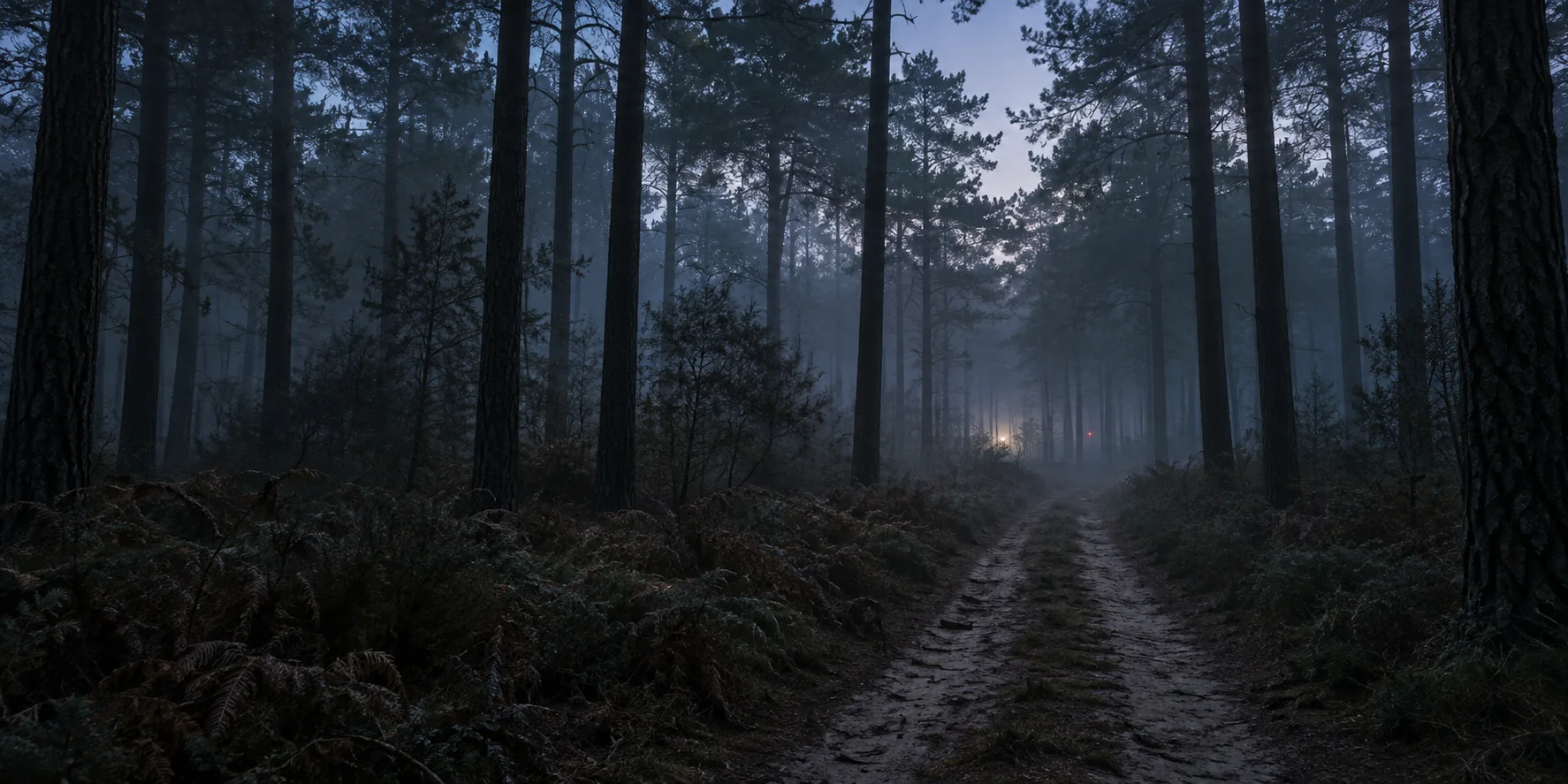
Lights beyond the perimeter
In the early hours of December 26, 1980, U.S. Air Force security personnel at RAF Woodbridge in Suffolk noticed unusual lights beyond the base’s eastern perimeter. Concerned that an aircraft might have come down in Rendlesham Forest, they obtained permission to investigate. Jim Penniston, John Burroughs, and Ed Cabansag went into the woods. Their search became the first of two principal episodes associated with the case; deputy base commander Lt. Col. Charles Halt took part in the later one.
Following a light through the trees
The early statements describe bright, colored lights that seemed to move away as the patrol approached. Penniston reported an apparent mechanical object; Burroughs and Cabansag described lights, including a distant beacon they eventually identified as a lighthouse. Halt’s subsequent memo summarized the first patrol’s report as a glowing, triangular object with red and blue lights. These accounts overlap, but they do not give identical descriptions of what the men saw or how close they came.
Marks on the forest floor
The following daylight search produced three shallow depressions that military personnel associated with a possible landing. Halt’s memo later described them as about seven inches across and an inch and a half deep, and recorded radiation readings taken during his return visit. Suffolk police also attended. Their records describe a search that found no aircraft; the officers identified the visible light as the Orford lighthouse. The ground marks became another point of disagreement, with ordinary animal activity offered as an explanation.
Halt takes a recorder into the woods
Two nights after the first patrol, Halt went out with a small team and a handheld cassette recorder. The surviving tape captures their attempts to inspect the marks, operate lighting equipment, and take radiation readings. Later, they describe a flashing light through the trees, then other lights in the sky. Halt reports what appears to him to be a beam reaching toward the ground. The recording runs for about 18 minutes but spans several hours: he repeatedly stopped and restarted it. It preserves their reactions, without providing an image of the lights themselves.
A memo reaches Whitehall
On January 13, 1981, Halt signed a one-page memorandum titled Unexplained Lights. It combined the first patrol’s account with observations from his own expedition. His dates, December 27 and 29, differ from the December 26 and 28 chronology supported by other early records. The memo was forwarded to the Ministry of Defence. In a later interview with researcher David Clarke, the official who handled it, Simon Weeden, said checks with air-defence specialists revealed no apparent threat that called for further action.
Why the accounts still differ
The story reached a wider audience in 1983, and later interviews added detail and disagreement. Astronomer and investigator Ian Ridpath argues that a meteor, the Orford Ness lighthouse, and bright stars explain different parts of the sightings. Halt rejects that overall interpretation. The Ministry of Defence’s decision concerned defence significance; it was not a comprehensive reconstruction of everything the witnesses experienced. The most useful comparison remains between the early statements, the tape, and what each witness recalled years later.