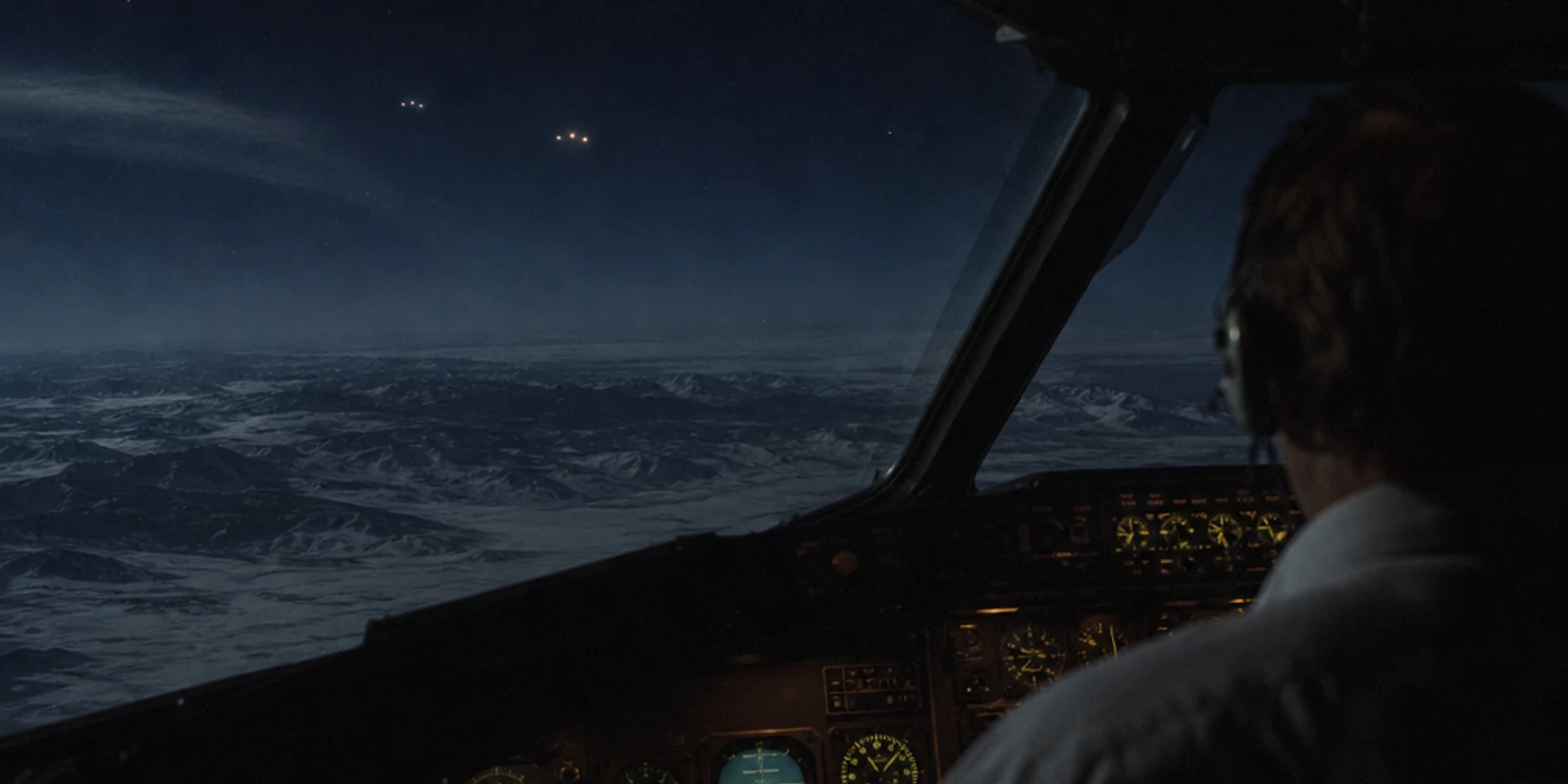
A freighter enters the Alaskan dark
On November 17, 1986, Japan Air Lines cargo Flight 1628 crossed eastern Alaska on the Reykjavík-to-Anchorage leg of a journey from Paris to Tokyo. The Boeing 747 carried a three-person cockpit crew: Capt. Kenju Terauchi, first officer Takanori Tamefuji, and flight engineer Yoshio Tsukuda. The air was clear and the aircraft cruised south at 35,000 feet. North of Fort Yukon, Terauchi noticed lights off the left side and below. He first took them for military traffic. They did not fall away. In his later written account, the quiet routine of a polar cargo flight became an encounter with lights that seemed to rise, close, and hold station beside the jet.
Two fires move toward the windshield
Terauchi later described two luminous arrays, each with a dark middle and rows of yellow-white lights that reminded him of glowing exhausts. He said they moved in front of the cockpit, bright enough to illuminate the cabin, and that he felt warmth on his face. Those vivid details come largely from his written report and later interviews. The live radio record is sparer. At 2:19 UTC, the crew asked Anchorage Center about traffic and reported two targets about a mile ahead. Asked what they could identify, Terauchi answered that he could see white and yellow navigation or strobe lights. The difference matters: the transcript preserves what was said under pressure; the narrative preserves how the captain later made sense of it.
A pale presence replaces the pair
According to Terauchi, the two close banks of light departed after several minutes. He then perceived a pale, enormous presence farther away on the left—a form he later likened to a walnut and described to reporters as larger than an aircraft carrier. The other crew members confirmed seeing lights, but the public FAA material does not show that they independently described the same vast silhouette. Terauchi’s scale estimate had no measured distance or solid edge to anchor it. Still, the impression governed the flight: an experienced captain believed something very large was pacing his aircraft over an empty winter landscape.
The controller searches an uncertain screen
At 2:25 UTC, Anchorage Center told the crew that it had a radar hit about five miles behind the 747. Terauchi disagreed with that position and placed what he saw eleven o’clock, eight miles away. A military Regional Operations Command Center controller reported a primary return near the aircraft, then lost it about a minute later. Fairbanks Approach saw only the JAL target. The exchanges sound dramatic because controllers were treating unknown nearby traffic as a safety problem in real time. They do not amount to one clean, continuous radar track synchronized with every visual claim. Even the controller described some returns as surge or possibly erroneous while continuing to watch them.
Descent, turn, disappearance
Terauchi requested a descent from flight level 350 to 310. When Anchorage asked whether the traffic was descending too, he answered that it was coming down “in formation.” He then requested a southwesterly heading, and the controller approved any deviation needed for safety. At 2:36 UTC, Anchorage asked the 747 to make a full right-hand circle and report what the traffic did. Roughly two minutes later, after the turn, the crew said it had disappeared. Military controllers then reported intermittent primary returns behind the aircraft, while Terauchi later regained lights off the left side. The sequence is less seamless than the familiar retelling in which one object visibly follows every maneuver.
Other aircraft enter the search
Anchorage vectored United Airlines Flight 69 toward the freighter and told its crew where to look. At 2:51 UTC, the United pilot saw the JAL 747 silhouetted against the lighter sky and its contrail, but “sure” saw no other airplane nearby. A military C-130 using the call sign Totem 71 also turned toward the scene. By 2:53, Terauchi reported that he could no longer see the UFO. The C-130 then identified the JAL jet after its landing lights flashed and reported no nearby traffic. These negative observations happened near the end, after the most dramatic close-light phase, but they constrain claims that an enormous visible object remained continuously beside the aircraft.
The crew lands into a paper trail
Flight 1628 landed at Anchorage at about 3:23 UTC. FAA security and flight-standards personnel interviewed all three crew members that evening. Their notes characterized the crew as normal, professional, rational, and uninfluenced by drugs or alcohol; they also recorded language difficulties during the interview. The FAA gathered controller statements, voice transcripts, flight-path charts, operations logs, radar data, simulations, crew drawings, and later interviews. Public fascination turned an air-traffic inquiry into one of the most extensive surviving government files attached to a civilian UFO report.
The FAA closes the radar question
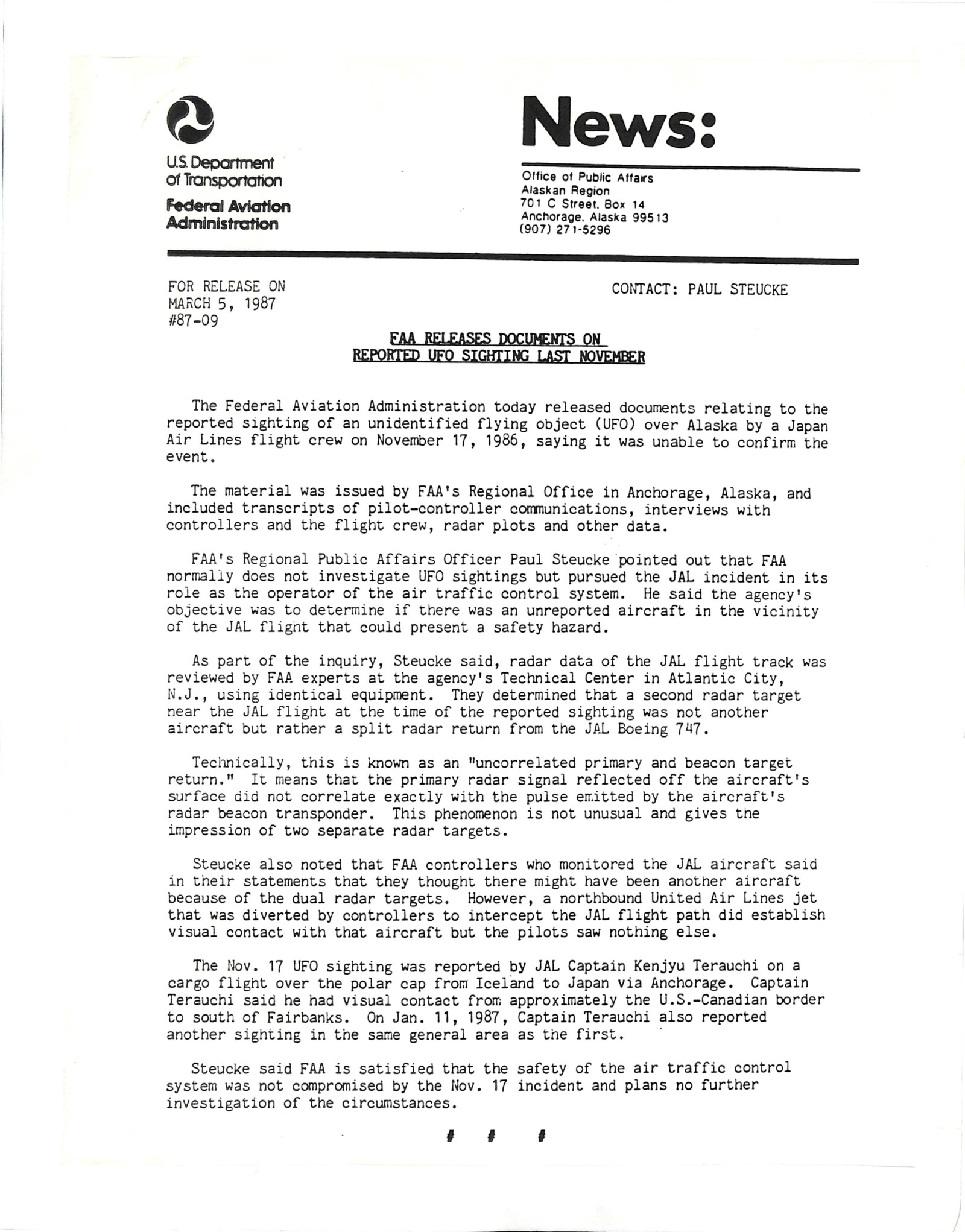
On March 5, 1987, the FAA released its file and said it could not confirm the event. Specialists at the FAA Technical Center replayed the radar data using equivalent equipment and concluded that the apparent nearby target was an uncorrelated primary and beacon return—a split image of the same 747 rather than a second aircraft. The agency also noted that the United crew saw nothing else. This finding addressed the FAA radar display and the safety of controlled airspace. The agency explicitly said it had not conducted a broader scientific study of stars, planets, magnetic effects, or perception, and it offered no final identification for what the crew saw outside.
Planets, ice crystals, and memory
Philip J. Klass offered the most developed conventional interpretation. With astronomical assistance, he placed bright Jupiter low to the left of the southbound aircraft and argued that at least one persistent light could have been the planet. He also proposed moonlit turbulent ice crystals or thin cloud for changing flame-colored lights and a weather-radar echo. That reconstruction has limits: it does not neatly reproduce every array Terauchi described, and even later skeptical commentary questioned whether reflected moonlight could create the reported appearance. Its stronger points are evidentiary rather than theatrical—the absence of a confirmed independent radar target, disagreement between the live transcript and later retellings, and the other crews’ failure to see a companion object.
What remains above Alaska
The encounter survives because neither the official closure nor the captain’s imagery consumes the whole record. The FAA file confirms that a professional crew reported unusual lights, controllers responded, course and altitude changes followed, intermittent returns appeared, and two other aircraft searched. It also records that Fairbanks saw no second target, the radar replay did not confirm separate traffic, and the intercepting crews saw only the 747. The most disciplined conclusion is therefore modest: the crew experienced a serious, prolonged airborne anomaly, but the public record does not establish a gigantic craft, extraordinary performance, or an extraterrestrial origin. Over Alaska, witness experience and instrument ambiguity crossed for less than an hour—and then separated again.