A thief in the lavender
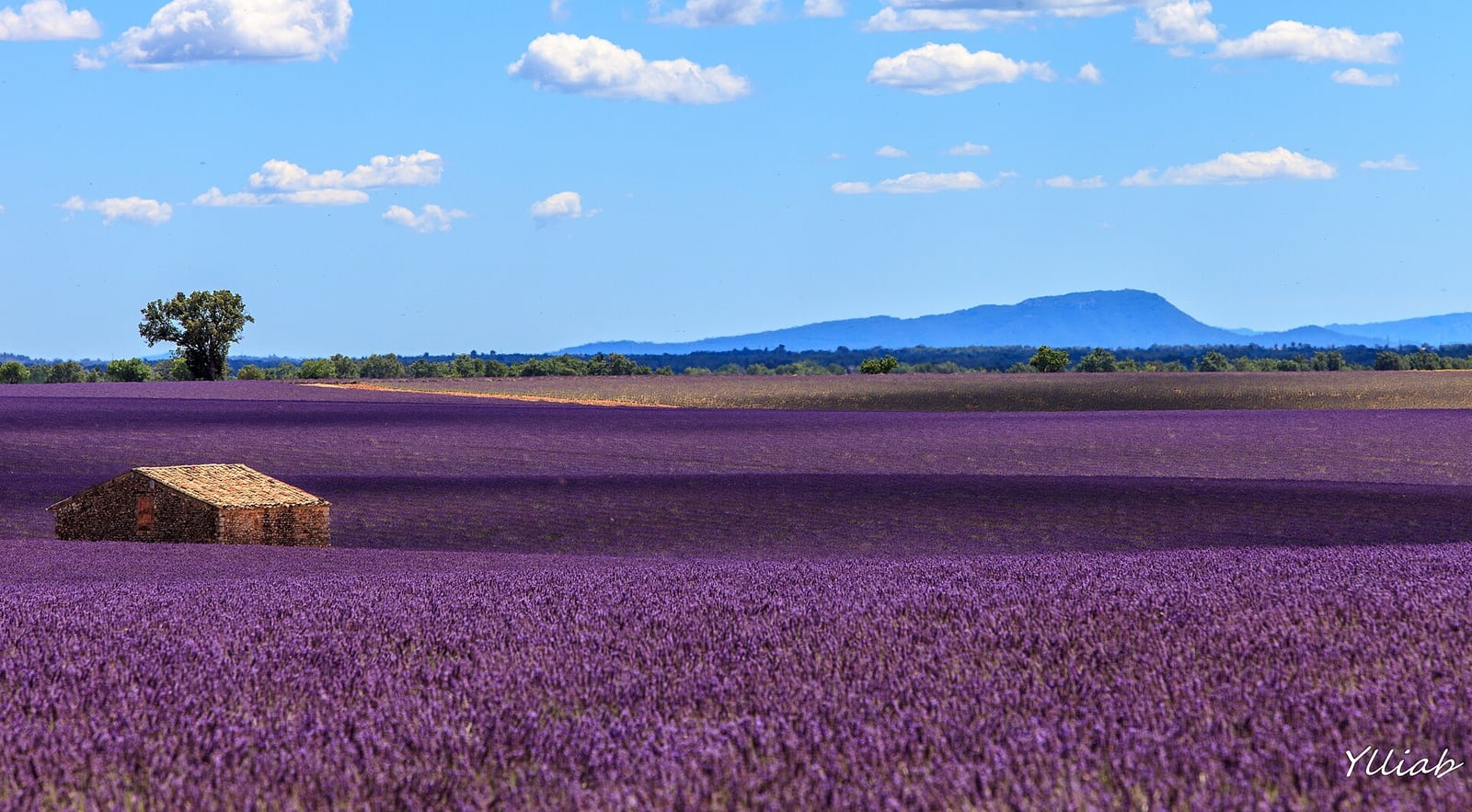
The plateau of Valensole rises about three hundred meters above the Durance valley in what was then the department of Basses-Alpes, a huge alluvial tableland ruled into rows of lavender that run, as one English visitor put it, “as far as the eye can see.” Maurice Masse farmed a field there called l’Olivol, about two kilometers northwest of the village on the road to Oraison. In 1965 he was forty-one, married, with two children nearly grown, and he worked the field with his father. He had fought in the Maquis during the war and liked hunting and fishing, and Le Provençal’s special correspondent found him “a solid mind, a serious man who generally does not talk just to talk.” In the last week of June the two men noticed something wrong. Each morning, sprigs had been snapped off young lavender plants and carried away, as if someone were coming in the night to take samples. Nothing was uprooted. The Masses were, in the words Aimé Michel later printed, “puzzled and annoyed.”
Sources: The Significant Report from France: G.E.P.A. Investigation · The Valensole AffairDid a “flying saucer” land in the Low-Alps?A Visit to Valensole
A whistle behind the rock pile
On Thursday, July 1, Masse left his house on the market square at about five to hoe his young lavender in the cool of the morning. At around 5:45 he stopped for a cigarette in the shade of a mound of stones and rubble, about two meters high, at the end of a small vineyard beside the field; his tractor was parked behind it. Then he heard a whistling. His first thought was a helicopter. Army helicopters were a familiar sight on the plateau, sometimes setting down in or near his field, and he made a habit of walking over to chat with the pilots, many of them hunters like himself. “It could have landed somewhere other than in my lavender,” he remembered thinking. He stepped around the mound. Standing in the field was a machine the size of a Renault Dauphine, shaped like a rugby ball, “of a matte color,” he told Le Provençal, with a cupola on top, resting on thin metal legs and a central pivot driven into the ground. “I thought of a monstrous spider.” Beside it, bending over a lavender plant, were two figures he first took for boys of about eight. His next thought, Michel wrote, was that he had finally caught the people who had been robbing his plants.
Sources: Did a “flying saucer” land in the Low-Alps?The Significant Report from France: G.E.P.A. Investigation · The Valensole AffairA Visit to ValensoleA flying saucer in the Basses-Alpes?
Glued to the spot
Masse went toward them. In the version he gave the GEPA investigator that September he walked “calmly,” empty-handed, across the young plants; to Michel he described slipping through the vines to take the pilferers by surprise. Michel saw no contradiction: Masse, he said, had told them both he walked up calmly but kept to the vines to surprise the thieves. The investigator thought it more likely he had skirted the vineyard, and put the difference down to the way each man asked his questions. At five or six meters (he later said seven) the figures straightened up and saw him, and one of them pointed a small tube, “a sort of tube or pistol,” at him. He stopped dead. He could not take a step or lift a hand, though he remained fully conscious, and he never thought to call out. Now he had time to look. The beings were the size of an eight-year-old, in close-fitting gray-green one-piece overalls, bareheaded and barehanded. Their heads were enormous, about three times the size of a man’s, hairless, the skin “as smooth as a baby’s,” white; their eyes were large and slanted, their cheeks high, their chins sharply pointed, and where a mouth should be there was only a small lipless hole. They made soft gurgling sounds that seemed to come from their throats, and he thought they were laughing at him. He never felt he was facing monsters, and the way they looked at him was, the investigator wrote, “not unpleasant, indeed quite the contrary.”
Sources: The Significant Report from France: G.E.P.A. Investigation · The Valensole AffairA Tentative Reply to Luis Schönherr’s Questionnaire · Valensole: Further DetailsA Visit to Valensole
Gone at twenty meters
After a moment the two returned to their machine with surprising agility and went in through a sliding door. Masse could see them watching him from inside. The pivot struck down into the ground with a dull thump, the legs began to whirl and fold away, and the craft rose with the same whistle, without dust or smoke, and left westward at about forty-five degrees, toward Manosque. Then it was simply not there. Asked by Michel whether it had simply flown too fast to follow, he allowed that he could see no other explanation, “but my impression was different: at one moment I could see it very well, and the following instant I could no longer see anything.” Had it vanished on the spot, then? He made a gesture of helplessness: “I don’t know, Sir. I haven’t understood anything at all about it. But such was indeed my impression.” The machine had vanished, by his estimate, about twenty meters from where it had stood. He did not get his limbs back for roughly another quarter of an hour, and when he did, they returned slowly. Around the hole where the pivot had stood, he said, the soil had turned to a nearly liquid mud, though it had not rained for a long time.
Sources: The Significant Report from France: G.E.P.A. Investigation · The Valensole AffairA Tentative Reply to Luis Schönherr’s Questionnaire · Valensole: Further DetailsA Visit to ValensoleDid a “flying saucer” land in the Low-Alps?
Something he would not say at the Café des Sports
Masse did not go back to work. He went back to the village to see his friend, the owner of the Café des Sports, who could see at once that he was shaken. He told him about the machine, its marks in the field and its astonishing departure, but almost nothing about anyone in it. That wasn’t all, he added, but nobody would believe the rest. When his friend urged him to go to the gendarmes, Masse, who had never been in trouble and did not want any, said the whole thing was a joke. The café owner hurried out to l’Olivol, found the marks, and the story escaped. That evening Masse took his eighteen-year-old daughter to the field, keeping her back from the hole for fear it might harm her. The mud around it had set like cement. On July 2 at 8 p.m. he made a statement to the Valensole brigade, commanded by Adjudant Oliva; the gendarmerie’s summary records a “flying saucer” the size of a Dauphine with two passengers, one of them “about 1 meter tall, heavily built, wearing a coverall, bareheaded,” who had climbed out for a few moments before the craft vanished “at the speed of lightning.” Captain Valnet, commanding the gendarmerie company at Digne, drove up the same night; the brigade questioned Masse again at 11:15, and the inquiry at the field went on almost all night.
Sources: The Significant Report from France: G.E.P.A. Investigation · The Valensole AffairProcès-verbal n° 445 · déclaration de M. Maurice MasseRencontre de ValensoleThe mystery remains whole on the Valensole “flying saucer”
A hole the size of a bottle
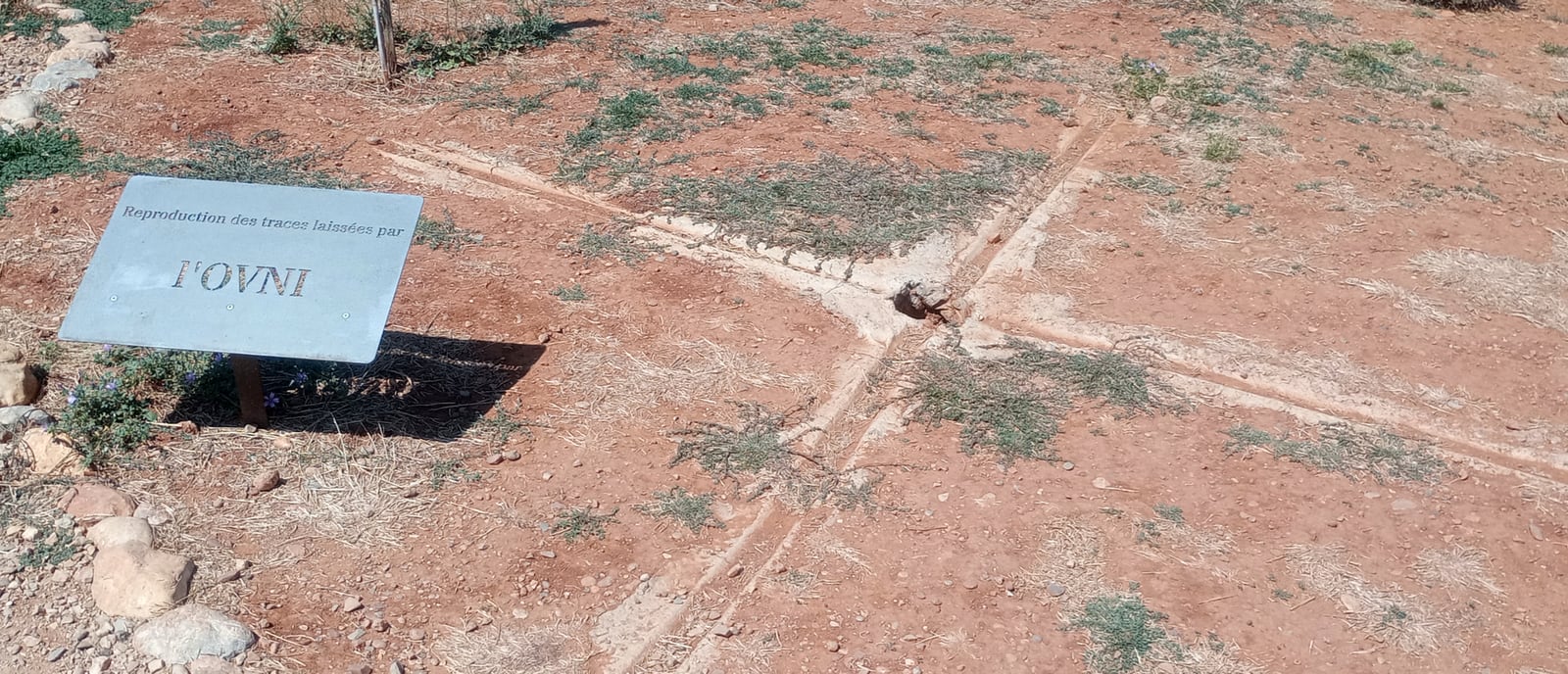
What the gendarmes and the first visitors found on July 2 was, by one witness’s careful account, a shallow basin about 1.2 meters across in freshly hoed soil, with a cylindrical hole 18 centimeters wide and 40 deep at its center and four shallow grooves, each about 8 centimeters wide and two meters long, forming a cross around it. The earth was densely packed; the reporter from Le Provençal, who went out with the gendarmes, found it “hard as cement” around the hole while elsewhere it crumbled to dust between his fingers. The figures soon multiplied. Le Provençal gave the hole as 20 by 50 centimeters, Le Monde as 20 by 80, and Masse himself described an inverted funnel 60 to 80 centimeters deep. By then the crowds had arrived. Hundreds of people drove up the plateau from the Var, the Bouches-du-Rhône, Paris and even Belgium, trampled the lavender and dug at the hole, which had been the size of a bottle and was nearly a meter deep by July 7. Everyone, Var-Matin reported, took home a stone or a bit of earth. The gendarmerie’s research brigade took soil samples on July 3; the press reported an engineer from the Marcoule atomic center on the site, and air force specialists on the way.
Sources: A Tentative Reply to Luis Schönherr’s Questionnaire · Valensole: Further DetailsDid a “flying saucer” land in the Low-Alps?La soucoupe volante était sans doute un hélicoptèreThe flying saucer of Valensole… The curious are flocking, Mr. Masse is depressedA flying saucer in the Basses-Alpes?The Valensole “saucer”: nervous breakdown for the author of the story
‘I still claim to know a helicopter’
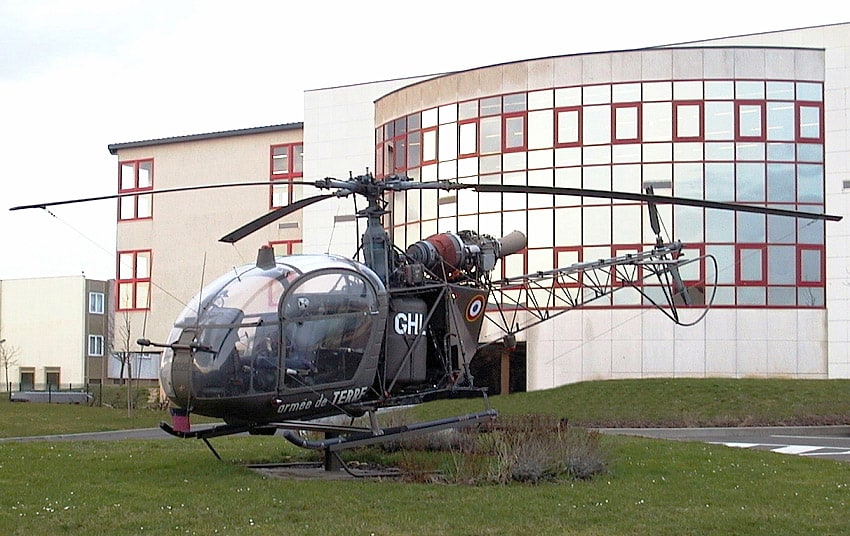
The newspapers could not agree on what Masse had said. Le Provençal’s first story, on July 3, had four legs, a being on the ground and another glimpsed inside; Agence France-Presse dressed the little figure in an orange suit and noted that Masse was known in the village as a lively talker given to tall tales about trout “that big.” The distance wandered from thirty meters to sixty, eighty and fifty. On July 4 Le Monde ran the headline “The flying saucer was probably a helicopter.” Military circles in Marseille were pointing to “Provence 65,” the maneuvers of the 9th Military Region that had been running since June 29, in which the army’s light aviation was flying Alouette helicopters out of Saint-Auban; Valensole lay just beyond the exercise area, nineteen kilometers from its eastern edge at Manosque. AFP suggested the orange suit might be a pilot’s “Mae West” life jacket. Le Provençal’s reporter found Masse hiding at friends’ on the Giens peninsula and got his answer: “The machine had the shape of a giant spider. I clearly counted six legs and a central pivot. The legs began to turn when it took off with a dull noise that has nothing to do with a plane or a helicopter. It had neither rotor nor blades. I still claim to know a helicopter when I see one. That wasn’t one. I am certain. … I never said it was a flying saucer.” Adjudant Oliva, meanwhile, was fielding telephone calls “from New York and London.”
Sources: Did a “flying saucer” land in the Low-Alps?The flying saucer of ValensoleLa soucoupe volante était sans doute un hélicoptèreA flying saucer in the Basses-Alpes?“Saucer”? Unknown craft? … but not a helicopterFrenchman sees ‘Flying Object’
Twelve hours of sleep
“My first reaction was to plow the field and make all the traces disappear,” Masse told Le Provençal. “I should have obeyed my first impulse. … I am literally hunted by a pack of reporters and curious people, not to mention the official interrogations. I have told my story so often that I am tired of it.” He fled to friends at Giens, on the coast, and a radio reporter from Europe n° 1 found him there anyway. On July 6 Le Méridional reported that villagers were warning journalists away from him: he had suffered a nervous breakdown. Then came the sleep. For three days after the encounter, Michel was told, Masse felt nothing; on the fourth he collapsed with an overpowering need to sleep. A man who had slept four or five hours a night now slept twelve to fifteen, and would have slept round the clock if his wife and father had not woken him to eat. He stopped talking and became withdrawn. Oliva confirmed the drowsiness to Michel, who also noted a slight trembling of the hands that was still visible on August 8. One evening after Giens, his wife told the GEPA investigator, he broke down sobbing and “let himself go,” and told her the whole story.
Sources: The mystery remains whole on the Valensole “flying saucer”The Valensole “saucer”: nervous breakdown for the author of the storyThe Significant Report from France: G.E.P.A. Investigation · The Valensole AffairThe flying saucer of Valensole… The curious are flocking, Mr. Masse is depressed
Seven meters
On August 18 Masse gave a fuller statement to “certain Valensole people” whom the GEPA investigator trusted absolutely but did not name. It opened: “When you questioned me on July 2, 1965, I did not reveal to you all that I had seen, for it was so extraordinary that I feared I might be taken for a madman and locked up,” which suggests they were the gendarmes. He had not stopped at a distance; he had got to within seven meters, skirting the vineyard. Both beings had been on the ground, squatting, one with its back to him, as if examining a lavender plant, and both had climbed back aboard after immobilizing him. Five days later, on August 23, the gendarmerie took a third statement recording the new details. Michel had already come to Valensole on August 8. At Digne, Captain Valnet showed him the first report, a plan of the site and its photographs, and warned him that Masse, encouraged by Oliva, had admitted getting very close. At a lavender distillery, with Oliva and Michel’s brother Gustave present, he told Michel his story. Michel had brought along a colored photograph of a model built from Lonnie Zamora’s description of the egg-shaped craft at Socorro, New Mexico, the year before, and he held it back until the end. Masse, he wrote, looked as though he had seen his own death; he thought someone had photographed his machine. Told it had been seen in America by a policeman, he relaxed. “You see then that I wasn’t dreaming, and that I am not mad.”
Sources: A Tentative Reply to Luis Schönherr’s Questionnaire · Valensole: Further DetailsValensole (04) 01.07.1965 · case 1965-07-00050A Visit to Valensole
‘I will die without telling anyone’
Michel published the Socorro episode only in 1968, after he and Charles Bowen, editor of Flying Saucer Review, visited Valensole on August 21, 1967. The gendarmes made no jokes about him, and the men at his distillery were certain of his good faith. The man himself was transformed: anxious, nervous and twice visibly distressed in 1965, he was now serene. “I did not tell all,” he admitted. “But I have already said too much.” And then: “What I have not told you, I have not told anybody, not even my wife, and nobody will make me tell it.” At l’Olivol, Michel tried the story of Betty and Barney Hill on him. Masse was unimpressed. “If those people say that they were forced, it is not true. … They don’t force anybody.” He said he sometimes knew when “they” were about: on the night of July 17–18, 1967, he had woken outdoors with the feeling they were going to show themselves and, twenty minutes later, had seen something cross the sky. The landing spot was still visible: a circle about three yards across where nothing grew but a few weeds, ringed by stunted lavender. He had replowed and replanted it, he said, and all the new plants died. Michel also realized that he had misremembered the field. The vineyard stood at least four times farther from the landing spot than in the sketch he had published, so Masse must have crossed fifteen meters of open ground under the beings’ eyes. To Michel that meant they had let him come.
Sources: A Visit to ValensoleThe Significant Report from France: G.E.P.A. Investigation · The Valensole Affair
A plateau full of stories
Valensole soon had more. In the same 1965 article Michel mentioned two further sightings over the plateau in August and September and a hunter near Manosque in October 1954 whose dog, Michel was told, came back half paralyzed. Figuet and Ruchon’s 1979 catalog, drawing on the GEPA bulletin, adds a report that at the end of July 1965, at 10 p.m., residents saw an object like Masse’s hover four or five meters off the ground beside the road to Gréoux-les-Bains, near some chestnut trees, three hundred meters from l’Olivol, while small beings came and went from it without any visible ladder. In the night of September 17–18, three astronomers at the Haute-Provence Observatory at Saint-Michel watched a stationary orange-red oval at the exact level of the plateau for ten to fifteen minutes; Michel had the lamps on the École Normale Supérieure’s ionospheric aerials at Valensole switched on for test nights and showed they could not be seen from the domes. In 1967 Phénomènes Spatiaux printed a tale that five locals had cornered a little man like Masse’s, but bearded, in an empty farmhouse room, only for “something like an invisible force” to make him slip through their hands. And while Michel and Bowen waited at the distillery, a workman told them that an old couple, long dead, had once seen a glowing red egg settle for a quarter of an hour right beside l’Olivol, around 1913. He was gone before they could question him again.
Sources: The Significant Report from France: G.E.P.A. Investigation · The Valensole AffairURECAT-000642 · End July 1965, ValensoleA Visit to Valensole
A saucer by the road
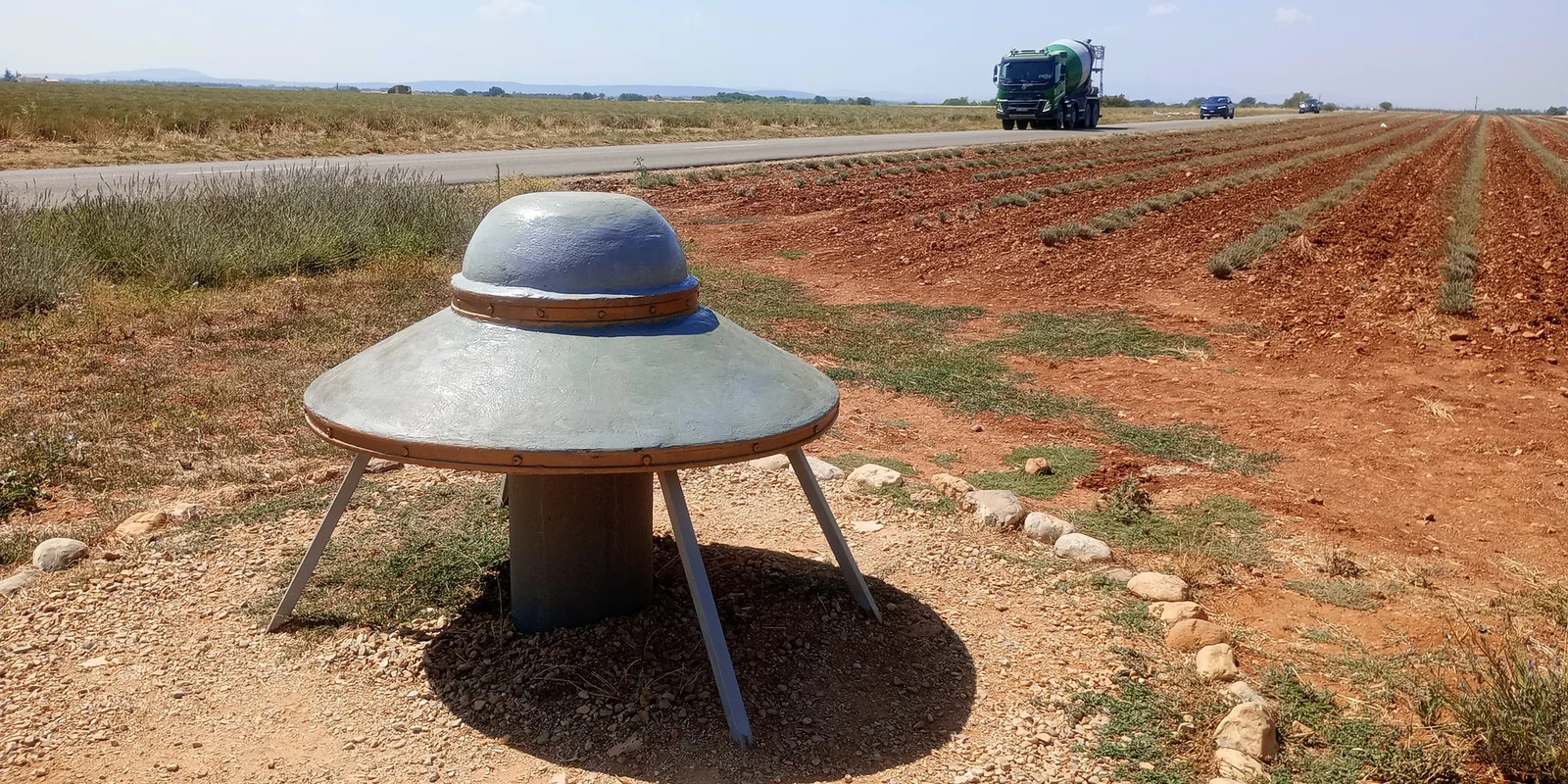
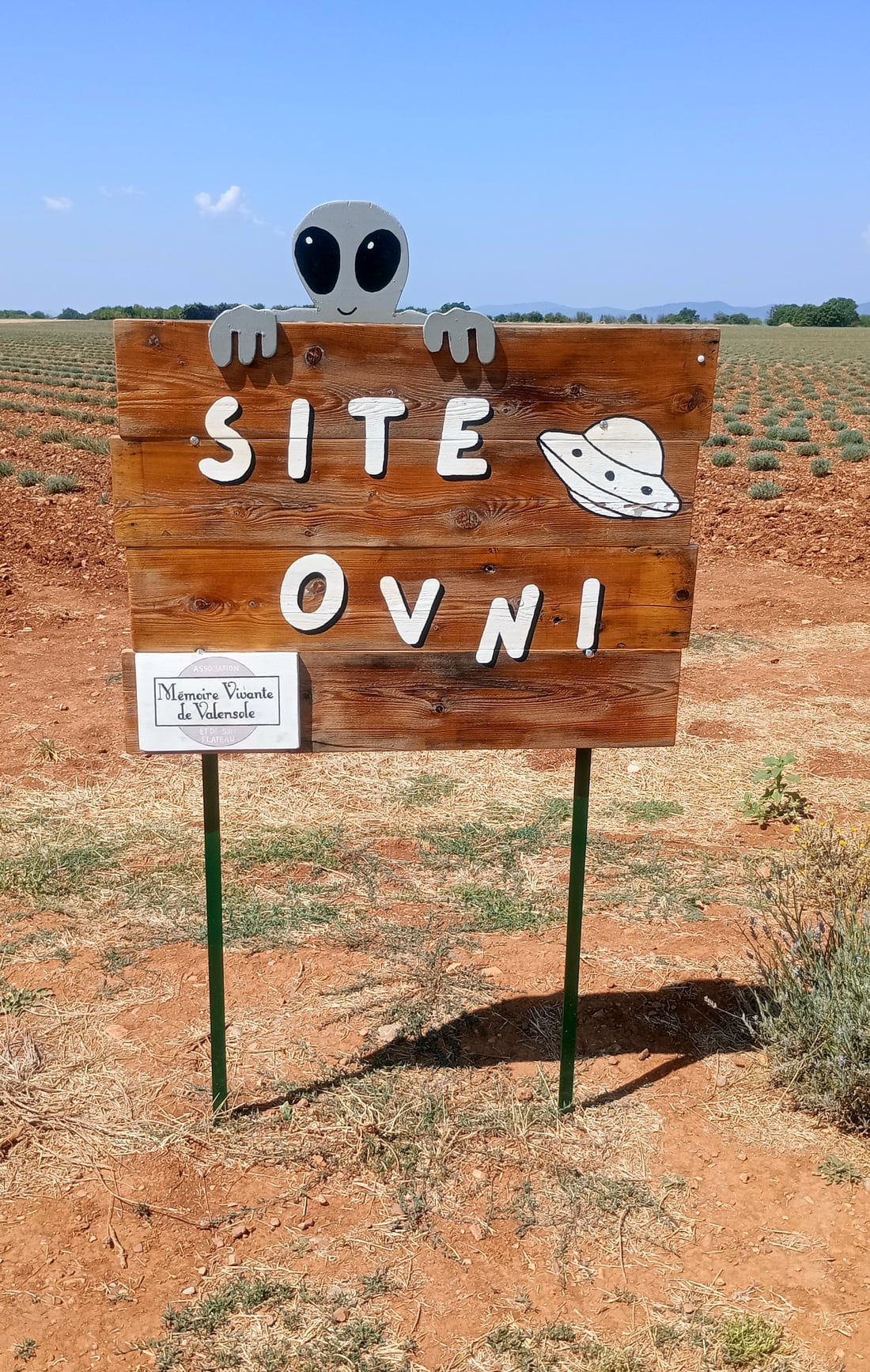
Masse never told the rest. He went on growing lavender and refused the psychiatric examination the GEPA investigator wished he had accepted. Others kept digging. The CNRS astronomer Pierre Guérin and Jacques Vallée investigated it, and in 1980 Guérin and the psychiatrist Dr. Beaudouard went back over it in the Belgian journal Inforespace. Masse died in 2004. GEPAN, the official study group created in 1977, collected documents on the case but never published an investigation of its own; for the fiftieth anniversary in 2015 its successor GEIPAN released the three gendarmerie reports as “the most reliable documents” and, “given its strangeness,” classed the case D, unexplained, “by default.” That July a saucer and two green men were installed at the site, and the municipality mounted an exhibition. Masse’s grandsons told France 3 that their grandfather was “someone who did not tell stories,” and the heir to his estate, Maurice Chaspoul, said it could not be “a pure invention.” Six years earlier a man from Nice had written to GEIPAN that, as teenagers in early July 1965, he and his older brother had seen from the back of their father’s green Peugeot 203 convertible “a big upturned plate” in a lavender field and children coming out of it, in the evening, not the morning. The memorial today is a gray saucer on four legs beside rows of lavender, a wooden sign reading “SITE OVNI,” and a plaque: “Here, on July 1, 1965, a UFO landed, giving rise to a close encounter of the third kind. Respect this place.” In 2025 the story reached cinemas as Valensole 1965, a drama by Dominique Filhol.
Sources: L’observation de Valensole 1965, cinquante ans après…Fiftieth anniversary of the arrival of aliens to ValensoleTémoignage direct · correspondence with a witness of early July 1965Rencontre de ValensoleA Tentative Reply to Luis Schönherr’s Questionnaire · Valensole: Further DetailsRencontre du troisième type à Valensole
Three gendarmerie reports
The official record consists of three procès-verbaux, released by GEIPAN in 2015. The first, n° 445, records Masse’s statement at the Valensole brigade on July 2, 1965, at 8 p.m., with a further hearing from 11:15 to 11:30 p.m.; its summary describes a craft the size of a Dauphine with two passengers, one of whom, about a meter tall, “is said to have” climbed out briefly, and notes that Captain Valnet saw on the spot “traces that could possibly correspond to the actual landing of a craft.” The second, drawn up on July 5 by another brigade, records the measurements and photographs of the marks taken on July 2 and 3. The third, dated August 23, records the closer approach, the two crouching beings and the immobilization that Masse had first described on August 18. GEPAN did not exist in 1965; its successive heads gathered documents on the case but never published an inquiry, and the 2015 note explains that one so long after the event, and after the work of the gendarmes, Pierre Guérin and Jacques Vallée, would probably have yielded little. Class D is GEIPAN’s category for the unexplained, but the note is frank about why Valensole got it: “given its strangeness,” the case was classed D “by default, to make searches easier for internet users.”
Sources: L’observation de Valensole 1965, cinquante ans après…Procès-verbal n° 445 · déclaration de M. Maurice MasseValensole (04) 01.07.1965 · case 1965-07-00050Rencontre de Valensole
The ground and the lavender
The trace was recorded before the crowds destroyed it, and the measurements of July 2 (an 18-by-40-centimeter hole, a basin 1.2 meters across, four 8-centimeter grooves forming a cross) are consistent across the gendarmerie summary and the GEPA investigator’s source. Masse said only four of the six legs left marks. Michel, who examined the plants on August 8, found one or two sprigs on each plant dried “exactly similar” to twigs withered by great heat or autumn, along a strip two or three meters wide and about a hundred meters long under the take-off path; the gendarmes had not noticed it, and the GEPA investigator, in September, saw no difference in color at all. A 1968 FSR summary stretched the strip to four hundred meters. Michel reported that the site was tested for radioactivity, easily done with the Cadarache nuclear center nearby, and that the result was negative; the GEPA investigator wrote that specialists had studied the soil’s radioactivity but never published the results. Guérin later cited a chemical analysis of soil taken by GEPA investigators soon after the landing: about 18 percent calcium at the spot, against an unmeasurable amount in control soil twenty or thirty meters away, though he admitted the report did not say how it was measured. He argued that an electromagnetic effect of the craft, rather than fertilizer, had sterilized the ground. The bare circle Bowen photographed in 1967 became the most durable physical claim. Later accounts say lavender did not grow back there until 1975, but Guérin called that a legend: the lavender Masse replanted failed at the end of 1965, the soil seemed fertile again by 1966 or 1967, with grass growing in tufts, and in 1969 the whole field was plowed and sown with buckwheat.
Sources: A Tentative Reply to Luis Schönherr’s Questionnaire · Valensole: Further DetailsThe Significant Report from France: G.E.P.A. Investigation · The Valensole AffairA Visit to ValensoleRencontre de ValensoleValensole (04) 01.07.1965 · case 1965-07-00050
A story told in layers
Masse’s account grew, and the growth is documented. The first reports, on July 3, had one being outside and another inside, four legs, a distance of thirty meters and a sudden departure; by July 4 and 5 he was insisting on six legs; from August 18 he described two beings on the ground, an approach to five or seven meters and a quarter-hour of paralysis. Times range from 5:30 to 5:45, and distances, in newspapers that sometimes contradicted their own quotes, from thirty to ninety meters. The orange suit appears only in the AFP dispatch; the GEPA investigator, and later Guérin, recorded gray-green. Some of the variants are journalistic. The Washington Post wondered about a secret version of the Coléoptère, an experimental French vertical-takeoff aircraft whose only prototype had crashed in 1959. The rest Masse explained himself: he had held back the beings and the paralysis, he said on August 18, for fear of being locked up. The GEPA investigator took him at his word and thought he had “knowingly and as it were instinctively” played the encounter down; the skeptics see a story that improved with every telling. Both readings are built on the same documents.
Sources: A Tentative Reply to Luis Schönherr’s Questionnaire · Valensole: Further DetailsDid a “flying saucer” land in the Low-Alps?The flying saucer of ValensoleFrenchman sees ‘Flying Object’“Saucer”? Unknown craft? … but not a helicopter
A helicopter, a tank or a comic book
The helicopter came first, from the military itself, on July 3: an Alouette II or III of the army’s light aviation, flying in Provence 65, could well have set down in the field. Dominique Caudron argued in 1990 that the details fit an Alouette II, including the whine of its turbine as the rotor runs down, and proposed that the marks came from a tank of limed liquid fertilizer set down by the farmer next door. Claude Maugé floated a variant he attributed to the physicist Yves Rocard: a U.S. Sixth Fleet helicopter on a spying mission, covered up by authorities who preferred a UFO to an admission of foreign incursion, all the more plausible, he wrote, because an American spy plane was intercepted over the Pierrelatte atomic plant two weeks later. Against all of these stands Masse, who knew the army’s helicopters and their pilots, and his insistence that there was no rotor. The comics collector Raoul Robé, in a 2015 draft, pointed to a 1955 picture story, reprinted in 1960, in which a flying saucer lands near Arles and bald little pilots freeze a rider and his horse with a ray and examine him; he suggested Masse spun a galéjade, a Provençal tall tale, around a lightning mark in his field and could not back out once the gendarmes came. Gilles Fernandez, who published the idea, judged it unlikely after a friend sent him a summary of the whole story. The sociologist Arnaud Esquerre treats the account as a fantastic narrative rather than a lived event. None of them has been tested against the soil the research brigade took on July 3, whose analysis has never been published; the only figures in circulation are the GEPA analysis Guérin relayed.
Sources: A flying saucer in the Basses-Alpes?Le Baron noir et ses ancêtresRencontre de ValensoleMaurice Masse Encounter (Valensole, 07/01/1965): Hoax inspired by a French Comic Book?“Saucer”? Unknown craft? … but not a helicopter
Classification and evidence note
This archive classifies Valensole as a reported close encounter of the third kind because a single witness described two animate beings beside a landed craft at a few meters and being immobilized by one of them. The label describes the account, not its cause. The evidence is the three gendarmerie reports of July 2, July 5 and August 23, 1965; the gendarmes’ measurements and photographs of the marks; the July 1965 press, which records the first version of the story and the helicopter explanation; the GEPA inquiry and Aimé Michel’s interviews of August 1965 and August 1967, published in Flying Saucer Review; and later statements by Masse’s family. No photograph of the craft exists, no second witness to the July 1 landing has been identified, and the soil analyses reported by Guérin have not been published in full.
Sources: Valensole (04) 01.07.1965 · case 1965-07-00050The Significant Report from France: G.E.P.A. Investigation · The Valensole AffairA Visit to Valensole
- LATE JUNE 1965
For about a week Maurice Masse and his father find sprigs broken off their young lavender at l’Olivol each morning.
- 29 JUN 1965
The army’s Provence 65 maneuvers begin west of Manosque, with Alouette helicopters of the light aviation flying out of Saint-Auban.
- 1 JUL 1965 · ABOUT 5:45 AM
Smoking behind a rock pile, Masse hears a whistle and sees a car-sized craft on six legs and a pivot, with two small beings bending over a lavender plant.
- MOMENTS LATER
Approaching to within a few meters, he is immobilized by a tube one of them points at him; they reboard, and the craft leaves westward and vanishes at about twenty meters.
- ABOUT 15 MINUTES LATER
Masse recovers the use of his limbs, returns to the village and tells the owner of the Café des Sports about the machine and its marks, but not the beings.
- 1 JUL 1965 · EVENING
He returns to the field with his daughter; the mud around the central hole has set like cement.
- 2 JUL 1965 · 8 PM
Masse makes his statement to Adjudant Oliva’s brigade at Valensole; Captain Valnet arrives from Digne and the investigation runs through the night.
- 3 JUL 1965
Le Provençal breaks the story; the research brigade takes soil samples, and the military suggests an Alouette helicopter.
- 4 JUL 1965
Le Monde: “The flying saucer was probably a helicopter.” Masse has fled to Giens; crowds trample the field.
- 5 JUL 1965
Le Provençal prints its Giens interview: “It wasn’t one. I am certain.” The gendarmes write up their record of the marks.
- 6–7 JUL 1965
The press reports Masse in a nervous breakdown, his long sleep already begun; souvenir hunters have dug the hole nearly a meter deep.
- 8 AUG 1965
Aimé Michel interviews Masse at his distillery and shows him a photograph of a model of the Socorro craft.
- 18 AUG 1965
Masse gives a fuller statement: seven meters, two beings squatting by a plant, the paralysis.
- 23 AUG 1965
The gendarmerie records the new details in a third report.
- SEPTEMBER 1965
The magistrate “G.C.” investigates for GEPA; on September 17–18 astronomers at Saint-Michel see an orange-red light on the plateau.
- NOV–DEC 1965
Flying Saucer Review publishes the GEPA report and Michel’s “The Valensole Affair.”
- 21 AUG 1967
Michel and Charles Bowen revisit l’Olivol; Masse, now serene, says he will die without telling the rest.
- 1980
Pierre Guérin and the psychiatrist Dr. Beaudouard return to the case in Inforespace.
- 1990
Dominique Caudron proposes an Alouette II and a fertilizer tank.
- 2004
Maurice Masse dies.
- AUG–SEP 2009
A man from Nice writes to GEIPAN about a landed “plate” and “children” they saw near Valensole as teenagers in July 1965.
- 26 JUN 2015
GEIPAN releases the three gendarmerie reports and classes the case D by default.
- JULY 2015
For the fiftieth anniversary a saucer and two green men are installed at the site, and the village mounts an exhibition.
- 2025
Dominique Filhol’s drama Valensole 1965 opens in France.
Sources & interviews
Valensole (04) 01.07.1965 · case 1965-07-00050GEIPAN · CNES · the official case page, classified D, with the three gendarmerie reports of July 2, July 5 and August 23, 1965L’observation de Valensole 1965, cinquante ans après…GEIPAN · CNES · Toulouse, June 26, 2015 · the note releasing the gendarmerie reports for the fiftieth anniversaryProcès-verbal n° 445 · déclaration de M. Maurice MasseGendarmerie nationale · brigade de Valensole · statement taken July 2, 1965, as published by GEIPANTémoignage direct · correspondence with a witness of early July 1965GEIPAN · CNES · emails of August 17 to September 2, 2009, names withheld · two brothers recall a landed “plate” near ValensoleDid a “flying saucer” land in the Low-Alps?Victor Nathan · Le Provençal · July 3, 1965 · page 1 · transcription and translation by Patrick GrossA flying saucer in the Basses-Alpes?Le Dauphiné Libéré · July 4, 1965 · with the military’s “probably an A.L.A.T. helicopter” statement · transcription by Patrick GrossThe mystery remains whole on the Valensole “flying saucer”Victor Nathan · Le Provençal · July 4, 1965 · transcription by Patrick GrossThe flying saucer of ValensoleAgence France-Presse · Le Méridional · July 4, 1965 · page 9 · transcription by Patrick GrossLa soucoupe volante était sans doute un hélicoptèreLe Monde · July 4, 1965 · page 18 · transcription by Patrick Gross“Saucer”? Unknown craft? … but not a helicopterLe Provençal · July 5, 1965 · Masse interviewed at Giens · transcription by Patrick GrossFrenchman sees ‘Flying Object’Waverley Root · The Washington Post · July 5, 1965 · transcription by Patrick GrossThe Valensole “saucer”: nervous breakdown for the author of the storyLe Méridional · July 6, 1965 · page 14 · transcription by Patrick GrossThe flying saucer of Valensole… The curious are flocking, Mr. Masse is depressedVar-Matin République · July 7, 1965 · transcription by Patrick GrossThe Significant Report from France: G.E.P.A. Investigation · The Valensole Affair“G.C.” for GEPA and Aimé Michel · Flying Saucer Review 11(6) · November/December 1965 · pp. 5–8 · via the Internet ArchiveA Tentative Reply to Luis Schönherr’s Questionnaire · Valensole: Further Details“G.C.” and Aimé Michel · Flying Saucer Review 12(3) · May/June 1966 · pp. 21–24 · via the Internet ArchiveA Visit to ValensoleAimé Michel and Charles Bowen · Flying Saucer Review 14(1) · January/February 1968 · pp. 6–12 · the August 1967 return to l’Olivol · via the Internet ArchiveValensole, France, 1965Patrick Gross · UFOs at close sight · case page and press index, updated August 4, 2023URECAT-000642 · End July 1965, ValensolePatrick Gross · UFO Related Entities Catalog · the second Valensole report, after Figuet and Ruchon (1979) and Phénomènes SpatiauxMaurice Masse Encounter (Valensole, 07/01/1965): Hoax inspired by a French Comic Book?Gilles Fernandez, presenting Raoul Robé’s hypothesis · Sceptiques vs. les Soucoupes Volantes · November 20, 2017, revised December 2017Le Baron noir et ses ancêtresDominique Caudron · Communications 52, Rumeurs et légendes contemporaines · 1990 · pp. 219–248 · via PerséeFiftieth anniversary of the arrival of aliens to ValensoleFrance 3 Marseille · July 3, 2015 · 2 min · INARencontre du troisième type à ValensoleAffaires sensibles · France Inter · May 28, 2018 · audio podcast, 54 minRencontre de ValensoleWikipédia · French-language article with the gendarmerie summaries, Pierre Guérin’s soil figures and the skeptical hypothesesSpotted an error, or know a better source? Write to hello@uap.fun.
Connected files
The Socorro ArroyoThe egg on legs Masse recognized: a model of Lonnie Zamora’s craft, shown to him in August 1965, left him convinced he was not mad.The Landing at Trans-en-ProvenceSixteen years later and sixty kilometers away, another Provençal farmer, another lone landing and a ring in the soil that France’s space agency did investigate.The Little Men of KellyTen years earlier in Kentucky: small figures with oversized heads around a farmhouse, and a family that went straight to the police.Betty and Barney HillThe American couple whose story Masse heard in 1967, and dismissed: “They don’t force anybody.”Jacques ValléeOne of the investigators GEIPAN credits with working the case years before the space agency had a UFO office.The kinds of close encountersWhy two beings and a landed craft make Valensole a third-kind report, whatever stood in the lavender.Discuss this case
Compare notes with other readers: witness details, sources, and the parts that still do not add up.
Open the discussion