A Saturday flight into the last light
At 5:23 p.m. on Saturday, October 21, Frederick Valentich filed for a night visual flight from Moorabbin Airport to King Island and back, below 5,000 feet. He was twenty, held a private licence and a Class Four instrument rating, and had about 150 flying hours. The rented Cessna 182L, VH-DSJ, was filled to capacity at 6:10. Nine minutes later he departed alone, carrying four life jackets and enough fuel for roughly five hours. His route ran southwest to the unmistakable Cape Otway lighthouse, then across the blackening water of Bass Strait.
Sources: Aircraft Accident Investigation Summary Report 197802563DSJ — Cape Otway to King Island, 21 October 1978 — Aircraft Missing (Valentich)Submerged Aircraft Wrecks Program: Cessna 182L VH-DSJ
Cape Otway at seven o’clock
Valentich reported over Cape Otway at about 7:00 p.m. and said he was continuing to King Island. The official weather reconstruction described light winds, excellent visibility and little low cloud; daylight at the cape would end around 7:18. No radar plot fixed VH-DSJ’s later position, so nearly everything that follows rests on the recorded radio exchange and on the route Valentich said he was flying. At 7:06:14 he called Melbourne Flight Service and asked a plain question: was any known traffic operating below 5,000 feet? Flight service officer Steve Robey answered that there was none.
Sources: Aircraft Accident Investigation Summary Report 197802563DSJ — Cape Otway to King Island, 21 October 1978 — Aircraft Missing (Valentich)Last Light: The Valentich Mystery
Four bright lights
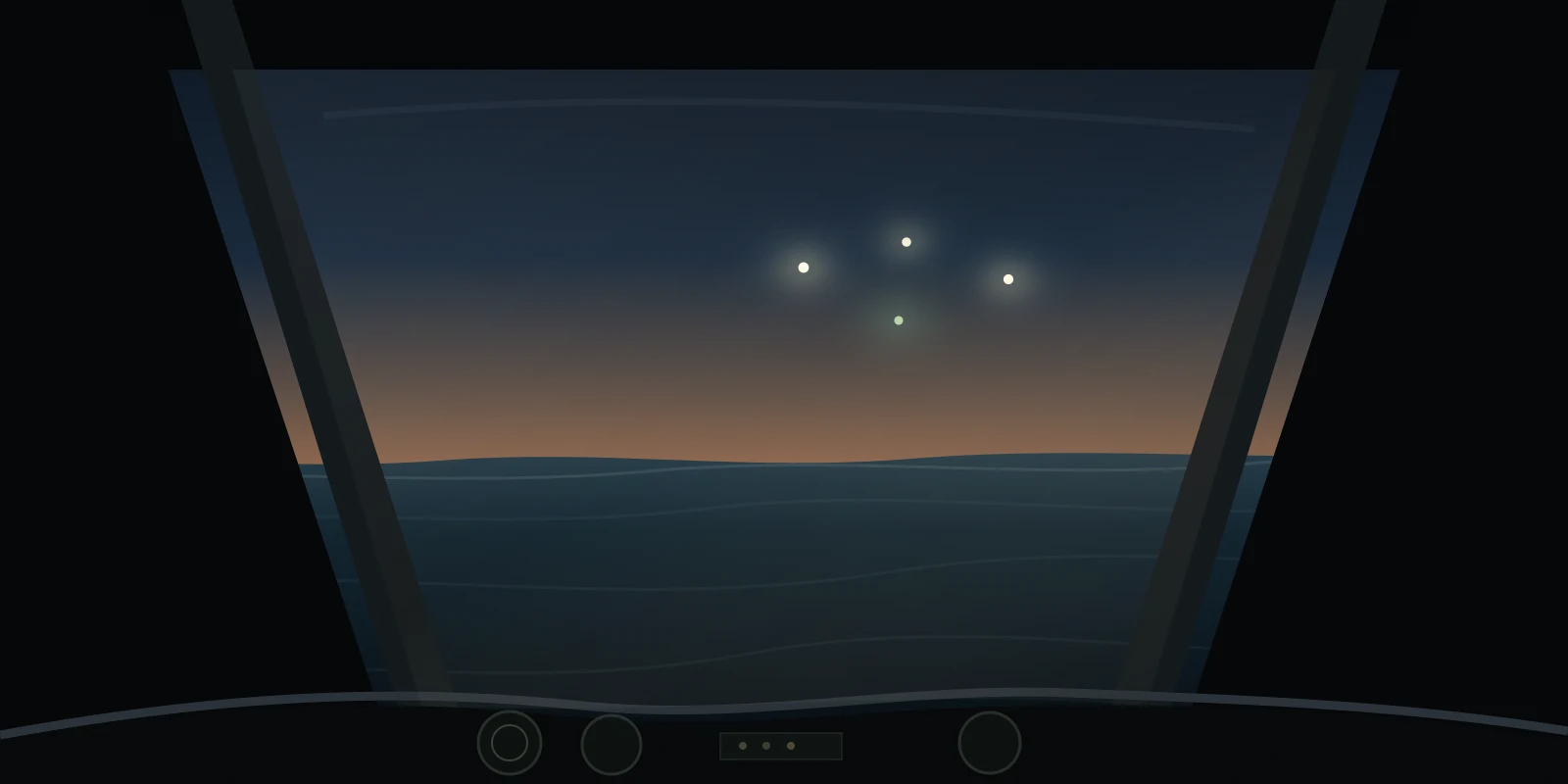
Valentich said there seemed to be a large aircraft below 5,000 feet. He could not identify its type; what he first made out were four bright lights, like landing lights. Then he said it had passed at least 1,000 feet above him. Robey asked whether it was large. Valentich could not judge because of its speed and asked if an Air Force aircraft was nearby. Again the answer was no known aircraft. The unknown returned from due east, he said, sweeping over him two or three times “at speeds I could not identify.” His voice made the encounter immediate: not a story assembled afterward, but a pilot trying to name something while watching it move.
Sources: Aircraft Accident Investigation Summary Report 197802563DSJ — Cape Otway to King Island, 21 October 1978 — Aircraft Missing (Valentich)The Valentich Disappearance: Another UFO Cold Case Solved
A long shape circling overhead
Robey confirmed Valentich’s altitude—4,500 feet—and asked again for an identification. After a pause Valentich answered, “It’s not an aircraft.” He described a long shape moving past, too fast for further detail. Then its apparent motion changed. While he orbited, Valentich said, the thing seemed stationary above him and was orbiting too. It showed a green light and a metallic or shiny exterior. It vanished, then approached again from the southwest. The transcript preserves hesitations and open-microphone gaps that polished retellings often remove; the description developed unevenly from lights, to an unknown aircraft, to a long reflective form.
Sources: Aircraft Accident Investigation Summary Report 197802563DSJ — Cape Otway to King Island, 21 October 1978 — Aircraft Missing (Valentich)The Valentich Disappearance: Another UFO Cold Case Solved
The engine begins to cough
At 7:11:52 Valentich reported that the engine was rough-idling. He had the manifold pressure set at twenty-three or twenty-four inches, he said, “and the thing is coughing.” Robey asked his intentions. Valentich still intended to proceed to King Island. Seconds later he reported the strange aircraft hovering above him again: “It is hovering and it’s not an aircraft.” At 7:12:28 he called “Delta Sierra Juliet, Melbourne,” followed by seventeen seconds of open microphone. The official transcript does not characterize the sound. Newspapers and later accounts called it metallic scraping, but the investigation established no source. There was no Mayday, ditching position or further voice.
Sources: Aircraft Accident Investigation Summary Report 197802563DSJ — Cape Otway to King Island, 21 October 1978 — Aircraft Missing (Valentich)Last Light: The Valentich Mystery
The empty frequency
Robey kept calling VH-DSJ. The alert phase began as contact failed; when the Cessna did not reach King Island, distress procedures followed at 7:33 p.m. Aircraft, ships and shore parties entered the search. An RAAF P-3 Orion and eight civilian aircraft helped examine more than 1,000 square miles—about 2,600 square kilometres—of sea. An oil slick north of King Island was sampled but not connected to VH-DSJ. No emergency beacon, body or confirmed wreckage appeared. The intensive search ended October 25, leaving a voice recording, a flight plan and an aircraft-shaped absence over the strait.
Sources: Aircraft Accident Investigation Summary Report 197802563VH-DSJ — Light Aircraft Overdue King IslandDSJ — Cape Otway to King Island, 21 October 1978 — Aircraft Missing (Valentich)
An investigation with no neat pilot portrait
The Department of Transport reconstructed the flight through instructors, friends, family, maintenance records, weather, radar analysis and the tape. Valentich was ambitious about aviation but inexperienced. He had struggled with commercial-licence examinations and had drawn official attention for earlier flying infringements. He was also interested in UFOs before the flight—important context for perception, but not proof of invention. Even the journey’s purpose stayed unsettled: he mentioned collecting friends to officials and crayfish to others, while investigators confirmed neither arrangement. The file did not turn those contradictions into evidence of a hoax or planned disappearance.
Sources: Aircraft Accident Investigation Summary Report 197802563DSJ — Cape Otway to King Island, 21 October 1978 — Aircraft Missing (Valentich)Flying Saucers — Fact or Fiction?
What seventeen seconds became
The terminal noise grew into the case’s signature artifact. Yet the primary report says only “17 seconds open microphone.” Notes in the larger file record that Valentich often kept the hand microphone on his lap, clicked its switch after transmissions and sometimes activated it while moving his long legs or sliding his seat. A later spectrum study using a copy tape found rapid microphone keying the closest cockpit comparison, though not a perfect match. The original operational tape was eventually reused, leaving surviving copies and recollections rather than a pristine recording that can be tested again.
Sources: DSJ — Cape Otway to King Island, 21 October 1978 — Aircraft Missing (Valentich)Last Light: The Valentich Mystery
A white cowl flap on Flinders Island
In May 1983, an eroded white engine cowl flap washed onto Flinders Island at the eastern side of Bass Strait. Investigators identified it as coming from a range of Cessna 182 serial numbers that included VH-DSJ. A Royal Australian Navy laboratory considered currents capable of carrying such wreckage toward the island. But the part bore no unique identifier tying it to Valentich’s aircraft, and other Cessna 182s existed. It remains a tantalising possibility, not recovered proof: a component compatible with the missing model, found five years later in a sea connected by plausible drift.
Sources: DSJ — Cape Otway to King Island, 21 October 1978 — Aircraft Missing (Valentich)Submerged Aircraft Wrecks Program: Cessna 182L VH-DSJ
The sentence that would not close the story
The accident summary was approved on April 27, 1982. Under “Opinion as to cause,” A. R. Woodward wrote one enduring sentence: “The reason for the disappearance of the aircraft has not been determined.” The outcome was presumed fatal. The full file later entered the National Archives, exposing both the extraordinary transmission and the ordinary machinery of accident inquiry—oil tests, weather charts, interviews, radar limitations and unanswered correspondence. A 1979 television crew retraced the route and landed safely at Currie, asking why Valentich had not. The question survives because no physical scene has ever answered it.
Sources: Aircraft Accident Investigation Summary Report 197802563DSJ — Cape Otway to King Island, 21 October 1978 — Aircraft Missing (Valentich)In ‘Search’ for ValentichLast Light: The Valentich Mystery
Sources & interviews
Aircraft Accident Investigation Summary Report 197802563Australian Department of Transport / Australian Transport Safety Bureau · V116/783/1047 · approved April 27, 1982DSJ — Cape Otway to King Island, 21 October 1978 — Aircraft Missing (Valentich)National Archives of Australia · B1497, V116/783/1047, item 10491375 · 1978–1992 investigation fileVH-DSJ — Light Aircraft Overdue King IslandNational Archives of Australia · A4703, 1978/1205, item 11485989 · contemporary marine search-and-rescue fileFlying Saucers — Fact or Fiction?National Archives of Australia · collection feature on official Australian UFO recordsSubmerged Aircraft Wrecks Program: Cessna 182L VH-DSJHeritage Victoria · Victorian Government · maritime-heritage recordLast Light: The Valentich MysteryPatrick Stokes · ABC Radio National, The History Listen · June 4, 2019 · interviews with Steve Robey and Rhonda RushtonThe Valentich Disappearance: Another UFO Cold Case SolvedJames McGaha and Joe Nickell · Skeptical Inquirer 37(6) · November/December 2013In ‘Search’ for ValentichKing Island News · October 24, 1979 · National Library of Australia TroveConnected files
The Lights beside the Newspaper PlaneTwo months later, another southern-ocean flight produced lights, radar reports, recorded voices—and this time, colour film.The Lights beside Flight 1628A freight captain’s luminous companions also unfolded over an open radio channel, but his aircraft returned safely.The Green Light over MansfieldAnother pilot reported a green-lit object close to his aircraft, with a full crew available to compare memories afterward.The Tehran InterceptMilitary pilots, controller traffic and reported instrument effects form a different kind of aviation mystery.Discuss this case
Compare notes with other readers: witness details, sources, and the parts that still do not add up.
Open the discussion