Army 15444 heads north
At about 10:30 p.m. on October 18, Army Reserve helicopter 68-15444 left Port Columbus for Cleveland Hopkins after its four-man crew completed routine flight physicals. Capt. Lawrence J. Coyne, thirty-six, was pilot in command; 1st Lt. Arrigo Jezzi sat at the controls, with crew chief Staff Sgt. Robert Yanacsek and flight medic Staff Sgt. John Healey behind them. The UH-1H cruised north-northeast at roughly ninety knots and 2,500 feet above sea level. Below lay rolling farmland and woods; ahead was Mansfield. The signed Army report fixes the encounter at 23:05, southeast or east-southeast of Mansfield Airport, on heading 030.
Sources: Near Midair Collision with UFO ReportA Helicopter-UFO Encounter Over OhioSpecial Political Committee, 35th Meeting: Verbatim Record (Partial)
A red light crosses the dark
Healey first noticed a bright red light west of the helicopter moving south. Minutes later Yanacsek found a steady red light on the eastern or southeastern horizon. He watched it long enough to consider a tower beacon or an aircraft navigation light, then warned Coyne that it had turned toward them. The light held an apparent collision bearing and swelled with unnerving speed. “I said, ‘Holy Christ, that could be a jet,’” Coyne told Hynek three months later. “The thing was terrifically fast,” he told UPI. “There had been so little time to respond.” The crew’s estimate—more than 600 knots—was a judgment made without radar range. Coyne took the controls and pushed the Huey into a powered descent.
Sources: Near Midair Collision with UFO ReportA Helicopter-UFO Encounter Over OhioIncident Named After PilotSpecial Political Committee, 35th Meeting: Verbatim Record (Partial)
Mansfield answers once
Coyne suspected one of Mansfield’s Air National Guard F-100s. He called the tower and asked whether high-performance traffic was nearby. The Army form records an acknowledgement, then no answer. In later testimony the crew said Jezzi tried UHF, VHF and the emergency frequency: keying and channel tones were audible, but no voice came back. Zeidman reported that the last local F-100 had landed at 10:47 p.m. and that Mansfield retained no tape of even the first exchange. The public record contains neither that tower tape nor a radar plot, so the radio episode survives through the report and recollection rather than technical data.
Sources: Near Midair Collision with UFO ReportA Helicopter-UFO Encounter Over OhioSpecial Political Committee, 35th Meeting: Verbatim Record (Partial)
The dive toward 1,700 feet
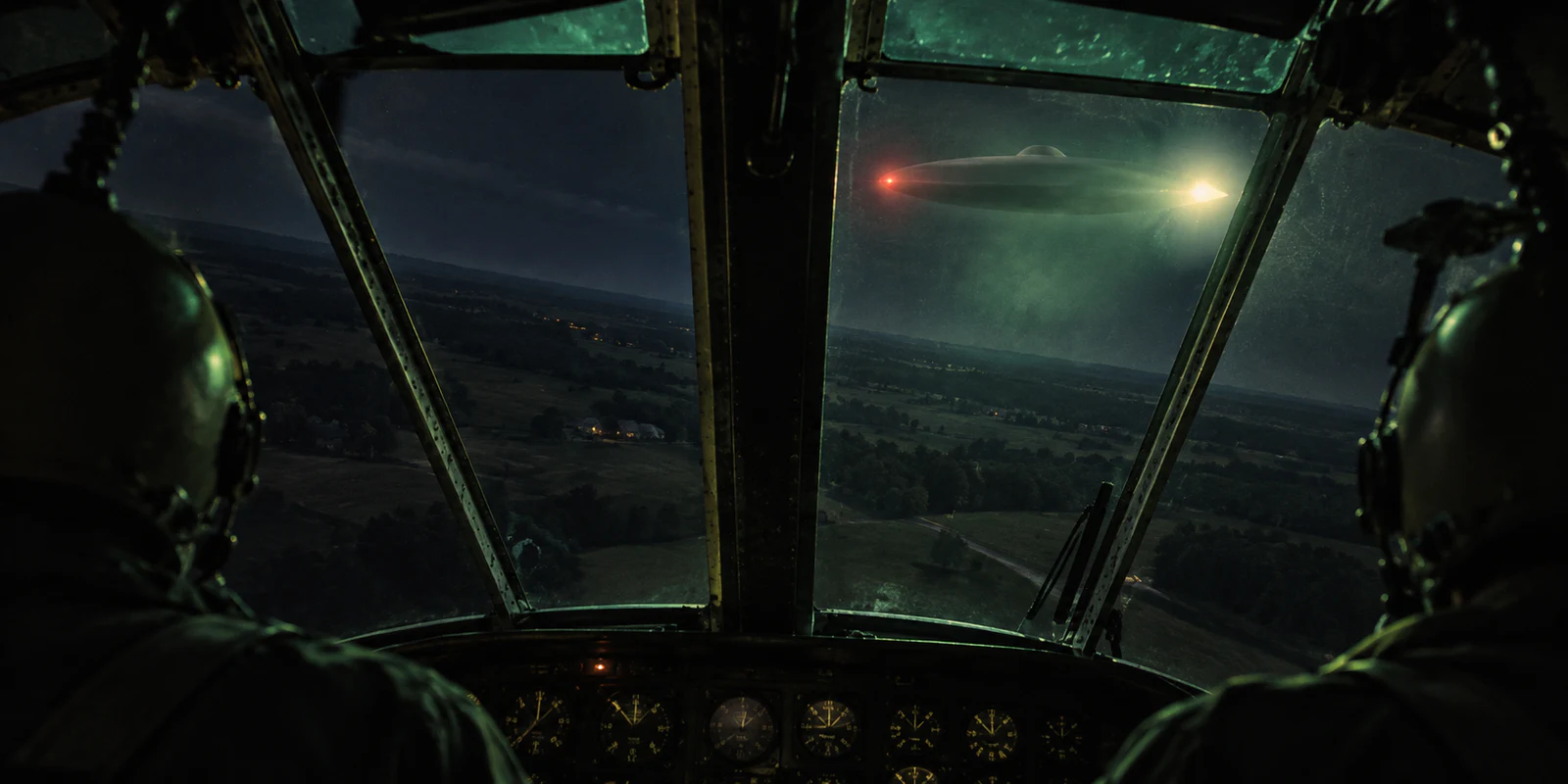
Coyne increased the descent from about 500 to 2,000 feet per minute while searching the black ground for an emergency landing field. The red light still appeared locked onto them. “I said the son of a gun is gonna hit us, y’know?” Coyne told Hynek. “And I braced—I figured this was it. What do you do when you have an automobile accident? You just stiffen up.” He told the crew over the intercom to brace. “The anticipated moment of impact never came,” he said at the United Nations five years later. “I closed my eyes momentarily, but was interrupted by the flight medic, Sergeant Healey, stating over the intercom, ‘Look at that.’” The light had stopped just ahead and above, close enough to become a form. “I remember it was 1700 feet and I thought, ‘Oh, this is it,’ and then I saw it right in front here, and I said, ‘That’s no F-100!’” It was gunmetal gray, streamlined like a fat cigar or airfoil, with a red glow at the front, white at the rear and a shallow dome. “It was just stopped, for maybe 10 to 12 seconds, and I mean stopped,” Yanacsek said. “It wasn’t cruising, it was stopped. It didn’t waver, it didn’t put on the brakes, it didn’t gyrate—it was just like in a cartoon.” It reminded him of a submarine, “silent and gliding, and just there,” and its solid part “blotted out the stars right behind it.” Healey: “This thing didn’t have any wings. I don’t know how the hell he got around, but he did.” Estimates around sixty feet long came from perception in darkness, not a measured range.
Sources: A Helicopter-UFO Encounter Over OhioIncident Named After PilotSpecial Political Committee, 35th Meeting: Verbatim Record (Partial)
Green through the roof
The Huey’s overhead windows turned the next seconds into the image that made the case famous. Coyne, Healey and Yanacsek described green light beneath or behind the object; in the fullest version, a pyramid-shaped beam swept across the nose, through the windshield and into the tinted roof panels. The cabin glowed green. “All colours inside the cabin of the helicopter were absorbed by that green light,” Coyne said, “and that includes the instrument panel lights on the aircraft.” Over dinner with Hynek he put it another way: “It was like looking into another world.” Jezzi’s view was poorer. “It was like a little ball of white light,” he said of what he saw moving overhead. The men heard no jet roar and felt no rotor wash from another aircraft. The signed Army form does not mention a cigar, dome or green beam; those details belong to early press accounts, interviews and Coyne’s later testimony.
Sources: A Helicopter-UFO Encounter Over OhioHelicopter Nearly Tangles With UFOIncident Named After PilotSpecial Political Committee, 35th Meeting: Verbatim Record (Partial)
A helicopter climbing with the collective down
When the object moved west, Coyne looked back to the panel. The Army report says the altimeter read 3,500 feet and the vertical-speed indicator showed a 1,000-foot-per-minute climb while the collective—the control used to change rotor lift—was still full down. Coyne later said the helicopter rose to about 3,800 feet before a small bump or patch of turbulence ended the ascent. “I says, ‘My God, we’re at 3500 feet,’” he told Hynek, “and I says, ‘What’s happening?’ The collective was bottomed.” He also described the magnetic compass card rotating slowly—“90, 180, 270, zero, 90—continuously,” about four times a minute—and said it never recovered: “The compass was removed because it was completely unserviceable.” Zeidman could not check that against the aircraft records, which the maintenance unit kept for only sixty days, and on one tape Healey said the compass had stayed the same. No flight recorder captured control position, power or altitude, and the official form does not say the object lifted the aircraft. What it preserves is narrower and still startling: a remembered descent to 1,700 feet followed by an indicated climb to 3,500 feet that the pilot said he had not commanded.
Sources: Near Midair Collision with UFO ReportA Helicopter-UFO Encounter Over OhioSpecial Political Committee, 35th Meeting: Verbatim Record (Partial)
The white light snaps away
The object accelerated west with its white rear light still brilliant. Coyne and Healey said it then made a sharp forty-five-degree turn toward the northwest and seemed to vanish toward Lake Erie; Jezzi did not see that final turn. Communications worked again farther along the route. Coyne returned the Huey to 2,500 feet, completed the flight to Cleveland and closed the flight plan. The FAA Flight Service Station told him to contact the General Aviation District Office, and the Army reporting chain was notified the following afternoon.
Sources: Near Midair Collision with UFO ReportA Helicopter-UFO Encounter Over OhioSpecial Political Committee, 35th Meeting: Verbatim Record (Partial)
Four signatures and five late-found witnesses
All four crewmen signed the November 23 Army disposition form, titled “Near Midair Collision with UFO Report.” It verifies the flight, red-light approach, evasive descent, tower acknowledgement, apparent hesitation above the helicopter, departure and climb indication. Three years later, after a newspaper appeal, investigators Warren Nicholson and William Jones found a woman Zeidman calls Mrs. C. and four children aged ten to thirteen who said they had watched from a car on Route 430 near the Charles Mill Reservoir bridge: a red light, a helicopter—“It was like beating the air,” thirteen-year-old Charles said of the sound—and a green-lit conjunction. “Everything was just so green from it,” Charles said, “you could only see a short way ’cause it was just so bright.” “We were scared,” his mother said. Zeidman considered their geometry strongly supportive, but their account was not contemporaneously recorded, and the family had already heard about the famous case before being interviewed.
Sources: Near Midair Collision with UFO ReportA Helicopter-UFO Encounter Over Ohio
From an Ohio cockpit to the United Nations
The story moved quickly through the Associated Press and UPI, then into documentaries and television. A National Enquirer panel that included J. Allen Hynek awarded the crew $5,000 for the most scientifically valuable UFO report of 1973—a publicity prize, not a scientific ruling. On November 27, 1978, now Lt. Col. Coyne retold the encounter at a United Nations Special Political Committee meeting convened around Grenada’s UFO proposal. Grenada’s minister of education, Wellington Friday, introduced him with a caveat: “Although Colonel Coyne is a member of the United States military, he is here in a private capacity and I want to stress that fact.” His appearance authenticated his testimony on an international stage; it did not turn the encounter into a United Nations finding.
Sources: Helicopter Nearly Tangles With UFOCoyne incident over Charles Mill Lake was ‘most credible’ UFO sighting of 1973Special Political Committee, 35th Meeting: Verbatim Record (Partial)The Case of Ohio’s Best Documented UFO
Five minutes that never acquired a machine
“In my opinion, that thing tried to ram us,” Coyne told Hynek. “To kill us. That’s what my fear was.” The encounter endured because trained aircrew did more than glimpse a wandering point: they reacted to a collision threat, described structure and light at close range, reported instrument oddities and put their names on an Army form. Yet the surviving record never gained the things that could settle an aviation mystery—radar returns, synchronized radio audio, flight-recorder data, maintenance findings or an event photograph. The result is an unusually well-attributed story with an official paper trail, but no identified aircraft and no instrument record capable of showing what crossed the Huey’s path.
Sources: Near Midair Collision with UFO ReportA Helicopter-UFO Encounter Over OhioThe 1973 Mansfield UFO EncounterThe Case of Ohio’s Best Documented UFO
What the Army form establishes
The November 23 form is the case’s strongest primary document. It names aircraft 68-15444, all four crewmen, the time, location, heading and altitude; records an apparent high-speed convergence, descent from 2,500 to 1,700 feet, one tower acknowledgement, the object’s westward departure and a later 3,500-foot reading with a 1,000-foot-per-minute climb indication. It does not contain the sixty-foot estimate, green beam, spinning compass, total radio failure or a claim that an external force caused the climb. Those may be genuine recollections, but they must not be folded backward into the narrower official text.
Sources: Near Midair Collision with UFO ReportA Helicopter-UFO Encounter Over Ohio
Four viewpoints, not one perfect account
The witnesses agreed on the central emergency but differed in what their seats allowed them to see. Coyne, Healey and Yanacsek supplied most of the structured-object description; Jezzi chiefly saw the departure light. Healey’s earliest account was reportedly recorded within eighteen hours, while Jezzi’s detailed interview came more than three years later. Even Zeidman’s sympathetic monograph charts disagreements about duration, cabin illumination, altitude sequence and final turn. Multiple trained witnesses strengthen the event’s reality as an alarming observation; their differences limit any exact reconstruction.
Sources: A Helicopter-UFO Encounter Over OhioHelicopter Nearly Tangles With UFOIncident Named After Pilot
Meteor, aircraft and cockpit workload
Philip J. Klass proposed an Orionid fireball approaching from the east: a bright meteor can appear to rush directly at an observer, trigger evasive action and flood a cockpit with light, while green-tinted roof panels could color that illumination. A separate aircraft could account for Healey’s earlier red light. The theory struggles with the crew’s prolonged structured view and apparent stop; Zeidman’s reconstructed five-minute duration is also too long for a meteor, though it depends on retrospective estimates. Conventional-aircraft proposals face the reported hover, silence and acceleration. The climb may reflect recovery from a steep descent, stress, delayed control input or instrument reading, but no recorder survives to choose among them.
Sources: A Helicopter-UFO Encounter Over OhioThe 1973 Mansfield UFO Encounter
Classification
This archive classifies the report as a military CE2 because the crew claimed radio, compass and flight-control effects during a close aerial encounter. Its status remains unresolved, not confirmed exotic: the instrument effects are unverified and no physical trace was recovered.
Sources: Near Midair Collision with UFO ReportA Helicopter-UFO Encounter Over OhioSpecial Political Committee, 35th Meeting: Verbatim Record (Partial)The 1973 Mansfield UFO Encounter
- 18 OCT 1973 · ABOUT 10:30 PM
Army Reserve UH-1H 68-15444 departs Port Columbus for Cleveland after the crew’s flight physicals.
- ABOUT 11:00 PM
Healey notices a red light west of the helicopter; Yanacsek soon tracks another or the same steady light to the southeast.
- 11:05 PM · ARMY REPORT
The light appears to converge at 2,500 feet on heading 030 southeast of Mansfield Airport.
- NEXT MINUTES
Coyne takes control, calls Mansfield and dives; the tower acknowledges once but gives no traffic answer.
- NEAR 1,700 FEET
The crew braces for impact, then reports a gray streamlined form stopping above and ahead of the Huey.
- SECONDS LATER
Three crewmen describe green illumination through the cockpit; the object moves west and accelerates away.
- AFTER DEPARTURE
The altimeter reads about 3,500 feet with a climb indicated; Coyne later says control returns near 3,800 feet.
- 19 OCT 1973
Coyne reports to FAA operations personnel; the Army chain is notified at 3:30 p.m., and early witness accounts begin.
- 21–22 OCT 1973
The Plain Dealer and Associated Press bring the near-collision account to a national audience.
- 23 NOV 1973
The four crewmen attest to the Army disposition form “Near Midair Collision with UFO Report.”
- 1974
A National Enquirer panel including Hynek gives the crew its $5,000 award for the most scientifically valuable report of 1973.
- 1976–1979
Ground witnesses are located; Jennie Zeidman interviews crew and civilians and publishes the CUFOS monograph.
- 27 NOV 1978
Coyne recounts the event in a private capacity before the UN Special Political Committee.
Sources & interviews
Near Midair Collision with UFO ReportU.S. Army DA Form 2496 · 83rd U.S. Army Reserve Command · November 23, 1973 · FOIA transcription preserved by NICAPA Helicopter-UFO Encounter Over OhioJennie Zeidman · Center for UFO Studies · March 1979 · Crew interviews, reconstruction and document appendicesSpecial Political Committee, 35th Meeting: Verbatim Record (Partial)United Nations General Assembly · A/SPC/33/PV.35 · November 27, 1978 · Coyne statement in a private capacityHelicopter Nearly Tangles With UFOAssociated Press · Lancaster Eagle-Gazette · October 22, 1973 · Contemporary clipping at Newspapers.comIncident Named After PilotUnited Press International · Mansfield News Journal · November 4, 1973 · Contemporary article transcriptionThe 1973 Mansfield UFO EncounterBrian Dunning · Skeptoid · September 2026 · Critical review with meteor and aircraft proposalsThe Case of Ohio’s Best Documented UFOVince Guerrieri · Ohio Magazine · September/October 2023 · Fiftieth-anniversary historyThe 1973 UFO ChronologyNICAP · Francis Ridge and documentation team · Updated April 10, 2022 · Regional sighting contextCoyne incident over Charles Mill Lake was ‘most credible’ UFO sighting of 1973Kenny Libben · Ashland Source · October 4, 2020 · Local history feature; the National Enquirer awardSpotted an error, or know a better source? Write to hello@uap.fun.
Connected files
The Tehran InterceptAnother military aircrew reported lost communications and instruments while closing on a brilliant light.The Lakenheath Radar NightRadar rooms and an interceptor crew turned a night-flight mystery into a disputed official record.The Lights Beside Flight 1628A professional crew, colored lights and missing confirming data shaped another enduring aviation case.Close Encounters, ExplainedHow claimed electromagnetic and vehicle effects move an observation into Hynek’s second kind.Discuss this case
Compare notes with other readers: witness details, sources, and the parts that still do not add up.
Open the discussion