Drawing sunspots at eight in the morning
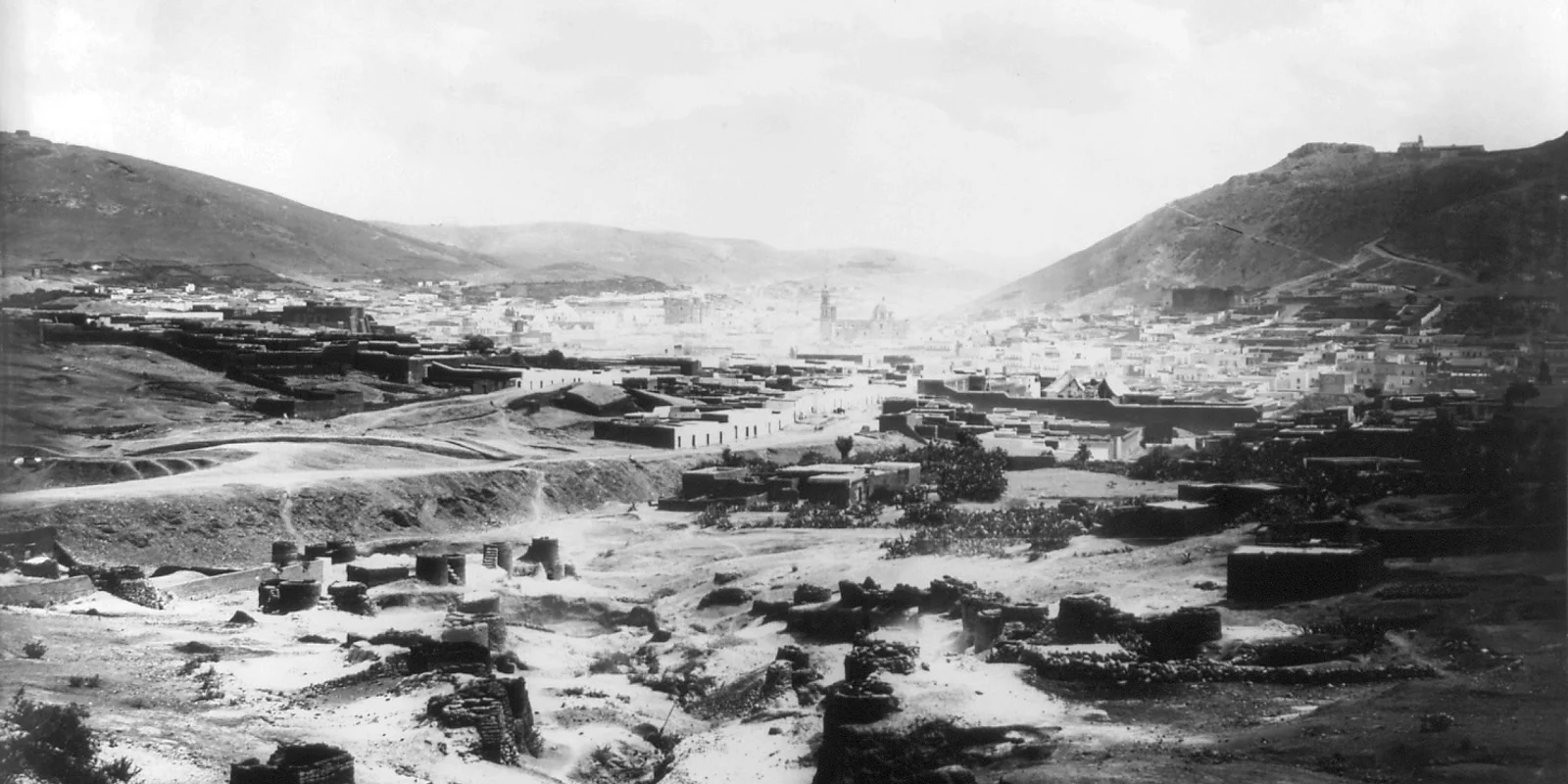
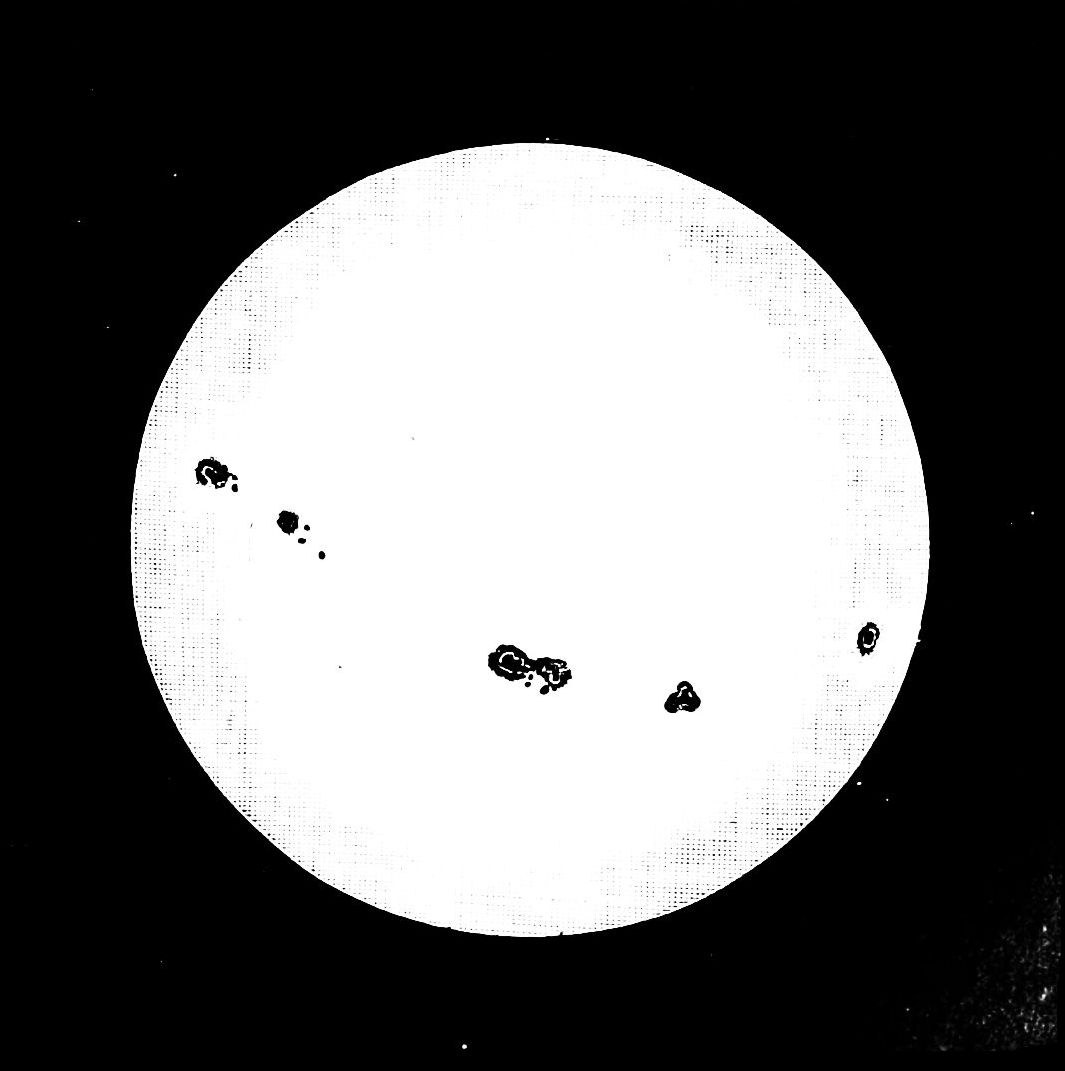
The observatory at Zacatecas had been built for exactly this kind of morning. It stood some 2,500 meters above sea level in a silver-mining city of the Mexican high plateau, under what its director called a tropical sky, and he had set it up for daily work on the Sun. A six-inch equatorial telescope, driven by clockwork to follow the Sun across the sky, threw an image of the solar disc 25 centimeters wide onto a sheet of paper, where he traced the dark spots and the bright patches called faculae by hand. The dome had small windows and thick black curtains so that nothing entered the lens but sunlight. On Sunday, August 12, 1883, at eight in the morning, José A. y Bonilla sat down to draw the day’s sunspots. “I suddenly noticed a small luminous body entering the field of the telescope,” he wrote. It showed up on the paper he was drawing on and ran across the disc of the Sun, “projected like an almost circular shadow.” He had not recovered from his surprise, he went on, when the same thing happened again, and then again, “with such frequency that in the space of two hours I was able to count up to 283 bodies crossing the disc of the Sun.”
Sources: Passage sur le disque solaire d’un essaim de corpuscules, vu à l’Observatoire de Zacatecas (Mexique)Nouvel observatoire au Mexique
A new observatory on the high plateau
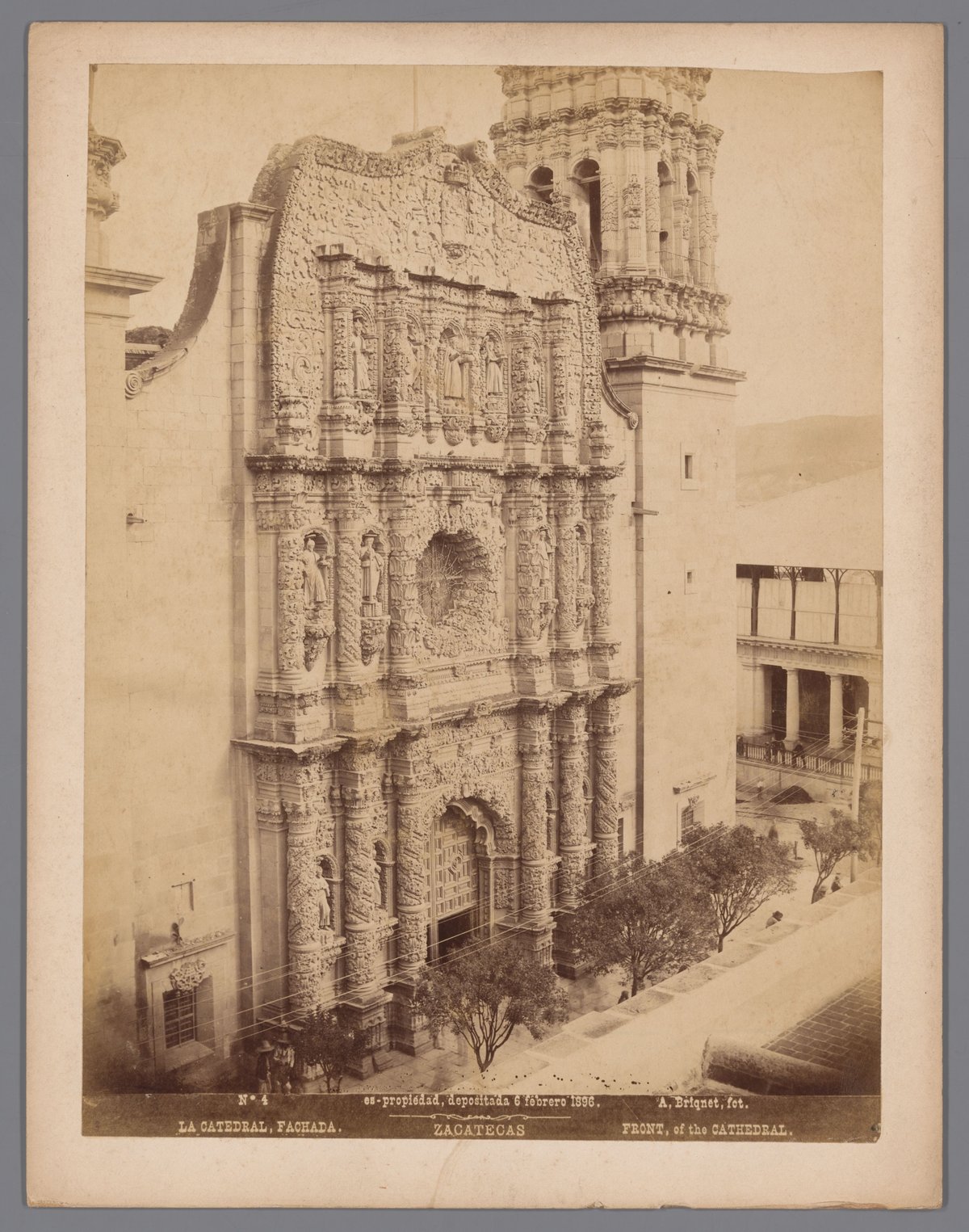
Bonilla was thirty. Born in Zacatecas on February 5, 1853, he had been one of the first two graduates in topographic engineering from the city’s Instituto Literario in 1873, and two years later President Sebastián Lerdo de Tejada gave him a silver medal for completing three years of courses in one. He taught at the Instituto, later the Instituto de Ciencias and today the Autonomous University of Zacatecas, for thirty-five years. His observatory began work on December 6, 1882, the day of the transit of Venus, when French and Mexican parties were watching the planet cross the Sun from Puebla, Guadalajara and León. In 1884 Camille Flammarion’s popular Paris monthly L’Astronomie announced the new station and printed its inventory: the Paris-made Secretan equatorial, two spectroscopes, a photographic attachment, astronomical clocks and a marine chronometer, a small transit instrument and a ten-centimeter Foucault reflector. Bonilla had asked to become the journal’s correspondent in what it called those distant lands. The notice mentioned, in one line, that on August 12–13, 1883, the passage of corpuscles across the solar disc had been observed there. It closed with a greeting from one republic to another: “Science has no homeland.”
Sources: Nouvel observatoire au MexiqueInstituto de Ciencias de Zacatecas: José Árbol y Bonilla, breves de la historiaInterpretation of the observations made in 1883 in Zacatecas (Mexico): A fragmented Comet that nearly hits the EarthJosé Árbol y Bonilla
Fifteen or twenty at once
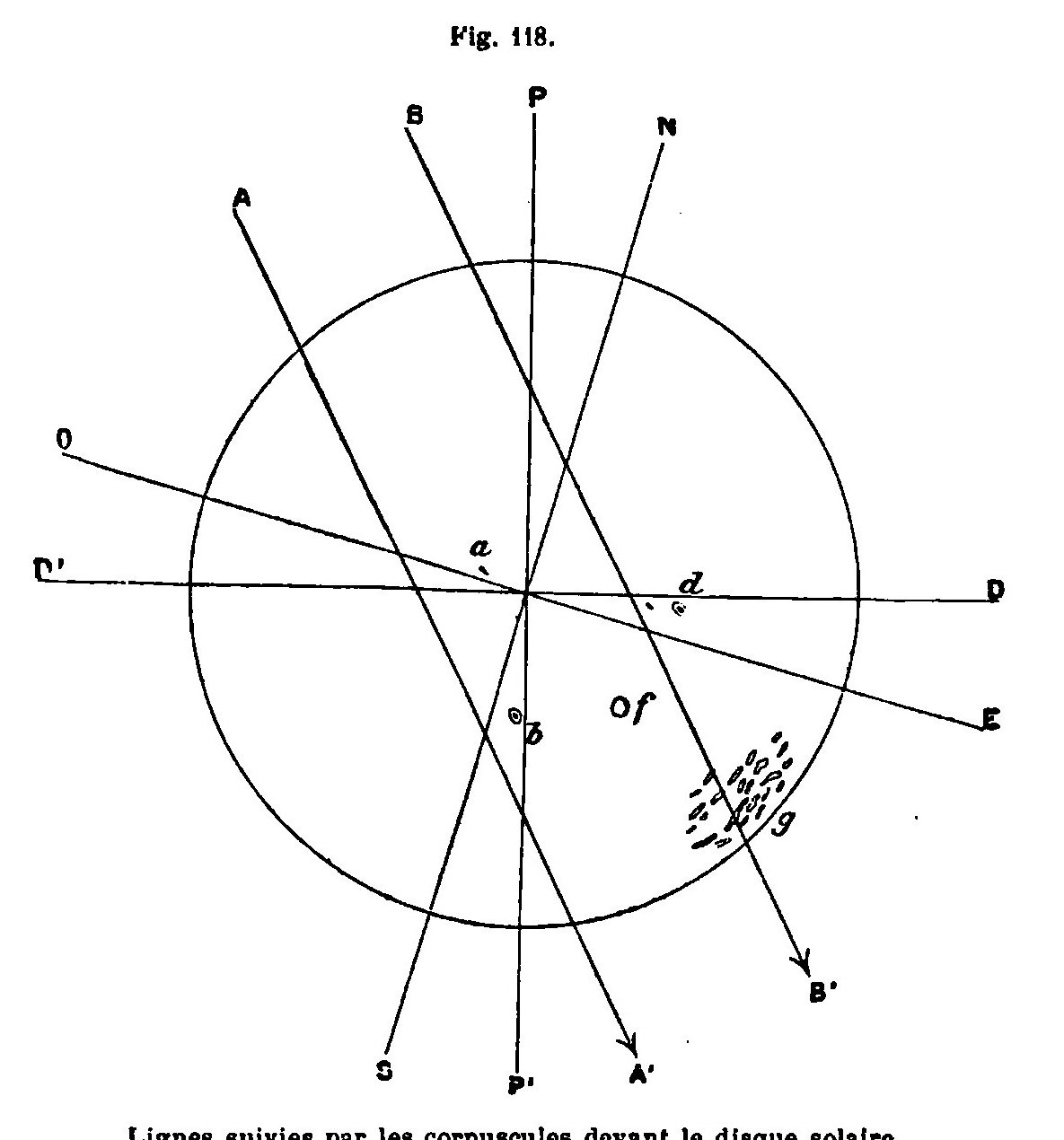
The bodies kept coming. Some crossed the whole disc in a third of a second, others in half a second, none in more than one. Sometimes one or two passed and a minute or two went by before the next; sometimes fifteen or twenty went over almost at once, so many that it was hard to count them. Against the Sun they looked black and dark, “some perfectly round and the others more or less broadened.” The strangest detail came as they left it. Out beyond the rim of the Sun, in the dim field of the telescope, the same bodies shone, and seemed to trail bright streaks behind them. All of them traveled the same way, west to east, tilting a little north or south. Because the paper moved with the telescope, Bonilla could mark where several of them entered and left the disc, and he drew their paths across that morning’s sunspots. Clouds gathered and stopped him. He could not start again until the Sun reached its highest point at noon, and then only for forty minutes, in which he counted 48 more.
Sources: Passage sur le disque solaire d’un essaim de corpuscules, vu à l’Observatoire de Zacatecas (Mexique)
A hundredth of a second
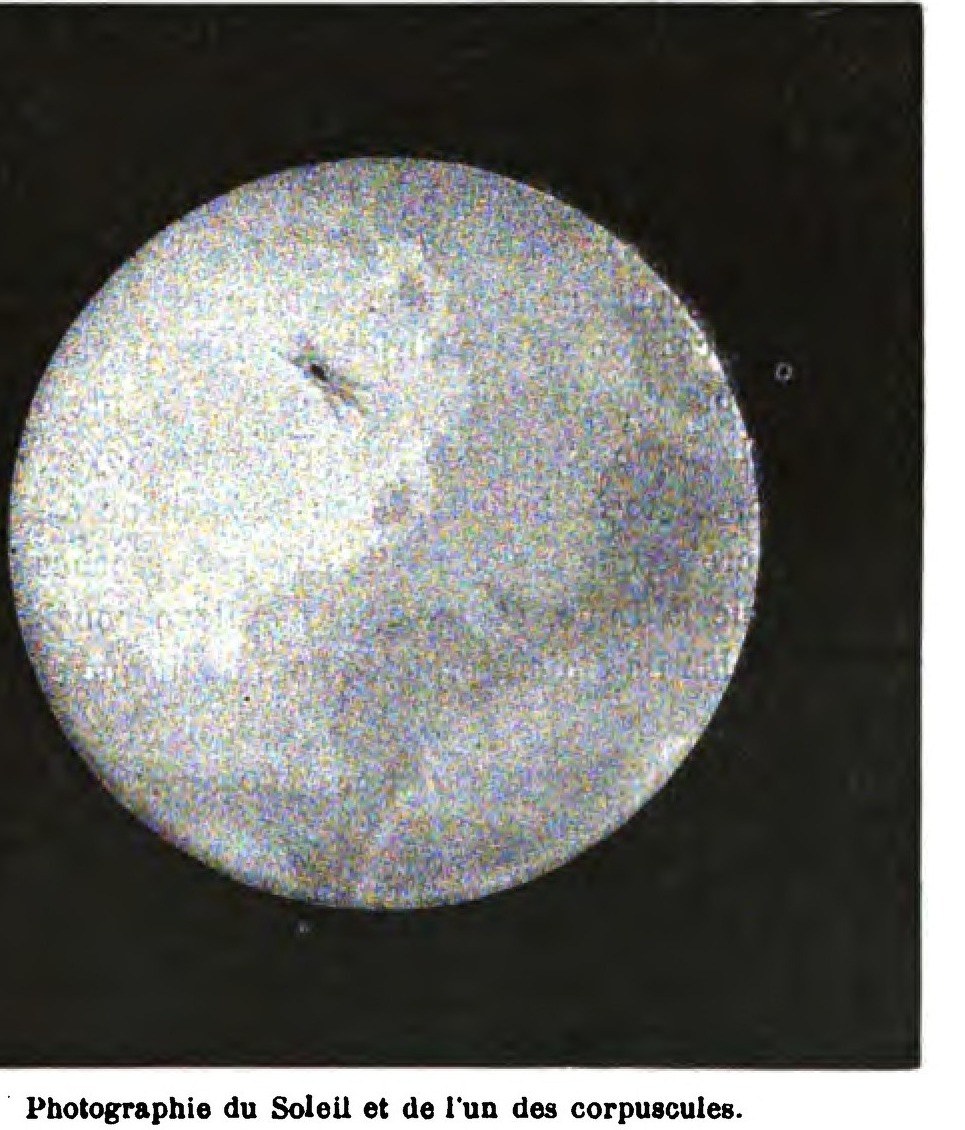
Bonilla photographed the Sun whenever its disc showed notable spots, and he now set out to photograph the bodies too. He swapped the telescope’s lens for one of the same power corrected for photography, fitted the camera, and after several tries at bringing the bodies into sharp focus managed to take a number of pictures, while an assistant counted bodies through the finder, the small sighting telescope mounted on the big one. The picture he chose for Paris was taken on a wet collodion plate, a glass plate coated and exposed while still wet, at a hundredth of a second. The haste, he admitted, left no time to filter and prepare the chemical baths properly, so the negative was slightly fogged by the developer. He had focused on the body, not the Sun, because the body interested him more. The photograph shows a mottled, blurred Sun and, in its upper left, a sharp dark oval with faint wisps before and behind it. By eye the bodies had looked round; on the plates, most were irregular. Looking closely, he saw that the body was wrapped in a haze, with dark trails that had looked bright outside the Sun. He wondered whether the trails were absorbing the Sun’s chemically active light as they crossed it.
Sources: Passage sur le disque solaire d’un essaim de corpuscules, vu à l’Observatoire de Zacatecas (Mexique)
Nothing in Mexico City, nothing in Puebla
Right after the first morning’s count, Bonilla had telegraphed the observatories of Mexico City and Puebla, several hundred kilometers to the southeast, asking them to look. They saw nothing. Clouds shut down the afternoon, and he took his measurements and drew up a plan in case the bodies came back. On August 13 the sky was cloudy until eight, then opened enough for 45 minutes of observation, and at once the bodies were back: “we counted 116 bodies crossing the solar disc.” Bonilla then tried to test their distance. He focused the finder, the equatorial and a ten-centimeter Foucault reflector on the bodies and, that night, without touching the focus, turned them on the planets and on the Moon, two days past first quarter. Only the Moon came almost into focus. Together with the blank telegrams, he wrote, this made him believe “that these bodies were quite close to the Earth, at a smaller distance than the Moon,” and that their large parallax, the shift in apparent position between two places, had thrown them off the face of the Sun as seen from Mexico City and Puebla. He did not say what he thought they were. Over two days, his three counts add up to 447.
Sources: Passage sur le disque solaire d’un essaim de corpuscules, vu à l’Observatoire de Zacatecas (Mexique)Interpretation of the observations made in 1883 in Zacatecas (Mexico): A fragmented Comet that nearly hits the Earth
“Birds, insects, or dust”
The report took two years to reach print. In June 1885 L’Astronomie apologized in its correspondence column for the delay in publishing Bonilla’s “excellent observations,” and they appeared in the September issue as “Passage across the solar disc of a swarm of corpuscles, seen at the Zacatecas Observatory,” with his drawing and a halftone, a printed dot-screen copy, of the photograph. The volume that bound them was dated January 1, 1886, which is probably why later accounts, from a Mexican UFO magazine in 1994 to a university paper in 2011, date the report to that year. An unsigned editors’ note followed. The observation was “very interesting, but not easy to explain.” The date suggested the August stream of shooting stars, the Perseids, but then it would be strange that nothing was seen in Mexico City or Puebla. “Could they be birds?” The editors had examined the photograph closely and measured the dark oval, preceded and followed by faint trails. “We would be inclined to believe,” they concluded, “that these are birds, insects, or high-altitude dust, in any case corpuscles belonging to our atmosphere.” The readers were not done. In February 1886 the journal printed a letter from J. Herschel of Hawkhurst, in Kent, pointing to a report in the Monthly Notices of the Royal Astronomical Society of March 1870 of phenomena in many ways similar, though he would not say they had the same origin; it was the account of bodies crossing the Sun at Bangalore, in India, that Charles Fort would later retell. Beside it ran a letter from H. Bruguière of Marseille, who with a small telescope had watched more than twenty-five shapeless bodies cross the Sun, all heading west to east, sometimes four at once moving in a line, on April 15 and 16, 1883, four months before Zacatecas; his letter also gives the date as April 25, a slip Vallée would copy. The editors called Marseille and Zacatecas “two identical phenomena” with the same cause, admitted the cause was hard to guess, and explained why no one else had seen them by bodies so close to the Earth that the smallest move by the observer threw them off the Sun.
Sources: Passage sur le disque solaire d’un essaim de corpuscules, vu à l’Observatoire de Zacatecas (Mexique)Passage de corpuscules devant le SoleilThe Book of the DamnedAnatomy of a PhenomenonLe dossier photo
Bonilla in Paris, and a stone from the sky
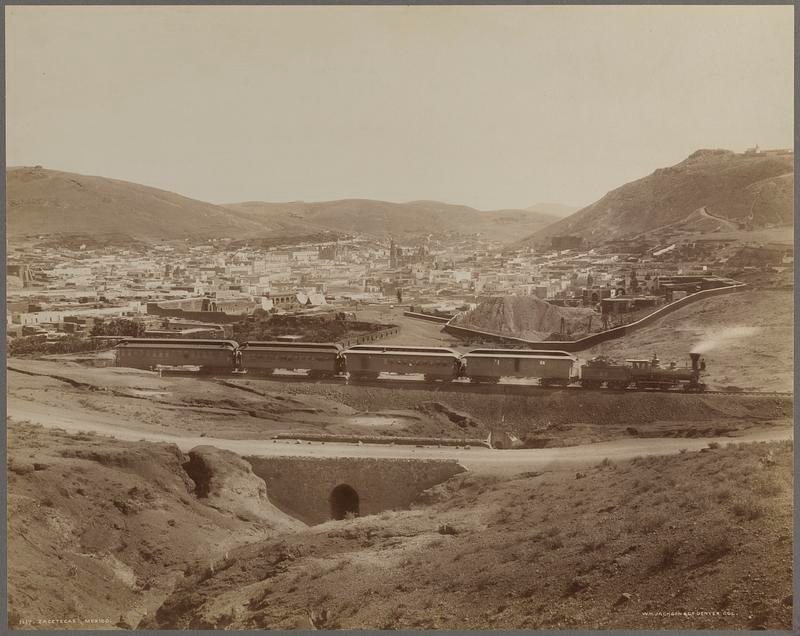
Bonilla kept looking up. For the night of November 27, 1885, when astronomers expected the Earth to meet the debris of Biela’s comet, which had split in two and vanished decades earlier, he organized his students and correspondents across the state to count meteors, and logged 240 in half an hour himself; his assistant counted 2,720 by three in the morning. Days later a rancher, Eulogio Mijares, sent him an iron he had seen fall that night at Rancho Concepción, near Mazapil in the north of the state. Mijares wrote of a strident noise, “exactly as if a piece of red-hot iron had been plunged into cold water,” a phosphorescent light bursting in the air with sparks, neighbors running out to help calm his frightened horses, and a hole in the ground with a ball of light glowing at the bottom. Everyone backed away, fearing an explosion, and when they finally tried to lift it out it was still too hot to hold. Bonilla traveled the 210 kilometers to the site and weighed the iron at 3,950 grams, and the American mineralogist William Earl Hidden exhibited it in New York in January 1887 as a meteorite that had fallen during the Biela shower. That April Bonilla was in Paris, at a meeting of the new Société astronomique de France. A member had just reported bodies crossing the Sun, and another had remarked that it was easy to tell whether such corpuscles were birds, but that so many things drift through the atmosphere that it was hard to know what to make of them. Bonilla spoke next. He showed a photograph of the Mazapil stone and, the minutes say, recalled the observation he had made in 1883 of a phenomenon of this kind “for two days without interruption.” Nothing in L’Astronomie records him answering the editors’ birds more directly than that.
Sources: Uranolithe tombé au Mexique pendant la pluie d’étoiles filantes du 27 novembre 1885On an iron meteorite that fell at Mazapil, Mexico, during the display of “Bielid” meteors, November 27, 1885Mining the Sky: José Árbol y Bonilla, Zacatecas Meteorites, and the Circulation of Scientific Knowledge
Charles Fort’s extraordinary picture
The swarm then slept in the bound volumes of L’Astronomie for a generation, until Charles Fort found it. Fort, the New York collector of anomalies who spent years copying “damned” data out of scientific journals, put Bonilla into The Book of the Damned in 1919, between the bodies seen crossing the Sun at Bangalore and Riccò’s “cranes” crossing it at Palermo. He followed Bonilla’s telegrams and his reckoning that the bodies were nearer than the Moon, and cheerfully refused to choose between “birds or bugs or hosts of a Super-Tamerlane.” Then he turned to the plate. “It may be that in the history of photography no more extraordinary picture than this has ever been taken,” he wrote. It showed, he said, “a long body surrounded by indefinite structures, or by the haze of wings or planes in motion.”
Sources: The Book of the Damned
An armada for the saucer age
When flying saucers arrived in 1947, their first historians went looking for precedents, and Fort had left them Zacatecas. In The Coming of the Saucers in 1952, Kenneth Arnold and Ray Palmer turned the 116 bodies of the second morning into 1,166, sent them from east to west, and imagined an interplanetary army or fleet of some thousands of space ships voyaging between the Earth and the Moon; Flammarion, they wrote, had suggested insects, birds or dust, “But Bonilla did not agree.” The next year Desmond Leslie, in Flying Saucers Have Landed, had the astronomer see “143 circular objects with projecting streamers, or rays,” a count that stuck. Leslie went further. In his telling the bodies were small dark ovals with five ray-like projections, one of them paused and hovered long enough to be photographed, and Mexico City did see them, a little way off the Sun. He claimed to have traced a copy of the photograph to an attic in Paris and made a special journey to see it, only to find it old and faded, and past reproducing. Frank Edwards, in 1956, called it “the first photograph of an unidentified flying object,” quoted Bonilla as saying he had photographed “most of these strange bodies in projection and in profile,” a line Bonilla never wrote that seems to come from Harold Wilkins’s Flying Saucers on the Attack of 1954, and declared the photographs still extant. A 1961 British bulletin, reprinting a note from a reader in Mexico City, said the photographs were said to be the property of the Mexican government. Jacques Vallée, in Anatomy of a Phenomenon in 1965, described formations of circular objects crossing the Sun at regular intervals in groups of fifteen to twenty, then asked the question the editors had asked eighty years earlier: how could anyone be sure they were not flocks of birds? Antonio Ribera, following Wilkins, described in 1969 a body shaped like a five-pointed star with a dark center. And in Operation Trojan Horse in 1970, John Keel opened his history of the phenomenon with Bonilla’s “long parade of circular objects,” 143 of them, photographed as cigar- and spindle-shaped shapes by a man who, Keel said, reckoned they had passed some 200,000 miles up. None of it is in Bonilla’s report.
Sources: The Coming of the SaucersFlying Saucers Have LandedStrangest of AllLUFORO Bulletin vol. 2 no. 4Anatomy of a PhenomenonPlatillos volantes en Iberoamérica y EspañaOperation Trojan HorseUFO Register vol. 6, parts 1–2Étranges météores
Four hundred forty-seven ships
In the 1970s the case came home to its source, and grew. In 1978 the Belgian researcher Michel Bougard reprinted Bonilla’s French text in full in the journal of SOBEPS, the Belgian UFO society, argued that the bodies were doubtless the same objects reported over other countries in the months that followed, from searchlight-like beams after Krakatoa to a “torpedo” over Texas, and suggested that ufologists stop dating the birth of their subject to June 1947 and move it to August 1883, “in memory of the astronomer Bonilla.” The next year Colman VonKeviczky, founder and president of ICUFON, the Intercontinental UFO Galactic Spacecraft Research and Analytic Network, published “The 447 UFOs of Zacatecas” in the Barcelona magazine Mundo Desconocido. By his count Bonilla and his assistant registered “283 + 48 = 331” on the first day and 116 spaceships on the second, flying in consecutive waves and squadrons of fifteen to twenty. ICUFON, he said, had written to the Zacatecas observatory on August 31, 1976, asking for information: “Nobody answered!” A representative in Argentina had asked again in January 1977 and been ignored. VonKeviczky called it the silence and dissimulation of the astronomers, printed a Spanish translation that labeled Bonilla’s everyday gelatin-bromide plates a daguerreotype process, and gave the ships a distance of 242,000 kilometers. In 1981 he repeated it in English in the French bulletin Ufologie Contact: “The first offical UFO photograph! A UFO ARMADA!” An English translation of the report also went into Trevor James Constable’s Sky Creatures, a book arguing that some UFOs were living creatures of the upper air, in an appendix by Larry Arnold on “critters” in history. In 1994 the Mexican magazine Perspectivas Ufológicas translated the report again and offered a different culprit: dust from Krakatoa, which had been rumbling for weeks and would explode two weeks after Bonilla’s second morning.
Sources: Le dossier photoLos 447 OVNIs de ZacatecasUfologie Contact, new series no. 6El Informe BonillaSky Creatures: Living UFOs
A comet that nearly hit the Earth
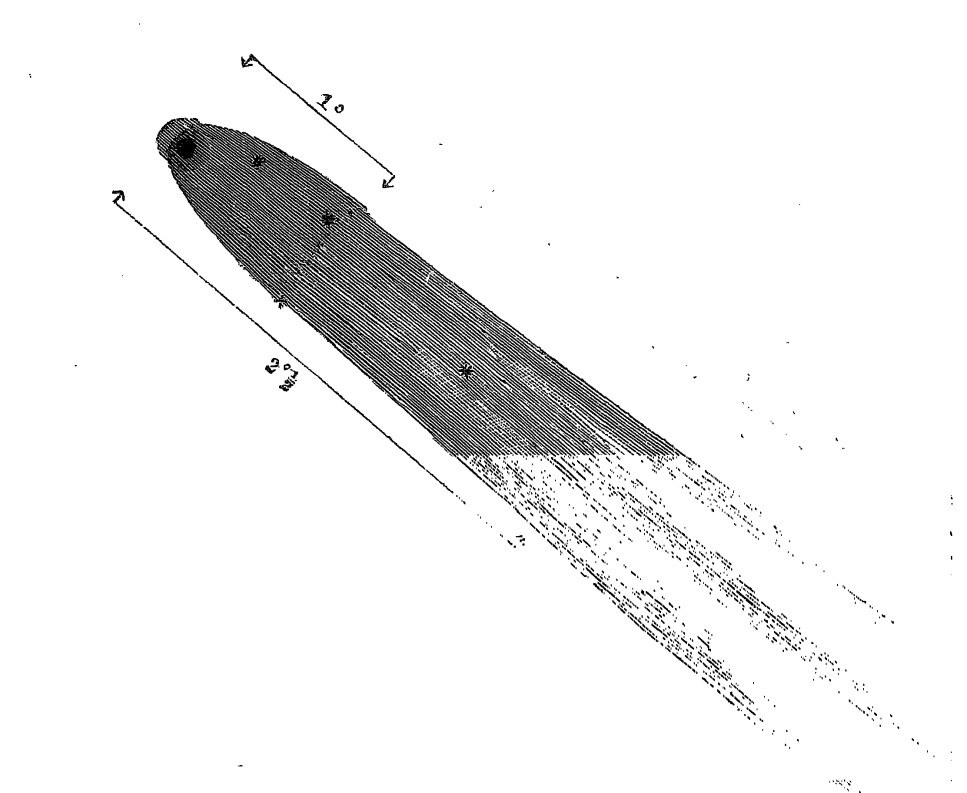
In October 2011 three researchers at Mexico’s national university, the space physicist Héctor Javier Durand Manterola, the historian of science María de la Paz Ramos Lara and Guadalupe Cordero, took Bonilla’s numbers at face value and posted a startling reading. If the bodies were invisible from Mexico City, 603 kilometers away, and Puebla, 728 kilometers away, they could be no farther than about 64,800 kilometers from Zacatecas. If they were fragments of a comet moving at 15 to 75 kilometers a second, Bonilla’s crossing times put them between 538 and 8,062 kilometers from the Earth’s surface, each 46 to 795 meters wide, with masses up to billions of tons. Extrapolating his rate across the 25 hours from the first morning to the second gave about 3,275 fragments, from a parent comet up to eight times the mass of Halley’s. Their candidate was a comet already broken up before 1883, perhaps one of the two comets seen that year, such as Pons–Brooks, whose orbit tilted about as steeply as Bonilla’s tracks. “If they had collided with Earth,” they wrote, “we would have had 3275 Tunguska events in two days, probably an extinction event,” the Tunguska event being the 1908 blast that flattened some 2,000 square kilometers of Siberian forest. MIT Technology Review ran the story as a billion-ton comet that may have missed the Earth by a few hundred kilometers. The astronomer Phil Plait was “very skeptical”: a swarm that close should have lit the sky with meteors, and no comet was seen. Durand Manterola, unbowed, told Mexico’s Notimex agency it was a plausible theory for an event a Mexican had recorded in 1883.
Sources: Interpretation of the observations made in 1883 in Zacatecas (Mexico): A fragmented Comet that nearly hits the EarthBillion-Ton Comet May Have Missed Earth by a Few Hundred Kilometers in 1883Did a fragmenting comet nearly hit the Earth in 1883? Color me very skepticalWas the First Photographed UFO a Comet?En 1883 mexicano captó cometa que casi choca con la Tierra
The telescope still turns
Bonilla went on to write an elementary cosmography, joined the Astronomical Society of the Pacific in 1890, experimented with spark-gap radio in 1906, and in 1911 moved to Mexico City to direct the National School of Arts and Trades. He died there on May 13, 1920. The French equatorial he pointed at the Sun in 1883 did not leave Zacatecas. In 2015 Notimex found it still in use, brass fittings and all, at an observatory of the Autonomous University of Zacatecas now named for Manuel Ríos Herrera, open to the public on weeknight evenings, and repeated the local pride: this was the telescope that took the first photographs of UFOs, though researchers, the agency added, now thought they had been comet debris. The university has awarded a José Árbol y Bonilla medal since 2007, and in 2023 the historian Rocío Gomez published a study of how Zacatecas, through Bonilla and others, fed the world’s meteorite science, with the Mazapil fall as one of its two cases. No one has published the original plates since 1885.
Sources: Instituto de Ciencias de Zacatecas: José Árbol y Bonilla, breves de la historiaPrimeras fotos de “OVNIS” fueron captadas en Zacatecas en 1883Mining the Sky: José Árbol y Bonilla, Zacatecas Meteorites, and the Circulation of Scientific KnowledgeJosé Árbol y Bonilla
What survives
The case rests on one document: Bonilla’s four-page report in L’Astronomie for September 1885, with his drawing of the tracks and a halftone of one photograph, followed by the editors’ note. The journal’s 1884 notice on the new observatory confirms that the passage of corpuscles on August 12–13, 1883, had been reported to Paris well before the full account appeared; the letters of February 1886 show readers taking it seriously, and the society minutes of April 1887 show Bonilla still citing it. No 1883 Mexican newspaper account, no reply from the Mexico City or Puebla observatories and no observing log has been found, and the original glass plates have not been located. Edwards’s 1956 claim that the photographs survived, a 1961 bulletin’s claim that the Mexican government held them, and Leslie’s faded copy in a Paris attic were never documented. Quotations from the French are this archive’s translations.
Sources: Passage sur le disque solaire d’un essaim de corpuscules, vu à l’Observatoire de Zacatecas (Mexique)Nouvel observatoire au MexiquePassage de corpuscules devant le SoleilUranolithe tombé au Mexique pendant la pluie d’étoiles filantes du 27 novembre 1885LUFORO Bulletin vol. 2 no. 4
How the numbers grew
Bonilla’s own counts were 283 in two hours and 48 in forty minutes on August 12, and 116 in forty-five minutes on August 13: 447 in all. The retellings rarely kept them. Arnold and Palmer made the second morning 1,166; Leslie and Keel settled on 143, and the French-language bulletin Vimana, in 1969, dropped a digit and made it 13; Ralph and Judy Blum, in 1974, gave “almost 150,” along with Keel’s cigar and spindle shapes, word for word. The direction flipped from west-to-east to east-to-west in Arnold and Edwards. Irregular bodies, round to the eye, became cigar- and spindle-shaped craft, five-rayed ovals, regular formations, squadrons and a five-pointed star. The distance Bonilla left at “smaller than the Moon” became 200,000 miles in Keel and 242,000 kilometers in VonKeviczky, and his one published photograph became a set of surviving plates. When the British catalogue UFO Register listed the world’s UFO photographs in 1975, it made Zacatecas entry 0001. The skeptic Marc Hallet noted in 1986 that even the copies of the photograph in UFO books had drifted, carrying a distortion the original did not have, a sign that each writer had copied the last.
Sources: Passage sur le disque solaire d’un essaim de corpuscules, vu à l’Observatoire de Zacatecas (Mexique)The Coming of the SaucersFlying Saucers Have LandedOperation Trojan HorseSoucoupes volantes dans le passéBeyond Earth: Man’s Contact with UFOsStrangest of AllLos 447 OVNIs de ZacatecasUFO Register vol. 6, parts 1–2Étranges météores
Explanations
The oldest answer is still the commonest. Paris proposed birds, insects or high dust in 1885, and the Bangalore bodies reported in 1870, which Herschel’s letter recalled, were in the end taken by their observer, Fort records, for “locusts or flies of some sort.” The writer John Spencer suggested an out-of-focus flock of ducks; Plait, in 2011, allowed for birds or an odd atmospheric phenomenon. Close, small objects would explain why Mexico City and Puebla saw nothing, why the Sun and the bodies could not both be in focus, and why the dark shapes shone once they left the disc. Against that stands Bonilla himself, a professional who watched for three and a half hours over two days, saw the bodies shine and trail outside the Sun, and, from his focusing test, judged them far off but nearer than the Moon. The editors’ first thought, the Perseid meteors, runs into the objection they raised themselves: Mexico City and Puebla saw nothing. Krakatoa dust has no known link to a stream of discrete bodies. The comet hypothesis explains the swarm but not the missing meteor storm, and the 1883 Perseids, as Universe Today noted, were an unremarkable display. More than 140 years on, the swarm is unidentified, and the answer depends on how far one trusts a single astronomer’s count, timing and focusing screw.
Sources: Passage sur le disque solaire d’un essaim de corpuscules, vu à l’Observatoire de Zacatecas (Mexique)Passage de corpuscules devant le SoleilThe Book of the DamnedEl Informe BonillaInterpretation of the observations made in 1883 in Zacatecas (Mexico): A fragmented Comet that nearly hits the EarthDid a fragmenting comet nearly hit the Earth in 1883? Color me very skepticalWas the First Photographed UFO a Comet?
Classification note
Zacatecas is filed here as a mass sighting because the report concerns hundreds of objects counted over two days by an astronomer and his assistant, not because many independent witnesses saw them; the observatories that were asked to look saw nothing. No close-encounter kind is assigned: the bodies were seen only through a telescope against the Sun, at a distance Bonilla could not measure. The “first UFO photograph” label belongs to later writers. Bonilla called them simply bodies, “corps,” and never offered an explanation of his own.
Sources: Passage sur le disque solaire d’un essaim de corpuscules, vu à l’Observatoire de Zacatecas (Mexique)Strangest of AllOperation Trojan Horse
- 6 DEC 1882
The Zacatecas observatory begins work on the day of the transit of Venus, directed by José A. y Bonilla.
- 15–16 APR 1883
In Marseille, H. Bruguière sees small shapeless bodies crossing the Sun from west to east.
- 12 AUG 1883 · 8:00 AM
Drawing sunspots, Bonilla sees a small body cross the Sun; he counts 283 in two hours.
- 12 AUG 1883 · NOON
In forty minutes around noon he counts 48 more.
- 12–13 AUG 1883
Bonilla photographs the bodies; one wet collodion plate, exposed at a hundredth of a second, is later printed in Paris.
- 12 AUG 1883
Bonilla telegraphs the Mexico City and Puebla observatories; neither sees the bodies.
- 13 AUG 1883 · FROM 8:00 AM
After the clouds clear, he and his assistant count 116 bodies in forty-five minutes.
- 1884
L’Astronomie announces the new observatory and notes the passage of corpuscles of August 12–13, 1883.
- SEP 1885
L’Astronomie publishes Bonilla’s report, his drawing and the photograph; its editors suggest birds, insects or dust.
- 27 NOV 1885
During the Biela meteor shower an iron falls near Mazapil; Bonilla’s account is read in New York in January 1887.
- FEB 1886
Letters from J. Herschel and H. Bruguière link the swarm to earlier bodies seen crossing the Sun at Bangalore and Marseille.
- 20 APR 1887
In Paris, Bonilla recalls his 1883 observation at the Société astronomique de France.
- 1919
Charles Fort includes the swarm and the photograph in The Book of the Damned.
- 1952
Kenneth Arnold and Ray Palmer turn the swarm into a fleet of space ships between the Earth and the Moon.
- 1953–1970
Leslie, Edwards, Vallée, Ribera and Keel retell the case; Edwards and Keel call it the first UFO photograph.
- DEC 1979
Colman VonKeviczky publishes “The 447 UFOs of Zacatecas” in Mundo Desconocido.
- 12 OCT 2011
UNAM researchers propose a fragmented comet that passed a few hundred to a few thousand kilometers from the Earth.
- OCT 2015
Notimex reports Bonilla’s telescope still in use at a Zacatecas university observatory.
Sources & interviews
Passage sur le disque solaire d’un essaim de corpuscules, vu à l’Observatoire de Zacatecas (Mexique)José A. y Bonilla, with the editors’ note · L’Astronomie vol. 4, no. 9 · Gauthier-Villars, Paris, September 1885, pp. 347–350, figs. 118–119 · Internet ArchiveNouvel observatoire au MexiqueL’Astronomie vol. 3 · Gauthier-Villars, Paris, 1884, pp. 311–312 · Internet ArchivePassage de corpuscules devant le SoleilLetters from J. Herschel and H. Bruguière, with the editors’ comments · L’Astronomie vol. 5 · February 1886, pp. 70–71 · Internet ArchiveUranolithe tombé au Mexique pendant la pluie d’étoiles filantes du 27 novembre 1885José A. y Bonilla · L’Astronomie vol. 6 · August 1887, pp. 281–284, and the Société astronomique de France meeting of April 20, 1887, p. 468 · Internet ArchiveOn an iron meteorite that fell at Mazapil, Mexico, during the display of “Bielid” meteors, November 27, 1885William Earl Hidden, with an account of its fall by José A. y Bonilla · Transactions of the New York Academy of Sciences vol. 6 · January 17, 1887 · Internet ArchiveThe Book of the DamnedCharles Fort · Boni and Liveright, New York, 1919 · Project GutenbergThe Coming of the SaucersKenneth Arnold and Ray Palmer · Amherst Press, Boise and Amherst, 1952, chapter 8 · Internet ArchiveFlying Saucers Have LandedDesmond Leslie and George Adamski · Werner Laurie, London, 1953; 1957 edition · Internet ArchiveStrangest of AllFrank Edwards · Lyle Stuart, New York, 1956; Ace edition 1962, pp. 167–168 · Internet ArchiveLUFORO Bulletin vol. 2 no. 4London Unidentified Flying Object Research Organisation · April 1961, quoting S.P.A.C.E. no. 49 · Internet ArchiveAnatomy of a PhenomenonJacques Vallée · Henry Regnery, Chicago, 1965, p. 30 · Internet ArchivePlatillos volantes en Iberoamérica y EspañaAntonio Ribera · Pomaire, Barcelona, 1969, pp. 24–25 · Internet ArchiveOperation Trojan HorseJohn A. Keel · G. P. Putnam’s Sons, New York, 1970, p. 31 · Internet ArchiveSky Creatures: Living UFOsTrevor James Constable · appendix by Larry Arnold, “The Critters in History,” with an English translation of Bonilla’s report · Internet ArchiveSoucoupes volantes dans le passéJ.-C. Dufour · Vimana no. 6, C.E.R.E.I.C. · August 1969 · Internet ArchiveBeyond Earth: Man’s Contact with UFOsRalph and Judy Blum · Bantam, New York, 1974 · Internet ArchiveUFO Register vol. 6, parts 1–2Contact UK · 1975 · photographic catalogue, entry 0001 · Internet ArchiveLe dossier photoMichel Bougard · Inforespace no. 41, SOBEPS, Brussels, 1978, pp. 18–20, with the French text of Bonilla’s report · Internet ArchiveLos 447 OVNIs de ZacatecasColman S. VonKeviczky, ICUFON · Mundo Desconocido no. 42, Barcelona, December 1979, pp. 61–65 · Internet ArchiveUfologie Contact, new series no. 6Colman S. VonKeviczky, ICUFON · January 1981 · English-language piece on the Zacatecas “armada” · Internet ArchiveÉtranges météoresMarc Hallet · from Astronomes et OVNIs, 1986 · Internet ArchiveEl Informe BonillaÓscar García · Perspectivas Ufológicas no. 3, Mexico, September 1994 · Internet ArchiveInterpretation of the observations made in 1883 in Zacatecas (Mexico): A fragmented Comet that nearly hits the EarthHéctor Javier Durand Manterola, María de la Paz Ramos Lara and Guadalupe Cordero, UNAM · arXiv:1110.2798 · October 12, 2011Billion-Ton Comet May Have Missed Earth by a Few Hundred Kilometers in 1883Emerging Technology from the arXiv · MIT Technology Review · October 17, 2011Did a fragmenting comet nearly hit the Earth in 1883? Color me very skepticalPhil Plait · Bad Astronomy · October 17, 2011Was the First Photographed UFO a Comet?Jon Voisey · Universe Today · October 2011En 1883 mexicano captó cometa que casi choca con la TierraNotimex · El Universal, Mexico City · October 18, 2011Primeras fotos de “OVNIS” fueron captadas en Zacatecas en 1883Notimex · Excélsior, Mexico City · October 8, 2015Instituto de Ciencias de Zacatecas: José Árbol y Bonilla, breves de la historiaLa Jornada Zacatecas · March 16, 2022Mining the Sky: José Árbol y Bonilla, Zacatecas Meteorites, and the Circulation of Scientific KnowledgeRocío Gomez · Mexican Studies/Estudios Mexicanos vol. 39 no. 3 · Fall 2023, pp. 401–426José Árbol y BonillaWikipedia (Spanish)Spotted an error, or know a better source? Write to hello@uap.fun.
Connected files
The Sky Battle over NurembergThree centuries earlier, a Nuremberg broadsheet recorded globes, crosses and tubes pouring in and out of the rising Sun; both cases survive as a single printed report and a picture.Nine Objects over Mount RainierThe sighting that started the saucer age; five years later Kenneth Arnold’s own book recast Bonilla’s swarm as a fleet of space ships.The Rocket in Lake KölmjärvSweden’s biggest night of ghost rocket reports fell on the Perseid maximum of August 11, 1946; in 1885 Paris first wondered whether Bonilla’s bodies were Perseids too.Jacques ValléeHis 1965 Anatomy of a Phenomenon placed Zacatecas in a long history of pre-1947 sightings, and asked whether the formations were birds.John KeelOpened his history of the phenomenon, Operation Trojan Horse, with Bonilla’s “long parade of circular objects,” photographed, he wrote, as the first UFO ever caught on film.Discuss this case
Compare notes with other readers: witness details, sources, and the parts that still do not add up.
Open the discussion