Something at the sun
The report begins the way a sixteenth-century news sheet should: with the year, the day and a warning that what follows is frightening. On the fourteenth of April 1561, in the early morning, “a very frightful apparition” appeared at the sun as it rose over Nuremberg. It was seen, the text insists, in the city, outside the gates and out in the country, “by many men and women.” Nobody is named, and no council minute backs them up. There is only a single printed sheet, sold by a Nuremberg woodcut printer called Hans Glaser, and a picture of a sky so crowded that modern viewers still cannot stop staring at it. What those anonymous townspeople described, according to Glaser, was not a light or a lone object. It was a battle.
Sources: Himmelserscheinung über Nürnberg vom 14. April 1561 — copy PAS II 12/60Transcription of the 1561 broadsheet text
Between 4 and 5, by the small clock
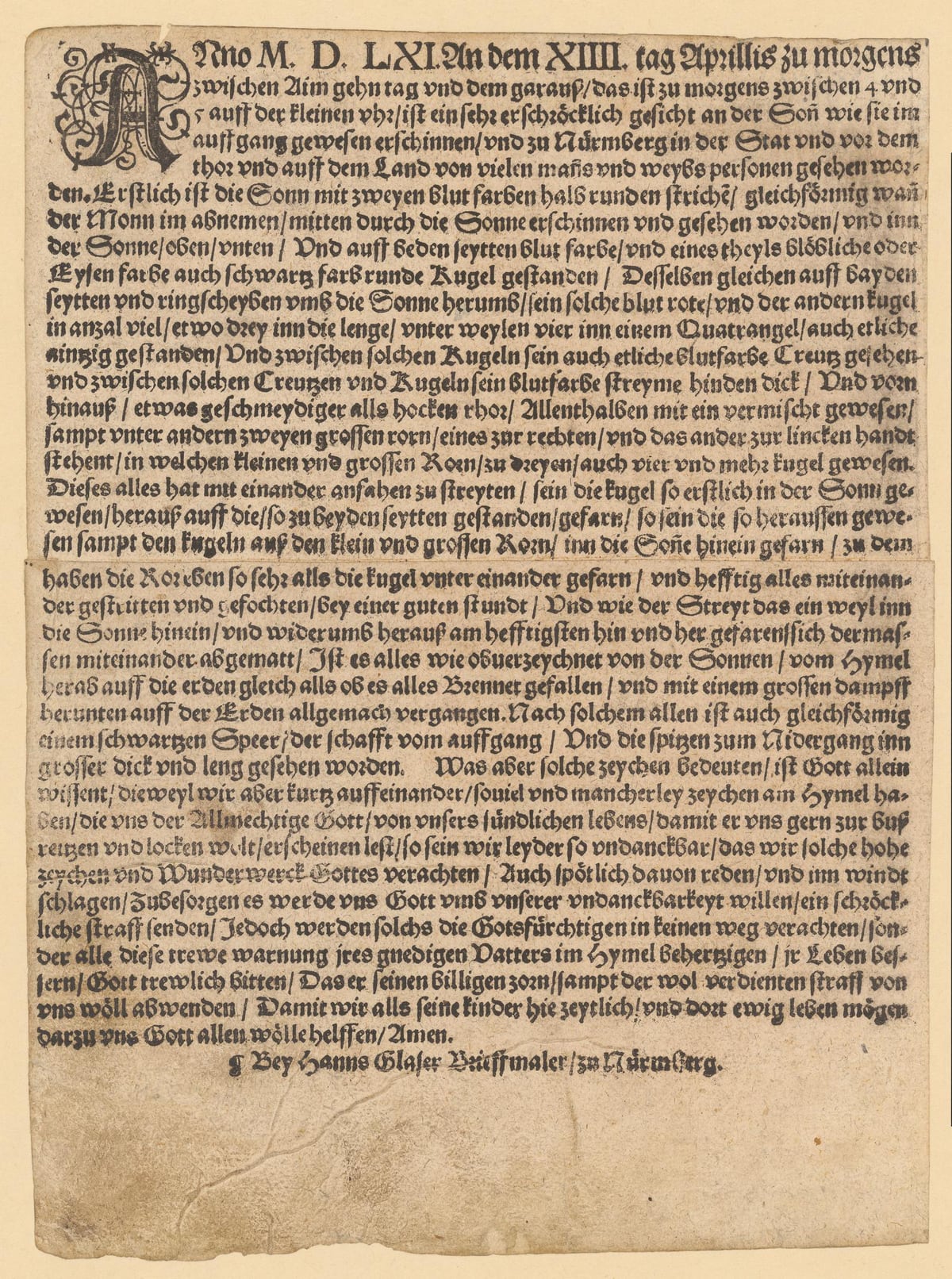
Glaser gives the time twice. First he uses the city’s own reckoning: “between one toward day and the Garaus.” Nuremberg kept a peculiar reckoning, the “great clock,” that counted daylight hours from sunrise and night hours from sunset, with the Garaus bell marking the changeover. Then, helpfully, he translates for everybody else: “in the morning between 4 and 5 on the small clock,” the ordinary twelve-hour count. In mid-April that is the stretch from first light to the moment the sun clears the horizon. The date needs its own small translation. Nuremberg kept the Julian calendar until 1700, so on a modern calendar the morning falls on April 24. Whatever later retellings say, the sheet puts the sight at sunrise.
Sources: Transcription of the 1561 broadsheet textNürnberger Uhr
Globes, crosses and tubes
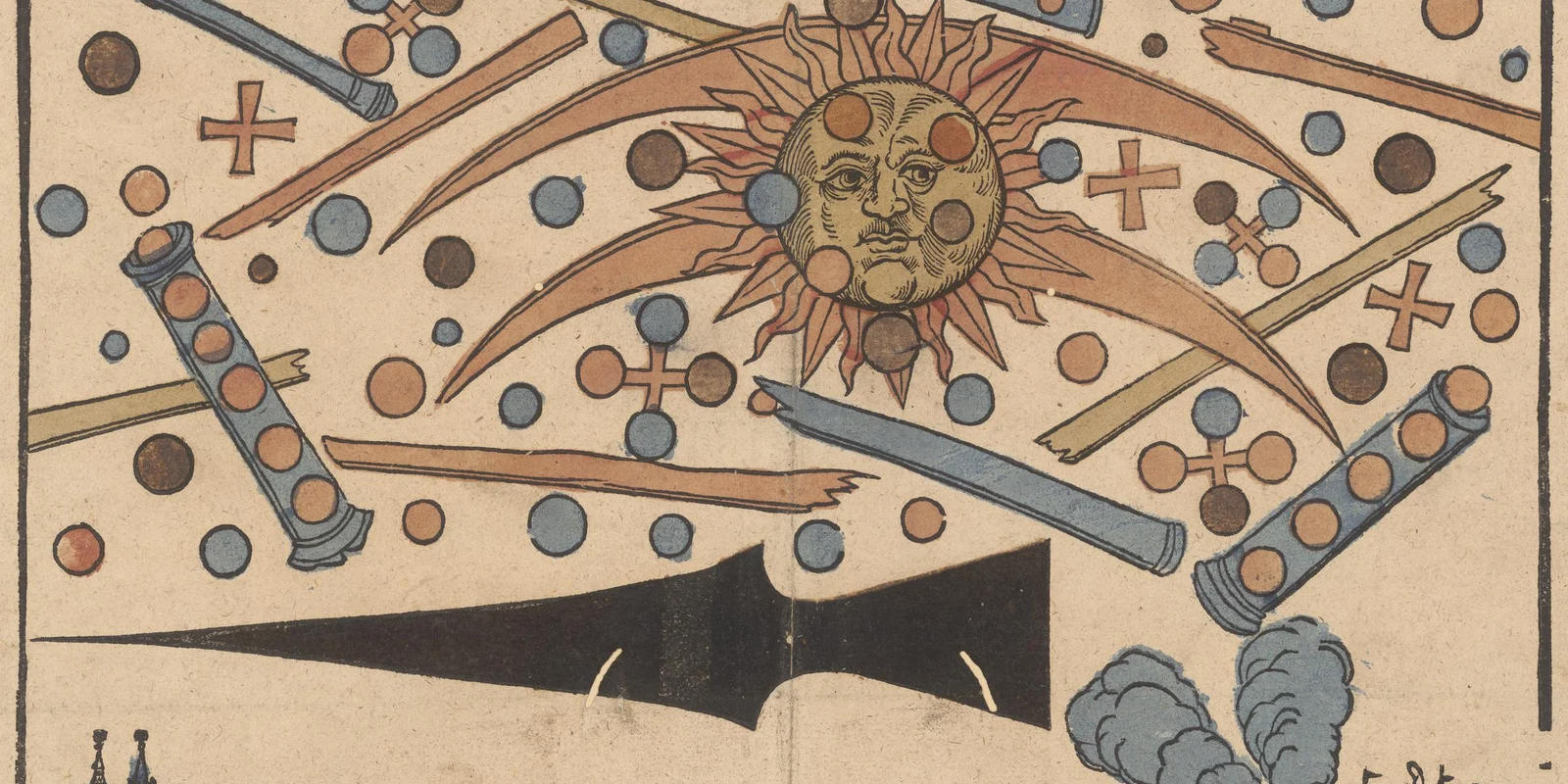
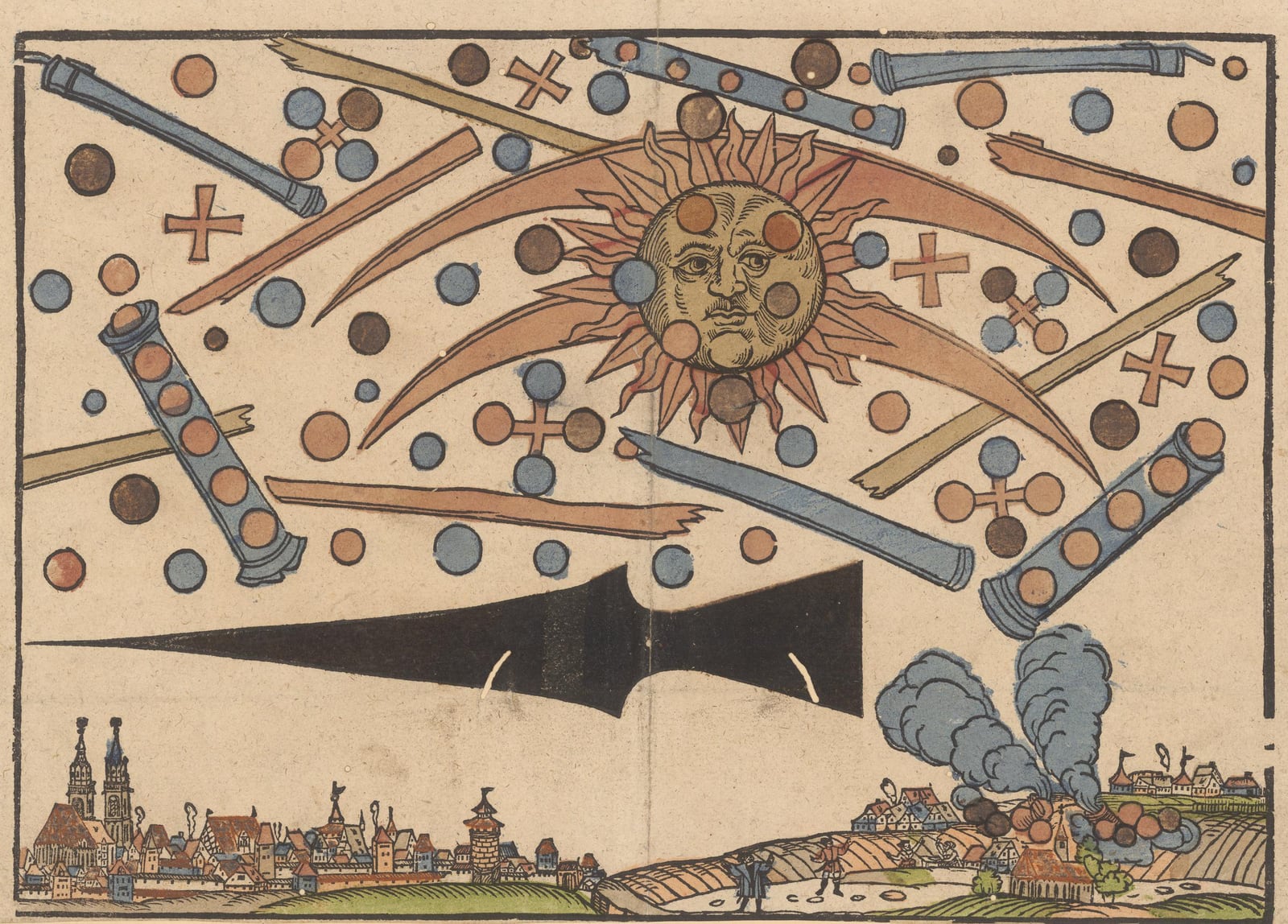
First the sun appeared with “two blood-coloured half-round streaks” running right through its middle, shaped like a waning moon. Then came the balls. They stood in the sun, above it, below it and on both sides: blood-red, bluish or iron-coloured, and black. Around the sun, in what Glaser calls ring-discs, there were many more, “in places three in a row, at times four in a square, and some standing alone.” Among them hung blood-red crosses. Between the crosses and balls ran blood-coloured streaks, thick at the back and thinner at the front. And there were tubes: small ones, and two large ones, one to the right and one to the left, each holding three, four or more balls. The woodcut delivers all of this at once, with the sun glaring out of the middle like an angry face.
Sources: Transcription of the 1561 broadsheet textHimmelserscheinung über Nürnberg vom 14. April 1561 — copy PAS II 12/60
“All of this began to fight”
Then the sky moved. “All of this began to fight with one another,” the sheet says. The balls that had been in the sun flew out toward those standing on either side. Those outside, along with the balls from the small and large tubes, flew into the sun. The tubes themselves moved among one another as much as the balls did, and everything “fought and battled fiercely” for “a good hour.” Glaser’s verbs are the verbs of war—streyten, to battle; fechten, to fight—but his account is oddly abstract. There are no riders, banners or trumpets, no side that wins. There is only exchange: objects pouring into the sun and out again until, in his words, the whole display had worn itself out.
Falling as if burning
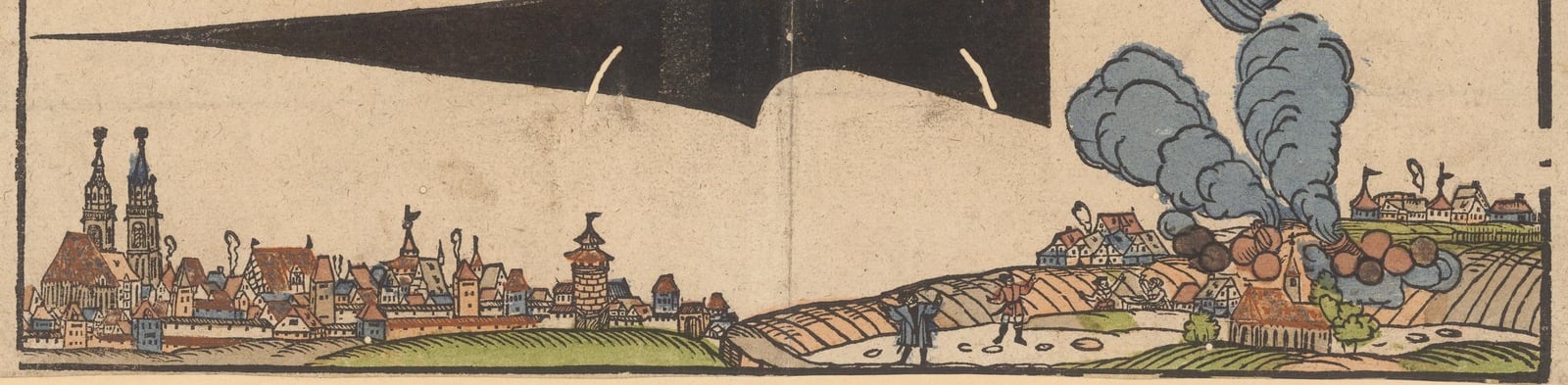
When the fight was spent, everything described above fell from the sun and the sky down to the earth, “as if it were all burning,” and on the ground it gradually passed away “in a great vapour.” The woodcut shows the aftermath at lower right: a heap of coloured balls in the fields beyond the city, with two thick grey-blue columns rolling up from them past a small church. A few tiny figures on the ground below gesture at the sky. The German word for the vapour is dampff, which can mean steam as easily as smoke; Carl Jung’s English translator rendered it “steam,” though Jung himself, a paragraph later, speaks of columns of smoke. Nothing in the text says a building burned, a field was scorched or anything was recovered. Whatever came down simply faded where it landed.
Sources: Transcription of the 1561 broadsheet textFlying Saucers: A Modern Myth of Things Seen in the SkiesHimmelserscheinung über Nürnberg vom 14. April 1561 — copy PAS II 12/60
The black spear
One more thing appeared after all the rest: something “like a black spear,” very thick and long, with its shaft toward the sunrise and its point toward the sunset. In the woodcut it is the most arresting shape on the sheet, a solid black blade longer than the city is wide, driving across the sky beneath the tumult. Retellings have turned it into a “black triangular object,” even a “super-ship.” Glaser says spear, and the woodcut shows one, complete with a flared socket. Its shaft pointed east, where the sun had just risen; its point aimed west.
Sources: Transcription of the 1561 broadsheet text1561 celestial phenomenon over NurembergCelestial Phenomenon over Nuremberg, 1561
“God alone knows”
Having described the sight, Glaser declines to decode it. “What such signs mean, God alone knows.” Then he preaches. So many and such varied signs have appeared in the sky in quick succession, he writes, sent by Almighty God because of our sinful lives to call us to repentance, yet we despise them, mock them and cast them to the wind. A terrible punishment is to be feared. The God-fearing will take their gracious Father’s faithful warning to heart, amend their lives and pray that his just wrath be turned away. The formula was not new: an unsigned Nuremberg sheet on a sky-sign of December 1560 ends in almost the same words. The sheet closes with “Amen” and an imprint: “Bey Hanns Glaser Brieffmaler zu Nürmberg.” For its first readers, the sermon was the point. The frightening picture was what made them stop and read it.
Sources: Transcription of the 1561 broadsheet textHimmelserscheinung über Nürnberg vom 14. April 1561 — copy PAS II 1/12Ein wunderbarlich Gesicht, so am xxviij. Decembris im LX. Jar inn der Statt Nürnberg und ausserhalb ist gesehen worden
Hans Glaser, letter-painter
Glaser was not a chronicler or a clergyman. He was a Briefmaler—literally a letter-painter—one of the Nuremberg craftsmen who cut woodblocks, printed single sheets and coloured them by hand for sale. He appears in the city records from 1538, lived at first near the smelting works and later kept a workshop by the church of St. Lorenz. He made his name with sheets on the sieges of the Second Margrave War of 1552 to 1554, and he also sold images of Landsknecht soldiers. Sky-wonders were a steady line: a blood rain at Dinkelsbühl on May 26, 1554, an apparition over Waldeck that July, a strange sun over Nuremberg in 1556, whose imprint placed his shop “behind St. Lorenz, on the square.” Glaser was buried on June 2, 1573. After 1575 his former apprentice Wolf Drechsel married his widow and went on printing from his blocks.
A winter of signs
Glaser’s complaint about “so many and such varied signs” was not rhetorical padding. The months before April 1561 were busy ones for Nuremberg’s printers. A sheet on December 28, 1560 showed a sky over the city hung with red curtains and flame, which the Zürich library now catalogues as an aurora. From Nuremberg presses came a triple sun with interlocking rings seen at Rothenburg on January 16, and an apparition between Eisleben and Mansfeld on February 27 with two ash-grey columns belching black vapour, a rod and a crucified Christ in the clouds. Glaser himself printed a sheet on a bristling moon seen over the city on March 2. Six weeks later came the globes and tubes. To readers who had been buying these sheets all winter, April’s wonder arrived as the latest instalment in a series.
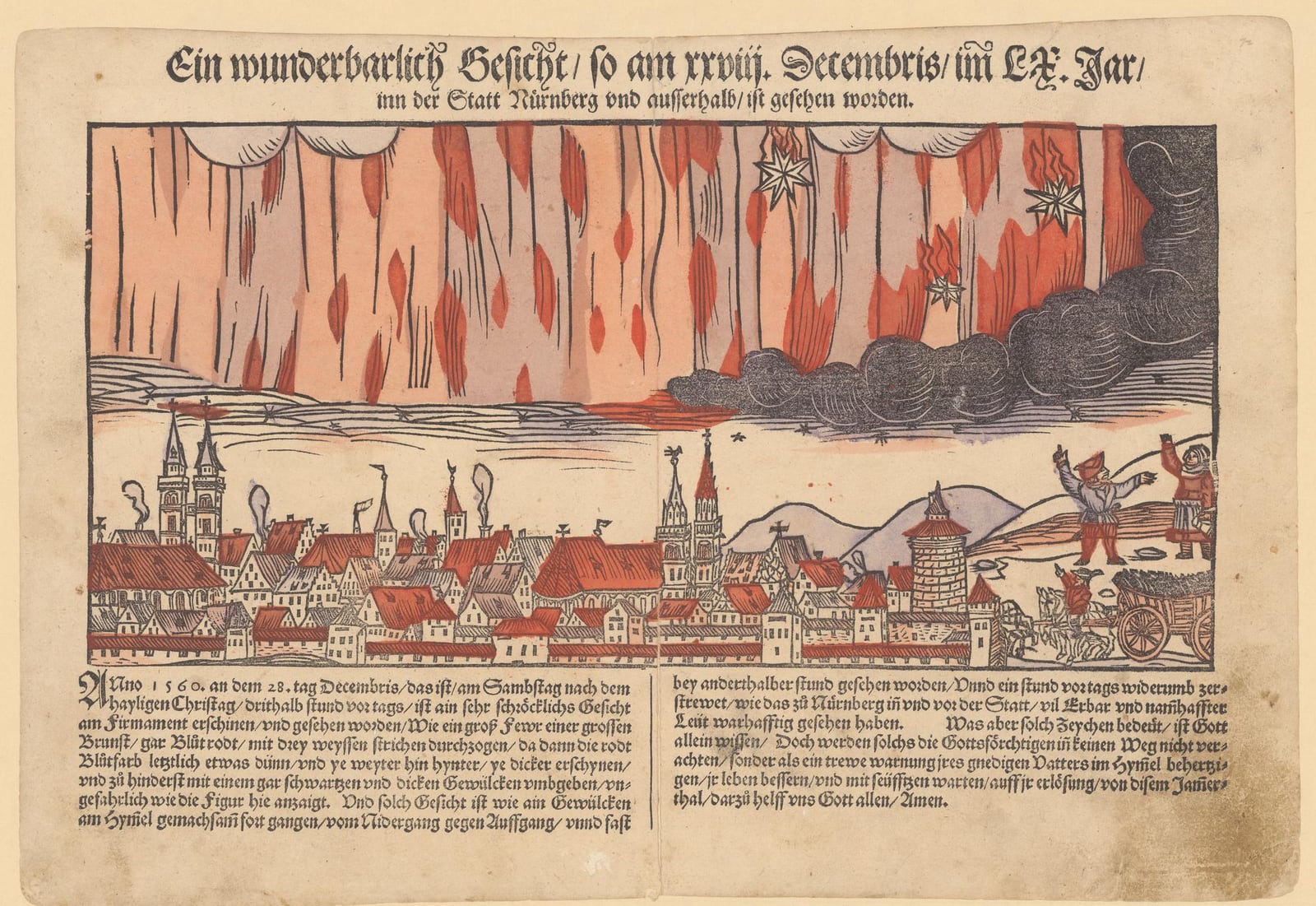
Sources: Ein wunderbarlich Gesicht, so am xxviij. Decembris im LX. Jar inn der Statt Nürnberg und ausserhalb ist gesehen wordenWarhaffte Zeichen und Zeyttung, so zu Rottenburg uff der Tauber den 16. Januarii 1561 gesehenApparition between Eisleben and Mansfeld, February 27, 1561Ein Wunderbarlich Gesicht des Monds, so yetz neulich den andern tag des Mertzens inn diesem LXI. Jar von vielen personen zu Nürmberg warhafftig gesehen
The pastor who kept everything
Glaser’s sheet survives because a Zürich clergyman was collecting wonders. Johann Jakob Wick, born in 1522, served as a pastor and from 1557 as a canon of Zürich’s Grossmünster. From 1560 until his death in 1588 he filled twenty-four folio volumes with handwritten reports and pasted-in print: around five hundred pamphlets and more than four hundred single sheets about comets, monstrous births, floods, crimes and signs in the sky. He called them his books of wonders, and he gathered news through a network whose most important informant was the reformer Heinrich Bullinger. Two copies of the Nuremberg sheet ended up in them. In 1925 the prints were cut out of Wick’s volumes and moved to the library’s print room; in June 2020 the Zentralbibliothek Zürich put both copies online at very high resolution. Every clean reproduction of the woodcut ultimately goes back to Wick.
Sources: Wick, Johann JakobZurich by WickHimmelserscheinung über Nürnberg vom 14. April 1561 — copy PAS II 12/60Himmelserscheinung über Nürnberg vom 14. April 1561 — copy PAS II 1/12
Basel, 1566: the black globes
Wick also preserved the case’s companion. In the summer of 1566 a young Basel student of scripture and the liberal arts, Samuel Coccius, born in 1548, wrote up three sights for the printer Samuel Apiarius. On the evening of July 27 the setting sun lost its rays and brilliance and seemed “to weep blood” against a black sky. The next morning it rose looking the same, washing houses and streets in a fiery glow. Then, at and just before sunrise on August 7, “many large black balls” were seen in the air, moving before the sun at great speed and turning against one another as if fighting a battle; some turned red and fiery, then burned away and went out. Coccius allowed that vapours from a wet year might play a part, but insisted on the meaning. Since balls belong to guns and guns to war, he wrote, Christians should pray that God would topple “the bloodthirsty Ottoman house.”
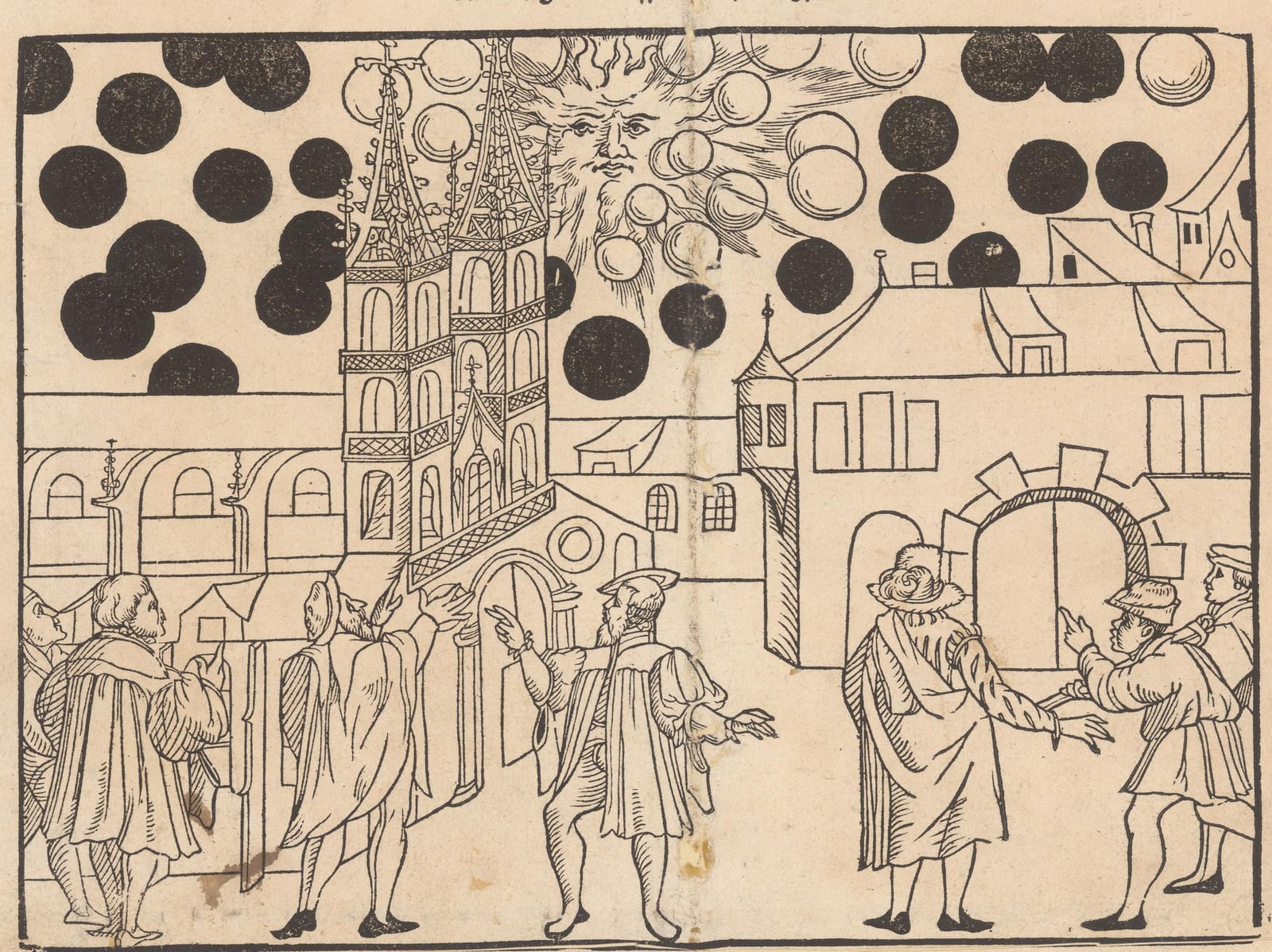
Sources: Seltzame gestalt so in disem M. D. LXVI. Jar … zů Basel … gesehen wordenCoccius, Samuel
Jung finds the mother ships
For almost four centuries the two sheets drew no attention outside the Zürich collection. Then, in 1958, Carl Gustav Jung printed them as plates V and VI of his book on flying saucers, the only examples he offered of the phenomenon’s “previous history.” His reading set the template. The tubes, Jung wrote, are analogous to the cylindrical objects in UFO reports, the “mother-ships” said to carry smaller craft; “the picture shows them in operation.” He saw mandalas in the crosses of four balls and a masculine thrust in the black spear. He also offered a line later retellings rarely quote: “The militaristic interpretation is as characteristic of the sixteenth century as the technological one is of ours.” And he floated a stranger image still. If these things were alive, he mused, one would think of insects rising with the sun—not to fight, but to mate.
Sources: Flying Saucers: A Modern Myth of Things Seen in the SkiesThe UFO Battle over Nuremburg
Into the saucer canon
Jung’s plates became a pipeline. In Anatomy of a Phenomenon in 1965, Jacques Vallée credited Jung and described spheres emerging from inclined tubes in “aerial dances,” placing the Nuremberg and Basel fights among behaviours “almost indescribable in terms of our technology.” The Condon Committee’s 1968 chapter on UFOs in history reproduced a ufology book’s version, which credited the story to “a mediaeval text found in the Annals of Nuremburg by C. R. Jung.” The English translation now circulating most widely online, by Ilse von Jacobi, first appeared in Colman VonKeviczky’s article in Official UFO magazine in January 1976. Vallée and Chris Aubeck gave the case its own entry, headed “Vertical cylinders,” in Wonders in the Sky in 2009. By then it was television material: Ancient Aliens used it in 2010, the German History channel ran an episode titled “UFOs over Nuremberg” in 2022, and Luis Elizondo cited the woodcut on a podcast the same year.
Sources: Anatomy of a PhenomenonScientific Study of Unidentified Flying Objects — Section V, Chapter 1: UFOs in HistoryThe Nuremberg UFOs of 1561Wonders in the Sky: Unexplained Aerial Objects from Antiquity to Modern TimesUFOs über Nürnberg – Das Nürnberger Himmelsspektakel von 1561Lue Elizondo Embraces Ancient Astronaut Theory, Fascinated by Ica Stones Hoax
What the retellings added
As the picture travelled, the story grew. Glaser says the balls were “many”; popular accounts say hundreds. He says everything fell “as if burning” and faded in vapour; the Public Domain Review described “a crash-landing somewhere beyond the city limits,” and UFO Evidence says several objects crashed and that a winner was perceived. The sheet is dated April 14, 1561, yet retellings give April 4, and captions routinely call the woodcut a work of 1566, borrowing Basel’s date. One widely copied version cites a “Nuremberg Gazette” that never existed. Another attaches the call to war against the Turks, which comes from Coccius in Basel. Reading Glaser’s own words is the quickest way to see the original, and it is stranger in some ways than the legend: no winner, no wreckage, only an hour of traffic in and out of the sun.
Sources: Transcription of the 1561 broadsheet textCelestial Phenomenon over Nuremberg (April 14th, 1561)Celestial Phenomenon over Nuremberg, 15611561 celestial phenomenon over NurembergNuremburg UFO “Battle” Debunked
Sun dogs and broken arcs
The leading natural explanation is written in ice. When sunlight passes through high, thin cloud full of hexagonal crystals, it can produce a halo display: a ring around the sun, bright false suns called sun dogs on either side, and arcs curving above, below and across the sky, sometimes tinted red and blue. At sunrise such displays can shift quickly as the sun climbs. A Munich newspaper put the halo reading to Nuremberg readers in 2008, suggesting the black spear might be a comet; Frank Johnson’s 2012 analysis read the balls and crosses as sun-dog effects, the tubes as broken halo arcs, the falling vapour as fall streaks of ice crystals and the spear as a shaft of shadowed light. Nuremberg’s printers certainly knew halos: the German meteor society catalogues accurate halo broadsheets from the city across the century. Even the 2008 article conceded that so many such phenomena rarely appear together.
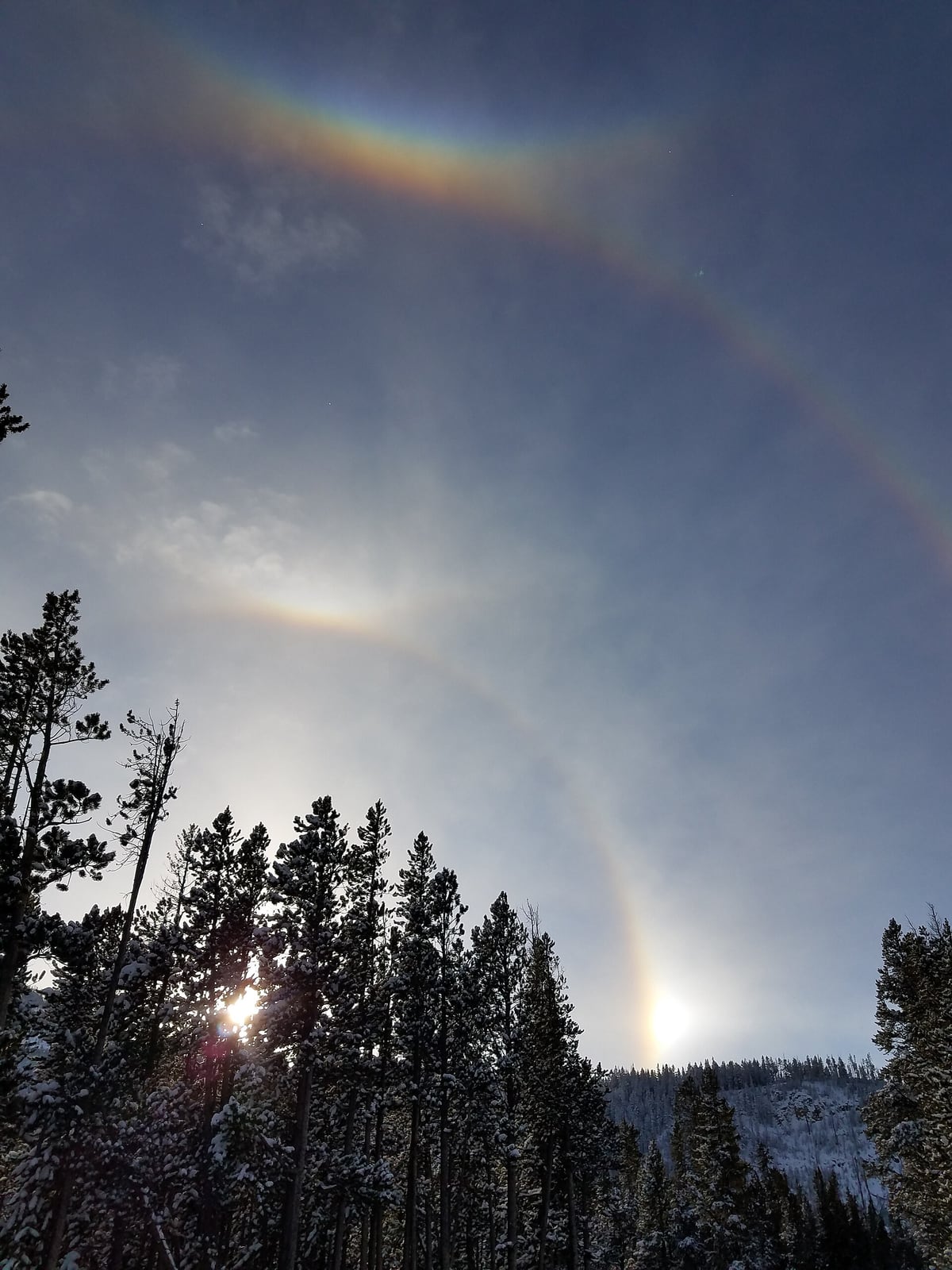
Sources: UFOs über Nürnberg: Was war da los an unserem Himmel?Nuremburg UFO “Battle” DebunkedHalos auf historischen EinblattdruckenThe Nuremberg UFOs of 1561
Three suns over Rothenburg
Three months before the battle, another Nuremberg printer showed what a halo looked like to a sixteenth-century eye. Georg Merckel’s sheet reports that at Rothenburg ob der Tauber on January 16, 1561, three suns stood in the sky around midday, joined by parallel circles and rings. His woodcut draws them as three faces linked by two great interlocking golden hoops, the compass points labelled in Latin, over a coloured townscape of towers and smoking chimneys. The text reaches back to three suns seen in Rome before the civil war of Galba, Otho and Vitellius, and in Hungary in 1525, shortly before King Ludwig fell to the Turks. Today the Zürich catalogue calls it a halo and sun-dog display. Put it beside Glaser’s April sheet and the kinship is clear—faced suns, rings, a sky treated as a stage—but so is the difference. Merckel’s suns stand still. Glaser’s globes move.
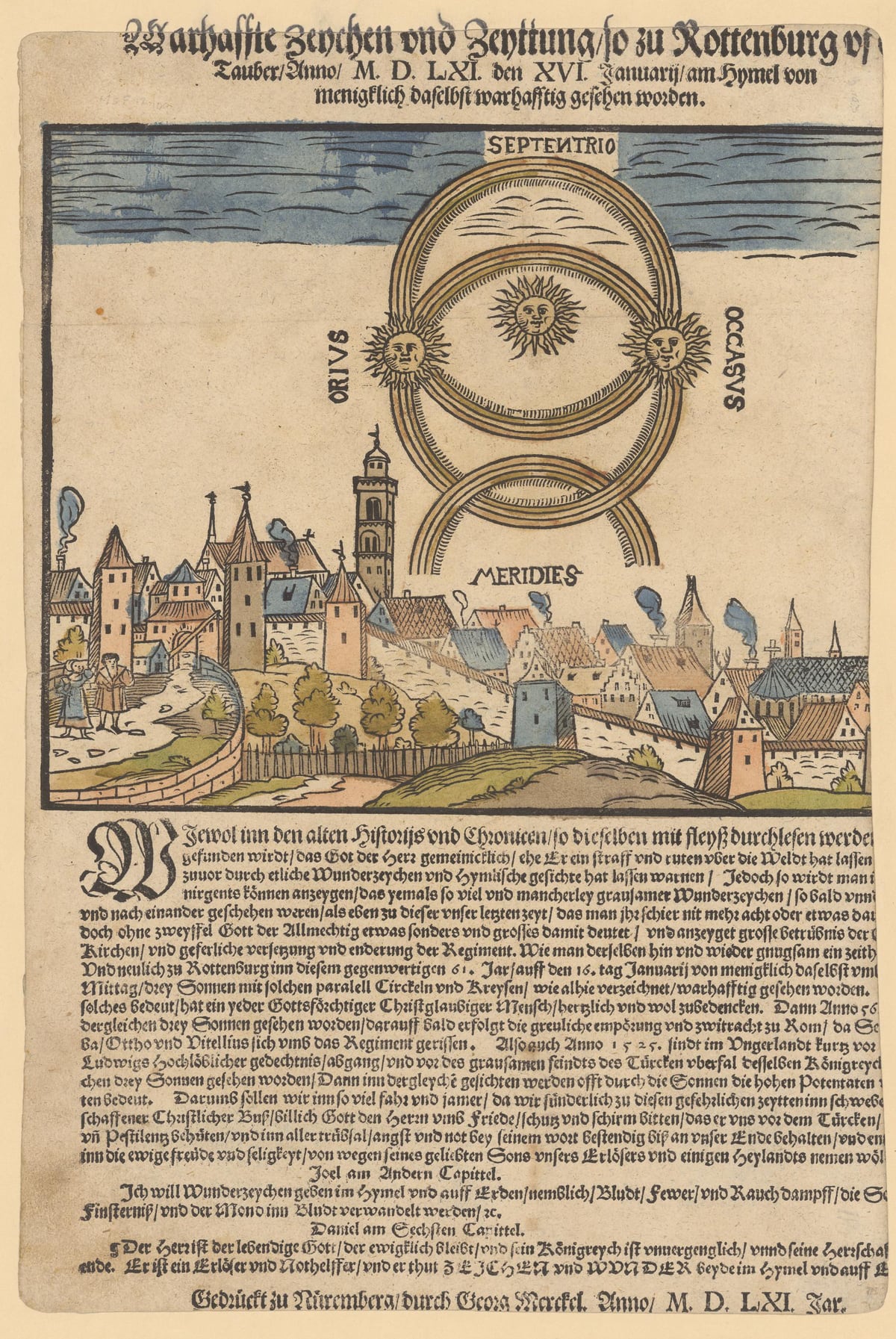
Sources: Warhaffte Zeichen und Zeyttung, so zu Rottenburg uff der Tauber den 16. Januarii 1561 gesehen
The moon with a peacock’s tail
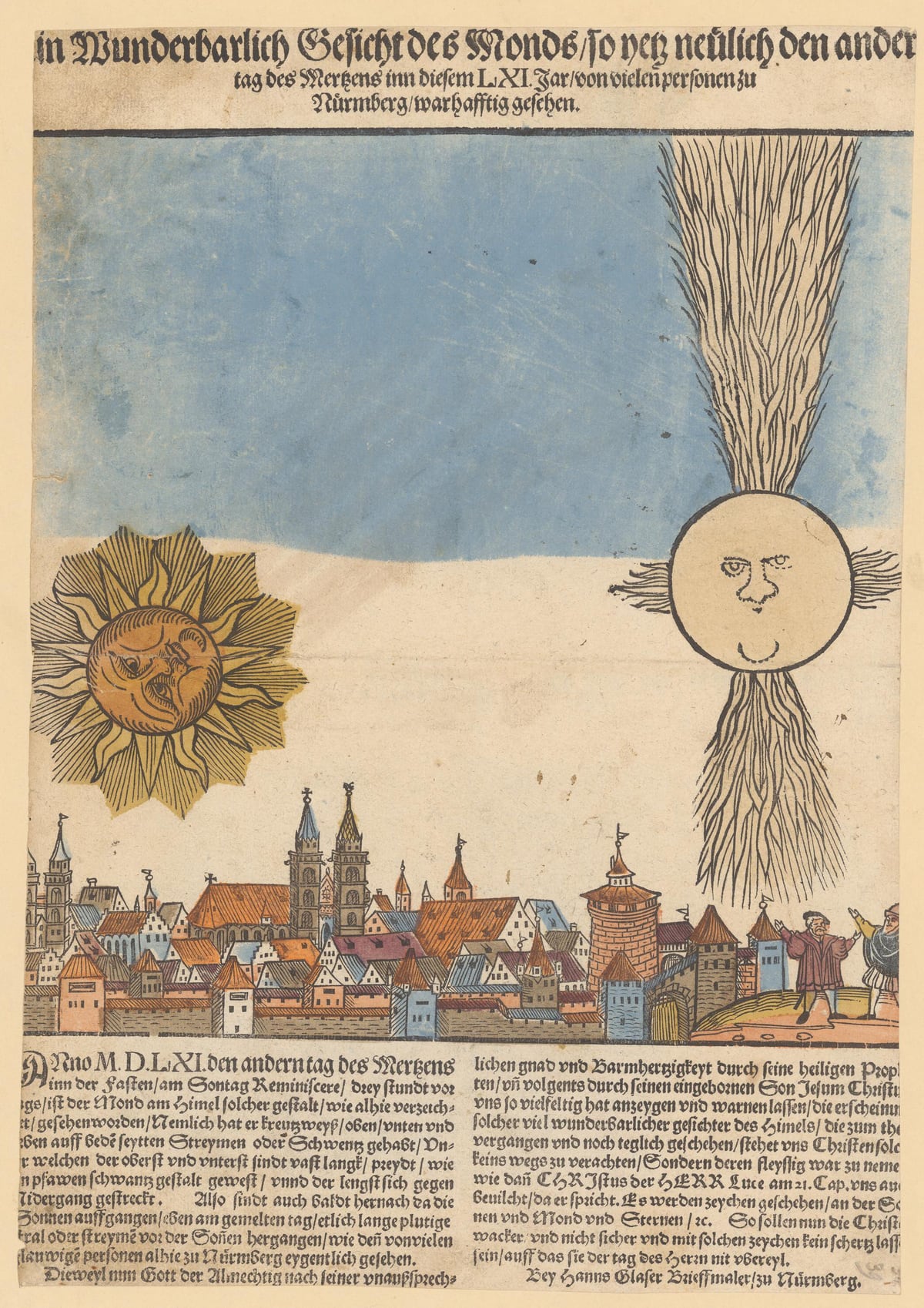
Glaser’s March sheet is the best clue to how he worked. His text describes a moon seen over Nuremberg three hours before daybreak on Sunday, March 2, 1561, with streamers or tails set crosswise—above, below and on both sides—the upper and lower ones very long and broad, “like a peacock’s tail.” Soon after sunrise the same day, long bloody rays ran before the sun. His woodcut shows the moon exactly as described: a pale full moon with a face, bristling with hairy shafts above and below, hanging over a carefully drawn skyline beside a golden sun, while two men on a hill point. The Zürich catalogue describes the phenomenon as a lunar halo with a light cross—an arrangement of ice-crystal reflections that can throw a vertical pillar through the moon. Glaser, then, was printing sky optics six weeks before the battle, and drawing them with a kind of wild literalism. Whether he did the same in April is the question at the centre of this case.
From horsemen to cannon
The German researcher Ulrich Magin offers a different key: genre. Armies fighting in the clouds were among the most frequently reported wonders of the age, a motif reaching back to the horsemen seen over Jerusalem in the Second Book of Maccabees. Magin points to a sheet from Plech, near Nuremberg, on June 1, 1554. Shortly after sunrise, Leonhardt Kellner, along with the pastor and the whole congregation, reportedly saw a bloody or fiery streak, then blue stars or balls coming from the sunrise, then riders who charged up and down with lances for two hours. As stars and riders neared the market square, there was a fall and a rushing “as if something plopped into water,” and everything rose again toward the sun. For Magin, Glaser simply modernised the old sky army, swapping horsemen for cannon: Glaser’s word for the tubes, Rohr, also meant a gun barrel. Magin notes that the Eisleben sheet, printed in Nuremberg two months earlier, already had smoking columns and a cross, and that a 1628 Oxford woodcut of a meteorite fall borrowed two sky-cannon firing balls. “The mother ships were cannons,” he concludes.
Sources: Ein UFO im Jahr 1561?
Still frightening at sunrise
Every explanation of the Nuremberg sheet leaves something over. The halo reading explains the crescents, the faced sun and perhaps the balls, but it has to stretch to cover an hour of combat and a fall to earth in vapour. The genre reading explains why the report looks like a battle, but not what the “many men and women” outside the gates were looking at in the first place. Jung’s reading explains why the picture grips modern viewers, and says little about 1561. What survives is a dated, local, uncomfortably specific account: the time given in two systems, the colours, the rows of three and squares of four, the shaft to the east and the point to the west. Glaser himself stopped short of an answer. What such signs mean, he wrote, God alone knows.
Sources: Transcription of the 1561 broadsheet textFlying Saucers: A Modern Myth of Things Seen in the SkiesEin UFO im Jahr 1561?Nuremburg UFO “Battle” Debunked
One printed account, two surviving copies
The evidence is a single broadsheet, known from two copies in the Zentralbibliothek Zürich that share the same typesetting. The text attributes the sight to many unnamed men and women in the city, at the gates and in the countryside. It does not say Glaser saw it himself, and no independent Nuremberg chronicle entry, council record or letter describing the morning has been cited in the sources gathered here. The date, time and appearance therefore rest on one commercial publication.
Sources: Himmelserscheinung über Nürnberg vom 14. April 1561 — copy PAS II 12/60Himmelserscheinung über Nürnberg vom 14. April 1561 — copy PAS II 1/12Transcription of the 1561 broadsheet text
The picture and the text disagree
The woodcut is an interpretation of the text, not a sketch from the scene. It shows more tubes than the two large ones the text describes, as Jung noticed, and it places an hour of movement, the fall and the spear in one frame. Magin notes that it omits Nuremberg’s castle, and he identifies the church beside the smoke as St. Leonhard. The black spear is drawn exactly as the text’s simile describes it. Details that exist only in the picture carry less weight than those the text states.
Sources: Flying Saucers: A Modern Myth of Things Seen in the SkiesHimmelserscheinung über Nürnberg vom 14. April 1561 — copy PAS II 12/60Ein UFO im Jahr 1561?
The halo explanation fits parts of the account
The crescents through the sun, the coloured balls around it, the ring-discs and the sunrise timing match elements of known halo displays, and the same printers issued sheets now catalogued as halos, a lunar light cross and an aurora. No peer-reviewed optical analysis of this sheet appears among the sources assembled here, and the Arbeitskreis Meteore halo catalogue does not include it. The reported fighting, the fall to earth and the vapour are the parts that fit a halo least comfortably.
Sources: Halos auf historischen EinblattdruckenEin Wunderbarlich Gesicht des Monds, so yetz neulich den andern tag des Mertzens inn diesem LXI. Jar von vielen personen zu Nürmberg warhafftig gesehenWarhaffte Zeichen und Zeyttung, so zu Rottenburg uff der Tauber den 16. Januarii 1561 gesehenNuremburg UFO “Battle” DebunkedUFOs über Nürnberg: Was war da los an unserem Himmel?
Genre shapes the telling, not necessarily the event
Wonder broadsheets borrowed motifs from one another and from scripture, and the 1554 Plech sheet already contains a sunrise battle, blue balls and objects falling to the ground. Magin also traces the smoking columns and cross to the Eisleben sheet printed in Nuremberg that February. That makes the Nuremberg account’s structure conventional. It does not establish that nothing unusual was seen on April 14, 1561, and Magin himself concludes that whether anything was seen over Nuremberg that morning cannot now be known.
Sources: Ein UFO im Jahr 1561?Apparition between Eisleben and Mansfeld, February 27, 1561
- June 1, 1554
A broadsheet reports riders fighting with lances and blue balls falling near the market at Plech, near Nuremberg, shortly after sunrise.
- December 28, 1560
Red streaks and flames over Nuremberg are printed as a wonder; the sheet is now catalogued as an aurora.
- January 16, 1561
Three suns and interlocking rings are seen at Rothenburg ob der Tauber; Georg Merckel prints the sheet in Nuremberg.
- February 27, 1561
Ash-grey columns, a rod and a crucifix are reported in the sky between Eisleben and Mansfeld; Georg Kreydlein prints the account in Nuremberg.
- March 2, 1561
A strange moon with long streamers is seen over Nuremberg before dawn; Hans Glaser prints the sheet, now catalogued as a lunar halo with a light cross.
- April 14, 1561 · Between 4 and 5 a.m.
Globes, crosses, tubes and a black spear are reported at the rising sun over Nuremberg; the display is said to last a good hour.
- July 27–August 7, 1566
In Basel, a blood-red setting sun and then black globes fighting before the rising sun are reported by Samuel Coccius.
- June 2, 1573
Hans Glaser is buried in Nuremberg.
- August 14, 1588
Johann Jakob Wick dies in Zürich, leaving twenty-four volumes of wonders that preserve both broadsheets.
- 1925
The prints are removed from Wick’s volumes and transferred to the library’s print collection.
- 1958
Carl Jung reproduces the Nuremberg and Basel sheets in his book on flying saucers and reads the tubes as “mother-ships.”
- 1965
Jacques Vallée’s Anatomy of a Phenomenon brings the Nuremberg and Basel “aerial fight” episodes into UFO literature, crediting Jung.
- 1968
The Condon report’s history chapter reproduces a ufology book’s version, credited to “the Annals of Nuremburg.”
- January 1976
Ilse von Jacobi’s English translation appears in Colman VonKeviczky’s article in Official UFO magazine.
- December 22, 2008
The Abendzeitung presents the halo explanation to Nuremberg readers.
- June 2020
The Zentralbibliothek Zürich publishes high-resolution scans of both copies under the Public Domain Mark.
Sources & interviews
Himmelserscheinung über Nürnberg vom 14. April 1561 — copy PAS II 12/60Hans Glaser, Nuremberg · 1561 · Zentralbibliothek Zürich, Wickiana collection · Hand-coloured woodcut and letterpress, digitized on e-manuscriptaTranscription of the 1561 broadsheet texte-manuscripta.ch · Zentralbibliothek Zürich · Transcribed from copy PAS II 12/60; original Early New High GermanHimmelserscheinung über Nürnberg vom 14. April 1561 — copy PAS II 1/12Hans Glaser, Nuremberg · 1561 · Zentralbibliothek Zürich, Wickiana collection · Second copy, removed from Wick’s volume Ms F 12Nürnberger UhrGerman Wikipedia · The city’s “great clock” of day and night hours, the Garaus bell and the Julian calendar in NurembergHans Glaser (Holzschneider)German Wikipedia · Biography drawing on Benzing, the Allgemeines Künstlerlexikon and Strauss, The German Single-leaf Woodcut 1550–1600Ein wunderbarlich Gesicht, so am xxviij. Decembris im LX. Jar inn der Statt Nürnberg und ausserhalb ist gesehen wordenNuremberg broadsheet without imprint · 1560 · Zentralbibliothek Zürich, PAS II 1/14 · Catalogued as an aurora; the catalogue tentatively names Georg Kreydlein, while Zeno.org lists a sheet of this date among Glaser’s worksWarhaffte Zeichen und Zeyttung, so zu Rottenburg uff der Tauber den 16. Januarii 1561 gesehenGeorg Merckel, Nuremberg · 1561 · Zentralbibliothek Zürich, PAS II 1/21 · Catalogued as a halo and sun-dog displayApparition between Eisleben and Mansfeld, February 27, 1561Georg Kreydlein, Nuremberg · 1561 · Zentralbibliothek Zürich, PAS II 1/6 · Names local officials as witnessesEin Wunderbarlich Gesicht des Monds, so yetz neulich den andern tag des Mertzens inn diesem LXI. Jar von vielen personen zu Nürmberg warhafftig gesehenHans Glaser, Nuremberg · 1561 · Zentralbibliothek Zürich, PAS II 1/8 · Catalogued as a lunar halo with a light crossWick, Johann JakobFranz Mauelshagen · Historisches Lexikon der Schweiz · 2015 · Biography and scale of the WickianaZurich by WickZentralbibliothek Zürich · Feature on Wick’s “books of wonders,” his informants and his aimsSeltzame gestalt so in disem M. D. LXVI. Jar … zů Basel … gesehen wordenSamuel Coccius, printed by Samuel Apiarius, Basel · 1566 · Zentralbibliothek Zürich, PAS II 6/5, with transcriptionFlying Saucers: A Modern Myth of Things Seen in the SkiesC. G. Jung · Princeton University Press · First published in German in 1958; chapter 4, paragraphs 757–763 and plates V–VIAnatomy of a PhenomenonJacques Vallée · Henry Regnery · 1965 · pp. 23–24 on Nuremberg and Basel; scanned copy on the Internet ArchiveScientific Study of Unidentified Flying Objects — Section V, Chapter 1: UFOs in HistorySamuel Rosenberg · Condon Committee report · 1968 · Online text hosted by NCASWonders in the Sky: Unexplained Aerial Objects from Antiquity to Modern TimesJacques Vallée and Chris Aubeck · Tarcher/Penguin · 2009 · Cases 194 (Nuremberg) and 196 (Basel)The Nuremberg UFOs of 1561Think Anomalous · Publication history of the woodcut in UFO literature, the 1976 Official UFO translation and television appearancesThe UFO Battle over NuremburgJason Colavito · Blog · December 12, 2012Lue Elizondo Embraces Ancient Astronaut Theory, Fascinated by Ica Stones HoaxJason Colavito · Blog · March 22, 2022 · Reports Elizondo citing the Nuremberg woodcut on the Theories of Everything podcastGlaser, Hans — GrafikenZeno.org · Catalogue of thirty prints attributed to Hans Glaser, including his sky-wonder sheets of 1554–1561Coccius, SamuelDeutsche Biographie · Authority record (GND 129646679) · Basel theologian, born 1548, died 16261561 celestial phenomenon over NurembergEnglish Wikipedia · Popular summary, including the “black triangular object” reading and the von Jacobi translationEin UFO im Jahr 1561?Ulrich Magin · ufo-information.de · German essay on the sky-army tradition, the Plech sheet of 1554 and the Oxford woodcut of 1628UFOs über Nürnberg: Was war da los an unserem Himmel?Abendzeitung · December 22, 2008 · Includes the halo explanation and comments by Werner WalterNuremburg UFO “Battle” DebunkedFrank Johnson · Ancient Aliens Debunked · December 12, 2012 · Archived copyHalos auf historischen EinblattdruckenArbeitskreis Meteore · Catalogue of sixteenth- and seventeenth-century halo broadsheets, including several from NurembergCelestial Phenomenon over Nuremberg (April 14th, 1561)The Public Domain Review · April 14, 2016Celestial Phenomenon over Nuremberg, 1561UFO Evidence · Case 486 · A typical online retelling, useful for its embellishmentsUFOs über Nürnberg – Das Nürnberger Himmelsspektakel von 1561Der Geschichte auf der Spur, season 1, episode 5 · History (Germany) · 2022 · Episode listing on fernsehserien.de22 degree halo with sundog, supralateral arc, upper tangent arc, and circumzenithal arcDiane Renkin · U.S. National Park Service · Yellowstone, December 18, 2016 · Public domain via Wikimedia CommonsSpotted an error, or know a better source? Write to hello@uap.fun.
Connected files
Utsuro-bune: The Woman in the Hollow BoatAnother pre-modern wonder known through illustrated copies, whose pictures found a second life in UFO culture.Nine Objects over Mount RainierThe 1947 sighting that launched the saucer era and the lens through which Jung and later writers reread Glaser’s globes.Jacques ValléeHe carried the Nuremberg and Basel “aerial fights” from Jung into UFO literature in 1965 and catalogued them again in Wonders in the Sky.The Belgian UFO WaveA modern mass sighting dominated by black triangles—the shape some retellings now read into Glaser’s black spear.Discuss this case
Compare notes with other readers: witness details, sources, and the parts that still do not add up.
Open the discussion