
A star that would not keep still
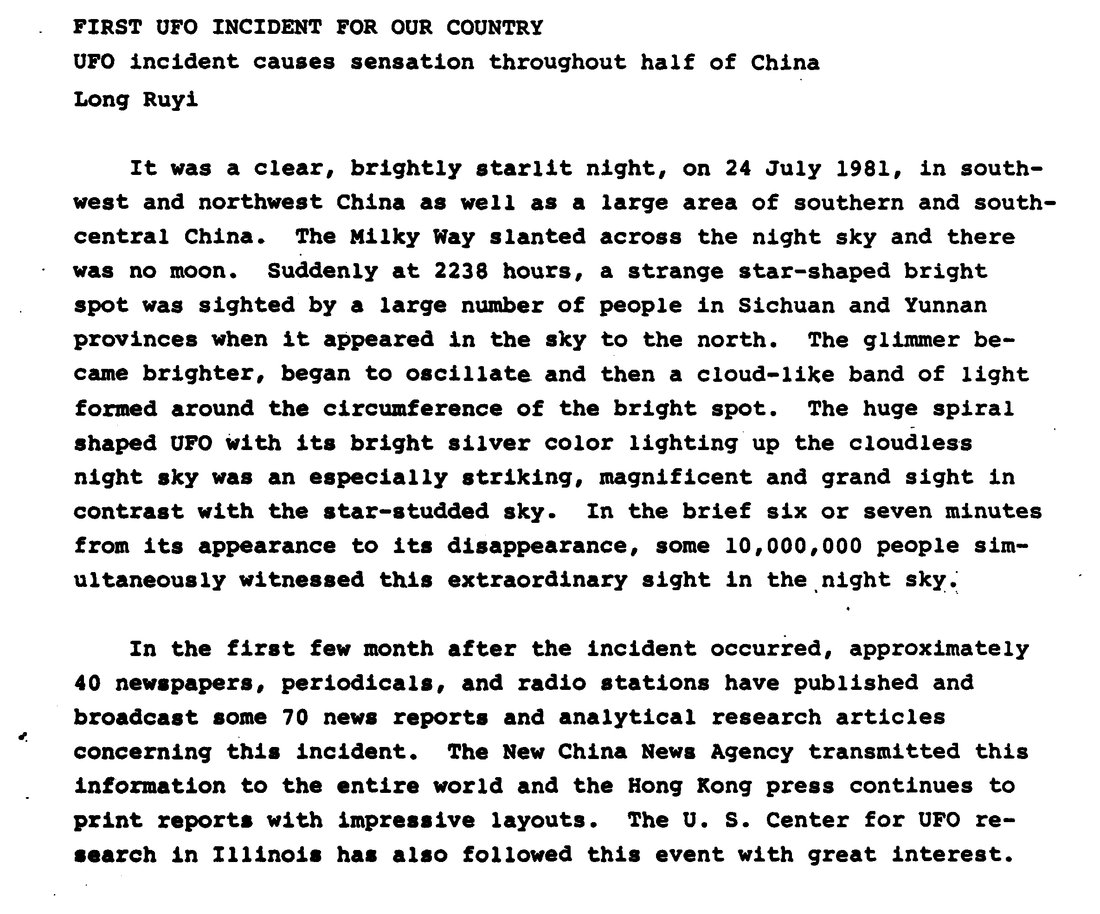
It was a clear summer night across western China, and the Milky Way slanted across a sky with no moon in it. That is how Long Ruyi set the scene a year later in Hangtian, the Chinese aerospace magazine, under a headline that still sums up the case: a UFO that caused a sensation throughout half of China. At 10:38 p.m. Beijing time on Friday, July 24, 1981, he wrote, a large number of people in Sichuan and Yunnan saw a strange, star-like bright spot appear in the northern sky. The glimmer brightened and began to oscillate. Then a cloud-like band of light formed around it, and the spot became the center of a huge spiral, bright silver against the stars. It lasted six or seven minutes. “Some 10,000,000 people,” Long wrote in the U.S. Air Force’s English translation, “simultaneously witnessed this extraordinary sight.” Nobody counted them. Other estimates run from hundreds of thousands to over a million and “several million.” Still, few UFO reports anywhere have had a bigger audience. Among the witnesses that night, by the various accounts, were peasants in Guizhou, provincial weather observers and astronomers, and staff of the Purple Mountain Observatory itself.
Sources: First UFO Incident for Our Country (UFO incident causes sensation throughout half of China)The “UFO” of July 24, 1981: A Discussion with Comrade Zhang ZhoushengPrepare for more UFO sightings万年前洞穴符号与螺旋状UFO (Cave symbols of ten thousand years ago and the spiral UFO)我国最大的UFO事件 (China’s biggest UFO event; originally headlined 横跨中国十省UFO事件目击者上百万)The official Chinese news agency said today an unidentified flying object spotted over Tibet July 24 also was seen in Peking…
UFO fever
Three years earlier the word UFO had barely existed in China. In November 1978 the People’s Daily ran an article titled “UFOs: A Mystery Puzzling the World,” and a country emerging from the Cultural Revolution took to the idea fast. On September 20, 1979, Zha Leping, a student in the space physics department of Wuhan University who had seen a glowing orange “moon” drift across the evening sky, set up a liaison office for UFO enthusiasts with his friends. On May 1, 1980, it became the China UFO Research Organization. By December, Xinhua reported that some 300 “UFO-logists” had joined it—workers, students, teachers, journalists, doctors and researchers—with branches from Beijing to Guangxi, a journal it called UFO Exploration, and, Xinhua said, a 26-year-old astrophysics student at its head. According to Chinese Wikipedia’s history of the society, it had about 500 members when it held its first national congress in Wuhan in March 1981, and Zha Leping was elected its first chairman. The Peking Evening News had printed what was said to be the first UFO photograph taken in China, a triple star with a halo shot by campers near the Great Wall. Reports that had been unthinkable a few years before were now newspaper copy. When the spiral came, four months after the congress, there was an organized movement ready to collect the sightings; by August 1981 the society’s reports department had bound a handwritten bulletin of more than six hundred Chinese cases.
Sources: The Astronomer Who Calmed China’s UFO Craze给UFO目击者写回信的人 (The man who wrote back to UFO witnesses)Chinese discovering UFOs中國UFO研究會 (China UFO Research Organization)The Paper (澎湃新闻) on the founding of the China UFO Research Organization at Wuhan University
An arc of light over the Yellow River
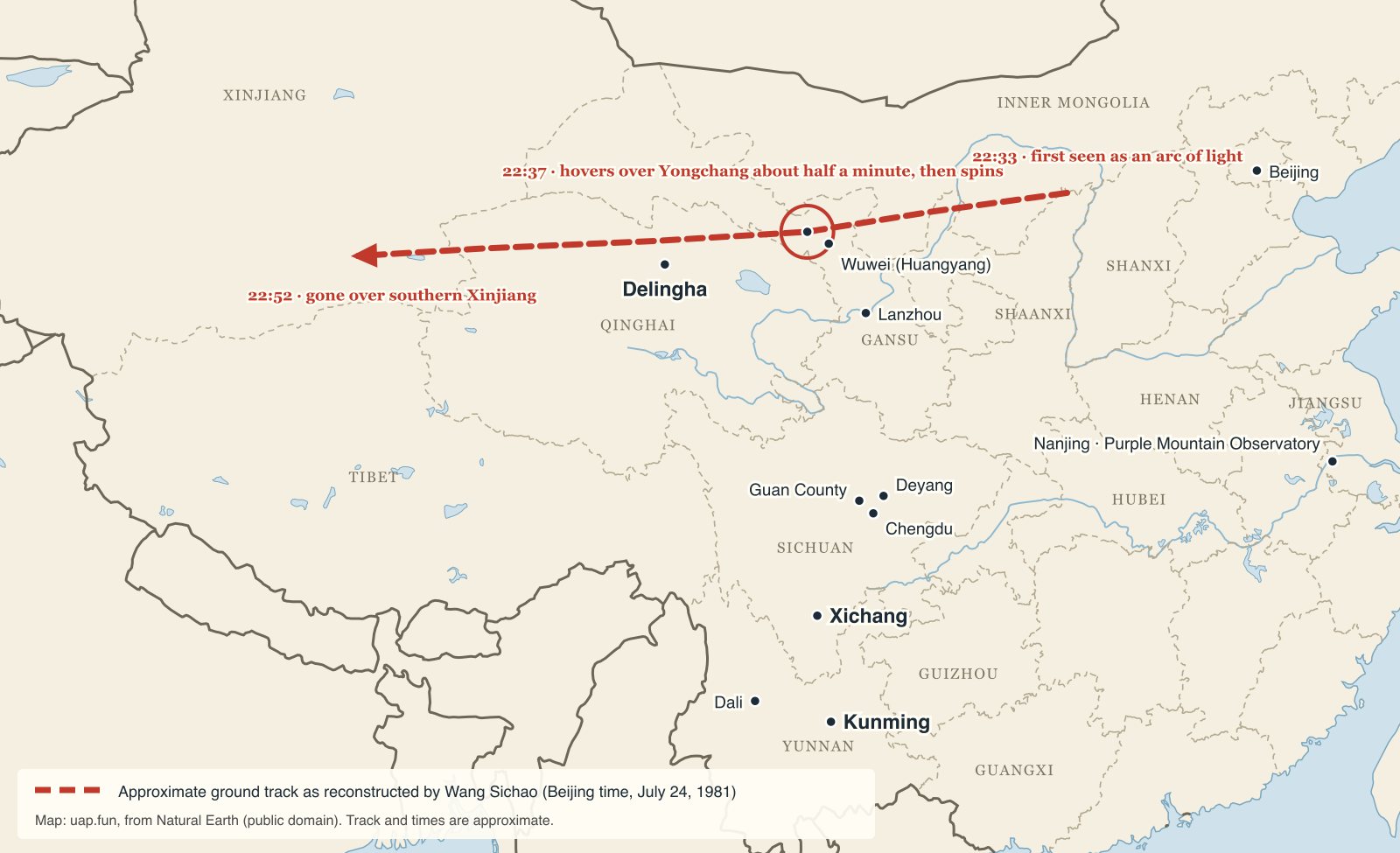
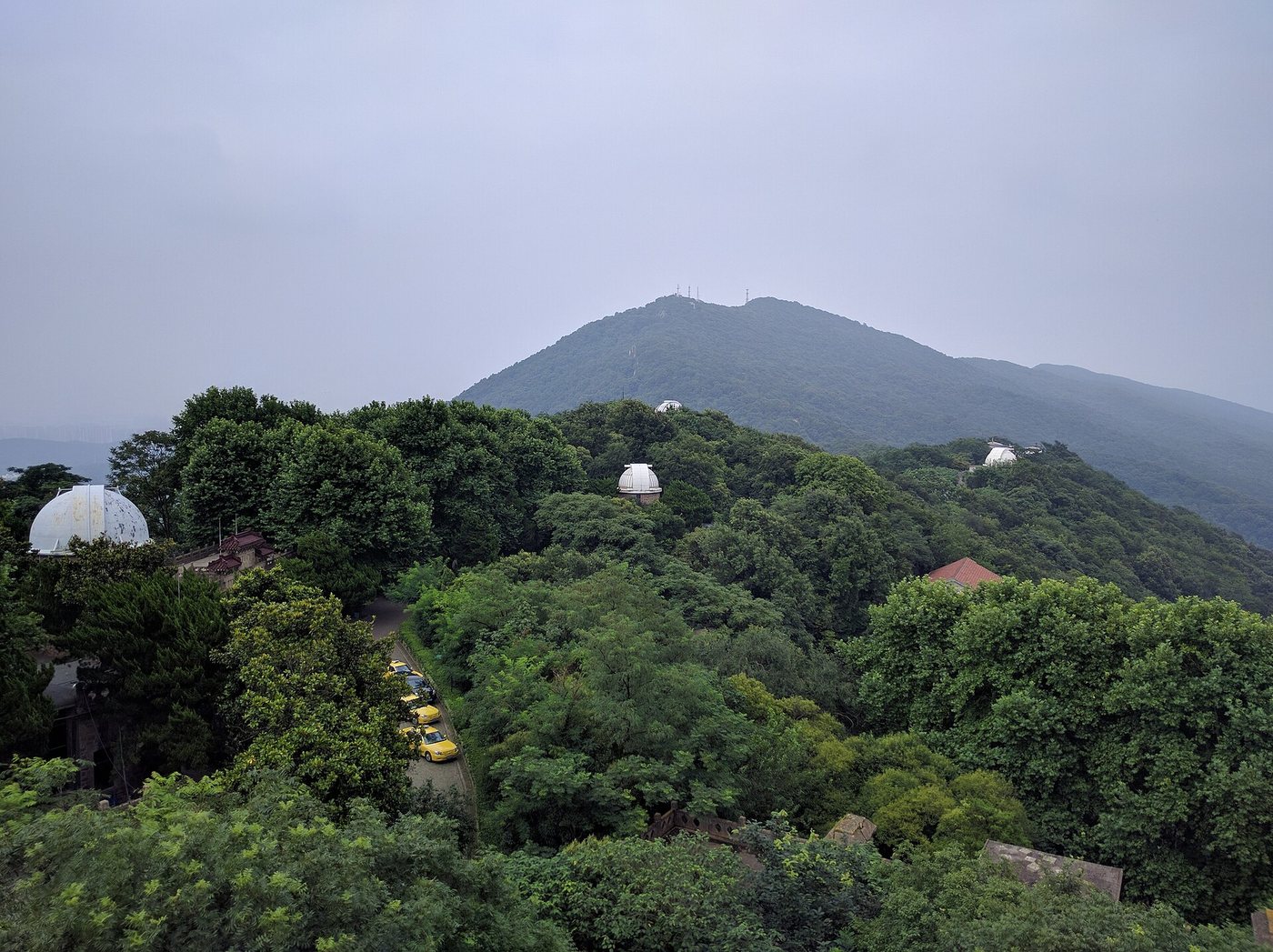
The most detailed reconstruction of the night came from Wang Sichao, an astronomer at the Purple Mountain Observatory in Nanjing who had been hunting for spirals like it since one hung silently over Jiangsu in 1971. The observatory received more than seventy written reports. Many came from amateur astronomers, who had marked the object’s path against the constellations, with times. Wang interviewed some of the witnesses, picked 38 of the best reports and worked out the object’s height, course and speed from them by spherical astronomy. In his account the object first appeared at 10:33 p.m. over the border between southern Inner Mongolia and northern Shaanxi, near the bend of the Yellow River. At first it was no spiral. It was an arc-shaped band of light, nebulous, about as bright as the densest star fields of the Milky Way, and it was moving west. As it went it brightened, and an intense flash appeared at the center of the band. This first phase, as Wang divided the night, lasted about four minutes.
Sources: 万年前洞穴符号与螺旋状UFO (Cave symbols of ten thousand years ago and the spiral UFO)我国最大的UFO事件 (China’s biggest UFO event; originally headlined 横跨中国十省UFO事件目击者上百万)
The ear above Yongchang
At about 10:37 p.m., according to Wang, the object reached the sky above Yongchang in central Gansu and stopped. For about half a minute it hung there, shaped like an ear: a bright inner crescent inside a fainter outer lobe. Du Xi’an and Xing Yong, watching from Hua County in Shaanxi, saw this stationary ear in the northwest at 10:37, and Wang published a figure of what they saw. Wang lists other places that reported the pause: Guyang in Inner Mongolia, Longxi in Gansu, Bijie in Guizhou, Peng’an in Sichuan, and Kunming and Dali in Yunnan. Then the crescent began to turn. As it rotated it flashed bright and dim, very bright at its peak, and it threw out a band of light that wound into a spiral as the whole thing set off west. Wang would come to see this pause as the heart of the mystery.
Sources: 万年前洞穴符号与螺旋状UFO (Cave symbols of ten thousand years ago and the spiral UFO)我国最大的UFO事件 (China’s biggest UFO event; originally headlined 横跨中国十省UFO事件目击者上百万)
Five spirals and a dragon
From about 10:38 the spiral drifted west and grew. Seen from Guan County in Sichuan, Wang recorded, its core was a yellow elongated ellipse as bright as Sirius, magnitude −1.5, with the color shading from yellow at the brightest point to pale blue in the outer coils. At Huangyang town near Wuwei in Gansu, where it passed overhead, a witness who had studied art and mechanical drawing watched it through a telescope and drew it on the spot: a dumbbell of yellow light, the upper ball larger than the lower, each throwing out a fan of rippled pale blue light, the outline sharp rather than blurred. In Qamdo in Tibet, Li Yufa recorded its shape at five moments between 10:38 and 10:47 as it moved slowly from the northeast toward the west-northwest. Wang timed the bright center turning counterclockwise, and popular Chinese retellings add that Sichuan witnesses counted five or six rings of trailing light, the outer ones flashing purplish red. Xinhua quoted peasants in Guizhou who saw an unusual star sprout a tail in about two minutes and wind it five times around itself. “The object then assumed the shape of a ‘dragon’ coiling in the sky,” one said, “the star being its head.”
Sources: 万年前洞穴符号与螺旋状UFO (Cave symbols of ten thousand years ago and the spiral UFO)我国最大的UFO事件 (China’s biggest UFO event; originally headlined 横跨中国十省UFO事件目击者上百万)The official Chinese news agency said today an unidentified flying object spotted over Tibet July 24 also was seen in Peking…
The film at Xichang
Nearly every popular Chinese retelling stops at the same scene. Two minutes before the pause over Yongchang, at around 10:35 p.m., about three hundred people in Xichang, in southern Sichuan, were watching an open-air film when the thing appeared in the northwestern sky and crossed slowly toward the southwest. The crowd stared, then broke into an uproar, and nobody cared any longer what was on the screen. After a minute it was gone. The story comes from compilations such as Phoenix New Media’s 2013 account, which do not name their source. The same accounts tell of the photographs. Very few people, they say, thought to use a camera. Wu Zhihong of Sichuan did, and two of his pictures were printed in Feidie Tansuo (UFO Exploration), described as China’s only UFO magazine. They show an oval light against the night sky but not the spiral tail. Another photograph, taken in Qinghai at about 10:40, shows a slanting rod of light. A Chinese researcher explained it as the spiral seen edge-on, which, the account says, seemed to make the story more credible.
Sources: 我国最大的UFO事件 (China’s biggest UFO event; originally headlined 横跨中国十省UFO事件目击者上百万)
Gone at thirty degrees
The spiral kept growing as it went west. Wang Sichao put its last phase in Qinghai, where Han Xingrong, a member of the Purple Mountain Observatory’s staff working at Delingha, saw it pass about fifteen degrees north of the zenith. Then, at about thirty degrees above the northwestern horizon, it vanished. It did not drop behind a mountain or a building; Han saw it disappear in open sky, and a report from Deyang in Sichuan agreed. Wang ended the track over southern Xinjiang at about 10:52, some 2,000 kilometers from where it began. From Inner Mongolia in the north to Guangxi and Yunnan in the south, and from Shanxi and Henan in the east to Tibet in the west, he wrote, people had seen it. There was a simple reason it could be seen so well. In the northwest, 10:40 p.m. Beijing time was only about two hours after local sunset. At the height Wang calculated, the object was still in sunlight while the ground below was dark.
Sources: 万年前洞穴符号与螺旋状UFO (Cave symbols of ten thousand years ago and the spiral UFO)我国最大的UFO事件 (China’s biggest UFO event; originally headlined 横跨中国十省UFO事件目击者上百万)
Xinhua tells the world
The Chinese press was quick. Zhang Zhousheng, an astronomer who will reappear shortly, counted more than thirty Chinese newspapers and magazines that reported the sighting promptly. In September, Xinhua, China’s state news agency, took it to the world, and by September 11 it was on its third report. That day United Press International summarized it from Peking: the object seen over Tibet on July 24 had also been seen “almost simultaneously” in Peking and in Xinjiang, Inner Mongolia, Ningxia, Qinghai, Gansu, Shaanxi, Sichuan, Henan, Hubei, Yunnan, Guizhou and Anhui. Xinhua called it a “bright, spinning spiral.” “Most reports said the object was sighted between 10:30 p.m. and 11:30 p.m. for periods of one to 10 minutes before it vanished,” the agency said. UPI added that Xinhua had suggested the week before that the same UFO had appeared over San Diego, California, the same night. In December Zhang echoed the claim: American papers, he wrote, had reported a UFO over California on the evening of July 24. The clocks make that hard to square. At 10:40 p.m. in Beijing it was 7:40 in the morning in California, in broad daylight, so whatever Californians saw that evening came about half a day after the spiral had faded.
Sources: The official Chinese news agency said today an unidentified flying object spotted over Tibet July 24 also was seen in Peking…UFO是一种自然现象 (UFOs are a natural phenomenon)我国最大的UFO事件 (China’s biggest UFO event; originally headlined 横跨中国十省UFO事件目击者上百万)
Seventy reports and a ping-pong ball
By Long Ruyi’s count, about forty Chinese newspapers, magazines and radio stations ran some seventy reports and analyses in the months that followed. The Hong Kong press splashed it, and the “U.S. Center for UFO research in Illinois,” presumably J. Allen Hynek’s Center for UFO Studies, followed it “with great interest.” The story reached Western ufologists within weeks. The APRO Bulletin of September 1981, also placing the sighting over Tibet, described an object that appeared about the size of a table tennis ball, inside a ring of blue-white light, moving east to west for seven minutes at an estimated 120 kilometers a minute. Its center turned against the direction of the rings around it, six of them in the first three or four minutes, and it made no sound. UPI noted that UFOs were reported only infrequently in the Chinese press, but that this one seemed to have generated greater interest than earlier ones. Some Chinese websites still claim that no Chinese newspaper ever reported the sighting. Xinhua’s own dispatches show otherwise.
Sources: First UFO Incident for Our Country (UFO incident causes sensation throughout half of China)CHINA July 24, 1981 — TibetThe official Chinese news agency said today an unidentified flying object spotted over Tibet July 24 also was seen in Peking…1981年7月24日UFO事件是真的吗?揭露7.24UFO真相 (Was the UFO incident of July 24, 1981 real?)
The astronomer who saw it coming
One man came out of July 24 a celebrity. Zhang Zhousheng was a twenty-four-year-old at the Yunnan Observatory in Kunming who said he had seen a UFO himself and had spent four years reading raw witness reports. In early June 1981, he wrote, he concluded that a meteor swarm capable of producing UFOs was about to meet the Earth again, and through the UFO society he sent a forecast to its branches across China: UFOs might be seen everywhere between July 10 and 30, especially July 24 to 29. They would be several times the moon’s width, spiral or disc-shaped, spinning slowly, with a bright core, silver-white edges and a colored center. In the evening they would move east to west, and they would first appear north of the zenith. On July 24 the spiral came, and it looked very much as he had said. Several dozen papers took up the story. In World Science that December, under an editors’ note praising him for treating UFOs as nature rather than “secret weapons” or alien ships, he claimed his success: nearly five hundred reports to the society, sightings almost nightly from July 18, and on the 24th several million people in more than twenty provinces. Many had taken photographs, he wrote, and the Gansu Science and Technology News reported that someone had shot a roll of cine film. On August 20 he had issued a second forecast, for October 12 to 24, and by October 22, he said, it too was coming true.
Sources: UFO是一种自然现象 (UFOs are a natural phenomenon)The “UFO” of July 24, 1981: A Discussion with Comrade Zhang Zhousheng给UFO目击者写回信的人 (The man who wrote back to UFO witnesses)The Astronomer Who Calmed China’s UFO Craze
“Almost every sentence is wrong”
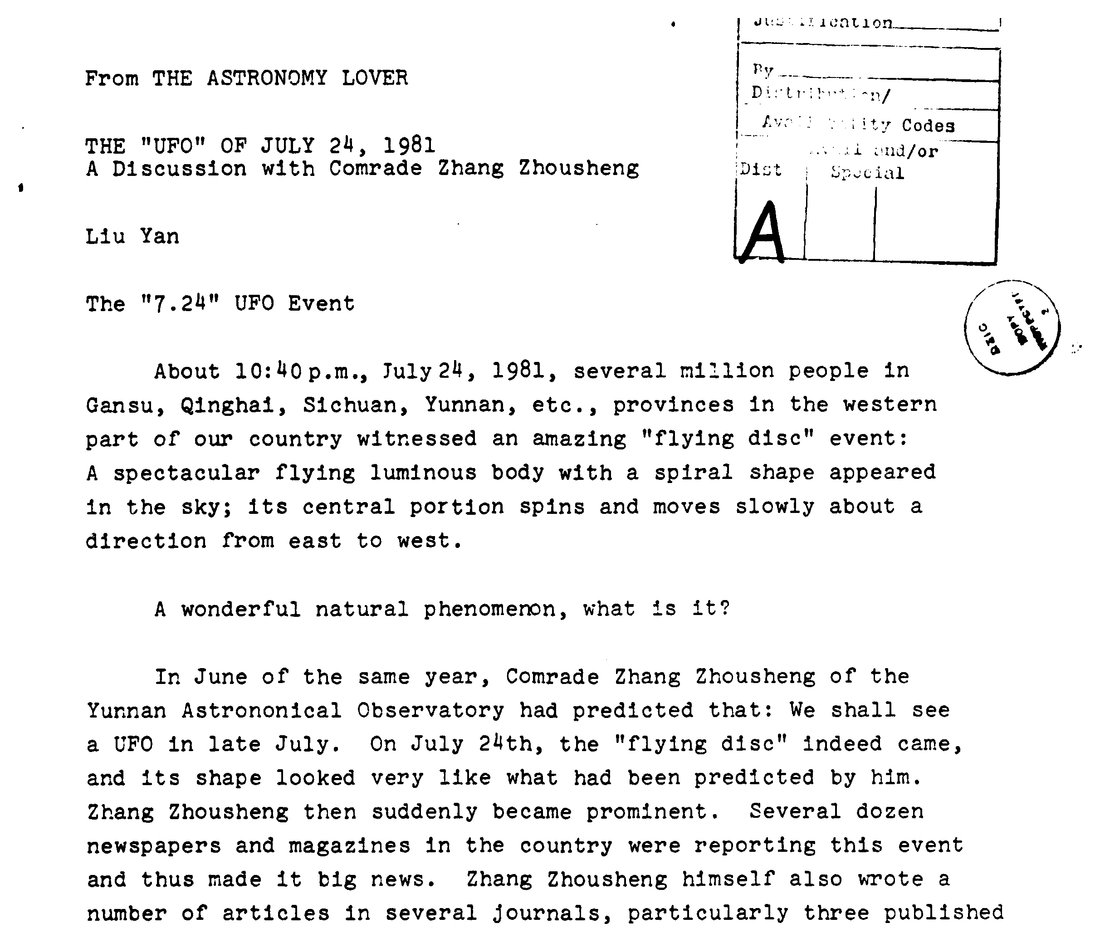
The answer came from Liu Yan, a solar radio astronomer at the Purple Mountain Observatory, who had become interested in the case in 1981, when his colleague Wang Sichao brought him along to meet students from the Wuhan UFO society. In the September 1982 issue of Tianwen Aihaozhe, The Astronomy Lover, he went after Zhang’s theory. It held that many UFOs were meteoroids from a swarm radiating from Cassiopeia. A few large ones carrying volatile material, he wrote, had an “ionosphere” of their own; when one entered the Earth’s magnetic field, its charged particles were stripped away, spiraled along the field lines and glowed. Point by point, Liu dismantled it. Meteors from one swarm can fly across the sky in any direction from their radiant, at any hour. A meteoroid is far too small to hold an atmosphere. Positive and negative particles would spiral in opposite directions and blur rather than form one clean, turning spiral. Zhang’s altitude of about 5,000 kilometers, Liu wrote, rested on a miscalculation; the true altitude was “only several hundred km.” Even Zhang’s radiant was wrong: for Chinese observers his prediction pointed toward Cygnus, Aquila and Lyra, not Cassiopeia. “Almost every sentence in his so-called ‘theory of UFO formation’ is wrong,” Liu wrote. His own view was that the object was very probably a man-made flying machine that ejected gas at about 300 meters per second while spinning, so that its jet traced a spiral. Wang Sichao and colleagues, he added, had already published that analysis.
Sources: The “UFO” of July 24, 1981: A Discussion with Comrade Zhang Zhousheng给UFO目击者写回信的人 (The man who wrote back to UFO witnesses)
Six hundred and fifty kilometers
Wang Sichao’s numbers became the standard ones. From the 38 reports he worked out, by spherical astronomy, a height of 650 kilometers, give or take ten, and a speed over the second half of the track of 1.6 kilometers per second, give or take 0.3. The bright core turned counterclockwise about once every eleven seconds, and the angular motion was about five degrees a minute. It was the mechanism Liu had credited to Wang and his colleagues: a body spinning counterclockwise while it sprayed out fine particles or gas from a nozzle would leave a clockwise spiral of material, lit by the sun. The two astronomers parted over what the body was. Liu, according to a 2023 profile, concluded that it was probably a man-made spacecraft at about 650 kilometers. Wang looked at the same figures and saw something no human craft could do. At 650 kilometers, he argued, nothing can hover for half a minute, or cruise at 1.6 kilometers per second, far below the 7.9 needed to stay in orbit, without falling. There was no air to push against, and no one saw it blasting material downward. In his view it might have had an “anti-gravity” property. He concluded that it might be a craft connected with extraterrestrial intelligence.
Sources: 万年前洞穴符号与螺旋状UFO (Cave symbols of ten thousand years ago and the spiral UFO)我国最大的UFO事件 (China’s biggest UFO event; originally headlined 横跨中国十省UFO事件目击者上百万)The Astronomer Who Calmed China’s UFO Craze给UFO目击者写回信的人 (The man who wrote back to UFO witnesses)
Portholes, a bell and a spy plane
Long Ruyi’s Hangtian article sorted the debate into three camps: the meteor theory, the aircraft theory and the flying saucer theory. The meteor theory he dismissed. The Purple Mountain Observatory and the Sichuan UFO research association had independently calculated a height of 500 kilometers, plus or minus ten percent, and a speed of several kilometers per second on a retrograde path inclined about 112 degrees to the equator. Those figures, he wrote, refuted the meteor theory. The saucer camp pointed to witnesses who said the object stopped and hovered for several minutes, then flew off fast, and changed direction as if it moved freely. Some went further. “Some people went so far as to claim they could see its central bell-like shape as well as a row of portholes,” Long wrote. Paul Dong, the Chinese-American writer who carried Chinese UFO stories to American readers, told the same story in 1984: one observer, using 7 × 50 Zeiss binoculars, saw a row of windows on its top, and peasants in Guizhou described it as immense, about the size of an airplane. Long did not dismiss such reports as illusions, but he found the proof lacking: apart from “a few blurred photos,” no physical evidence and no good record of a signal. Nothing like it, he noted, was among foreign researchers’ many saucer photographs. That, he wrote, “causes us to return to the spy plane hypothesis,” an idea he had developed under the heading “Spy satellite is doubtful,” in a passage the American translator left out. The incident, he concluded, still awaits “those who know the inside story to come forward and ‘make a clean breast of it.’”
Sources: First UFO Incident for Our Country (UFO incident causes sensation throughout half of China)The Four Major Mysteries of Mainland China
Read in Ohio
Both articles crossed the Pacific. In 1983 the Foreign Technology Division at Wright-Patterson Air Force Base in Ohio, the U.S. Air Force’s office for reading foreign technical literature, had them translated. Liu Yan’s rebuttal was done by a contractor, Leo Kanner Associates, and dated April 11, and Long Ruyi’s article by Randy Dorsey, dated September 9. Decades later the translations surfaced online through the Defense Technical Information Center and The Black Vault. Somewhere along the way the spy-plane idea changed hands. A 2014 Listverse list of Chinese paranormal stories, citing no source, said the U.S. Air Force had put the spiral down to a particularly clumsy spy plane, and That’s Beijing repeated it in 2021 as “the US Air Force’s deduction.” No such Air Force finding has turned up. The only spy-plane hypothesis on record is Long Ruyi’s, made in a Chinese aerospace magazine, and the Air Force’s known part in the story is that it had the article translated.
Sources: First UFO Incident for Our Country (UFO incident causes sensation throughout half of China)The “UFO” of July 24, 1981: A Discussion with Comrade Zhang ZhoushengUFO Incident Causes Sensation Throughout Half of China, 24 July 198110 Eerie Chinese Paranormal StoriesThis Day in History: China’s Otherworldly ‘Alien Sky Spiral’ of 1981
Other spirals, and two thousand replies
July 24 was not the last spiral. Long Ruyi cited the Chinese UFO society’s count of at least three such giant spirals over northwest China in four years. Wang Sichao traced the type back to September 26, 1971. That evening, he wrote, Ji Xiang in Huaisi commune north of Yangzhou and Tao Siyan at Shiqiao to the south independently saw a spiral as big as the full moon hanging silently low in the northwest. In Huangcun, south of Beijing, He Zengrong watched a rippling ring of light for five minutes. On June 18, 1982, a “bright star” low in the north exploded into a dazzling cluster and then a halo that filled half the northern sky. It was seen from Heilongjiang to Jiangsu, and nearly two hundred letters about it piled up at the Purple Mountain Observatory. Liu Yan answered them all with a mimeographed reply. A man-made spacecraft more than 1,000 kilometers up, he wrote, had spun while ejecting gas and particles and left an expanding ring. The observatory sent him every similar letter after that; he estimates he wrote at least 2,000 replies. His replies told writers again and again that this was not an alien flying saucer, not an omen of disaster and nothing supernatural. Over the years he came to explain spirals, arcs, trumpets and springs more than 100 kilometers up as the vapor trails of spent rocket stages dumping leftover fuel.
Sources: First UFO Incident for Our Country (UFO incident causes sensation throughout half of China)万年前洞穴符号与螺旋状UFO (Cave symbols of ten thousand years ago and the spiral UFO)给UFO目击者写回信的人 (The man who wrote back to UFO witnesses)The Astronomer Who Calmed China’s UFO Craze
The largest audience
Wang Sichao never changed his mind. In a 2010 interview with China News Service, he said the spiral had been seen in fifteen provinces and municipalities and was perhaps the most widely witnessed UFO event in the world. He had studied it for more than twenty years. Of the thousands of Chinese cases he had looked at, he said, about a fifth could not be put down to human or natural causes, and seven or eight of the best-documented were very probably alien craft. His 2016 blog post set the 1981 spiral beside a spiral sign painted in Ice Age caves. The case moved on into Western lists of unsolved mysteries, usually with Long Ruyi’s ten million witnesses and without his caveats; Futura Sciences filed it in 2022 among five great unsolved UFO stories. At the Purple Mountain Observatory, the letters stopped. When Shanghai reporters visited Liu Yan, retired and turning eighty, in 2023, the observatory’s head of science outreach, Zhang Yang, said nobody had written in about a UFO for many years. Cheap all-sky cameras and a phone in every pocket, the reporters noted, now catch such things, and once they are analyzed the mystery vanishes in an instant.
Sources: 天文学家王思潮:39年追踪UFO 坚信外星人的存在 (Astronomer Wang Sichao: 39 years tracking UFOs, convinced aliens exist)万年前洞穴符号与螺旋状UFO (Cave symbols of ten thousand years ago and the spiral UFO)给UFO目击者写回信的人 (The man who wrote back to UFO witnesses)5 histoires extraordinaires et non résolues d’ovnis : des millions de témoins d’un objet dans le ciel chinoisPrepare for more UFO sightings
What survives
No official Chinese investigation of the spiral has been published, and none is known to exist. The record is a scientific and journalistic one. More than seventy witness letters reached the Purple Mountain Observatory, Wang Sichao said; other reports went to the China UFO Research Organization, which surveyed the sighting through its branches, and to newspapers. The letters themselves have not been published. What can be read today is the published argument about them: Xinhua’s dispatches of September 1981 as relayed by UPI; Zhang Zhousheng’s World Science article of December 1981, the earliest Chinese account available online in full; Liu Yan’s Astronomy Lover article of 1982 in full and Long Ruyi’s Hangtian article in an abridged version, both in the U.S. Air Force’s English translations; and Wang Sichao’s reconstruction, which he repeated in interviews and on his blog for decades. A few witness drawings survive in print: Du Xi’an and Xing Yong’s ear from Hua County, Li Yufa’s five spirals from Qamdo, printed as a color plate in a Chinese astronomy primer, and the Huangyang telescope sketch. Wu Zhihong’s photographs, printed in Feidie Tansuo, are described in later accounts but have not been reproduced in any source checked for this file.
Sources: 万年前洞穴符号与螺旋状UFO (Cave symbols of ten thousand years ago and the spiral UFO)中國UFO研究會 (China UFO Research Organization)The official Chinese news agency said today an unidentified flying object spotted over Tibet July 24 also was seen in Peking…UFO是一种自然现象 (UFOs are a natural phenomenon)First UFO Incident for Our Country (UFO incident causes sensation throughout half of China)The “UFO” of July 24, 1981: A Discussion with Comrade Zhang Zhousheng我国最大的UFO事件 (China’s biggest UFO event; originally headlined 横跨中国十省UFO事件目击者上百万)
The contradictions
The clock varies with the teller. Wang Sichao’s phases run from 10:33 to 10:52 p.m.; Long Ruyi has the spot appear at 10:38 and the whole show last six or seven minutes; Liu Yan wrote “about 10:40”; Xinhua said most reports fell between 10:30 and 11:30, for one to ten minutes each. A widely copied Chinese web text even dates it to July 14. The audience swings from hundreds of thousands (China.org.cn) and “over a million” (Phoenix New Media’s 2013 headline) to “several million” (Liu) and ten million (Long). Xinhua named Peking and twelve provinces and regions, Zhang Zhousheng claimed more than twenty, later writers say ten or fourteen, and Wang himself in 2010 said fifteen. Xinhua and APRO put the object over Tibet; Wang has it first appear over the Inner Mongolia–Shaanxi border. The height went from Zhang Zhousheng’s 5,000 kilometers, as Liu reported it, to 500, plus or minus ten percent, in the independent Purple Mountain and Sichuan calculations that Long reported, and then to Wang’s 650. French researcher F. Lagarde, as Wang reported it, favored a meteor and put the spiral’s diameter at 176 kilometers. Even the vanishing point shifts: northwest in Wang’s blog, west in another version of his paper. The hover lasts about half a minute in Wang’s account and “several minutes” in the saucer camp’s reports. Wang timed the core’s spin at eleven seconds, while Liu’s comparison table gives the object one to two turns a minute. Zhang wrote that many people photographed it and that someone shot a roll of cine film; Long, a few months later, knew of only a few blurred photographs, and no film has surfaced.
Sources: 万年前洞穴符号与螺旋状UFO (Cave symbols of ten thousand years ago and the spiral UFO)First UFO Incident for Our Country (UFO incident causes sensation throughout half of China)The “UFO” of July 24, 1981: A Discussion with Comrade Zhang ZhoushengThe official Chinese news agency said today an unidentified flying object spotted over Tibet July 24 also was seen in Peking…UFO是一种自然现象 (UFOs are a natural phenomenon)Prepare for more UFO sightings我国最大的UFO事件 (China’s biggest UFO event; originally headlined 横跨中国十省UFO事件目击者上百万)盘点中国历史上横跨十省的重大UFO事件 (China’s great UFO events across ten provinces)天文学家王思潮:39年追踪UFO 坚信外星人的存在 (Astronomer Wang Sichao: 39 years tracking UFOs, convinced aliens exist)
The case for a rocket
Liu Yan’s answer has the weight of later experience behind it. A spinning body venting gas or particles makes exactly this kind of spiral, and the vent can be a rocket stage spun up for stability dumping its leftover propellant. At that height, as Wang’s own figures showed, the cloud stays sunlit over a darkened country. That is why one event can be seen across half a continent, and why every place saw it at a slightly different time and angle. The same picture came back over China on June 18, 1982, and later over Norway in December 2009, when a spiral seen over the north was blamed on a failed Russian missile test. Wang’s and Liu’s own explanation of how the spiral formed, a spinning core ejecting material, describes a rocket stage as well as anything else. In 1982, the year after the spiral, the American space writer James Oberg was matching giant luminous UFOs over the Soviet Union and South America to secret launches from Plesetsk; excess fuel dumped by a rocket, he explained, “may appear to be a huge glowing cloud under certain sunlighting conditions.”
Sources: The “UFO” of July 24, 1981: A Discussion with Comrade Zhang Zhousheng给UFO目击者写回信的人 (The man who wrote back to UFO witnesses)The Astronomer Who Calmed China’s UFO Craze5 histoires extraordinaires et non résolues d’ovnis : des millions de témoins d’un objet dans le ciel chinoisFlying saucers — or Soviet satellites?
What a rocket does not explain
Nobody has found the rocket. Jonathan McDowell’s launch log, which lists Soviet, American and Chinese missile tests as well as space launches, has nothing near 10:40 p.m. Beijing time (14:40 UTC) on July 24, 1981, beyond weather rockets fired elsewhere in the world. Its record of Chinese missile tests from those years is patchy, so the absence is suggestive rather than final. Wang Sichao raised other objections. Most satellites are launched eastward to take advantage of the Earth’s spin, but this object moved west. And there were the objections already met: a speed far too slow for orbit, and the half-minute pause over Gansu. Nor has any satellite or rocket body been matched to the 500 kilometers and retrograde path of the calculations Long reported. Those calculations, like Wang’s, rested mostly on naked-eye reports, timed by watches and plotted against the stars by amateurs, and the hover rests on the impression of witnesses looking at a slow object from far away. The rocket explanation remains the most likely one. It has never been demonstrated for this night.
Sources: General Catalog of Artificial Space Objects: launch log盘点中国历史上横跨十省的重大UFO事件 (China’s great UFO events across ten provinces)万年前洞穴符号与螺旋状UFO (Cave symbols of ten thousand years ago and the spiral UFO)First UFO Incident for Our Country (UFO incident causes sensation throughout half of China)
Classification and evidence note
This file counts the July 24 spiral as a mass sighting of a high-altitude light, not a close encounter. No witness reported a landing or occupants, and the portholes and bell come only from unnamed witnesses cited by Long Ruyi and Paul Dong. Its resolution is listed as disputed: the leading explanation, a vented rocket or spacecraft, was Liu Yan’s and is how most later analysts explain such spirals, but no launch has been identified, and Wang Sichao contested it to the end. The hero image is an illustration, not a photograph. The two document pages are from U.S. government translations of Chinese articles. The map follows Wang’s description and is approximate. Witness drawings were not reproduced because their rights holders could not be identified, and Wu Zhihong’s photographs could not be found.
Sources: First UFO Incident for Our Country (UFO incident causes sensation throughout half of China)万年前洞穴符号与螺旋状UFO (Cave symbols of ten thousand years ago and the spiral UFO)The “UFO” of July 24, 1981: A Discussion with Comrade Zhang Zhousheng
- NOV 1978
The People’s Daily publishes “UFOs: A Mystery Puzzling the World,” introducing the idea to Chinese readers.
- 20 SEP 1979
Zha Leping and fellow students in Wuhan University’s space physics department set up a liaison office for UFO enthusiasts.
- 1 MAY 1980
The office becomes the China UFO Research Organization.
- 15–20 MAR 1981
The society, about 500 members strong, holds its first national congress in Wuhan.
- JUN 1981
Zhang Zhousheng of the Yunnan Observatory predicts a UFO for late July.
- 24 JUL 1981 · 10:33 PM
An arc of light appears over the border of Inner Mongolia and Shaanxi and moves west (Wang Sichao’s reconstruction, Beijing time).
- 24 JUL 1981 · ABOUT 10:35 PM
About three hundred people at an open-air film in Xichang see it cross their northwestern sky, by later accounts.
- 24 JUL 1981 · 10:37 PM
The object hangs over Yongchang, Gansu, for about half a minute as an ear-shaped light, then begins to spin.
- 24 JUL 1981 · 10:38 PM
The time Long Ruyi gives for the bright spot’s appearance in Sichuan and Yunnan; Li Yufa in Qamdo begins to sketch it.
- 24 JUL 1981 · 10:52 PM
The track ends over southern Xinjiang, by Wang’s reconstruction; from Delingha, Han Xingrong has watched it vanish in open sky about thirty degrees above the northwestern horizon.
- 20 AUG 1981
Zhang Zhousheng issues a second forecast, for October 12 to 24.
- SEP 1981
Xinhua reports the sighting abroad and suggests the same object was seen over San Diego.
- 11 SEP 1981
Xinhua’s third report names Peking and twelve provinces and regions; UPI quotes a Guizhou peasant’s coiling “dragon.”
- DEC 1981
Zhang Zhousheng claims his forecast was fulfilled in World Science, citing nearly five hundred reports.
- 1982
Long Ruyi’s “First UFO Incident for Our Country” appears in Hangtian, no. 4.
- 18 JUN 1982
A “bright star” bursts into a halo over northern China; nearly two hundred letters reach the Purple Mountain Observatory.
- SEP 1982
Liu Yan’s rebuttal of Zhang Zhousheng appears in Tianwen Aihaozhe.
- 11 APR 1983
The U.S. Air Force’s Foreign Technology Division dates its translation of Liu Yan’s article.
- 9 SEP 1983
The Foreign Technology Division dates its translation of Long Ruyi’s article.
- 26 JUL 2010
Wang Sichao tells China News Service that the spiral may be the most widely witnessed UFO event in the world.
- 5 JAN 2016
Wang publishes his reconstruction on his blog, with the anti-gravity hypothesis.
- 26 APR 2023
Shanghai Observer publishes Chen Shuyi’s profile of Liu Yan, turning eighty, and the thousands of letters he answered.
Sources & interviews
First UFO Incident for Our Country (UFO incident causes sensation throughout half of China)Long Ruyi · Hangtian (Aerospace), no. 4, 1982, pp. 12–13 · English translation by Randy Dorsey for the U.S. Air Force Foreign Technology Division, FTD-ID(RS)T-1019-83, September 9, 1983 · DTIC ADA133326The “UFO” of July 24, 1981: A Discussion with Comrade Zhang ZhoushengLiu Yan, Purple Mountain Observatory · Tianwen Aihaozhe (The Astronomy Lover), no. 9, September 1982, pp. 11–13 · English translation by Leo Kanner Associates for the Foreign Technology Division, FTD-ID(RS)T-0231-83, April 11, 1983 · DTIC ADA128307UFO Incident Causes Sensation Throughout Half of China, 24 July 1981The Black Vault case file · hosts the PDF of the FTD translation of Long Ruyi’s articleUFO是一种自然现象 (UFOs are a natural phenomenon)Zhang Zhousheng, Yunnan Observatory · Shijie Kexue (World Science), December 1981 · with the editors’ note; his June forecast, the July 24 sighting and his second forecast for OctoberThe Paper (澎湃新闻) on the founding of the China UFO Research Organization at Wuhan Universitythepaper.cn · Zha Leping’s 1979 sighting, the founding on September 20, 1979, the March 1981 congress and the society’s file of more than 600 casesThe official Chinese news agency said today an unidentified flying object spotted over Tibet July 24 also was seen in Peking…United Press International · Peking, September 11, 1981 · summarizing Xinhua’s third report on the sightingChinese discovering UFOsPaul Loong · United Press International · Peking, December 4, 1980 · on Xinhua’s report of China’s first UFO society, in Wuhan万年前洞穴符号与螺旋状UFO (Cave symbols of ten thousand years ago and the spiral UFO)Wang Sichao, Purple Mountain Observatory · his Sina blog, January 5, 2016 · his four-phase reconstruction of July 24, 1981, the 38 selected reports, the 650 km altitude and the anti-gravity hypothesis我国最大的UFO事件 (China’s biggest UFO event; originally headlined 横跨中国十省UFO事件目击者上百万)Phoenix New Media (ifeng.com) · August 30, 2013 · a compilation that combines popular retellings (Xichang, Wu Zhihong’s photographs) with Wang Sichao’s first-person analysis盘点中国历史上横跨十省的重大UFO事件 (China’s great UFO events across ten provinces)China Education and Research Network (edu.cn) · August 29, 2013 · reprint including Wang Sichao’s rebuttal of the meteor, comet and third-stage explanations天文学家王思潮:39年追踪UFO 坚信外星人的存在 (Astronomer Wang Sichao: 39 years tracking UFOs, convinced aliens exist)China News Service (chinanews.com) · July 26, 2010给UFO目击者写回信的人 (The man who wrote back to UFO witnesses)Chen Shuyi · Shanghai Observer (Jiefang Daily) · April 26, 2023 · interview with Liu Yan at the Purple Mountain ObservatoryThe Astronomer Who Calmed China’s UFO CrazeShanghai Observer · Sixth Tone, May 20, 2023 · English version of the Liu Yan interviewPrepare for more UFO sightingsChen Xia · China.org.cn, August 2, 2010中國UFO研究會 (China UFO Research Organization)Chinese Wikipedia · founding at Wuhan University, the 1981 congress and the society’s survey after the July 24 sightingFlying saucers — or Soviet satellites?Robert C. Cowen · The Christian Science Monitor, June 9, 1982 · on James Oberg’s matching of UFO waves to secret Soviet launchesGeneral Catalog of Artificial Space Objects: launch logJonathan McDowell · planet4589.org · orbital, suborbital and missile launches; no entry near 14:40 UTC on July 24, 1981CHINA July 24, 1981 — TibetThe A.P.R.O. Bulletin, vol. 29, no. 9, September 1981 · Aerial Phenomena Research Organization, Tucson · scan via archive.orgThe Four Major Mysteries of Mainland ChinaPaul Dong · Prentice-Hall, 1984 · chapter on UFOs, with the binocular observer and the Guizhou peasants (consulted through archive.org full-text search)10 Eerie Chinese Paranormal StoriesPauli Poisuo · Listverse, January 13, 2014 · the unsourced claim that the U.S. Air Force blamed a spy plane1981年7月24日UFO事件是真的吗?揭露7.24UFO真相 (Was the UFO incident of July 24, 1981 real?)etufo.org, a Chinese UFO website · April 9, 2014 · repeats Wang Sichao’s phases and claims that no Chinese media reported the event5 histoires extraordinaires et non résolues d’ovnis : des millions de témoins d’un objet dans le ciel chinoisNathalie Mayer · Futura Sciences, December 17, 2022This Day in History: China’s Otherworldly ‘Alien Sky Spiral’ of 1981Matthew Bossons · That’s Beijing, July 23, 2021File:Purple Mountain Observatory 2016.7.16-1.jpgGmbsfd · Wikimedia Commons, July 16, 2016 · CC BY-SA 4.0Spotted an error, or know a better source? Write to hello@uap.fun.
Connected files
The Jellyfish over PetrozavodskFour years earlier a sunlit rocket plume over Soviet Karelia was taken for a hovering jellyfish; there the launch was found.The Giants of GáldarA glowing sphere over the Canary Islands in 1976, now usually blamed on an American submarine-launched missile test, though the timing is disputed.The Sign of ShambhalaIn 1927 Nicholas Roerich’s caravan saw a shining oval cross the sky over the Shara-gol valley, on the road into the Tsaidam, a few hundred kilometers from where the spiral vanished for an observer at Delingha.The Light in Jeon Mun-wi’s CourtyardLights and fire over Korea in 1609, sent by a provincial governor to the king and kept in the royal annals: East Asia’s long habit of writing down strange things in the sky.J. Allen HynekLong Ruyi reported that a “U.S. Center for UFO research in Illinois,” presumably Hynek’s Center for UFO Studies, followed the spiral “with great interest.”Discuss this case
Compare notes with other readers: witness details, sources, and the parts that still do not add up.
Open the discussion