Shells off Ellwood
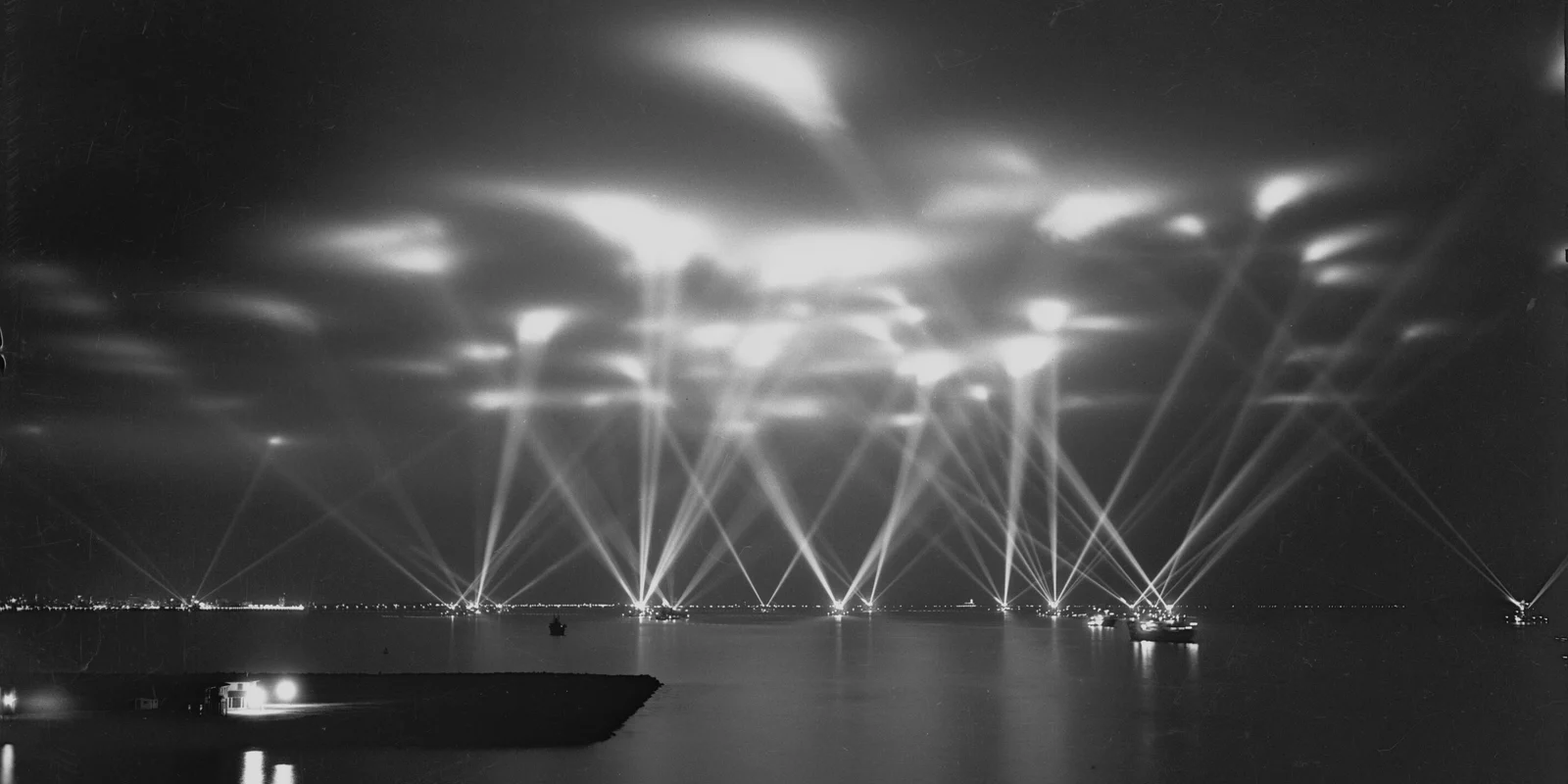
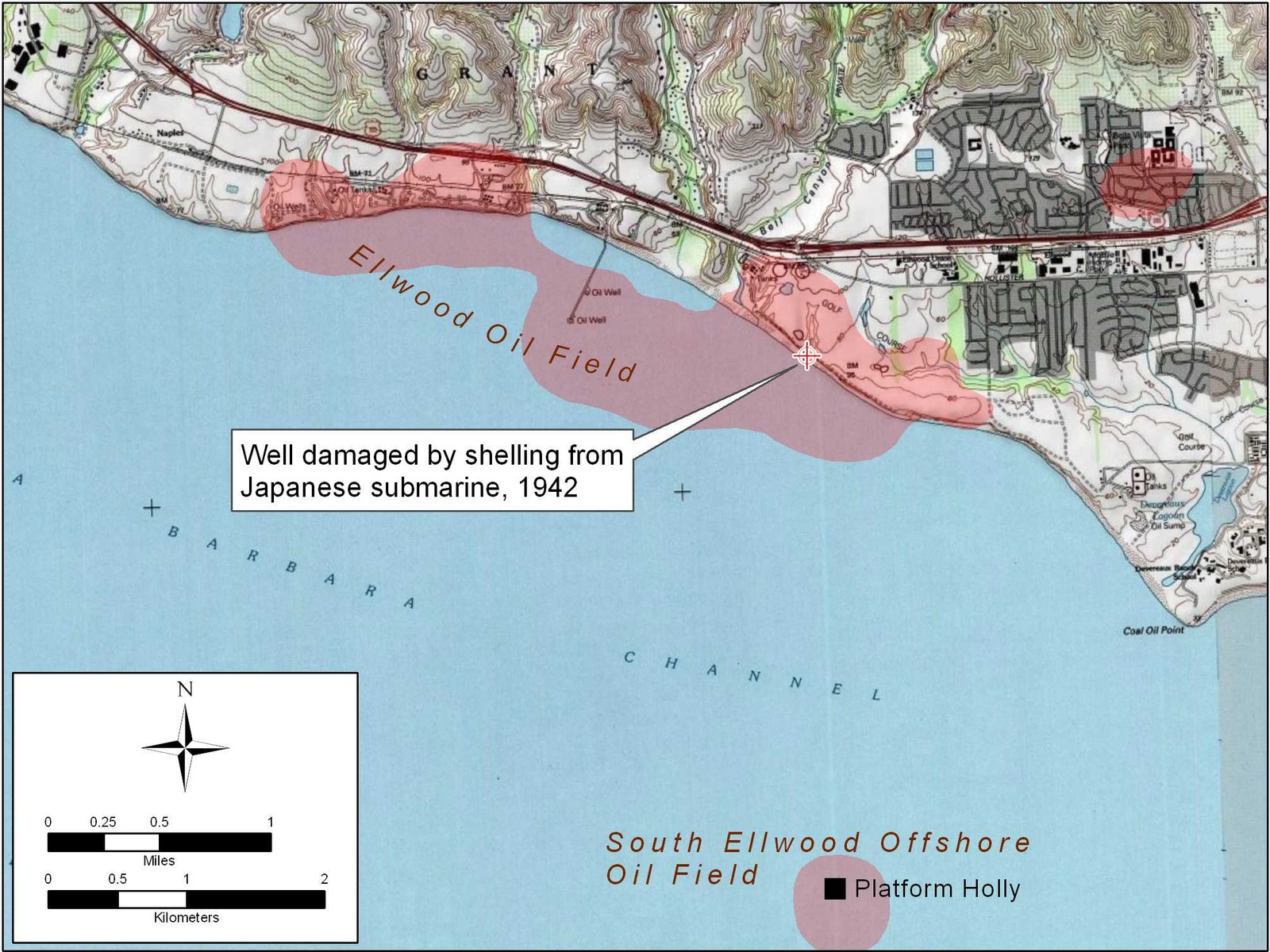
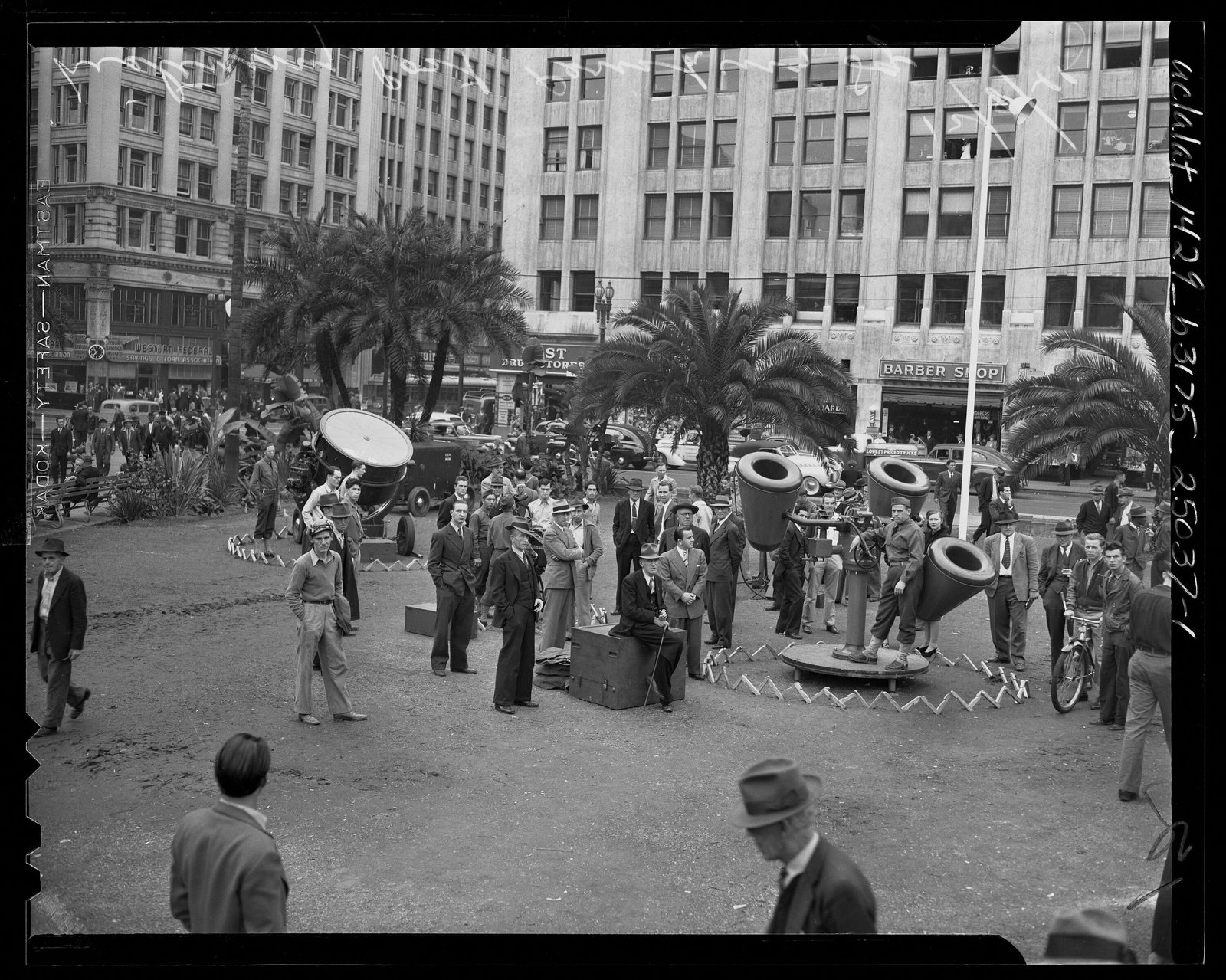
On the evening of February 23, 1942, as President Roosevelt began one of his fireside chats, the Japanese submarine I-17 surfaced off Ellwood, an oil field and refinery on the coast about a dozen miles west of Santa Barbara. Its deck gun fired for about twenty minutes at the tanks and piers. The official Air Forces history counts thirteen shells; naval historians working from Japanese records count seventeen; survivors of the submarine questioned in 1943 put it at twenty-four or twenty-five. The damage, a catwalk and some pumping equipment, came to a few hundred dollars, but it was the first enemy shells to fall on the continental United States since the War of 1812. The Army history notes that the shots seemed to punctuate the President’s warning that the broad oceans had “become endless battlefields.” The same history passes on a claim that Japanese Americans had predicted a demonstration during the speech and prophesied an attack on Los Angeles the next night. California was already strung tight. Four days earlier Roosevelt had signed Executive Order 9066, the authority under which Japanese Americans would be removed from the West Coast to camps, and searchlights and sound locators had been set up in downtown Pershing Square in December.
Sources: The Army Air Forces in World War II, Vol. I: Plans and Early Operations, chapter 8, “The Defense of the Western Hemisphere,” pp. 277–286IJN Submarine I-17: Tabular Record of MovementDid Enemy Aircraft Threaten Los Angeles During World War II?Executive Order 9066: Resulting in Japanese-American Incarceration (1942)
Within the next ten hours
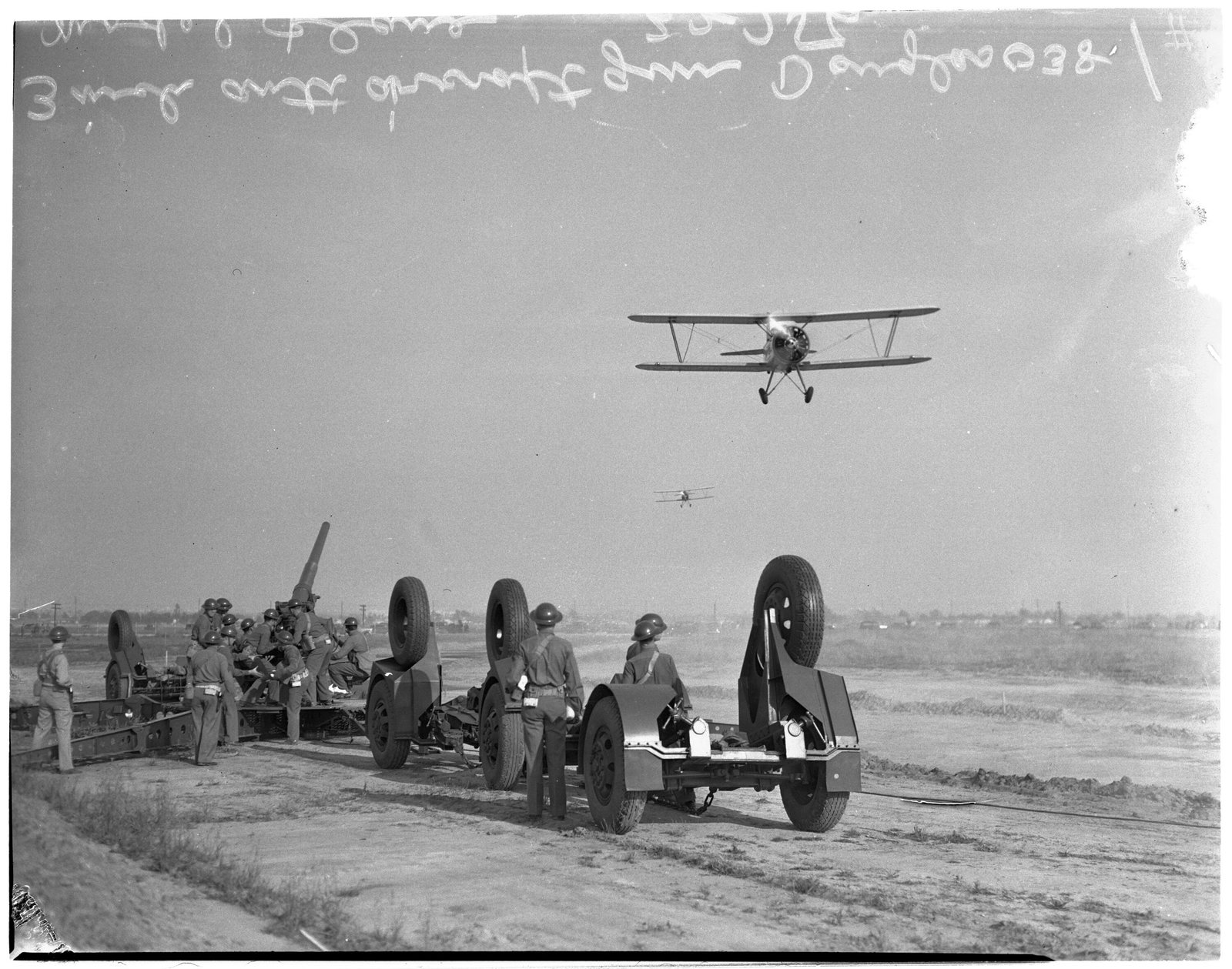
On February 24 naval intelligence warned that an attack could be expected within the next ten hours. That evening the Army’s information center took reports of flares and blinking lights near defense plants, and an alert called at 7:18 p.m. lasted until 10:23. Newspapers were allowed to announce that a strict state of readiness had been imposed. Southern California’s air defense was thinner than the public knew. Fighters were few, the Fourth Air Force’s commander had warned repeatedly that the coast was exposed, and Washington’s planners judged in early February that there was “little probability” the air units on the West Coast could defend vital targets against a determined carrier attack. Most of the protection on the ground belonged to the 37th Coast Artillery Brigade (Antiaircraft), whose 3-inch and 90-millimeter guns, 40-millimeter cannon, machine guns and searchlights guarded the aircraft plants and the harbor. Col. John G. Murphy, the Fourth Army’s antiaircraft officer, later wrote that the antiaircraft troops on the coast were always ready for action, “albeit sometimes overready or maybe even gullible.”
Sources: The Army Air Forces in World War II, Vol. I: Plans and Early Operations, chapter 8, “The Defense of the Western Hemisphere,” pp. 277–286Activities of the Ninth Army AAA (section “L.A. ‘Attacked’”)California in World War II: The Battle of Los Angeles
A target 120 miles out
Early on the 25th the radars picked up an unidentified target 120 miles west of Los Angeles. The antiaircraft batteries were alerted at 2:15 a.m. and put on Green Alert, ready to fire, a few minutes later. The Air Forces kept their pursuit planes on the ground, waiting to see how large the attack was and where it was headed. The radars tracked the target to within a few miles of the coast, and at 2:21 the regional controller ordered a blackout. Sirens wailed across the basin at 2:25. According to the Army history, the radar target then seemed to vanish, but the information center was “flooded with reports of ‘enemy planes.’” At 2:43 planes were reported near Long Beach, and a few minutes later a coast artillery colonel reported “about 25 planes at 12,000 feet” over Los Angeles. The night was clear. A waxing moon, about three-quarters full, hung low in the west; by the wartime clock Americans had adopted that month, it would set at about 3:30 a.m.
Sources: The Army Air Forces in World War II, Vol. I: Plans and Early Operations, chapter 8, “The Defense of the Western Hemisphere,” pp. 277–286Los Angeles Defense Guns Blaze Away: City Gets Air Raid Scare As Unidentified Plane Crosses HeavensMysteries of the Skies: UFOs in Perspective, chapter 6, “The Battle of Los Angeles”Activities of the Ninth Army AAA (section “L.A. ‘Attacked’”)The Battle of Los Angeles (episode 171)
Like a volcano
At 3:06, the Army history records, “a balloon carrying a red flare was seen over Santa Monica and four batteries of antiaircraft artillery opened fire, whereupon ‘the air over Los Angeles erupted like a volcano.’” Gen. George C. Marshall, the Army chief of staff, put the firing between 3:12 and 4:15 a.m. in his report to the President the next day. Murphy was asleep in a hotel on a staff visit to the brigade when the guns woke him. He climbed to the roof. It was, he wrote in 1949, “a beautiful moonlight night, but the moon’s magnificence was dwarfed by the brilliant glare of nineties and three-inchers spewing fire to the heavens, the glare and noise of the bursting shells, the delicate sky tracery of red and green forty-millimeters and fifty-calibers arching lazily through the skies, and the brilliant incandescence of the searchlights probing the heavens, hither and yon.” He called it a grand show. “But at what were they firing?” The guns fell silent, then, as he stood wondering how to find brigade headquarters in the blackout, “all hell broke loose again.” Frank Frawley of the Associated Press heard the “poom, poom, poom” of the guns rattling windows along the beaches, with bursts spreading “somewhat like the spreading of Fourth of July sky rockets.”
Sources: The Army Air Forces in World War II, Vol. I: Plans and Early Operations, chapter 8, “The Defense of the Western Hemisphere,” pp. 277–286Memorandum for the President [on the air alarm over Los Angeles]Activities of the Ninth Army AAA (section “L.A. ‘Attacked’”)Los Angeles Defense Guns Blaze Away: City Gets Air Raid Scare As Unidentified Plane Crosses Heavens
The hub of a bicycle wheel
Many people never saw an airplane at all. What they saw was a point of light where the searchlight beams met. The AP reported that within minutes of the sirens people “saw a slow-moving object, which many thought was a blimp, caught in an intensely bright patch of light where scores of searchlights converged.” Marvin Miles of the Los Angeles Times watched the target creep across the sky “caught in the center of the lights like the hub of a bicycle wheel surrounded by gleaming spokes,” and wrote that it “inched along high overhead, flanked by the cherry-red bursts.” He overheard neighbors arguing: “No, it’s a blimp. It must be because it’s moving so slowly,” and “Test, hell! You don’t throw that much metal into the air unless you’re fixing on knocking something down!” Ernie Pyle, the war correspondent, watched from about twenty miles away as the beams “converged into a big blue spot in the heavens” and held it “like a leech that would not let go.” He could see nothing in the spot, but shells burst around it, and “now and then one seemed to burst right in the spot.” CBS radio described an object some thought might be a blimp drifting slowly down the coast from Santa Monica and disappearing south of Long Beach.
Sources: Los Angeles Defense Guns Blaze Away: City Gets Air Raid Scare As Unidentified Plane Crosses HeavensRoaring Guns Mark Blackout; Five Deaths Laid to Raid Blackout; Plane Signaling Suspects Seized; “Seeking Out ‘Object’” (photo and caption); Marvin Miles’s eyewitness story; editorial “Whose nerves, Mr. Knox?”Another Good Story Ruined: Saucers Over L.A.! — Part 3The Battle of Los Angeles UFO storyDid Enemy Aircraft Threaten Los Angeles During World War II?
A batch of balloons
Bill Henry, the Times columnist, watched from home, “close enough to be easy to see, far enough away to be quite safe.” His column the next morning became, decades later, one of the most quoted pieces of evidence in the case. “I was far enough away to see ‘an object’ without being able to accurately identify it,” he wrote, and he would bet “what shekels I have that there were a good number of direct hits scored on ‘the object.’” The shooting, he thought, was better than any night ack-ack he had seen overseas. The UFO retellings stop there. Henry went on. He had seen no airplanes, “native or furrin’,” and did not believe the object in the searchlights was one, since “airplanes, particularly enemy airplanes, don’t move that slowly or steadily when under fire.” What did it look like to him? “Well, it looked to me like a batch of balloons just floating along on the strong night wind — an ideal target.”
Sources: By the Way With Bill HenryThe Army Air Forces in World War II, Vol. I: Plans and Early Operations, chapter 8, “The Defense of the Western Hemisphere,” pp. 277–286The Most Incredible Mass Sighting Of All? The Battle Of Los Angeles
One plane or two hundred
Everyone else saw something different. The coast artillery colonel saw twenty-five planes; at 3:10 a sergeant of the 214th Coast Artillery saw five; the acting commander of the brigade, Col. Henry C. Davis, thought for a few minutes he saw ten to fifteen over Inglewood before deciding it was smoke from the shell bursts. A Captain Cohen of the 214th said he identified the target as a meteorological balloon when the searchlights lit it. Civilians told the brigade of seven or eight planes flying high, and of “a big object, too big to be an airplane.” Some walked about to test whether the object was really standing still. When Ray Zeman of the Times asked two Inglewood policemen how many planes they had seen, one answered “Oh, 150 or 200, I guess. They came in great dark clouds.” At the station a jail matron told him she had counted seven. Long Beach’s police chief, J. H. McClelland, watched from the top of city hall: “Personally, I did not see any planes. But younger men with me said they could.” Minard Fawcett of Redondo Beach and his wife were certain they saw about fifteen planes trapped in the cone of light; “later we decided the smoke clouds had confused us.” The Army history’s summary: “swarms” of planes or balloons, “numbering from one to several hundred,” at speeds from “very slow” to over 200 miles an hour.
Sources: Mysteries of the Skies: UFOs in Perspective, chapter 6, “The Battle of Los Angeles”The Army Air Forces in World War II, Vol. I: Plans and Early Operations, chapter 8, “The Defense of the Western Hemisphere,” pp. 277–286Did Enemy Aircraft Threaten Los Angeles During World War II?The Battle of Los Angeles UFO story
Dawn over a dark city
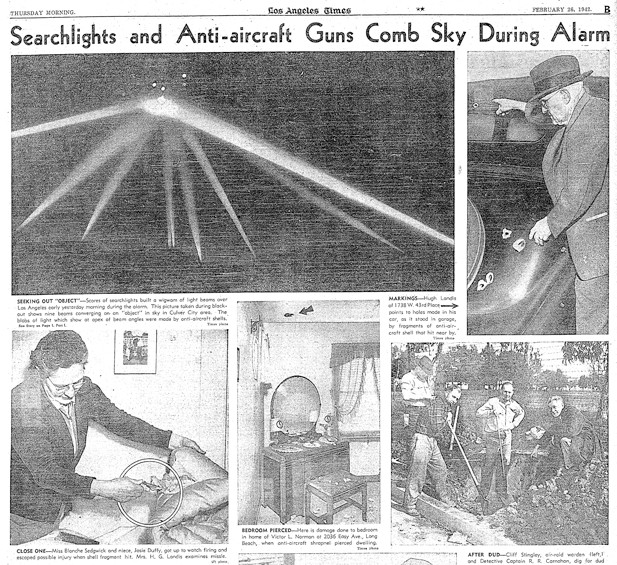
The all-clear sounded at 7:21 a.m. The night had produced no bomb craters and no wreckage, though there were reports that four enemy planes had been shot down and that one had crashed in flames at a Hollywood intersection. What fell on Los Angeles was its own artillery. Shell fragments and duds holed roofs, streets and cars; one crashed into a bed that a woman and a girl had left moments earlier to watch the show. The Times counted five deaths laid to the blackout, “three in traffic accidents, two as victims of heart attacks.” George P. Weil, a 36-year-old air-raid warden, suffered a heart attack and died at home. Henry B. Ayers, 60, driving an ammunition wagon for the State Guard in Hollywood, “slumped over in his seat and died of a heart attack.” Zeulah Klein of Arcadia was killed when the car her husband was driving collided with a truck; a Long Beach police sergeant, Engebert Larson, died in a head-on crash on his way to duty, and a pedestrian, Jesus Alferez, was struck and killed near the University of Southern California. Countless thousands of residents, the Times reported, agreed that whatever the alarm had been, it was “a great show” and “well worth losing a few hours’ sleep.”
Sources: Los Angeles Defense Guns Blaze Away: City Gets Air Raid Scare As Unidentified Plane Crosses HeavensRoaring Guns Mark Blackout; Five Deaths Laid to Raid Blackout; Plane Signaling Suspects Seized; “Seeking Out ‘Object’” (photo and caption); Marvin Miles’s eyewitness story; editorial “Whose nerves, Mr. Knox?”The Army Air Forces in World War II, Vol. I: Plans and Early Operations, chapter 8, “The Defense of the Western Hemisphere,” pp. 277–286Did Enemy Aircraft Threaten Los Angeles During World War II?
Signals in the dark
The hunt for an enemy on the ground began before the guns stopped. Air-raid wardens and residents reported lights blinking from rooftops and flares falling on beaches and far inland, some as late as 6 a.m., and police in some districts said they were convinced Japanese had tried to guide invading planes with red, green and white flares. The counts of arrests differ. The AP reported eight Japanese held and later released after the Army said the blinking lights were “undoubtedly” tracer bullets from heavy machine guns. The Times reported thirty people arrested during the night, twenty of them Japanese, and fifteen Japanese arrested by sheriff’s deputies, some of them accused of trying to guide the planes with signals, among them three members of the Kunisaki family and Tokushiki Okuda, all of one address on Buel Street. City police in Venice took two men and a woman into custody for supposedly signaling with flashlights. The same edition quoted a woman demanding internment: every hour that a single Japanese person was at liberty in the state, she said, was “an hour we might tragically regret.” The forced removal of Japanese Americans from the coastal military areas began a few weeks later.
Sources: Los Angeles Defense Guns Blaze Away: City Gets Air Raid Scare As Unidentified Plane Crosses HeavensRoaring Guns Mark Blackout; Five Deaths Laid to Raid Blackout; Plane Signaling Suspects Seized; “Seeking Out ‘Object’” (photo and caption); Marvin Miles’s eyewitness story; editorial “Whose nerves, Mr. Knox?”Executive Order 9066: Resulting in Japanese-American Incarceration (1942)
Just a false alarm
By afternoon the services were contradicting each other. In Washington, Navy Secretary Frank Knox told reporters that it was “just a false alarm.” “There were no planes over Los Angeles last night,” he said, “at least that’s our understanding. None have been found and a very wide reconnaissance has been carried on.” The AP reported that Knox thought the reports of enemy activity might be due largely to “jittery nerves.” He also said that vital industries on the coast might eventually have to be moved inland. The Western Defense Command said only that no bombs had been dropped, no planes shot down, and “there was a considerable amount of anti-aircraft firing.” At 3:45 that afternoon Fourth Army headquarters issued a single sentence: “The aircraft which caused the blackout in the Los Angeles area for several hours this morning have not been identified.” One official source told the AP that Army fighters had gone up as soon as the signal was given; another said they had stayed on the ground to avoid their own guns. The Times answered Knox in a front-page editorial: “Whose nerves, Mr. Knox? The public’s or the Army’s?”
Sources: Los Angeles Defense Guns Blaze Away: City Gets Air Raid Scare As Unidentified Plane Crosses HeavensRoaring Guns Mark Blackout; Five Deaths Laid to Raid Blackout; Plane Signaling Suspects Seized; “Seeking Out ‘Object’” (photo and caption); Marvin Miles’s eyewitness story; editorial “Whose nerves, Mr. Knox?”The Army Air Forces in World War II, Vol. I: Plans and Early Operations, chapter 8, “The Defense of the Western Hemisphere,” pp. 277–286
As many as fifteen airplanes
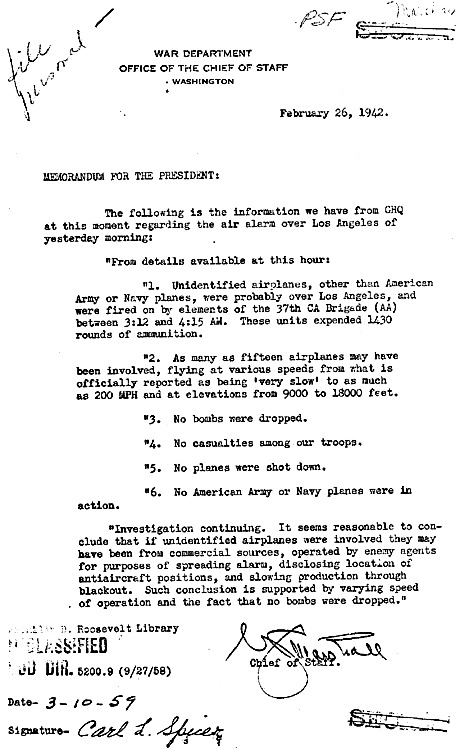
On February 26 Marshall sent Roosevelt what GHQ knew “at this moment.” “Unidentified airplanes, other than American Army or Navy planes, were probably over Los Angeles, and were fired on by elements of the 37th CA Brigade (AA) between 3:12 and 4:15 AM. These units expended 1430 rounds of ammunition.” As many as fifteen planes might have been involved, flying at speeds “officially reported as being ‘very slow’ to as much as 200 MPH” and at heights from 9,000 to 18,000 feet. No bombs dropped, no troops hurt, no planes shot down, no American planes in action. If they were airplanes, Marshall reasoned, they “may have been from commercial sources, operated by enemy agents for purposes of spreading alarm, disclosing location of antiaircraft positions, and slowing production through blackout.” Roosevelt wrote to his secretary of war, Henry Stimson, the same day, asking who was responsible for the air alarm system and insisting that all comment on alarms be made “exclusively by the appropriate officials of the Department responsible”; he was writing, he said, “in the light of the two alarms last night.” Stimson read Marshall’s memo almost word for word to the press and added: “perhaps it is better to be too alert than not alert enough. At any rate, they were alert there.” Stimson also raised the idea of light planes launched from Japanese submarines, the Army history adds; by then the local commanders, after a day of hearings, had settled on one to five planes.
Sources: Memorandum for the President [on the air alarm over Los Angeles]Note to the Secretary of War (“Dear Harry”) on air alarmsMystery Planes Fly Over Los AngelesKnox Assailed on ‘False Alarm’; stenographic report of the Marshall memorandum as read by StimsonThe Army Air Forces in World War II, Vol. I: Plans and Early Operations, chapter 8, “The Defense of the Western Hemisphere,” pp. 277–286
A recipe for jitters
The public quarrel ran for a week. Wendell Willkie, the defeated Republican presidential candidate, told reporters on arriving in Los Angeles that the conflicting statements showed “the same lack of coordination and confusion that brought the disaster at Pearl Harbor,” and told his audience that night that in a real air raid “you won’t have to argue about it — you’ll just know.” Representative Leland Ford of Santa Monica asked whether the incident was “a practice raid, or a raid to throw a scare into 2,000,000 people, or a mistaken identity raid, or a raid to take away Southern California’s war industries,” and the Times reported calls for a congressional investigation and a canvass of Southern California for secret airfields. The Washington Post called the episode a “recipe for jitters” and noted that the commercial-plane theory explained “everything except where the planes came from, whither they were going, and why no American planes were sent in pursuit of them.” The New York Times found it more incredible the more it was studied: if the batteries had fired at nothing, it was “a sign of expensive incompetence and jitters”; if at real planes, “why were they completely ineffective?” The official historians later admitted that a frank answer would have exposed how weak the country’s air defenses still were.
Sources: Mystery Planes Fly Over Los AngelesKnox Assailed on ‘False Alarm’; stenographic report of the Marshall memorandum as read by StimsonThe Army Air Forces in World War II, Vol. I: Plans and Early Operations, chapter 8, “The Defense of the Western Hemisphere,” pp. 277–286
The balloon that started all the shooting
Behind closed doors the Army had already found its answer. Maj. Gen. Jacob Fickel and Col. Samuel Kepner flew down from San Francisco and, with Murphy, formed a board that questioned about sixty witnesses, civilians and Army, Navy and Air Forces men. As Murphy recalled it, “Roughly about half the witnesses were sure they saw planes in the sky. One flier vividly described 10 planes in V formation. The other half saw nothing.” On one gun director, he wrote, “the elevation operator … looking through his scope saw many planes. His azimuth operator looking through a parallel scope on the same instrument did not see any planes.” The board found that the firing had been ordered by a young Air Forces controller in the fighter command operations room who, hearing a balloon reported, “visualized a German or Japanese zeppelin” and ordered the guns to fire, though he had no authority to do so. “One of the AA Regiments … sent up a meteorological balloon about 1:00 A.M. That was the balloon that started all the shooting!” His hour does not match the Army’s own timeline, which has the guns opening two hours later. When things had quieted, another regiment sent up its own weather balloon “and hell broke loose again.” Both balloons, as Murphy remembered, “floated away majestically and safely.” By Murphy’s reckoning, the gunners had fired more rounds than they would have been allowed in ten peacetime years of target practice. Lore and Deneault, drawing on the 4th Antiaircraft Command’s history, add that one officer who saw a balloon at about 3 a.m. found that the meteorological laboratory had sent one aloft, and ordered no firing.
Sources: Activities of the Ninth Army AAA (section “L.A. ‘Attacked’”)Mysteries of the Skies: UFOs in Perspective, chapter 6, “The Battle of Los Angeles”The Army Air Forces in World War II, Vol. I: Plans and Early Operations, chapter 8, “The Defense of the Western Hemisphere,” pp. 277–286
A myth, says Tokyo
The question lingered through the war. On October 28, 1945, the Fourth Air Force in San Francisco said planes, possibly Japanese, had been overhead that night, perhaps launched from submarines close to shore. On November 1 a Japanese navy spokesman told the Associated Press in Tokyo that “the Battle of Los Angeles was a myth; the Japanese did not send planes over that city the night of Feb. 24–25, 1942.” The idea was not absurd. The Army historians note that I-17 normally carried a floatplane and that submarine-launched aircraft did later fly over the Pacific Northwest, though Bill Yenne writes that on this patrol the submarine carried extra fuel instead of a plane. But the official Air Forces history, published in 1948, concluded that “meteorological balloons — known to have been released over Los Angeles — may well have caused the initial alarm,” that the batteries had been officially criticized for wasting ammunition on targets that moved too slowly to be airplanes, and that shell bursts caught in the searchlights had themselves been taken for planes. “It is hard to see,” it added, “what enemy purpose would have been served by an attack in which no bombs were dropped, unless perhaps, as Mr. Stimson suggested, the purpose had been reconnaissance.”
Sources: Air Battle Called MythThe Army Air Forces in World War II, Vol. I: Plans and Early Operations, chapter 8, “The Defense of the Western Hemisphere,” pp. 277–286IJN Submarine I-17: Tabular Record of MovementDid Enemy Aircraft Threaten Los Angeles During World War II?
The photograph
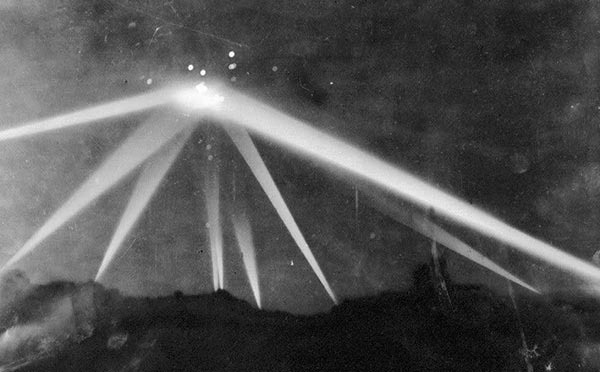
The image that made the case famous ran in the Times on February 26, 1942: nine beams converging on a bright patch over the Culver City area, studded with points of light. The paper’s caption was candid, saying the beams converged on an “object” in the sky and that the “blobs of light which show at apex of beam angles were made by anti-aircraft shells.” A differently retouched version, with bigger white spots, ran in the Times on October 29, 1945. In March 2011 the paper reexamined it. Scott Harrison of the photo staff inspected two negatives found at UCLA by Simon Elliott of Special Collections. One, showing the scene before retouching, was “very flat, the focus is soft and it looks underexposed”; the other was a copy negative of the published print, on which many beams had been “lightened and widened with white paint, while other beams were eliminated.” With current standards, Harrison wrote, “this image would not be published.” Larry Harnisch, holding the battered 1942 print, wrote that the beams were airbrushed, the shell bursts were “blobs of paint,” and the dark skyline along the bottom was black paint. The untouched negative, he concluded, shows “nothing but a convergence of light beams with some randomly clustered dots of light.”
Sources: Roaring Guns Mark Blackout; Five Deaths Laid to Raid Blackout; Plane Signaling Suspects Seized; “Seeking Out ‘Object’” (photo and caption); Marvin Miles’s eyewitness story; editorial “Whose nerves, Mr. Knox?”The Battle of L.A., 1942 [updated]Another Good Story Ruined: Saucers Over L.A.! — Part 1Another Good Story Ruined: Saucers Over L.A.! — Part 7File:Battle of Los Angeles LATimes.jpg (Los Angeles Times picture page, February 26, 1942)
From war scare to flying saucer
For a quarter of a century the battle was a war story, and a comic one. When the flying saucers arrived in the summer of 1947, a Times editorial on July 8 recalled how “antiaircraft bursts caught in searchlight beams were magnified into 27 twin-engined Japanese bombers, majestically flying in formation.” Bill Henry, in 1952, remembered the night when “something resembling a flying saucer — it was really an errant weather balloon — touched off the gosh-durndest artillery barrage that our community has witnessed before or since.” The UFO reading arrived in 1968, from two directions at once. Gordon Lore and Harold Deneault gave the battle a chapter of Mysteries of the Skies, working from the 4th Antiaircraft Command’s unpublished history; the official record, they wrote, was “amazingly sparse.” That September Paul T. Collins published “The UFOs of 1942” in Exploring the Unknown. He described “an object big enough to dwarf an apartment house,” cited an unnamed Herald-Express writer who was sure many shells had burst in the middle of it, and told his own story. Driving home from a swing shift at Douglas in Long Beach, he was stopped by wardens in Pasadena and saw “bright red spots of light” low over Long Beach, “zigzagging from side to side,” vanishing and reappearing while the shells burst among them. He decided that no man-made device could fly like that.
Sources: Another Good Story Ruined: Saucers Over L.A.! — Part 6Mysteries of the Skies: UFOs in Perspective, chapter 6, “The Battle of Los Angeles”The UFOs of 1942 (reprinted from Exploring the Unknown, September 1968)
Katie and the editor
Collins had already claimed in 1968 that “thousands” of observers had “verified the presence of one enormous, unidentifiable, indestructible object,” and he said it again when he retold his story for Fate in July 1987. In the late 1990s two more voices joined the lore and became its most quoted. In Jeff Rense’s article “The Most Incredible Mass Sighting Of All?” an unnamed air-raid warden and interior decorator on the west side, “Katie,” remembered an object that was “huge! It was just enormous! And it was practically right over my house,” “a lovely pale orange and about the most beautiful thing you’ve ever seen,” with fighter planes approaching it and turning away, though Marshall’s memo says no American planes were in action that night. The other is Peter Jenkins, “editor” of the Los Angeles Herald Examiner, who “could clearly see the V formation of about 25 silvery planes overhead moving slowly across the sky toward Long Beach.” His quote comes from a 1996 article by Terrenz Sword in the magazine Unsolved UFO Sightings, passed on by Joseph Trainor’s newsletter UFO Roundup in February 1998 and later added to Rense’s page. No 1942 printing of it has been found, and the Herald Examiner did not exist until the Examiner and the Herald-Express merged in 1962.
Sources: The UFOs of 1942 (reprinted from Exploring the Unknown, September 1968)The Most Incredible Mass Sighting Of All? The Battle Of Los AngelesMemorandum for the President [on the air alarm over Los Angeles]The Battle of Los Angeles UFO story
Not earthly
Around the same time the researcher Timothy Cooper received, from anonymous sources, copies of supposed wartime memos. One, in a letter postmarked Sacramento, was a Marshall memo of March 5, 1942, reporting that the mystery airplanes were “not earthly” and “in all probability of interplanetary origin,” and that one had been recovered off the coast and a similar one east of Los Angeles. Robert and Ryan Wood published it among their “Majestic” documents, noting that the words “Interplanetary Phenomenon Unit” had been typed on it later on a different typewriter; skeptics such as Brian Dunning dismiss it as a hoax. In 2011 the publicity for the Hollywood film Battle: Los Angeles leaned on the retouched photograph and on fake newspaper headlines, and the night became, for much of the internet, the first great UFO battle.
Sources: Documents Dated Prior to 1948 (the “Marshall to Roosevelt, March 5, 1942” and “Roosevelt to Marshall, February 27, 1942” memos)The Battle of Los Angeles (episode 171)Another Good Story Ruined: The Battle of Los Angeles
What survives
The core of the record is military and contemporary. Marshall’s memorandum (stamped PSF, for the President’s Secretary’s File) and a file copy of Roosevelt’s note to Stimson survive as scans hosted by the California State Military Museum. The Army Air Forces’ official history of 1948 reconstructs the night minute by minute from the Western Defense Command’s reports and the history of the 4th Antiaircraft Command, which has not been published and which Lore and Deneault quoted in 1968. Colonel Murphy’s 1949 article in The Antiaircraft Journal is the only account by a member of the investigating board, written from memory seven years later; it misdates the night to February 26. The contemporary press is rich: the Associated Press wire, the Los Angeles Times of February 25–27, with Marvin Miles’s and Bill Henry’s eyewitness pieces, the casualty list and the arrests, and Ernie Pyle’s column. This account does not draw on the other Los Angeles papers of 1942, including the Herald-Express, the Examiner and the Long Beach papers. The two negatives of the searchlight photograph are at UCLA. No radar plot, gun log or interrogation transcript has been published, and no wreckage or film of an aircraft exists.
Sources: Memorandum for the President [on the air alarm over Los Angeles]The Army Air Forces in World War II, Vol. I: Plans and Early Operations, chapter 8, “The Defense of the Western Hemisphere,” pp. 277–286Activities of the Ninth Army AAA (section “L.A. ‘Attacked’”)Mysteries of the Skies: UFOs in Perspective, chapter 6, “The Battle of Los Angeles”Roaring Guns Mark Blackout; Five Deaths Laid to Raid Blackout; Plane Signaling Suspects Seized; “Seeking Out ‘Object’” (photo and caption); Marvin Miles’s eyewitness story; editorial “Whose nerves, Mr. Knox?”The Battle of L.A., 1942 [updated]
How the story grew
Almost every number moves. The guns opened at 3:06 in the Army history, at 3:12 in Marshall’s memo and at 3:16 in Collins; they stopped at 4:15 or 4:14. Marshall and Stimson said 1,430 rounds, the Army history 1,440, later retellings 1,433 or “nearly 2,000.” The Times counted five deaths, Collins six, the Army history “at least one death from heart failure.” The planes number one to five (the local commanders), up to fifteen (Marshall), twenty-five (a colonel), seven or two hundred (civilians and police), or none (Knox, and the Fourth Air Force in its first report). The moon is a small puzzle of its own. Murphy remembered “a beautiful moonlight night,” while Brian Dunning wrote that the moon had set at 2:30 a.m. Both may be right. Dunning’s figure matches standard time, but the country had moved its clocks an hour ahead on February 9, so the moon was still up, low in the west, when the firing began. The quotations changed most. Bill Henry’s “object” and its direct hits survive in the UFO retellings, but his batch of balloons does not. The Navy observer with “powerful Carl Zeiss binoculars” who counted nine silver planes appears in the 1990s versions of Chief McClelland’s account and has not been found in the searchable text of the 1942 Times. Katie and Peter Jenkins have no source earlier than the 1990s.
Sources: The Army Air Forces in World War II, Vol. I: Plans and Early Operations, chapter 8, “The Defense of the Western Hemisphere,” pp. 277–286Memorandum for the President [on the air alarm over Los Angeles]The UFOs of 1942 (reprinted from Exploring the Unknown, September 1968)Roaring Guns Mark Blackout; Five Deaths Laid to Raid Blackout; Plane Signaling Suspects Seized; “Seeking Out ‘Object’” (photo and caption); Marvin Miles’s eyewitness story; editorial “Whose nerves, Mr. Knox?”The Battle of Los Angeles (episode 171)The Battle of Los Angeles UFO storyThe Most Incredible Mass Sighting Of All? The Battle Of Los Angeles
Explanations on offer
The Army’s own explanation, from the board of inquiry and the official history, is a chain reaction. A weather balloon, released by an antiaircraft regiment to measure winds and perhaps carrying the red flare the Army history mentions, was reported as an aircraft. A young controller ordered fire, and the shell bursts, lit by searchlights and drifting in smoke, became the formations that later witnesses saw. A second balloon restarted the shooting. Bill Henry’s “batch of balloons” and Captain Cohen’s identification support it, and so does the slowness of the target, which Marshall’s own memo recorded as “very slow.” Skeptics since, including Tim Printy and Brian Dunning, argue that the bright “object” was searchlight glare on shell smoke, and the Times’s own 2011 review found the published print heavily retouched. The War Department’s theory of commercial planes flown by enemy agents was never supported, and Japan denied sending any aircraft. The UFO interpretation rests mainly on accounts written down decades later, on the photograph, and on the fact that the Army never published its full findings. Some witnesses, Collins among them, described lights that zigzagged and vanished. Balloons, flares, tracers and bursts seen through smoke and searchlight glare may explain them, but no one can now prove what any single witness saw.
Sources: Activities of the Ninth Army AAA (section “L.A. ‘Attacked’”)The Army Air Forces in World War II, Vol. I: Plans and Early Operations, chapter 8, “The Defense of the Western Hemisphere,” pp. 277–286By the Way With Bill HenryMemorandum for the President [on the air alarm over Los Angeles]The Battle of Los Angeles UFO storyThe Battle of Los Angeles (episode 171)The Battle of L.A., 1942 [updated]The UFOs of 1942 (reprinted from Exploring the Unknown, September 1968)
Classification note
This archive files the Battle of Los Angeles as a military encounter because the core record is an Army air-defense action, its after-action reports and the War Department’s statements. It carries no close-encounter code: no witness of 1942 described a structured craft at close range, landing traces or occupants, and the giant hovering object of later accounts first appears in print a quarter of a century after the event. The case is included for what the night shows about how a city, its gunners and its newspapers saw the sky, and how a war scare became UFO lore.
Sources: The Army Air Forces in World War II, Vol. I: Plans and Early Operations, chapter 8, “The Defense of the Western Hemisphere,” pp. 277–286The UFOs of 1942 (reprinted from Exploring the Unknown, September 1968)
- 19 FEB 1942
Roosevelt signs Executive Order 9066, opening the way to the removal of Japanese Americans from the West Coast.
- 23 FEB 1942
During a fireside chat, the submarine I-17 shells the Ellwood oil field near Santa Barbara for about twenty minutes.
- 24 FEB 1942
Naval intelligence warns of an attack within ten hours; an alert runs from 7:18 to 10:23 p.m.
- 25 FEB, 2:15 A.M.
A radar target 120 miles west puts the antiaircraft batteries on alert.
- 25 FEB, 2:21–2:25 A.M.
The regional controller orders a blackout; sirens sound across Los Angeles.
- 25 FEB, 2:43 A.M.
Planes are reported near Long Beach; a colonel reports about 25 at 12,000 feet.
- 25 FEB, 3:06 A.M.
After a balloon with a red flare is seen over Santa Monica, four batteries open fire (3:12 in Marshall’s memo).
- 25 FEB, 4:15 A.M.
The firing ends after about 1,430 rounds; the board later traces a second burst of shooting to another weather balloon.
- 25 FEB, 7:21 A.M.
All-clear. Five deaths are laid to the blackout; about thirty people, twenty of them Japanese, are arrested, some accused of signaling.
- 25 FEB 1942
Navy Secretary Knox calls it “just a false alarm”; the Fourth Army says the aircraft “have not been identified.”
- 26 FEB 1942
The Times publishes the searchlight photograph; Marshall tells Roosevelt as many as fifteen planes may have been involved; Stimson reads the memo to the press.
- 26–28 FEB 1942
Rep. Leland Ford demands answers; the Washington Post and New York Times question the contradictions.
- 28–29 OCT 1945
The Fourth Air Force says planes, possibly Japanese and launched from submarines, were over the city; the Times reruns a retouched searchlight photograph.
- 1 NOV 1945
A Japanese navy spokesman calls the Battle of Los Angeles “a myth.”
- 8 JUL 1947
As flying saucers fill the news, a Times editorial recalls the phantom bombers of 1942.
- 1948
The official Air Forces history blames weather balloons and shell bursts in the searchlights.
- MAY–JUN 1949
Col. John G. Murphy reveals the board’s finding: a weather balloon “started all the shooting.”
- 1968
Lore and Deneault’s Mysteries of the Skies and Paul T. Collins’s “The UFOs of 1942” recast the night as a UFO case.
- JUL 1987
Collins retells his 1968 story in Fate, again describing “one enormous, unidentifiable, indestructible object.”
- LATE 1990s
Jeff Rense publishes “Katie”’s account; Peter Jenkins’s quote spreads from a 1996 magazine article; a disputed Marshall memo calls the craft “interplanetary.”
- MAR 2011
Battle: Los Angeles opens; the Times shows that its 1942 photograph was heavily retouched.
Sources & interviews
The Army Air Forces in World War II, Vol. I: Plans and Early Operations, chapter 8, “The Defense of the Western Hemisphere,” pp. 277–286Wesley Frank Craven and James Lea Cate, eds. · University of Chicago Press, 1948; Office of Air Force History reprint, 1983 · HyperWar transcriptionMemorandum for the President [on the air alarm over Los Angeles]Gen. George C. Marshall, Chief of Staff · February 26, 1942 · President’s Secretary’s File, Franklin D. Roosevelt Library (declassified March 10, 1959) · scan hosted by the California State Military MuseumNote to the Secretary of War (“Dear Harry”) on air alarmsFranklin D. Roosevelt · February 26, 1942 · scan hosted by the California State Military MuseumCalifornia in World War II: The Battle of Los AngelesCalifornia State Military Museum, California Military DepartmentActivities of the Ninth Army AAA (section “L.A. ‘Attacked’”)Col. John G. Murphy · The Antiaircraft Journal, vol. 92, no. 3, May–June 1949, pp. 4–5 · Defense Technical Information Center scan ADA509813, Internet ArchiveLos Angeles Defense Guns Blaze Away: City Gets Air Raid Scare As Unidentified Plane Crosses HeavensFrank Frawley, Associated Press · Wilmington Morning Star (North Carolina), February 26, 1942, pp. 1 and 3 · DigitalNCMystery Planes Fly Over Los AngelesAssociated Press · Wilmington Morning Star (North Carolina), February 27, 1942, p. 2 · DigitalNCVast Los Angeles Area Raided by Jap Planes (later edition)Los Angeles Times · February 25, 1942 · Internet Archive (lending-restricted scan, searchable text)Roaring Guns Mark Blackout; Five Deaths Laid to Raid Blackout; Plane Signaling Suspects Seized; “Seeking Out ‘Object’” (photo and caption); Marvin Miles’s eyewitness story; editorial “Whose nerves, Mr. Knox?”Los Angeles Times · February 26, 1942 · Internet Archive (lending-restricted scan, searchable text)By the Way With Bill HenryBill Henry · Los Angeles Times, February 26, 1942, Part II · Internet Archive (lending-restricted scan, searchable text)Knox Assailed on ‘False Alarm’; stenographic report of the Marshall memorandum as read by StimsonLos Angeles Times · February 27, 1942 · Internet Archive (lending-restricted scan, searchable text)Air Battle Called MythAssociated Press from Tokyo · Los Angeles Times, November 1, 1945 · Internet Archive (lending-restricted scan, searchable text)IJN Submarine I-17: Tabular Record of MovementBob Hackett, Sander Kingsepp and Peter Cundall · Combinedfleet.comExecutive Order 9066: Resulting in Japanese-American Incarceration (1942)National Archives, Milestone DocumentsMysteries of the Skies: UFOs in Perspective, chapter 6, “The Battle of Los Angeles”Gordon I. R. Lore Jr. and Harold H. Deneault Jr. · Prentice-Hall, 1968 · Internet Archive (lending library)The UFOs of 1942 (reprinted from Exploring the Unknown, September 1968)Paul T. Collins · Flying Saucer Digest, no. 19 · Internet ArchiveThe Most Incredible Mass Sighting Of All? The Battle Of Los AngelesJeff Rense · Rense.com (first posted on Sightings.com by early 1998; later expanded with photo analyses)Documents Dated Prior to 1948 (the “Marshall to Roosevelt, March 5, 1942” and “Roosevelt to Marshall, February 27, 1942” memos)Robert M. Wood and Ryan S. Wood · Majestic DocumentsAnother Good Story Ruined: Saucers Over L.A.! — Part 1Larry Harnisch · The Daily Mirror (Los Angeles Times blog, now ladailymirror.com) · March 7, 2011Another Good Story Ruined: Saucers Over L.A.! — Part 3Larry Harnisch · The Daily Mirror · March 9, 2011Another Good Story Ruined: Saucers Over L.A.! — Part 6Larry Harnisch · The Daily Mirror · March 12, 2011Another Good Story Ruined: Saucers Over L.A.! — Part 7Larry Harnisch · The Daily Mirror · March 13, 2011Another Good Story Ruined: The Battle of Los AngelesLarry Harnisch · The Daily Mirror · February 21, 2011The Battle of L.A., 1942 [updated]Scott Harrison · Framework, Los Angeles Times photography blog · March 10, 2011 · Wayback Machine copyThe Battle of Los Angeles UFO storyTim Printy · SUNlite, vol. 3, no. 1, January–February 2011The Battle of Los Angeles (episode 171)Brian Dunning · Skeptoid · September 15, 2009Did Enemy Aircraft Threaten Los Angeles During World War II?Bill Yenne · HistoryNet · 2019File:Battle of Los Angeles LATimes.jpg (Los Angeles Times picture page, February 26, 1942)Wikimedia CommonsFleet searchlights over San Pedro, 1935 (Los Angeles Times Photographic Collection)UCLA Library Special Collections, Charles E. Young Research Library · CC BY 4.0Spotted an error, or know a better source? Write to hello@uap.fun.
Connected files
The Foo Fighters of the RhineTwo years later, American night fighter crews over Germany chased lights that ground radar could not find.The Washington FlapTen years later, radar blips over the capital sent jets chasing targets that may never have been there, and the press demanded answers.The Rocket in Lake KölmjärvFour years later, a neutral country’s military logged hundreds of reports and suspected a foreign power’s secret weapon.The Ghost Fliers of NorrlandAn earlier scare in which a nervous public saw enemy aircraft that no one could ever find.Discuss this case
Compare notes with other readers: witness details, sources, and the parts that still do not add up.
Open the discussion