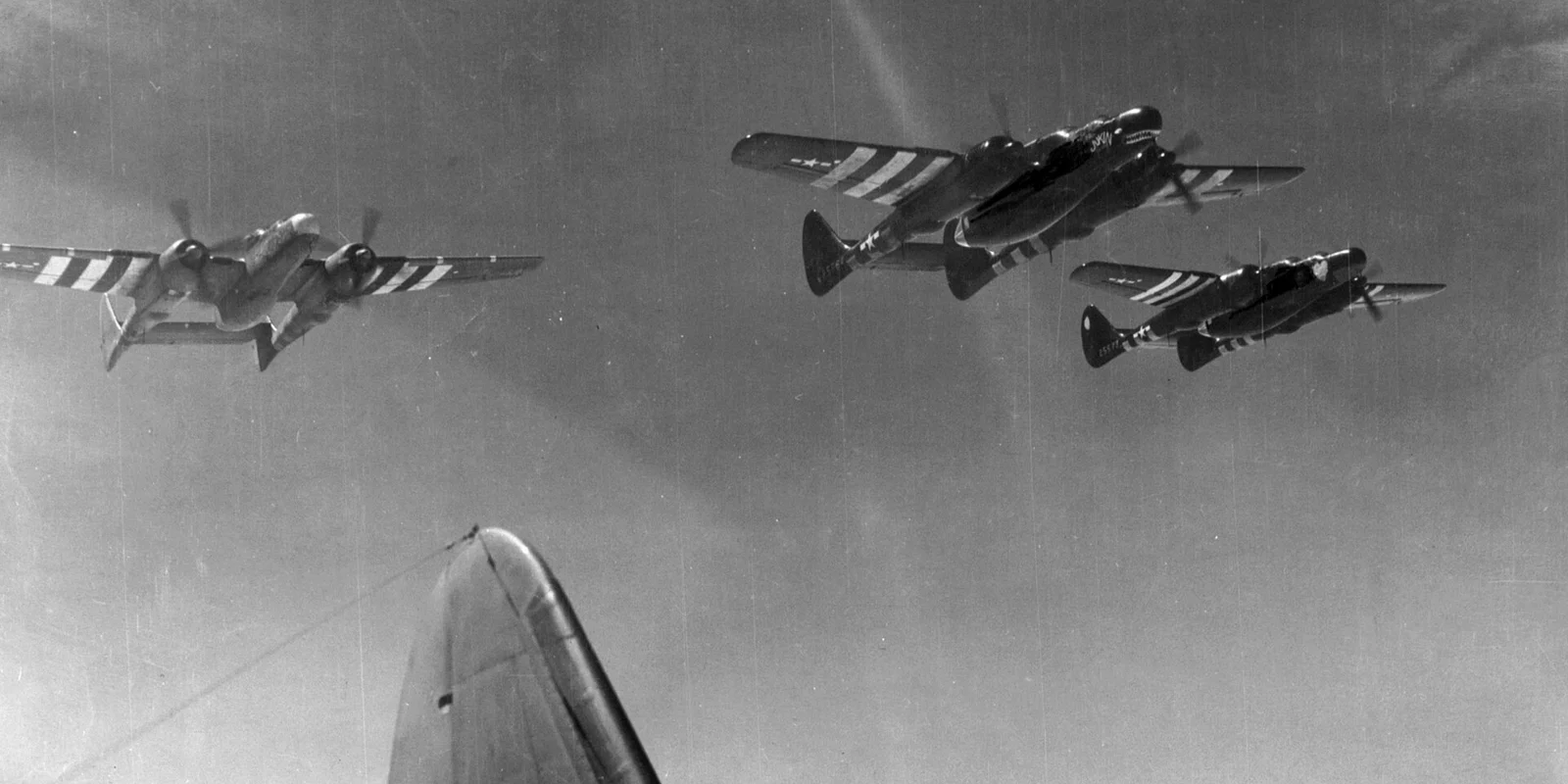
A red light off the starboard wing
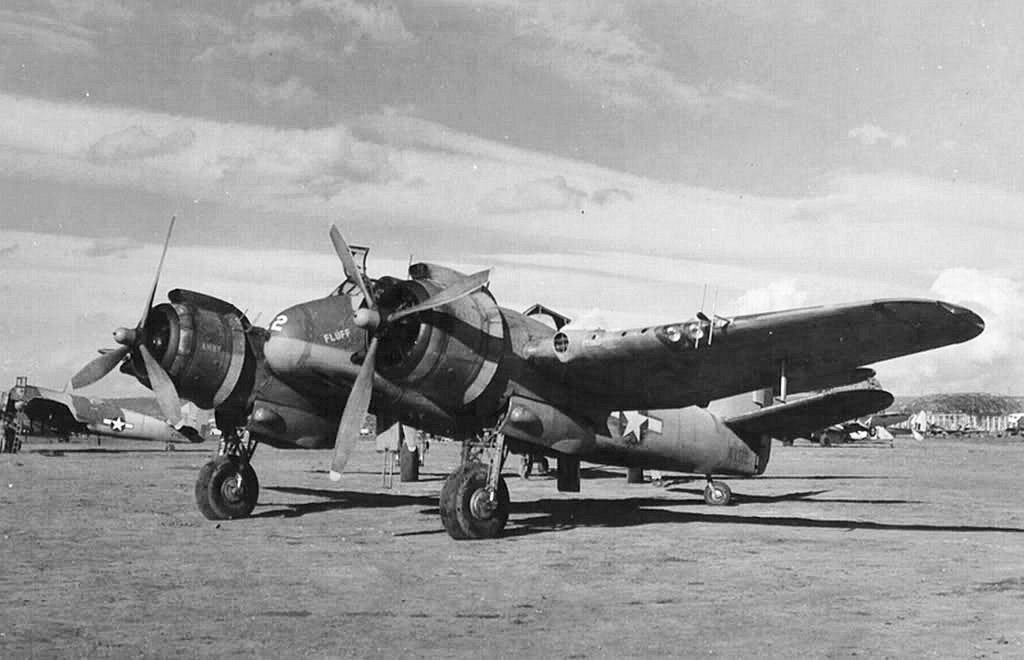
The 415th Night Fighter Squadron hunted in the dark. Its crews, a pilot and a radar observer to each twin-engined Bristol Beaufighter, had fought across North Africa, Sicily and Italy, and in the autumn of 1944 they were flying from Dijon in eastern France on intruder missions: low, lonely sweeps across the Rhine into Germany, hunting for trains, truck convoys and enemy night fighters. On the night of November 26–27 the pilot was Lieutenant Edward Schlueter, a tall young man from Oshkosh, Wisconsin, with his radar observer, Lieutenant Donald J. Meiers of Chicago. The squadron’s War Diary for November 27 copied what Schlueter put in his report and called it “the following weird excerpt”: “Upon returning to base saw a red light flying through area about 35 miles ENE of Pt. A. Came in to about 2000 feet off starboard and then it disappeared in a long red streak.” The researcher Keith Chester, working from the mission records, places the flight between Karlsruhe and Mannheim. The unit’s own history, written later, remembered the night as the beginning of something: “At first these two officers were taunted by their buddies and began to wonder if they had developed combat fatigue.”
Sources: First Official Foo-Fighter Records DiscoveredUFO Reports and Official Documents, 1945Strange Company: Military Encounters with UFOs in World War IIThe Foo Fighter Mystery
That hill is considerably closer
Within days, by Keith Chester’s reading of the records (Chamberlin puts him aboard on the very first night), the squadron’s intelligence officer, Captain Fred “Fritz” Ringwald, a private pilot who had run a service station in East St. Louis before the war, went along on a mission to see for himself. In the version he gave the Associated Press in January, he saw lights off to the right and told the pilot, who said they were “lights on a hill.” A few minutes later he looked again: “Well, that hill is considerably closer to us now.” In the longer telling of Jo Chamberlin, an aide to the air forces chief General Hap Arnold who interviewed the crews in the spring of 1945, the night was reasonably clear, with a quarter moon, and the Beaufighter was working both sides of the Rhine north of Strasbourg. Ringwald wondered aloud what the lights in the hills were; Schlueter said they were probably stars. Then Ringwald remembered that there were no hills there. The lights were “eight or ten of them in a row – orange balls of fire moving through the air at a terrific speed.” Schlueter called ground radar, which told him there was nobody up there but himself. “Are you crazy?” He turned into the lights, which went out, came back far off and, five minutes later, slid away in a flat glide. The crew went on to shoot up seven freight trains, landed at Dijon and agreed to say nothing: Schlueter and Meiers were near the end of their tours and had no wish to be grounded for combat fatigue.
Sources: UFO Reports and Official Documents, 1945The Foo Fighter MysteryStrange Company: Military Encounters with UFOs in World War IIThe Foo Fighters of World War II, Part One
Where there’s foo, there’s fire
The lights needed a name, and the crews took one from the funny papers. Bill Holman’s comic strip Smokey Stover followed a fireman who drove a two-wheeled fire engine and littered every panel with the nonsense word foo; the running gag was “Where there’s foo, there’s fire.” In Chamberlin’s account a pilot at chow suggested naming the lights, and “a reader of the comic strip” proposed foo-fighters. The unit history is more specific: the first lights were “referred to as such by Lt. Myers” — its spelling of Meiers — “for the lack of a better name and because of the eerie feeling it gave the crew.” When Jeffery Lindell interviewed the surviving officers in 1991, Ringwald recalled that Meiers had a copy of the strip tucked in his back pocket, slammed it down on Ringwald’s desk and swore that it had been another of those foo fighters, with a stronger word in front; the commander, Major Harold Augspurger, is said to have cleaned the name up for the reports. The first written use that survives is in the War Diary for December 18, 1944, where one word has faded past reading on the microfilm: “Our pilots have named these mysterious … which they encounter over Germany at night ‘Foo-Fighters.’”
Sources: The Foo Fighter MysteryFirst Official Foo-Fighter Records DiscoveredFoo-Fighter DocumentsEtymology of “Foo” (RFC 3092)The real Foo fighters
Under perfect control
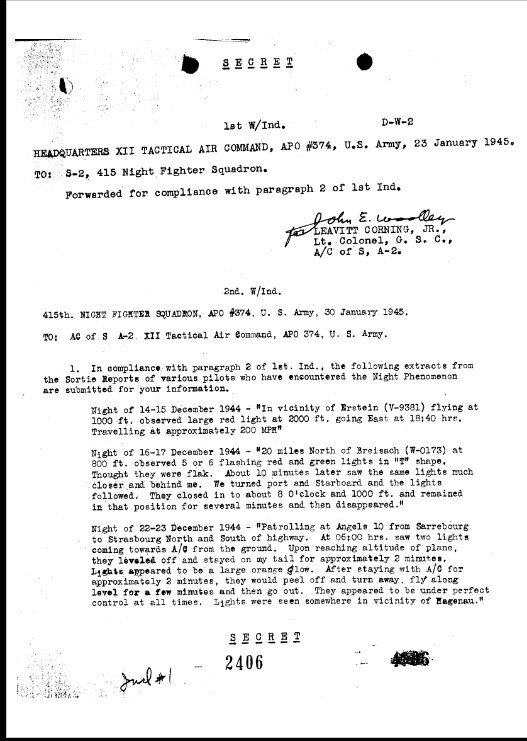
On December 6 the squadron moved to Ochey, near Nancy, and through the rest of December the lights came almost nightly. On December 14–15, near Erstein, a crew flying at 1,000 feet saw a large red light at 2,000 feet heading east at about 200 miles an hour; their radar had failed, so they followed it by eye until it went out. On December 16–17, twenty miles north of Breisach, another crew saw “5 or 6 flashing red and green lights in ‘T’ shape” and took them for flak, until ten minutes later the same lights were behind them: “We turned port and Starboard and the lights followed.” They closed to about 1,000 feet, off the left rear, and held there for several minutes before disappearing. The same night a crew over Lichtenau fired at lights, with no result observed. At six in the morning of December 23, patrolling at 10,000 feet between Sarrebourg and Strasbourg, a pilot watched two lights climb toward him from the ground near Hagenau, level off at his altitude and sit on his tail for two minutes before peeling away. “They appeared to be under perfect control at all times.” On the night of December 23–24 Lieutenant David McFalls and his radar observer, Lieutenant Ned Baker, saw a glowing red object shoot straight up and then turn into what looked like an aircraft seen from above, rolling over and diving out of sight: a “plane view of A/C doing a wing over and going into a dive and disappearing.” Chamberlin called it “the first and only suggestion of a controlled flying device.” On December 26–27 a crew called the ground controllers, call sign Blunder, to ask whether any enemy aircraft were about, was told no, and then felt the jolt of another plane’s propeller wake — “what was thought to be prop wash; very distinct” — where no aircraft was, and saw lights that “made distinct lines somewhat like arrows”; another watched a light near Worms come “within 100” (the report gives no unit) and follow it through five minutes of evasive action before pulling up out of sight.
Sources: 2nd Wrapper Indorsement: extracts from sortie reportsFoo-Fighter DocumentsUFO Reports and Official Documents, 1945The Foo Fighter Mystery
Christmas Eve over Karlsruhe
One of the men who saw the lights was a reporter. Sergeant Ed Clark of Stars and Stripes flew with the squadron on Christmas Eve, and the story he filed about the mission said nothing of foo fighters, probably because the censors would not pass it. In 1950, with the flying saucers in the headlines, he told it for United Press. “I had my first experience with them Christmas Eve, 1944, in the vicinity of Karlsruhe,” he wrote. A red ball rose from the ground, climbed with tremendous speed and drew level off the left wing. “We turned, we rolled, we dived, we climbed, but the red ball stayed with us.” Chamberlin’s notes, which survive with Project 1947, record the rivalry drily: “On Christmas Eve, Sergeant Ed Clark scooped Associated Press reporter Bob Wilson.”
Sources: UFO Reports and Official Documents, 1945The Foo Fighters of World War II, Part One
Until four in the morning
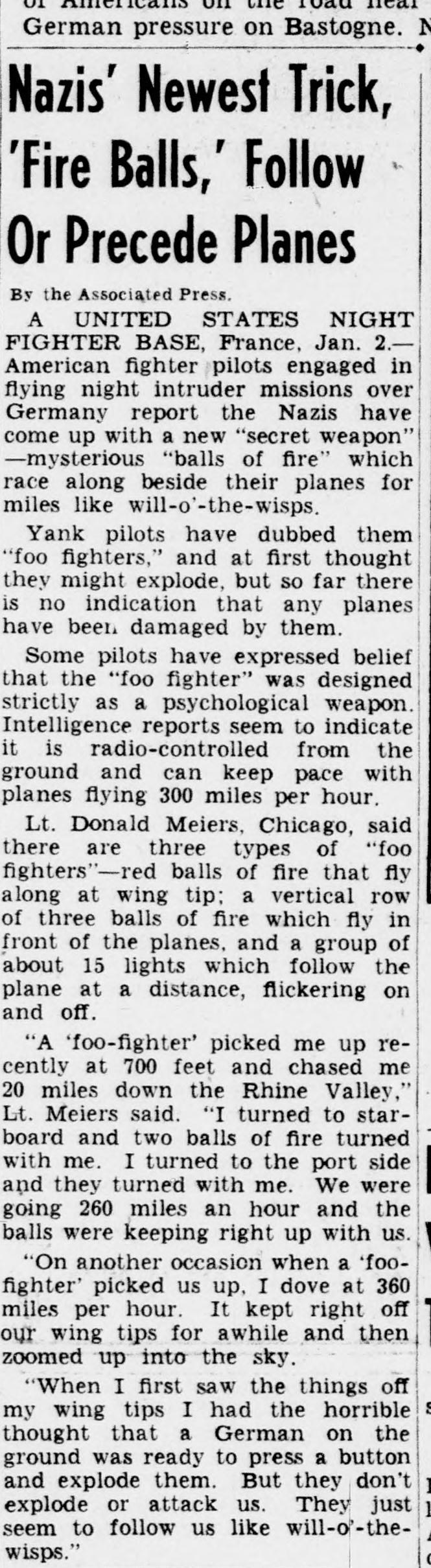
Bob Wilson of the Associated Press reached the squadron on the last day of 1944 hoping to be over Germany with a crew at the stroke of midnight. The weather grounded the flight, so he spent New Year’s Eve sharing cognac with the fliers and, by Chamberlin’s account, questioning them until four in the morning. His story cleared the censors and ran across America on January 1 and 2, 1945. “There are three kinds of these lights we call ‘foo-fighters,’” Meiers told him: red balls of fire that flew along off the wingtips, a vertical row of three balls that flew in front, and a group of about fifteen lights far off that looked “like a Christmas tree up in the air” and flickered on and off. “A ‘foo-fighter’ picked me up recently at 700 feet and chased me 20 miles down the Rhine Valley,” he said. “I turned to starboard and two balls of fire turned with me. I turned to the port side and they turned with me. We were going 260 miles an hour and the balls were keeping right up with us.” Another time, he said, they dived at 360 miles an hour; the lights kept to his wingtips and then zoomed away. “When I first saw the things off my wing tips I had the horrible thought that a German on the ground was ready to press a button and explode them. But they don’t explode or attack us. They just seem to follow us like will-o’-the-wisps.” Lieutenant Wallace Gould of Silver Creek, New York, said the lights shadowed his wingtips and then “zoomed 20,000 feet into the air and out of sight”; none of his crew saw any structure on them. The long version of the wire story listed some twenty more fliers of the squadron who had seen them.
Sources: Nazis’ Newest Trick, ‘Fire Balls,’ Follow Or Precede PlanesEerie Nazi ‘Foo-Fighters’ Mystify Yank Night FliersUFO Reports and Official Documents, 1945The Foo Fighters of World War II, Part OneThe Foo Fighter Mystery
Spots before the eyes
The press was primed. In mid-December Supreme Headquarters had disclosed that American airmen were meeting silver spheres over Germany, which the New York Times likened to the huge glass balls on Christmas trees; the 415th pointed out to Chamberlin that the spheres floated and never followed a plane. So the newspapers called the lights the Nazis’ newest secret weapon; the experts at home called them something else. On January 15 Time wrote that “if it was not a hoax or an optical illusion, it was certainly the most puzzling secret weapon that Allied fighters have yet encountered,” and reported that skeptical scientists thought the fireballs might be an afterimage left in the pilots’ eyes after they had been dazzled by flak bursts, while “front-line correspondents and armchair experts had a Buck Rogers field day.” The correspondents, Time said, guessed that the fireballs were meant to dazzle pilots, mark targets for the flak gunners, jam radar or cut a plane’s ignition in midair. Some scientists in New York, Chamberlin wrote, decided “apparently by remote control” that it was St. Elmo’s fire, the glow of atmospheric electricity on masts and wingtips; a transport pilot back from the Himalayan “Hump” told the AP the foo fighters were only static. Newsweek wondered about the exhaust of a small radio-controlled Messerschmitt rocket plane. At Ochey the crews were furious. When the Time piece reached them in February, Stars and Stripes found them “incensed to learn that the phenomenon had been lightly passed off as a case of spots before their eyes.” Lieutenant Owen Davis and his navigator, Lieutenant Warren Rodick, put it plainly: “If we’re starting to see things now, we’d better quit and go home.” Chamberlin heard the same anger about St. Elmo’s fire, which every night flier knew well: “Just let the sons come over and fly a mission with us. We’ll show ’em.”
Sources: UFO Reports, 1944Science: Foo-FighterFoo Fighters Only Static, Transport Pilot BelievesUFO Reports and Official Documents, 1945The Foo Fighter Mystery
They keep the crews on edge
Behind the headlines the reports were climbing the chain of command. On January 2, the day the AP story ran, the War Department’s Military Intelligence Division cabled Eisenhower’s headquarters: “Press reports red balls of fire accompanying planes in flight termed ‘Foo Fighters’ by air personnel. Desire explanation if available.” No reply has been found. On January 16 the XII Tactical Air Command sent up the squadron’s own words: “We have encountered a phenomenon which we cannot explain; crews have been followed by lights that blink on and off changing colors etc. The lights come very close and fly formation with our planes. They are agitating and keep the crews on edge when they encounter them, mainly because they cannot explain them.” The First Tactical Air Force answered that no one else had reported anything like it and asked for colors, sizes and altitudes. Meanwhile, on January 19, a top secret evaluation of German capabilities for 1945 by the intelligence staff of the U.S. Strategic Air Forces listed, among untried enemy weapons, the “‘Phoo’ Bomb, Magnetic Waves and gases applicable to aircraft,” and judged that none offered a new threat “of really serious proportions.” On January 30 Ringwald sent back fifteen extracts from the pilots’ sortie reports, stamped secret, with a footnote explaining the word — “Foofighters is the name given these phenomenon by combat crews of this Squadron” — and a last line that hung over the whole file. GCI was the ground-controlled interception radar that steered the night fighters, a bogey an unidentified aircraft: “In every case where pilot called GCI Control and asked if there was a Bogey A/C in the area he received a negative answer.”
Sources: War Department message CM-OUT-86184: Foo FightersNight Phenomenon2nd Wrapper Indorsement: extracts from sortie reportsUFO Reports and Official Documents, 1945
Something more than mere imagination
The file went on to Supreme Headquarters Allied Expeditionary Force, Eisenhower’s command, known as SHAEF. On February 11, 1945, the British Air Commodore C. M. Grierson of SHAEF’s Air Staff wrote to the chief technical intelligence officer of the U.S. Strategic Air Forces that, from the number of reports in the 415th’s list, “it would seem that there must be something more than mere imagination behind the matter,” and that since “pilots and crews are becoming slightly worried by them,” everything possible should be done to get to the root of it. He added that the headquarters’ Scientific Investigation Division, “Mr. Robertson,” had been asked to consider the problem. That was very probably the Caltech physicist Howard P. Robertson, then SHAEF’s scientific intelligence adviser. On March 13 the Air Ministry in London replied that Bomber Command crews had been reporting similar things for some time, that a few might have been Me 262 jets and the rest flak rockets, and that “the whole affair is still something of a mystery.”
Sources: UFO Reports and Official Documents, 1945Report of the Scientific Advisory Panel on Unidentified Flying Objects (the Durant report)
The cloud and the prop wash
The lights did not stop for the paperwork. On the night of January 29–30, halfway between Wissembourg and Landau, a crew saw amber lights at 2,000 feet, one twenty to fifty feet above the other, about a foot across and a thousand feet away, following the Beaufighter. They went out when it turned into them. In another of Chamberlin’s January stories, three sets of red and white lights trailed a plane; when the pilot pulled up sharply they carried straight on, “as though caught napping, and then sheepishly pulled up to follow.” Chamberlin built his climax from nights like these: a pilot turns into the lights, which vanish, and feels the prop wash of an aircraft that ground radar says is not there; later, with lights behind him again, he dives into a cloud, drops two thousand feet and swings thirty degrees left, and when he comes out the light emerges from the cloud “in the same relative position,” as though to thumb its nose at him. On February 13–14 a crew turned into two sets of lights; one set blinked out, the other shot straight up two or three thousand feet and vanished, and when the crew looked back the lights were sitting in their original position. On March 19–20, at Speyer on the Rhine, a crew logged “2 ‘Foo’ Fighters – 1 orange ball and 1 green one.” On April 23–24, by then in a P-61 Black Widow, a crew saw four lights arranged in a square, which went out as the plane approached. “The foo-fighters simply disappeared when Allied ground forces captured the area East of the Rhine,” Chamberlin wrote, a region “known to be the location of many German experimental stations.” The crews had a verdict ready either way: if it turned out the Germans had nothing airborne there, “We’ll be all set for Section Eight psychiatric discharges.”
Sources: Foo-Fighter Documents2nd Wrapper Indorsement: extracts from sortie reportsFirst Official Foo-Fighter Records DiscoveredThe Foo Fighter Mystery
Even the teetotalers
The 415th was not alone for long. The 416th Night Fighter Squadron in Italy noted in February 1945 that “the hypothesis that the foo-fighters are a post-cognac manifestation has been disproved. Even the teetotalers have observed the strange and mysterious foofighters.” In the Pacific that spring, B-29 crews over Japan reported what an intelligence summary called “red balls of fire,” about the size of a basketball with a phosphorescent glow, which followed the bombers and could not be shaken off: “No amount of evasion of the most violent nature succeeded in shaking the balls,” and one B-29 escaped a ball only by pushing its speed to 295 miles an hour. Another crew flew into cloud twice and came out with the light still on its tail. On May 3, 1945, a B-24 of the 11th Bomb Group over Truk lagoon was joined by two red lights that rose from below; one turned back after an hour, and the other stayed with the bomber until dawn, changing from red to orange to white, and then “climbed to 15,000 ft and stayed in the sun.” Some recollections reach back further still. Years later a B-29 captain, Alvah Reida, remembered a throbbing red-orange globe with a halo pacing his wing on a raid on Palembang, in Sumatra, in August 1944, three months before Schlueter’s red light, before it made an abrupt ninety-degree turn and was gone.
Sources: UFO Reports and Official Documents, 1945The Foo Fighter MysteryThe Mysterious Foo Fighters of WW IIFoo-Fighter Documents
Dear Pete
When the war in Europe ended, the Americans went looking for the weapon. On October 9, 1945, the intelligence staff of U.S. Air Forces in Europe wrote to General Elwood “Pete” Quesada in Washington: “Exhaustive investigation of German technical personnel and American technical sources in European Theater of operations reveals no confirmatory evidence of German use of so called ‘Balls of Fire.’” Eleven Allied agencies had been consulted and thirteen German generals and scientists questioned, among them the flak commander General Walther von Axthelm and the designer of the Natter rocket interceptor, Hans Zacher, who said his machine “could not possibly be the Ball of Fire.” Several of the scientists suggested static electricity or some weather effect. The letter recommended “that the active search for the ‘Ball of Fire’ be dropped,” while guessing that the reports might add up to scattered German guided-missile tests. General Hap Arnold had also sent his scientific adviser, the geophysicist David Griggs, to look into the lights in Europe and the Pacific. Griggs’s report has never been found.
Sources: UFO Reports and Official Documents, 1945Report of the Scientific Advisory Panel on Unidentified Flying Objects (the Durant report)
If the term had been popular
Two years later the world had a new word. When Kenneth Arnold saw nine objects over Mount Rainier in June 1947 and the flying saucer was born, veterans of the night skies noticed the family resemblance; Ed Clark wrote in 1950 that some saucer reports described reddish-orange lights “similar in appearance to the unexplained sights seen by American airmen.” In January 1953 the CIA convened a panel of scientists to decide what to make of the saucers. Its chairman was Howard P. Robertson. The panel’s minutes note that foo fighters were cited as a precedent — balls of light that flew with aircraft and maneuvered rapidly, thought to be electrostatic, electromagnetic or reflections from ice crystals, “but their exact cause or nature was never defined.” Robertson and Luis Alvarez “had been concerned in the investigation of these phenomena,” the minutes say, and Griggs was believed to know the most about them. Then comes the line that ties the eras together: “If the term ‘flying saucers’ had been popular in 1943-1945, these objects would have been so labeled.” The panel filed two recent sightings as probably foo fighters, “to date unexplained but not dangerous.”
Sources: Report of the Scientific Advisory Panel on Unidentified Flying Objects (the Durant report)Appendix U: Report of Meetings of Scientific Advisory Panel on Unidentified Flying ObjectsUFO Reports and Official Documents, 1945
The Feuerball
If the Germans had not built the foo fighters, the legend-makers would build them. In 1968 the Italian aviation writer Renato Vesco published Intercettateli senza sparare, translated in 1971 as Intercept — But Don’t Shoot, which described a German Feuerball: a round, armored, radio-controlled machine “resembling the shell of a tortoise,” built at Wiener Neustadt, that followed enemy aircraft, interfered with their radio and radar and, if hit, fled at maximum acceleration. Vesco also named a Kugelblitz, “ball lightning.” No wartime document supports either, and the 1945 interrogations had found nothing of the kind, but the Feuerball became a foundation stone of the Nazi flying saucer myth. The British researcher Kevin McClure concluded that both could be dismissed “as objects that never had any physical reality.” Other inventions followed: Andy Roberts showed that a German foo fighter study called Sonderbüro 13 was a hoax planted in a 1970 French book to see who would copy it without checking, and several “foo fighter photographs” now circulating online have no known source at all.
Sources: The Nazi UFO Mythos, part twoW.W.II Document Research (In Search of Foo-Fighters)The Foo Fighters: Today’s Pilots’ Encounters with UAP Are Nothing New
A name that outlived the war
The word the 415th borrowed from a comic strip is now better known than the squadron. In 1994 Dave Grohl, recording alone after the end of Nirvana, needed a name that would sound like a band; he was reading a lot of books about UFOs, which he told Clash were “a treasure trove of band names,” and chose Foo Fighters. He has since called it the stupidest band name in the world. The lights also came back into official conversation in the twenty-first century, when Navy pilots began to describe objects that kept pace with their jets. Writing in 2021, the historian Graeme Rendall set the Rhine reports beside the 2004 “Tic Tac” encounter off California and found them not so different. When the Pentagon’s All-domain Anomaly Resolution Office published the first volume of its historical review in March 2024, it traced official interest back to an unnamed program of 1945 but never mentioned the foo fighters. Barry Greenwood, who had published the 415th’s records from Air Force microfilm in 1992, pointed out that the Air Force had acknowledged in 1952 an inquiry into foo fighters after the war, notably by David Griggs.
Sources: Foo Fighters On Their Band NameThe Foo Fighters: Today’s Pilots’ Encounters with UAP Are Nothing NewThe 2024 AARO Report
What survives
The foo fighters of the Rhine are unusually well documented for a wartime story. The 415th’s unit history and its day-by-day War Diary survive on Air Force microfilm, and their foo fighter entries were found and transcribed by Barry Greenwood of Citizens Against UFO Secrecy in 1992; the squadron’s mission reports at the National Archives add more nights. The correspondence of January to March 1945 — the War Department cable, the XII Tactical Air Command letter, the 415th’s fifteen sortie extracts, the SHAEF letters and the Air Ministry reply — and the USAFE report of October 1945 are transcribed by Project 1947, with page scans. Around them sit the contemporary press, led by Bob Wilson’s Associated Press story and Time’s reply, and Jo Chamberlin’s American Legion Magazine article of December 1945, written by an aide to General Arnold who interviewed the crews in the spring of 1945. Most of the men’s own later recollections come through Jeffery Lindell’s 1991 interviews and Keith Chester’s 2007 book. The Griggs report and any SHAEF answer to the War Department have not been found.
Sources: First Official Foo-Fighter Records DiscoveredFoo-Fighter DocumentsUFO Reports and Official Documents, 1945The Foo Fighter MysteryStrange Company: Military Encounters with UFOs in World War IIThe real Foo fighters
How the story grew
The first night changes with every telling. The unit history says late October; the War Diary’s first entry is November 27, and it describes a single red light that ended in a streak; Chamberlin’s article has eight or ten orange balls with Ringwald aboard; and Harold Wilkins, writing for Fate in 1951, fixed it at 10 p.m. on November 23 and turned the lights red, a date no wartime document supports. Wilkins also supplied the radio operator’s jeering lines that later books quote as if they were logged. Chamberlin’s story of the cloud and the prop wash stitches together separate nights, and his cloud maneuver closely resembles the Pacific bomber reports. Meiers’s three kinds of lights became “as many as ten” in every color in Stars and Stripes. The naming scene has three versions, from an anonymous pilot at chow to Meiers with the comic strip in his pocket, the last recalled nearly fifty years later. Even Meiers’s name wanders: Myers in the unit history, Meyers in the War Diary, Meierson in a modern catalog. The claim that German pilots saw foo fighters too has never been traced to any report.
Sources: First Official Foo-Fighter Records DiscoveredThe Foo Fighter MysteryThe Strange Mystery of the Foo FightersThe Mysterious Foo Fighters of WW IIUFO Reports and Official Documents, 1945The Foo Fighters: Today’s Pilots’ Encounters with UAP Are Nothing New
Explanations on offer
At the time the crews suspected a German weapon, radio-controlled or psychological; the postwar interrogations found no such device, and the Feuerball story came decades later. The Air Ministry suggested Me 262 jets and flak rockets, and one controller of the 64th Fighter Wing, Albert Rosenthal, recalled in 1952 that the lights sometimes seemed tied to concentrated flak, sometimes were said to explode when chased, and sometimes produced a slight response on the Beaufighters’ radar. He listed the theories of the time as St. Elmo’s fire, barrage balloons, meteors and “gremlins from the Black Forest nearby.” Time’s scientists offered afterimages of flak flashes; the Robertson Panel, electrostatic or electromagnetic effects and ice-crystal reflections. Planets, stars and ground lights seen from a moving cockpit may account for some reports; Lindell, who interviewed the survivors, argued in 2012 for disorientation and visual illusions, noting that Meiers and his own pilot had quite different memories of the same flight. None of these fits every report, and the squadron’s insistence that ground radar found nothing each time left the file open.
Sources: UFO Reports and Official Documents, 1945Science: Foo-FighterReport of the Scientific Advisory Panel on Unidentified Flying Objects (the Durant report)The real Foo fightersThe Nazi UFO Mythos, part two
Classification note
This archive files the Rhine foo fighters as a military encounter because the core record is a combat squadron’s own reports, forwarded through military intelligence channels to Supreme Headquarters. It carries no close-encounter code: the lights were seen in flight, usually hundreds or thousands of feet away, and no one described a structured craft at close range, landed traces or occupants. The Pacific and Italian reports are included for context and are not part of the 415th’s record.
Sources: 2nd Wrapper Indorsement: extracts from sortie reportsUFO Reports and Official Documents, 1945
- OCT 1944
The 415th’s unit history, written later, dates the first foo fighter to “late in October.”
- 26–27 NOV 1944
Lt. Edward Schlueter and Lt. Donald Meiers see a red light close to 2,000 feet off the starboard wing; it vanishes in a long red streak.
- LATE NOV 1944
Capt. Fred Ringwald flies along and sees a row of eight or ten orange lights; ground radar reports the sky empty.
- 6 DEC 1944
The squadron moves from Dijon to Ochey, near Nancy.
- 14 DEC 1944
The New York Times reports silver spheres like Christmas tree ornaments over Germany.
- 16–17 DEC 1944
Five or six red and green lights in a “T” follow a Beaufighter north of Breisach.
- 18 DEC 1944
The War Diary records the name for the first time: “Our pilots have named these mysterious … ‘Foo-Fighters.’”
- 22–23 DEC 1944
Two orange lights climb from the ground near Hagenau and sit on a Beaufighter’s tail for two minutes.
- 23–24 DEC 1944
Lt. David McFalls and Lt. Ned Baker see a red object turn into the shape of an aircraft.
- 24 DEC 1944
Sgt. Ed Clark of Stars and Stripes, flying with the squadron, is paced by a red ball near Karlsruhe.
- 26–27 DEC 1944
A crew feels prop wash from an empty sky; a light near Worms follows through five minutes of evasive action.
- 31 DEC 1944
AP reporter Bob Wilson interviews the crews until 4 a.m.
- 1–2 JAN 1945
The AP story runs across the United States; the War Department cables SHAEF for an explanation.
- 15 JAN 1945
Time suggests afterimages from flak bursts and St. Elmo’s fire.
- 16 JAN 1945
XII Tactical Air Command forwards the squadron’s plea: the lights “keep the crews on edge.”
- 19 JAN 1945
A top secret USSTAF evaluation lists a “Phoo” Bomb among untried German weapons.
- 30 JAN 1945
Ringwald sends fifteen sortie extracts; every call to ground control had found no aircraft.
- 11 FEB 1945
SHAEF writes that there “must be something more than mere imagination” and asks “Mr. Robertson” to investigate.
- 13 MAR 1945
The Air Ministry suggests Me 262s and flak rockets but calls the affair “still something of a mystery.”
- 19–20 MAR 1945
A crew logs an orange and a green foo fighter at Speyer.
- SPRING 1945
B-29 crews over Japan report red balls of fire; a B-24 over Truk is followed until dawn on May 3.
- 9 OCT 1945
U.S. Air Forces in Europe reports no evidence of a German “Ball of Fire” and recommends ending the search.
- DEC 1945
Jo Chamberlin’s “The Foo Fighter Mystery” appears in The American Legion Magazine.
- JAN 1953
The CIA’s Robertson Panel cites the foo fighters: they would have been called flying saucers.
- 1968
Renato Vesco’s book introduces the German Feuerball.
- JUN 1992
Barry Greenwood publishes the 415th’s unit history and War Diary entries.
- 1995
Dave Grohl releases the first Foo Fighters album.
Sources & interviews
UFO Reports and Official Documents, 1945Project 1947 (Jan Aldrich) · transcriptions of the 415th Night Fighter Squadron’s unit history and sortie extracts, the XII Tactical Air Command, SHAEF and Air Ministry letters, the USAFE report of October 1945, and the AP, Time, Newsweek and Stars and Stripes storiesUFO Reports, 1944Project 1947 · the New York Times, Stars and Stripes and Newsweek reports of December 1944 on silver spheres over GermanyFoo-Fighter DocumentsBarry Greenwood · Computer UFO Network, 1998 · the 415th War Diary for December 1944 and January 1945 and transcribed mission reports · archived copyFirst Official Foo-Fighter Records DiscoveredJust Cause no. 32 · Citizens Against UFO Secrecy, ed. Barry Greenwood · June 1992 · the 415th unit history from the Air Force historical microfilm · Internet ArchiveThe Foo Fighter MysteryJo Chamberlin · The American Legion Magazine vol. 39 no. 6 · December 1945 · Project 1947 transcriptionThe American Legion Magazine, December 1945The American Legion · scan of the issue with Chamberlin’s article and Raymond Creekmore’s sketch · Internet ArchiveNazis’ Newest Trick, ‘Fire Balls,’ Follow Or Precede PlanesAssociated Press · Evening Star (Washington), January 2, 1945, p. A-3 · Library of Congress, Chronicling AmericaEerie Nazi ‘Foo-Fighters’ Mystify Yank Night FliersAssociated Press · Springfield Weekly Republican, January 4, 1945, p. 5 · Library of Congress, Chronicling AmericaFoo Fighters Only Static, Transport Pilot BelievesAssociated Press · Evening Star (Washington), January 10, 1945 · Library of Congress, Chronicling AmericaScience: Foo-FighterTime · January 15, 1945The Foo Fighters of World War II, Part OneSaturday Night Uforia · with the War Diary, the long AP version from the Chicago Tribune and a profile of the reporter Bob WilsonNight PhenomenonHeadquarters XII Tactical Air Command · secret letter of January 16, 1945, with the First Tactical Air Force reply · scan · Internet Archive2nd Wrapper Indorsement: extracts from sortie reports415th Night Fighter Squadron, signed Capt. F. B. Ringwald, intelligence officer · January 30, 1945 · scan · Internet ArchiveWar Department message CM-OUT-86184: Foo FightersMilitary Intelligence Division to SHAEF, Versailles · January 2, 1945 · scan · Internet ArchiveReport of the Scientific Advisory Panel on Unidentified Flying Objects (the Durant report)F. C. Durant for the CIA Office of Scientific Intelligence · meetings of January 14–18, 1953 · transcription with page scans by Patrick GrossAppendix U: Report of Meetings of Scientific Advisory Panel on Unidentified Flying ObjectsScientific Study of Unidentified Flying Objects (the Condon Report) · 1969 · NCAS web editionThe Strange Mystery of the Foo FightersHarold T. Wilkins · Fate · August–September 1951 · Project 1947 transcriptionThe Mysterious Foo Fighters of WW IIJerome Clark and Lucius Farish · SAGA UFO Report · spring 1975 · Project 1947 transcriptionStrange Company: Military Encounters with UFOs in World War IIKeith Chester · Anomalist Books · 2007 · Internet Archive recordThe real Foo fightersJeffery A. Lindell · Skeptic vol. 17 no. 2 · 2012 · GaleWhat Were the Mysterious ‘Foo Fighters’ Sighted by WWII Night Flyers?Zoe Krasney · Air & Space/Smithsonian · August 2016The Foo Fighters: Today’s Pilots’ Encounters with UAP Are Nothing NewGraeme Rendall · The Debrief · April 15, 2021W.W.II Document Research (In Search of Foo-Fighters)Andy Roberts · UFO Brigantia · July 1990 · Project 1947 transcriptionThe Nazi UFO Mythos, part twoKevin McClure · Magonia · 2015 repostThe 2024 AARO ReportBarry Greenwood · Center for UFO Studies · March 2024Foo Fighters On Their Band NameClash · November 2010Etymology of “Foo” (RFC 3092)D. Eastlake, C. Manros and E. Raymond · Internet Engineering Task Force · April 1, 2001 · on Bill Holman’s Smokey StoverSpotted an error, or know a better source? Write to hello@uap.fun.
Connected files
The Rocket in Lake KölmjärvThe next wave of unexplained lights in European skies, a year later, this time blamed on German rocket technology in Soviet hands.Nine Objects over Mount RainierThe sighting that gave the world the flying saucer, and a new name for what the night fliers had seen.The Washington FlapThe summer of radar returns over the capital that led the CIA to convene the Robertson Panel and look back at the foo fighters.The Nimitz EncounterSixty years on, Navy pilots describing an object that kept pace with their jets, the case modern writers most often set beside the foo fighters.Kenneth ArnoldThe pilot whose 1947 sighting gave the world the flying saucer, the label the Robertson Panel said the foo fighters would have carried.Discuss this case
Compare notes with other readers: witness details, sources, and the parts that still do not add up.
Open the discussion