One line in the annals
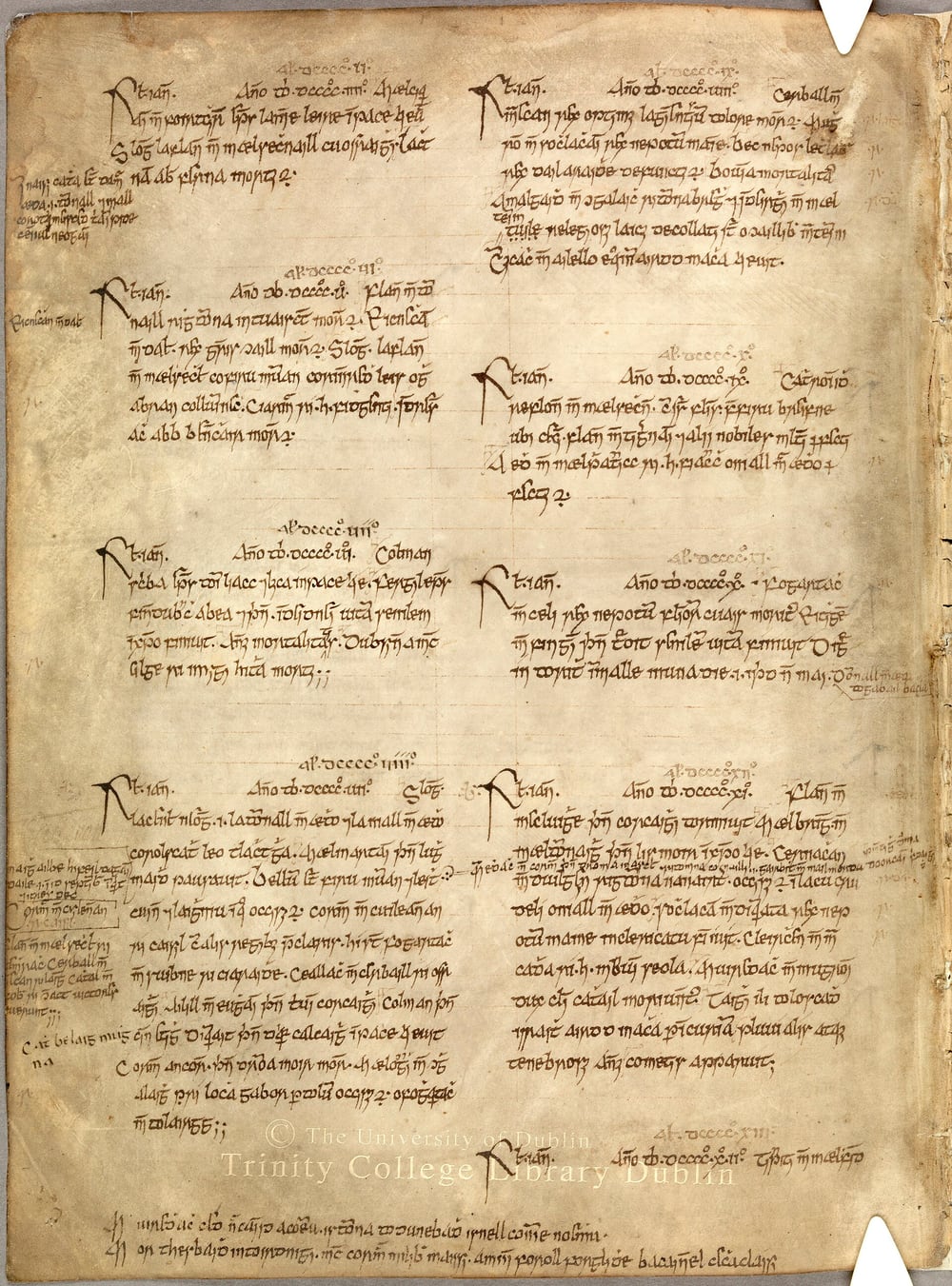
The Irish annals are laconic. Year by year their compilers noted deaths of kings and abbots, battles, burnings of monasteries, storms and famines, usually in a sentence each, in a mixture of Latin and Irish. In the year that the modern editors of the Annals of Ulster date to 749 (the manuscript itself reckons it 748), the list runs like this: a king of the Cruithin killed, the monastery of Clonfert burned, a battle in Ard Ciannachta, a great windstorm, the drowning of the community of Iona. And then, as entry nine in the translation: “Ships with their crews were seen in the air above Cluain Moccu Nóis.” In the original the annalist writes in Latin, “Naues in aere uisae sunt cum suis uiris,” and then slips into Irish for the place: “os cinn Cluana Mc. Nois,” above Clonmacnoise. That is the whole report. There is no witness named, no hour, no shape, no number of ships. The years around it were hard and strange. The annal for the year before records snow of unusual depth that killed nearly all the cattle of Ireland, followed by drought, and three years earlier the same chronicle notes, just as briefly, that “dragons were seen in the sky.”
Sources: The Annals of Ulster (Latin and Irish text), entry U749.10The Annals of Ulster (translation), entries U746.2, U748.3, U749.3–9, U755.2, U764.6, U786.3, U845.3
The city of Ciarán
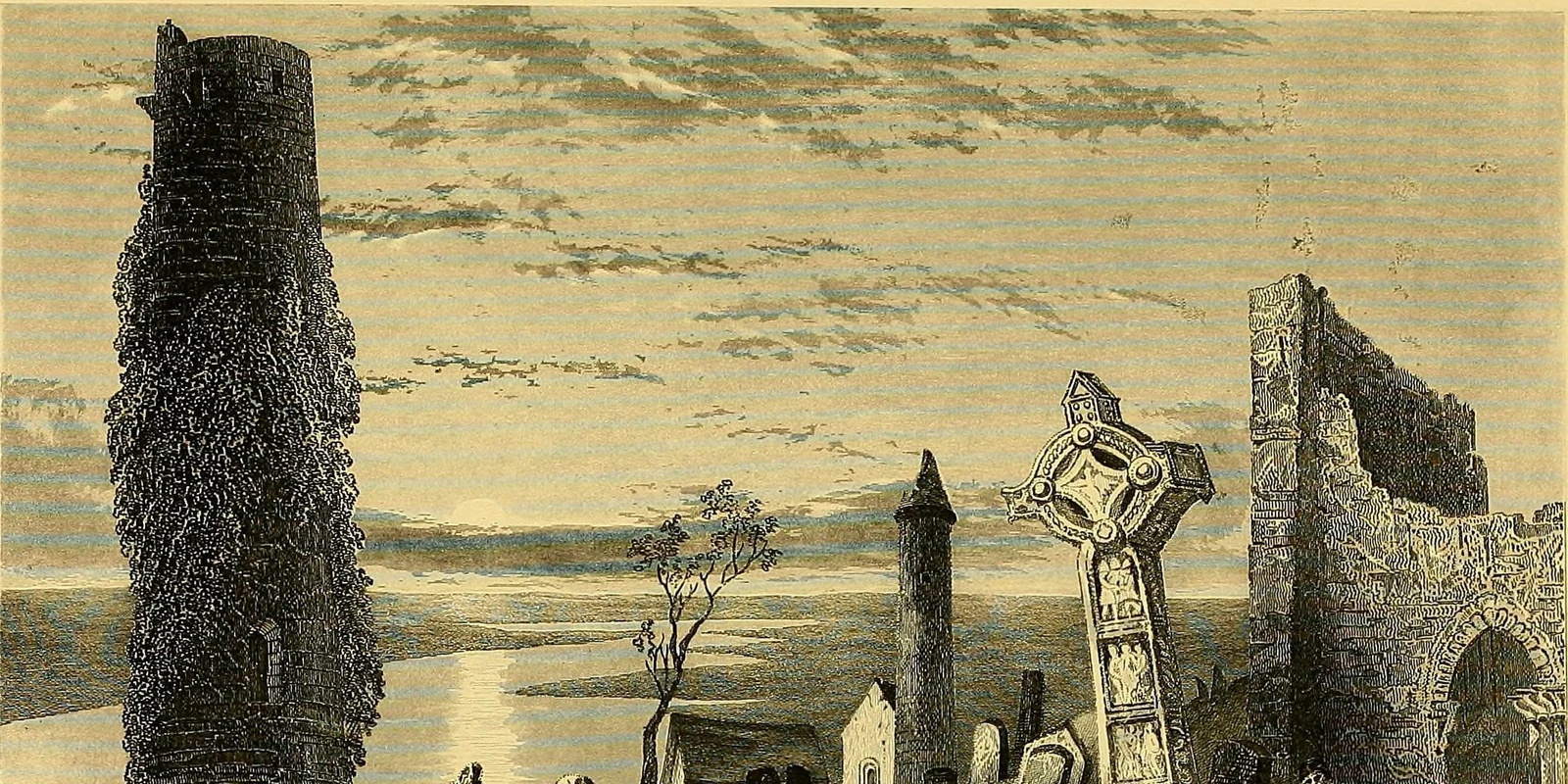
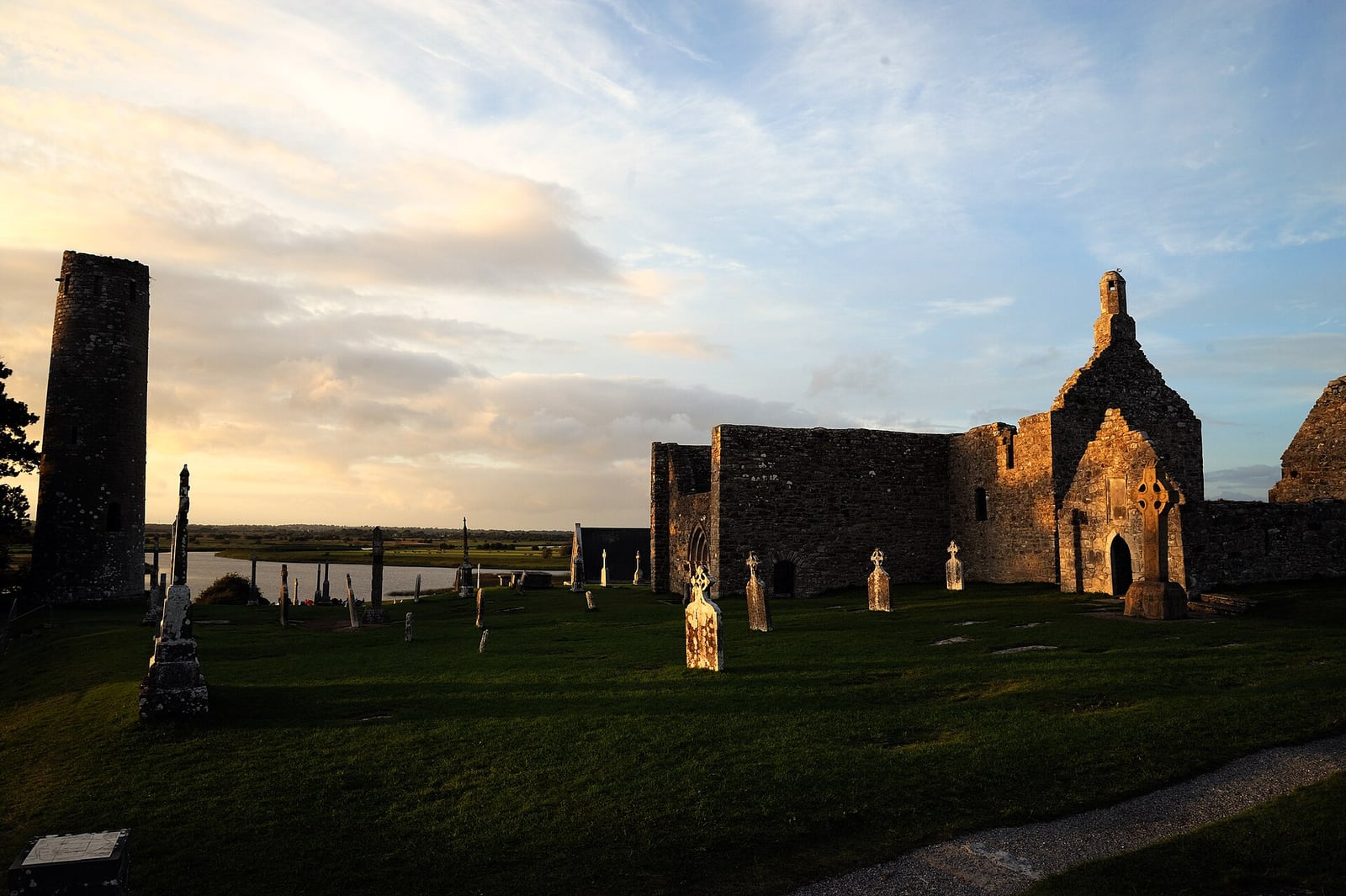
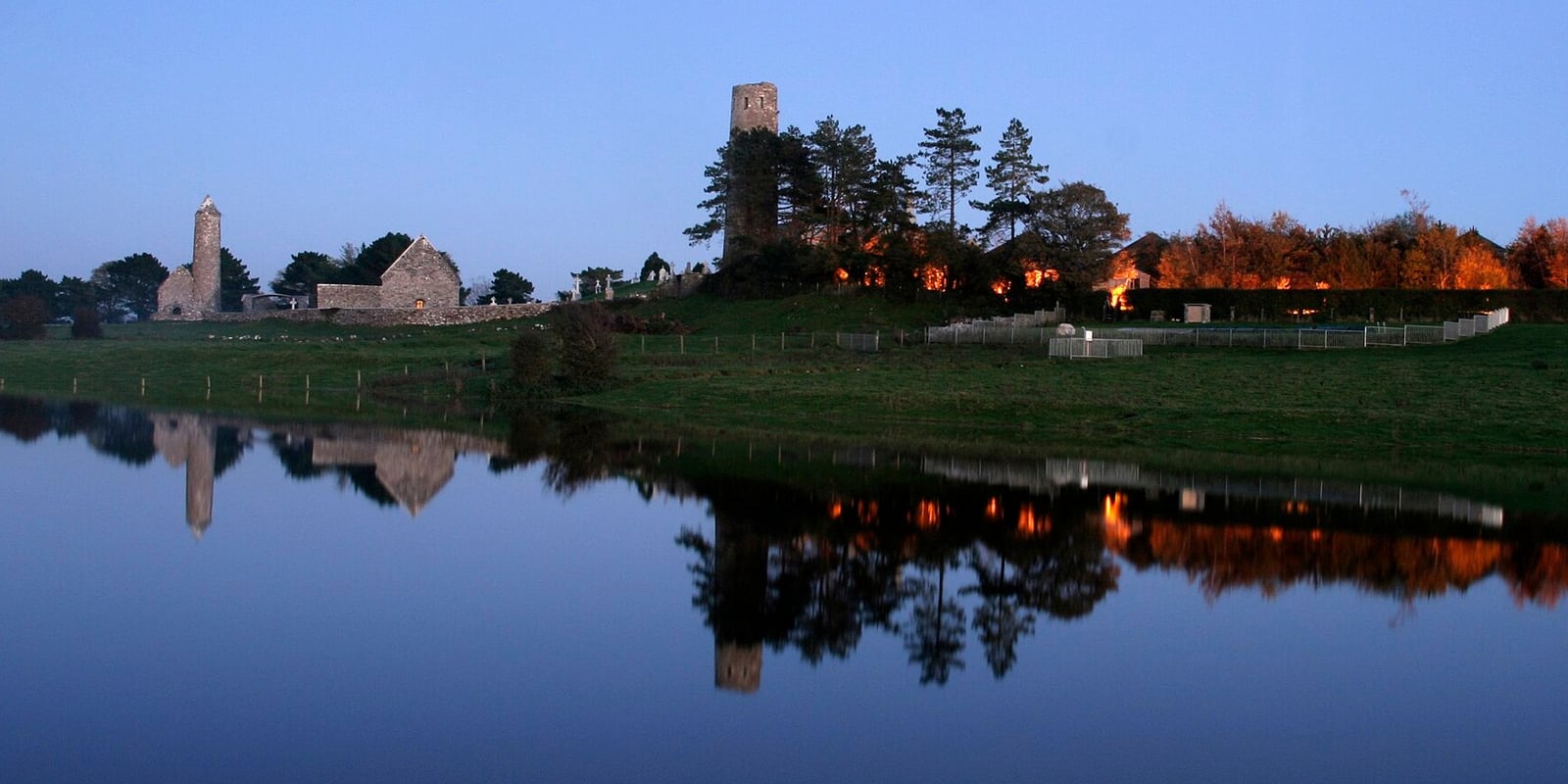
Clonmacnoise was no quiet hermitage. Saint Ciarán, “the son of the wright” in the annals, founded it in the 540s (the Annals of Ulster say 548) on a gravel ridge above the Shannon, where the river crossed the great east–west road through the bogs of the midlands, and died there within a year or so, in his thirty-third year. By the eighth century it was one of the great monastic towns of Ireland, rich enough to be worth burning and powerful enough to fight. The Annals of Ulster chart its fortunes in the decades around the sighting: abbots dying in 740 and 753, the monastery burned on March 21, 755, and in 764 a pitched battle at Argaman between the community of Clonmacnoise and the community of Durrow, in which two hundred of Durrow’s men were killed. In 786 the same annals note, without explanation, “a horrible vision in Cluain Moccu Nóis, and great penance done throughout Ireland.” The Vikings came later, plundering the monastery by 842; in 845 Turgéis, camped on Lough Ree, burned Clonmacnoise “with its oratories.” The round towers, high crosses and stone churches that visitors see today mostly date from the tenth century onward, rebuilt after raids by Irish kings, Norsemen and eventually Normans.
Sources: The Annals of Ulster (translation), entries U746.2, U748.3, U749.3–9, U755.2, U764.6, U786.3, U845.3Clonmacnoise
Four annals, four dates
The notice turns up in the other great chronicles too, which strongly suggests a single early record copied down different lines of transmission. The Annals of Tigernach, under 748, say simply “Naues in aere uise sunt cum uiris suis,” ships were seen in the air with their men, and name no place. The Annals of the Four Masters, compiled in the 1630s, put it in 743 and add an adverb: ships with their crews “were plainly seen in the sky this year.” The Annals of Clonmacnoise, which survive only in Conell Mageoghagan’s English translation of 1627, give it under 744 in his splendid spelling: “There were shipes seen in the skyes with their men this yeare.” The Chronicon Scotorum, another Clonmacnoise-connected annal, has a gap covering these decades. And the Book of Leinster, a twelfth-century compendium, tucks the Latin line into its roll of the kings of Ireland under Domnall son of Murchad, who reigned from 743 to 763. Of all these witnesses, only the Annals of Ulster puts the ships above Clonmacnoise; even the chronicle named for the monastery leaves the place out.
Sources: The Annals of Tigernach (translation), entries T746.3, T748.3, T748.13Annals of the Kingdom of Ireland by the Four Masters, entry M743.9The Annals of Clonmacnoise, being Annals of Ireland from the Earliest Period to A.D. 1408The Book of Leinster, formerly Lebar na Núachongbála, Roll of the Kings (fol. 25b)Airship of Clonmacnoise
Three ships over the fair at Teltown
Then the story began to move. The Book of Leinster also keeps a list of the wonders of Tailtiu, the great royal assembly held each summer at Teltown in County Meath, where kings presided over games, horse racing and law. One of them is “seeing three ships voyaging in the air above them, when the men of Ireland were celebrating the assembly with Domnall son of Murchad.” The eighth-century sighting had acquired a crowd and a king. By the eleventh century it had also acquired a plot. In a collection of the wonders of Ireland preserved in the Irish version of the Historia Brittonum, the ship appears over the fair at Teltown in the presence of a different king, Congalach son of Máel Mithig, who ruled in the mid-tenth century and was killed by the Norse in 956. One of the crew throws a dart at a salmon. The dart falls among the crowd, and a man comes down out of the ship after it. As he comes down, a man below catches hold of him. “I am being drowned,” says the man from above. “Let him go,” says Congalach, and the stranger is released and goes “away from them, swimming in the air.” James Henthorn Todd, who printed the Irish text in 1848, dismissed it as “this unmeaning story”; another manuscript has the sailor throw a fork instead of a dart.
Sources: The Book of Leinster, formerly Lebar na Núachongbála, Roll of the Kings (fol. 25b)Of the Wonders of Eri (Do ingantaib Érenn), wonder no. 23The Irish Mirabilia in the Norse “Speculum Regale”Airship of Clonmacnoise
A king at the theater of the Irish
The same scene appears in Latin verse in De mirabilibus Hibernie, a poem on the wonders of Ireland usually attributed to Patrick, bishop of Dublin in the late eleventh century. One of its wonders is headed “De naui que uisa est in aere,” on the ship that was seen in the air. A king is at the “theater of the Irish,” probably meaning an assembly like the one at Teltown, with thousands of people around him in fair array, when suddenly they see a ship running through the air. One of the crew throws a spear after a fish, the spear drops to earth, and the man swims down and pulls it back. The poem drops the king’s mercy and the man seized from below, but keeps the inversion that makes the story endure: to the sailors, the air above Ireland is the sea, the Irish live on its floor, and a man can swim down through it after a lost spear. The poet ends by asking who could hear of such a thing without praising the Thunderer.
Sources: On the Wonders of Ireland: Translation and AdaptationAirship of Clonmacnoise
The anchor comes to Clonmacnoise
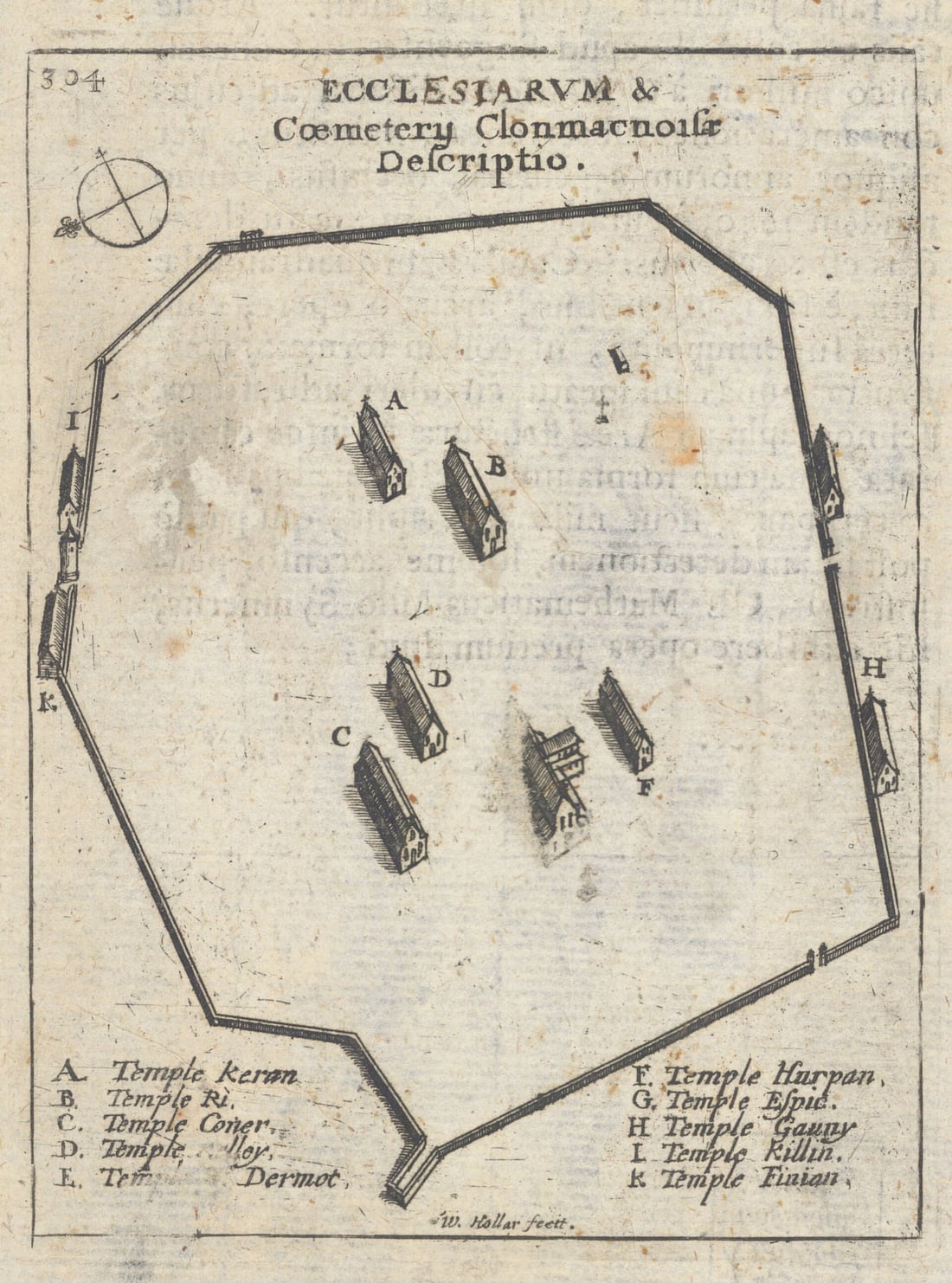
At some point the ship came back to Clonmacnoise, this time with an anchor. An Irish version preserved in a late-medieval manuscript in Edinburgh (National Library of Scotland, Adv. MS 72.1.26) sets the story at the church of Clonmacnoise: an anchor drops down from the sky, the clergy seize it, a man comes swimming down after it, and when they will not let go he protests that he is drowning, until he is allowed to swim back up to his ship with the anchor. Scholars disagree about its date. Kenneth Jackson thought the text perhaps fourteenth or fifteenth century, while the Celticist John Carey assigned it to the later Middle Irish period, before about 1200. Carey, whose 1992 article traced the whole evolution, also proposed where the anchor came from. A gloss on an early Irish hymn to Saint Brigit tells of a ship at sea whose anchor fouls on a monastery at the bottom of the Sea of Wight, and he suggests the monks of Clonmacnoise borrowed that marvel for their own sky-ship. In Carey’s reading, Clonmacnoise in this period was a house hungry for marvels.
Sources: Airship of ClonmacnoiseAerial Ships and Underwater Monasteries: The Evolution of a Monastic MarvelWhen a Sighting Report Is Not
Sunday Mass at Cloena
The fullest version was written down not in Ireland but in Norway. Around 1250 an anonymous author composed the Konungs skuggsjá, the King’s Mirror, a dialogue in which a father instructs his son in everything a courtier or merchant should know, including the marvels of Ireland. One happened, he says, in the town called Cloena, which the scholar Kuno Meyer identified as Clonmacnoise, in a church dedicated to a saint named Kiranus. “One Sunday while the populace was at church hearing mass, it befell that an anchor was dropped from the sky as if thrown from a ship,” in Laurence Larson’s 1917 translation. A rope was tied to it, and one fluke caught “in the arch above the church door.” The congregation ran out and followed the rope upward with their eyes. They saw “a ship with men on board floating before the anchor cable,” and then a man leaped overboard and dived down toward the anchor, his hands and feet moving “like those of a man swimming in the water.” The people rushed to seize him. But the bishop, whose throne stood in that church, forbade them, “for, said he, it might prove fatal as when one is held under water.” Released, the diver hurried back up; the crew cut the rope, and “the ship sailed away out of sight. But the anchor has remained in the church since then as a testimony to this event.” The Old Norse makes the bishop’s fear vivid: the man would die “sem hann væri i vatni haldinn,” as if he were held in water.
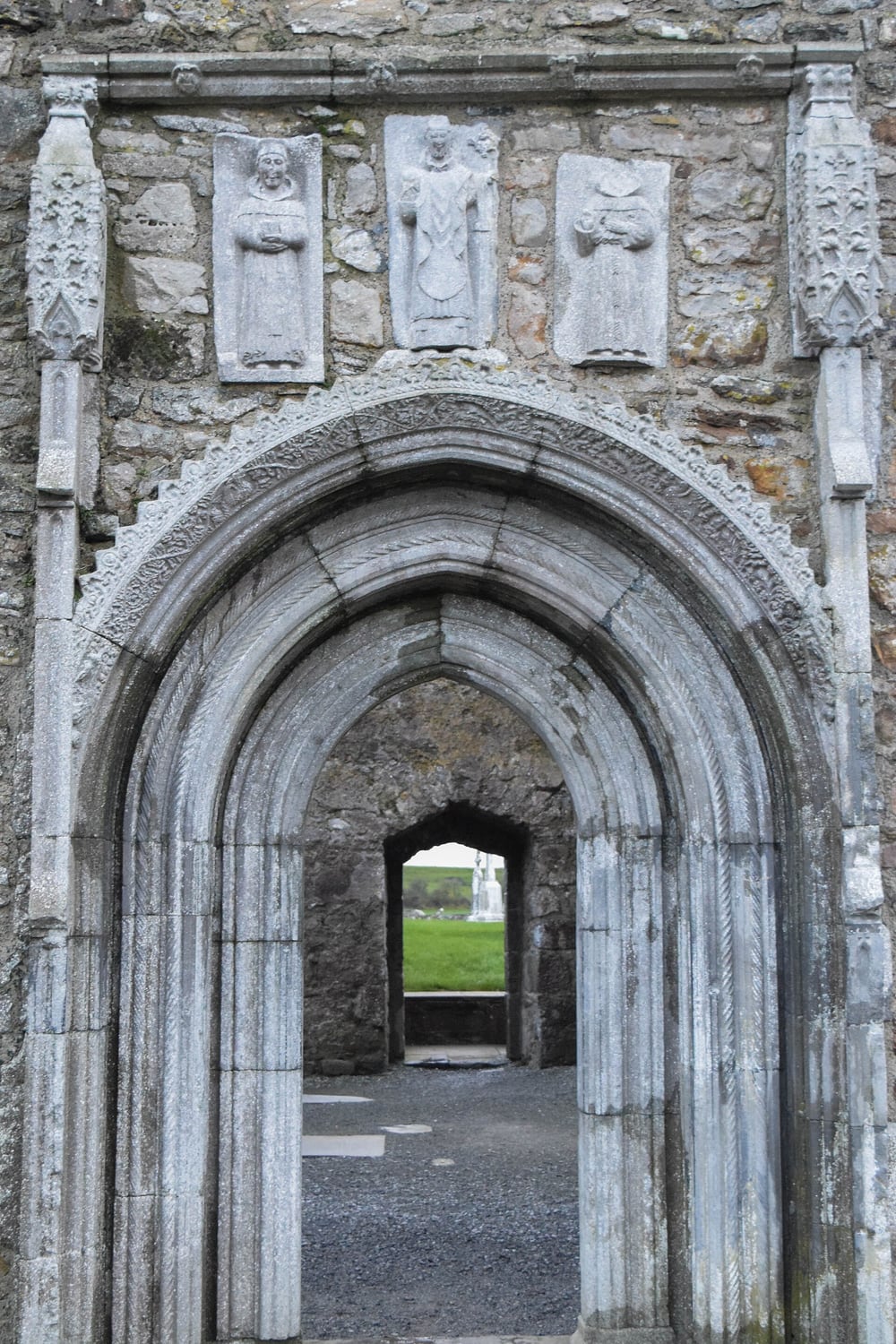
Sources: The King’s Mirror (Speculum regale – Konungs skuggsjá), chapter XI, “Irish Marvels which have Miraculous Origins”Speculum regale. Konungs-skuggsjáThe Irish Mirabilia in the Norse “Speculum Regale”
Wonders heard in Ireland
The King’s Mirror places the anchor tale among a string of Irish wonders: an island where the dead never decay, a lake where a stake of holly turns to iron in the mud and to stone in the water, and the men called gelts (from the Irish geilt, “madman”), who flee in terror from battle into the woods and grow feathers after twenty winters. Kuno Meyer, who compared them with the Irish lists in 1894 (reprinted in 1910), thought the Norwegian author had collected them by word of mouth in Ireland rather than from books. His comparison also showed how much the Norse version differs from the Irish ones then known. The Irish lists Meyer knew put the ship over Teltown and give its sailor a spear; the Norse text moves it to Saint Ciarán’s church, as the Edinburgh Irish text also does, and alone adds the bishop, the Sunday and the whole anchor kept in the church as a relic.
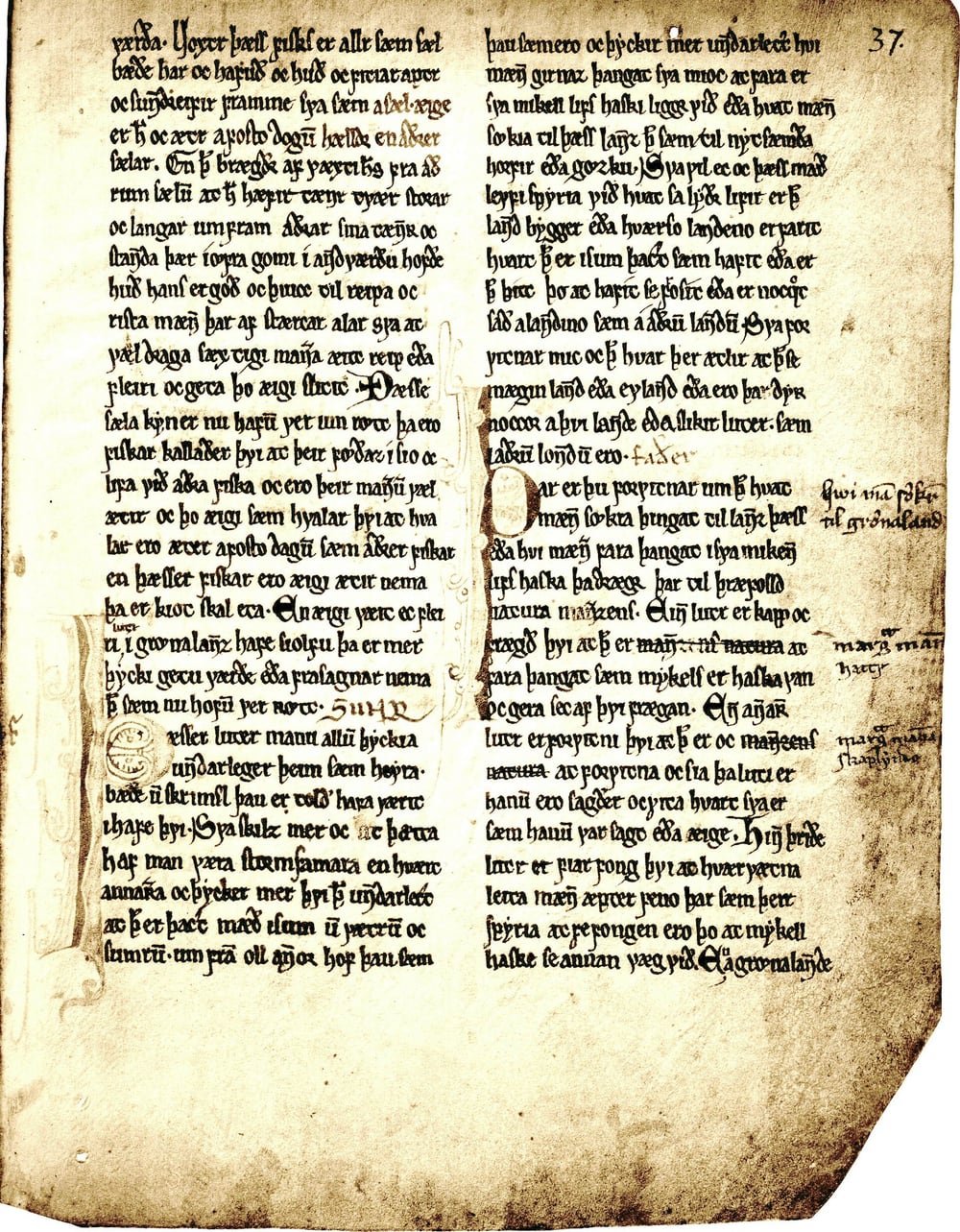
Sources: The King’s Mirror (Speculum regale – Konungs skuggsjá), chapter XI, “Irish Marvels which have Miraculous Origins”The Irish Mirabilia in the Norse “Speculum Regale”Airship of Clonmacnoise
A feast day somewhere in Britain
Four decades before the King’s Mirror, the anchor had already crossed the Irish Sea. Around 1211 Gervase of Tilbury, an English lawyer and courtier in the service of Emperor Otto IV, filled his Otia Imperialia, or Recreation for an Emperor, with marvels, and in his chapter on the sea he tells a darker version, a marvel he calls new and widely reported in his own day. On a feast day “in greater Britain,” as a congregation came out of its parish church after Mass into thick, cloudy air, they found a ship’s anchor lodged in a stone tomb inside the churchyard, its rope stretched up into the sky. While they argued over it, the rope moved as if someone above were struggling to free it, and a clamor came out of the fog like sailors shouting. Then one of the crew came down the rope hand over hand, as sailors do. He had just worked the anchor loose when the bystanders grabbed him, and he died in their hands, choked, as Gervase’s Latin puts it, by the dampness of our thick air, as if he were shipwrecked at sea. After about an hour the sailors above gave him up for drowned, cut the rope and sailed away. The iron of the anchor, Gervase says, was made into fittings for the church door, and they can still be seen. He does not name the parish. An older anchor falls in the chronicle of Geoffroy of Vigeois, a twelfth-century monk of the Limousin: a ship “navis sursum in aere” over London in 1122, whose crew had to cut their rope when the townspeople rushed the anchor.
Sources: Des Gervasius von Tilbury Otia imperialia, in einer Auswahl neu herausgegeben (book I, chapter 13, “De mari”)Airship of ClonmacnoiseSt. Patrick’s Purgatory: An Essay on the Legends of Purgatory, Hell, and Paradise
The Bristol knife and the sea above
Gervase told the anchor story as proof of a proposition: that the sea lies above us, in the air. In the same chapter he adds a second proof. A Bristol man sailing for Ireland, far out in remote waters, was rinsing his knife over the ship’s side after a meal when it slipped from his hand; at that same hour it dropped through the roof-light of his house in Bristol and stuck in the table in front of his wife. She knew the knife and put it away, and when he came home long afterward the day and the hour matched. Medieval readers had a text for this upper ocean in the first chapter of Genesis, where God divides the waters under the firmament from the waters above it, and Irish writers in particular played with the idea. In the Voyage of Bran, the sea god Manannán drives his chariot across the waves and tells Bran that what looks like ocean to him is a flowering plain, and the leaping salmon are his calves and lambs. Against that background the sky-sailors are not visitors from another world so much as neighbors from an upstairs one, fishing, dropping anchor and drowning in our heavy air as we would drown in theirs.
Sources: Des Gervasius von Tilbury Otia imperialia, in einer Auswahl neu herausgegeben (book I, chapter 13, “De mari”)Voyagers in the Vault of Heaven: The Phenomenon of Ships in the Sky in Medieval Ireland and BeyondSt. Patrick’s Purgatory: An Essay on the Legends of Purgatory, Hell, and ParadiseIreland’s Upper SeaAirship of ClonmacnoiseWonders in the Sky: Unexplained Aerial Objects from Antiquity to Modern Times
Magonia
The oldest sky-ship story from the Continent has nothing to do with Ireland. Around 815 Agobard, archbishop of Lyon, wrote a tract against the popular belief that storm-makers, tempestarii, could raise hail. He complains that many people believe and say “that there is a certain region called Magonia, from which ships come in the clouds,” to carry away the crops beaten down by hail and storms, the aerial sailors paying the weather-wizards for the grain. Worse, he writes, he had seen four people, three men and a woman, displayed in chains at a gathering as if they had fallen from those ships. They had been held for some days and were being shown to the crowd, “in our presence,” as though they were to be stoned. After a long dispute, Agobard says, the truth prevailed and their accusers were confounded, “as a thief is confounded when he is caught.” More than a thousand years later Jacques Vallée borrowed the name for his 1969 book Passport to Magonia, which argued that modern UFO encounters continue the old folklore of fairies and aerial visitors. The book quoted Agobard at length and gave the anchor stories their own pages.
Sources: Liber contra insulsam vulgi opinionem de grandine et tonitruisPassport to Magonia: From Folklore to Flying SaucersSt. Patrick’s Purgatory: An Essay on the Legends of Purgatory, Hell, and Paradise
The anchor lands in Texas
In 1844 the English antiquary Thomas Wright paraphrased Gervase’s anchor tale and the Bristol knife in a book on medieval legends, placing them beside Agobard’s Magonia as examples of a medieval belief in a sea above the sky. Wright’s English wording, with the anchor “hooked to one of the tombstones” and the villagers making the church-door hinges out of its iron, was recopied for half a century, and in the spring of 1897 it went out again as newspaper filler. A piece headed “A Sea Above the Clouds,” credited to the Boston Post, ran in the Pine Bluff Daily Graphic in Arkansas on March 7 and in other papers through the spring. That spring the United States was in the grip of the great airship wave: after a first flurry over California in late 1896, lighted craft were being reported across the Midwest and Texas. On April 28 the Houston Post printed a dispatch from Merkel, Texas, dated April 26: “Some parties returning from church last night noticed a heavy object dragging along with a rope attached.” They followed it until it caught on a railroad rail, looked up and saw what they took for the airship, with light coming from several windows and “one bright light in front like the headlight of a locomotive.” After some ten minutes a man came down the rope. “He wore a light-blue sailor suit, was small in size.” Seeing the people at the anchor, he cut the rope below him and sailed off to the northeast. “The anchor is now on exhibition at the blacksmith shop of Elliott and Miller and is attracting the attention of hundreds of people.”
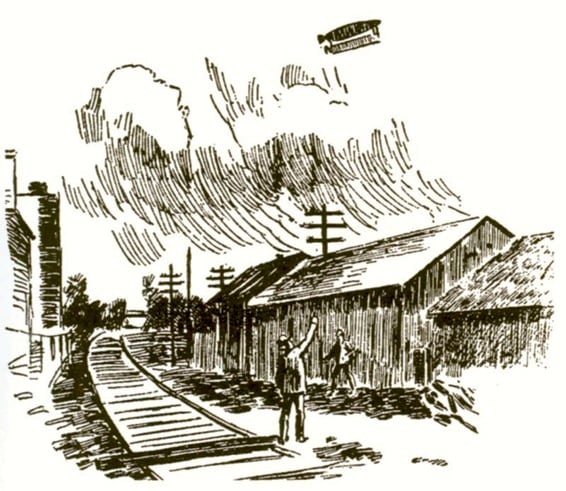
Sources: St. Patrick’s Purgatory: An Essay on the Legends of Purgatory, Hell, and ParadiseA Sea Above the CloudsA Sea Above the Clouds. Extraordinary Superstition Once Prevalent in EnglandWonders in the Sky: Unexplained Aerial Objects from Antiquity to Modern TimesAirship of Clonmacnoise
Demon ships and the flying saucer books
The Clonmacnoise ship entered the flying saucer literature through Harold T. Wilkins, a British writer on mysteries, whose Flying Saucers on the Attack (1954) retold the King’s Mirror story as one of the “demon ships” of old Ireland. His version was garbled in ways that later writers could not see past. Cloena became “Cloera,” Saint Kiranus became “St. Kinarus,” the ninth-century writer Nennius was moved to around 212 AD, and Gervase’s unnamed churchyard became Gravesend in Kent, where a blacksmith supposedly beat the anchor into ornaments for a lectern. In Flying Saucer Review in 1964, W. Raymond Drake offered what he called a translation of Gervase “possibly the first in English” and inferred that the anchor fell at Bristol. Frank Edwards, in Flying Saucers—Serious Business (1966), dated the Irish story to 956 AD, the year King Congalach died, and gave the anchor sharp flukes and a wooden arch to catch on. Donald Hanlon set the Merkel dispatch beside the medieval tales in Flying Saucer Review later that year and found the resemblance “downright suspicious.” Jacques Vallée quoted him in Passport to Magonia: the Texas account “sounds much too familiar to be taken lightly.” John Keel opened a section of UFOs: Operation Trojan Horse (1970) with “the puzzle of the anomalous anchors,” set the Irish ship, Gervase and Merkel beside an Iowa farmer’s tale of an airship grapnel that snagged his trousers, and offered readers a choice: either the stories were derivative, or airships “all dragging anchors, appeared in 956, 1200, and 1897.”
Sources: Flying Saucers on the AttackFlying Saucers UncensoredFlying Saucer Review: W. R. Drake, “Spacemen in the Middle Ages,” vol. 10, no. 3 (May–June 1964); Donald B. Hanlon, “Texas Odyssey of 1897,” vol. 12, no. 5 (September–October 1966)Flying Saucers—Serious BusinessPassport to Magonia: From Folklore to Flying SaucersUFOs: Operation Trojan Horse
Out of the marvellous
The story’s most famous modern telling is not a UFO book but a poem. Seamus Heaney came across the legend in an academic paper and retold it as the eighth of his twelve-line “Lightenings” in Seeing Things (1991). In his version the monks are at prayer when the anchor hooks into the altar rails; the sailor cannot free it, the abbot warns that he will drown in their air, the monks help him, and he climbs back up into the ship and out of the marvellous as he had known it. When Heaney won the Nobel Prize in 1995, the Swedish Academy’s press release singled the poem out as “a crystallisation of much of Heaney’s imaginative world.” Heaney later called the legend a kind of dream instruction and in a commencement address in 2000 urged his listeners to “never be so canny as to ignore the uncanny.” In 2014 a tapestry by the Czech artist Peter Sís, Out of the Marvellous, woven in France and paid for by Heaney’s friends and admirers, was hung in Dublin Airport’s Terminal 2. It shows a small figure in a tiny ship in the sky, so that travelers passing beneath look up at the sailor from below, as the congregation did.
Sources: Airship of ClonmacnoiseThe Nobel Prize in Literature 1995: Press ReleasePoetry in Motion: Tapestry Tribute to Seamus Heaney
What survives
The core of the case is a single annal notice, copied into at least four chronicles and a king-list, which places ships with their crews in the Irish sky in the 740s. Only the Annals of Ulster, which dates it to 749, says the ships were above Clonmacnoise; the Annals of Tigernach, the Four Masters and the Annals of Clonmacnoise give 748, 743 and 744 and name no place. For John Carey, the date, the range of annals that carry it and the fact that it was first written in Latin all suggest a contemporary notice of an anomalous occurrence, not a later invention; Elizabeth Boyle is more doubtful. Everything else, including the fishing spear, the drowning sailor, the anchor, the bishop and the Sunday Mass, belongs to retellings written down from the eleventh century onward.
Sources: The Annals of Ulster (translation), entries U746.2, U748.3, U749.3–9, U755.2, U764.6, U786.3, U845.3The Annals of Tigernach (translation), entries T746.3, T748.3, T748.13Annals of the Kingdom of Ireland by the Four Masters, entry M743.9The Annals of Clonmacnoise, being Annals of Ireland from the Earliest Period to A.D. 1408Aerial Ships and Underwater Monasteries: The Evolution of a Monastic MarvelWhen a Sighting Report Is NotOn the Wonders of Ireland: Translation and Adaptation
How the story drifted
The medieval drift is well mapped: several ships over Clonmacnoise, then three ships over the Teltown fair under Domnall son of Murchad, then one ship and a spear under Congalach, then an anchor at Clonmacnoise, then an anchor in a British churchyard, and finally, in the King’s Mirror, the full scene with bishop and relic. The modern drift garbled as it spread: Wilkins’s “Cloera,” Drake’s Bristol, Edwards’s “956” and the Gravesend lectern were copied from book to book through the 1970s. It took Vallée and Chris Aubeck’s Wonders in the Sky (2010) to go back to the Annals of Ulster and to Carey’s scholarship.
Sources: Airship of ClonmacnoiseAerial Ships and Underwater Monasteries: The Evolution of a Monastic MarvelFlying Saucers on the AttackFlying Saucer Review: W. R. Drake, “Spacemen in the Middle Ages,” vol. 10, no. 3 (May–June 1964); Donald B. Hanlon, “Texas Odyssey of 1897,” vol. 12, no. 5 (September–October 1966)Flying Saucers—Serious BusinessUFOs: Operation Trojan HorseWonders in the Sky: Unexplained Aerial Objects from Antiquity to Modern Times
Explanations
What the annalists saw in the 740s is open. An aurora is one suggestion: the historian David Woods argued in 2000 that the Latin should be emended to describe clouds turning green, though Elizabeth Boyle notes that this requires too much rewriting of the text, and she herself suspects the entry records a literary motif, the ship in the air, rather than an observation. Others point to cloud shapes: in the thirteenth century the monks of St Albans recorded a cloud like a ship, and in 1796 the Nova Scotia merchant Simeon Perkins heard that a girl at New Minas had cried out at sunrise and brought two men from the house to see fifteen ships in the air, so near they could make out sides and ports, with a man at their head, his hand stretched out; Perkins judged it “only in imagination, as the cloud at sunrise might make some such appearance.” A third reading is a superior mirage, which can lift real ships above the horizon. The Irish historian James Hardiman remembered watching, as a boy, an aerial fleet from high ground near Croagh Patrick on an autumn evening in 1798, a sight hundreds believed supernatural until it was traced to Admiral Warren’s squadron, chasing a French fleet off the west coast in the year of the United Irish rising. Clonmacnoise, though, lies far inland. Finally, Michael McCaughan sets the eighth-century notice beside the art of its own time: the Ship of the Church, rowed heavenward, carved on Irish stones such as the Kilnaruane pillar in County Cork.
Sources: On the Wonders of Ireland: Translation and AdaptationVoyagers in the Vault of Heaven: The Phenomenon of Ships in the Sky in Medieval Ireland and BeyondAirship of Clonmacnoise
The Texas question
The Merkel dispatch is almost certainly a newspaper hoax, one of many during the 1897 airship wave, and its resemblance to Gervase is too close for coincidence. It shares the churchgoers on their way home, the poor light and the snagged anchor with Gervase, and the escaping sailor and the anchor on public display with the King’s Mirror. Lucius Farish, quoted by Keel, objected that a citizen of Merkel owning a copy of the Speculum Regale in 1897 “would be fully as fantastic as the reports themselves.” The syndicated “Sea Above the Clouds” item removes that objection. It was in circulation seven weeks before the Merkel story ran, and Vallée and Aubeck argue that it inspired the Texas report. No one has identified who wrote the Merkel dispatch, and the whereabouts of the Elliott and Miller anchor, if it ever existed, are unknown.
Sources: A Sea Above the CloudsA Sea Above the Clouds. Extraordinary Superstition Once Prevalent in EnglandUFOs: Operation Trojan HorseWonders in the Sky: Unexplained Aerial Objects from Antiquity to Modern TimesAirship of Clonmacnoise
Classification note
The case is filed as a mass sighting because the only contemporary record describes ships and crews seen in the sky, presumably by more than one person, above a busy monastic town. No close-encounter kind is assigned. The descending sailor, the anchor and the bishop who spares the stranger are the core of the legend, but they appear centuries after the sighting, in literary collections of wonders, and cannot be traced to any witness.
Sources: The Annals of Ulster (translation), entries U746.2, U748.3, U749.3–9, U755.2, U764.6, U786.3, U845.3Aerial Ships and Underwater Monasteries: The Evolution of a Monastic MarvelThe King’s Mirror (Speculum regale – Konungs skuggsjá), chapter XI, “Irish Marvels which have Miraculous Origins”
- c. 548
Saint Ciarán founds the monastery of Clonmacnoise on a ridge above the Shannon.
- 743–763
The reign of Domnall son of Murchad, under whom the Book of Leinster later places three ships over the Teltown fair.
- 746
The Annals of Ulster record that “dragons were seen in the sky.”
- 748
Snow of unusual depth kills nearly all the cattle in Ireland; drought follows.
- 749
Ships with their crews are seen in the air above Clonmacnoise, in the same year as a great windstorm and the drowning of the community of Iona.
- c. 815
Agobard of Lyon denounces the belief in cloud-ships from Magonia and sees four supposed sky-sailors paraded in chains as if to be stoned.
- 845
Turgéis’s Vikings burn Clonmacnoise with its oratories.
- 944–956
The reign of Congalach son of Máel Mithig, the king in the spear-and-salmon version at Teltown.
- LATE 11TH C.
Patrick of Dublin’s Latin poem on the wonders of Ireland includes the ship seen in the air.
- 1122
Geoffroy of Vigeois records a sky-ship’s anchor seized by the people of London.
- c. 1211
Gervase of Tilbury tells of a sky-sailor who drowned in a British churchyard and an anchor made into church-door iron.
- c. 1250
The Norwegian King’s Mirror describes the anchor caught above the church door at “Cloena” during Sunday Mass.
- 12TH–15TH C.
An Irish version, preserved in Edinburgh, moves the ship back to Clonmacnoise and gives it an anchor.
- 1627
Conell Mageoghagan translates the Annals of Clonmacnoise: “shipes seen in the skyes with their men.”
- 1844
Thomas Wright paraphrases Gervase’s anchor and pairs it with Agobard’s Magonia.
- 7 MAR 1897
“A Sea Above the Clouds” runs in the Pine Bluff Daily Graphic.
- 28 APR 1897
The Houston Post prints the Merkel, Texas, airship-anchor dispatch.
- 1954
Harold T. Wilkins retells the “Cloera” demon ship in Flying Saucers on the Attack.
- 1966
Frank Edwards dates the Irish anchor to 956; Donald Hanlon links Merkel to the medieval tales.
- 1969
Jacques Vallée’s Passport to Magonia reprints the anchor stories.
- 1991
Seamus Heaney publishes “Lightenings viii” in Seeing Things.
- 1992
John Carey traces the evolution of the legend in the Proceedings of the Harvard Celtic Colloquium.
- 5 OCT 1995
The Swedish Academy cites the Clonmacnoise poem when awarding Heaney the Nobel Prize.
- APR 2014
Peter Sís’s tapestry Out of the Marvellous is hung in Dublin Airport.
Sources & interviews
The Annals of Ulster (Latin and Irish text), entry U749.10Seán Mac Airt and Gearóid Mac Niocaill (eds.), Dublin Institute for Advanced Studies, 1983 · CELT, University College CorkThe Annals of Ulster (translation), entries U746.2, U748.3, U749.3–9, U755.2, U764.6, U786.3, U845.3Seán Mac Airt and Gearóid Mac Niocaill (trans.), Dublin Institute for Advanced Studies, 1983 · CELT, University College CorkThe Annals of Tigernach (translation), entries T746.3, T748.3, T748.13Gearóid Mac Niocaill (trans., unpublished) · CELT, University College CorkAnnals of the Kingdom of Ireland by the Four Masters, entry M743.9John O’Donovan (ed. and trans.), 1848–1851, vol. 1, p. 347 · CELT, University College CorkThe Annals of Clonmacnoise, being Annals of Ireland from the Earliest Period to A.D. 1408Conell Mageoghagan (trans.), 1627, ed. Denis Murphy · Royal Society of Antiquaries of Ireland, Dublin, 1896 · Internet ArchiveThe Book of Leinster, formerly Lebar na Núachongbála, Roll of the Kings (fol. 25b)R. I. Best, Osborn Bergin and M. A. O’Brien (eds.), Dublin Institute for Advanced Studies · CELT, University College CorkOf the Wonders of Eri (Do ingantaib Érenn), wonder no. 23James Henthorn Todd (ed. and trans.), Leabhar Breathnach annso sis: The Irish Version of the Historia Britonum of Nennius, Irish Archaeological Society, Dublin, 1848, pp. 210–213 · CELT, University College CorkThe Irish Mirabilia in the Norse “Speculum Regale”Kuno Meyer · Ériu, vol. 4, 1910, pp. 1–16 · Internet ArchiveOn the Wonders of Ireland: Translation and AdaptationElizabeth Boyle · in Elizabeth Boyle and Deborah Hayden (eds.), Authorities and Adaptations: The Reworking and Transmission of Textual Sources in Medieval Ireland, Dublin Institute for Advanced Studies, 2014 · Maynooth University open accessThe King’s Mirror (Speculum regale – Konungs skuggsjá), chapter XI, “Irish Marvels which have Miraculous Origins”Laurence Marcellus Larson (trans.), American-Scandinavian Foundation, New York, 1917, pp. 116–118 · Internet ArchiveSpeculum regale. Konungs-skuggsjáR. Keyser, P. A. Munch and C. R. Unger (eds.), Christiania, 1848, pp. 27–28 · Internet ArchiveDes Gervasius von Tilbury Otia imperialia, in einer Auswahl neu herausgegeben (book I, chapter 13, “De mari”)Felix Liebrecht (ed.), Carl Rümpler, Hanover, 1856, pp. 2–3 · Internet ArchiveLiber contra insulsam vulgi opinionem de grandine et tonitruisAgobard of Lyon, c. 815 · Patrologia Latina vol. 104, cols. 147–148 · Wikisource (Latin)Airship of ClonmacnoiseWikipediaClonmacnoiseWikipediaAerial Ships and Underwater Monasteries: The Evolution of a Monastic MarvelJohn Carey · Proceedings of the Harvard Celtic Colloquium, vol. 12, 1992, pp. 16–28 · JSTORWhen a Sighting Report Is NotBryan Sentes · Skunk Works blog · September 8, 2019 · on Carey’s 1992 articleVoyagers in the Vault of Heaven: The Phenomenon of Ships in the Sky in Medieval Ireland and BeyondMichael McCaughan · Material Culture Review, vol. 48, Fall 1998St. Patrick’s Purgatory: An Essay on the Legends of Purgatory, Hell, and ParadiseThomas Wright · John Russell Smith, London, 1844, pp. 27–29 · Internet ArchiveA Sea Above the Clouds. Extraordinary Superstition Once Prevalent in EnglandBoston Post syndicated item · The Virginia Enterprise (Virginia, Minnesota), April 2, 1897, p. 2 · Library of Congress, Chronicling AmericaA Sea Above the CloudsPine Bluff Daily Graphic (Pine Bluff, Arkansas), March 7, 1897, p. 2 · Library of Congress, Chronicling AmericaFlying Saucers on the AttackHarold T. Wilkins · Citadel Press, New York, 1954, chapter VIII · Internet ArchiveFlying Saucers UncensoredHarold T. Wilkins · Citadel Press, New York, 1955 · Internet ArchiveFlying Saucer Review: W. R. Drake, “Spacemen in the Middle Ages,” vol. 10, no. 3 (May–June 1964); Donald B. Hanlon, “Texas Odyssey of 1897,” vol. 12, no. 5 (September–October 1966)Flying Saucer Review, London · Internet Archive collectionFlying Saucers—Serious BusinessFrank Edwards · Lyle Stuart, New York, 1966, chapter 1 · Internet ArchivePassport to Magonia: From Folklore to Flying SaucersJacques Vallée · Henry Regnery, Chicago, 1969 · Internet ArchiveUFOs: Operation Trojan HorseJohn A. Keel · G. P. Putnam’s Sons, New York, 1970, pp. 183–185 · Internet ArchiveWonders in the Sky: Unexplained Aerial Objects from Antiquity to Modern TimesJacques Vallée and Chris Aubeck · Tarcher/Penguin, New York, 2010 · Internet ArchiveThe Nobel Prize in Literature 1995: Press ReleaseThe Swedish Academy · October 5, 1995 · NobelPrize.orgPoetry in Motion: Tapestry Tribute to Seamus HeaneyKathy Sheridan · The Irish Times · April 19, 2014Ireland’s Upper SeaAmelia Soth · JSTOR Daily · August 31, 2023Spotted an error, or know a better source? Write to hello@uap.fun.
Connected files
The Sky Battle over NurembergEight centuries later a Nuremberg printer sold a broadsheet of globes and tubes battling in the sky, another marvel reread by each new age.The Light in Jeon Mun-wi’s CourtyardAnother sky portent kept in a court chronicle, rediscovered centuries later and turned into modern popular legend.Utsuro-bune: The Woman in the Hollow BoatA strange vessel and a stranger crew from the edge of the known world, whose story also grew with every retelling.The Sun That Danced at FátimaVallée read Fátima, like Agobard’s Magonia and the Irish sky-sailors, as part of one long tradition of aerial visitors.Jacques ValléeNamed his 1969 book after Agobard’s Magonia, reprinted the anchor stories in it, and with Chris Aubeck traced the ships back to the Annals of Ulster in 2010.John KeelOpened a section of Operation Trojan Horse with “the puzzle of the anomalous anchors,” setting the Irish ship beside Merkel and Sioux City.Discuss this case
Compare notes with other readers: witness details, sources, and the parts that still do not add up.
Open the discussion