The long walk home
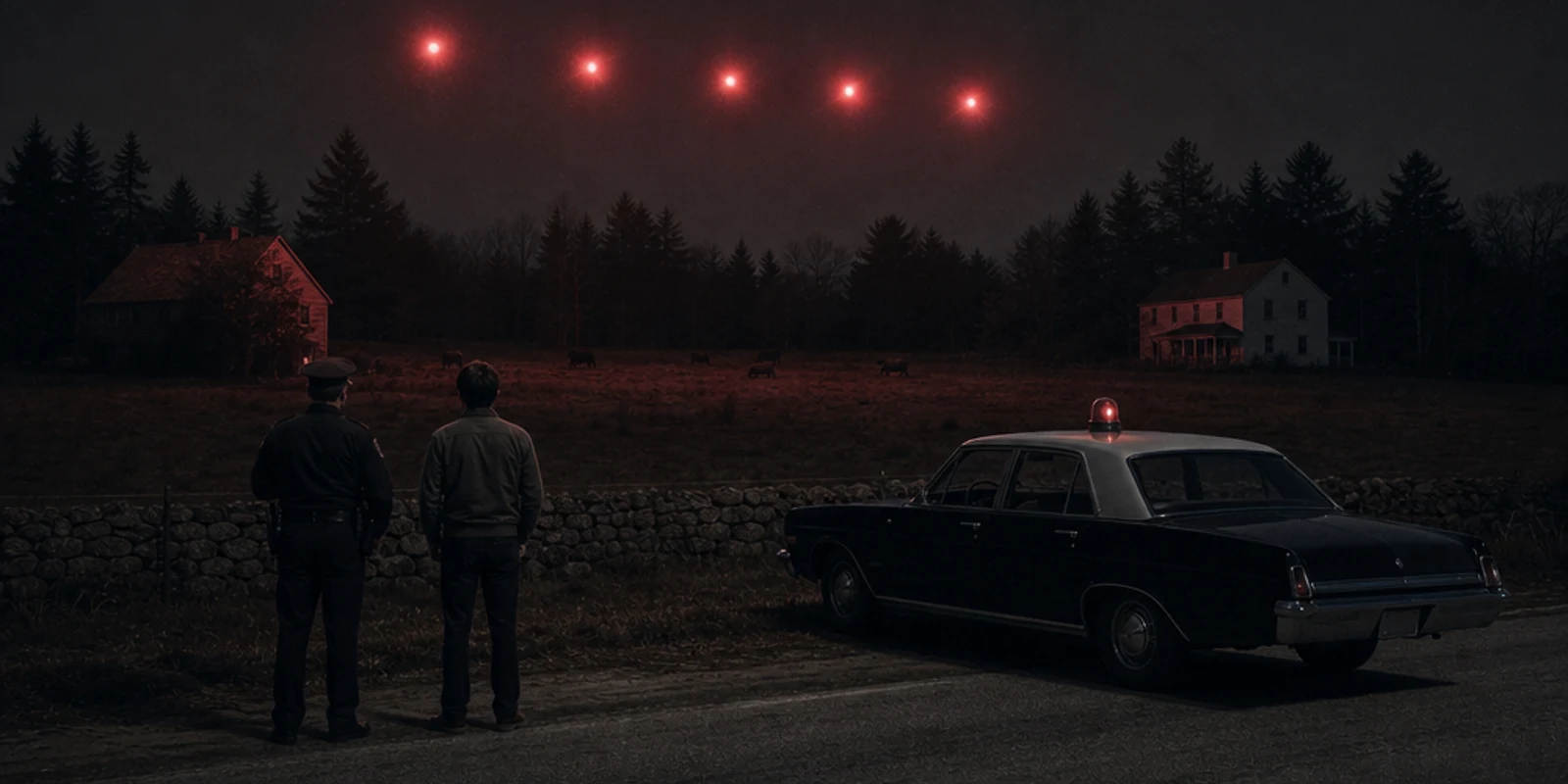
A little after two in the morning on Friday, September 3, 1965, eighteen-year-old Norman Muscarello was walking north toward Exeter on New Hampshire Route 150. He had sold his car, spent the evening at his girlfriend’s home in Amesbury, Massachusetts, and failed to catch a ride for much of the roughly ten-mile trip. Navy service was three weeks away. South of Exeter, in the neighboring town of Kensington, the road narrowed between the Clyde Russell and Carl Dining farms. The sky was clear. Traffic had almost disappeared. Then five red lights appeared above a house about one hundred feet from him.
Sources: Exeter Project Blue Book documentsClose Encounter Revisited: N.H. Teen’s 1965 Sighting Became Blueprint for UFOsImportant New England Sighting
One, two, three, four, five—and back again
Muscarello’s signed Air Force statement fixed the detail that made Exeter unforgettable. The lights formed a slanted row at roughly sixty degrees and pulsed one at a time: “one, two, three, four, five, four, three, two, one.” They moved together, bright enough to wash the field and nearby buildings in red, yet the glare hid whatever might have joined them. He watched for about fifteen minutes as the formation drifted behind trees and a house, reappeared somewhere else, and moved with what he called the motion of a floating leaf. When it seemed to rush close, he threw himself into the roadside ditch.
Sources: Project Blue Book case file — Exeter, New Hampshire, September 1965Exeter Project Blue Book documentsThe ‘Incident at Exeter’
The door that stayed shut
The lights backed away toward the field. Muscarello ran to the Russell farmhouse, hammered on the door and shouted, but nobody let him in; later accounts say the family heard him and feared opening the house at that hour. When headlights finally came along, he stepped into the road and flagged down the car. The couple carried a pale, shaking young man to the Exeter police station, where night dispatcher Reginald “Scratch” Toland listened to the story. Muscarello was frightened enough that witnesses remembered him struggling to hold a cigarette. Toland called Patrolman Eugene F. Bertrand Jr. back to the station.
Sources: The Exeter investigation and reportClose Encounter Revisited: N.H. Teen’s 1965 Sighting Became Blueprint for UFOsImportant New England Sighting
Bertrand had already heard about the red light
Bertrand did not arrive as a blank witness. Around one o’clock, while patrolling the Route 108 bypass, he had stopped beside a parked car. Its driver was too upset to continue and said a brilliant red object had followed her from Epping, diving toward the car before vanishing. Bertrand found only a bright star and sent her on her way. He remained skeptical when Toland introduced Muscarello, but the two stories rhymed closely enough that he drove the teenager back toward the farms. They sat in the cruiser, saw nothing, and were about to leave when the station asked Bertrand to make one quick sweep of the field.
Sources: Exeter Project Blue Book documentsThe Exeter investigation and reportOfficer Eugene Bertrand on UFOs
‘Look out, here it comes’
Bertrand and Muscarello walked about fifty feet into the pasture. Bertrand played his flashlight across the dark. Muscarello suddenly shouted, “Look out, here it comes!” Five brilliant red lights rose from behind the pines at treetop height. In Bertrand’s signed statement they flashed one after another, held the same angled line, and moved over the field without sound or vibration. At their nearest, the glare erased any dependable outline. Bertrand dropped to one knee and started for his revolver, then abandoned the idea. The formation tilted toward them. He dragged the frozen Muscarello back to the cruiser and radioed for help.
Sources: Exeter Project Blue Book documentsThe Exeter investigation and reportThe ‘Incident at Exeter’
A second cruiser at the pasture
Patrolman David R. Hunt received Bertrand’s call at about 2:55 a.m. and arrived within minutes. He saw the same sequence of red lights farther out over the field, estimated roughly half a mile away and about one hundred feet high. All three watched the formation recede southeastward at a level altitude until it disappeared. Bertrand and Muscarello had seen the return for roughly ten minutes; Hunt caught only its final minutes. A probable B-47 crossed high overhead after the red lights had gone, and the officers later emphasized that it looked and behaved like an ordinary aircraft. Nearby horses kicked and whinnied and dogs barked, but the cruiser’s engine, lights and radio kept working. A daylight search found no burn, indentation or debris.
Sources: Exeter Project Blue Book documentsImportant New England SightingThe Exeter investigation and report
The Air Force comes down from Pease
Exeter’s police chief notified Pease Air Force Base, about ten miles east. Major David H. Griffin, the base disaster-control officer and a command pilot, and Lieutenant Alan Brandt interviewed Muscarello, Bertrand and Hunt and visited the field. Griffin’s September 15 report called all three stable and reliable—especially the patrolmen—and said he could find no probable cause at the site. He noted clear weather, a shallow temperature inversion, and five B-47s operating in the wider area, but wrote that he did not believe those aircraft were connected. The official report described the lights as extremely bright, silent, close together and moving as one object. It recorded no radar confirmation, photograph or physical trace.
Sources: Project Blue Book case file — Exeter, New Hampshire, September 1965Exeter Project Blue Book documentsThe ‘Incident at Exeter’
Big Blast, bright stars and a public answer too soon
Project Blue Book searched for aircraft. A Strategic Air Command exercise named Big Blast “Coco” had sent ten B-47 bombers back toward Pease, and Exeter lay beneath their recovery pattern. The problem was the clock: Air Force records placed the last exercise aircraft on the ground around 1:35 a.m., before Muscarello’s first report and well before the officers’ sighting. A newspaper’s aerial-advertising theory also failed when the operator said its sign plane was not flying. Even so, Pentagon statements floated high-altitude aircraft, a temperature inversion, stars and planets. To Bertrand and Hunt, who had watched the lights low over a field and then separately recognized a high B-47, the explanations sounded less like investigation than an attack on their competence.
Sources: Exeter Project Blue Book documentsThe Exeter investigation and reportExeunt Exeter? Should This 1965 New Hampshire Classic Finally Shuffle off the Stage?
Two patrolmen write back
On December 2, Bertrand and Hunt answered Blue Book chief Major Hector Quintanilla. Their official police report was dated September 3, not September 2; their observation occurred nearly an hour after two; the object was silent and low; and Bertrand had spent four Air Force years around aerial-refueling operations. They had seen a probable B-47 after the encounter and could distinguish it. What they wanted was simple: a letter clearing them of having invented the story or proved themselves incompetent observers. A later Air Force memorandum split the night in two—earlier sightings were attributed to Big Blast aircraft, while the officers’ post-two-o’clock observation was regarded as unidentified. In February 1966, Lieutenant Colonel John Spaulding wrote that the added information still did not permit an identification.
Sources: Project Blue Book case file — Exeter, New Hampshire, September 1965Exeter Project Blue Book documentsThe ‘Incident at Exeter’
The tanker that returned forty-five years later
In 2011, pilot James McGaha and investigator Joe Nickell proposed a more specific aircraft: a KC-97 aerial tanker. Five red director lights on its belly could guide a receiving bomber in a rippling sequence, they argued; reflections along an angled refueling boom could produce the sixty-degree line, while distance and night vision could turn the aircraft into a silent, leaf-like apparition. The match to the number, color and sequence of lights is the strongest conventional model yet offered. Its missing piece is a flight. Project Blue Book’s own inquiries reported no refueling operations in New England during the relevant period, and the later hypothesis produced no log placing a KC-97 over the Kensington field after two o’clock. Martin Shough’s review also found technical problems with where the director lights sat, when they illuminated and how an extended boom would appear. The tanker remains plausible in form, unconfirmed in time and place.
Sources: ‘Exeter Incident’ Solved! A Classic UFO Case, Forty-Five Years ‘Cold’Exeunt Exeter? Should This 1965 New Hampshire Classic Finally Shuffle off the Stage?Exeter Project Blue Book documents
How one field became a template
Raymond Fowler began fieldwork eight days later, interviewing the patrolmen, walking the site and assembling a report that entered the Congressional Record during the House Armed Services Committee’s 1966 UFO hearing. Journalist John G. Fuller followed. His Incident at Exeter became a bestseller and, during the same New Hampshire reporting trip, led him toward Betty and Barney Hill and The Interrupted Journey. Together, those books helped furnish later UFO culture with its enduring scenery: the empty road, impossible lights, shaken witnesses, skeptical police, official explanations and suspicions of official pressure. Exeter eventually embraced the story. The annual Exeter UFO Festival now sends trolley tours back to Kensington and turns the encounter into a fundraiser for local children’s programs. The field passed into folklore; the five red lights never acquired a verified name.
Sources: The Exeter investigation and reportClose Encounter Revisited: N.H. Teen’s 1965 Sighting Became Blueprint for UFOsThe ‘Incident’ and the Exeter UFO Festival
Three signed witnesses, two stages of observation
The core evidence is unusually well documented eyewitness testimony. Muscarello reported one close episode alone, then returned with Bertrand; Hunt arrived for the receding phase. Their signed statements agree on five sequential red lights, an angled formation, low apparent altitude, silence and southeastward departure. They do not provide three fully independent close-range observations: Muscarello guided Bertrand to the site, and Hunt saw the lights later and farther away. Apparent size and distance were estimates made at night against trees and buildings, not instrument readings.
Sources: Exeter Project Blue Book documentsThe ‘Incident at Exeter’The Exeter investigation and report
What the official file establishes
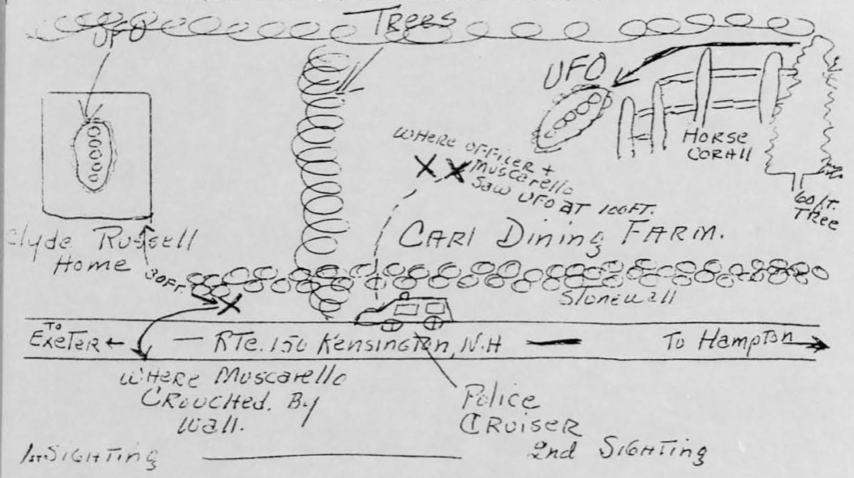
Project Blue Book case 9890 preserves the witness statements, weather, site map, Air Force interviews, aircraft inquiries and correspondence. Griffin found the witnesses reliable and no cause at the location. The later Air Force position identified some earlier reports with Big Blast but left the police observation unidentified after additional information failed to match it to a specific aircraft or celestial source. “Unidentified” records an unsuccessful identification under the available data; it is not an Air Force finding that an extraterrestrial craft was present.
Sources: Project Blue Book case file — Exeter, New Hampshire, September 1965Exeter Project Blue Book documentsIncident at Exeter map
The missing instrumental trail
No authenticated photograph, motion picture, radar plot, electromagnetic effect, landing mark, sample or recovered material accompanies the case. The frightened animals add atmosphere but not a diagnostic signature, and no veterinarian examined them. Reports of other red lights that night broaden the context without proving a single object connected every call. The evidence fixes what several people recorded and remembered seeing; it does not independently fix the lights’ range, size, structure or source.
Sources: Exeter Project Blue Book documentsImportant New England SightingExeunt Exeter? Should This 1965 New Hampshire Classic Finally Shuffle off the Stage?
Interpretations
Stars, planets, advertising aircraft and the documented Big Blast B-47 approaches do not fit the officers’ post-two-o’clock timing and low moving formation. The KC-97 model earns attention because it reproduces five sequential red lights and an association with refueling traffic, but no public record places such a tanker there, and archival checks reported no relevant refueling mission. An exotic craft fits the witnesses’ impression but adds a physical vehicle where glare prevented them from reliably describing one. The most defensible status is therefore disputed and unidentified: a strong, coherent visual report with a suggestive aircraft analogue and no verified source.
Sources: ‘Exeter Incident’ Solved! A Classic UFO Case, Forty-Five Years ‘Cold’Exeunt Exeter? Should This 1965 New Hampshire Classic Finally Shuffle off the Stage?Exeter Project Blue Book documents
Classification and evidence note
This archive classifies Exeter as a reported close encounter of the first kind because the principal witnesses described a nearby luminous object without occupants or durable physical effects. The classification describes the account, not its cause. Evidence consists of signed contemporary statements, police involvement, prompt Air Force and civilian investigations, official correspondence and a case map; the decisive limits are the absence of imagery, radar, measured range and a matched flight record. Sources were reviewed September 18, 2026; review again by September 2028 or when additional military or police records appear.
Sources: Project Blue Book case file — Exeter, New Hampshire, September 1965Exeter Project Blue Book documentsThe Exeter investigation and report
- 3 SEP 1965 · ABOUT 1:00 AM
Patrolman Eugene Bertrand stops beside an upset motorist on the Route 108 bypass; she says a red flashing object followed her from Epping.
- ABOUT 2:00 AM
Norman Muscarello, walking home on Route 150, sees five red lights above the Russell and Dining farm area.
- NEXT 15 MINUTES
The lights pulse in sequence, move behind trees and buildings, illuminate the field and appear to approach; Muscarello dives into a ditch.
- SHORTLY AFTER
Muscarello pounds on the Russell door, flags down a passing car and reaches the Exeter police station visibly shaken.
- BEFORE 3:00 AM
Bertrand drives Muscarello back, walks into the pasture with him and sees the lights rise above the pines at treetop height.
- ABOUT 2:55 AM
Bertrand radios Patrolman David Hunt, who arrives in time to see the five lights receding across the field.
- MINUTES LATER
The formation disappears southeastward; the witnesses then distinguish a probable B-47 high overhead as a separate aircraft.
- 3–15 SEP 1965
Pease Air Force Base interviews the witnesses and inspects the site; Major David Griffin reports no probable cause and calls them reliable.
- 11 SEP 1965
Raymond Fowler begins NICAP’s field investigation, interviewing officers and walking the farm site.
- AUTUMN 1965
Public explanations invoke advertising aircraft, stars, inversion and Operation Big Blast while Blue Book searches aircraft records.
- 2 DEC 1965
Bertrand and Hunt write Major Hector Quintanilla, rejecting Big Blast and defending the accuracy of their police report.
- 11 JAN–8 FEB 1966
Air Force correspondence leaves the officers’ later observation unidentified and says available information does not permit identification.
- 5 APR 1966
Fowler’s Exeter material enters the Congressional Record during a House Armed Services Committee hearing on UFOs.
- 1966
John G. Fuller publishes Incident at Exeter, turning the Kensington field into a landmark of American UFO literature.
- 2011–2012
McGaha and Nickell propose a KC-97 tanker; Shough answers with an archival and technical critique.
- 2009–PRESENT
The Exeter Area Kiwanis Club’s annual UFO Festival carries the story through talks, trolley tours and community fundraising.
Sources & interviews
Project Blue Book case file — Exeter, New Hampshire, September 1965U.S. Air Force · Project Blue Book case 9890 · T1206, Roll 57 · primary records and correspondenceExeter Project Blue Book documentsU.S. Air Force records · NICAP archival access copy · initial report, witness statements, memoranda and lettersIncident at Exeter mapU.S. Air Force · Project Blue Book archive · 1966 hand-drawn case map · public domainThe Exeter investigation and reportRaymond E. Fowler · NICAP investigator · fieldwork begun September 11, 1965; later published in UFOs: Interplanetary VisitorsImportant New England SightingFlying Saucer Review · January/February 1966 · contemporary condensation of Raymond Fowler’s NICAP reportThe ‘Incident at Exeter’J. Allen Hynek · The Hynek UFO Report · 1977 · excerpts from the Project Blue Book fileOfficer Eugene Bertrand on UFOsThe Talon, Exeter Area High School · 1980 oral-history interview · SeacoastNH archiveClose Encounter Revisited: N.H. Teen’s 1965 Sighting Became Blueprint for UFOsJoel Brown · The Boston Globe · September 1, 2005 · archival transcript‘Exeter Incident’ Solved! A Classic UFO Case, Forty-Five Years ‘Cold’James McGaha and Joe Nickell · Skeptical Inquirer 35(6) · November/December 2011Exeunt Exeter? Should This 1965 New Hampshire Classic Finally Shuffle off the Stage?Martin Shough · archival analysis of the KC-97 hypothesis and Project Blue Book file · 2012The ‘Incident’ and the Exeter UFO FestivalExeter Area Kiwanis Club · local history and annual festivalConnected files
The Hill AbductionFuller encountered the Hills’ story while reporting in New Hampshire; his two 1966 books helped establish the road-at-night grammar of modern UFO lore.The Lakenheath–Bentwaters Radar CaseAnother Blue Book-era case with military witnesses and a far richer instrumental record—useful contrast to Exeter’s testimony-only evidence.The Levelland NightA rural road, repeated witnesses and an Air Force aircraft-and-weather explanation created another famous Blue Book dispute.Inside Project Blue BookHow the Air Force received, categorized and publicly explained reports—and what its label “unidentified” actually meant.Discuss this case
Compare notes with other readers: witness details, sources, and the parts that still do not add up.
Open the discussion