Breakfast at the trading post
Vanavara in 1908 was not yet a village. It was a trading post, a factoriya, on the north bank of the Podkamennaya Tunguska, three settlers’ huts and the tents of the Evenki who came in to trade furs, deep in the Yeniseysk Governorate of the Russian Empire and about as far from anywhere as a place could be. The morning of Tuesday, June 17, Old Style, which the rest of the world called June 30, was clear and warm. Semyon Semenov, a farmer at the post, had sat down on his porch at breakfast time, facing north. What happened next he described twice, once in a letter a relative wrote out for Kulik in March 1927 and again to Krinov in 1930, and the two tellings do not quite match. In the first, “at that moment in the north-west a fiery blaze formed in an instant, from which there came such heat that it was impossible to sit; my shirt very nearly caught fire.” The red-hot marvel, he judged, spanned at least two versts of sky. It closed as suddenly as it had opened, it went dark, and an explosion threw him off the porch “about a sazhen or more,” some two meters, and knocked him senseless for a moment. The houses shook and seemed to move on their foundations, the windows broke, a strip of earth was torn out of the square, and the iron hasp on the storehouse door snapped while the lock survived. In the second telling he was swinging an axe to hoop a tub when “the sky split in two” due north over the Evenki road, the fire stood fifty degrees high, the blow threw him three sazhens, his wife led him indoors, a hot wind ran past the huts “as from a cannon” and damaged the onions in the garden. Pyotr Kosolapov, pulling a nail from a window frame a few steps away, felt something scorch his ears, grabbed them, thought the roof was on fire and asked Semenov whether he had seen anything. “How could I not see,” Semenov answered, “I too felt wrapped in heat.” Then the blow came, earth fell from the ceiling, the stove damper flew across the room onto the bunk and a pane burst inward. Semenov’s nineteen-year-old daughter remembered thinking that she had heard of the sky opening at night, but never by day. They found her father lying unconscious by the barn.
Sources: К вопросу о месте падения Тунгусского метеорита 1908 годаПоказания очевидцев Тунгусского падения (каталог)Тунгусский метеорит
A pipe of fire over the Angara
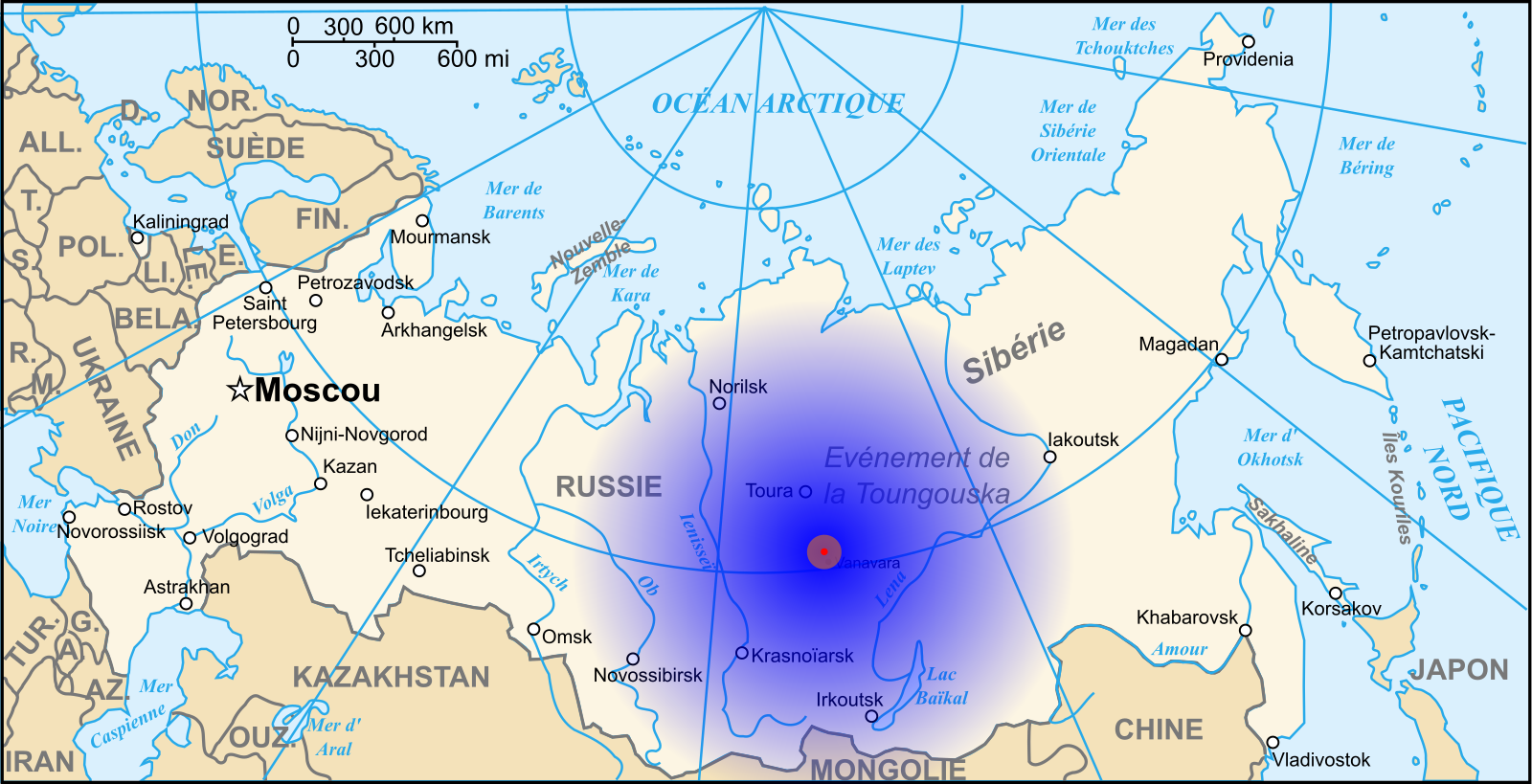
The thing had been seen for hundreds of kilometers before it reached Vanavara. Along the Angara and the upper Lena, in the villages of Russian settlers and exiles, people looked up from ploughing and building and saw a body “shining with an unbearably bright white-bluish light” moving down the sky for what felt like ten minutes, shaped, one letter said, like a pipe, a cylinder, before it blurred into an enormous club of black smoke and “an exceedingly strong knocking, not thunder,” broke over the village of Nizhne-Karelinskoye. “All the inhabitants ran into the street in panic, the women wept, everyone thought the end of the world was coming,” the correspondent S. Kulesh wrote to the Irkutsk newspaper Sibir, which printed his letter on July 2, Old Style, three days after the Tomsk column about a stone at a railway siding and the first published account to describe the body in flight. At Kezhma on the Angara, the newspaper Krasnoyarets reported, at 7:43 a.m. there came a noise like a strong wind, then a terrible blow as if a huge log had struck the building, an underground rumble like a dozen trains passing at once, fifty or sixty lesser blows, and at treetop level “an enormous flame flared up, splitting the sky in two”; horses and cows on the island opposite ran screaming from end to end, and everyone, at the first reports, thought of the Japanese, with whom Russia had been at war three years before. At Nizhne-Ilimsk workmen on a bell tower saw “a fiery block,” the priest’s servant girl fell off a bench, and two Evenki came in to say the fall had made a lake that boiled for two days and offered to show it; nobody believed them. At the Mursky rapid a helmsman saw a bluish flash and a fiery body “considerably bigger than the sun” trailing a wide bright band, and such a cannonade followed that the boatmen hid in the cabin and forgot the rapid. At Kansk a tanner heard a noise like the wings of a startled bird and watched a swell run up the river Kan against the current. On the Trans-Siberian line an engine driver named Gryaznov was so frightened by the roar and the shaking of the air that he stopped his train, sure it had derailed, and proposed searching the wagons for something that had exploded. Back at Kezhma, a ploughman saw his horse fall to its knees, flame leap over the forest to the north and the spruce bend before a wind that drove the Angara into waves; “the enemy is firing,” he thought, and held the plough with both hands so as not to be carried away.
Sources: Показания очевидцев Тунгусского падения (каталог)Тунгусский метеорит
Akulina’s forest
Closest of all were the Evenki, the reindeer people the Russians called Tungus, whose summer camps stood along the Khushmo, the Chambe and the Dilyushma inside what would become the zone of fallen forest. Their stories were not written down until 1926, when the ethnographer Innokenty Suslov questioned a woman named Akulina near Vanavara and then, at a gathering, a suglan, of some sixty Evenki at Strelka on the Chunya in the first days of June, took down the rest. Akulina had been asleep in a chum at the mouth of the Dilyushma with her husband Ivan and old Vasily, son of Okhchen. “Suddenly someone shoved our chum hard,” she said. Before they could crawl out it was shoved again and they fell; old Vasily landed on top of them “as if someone had thrown him.” Then it became very bright, “a bright sun shone on us, a strong wind blew,” someone fired “as when the ice bursts on the Katanga in winter,” and the dancing whirlwind the Evenki call Uchir seized the hide cover of the tent, spun it and carried it off, leaving the frame of thirty poles standing. She fainted. When she came to, “I look at our forest and don’t see it.” Trees stood stripped of branches, many more lay on the ground, dry wood and reindeer moss were burning, and she found Ivan among the branches of a fallen tree with his arm broken so that the bone stuck through his shirt. Their sack of flour had become a black stone that crumbled when she poked it. “The forest was not ours,” she said. “I had never seen such a forest. It was somehow alien.”
Sources: Опрос очевидцев Тунгусской катастрофы в 1926 г.К вопросу о месте падения Тунгусского метеорита 1908 годаПоказания очевидцев Тунгусского падения (каталог)
In the tents of the Shanyagir
Two brothers of the Shanyagir clan, Chuchancha and Chekaren, were asleep on the Avarkitta after a night visiting Ivan and Akulina. They woke to whistling and wind; Chekaren shouted, “Do you hear how many goldeneyes or mergansers are flying?” A second shove threw Chuchancha against a tent pole and onto the hot coals of the hearth. Then thunder, the first blow; the earth jerked and swayed, the tent went down, trees were falling with their needles alight, the moss was burning, and over the hill where the forest had already fallen it grew very bright, “as if a second sun appeared,” followed by a second blow, a third that threw them against a fallen trunk, a fourth like ordinary thunder, and a faint fifth “where the sun sleeps at night.” Suslov fired a shotgun at a cliff a kilometer away so the brothers could time the gap between the first blows by the echo: six seconds, they said, exactly that. An old man called Ulkigo told the suglan that his father, Lyurbuman, had heard the account of the burning forest, taken fright and died the same day. The gathering counted three dead altogether: Lyurbuman; Ivan, Akulina’s husband, whose crushed arm killed him later; and the shaman Uyban, who fell senseless and died on the Lakura. Their storehouses had gone too. Ilya Potapovich Petrov, called Lyuchetkan, who would guide Kulik the next year, told him that his relative Vasily Ilyich had kept as many as 1,500 reindeer and many storehouses in the area: “fire came and scorched the forest; the reindeer and the storehouses perished. Of some reindeer charred carcasses were found, the rest were not found at all. Of the storehouses nothing remained: everything burned and melted, clothing, utensils, reindeer harness, dishes and samovars; only some pails were found whole.” Among the Evenki the event became the work of Agdy, the thunder, whose iron birds a shaman named Magankan was said to have sent against a rival clan. How much of the god and how much of the birds belongs to the Evenki, and how much to the Russians who later wrote about them, is itself disputed.
Sources: Опрос очевидцев Тунгусской катастрофы в 1926 г.К вопросу о месте падения Тунгусского метеорита 1908 годаПоказания очевидцев Тунгусского падения (каталог)
The pendulums and the bright nights
The instruments saw it before anyone understood what they had seen. At the magnetic and meteorological observatory in Irkutsk, 970 kilometers to the south, the Repsold pendulums began to tremble at 0h 18.8m Greenwich time and went on tracing a disturbance for an hour and a half; three quarters of an hour after the onset the same pens drew three slow waves that were, the director Arkady Voznesensky later realized, the air wave itself arriving. Working back from the seismogram he put the event at 0h 17m 11s Greenwich time, about 7:17 in the morning by Irkutsk clocks, and guessed that the meteorite had burst “at a height of about 20 kilometers.” He sent out questionnaires that year, got some sixty answers, and published none of it until 1925. Barographs from Turukhansk to Chita recorded the pressure pulse, and so, five hours after the event, did six microbarographs in England, a set of curious wiggles that the Meteorological Office noted at the time and that nobody connected with Siberia until Charles Cave spotted the coincidence of dates in 1929. The wave, F. J. W. Whipple told the Royal Meteorological Society the next year, had traveled at a velocity “a little greater” than that of the famous wave from Krakatoa; the Siberian meteor was “probably the greatest meteor which has occurred in historic times.” Then there were the nights. From the evening of June 30 and for two or three nights after, the sky over northern Europe and European Russia did not get dark. In Kostroma a diarist read small newspaper print outdoors; in Narovchat a photographer exposed a street scene for half an hour before midnight and got a picture; from Epsom, south of London, a correspondent recalled that “twilight was prolonged to daybreak and there was no real darkness”; in Prague and Bristol astronomers wrote to Nature about the glow. The Russian papers filled with letters from Penza, Slavyansk, Kiev and Tiraspol. No one in Western Europe connected the bright nights with a bang in Siberia for a quarter of a century, and even now there is an argument about when they began: some observers date the first strange twilights to a week before the fall, which is awkward for the simplest explanation, that the meteor’s dust was lit by the midnight sun. One more trace lay undiscovered until 1959, when a geophysicist going through the Irkutsk magnetograms found that the observatory’s magnets had begun to swing two or three minutes after the blast and had not settled for five or six hours, which looked, to Soviet eyes of 1959, uncomfortably like the signature of a nuclear test.
Sources: Тунгусский метеоритThe Great Siberian Meteor and the Waves, Seismic and Aerial, which it ProducedOn Phenomena related to the Great Siberian MeteorМагнитные эффекты тунгусских событий 1908 годаПоказания очевидцев Тунгусского падения (каталог)
A visitor from celestial space
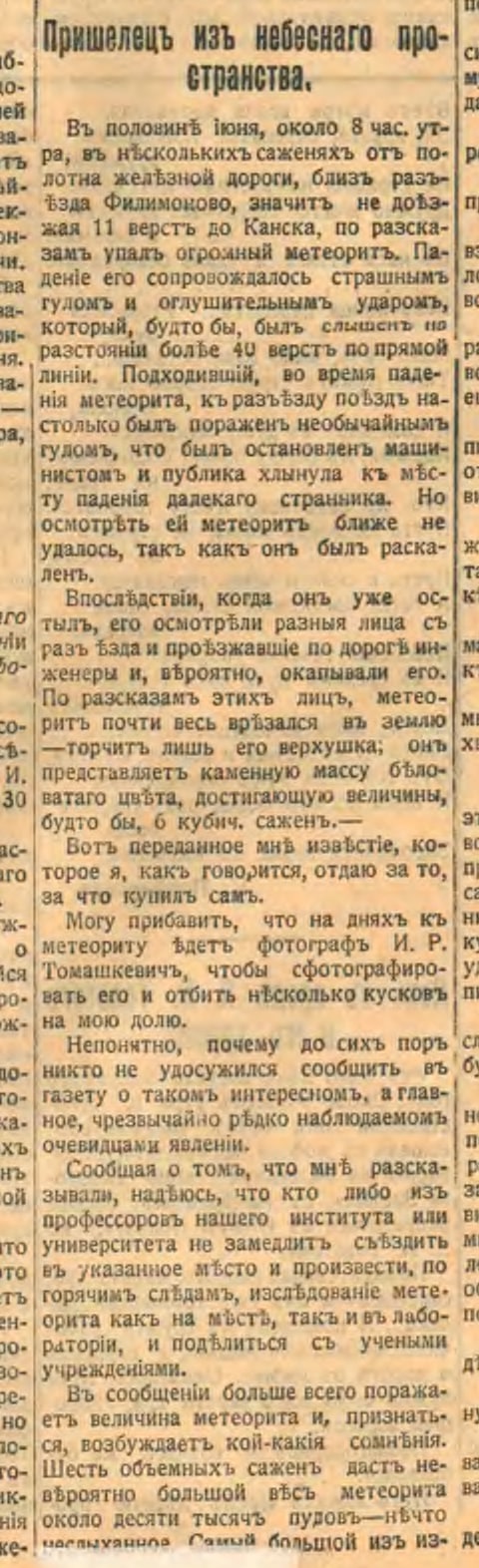
The Russian press of 1908 did not lack for reports. What it lacked was a reporter willing to go. The Tomsk newspaper Sibirskaya zhizn carried, on July 12 by the Western calendar, a long column by the ethnographer and journalist Alexander Adrianov under the headline “A visitor from celestial space,” telling how a meteorite had come down a few sazhens from the track at the Filimonovo railway siding near Kansk, so that a passing train stopped and the passengers went to look at a red-hot stone, whitish once it cooled, sunk in the ground. Nearly all of it was wrong. When Kulik tracked down the witnesses in 1921, the stationmaster at Filimonovo told him the train had stopped at the next siding along, that the driver had feared a derailment, that no light had been seen and that visitors from the Tomsk polytechnic, from Krasnoyarsk and from Irkutsk had come looking for the stone and found nothing. Other papers reported “two strong explosions” near the Lovat and an earthquake at Kansk; the district police officer sent the Yeniseysk governor a report of “an aerolite of enormous dimensions” over Kezhemskoye. And then the Russian Empire, which had a revolution and a lost war behind it and a world war ahead, forgot. Voznesensky’s questionnaires went into a drawer. The settlers on the Angara told the story to their children, the Evenki avoided the burned country and the hunters who did cross it talked of a cursed place where the forest lay flat and a mountain had crumbled into the river Ogniya. The explosion that had been heard over a circle 1,400 kilometers across went unsought for thirteen years and unvisited for nineteen.
Sources: Пришелец из небесного пространстваПоказания очевидцев Тунгусского падения (каталог)Тунгусский метеорит
The calendar leaf
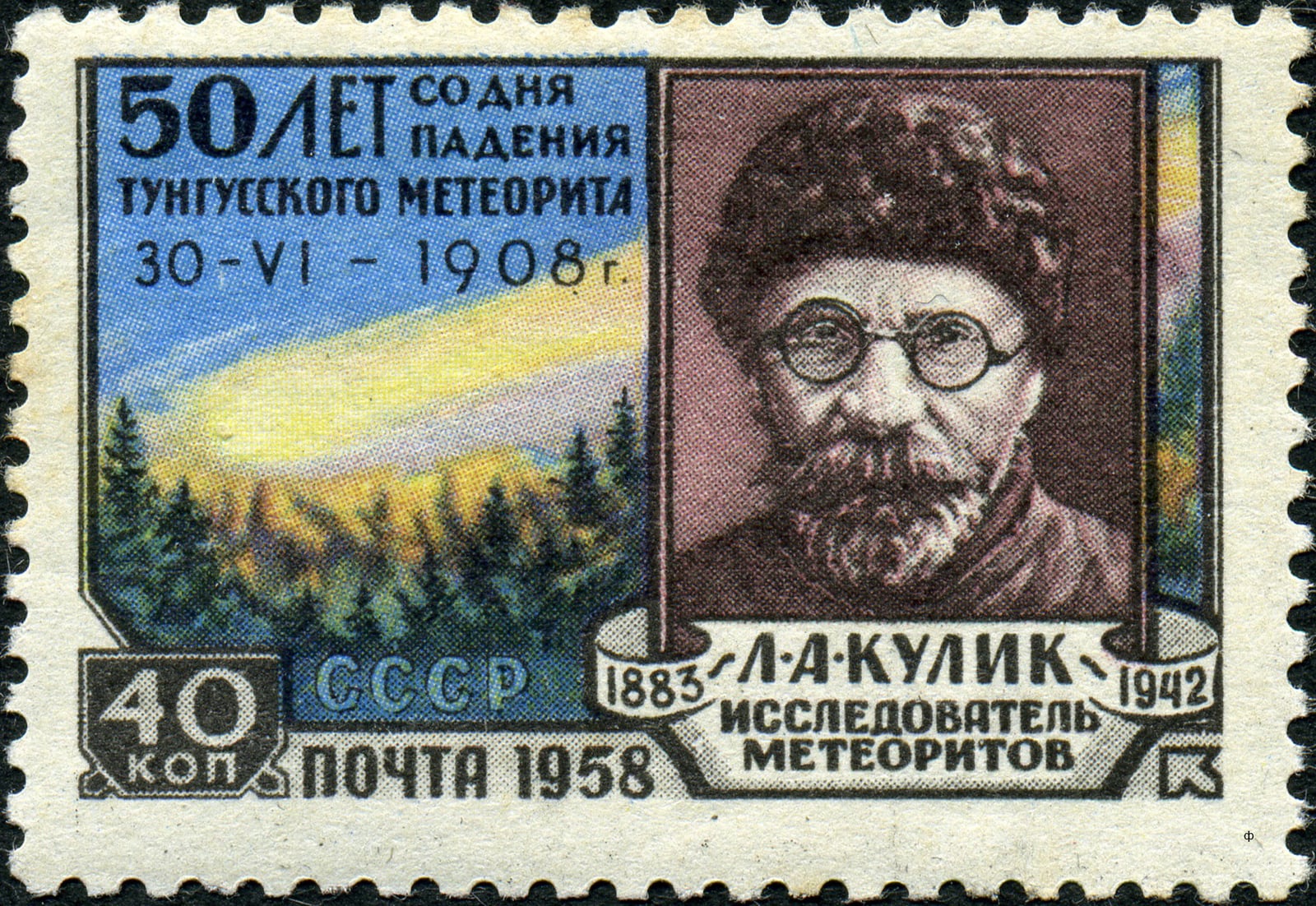
Leonid Alekseevich Kulik was thirty-seven, a mineralogist at the Petrograd museum who had come to meteorites through Vladimir Vernadsky, when, in March 1921, the editor of the journal Mirovedenie, Daniil Svyatsky, handed him the back of a tear-off calendar leaf from 1910 on which some anonymous compiler had reprinted the start of Adrianov’s Filimonovo story. “Look,” Svyatsky said, “there is no smoke without fire.” “How vividly I remember that moment,” Kulik wrote six years later. He got money from Lunacharsky’s education commissariat, a railway car from the transport commissariat and a mandate from the Central Executive Committee, and in September 1921 the first Soviet meteorite expedition rolled east, distributing 2,500 questionnaires. It never got near the fall. But the answers that came back convinced Kulik that on June 30, 1908, between five and eight in the morning, a great meteorite had crossed the Yeniseysk province from south to north and come down somewhere beyond the Podkamennaya Tunguska, where it had flattened forest and “dammed the river Ogniya.” He wrote verses about it.
Sources: За Тунгусским дивом (вместо фельетона)К вопросу о месте падения Тунгусского метеорита 1908 годаТунгусский метеоритПоказания очевидцев Тунгусского падения (каталог)
Reindeer to the Makirta
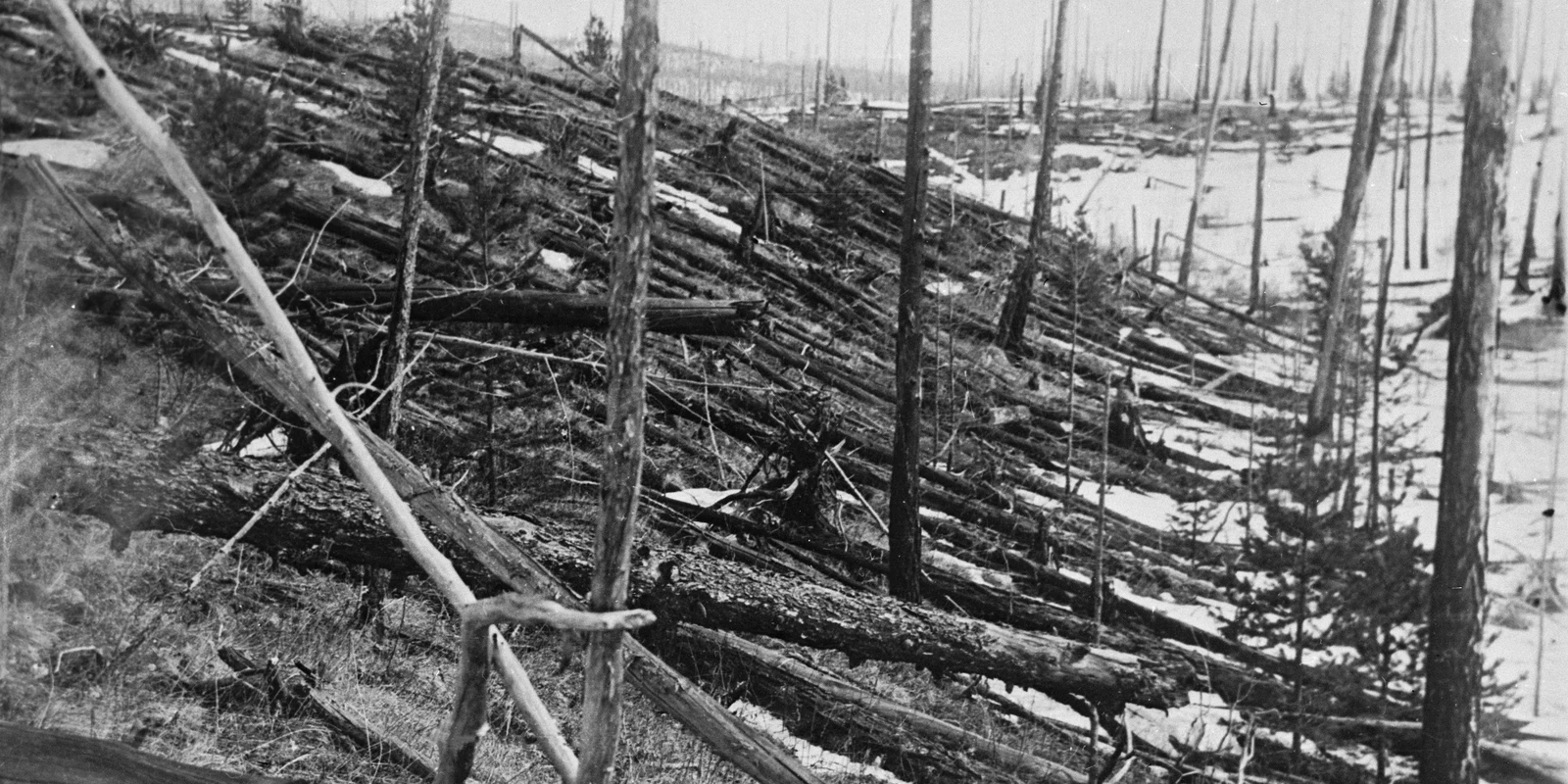
It took him six years to get back. The geologist Sergei Obruchev heard from the Evenki in 1924 that the fallen forest covered 680 square kilometers; Suslov’s suglan of 1926 produced the testimony of Akulina and the Shanyagir brothers and a sketch map drawn by Lyuchetkan. In 1927 Kulik and one assistant left the railway at Tayshet on March 14, reached Kezhma on the Angara on the 19th and Vanavara on the 25th, where Semenov’s letter was written for him and Kosolapov told his story. With Lyuchetkan and a second Evenk, Pavel Aksenov, called Okhchen, as guides, he went north on reindeer on April 8. On the 13th they crossed the Makirta and entered continuous fallen forest. From a ridge two days later the taiga, “which knows no clearings,” parted over a hundred and twenty degrees of horizon and “mighty chains of snow-white mountains, without a trace of any vegetation, glittered under the bright rays of the April sun.” His guide, Kulik wrote, “went grey all over, began to tremble” and refused flatly to go on to the Khushmo. They turned back. In his diary he wrote of the eeriness of seeing “giants ten and twenty vershoks thick,” trunks of forty to ninety centimeters, “broken in half like reeds, with their tops flung many meters to the south.” At the end of April he set out again by sledge; as the rafts were about to leave in May a shaman saw him off with a blessing he recorded: go, there “Od” churned the earth, there the forest was broken all round, you will see it all from a high mountain. He rafted down the Chambe and on May 30 made his thirteenth camp at the mouth of the Churgim creek on the Khushmo. In early June he climbed the hills around the Great Hollow and found that whichever way he walked, the fallen trunks pointed their tops away from the same place. “There was no doubt: I had walked right round the centre of the fall!” In the hollow lay dozens of flat, round, water-filled pits, ten to fifty meters across, which he took for the craters of a swarm of iron meteorites, each of more than 130 tons. Then the food ran out. The retreat down the Khushmo and the Chambe took nine days “day and night,” he admitted, “a flight in the full sense of the word.”
Sources: За Тунгусским дивом (вместо фельетона)К вопросу о месте падения Тунгусского метеорита 1908 годаТунгусский метеоритПоказания очевидцев Тунгусского падения (каталог)
Digging for an iron that was not there
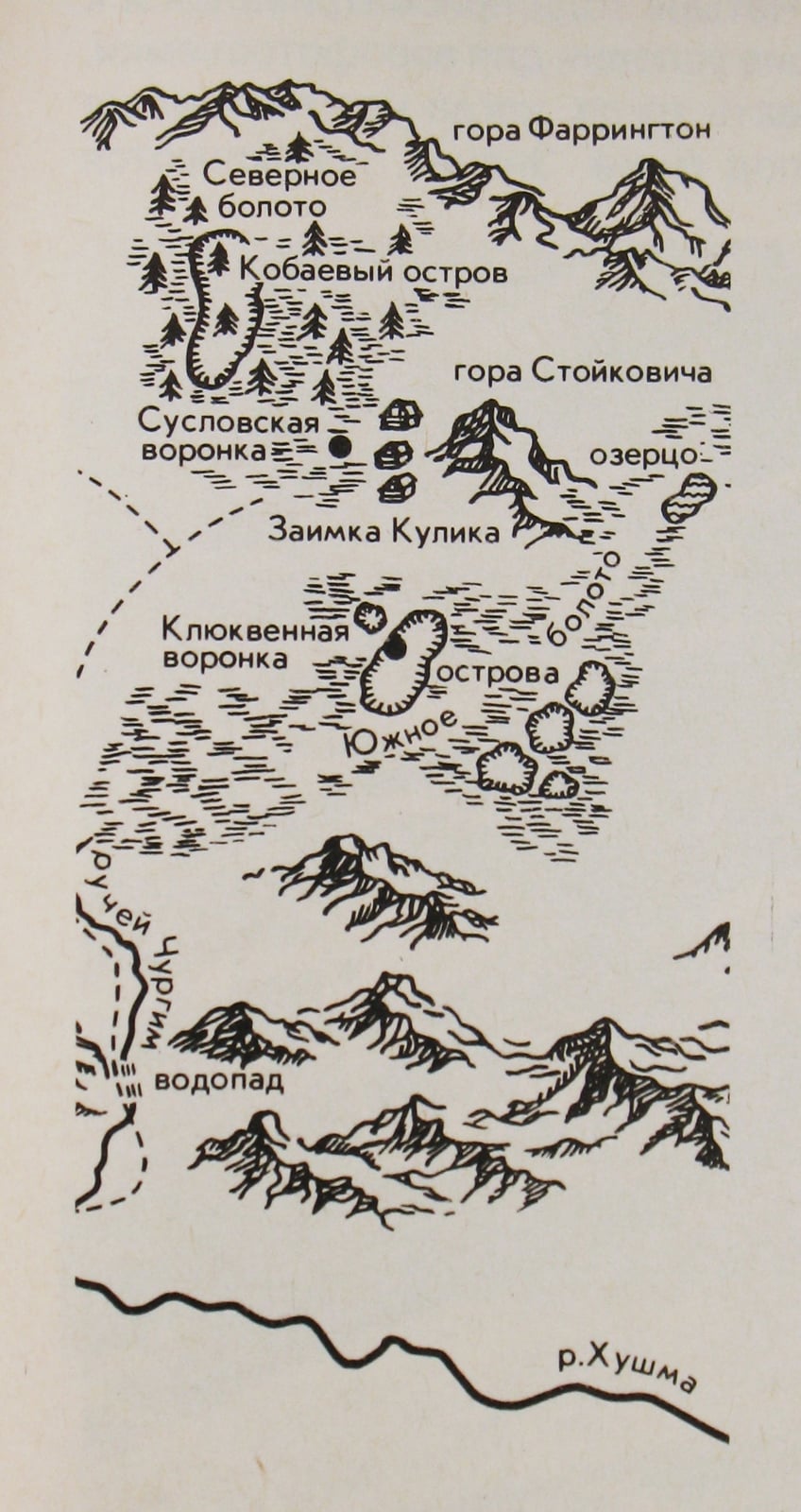
Kulik came back in 1928 with the writer Viktor Sytin and a Sovkino cameraman, N. A. Strukov, who filmed him capsizing in the Burkan rapid for a newsreel called Into the Taiga for a Meteorite, and stayed on with a single worker through the summer when scurvy sent the others out; a relief party with journalists reached him in October. Magnetic survey of the biggest pit, the “Suslov crater,” thirty-two meters across, found no iron in it. He came back again in February 1929 with Evgeny Krinov, a bog specialist, a driller, workmen, fifty cart-loads of gear and eighteen months’ food, and this time he dug. A trench thirty-eight meters long drained the Suslov crater in May; in June, in the middle of its floor, the diggers found the stump of a tree, rooted, intact and older than the fall. The expedition wintered in log huts built by Angara carpenters at what is still called Kulik’s zaimka, in a cold that reached minus 55.6 degrees in December; Krinov lost a toe to frostbite and left in March 1930; a borehole went down 31.5 meters through twenty-five meters of permafrost into an artesian aquifer; a piece of fused glass that Kulik hailed as impact glass turned out to be a bottle melted when his hut burned down. In March 1930 Lyuchetkan walked him to the ruins of Vasily Ilyich’s storehouses and told him the Southern Swamp had not been a swamp before 1908. Kulik believed him to the end. He went back in 1933 and again in 1937, when the survey plane crashed on landing at Vanavara. In 1938 a Glavsevmorput aircraft finally photographed 250 square kilometers of the fall from the air, and in 1939 he probed the bottom of the Southern Swamp and wrote his last paper: the meteorite was nickel iron, it had struck in two to four places, its craters had been fifty to a hundred meters across and its masses lay twenty-five to fifty meters down. “History hurries us with this business,” he had written in 1933. In July 1941, at fifty-seven, he joined the Moscow militia, was wounded in October near Spas-Demensk, and died of typhus in a German prisoner-of-war camp there on April 14, 1942. The 1,500 negatives of his aerial survey were burned in 1975, on Krinov’s order, as a fire hazard; the prints survive in Tomsk.
Sources: Тунгусский метеоритДанные по Тунгусскому метеориту к 1939 годуTunguska eventТунгусский метеоритПоказания очевидцев Тунгусского падения (каталог)
The butterfly
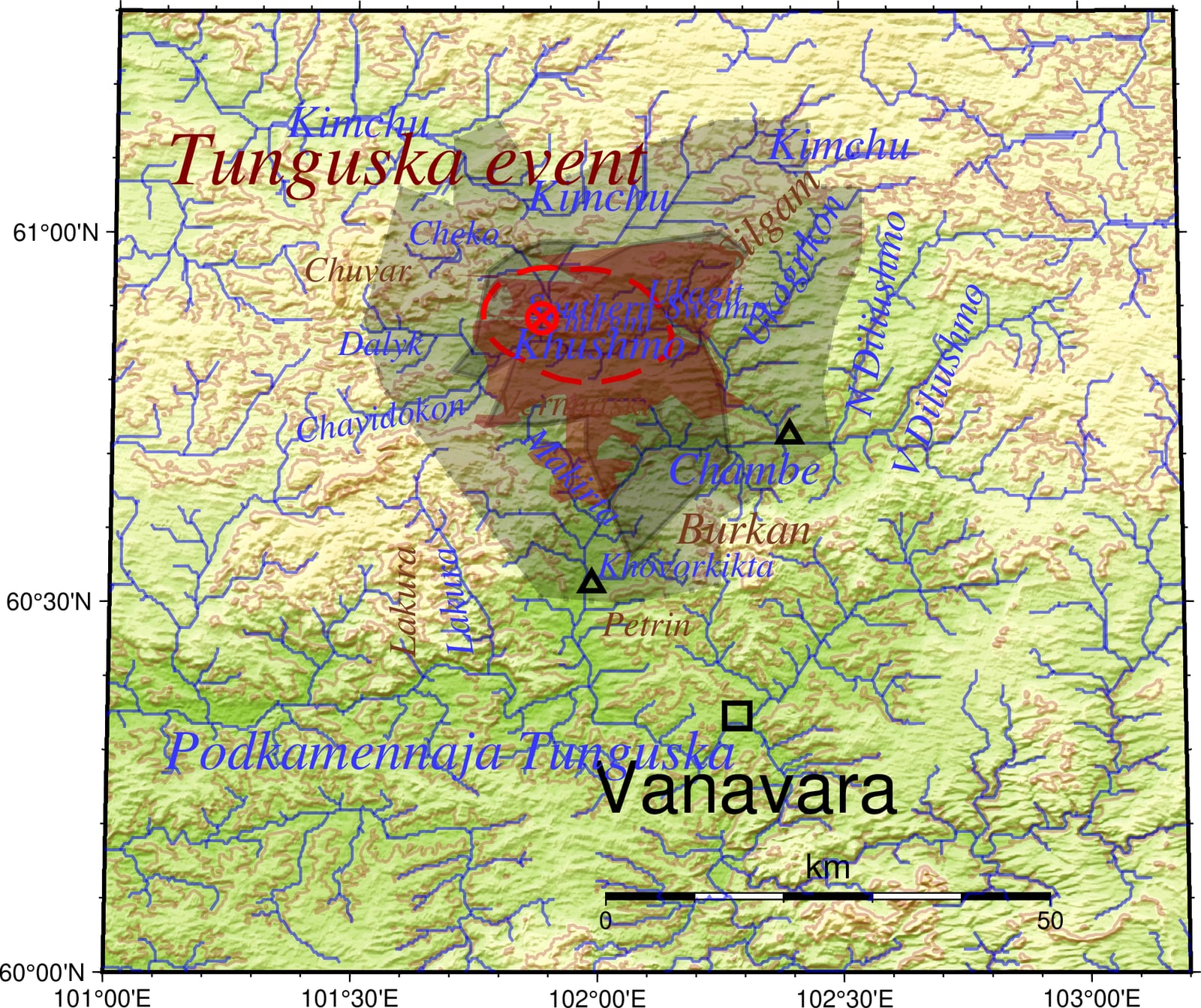
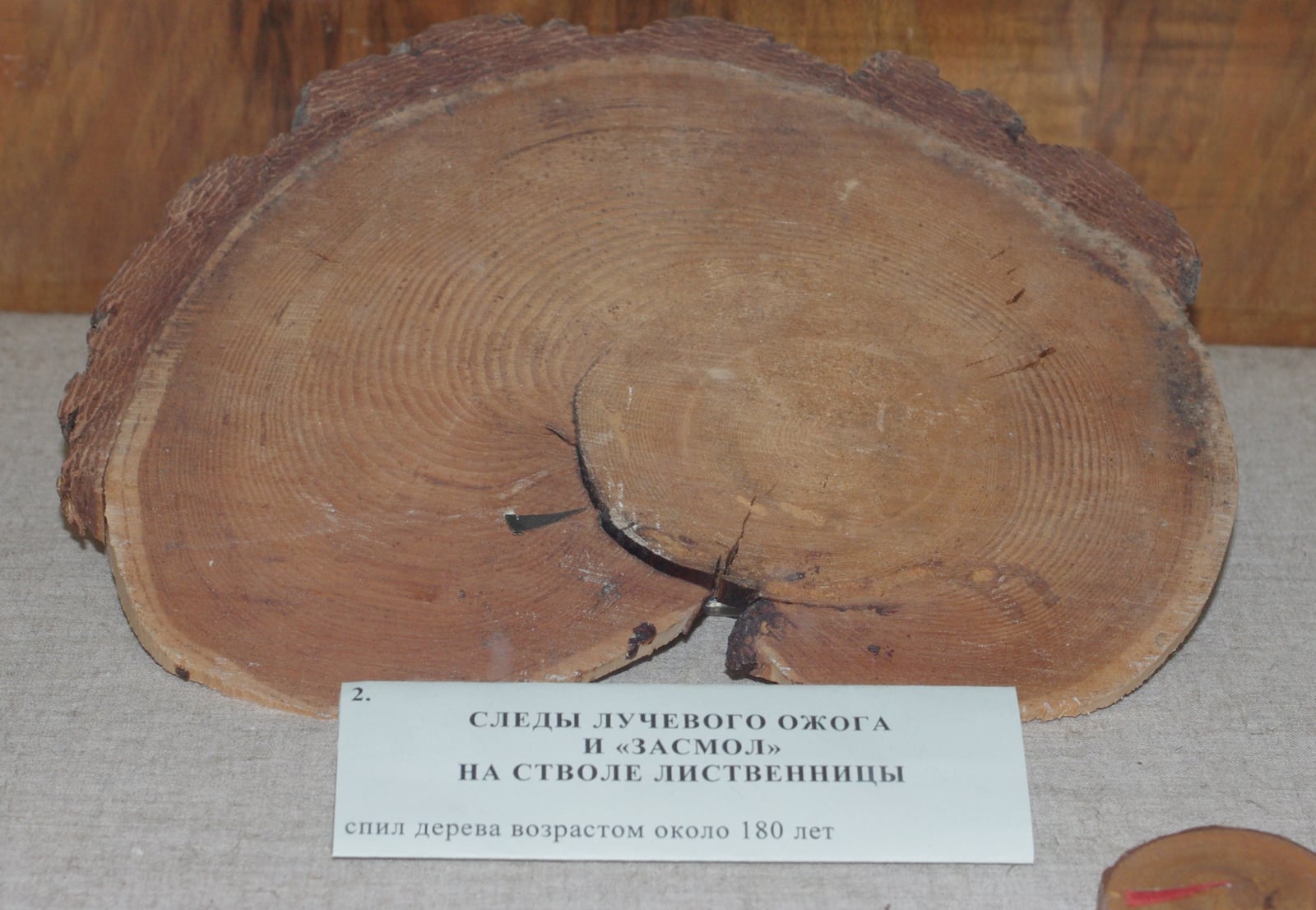
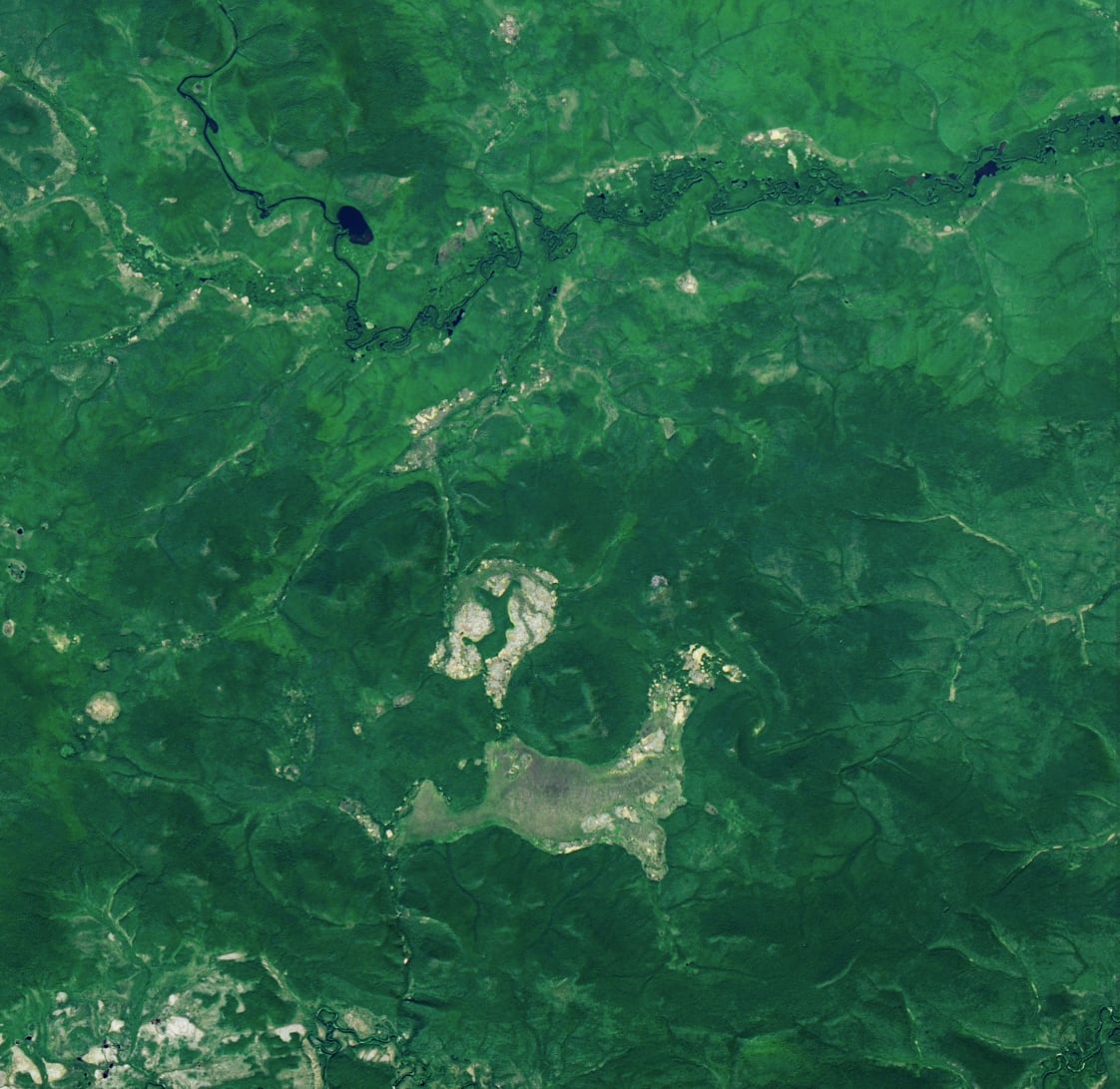
As late as 1951 the Academy of Sciences, in a statement signed by Fesenkov, Krinov and three colleagues, still held that “undoubtedly, in the first moment after the meteorite’s fall a crater-like depression formed on the site of the Southern Swamp,” later silted over and covered with moss. The man who ended that was Kirill Florensky, son of the philosopher-priest, whose Academy expedition in the summer of 1958 crossed the Southern Swamp four times, found living larches on it more than a century old, found no trace of a crater and concluded that the shock wave had come “from above downward,” from a centre high in the air. Over the next seven summers Wilhelm Fast, a Tomsk mathematician, and his helpers walked the whole zone with compasses, measuring the direction of fall on sample plots of a quarter to half a hectare, 5,500 azimuths in all, and drew the result: a fall of 2,150 square kilometers, radial around a point they placed at 60°53′09″ north, 101°53′40″ east, shaped like “a gigantic spread-eagled butterfly” with a wingspan of seventy kilometers and a body of fifty-five, its axis pointing back towards the east-south-east along the line the thing had flown. At the centre, where Kulik had found his pits, stood the “telegraph forest,” a few kilometers of dead trunks that had kept their feet while losing every branch, because the blast there had come straight down. Florensky’s 1961 expedition, seventy-eight strong, measured burns on larch branches no thicker than a pencil in 1908 out to ten kilometers, all facing the centre, and sieved the soil for tiny magnetite and silicate spheres, a few per sample and ninety in one from the Chunya eighty kilometers to the north-north-west, a dusting of several tons of something cosmic across the taiga and no fragment anywhere. Laboratory models, in which a charge slid down a wire over a forest of matchsticks and detonated, reproduced the butterfly when the charge came in at about thirty degrees from the east-south-east. By the mid-1960s the Soviet academy’s answer was a comet nucleus of dirty ice, fifty to a hundred meters across, vaporized in the air with the force of some twenty megatons; in 1970 the astronomer Igor Zotkin, writing in Priroda under the pseudonym P. I. Privalov, listed the seventy-seven hypotheses in print as of New Year’s Day 1969.
Sources: Разрушения, вызванные ударной волной Тунгусского метеоритаPreliminary Results from the 1961 Combined Tunguska Meteorite ExpeditionТунгусский метеоритTunguska event
A story-hypothesis
The question had, in another sense, been reopened in 1945. Alexander Kazantsev was an engineer, a wartime colonel and the author of a prewar science-fiction novel, and in August 1945, by his own account, he was in a car on official business when he switched on a captured radio and heard, in English, that an atomic bomb had been dropped on Hiroshima. “An analogy arose at once and it shook me,” he recalled decades later: in Hiroshima the only buildings left standing were those directly under the burst, where the shock came from above, “exactly as in the Tunguska basin the forest was left standing at the centre of the fall.” He went to the Committee on Meteorites, where Krinov, by Zhuravlev and Zigel’s account, received him warmly, gave him the Tunguska materials and liked the idea of a story that would revive interest in Kulik’s work. In November Kazantsev wrote “Vzryv,” “Explosion,” read it to the Moscow writers on December 1 and published it in the first 1946 issue of Vokrug sveta under the label rasskaz-gipoteza, a story-hypothesis. It is a good story. A theoretical physicist tells the narrator his hypothesis is about “the Tunguska meteorite. The one that fell near the Vanavara trading post in 1908? The one that never fell to earth.” A telegram on August 14, 1945 asks him to compare the seismic records of June 30, 1908 with those of “the second American gift,” Nagasaki; the two match “with astonishing exactness.” The Evenki who had died of a strange ulcerating disease were victims of radiation. The standing dead trees at the centre were “telegraph poles,” which “could have stayed upright only under a vertical hurricane, a hurricane that fell from above,” from an explosion in the air. And the last paragraphs, dictated as an addendum, admit the possibility “that the explosion occurred not in a uranium meteorite but in an interplanetary ship that used atomic energy,” whose travelers had landed to explore the taiga when their vessel blew up with the fuel meant for the voyage home. The 1946 text, according to Zhuravlev and Zigel, put the burst at 350 meters; later editions raised it to five kilometers. Mars is not named; there is a black shamaness who heals with her eyes and asks, dying, to be taken to the morning star.
Sources: Тунгусское дивоГость из космосаНЛО над планетарием: эпистемологическая пропаганда и альтернативные формы знаний о космосе в СССР в 1940–1960-е годыSoviet Scientists Scold Writers Who Spread ‘Space-Ship’ HoaxВ ожидании последней войны. Как советские ученые начали изучать космонавтов древности, ядерные межпланетные корабли и марсианскую фаунуAtomic Visitors from Outer Space: The Tunguska Nuclear Hypothesis in Soviet Technological ImaginationТунгусский метеорит: история исследования
Seventy per cent meteorite
Krinov’s warmth cooled quickly. In 1947 Kazantsev and a young planetarium astronomer, Felix Zigel, turned the story into a staged lecture-debate, The Riddle of the Tunguska Meteorite, with an actor as a student, a physics professor and a rocket colonel, which opened at the Moscow Planetarium in January 1948 and ran to packed houses. At a meeting of the astronomical society in February the astronomer Pavel Parenago summed up: everyone agreed they were dealing with “a guest from the Cosmos”; for his part he was seventy per cent sure it was a meteorite “but thirty per cent ready to admit that it was aliens.” In May three meteorite scientists, Stanyukovich, Fedynsky and Krinov, attacked the show in Moskovsky komsomolets for obscuring plain natural phenomena with “pseudo-hypotheses” and trading on the horrors of American bombs; a magazine cartoonist, in Bronshten’s telling, drew them as penguins. The popularizer Boris Lyapunov went further in Znanie–sila in 1950: “It was a spaceship. What it was like, who its passengers were, where it came from, exactly what happened to it in flight, we do not know.” In March 1951 Kazantsev retold the tale in Tekhnika–molodezhi as “A Guest from the Cosmos,” now “most probably from Mars,” and proposed measuring the radioactivity of the fallen trees. That June the Associated Press reported from Moscow that Siberia had had “its own ‘invasion from Mars’ scare,” that peasants were writing to editors to ask when the next visit could be expected, and that the Teachers’ Gazette had scolded the writers responsible. In August Fesenkov and Krinov replied in Literaturnaya gazeta: the explosion had occurred “not at a height of several hundred meters, as A. Kazantsev fantasizes, but on impact with the earth’s surface,” and the authors were spreading khaltura, hackwork, “under the guise of scientifically grounded explanations.” The planetarium show was withdrawn. The historian of the affair, Vitaly Bronshten, no friend of the spaceship, conceded fifty years later that Kazantsev had been right about the one thing the academicians had been wrong about: the thing had exploded in the air.
Sources: Тунгусское дивоГость из космосаНЛО над планетарием: эпистемологическая пропаганда и альтернативные формы знаний о космосе в СССР в 1940–1960-е годыSoviet Scientists Scold Writers Who Spread ‘Space-Ship’ HoaxВ ожидании последней войны. Как советские ученые начали изучать космонавтов древности, ядерные межпланетные корабли и марсианскую фаунуAtomic Visitors from Outer Space: The Tunguska Nuclear Hypothesis in Soviet Technological ImaginationТунгусский метеорит: история исследования
A dormitory on Usova Street
The rebuttal did not kill the idea; it sent it underground, where it grew. Stanisław Lem built his first published novel, The Astronauts (1951), on the Tunguska ship. Zigel, whom the meteorite men had tried to have barred from the planetarium rostrum in 1952, wrote in Znanie–sila in June 1959 that “at the present time, whether anyone likes it or not, A. P. Kazantsev’s hypothesis is the only plausible one” that explained the missing crater and the airburst; Fate magazine carried the theory to America that October under the headline “Did a Space Ship Explode Over Siberia?” In the physics dormitory of the Tomsk Polytechnic on Usova Street, in November 1958, two groups of students who had each been planning a summer trek to the fall met and merged into what they named, the next spring, the Complex Amateur Expedition, the KSE, under a thirty-two-year-old physician and radio engineer, Gennady Plekhanov, with a young microbiologist, Nikolai Vasilyev, beside him. The first KSE party left Tomsk on June 30, 1959, the anniversary, and reached Kulik’s huts on July 31; the second, in 1960, numbered seventy-three, including a twenty-two-man group with a helicopter sent by Sergei Korolev, the chief designer of the Soviet space program, who wanted to know whether there was a ship, and among them a young engineer named Georgy Grechko, later a cosmonaut.
Sources: Тунгусское дивоТунгусский метеорит: история исследованияDid a Space Ship Explode Over Siberia?Possible Anti-Matter Content of the Tunguska Meteor of 1908Atomic Visitors from Outer Space: The Tunguska Nuclear Hypothesis in Soviet Technological ImaginationНЛО над планетарием: эпистемологическая пропаганда и альтернативные формы знаний о космосе в СССР в 1940–1960-е годы
Zolotov’s fifteenth conclusion
A geophysicist from the Bashkir oil fields, Aleksey Zolotov, had read Kazantsev’s 1951 story while convalescing from an illness, felt well at once and “decided that one must not doubt but act”; he spent a week in the taiga in 1959, wrote a 116-page report that the Ninth Meteorite Conference in Kiev condemned for “an exceptionally frivolous attitude to the collection of materials,” and found patrons in physicists who did not mind, among them Mikhail Leontovich and Boris Konstantinov, vice-president of the Academy, whose preface to Zolotov’s 1969 monograph admitted that the nuclear idea seemed to many “utterly improbable and unscientific” but had value as a working hypothesis. Zolotov’s fifteenth conclusion read: “The Tunguska explosion occurred accompanied by nuclear reactions.” What remained unknown, he wrote, was whether the body was natural or artificial. “Everyone knew that Zolotov was looking for aliens,” Zhuravlev and Zigel wrote. “And that is unscientific, unrespectable and unserious.” The students looked for the things a nuclear explosion would have left. They counted tree rings for radioactivity and found only the fallout of the 1950s; Plekhanov went through two thousand Vanavara case histories and the bones of Evenki for strontium and found no radiation sickness; a one-per-cent excess of carbon-14 in 1909 tree rings that Clyde Cowan, C. R. Atluri and Willard Libby reported in Nature in 1965, in support of a meteor made of antimatter, dissolved under later measurement. Plekhanov gave up the leadership in 1962, he told Bronshten, “as soon as I was convinced that it could not have been a spaceship.” The KSE did not give up. It became the Tunguska establishment, fifty-two expeditions and some three thousand participants over the decades, publishing the catalogue of witnesses, the tree-fall census and the night-sky study, and treating its founding motive with the mixture of embarrassment and affection that families reserve for an eccentric grandfather.
Sources: Тунгусское дивоТунгусский метеорит: история исследованияDid a Space Ship Explode Over Siberia?Possible Anti-Matter Content of the Tunguska Meteor of 1908Atomic Visitors from Outer Space: The Tunguska Nuclear Hypothesis in Soviet Technological ImaginationНЛО над планетарием: эпистемологическая пропаганда и альтернативные формы знаний о космосе в СССР в 1940–1960-е годы
The maneuver
Zigel did not give up either, and he gave the legend its most durable twist. The witnesses did not agree about where the thing had come from. The 1908 letters from the Angara and the Lena described a body flying from the south; the tree-fall and the witnesses questioned later on the Lower Tunguska put its last course from the east-south-east. Krinov had drawn a compromise from the south-east; Zotkin and Fast drew the axis of the butterfly. Where a statistician saw scatter, Zigel in 1966 saw a turn. The Tunguska body, he argued in a book published in Minsk, had first flown north over the Angara and then swung to the west; the loop it described in the atmosphere, he wrote later, “was many hundreds of kilometers long.” “To admit that the Tunguska body performed a ‘maneuver,’” he wrote in 1981, “sharply changing its direction of flight at least twice, means admitting its artificiality, its controllability.” In August 1967 Kazantsev co-wrote an article on UFOs in the trade-union daily Trud with Jacques Vallée; that autumn Zigel was deputy to a major-general in a short-lived UFO section of the Soviet cosmonautics committee, appeared on central television on November 10 to appeal for sighting reports, and saw the section dissolved within weeks. A maneuver paper Zigel submitted to the 1971 Tunguska conference in Novosibirsk was struck from the program at the Committee on Meteorites’ insistence; his history of the affair, commissioned in 1972, was killed in 1974 after reviews by Bronshten and Yavnel, and he answered with a samizdat afterword comparing his critics’ methods to Lysenko’s and declaring the Tunguska body “a unique representative of that very numerous class of objects” called UFOs. The Siberian commission that reviewed the manuscript was unkinder than Bronshten: it was harder, the reviewers wrote, to confuse a smallpox epidemic with radiation sickness “than a hedgehog with a crocodile.”
Sources: Тунгусское диво — факты и фантастикаПослесловие, которого могло бы и не бытьЗигель, Феликс ЮрьевичТунгусское дивоТунгусский метеорит: история исследованияThe Fire Came By: The Riddle of the Great Siberian ExplosionWas the Tungus Event due to a Black Hole?UFO Chronicles of the Soviet Union: A Cosmic SamizdatThe Tunguska Mystery
Something Third
The Strugatsky brothers had made the ship a joke in 1965: it had been not a landing but a take-off, by a vessel moving backward in time. In 1976 the writers John Baxter and Thomas Atkins published The Fire Came By, with an introduction by Isaac Asimov and a blurb about a cylindrical object “seen to have changed direction at speed,” and concluded that the weight of evidence led “inescapably” to a nuclear explosion of about thirty megatons; the same decade Nature printed, and then dismantled, a proposal that a small black hole had passed clean through the earth. By 1981 even Zigel had let the ship go. The explosion, he wrote in a science-fiction annual, was caused “neither by a comet nucleus nor by a spaceship blown up in a thermonuclear catastrophe, but by Something Third,” most likely an experimental alien probe. In January 1990 Vallée sat in Kazantsev’s Moscow study with Zolotov, who told him that reading Kazantsev’s article had been “the turning point in my life.” Zolotov was stabbed to death in October 1995 defending his expedition’s instruments from thieves, by Bronshten’s account; Vasilyev, the KSE’s scientific conscience, who died in 2001, had written in a book that appeared only after his death that of all the events of “collisional astronomy” Tunguska was the only one “suspicious as regards contact with extraterrestrial life.” Kazantsev died in 2002 at ninety-six, still writing new versions; in one from 1988 the thing over the taiga was a landing module and its mother ship had scuttled itself in orbit.
Sources: Тунгусское диво — факты и фантастикаПослесловие, которого могло бы и не бытьЗигель, Феликс ЮрьевичТунгусское дивоТунгусский метеорит: история исследованияThe Fire Came By: The Riddle of the Great Siberian ExplosionWas the Tungus Event due to a Black Hole?UFO Chronicles of the Soviet Union: A Cosmic SamizdatThe Tunguska Mystery
What fell, and from where
The Western scientific consensus, insofar as there is one, dates from 1983, when Zdeněk Sekanina argued that a comet on so shallow a path should have disintegrated far higher and that the Tunguska body must have been “a dense rocky object, probably of asteroidal origin,” and from 1993, when Christopher Chyba and two colleagues showed in Nature that a stony asteroid some sixty meters across, entering at ordinary hypersonic speed, would do precisely this: hold together through the thin air, then crush and vaporize in a few kilometers of flight around ten kilometers up, dumping ten to twenty megatons into the atmosphere, while a comet would burst too high and an iron would reach the ground and leave a crater. A NASA workshop in 2018 converged on a stony body of fifty to eighty meters, ten to twenty megatons, a burst near ten kilometers, and the honest admission that the real limit on understanding was “the dearth of quantitative data,” not the models. Even that is contested at the edges. Mark Boslough of Sandia argued from 2007 that the fireball’s downward momentum had been ignored and the yield was three to five megatons; in 2025 he and Andrea Bruno traced the famous “80 million trees” back to a 1933 guess four times too large and showed that the ground winds were tens of meters a second, not hundreds. A Krasnoyarsk group proposed in 2020 that an iron asteroid of one to two hundred meters had skimmed through the atmosphere at ten to fifteen kilometers and flown back into space, leaving only its shock wave and a plume of vaporized iron, which would explain the missing fragments by removing the need for any. Russian astronomers still speak of a comet fragment as the main hypothesis. The search for the body goes on. The Bologna physicist Giuseppe Longo’s team announced in 2007 that Lake Cheko, a deep, funnel-shaped pond eight kilometers north-north-west of the epicentre, was the crater of a surviving fragment; a Siberian team reported in 2017 at least 280 annual layers in its mud, which was a problem for a lake supposedly a century old. Diamond and lonsdaleite grains with meteoritic iron sulfide inclusions, found in peat collected in 1978 beside Kulik’s hut, were published in 2013 as “new evidence of meteoritic origin,” with the authors’ own caveat that the iridium was too low and the carbon too light. A ten-ton quartzite block on Mount Stoykovich, found in 1972 and called John’s Stone after its finder, was proposed as a fragment in 2014 and shown by its oxygen isotopes a year later to be, in all probability, terrestrial. On February 15, 2013, a nineteen-meter rock exploded over Chelyabinsk with about half a megaton, blew in windows across the city and sent some 1,500 people to doctors, and for the first time scientists had a filmed, measured, fragment-strewn small cousin of Tunguska to calibrate against; the models that fit Chelyabinsk fit Tunguska only if the 1908 body was a good deal stronger. And the witnesses still disagree about the time. Of the 316 accounts that give one, seven in ten say morning and the rest noon or after, a split that once persuaded researchers there had been two bolides and that Fast and a co-author, N. P. Fast, explained in 2003 by the Old Believers’ “Jerusalem time,” which set the clock to six at local noon.
Sources: The 1908 Tunguska explosion: atmospheric disruption of a stony asteroidTunguska Workshop: Applying Modern Tools to Understand the 1908 Tunguska ImpactTunguska Revisited: 111-Year-Old Mystery Impact Inspires New, More Optimistic Asteroid PredictionsTunguska airburst misconceptions and their originsOn the possibility of through passage of asteroid bodies across the Earth’s atmosphereA possible impact crater for the 1908 Tunguska EventEvidence that Lake Cheko is not an impact craterNew evidence of meteoritic origin of the Tunguska cosmic bodyTunguska event
The reserve and the red sphere
Kulik had wanted the place preserved, and on October 9, 1995, by government decree, it was: the Tunguska State Nature Reserve, 296,562 hectares of larch taiga and bog with its office on Moskovskaya Street in Vanavara, a village of some 2,500 people reachable only by air, by the winter road or by boat. Kulik’s three log buildings at the zaimka, the commander’s hut, the workers’ hut and the storehouse, were made a historic monument of the region in 1980 and still stand, with chess pieces on a windowsill and the remains of drilling gear forged in the vanished smithy; the Suslov crater is two hundred meters away, Mount Farrington with its 1929 survey marker a short climb, and the Churgim creek drops ten meters over a sill of trap rock into a pool where the water stays at eight degrees in the hottest summer. Visitors walk in along Kulik’s 1928 trail through the Vyezd, Makikta and Pristan cordons, two weeks there and back, or come by boat up the Chambe and the Khushmo, or pay for a helicopter from the Vanavara strip. Forty people made it in 2017, a summer in which Evgenia Moroz of the reserve staff walked four groups to the epicentre; in other years fires close the forest. For the centenary in 2008 Vanavara raised a monument on its square, a red sphere a meter and a half across on a ten-meter pedestal with Evenki chums on its four sides, and an iron bird for Agdy was planned for the reserve; Krasnoyarsk and Moscow held rival conferences; a Krasnoyarsk collector who ran a “Tunguska Space Phenomenon” foundation and had been breaking pieces off a boulder since 2004 insisted he had five tons of the ship. In December 2016 the United Nations General Assembly declared June 30 International Asteroid Day, “to observe each year at the international level the anniversary of the Tunguska impact over Siberia.” The reserve’s scientists core the small lakes east of the epicentre for the 1908 layer and announce traces of rare earths in it; the reserve promises a fitted-out trail to the fall by 2028; an asteroid named for Plekhanov, who died in 2019, circles the sun. In Vanavara the thing is still called, with care, the Tunguska cosmic body, since nobody has ever held a piece of the meteorite.

Sources: Государственный природный заповедник «Тунгусский»30 июня исполняется 115 лет со дня падения Тунгусского метеорита: явление изучается в заповедникеМесто падения тунгусского метеорита отметят памятным знакомInternational Asteroid Day, 30 JuneТунгусский метеорит: что известно о событии
What survives
No photograph, drawing or instrument reading of the object itself exists. What survives is the record of its effects. The Tomsk catalogue of 1981 collects some 700 eyewitness accounts: the 1908 newspaper letters, the sixty-odd replies to Voznesensky’s questionnaires, Kulik’s 1921 and 1927 correspondence, Suslov’s 1926 interviews with the Evenki, Krinov’s 1930 interviews on the Angara and the KSE’s collections of 1959 to 1970, all available on the Tunguska phenomenon archive in Tomsk together with Kulik’s papers and Krinov’s 1949 monograph. The Irkutsk seismogram and the Siberian barograms are preserved in Voznesensky’s 1925 publication and Krinov’s tables; the English microbarograph traces in Whipple’s 1930 paper; the bright nights in letters to Nature and the Russian papers and in Vasilyev’s 1965 study of 155 observing points; the geomagnetic disturbance in the Irkutsk magnetograms rediscovered in 1959. Fast’s tree-fall census of 1958 to 1965 and his 1983 catalogue of fallen trees are the physical map of the event; Florensky’s 1961 soil samples, the peat columns with their 1908 layer, the 1978 peat with its diamond grains and the resin of surviving larches have been the hunting ground for traces of the body. Kulik’s 1938 aerial negatives were burned in 1975, but prints are kept in Tomsk; Strukov shot a newsreel in 1928; the three log buildings of Kulik’s camp stand as a monument; the Suslov crater, the Churgim waterfall and the “telegraph forest” can be visited. The literature is enormous: Zotkin’s 1970 tally found 77 hypotheses, as of the start of 1969, in 10 monographs, 390 articles, 180 reports and 550 popular pieces, and Russian Wikipedia now speaks of 120. Of the Tunguska meteorite, after a century of digging, drilling, coring, sieving and diving, there is not one certified gram.
Sources: Показания очевидцев Тунгусского падения (каталог)Тунгусский метеоритРазрушения, вызванные ударной волной Тунгусского метеоритаPreliminary Results from the 1961 Combined Tunguska Meteorite ExpeditionТунгусский метеорит
The contradictions
The event has two dates, June 17 and June 30, and the sources confuse them to this day; the Sibir letter that every history quotes appeared on July 2 Old Style, which is July 15 by our calendar. The time is 7:14 in most modern references, 7:02 by mean solar time at the epicentre, 7:17 by Voznesensky’s Irkutsk clock, 7:43 in the Krasnoyarets report from Kezhma, “about 8” in Semenov’s first account and anywhere from five in the morning to after noon in the testimony. Semenov’s two accounts put the fire in the north-west and then due north, throw him one sazhen and then three, and in the second he could no longer remember the year. Voznesensky’s trajectory came from the south at azimuth 192 degrees, Krinov’s from the south-east at 137, Fast’s butterfly from the east-south-east at 115 and later 99; the choice between them is the whole difference between a statistical scatter and Zigel’s maneuver. The area of fallen forest is 680 square kilometers in the Evenki’s estimate to Obruchev, about 1,500 in Florensky’s 1958 report, 2,150 in Fast’s census and 8,000 in Astapovich’s 1933 guess, from which the “80 million trees” of a hundred later books descend. The energy has been put at everything from a tenth of a megaton to fifty; the burst height at five kilometers, ten, twenty, and, by Kulik and the academy until 1958, at ground level. The 1926 suglan named three dead; a 1960 witness said “there were no victims, people lay a while and got up”; a 2019 paper counts up to three. The reindeer killed number “a few” in one 1921 letter, two hundred of one herder’s in the suglan, up to 1,500 in Lyuchetkan’s account and “more than a thousand” in a 1959 recollection, against the catalogue’s own note that a family seldom kept more than fifty. The Evenki told Kulik the tops of the fallen trees pointed north-east; he found them pointing south, then radial. The Southern Swamp was no swamp before 1908, Lyuchetkan told him; it had always been one, another Evenk told the students in 1959. Even the spaceship has two heights: 350 meters in the 1946 printing of Kazantsev’s story, five kilometers in the editions everyone reads.
Sources: Показания очевидцев Тунгусского падения (каталог)Тунгусский метеоритРазрушения, вызванные ударной волной Тунгусского метеоритаTunguska airburst misconceptions and their originsТунгусское диво
Explanations and objections
The explanation accepted by nearly every working scientist is an airburst: a natural body of ice or stone tens of meters across, moving at some fifteen to thirty kilometers a second, that was crushed by the air at a height of five to fifteen kilometers and gave up the energy of several to a few tens of megatons as heat and shock. It accounts for the fire seen over the forest, the burns facing one point, the radial fall with its standing centre, the butterfly, the seismic and air waves, the dust that lit the nights and the absence of a crater. Its two branches, comet and stony asteroid, have argued since Whipple proposed a comet in 1930 and Sekanina a rock in 1983; the asteroid wins on strength, the comet on the bright nights and the dust, and Russian astronomers and Western ones still answer differently when asked. The iron grazer of 2020 is a minority proposal that answers the missing fragments too neatly for most. Against all of them stands the plain fact that no fragment has been identified, which the airburst models explain by total vaporization and which the lore has never accepted as an answer. The nuclear-ship hypothesis of Kazantsev, Zolotov and Zigel rested on the airburst itself, on the standing trees, on the magnetic storm, on reports of radiation sickness among the Evenki and of radioactivity in the trees, and on the apparent turn in the trajectory. The airburst turned out to be natural; the storm resembles the ionospheric effect of any great explosion; the illness, the catalogue’s compilers note, was probably smallpox; the radioactivity was fallout from the 1950s; the maneuver dissolves when the witness reports from the Angara are weighed against those from the fall zone. Later exotica, antimatter in 1965 and a mini black hole in 1973, were refuted in the same journal that printed them. An alternative school ranges from the KSE’s own Dmitriev and Zhuravlev, with a plasmoid thrown off by the Sun, to the independent physicist Andrei Olkhovatov, who holds that nothing fell at all and that the earth itself produced the fire and the quakes; it has adherents and few converts. The Tesla legend, that the inventor tested a wireless power beam from Long Island that morning, is an invention of the 1990s and has no document behind it. What is left for the mystery is real enough: the body’s nature, its mass, its true path, the time the witnesses could not agree on, the bright nights that may have begun before it arrived, and the hole in the middle of the story where the meteorite should be.
Sources: The 1908 Tunguska explosion: atmospheric disruption of a stony asteroidTunguska Workshop: Applying Modern Tools to Understand the 1908 Tunguska ImpactOn the possibility of through passage of asteroid bodies across the Earth’s atmosphereПослесловие, которого могло бы и не бытьТунгусское дивоPossible Anti-Matter Content of the Tunguska Meteor of 1908Was the Tungus Event due to a Black Hole?Tunguska event
Classification and evidence note
This archive files Tunguska as a crash report: for half a century it was investigated as the fall of a meteorite, and for eighty years now it has also been told as the crash of a ship, and both searches were for a body on the ground. No close-encounter kind is assigned; nothing was seen but fire, smoke and light, and the “pipe” of the Nizhne-Karelinskoye letter is the only shape anyone reported. The evidence for the event is as strong as evidence gets, with instrument records on three continents, a physical footprint of two thousand square kilometers that can still be walked, and hundreds of witnesses recorded over sixty years. The evidence for anything but a natural body is the absence of that body and a trajectory argument that most specialists reject. The archive treats the Kazantsev story, the planetarium debate, Zolotov’s nuclear program and Zigel’s maneuver as the founding lore of Soviet ufology, which they were, and not as findings about what crossed the sky on June 30, 1908.
Sources: Показания очевидцев Тунгусского падения (каталог)Tunguska Workshop: Applying Modern Tools to Understand the 1908 Tunguska ImpactНЛО над планетарием: эпистемологическая пропаганда и альтернативные формы знаний о космосе в СССР в 1940–1960-е годы
- 30 JUN 1908 · C. 7 AM
A body brighter than the sun crosses central Siberia and bursts over the taiga north of the Podkamennaya Tunguska; Semenov is thrown from his porch at Vanavara, Evenki camps are flattened, the Irkutsk seismograph records the onset of the shock at 0:18 Greenwich time.
- 30 JUN–2 JUL 1908
Bright nights over northern Europe and European Russia; microbarographs in England record the air wave five hours after the event.
- 12 JUL 1908
Sibirskaya zhizn in Tomsk prints Adrianov’s “A visitor from celestial space,” the garbled story of a meteorite at the Filimonovo siding.
- 15 JUL 1908
The Irkutsk newspaper Sibir prints S. Kulesh’s letter from Nizhne-Karelinskoye: a body shaped like a pipe, a club of black smoke and villagers weeping for the end of the world.
- 1908
Voznesensky, director of the Irkutsk observatory, circulates questionnaires and receives some sixty replies, published only in 1925.
- MAR 1921
Svyatsky hands Kulik a 1910 calendar leaf reprinting the Filimonovo story: “there is no smoke without fire.”
- SEP 1921
Kulik’s first meteorite expedition leaves Petrograd with 2,500 questionnaires; it establishes the date and the direction but does not reach the fall.
- 1–4 JUN 1926
Suslov questions some sixty Evenki at Strelka on the Chunya; the gathering names three dead and Lyuchetkan draws a map.
- 13 APR 1927
Kulik, Lyuchetkan and Okhchen cross the Makirta into continuous fallen forest; two days later Kulik sees the treeless white ridges and his guide refuses to go on.
- JUN 1927
From the hills around the Great Hollow Kulik finds the fall radial: “I had walked right round the centre of the fall!” He takes the water-filled pits for meteorite craters.
- 1928
Second expedition with Sytin and the cameraman Strukov; a magnetic survey of the Suslov crater finds no iron; when scurvy sends the others out, Kulik stays on with one worker until a relief party with journalists reaches him in October.
- MAY–JUN 1929
A 38-meter trench drains the Suslov crater; an intact, rooted tree stump older than the fall is found on its floor. The expedition winters at the camp, where Krinov loses a toe to frostbite in November and the thermometer reaches minus 55.6 degrees in December.
- 26 JUN–18 JUL 1938
Aerial photography of 250 square kilometers of the fall from a Glavsevmorput aircraft; the negatives will be burned in 1975.
- 1939
Kulik’s last expedition probes the Southern Swamp; his final paper still places nickel iron 25 to 50 meters down.
- 14 APR 1942
Kulik, a volunteer in the Moscow militia, dies of typhus in a German prisoner-of-war camp at Spas-Demensk.
- JAN 1946
Kazantsev’s “Vzryv” appears in Vokrug sveta: the Tunguska meteorite “that never fell to earth” becomes an atomic explosion and, in its last lines, an interplanetary ship.
- JAN 1948
The staged lecture-debate The Riddle of the Tunguska Meteorite opens at the Moscow Planetarium; in February Parenago declares himself seventy per cent for a meteorite and thirty per cent for aliens.
- 4 AUG 1951
Fesenkov and Krinov denounce Kazantsev and Lyapunov in Literaturnaya gazeta as spreaders of hackwork; the planetarium show is withdrawn. In June the Associated Press had reported a Siberian “invasion from Mars” scare.
- 1958
Florensky’s Academy expedition finds no crater in the Southern Swamp and places the explosion in the air; a fiftieth-anniversary stamp carries Kulik’s portrait; Tomsk students found the Complex Amateur Expedition in a dormitory on Usova Street.
- 30 JUN 1959
The first KSE party leaves Tomsk on the anniversary and reaches Kulik’s huts on July 31; Zolotov makes his first visit in August and reports a nuclear explosion.
- 1960
Seventy-three people, including a helicopter team sent by Korolev, search for radiation and a ship; they find neither.
- 1958–1965
Fast’s census maps 2,150 square kilometers of fallen forest in the shape of a butterfly; Florensky’s 1961 expedition, seventy-eight strong, finds cosmic spherules in the soil; by the mid-1960s the Soviet academy settles on a comet.
- 1966–1967
Zigel publishes the “maneuver”; in November 1967 he appears on Soviet television for a short-lived official UFO section.
- 1969
Zolotov’s monograph, with a preface by the Academy’s vice-president, concludes that the explosion was “accompanied by nuclear reactions”; Zotkin’s count of the hypotheses in print, published the next year, stands at seventy-seven.
- 1976
Baxter and Atkins publish The Fire Came By, carrying the thirty-megaton nuclear reading and the maneuver to English readers.
- 1981
Zigel renounces the ship for “Something Third,” an alien probe; the Tomsk catalogue of some 700 witness accounts is deposited.
- 1983
Zdeněk Sekanina argues that a comet on so shallow a path would have broken up far higher: the body was a dense rock of asteroidal origin.
- 7 JAN 1993
Chyba, Thomas and Zahnle publish the stony-asteroid airburst model in Nature: 10 to 20 megatons at about 10 kilometers.
- 9 OCT 1995
The Tunguska State Nature Reserve is created by decree; two days earlier Zolotov is killed defending his expedition’s instruments.
- 2007–2017
The Bologna team names Lake Cheko as the crater of a fragment; a Siberian team reports in 2017 at least 280 annual layers in its mud.
- 10 JUN 2008
Centenary monuments are announced for Vanavara and the reserve; conferences in Krasnoyarsk and Moscow mark the hundredth anniversary.
- 15 FEB 2013
The Chelyabinsk airburst gives science a measured small cousin of Tunguska.
- DEC 2016
The United Nations General Assembly declares June 30 International Asteroid Day in memory of the Tunguska impact.
- 2020–2025
A Krasnoyarsk group proposes a grazing iron asteroid that never fell; Boslough and Bruno trace the “80 million trees” to a 1933 overestimate.
Sources & interviews
Показания очевидцев Тунгусского падения (каталог)N. V. Vasilyev, A. F. Kovalevsky, S. A. Razin and L. E. Epiktetova · Tomsk, 1981, deposited at VINITI · the general catalogue of some 700 eyewitness accounts, from the 1908 newspapers and questionnaires through Suslov’s 1926 survey, Kulik’s and Krinov’s interviews and the expeditions of 1959 to 1970 · online at the Tunguska phenomenon archive, TomskТунгусский метеоритE. L. Krinov · Izdatelstvo Akademii nauk SSSR, Moscow and Leningrad, 1949, 196 pp. · the standard prewar account by Kulik’s companion: the 1908 observations, the Irkutsk seismogram, the barograms, the bright nights and the four expeditions · online at the Tunguska phenomenon archiveК вопросу о месте падения Тунгусского метеорита 1908 годаL. A. Kulik · Doklady Akademii nauk SSSR, 1927, no. 23, pp. 399–402 · the first report from the fall site, printing Semenov’s letter of March 26, 1927 and Lyuchetkan’s account of the burned reindeerЗа Тунгусским дивом (вместо фельетона)L. A. Kulik · Krasnoyarsky Rabochy press, Krasnoyarsk, 1927, dated August 19, 1927 · Kulik’s own narrative of the 1921 calendar leaf, the 1927 journey, the frightened guide, the shaman’s send-off, the walk round the centre of the fall, the estimate of iron masses above 130 tons and the nine-day retreatДанные по Тунгусскому метеориту к 1939 годуL. A. Kulik · Doklady Akademii nauk SSSR, vol. XXII, no. 8 (1939), pp. 520–524, presented by V. I. Vernadsky · the 1938 aerial survey, the astro-point coordinates, and Kulik’s last statement that nickel iron lay 25 to 50 meters under the Southern SwampОпрос очевидцев Тунгусской катастрофы в 1926 г.I. M. Suslov · the ethnographer’s record of Akulina’s account at Vanavara in March 1926 and of the suglan of some sixty Evenki at Strelka on the Chunya, June 1–4, 1926, with the testimony of Chuchancha and Chekaren and the list of the dead · published 1967 · online at the Tunguska phenomenon archiveПришелец из небесного пространстваA. V. Adrianov · Sibirskaya zhizn (Tomsk), no. 135, June 29 (July 12), 1908, p. 4 · the report of a meteorite falling beside the Filimonovo railway siding near Kansk, reprinted on a calendar leaf in 1910 and handed to Kulik in 1921 · transcription on Russian Wikisource; the page scan is held by the Tomsk State University libraryThe Great Siberian Meteor and the Waves, Seismic and Aerial, which it ProducedF. J. W. Whipple · Quarterly Journal of the Royal Meteorological Society, vol. 56, no. 236 (1930), pp. 287–304 · the British microbarograph traces of June 30, 1908, noticed by C. J. P. Cave in 1929: the air wave took five hours to reach EnglandOn Phenomena related to the Great Siberian MeteorF. J. W. Whipple · Quarterly Journal of the Royal Meteorological Society, vol. 60, no. 257 (1934), pp. 505–522 · the bright nights of northern Europe explained by a cometary tail caught in the atmosphere; the air wave recorded at Batavia and WashingtonМагнитные эффекты тунгусских событий 1908 годаV. V. Shaydurov · Vestnik SibGAU, vol. 16, no. 3 (2015), pp. 624–631 · the Irkutsk geomagnetic disturbance found by K. G. Ivanov in 1959 on the 1908 magnetograms: onset two and a half minutes after the blast, duration about six hours · CyberLeninkaРазрушения, вызванные ударной волной Тунгусского метеоритаV. G. Fast, A. P. Boyarkina and M. V. Baklanov · the methods and results of the 1958–1965 ground census of the fallen forest: 2,150 square kilometers, the butterfly, the symmetry axis and the singular point at 60°53′09″ N, 101°53′40″ E · online at the Tunguska phenomenon archivePreliminary Results from the 1961 Combined Tunguska Meteorite ExpeditionK. P. Florenskiy · report read at the Tenth Conference on Meteorites, May 1962; Meteoritika, vol. 23 (1963) · English translation by Spectrum Translation and Research, Taurus Press, 1965 · the seventy-eight-member expedition, the 2,000 square kilometers of fall, the branch injuries and the magnetite spherulesThe 1908 Tunguska explosion: atmospheric disruption of a stony asteroidChristopher F. Chyba, Paul J. Thomas and Kevin J. Zahnle · Nature, vol. 361, January 7, 1993, pp. 40–44 · the model that made a stony asteroid tens of meters in radius, bursting at about 10 kilometers with 10 to 20 megatons, the working consensusTunguska Workshop: Applying Modern Tools to Understand the 1908 Tunguska ImpactDavid Morrison, ed. · NASA/TM-2018-220174, NASA Ames Research Center, December 2018 · summary of the January 16, 2018 workshop: energy 10 to 20 megatons, burst height about 10 kilometers, a stony body of 50 to 80 meters, and the admission that the real constraint is “the dearth of quantitative data”Tunguska Revisited: 111-Year-Old Mystery Impact Inspires New, More Optimistic Asteroid PredictionsNASA · June 26, 2019 · the Ames workshop results in popular form: a stony body of 50 to 80 meters at about 15 kilometers per second, 10 to 30 megatons, and a recurrence of millennia rather than centuriesTunguska airburst misconceptions and their originsMark Boslough and Andrea Bruno · Scientific Reports, vol. 15, article 13869, April 22, 2025 · the genealogy of the “80 million trees” figure back to Astapovich’s 1933 overestimate, and the argument that the ground winds were tens of meters per secondOn the possibility of through passage of asteroid bodies across the Earth’s atmosphereDaniil E. Khrennikov, Andrei K. Titov, Alexander E. Ershov, Vladimir I. Pariev and Sergei V. Karpov · Monthly Notices of the Royal Astronomical Society, vol. 493, no. 1 (March 2020), pp. 1344–1351 · the Krasnoyarsk proposal that an iron body of 100 to 200 meters skimmed through the atmosphere at 10 to 15 kilometers and flew onNew evidence of meteoritic origin of the Tunguska cosmic bodyVictor Kvasnytsya, Richard Wirth, Larissa Dobrzhinetskaya and others · Planetary and Space Science, vol. 84 (August 2013), pp. 131–140 · diamond, lonsdaleite and graphite intergrowths with troilite and taenite inclusions from peat collected in 1978 near Kulik’s hut, and the authors’ own caveats on iridium and carbon isotopesA possible impact crater for the 1908 Tunguska EventLuca Gasperini, Francesca Alvisi, Giuseppe Biasini, Enrico Bonatti, Giuseppe Longo and others · Terra Nova, vol. 19, no. 4 (June 2007), pp. 245–251 · the Bologna group’s case that Lake Cheko, 8 kilometers north-north-west of the epicentre, is the crater of a surviving fragmentEvidence that Lake Cheko is not an impact craterGareth S. Collins, Natalya Artemieva, Kai Wünnemann, Phil A. Bland, W. Uwe Reimold and Christian Koeberl · Terra Nova, vol. 20, no. 2 (2008), pp. 165–168 · the reply: an un-crater-like lake, no impactor material, mature trees on its shore, and a fragment strength ten to a hundred times too highГость из космосаA. P. Kazantsev · Tekhnika–molodezhi, 1951, no. 3, with the author’s “scientific commentary” · the second telling, in which the ship comes “most probably from Mars” and radioactivity of the fallen trees is proposed as the test · online at the Tunguska phenomenon archiveТунгусское дивоV. K. Zhuravlev and F. Yu. Zigel · Basko, Yekaterinburg, 1998 (first edition Novosibirsk, 1994) · the insiders’ history: Kazantsev’s November 1945 visit to Krinov, the planetarium show of January 1948, Parenago’s seventy–thirty verdict, the 1951 rebuttal, the birth of the Tomsk expedition and the Zolotov affair · online at the Tunguska phenomenon archiveПослесловие, которого могло бы и не бытьF. Yu. Zigel · 1975 typescript afterword to the banned manuscript of “Тунгусское диво,” printing the Siberian Commission’s 1973 review, Bronshten’s and Yavnel’s reports and Zigel’s reply, in which the Tunguska body becomes “a unique representative” of the class called UFOs · online at the Tunguska phenomenon archiveТунгусское диво — факты и фантастикаF. Yu. Zigel · in the anthology Fantastika-80, Molodaya gvardiya, Moscow, 1981, pp. 335–347 · the “maneuver” stated in full and the author’s farewell to the spaceship in favour of “Something Third” · online at the Tunguska phenomenon archiveЗигель, Феликс ЮрьевичWikipedia (Russian) · the 1967 UFO section of the DOSAAF cosmonautics committee, the television appearance of November 10, 1967 and the fate of Zigel’s booksТунгусский метеорит: история исследованияV. A. Bronshten · A. D. Selyanov, Moscow, 2000 · the Committee on Meteorites’ historian on Kazantsev, the planetarium quarrel, the Tomsk expedition, Zolotov and Zigel, conceding that the writer had been right about the airburst · online at the Tunguska phenomenon archiveНЛО над планетарием: эпистемологическая пропаганда и альтернативные формы знаний о космосе в СССР в 1940–1960-е годыA. V. Golubev · Vestnik Permskogo universiteta. Istoriya, 2021, no. 3 (54), pp. 5–16 · how the spaceship hypothesis spread through the Moscow Planetarium, the Znanie society and the popular-science press rather than against them · CyberLeninkaAtomic Visitors from Outer Space: The Tunguska Nuclear Hypothesis in Soviet Technological ImaginationAndy Bruno · The Russian Review, vol. 81, no. 1 (January 2022), pp. 92–109 · the nuclear reading of Tunguska from Zigel’s 1948 planetarium stage to Zolotov, set against the Soviet atomic projectВ ожидании последней войны. Как советские ученые начали изучать космонавтов древности, ядерные межпланетные корабли и марсианскую фаунуAleksei Konakov · Knife (knife.media), June 2022 · from the book “Убывающий мир” · Kazantsev’s captured radio in August 1945 and the consultations with Landau and TammSoviet Scientists Scold Writers Who Spread ‘Space-Ship’ HoaxAssociated Press, Moscow · Evening Star (Washington, D.C.), June 7, 1951, p. 2 · the Siberian “invasion from Mars” scare and the Teachers’ Gazette rebuke of Kazantsev and Lyapunov · Library of Congress, Chronicling AmericaDid a Space Ship Explode Over Siberia?Frank Edwards · Fate, October 1959, pp. 46–51 · the first long American telling of Kazantsev’s theory, with its claim that he had visited Hiroshima · Internet ArchiveThe Fire Came By: The Riddle of the Great Siberian ExplosionJohn Baxter and Thomas Atkins, with an introduction by Isaac Asimov · Doubleday, New York, 1976 · the book that carried Zigel’s “maneuver” and the thirty-megaton nuclear reading to English readers · Internet ArchivePossible Anti-Matter Content of the Tunguska Meteor of 1908Clyde Cowan, C. R. Atluri and W. F. Libby · Nature, vol. 206, May 29, 1965, pp. 861–865 · the antimatter proposal and the one-per-cent carbon-14 excess in 1909 tree rings, later attributed to other causesWas the Tungus Event due to a Black Hole?A. A. Jackson IV and Michael P. Ryan Jr. · Nature, vol. 245, September 14, 1973, pp. 88–89 · with the reply by W. H. Beasley and B. A. Tinsley, “Tungus event was not caused by a black hole,” Nature, vol. 250, August 2, 1974, pp. 555–556UFO Chronicles of the Soviet Union: A Cosmic SamizdatJacques Vallée with Martine Castello · Ballantine Books, New York, 1992 · Vallée’s January 1990 evening with Kazantsev and Zolotov in Moscow · Internet ArchiveThe Tunguska MysteryVladimir Rubtsov · Springer, New York, 2009 · chapter 1, “The Enigma of Tunguska” · a Tomsk-school account in English, with the energy figures and the Semenov quotation in its 1930 wordingГосударственный природный заповедник «Тунгусский»the reserve’s own site · its history from Kulik’s idea to the decree of October 9, 1995, the trail from Vanavara through the Vyezd, Makikta and Pristan cordons, and the news of the 2026 coring of Lake Peyungda30 июня исполняется 115 лет со дня падения Тунгусского метеорита: явление изучается в заповедникеMinistry of Natural Resources of Russia press release, June 30, 2023, via AK&M · the monument status of Kulik’s camp since 1980, John’s Stone, the Lake Zapovednoye cores and the Evenki account of a body that split in twoМесто падения тунгусского метеорита отметят памятным знакомInterfax · June 10, 2008 · the centenary monuments: a bolide one and a half meters across on a ten-meter pedestal with chums in Vanavara, and an iron bird for the Evenki thunder spirit in the reserveТунгусский метеорит: что известно о событииKommersant · June 30, 2023 · a reference explainer with the current Russian figures and the Jenniskens witness statisticsInternational Asteroid Day, 30 JuneUnited Nations · General Assembly resolution A/RES/71/90 of December 2016, observing “the anniversary of the Tunguska impact over Siberia, Russian Federation, on 30 June 1908”A Cosmic Explosion Over SiberiaNASA Earth Observatory · image of the day, 2024 · Landsat 8 view of the site acquired July 6, 2024, by Michala Garrison, with Adam Voiland’s textTunguska eventWikipedia (English) · overview with the Jenniskens 2019, Boslough 2008 and Rogozin 2017 citationsТунгусский метеоритWikipedia (Russian) · the Russian literature, the 1951 Nauka i zhizn statement, Zotkin’s 1970 count of seventy-seven hypotheses, and the bibliography of Voznesensky, Kulik and KrinovSpotted an error, or know a better source? Write to hello@uap.fun.
Connected files
The Sign of ShambhalaThe other great sighting of the 1920s in Asia: a shining oval over the Roerich camp at Sharagolji, on the road from Gansu to the Tsaidam, in the same summer Kulik first walked round the centre of the fall.The Rocket in Lake KölmjärvAnother search for a fallen body in a northern lake in 1946, the year Kazantsev’s story appeared, and another empty bottom.The Fall on Height 611The Soviet Far East’s “crash,” investigated by Soviet amateur scientists of the kind the Tomsk expedition had made respectable, with its own spherules and no body.The Swarm across the SunA nineteenth-century observation reinterpreted as a passing comet broken into fragments, each of them a Tunguska that missed.The Three-Eyed Giants of VoronezhWhere Soviet ufology ended up: the TASS-certified landing of 1989, four decades after Zigel first put the Tunguska ship on a planetarium stage.Jacques ValléeCo-wrote a 1967 article with Kazantsev in Trud and sat with him and Zolotov in Moscow in January 1990.Discuss this case
Compare notes with other readers: witness details, sources, and the parts that still do not add up.
Open the discussion