The end of the mountain road
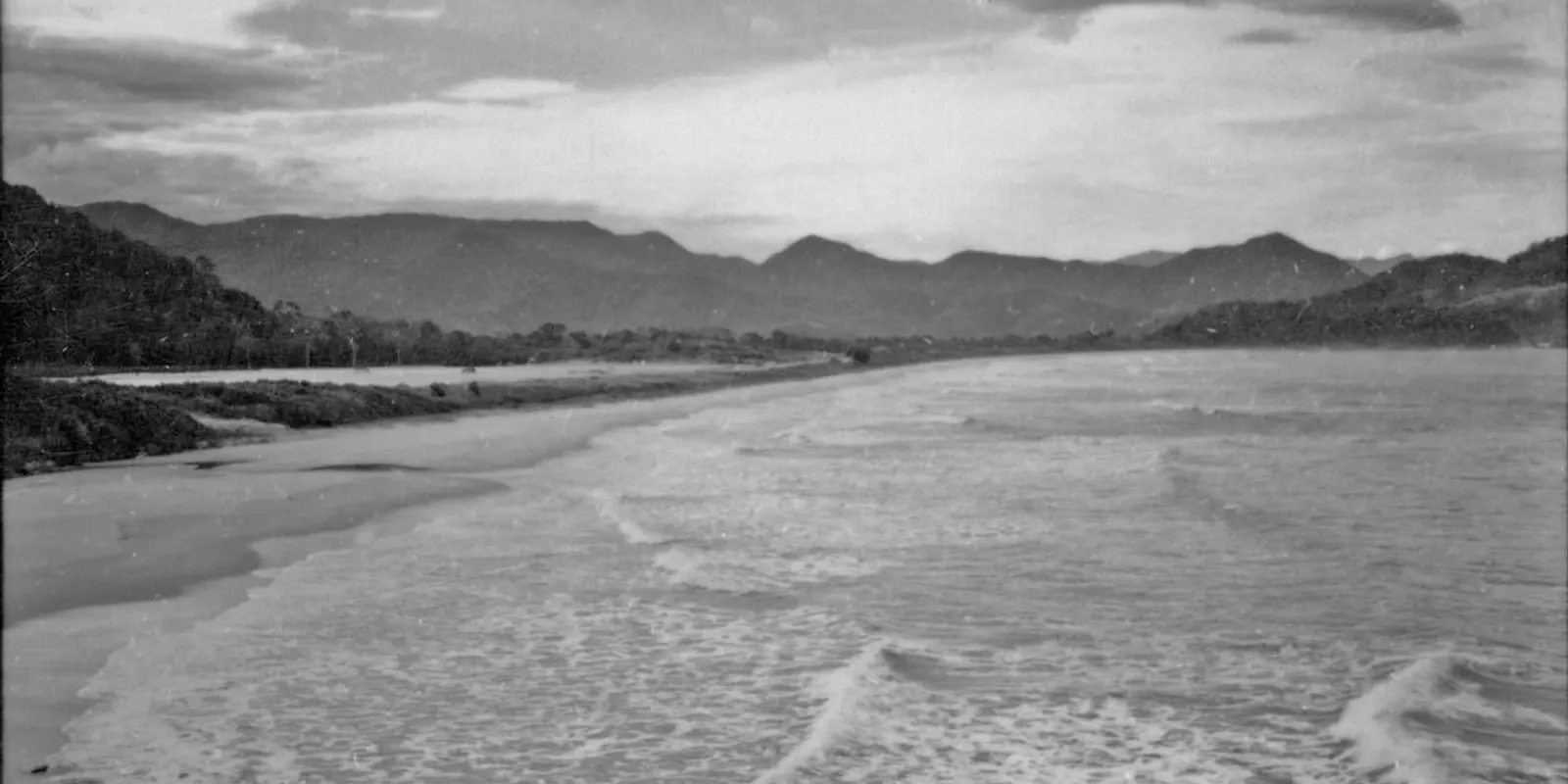
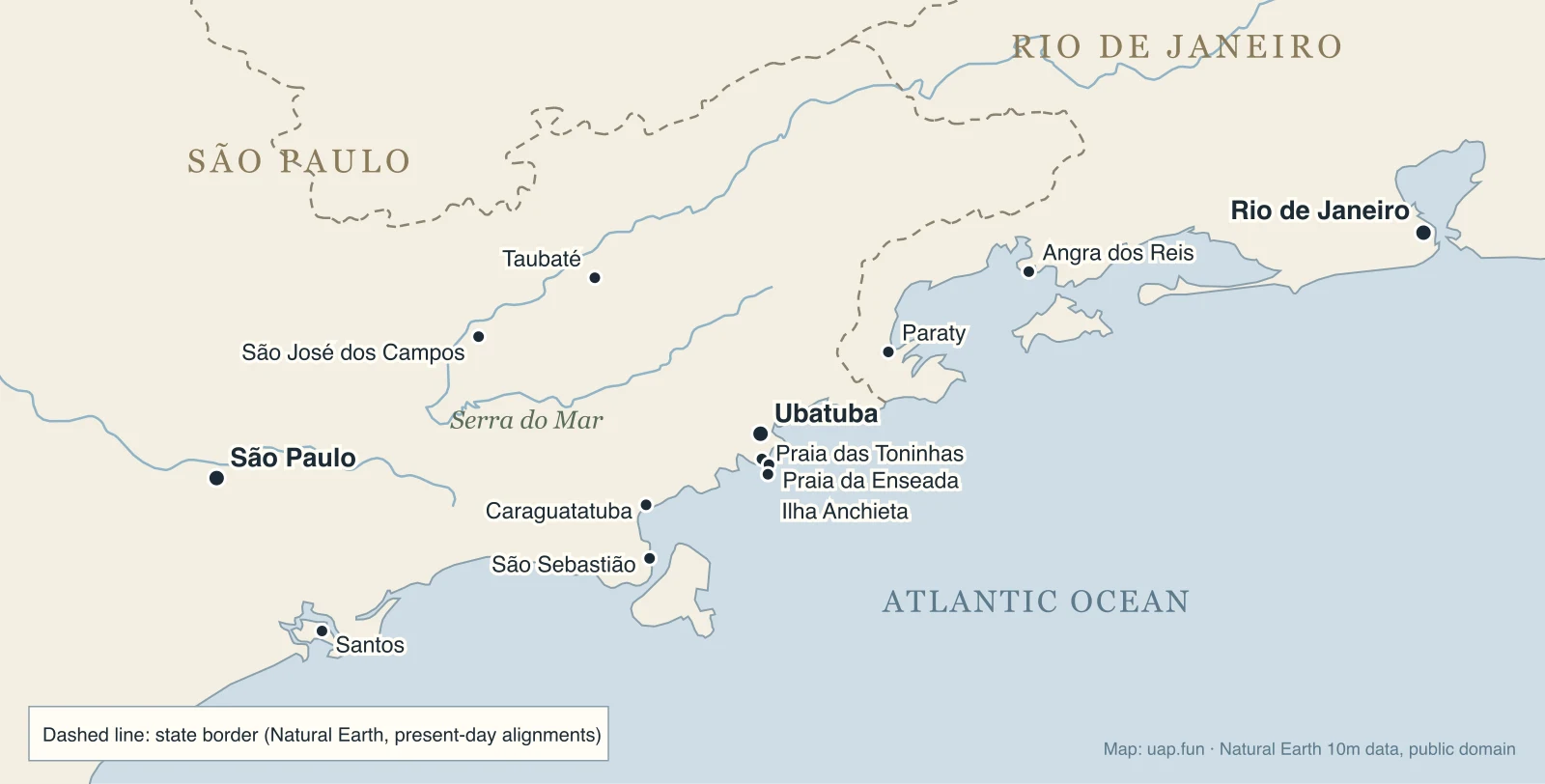
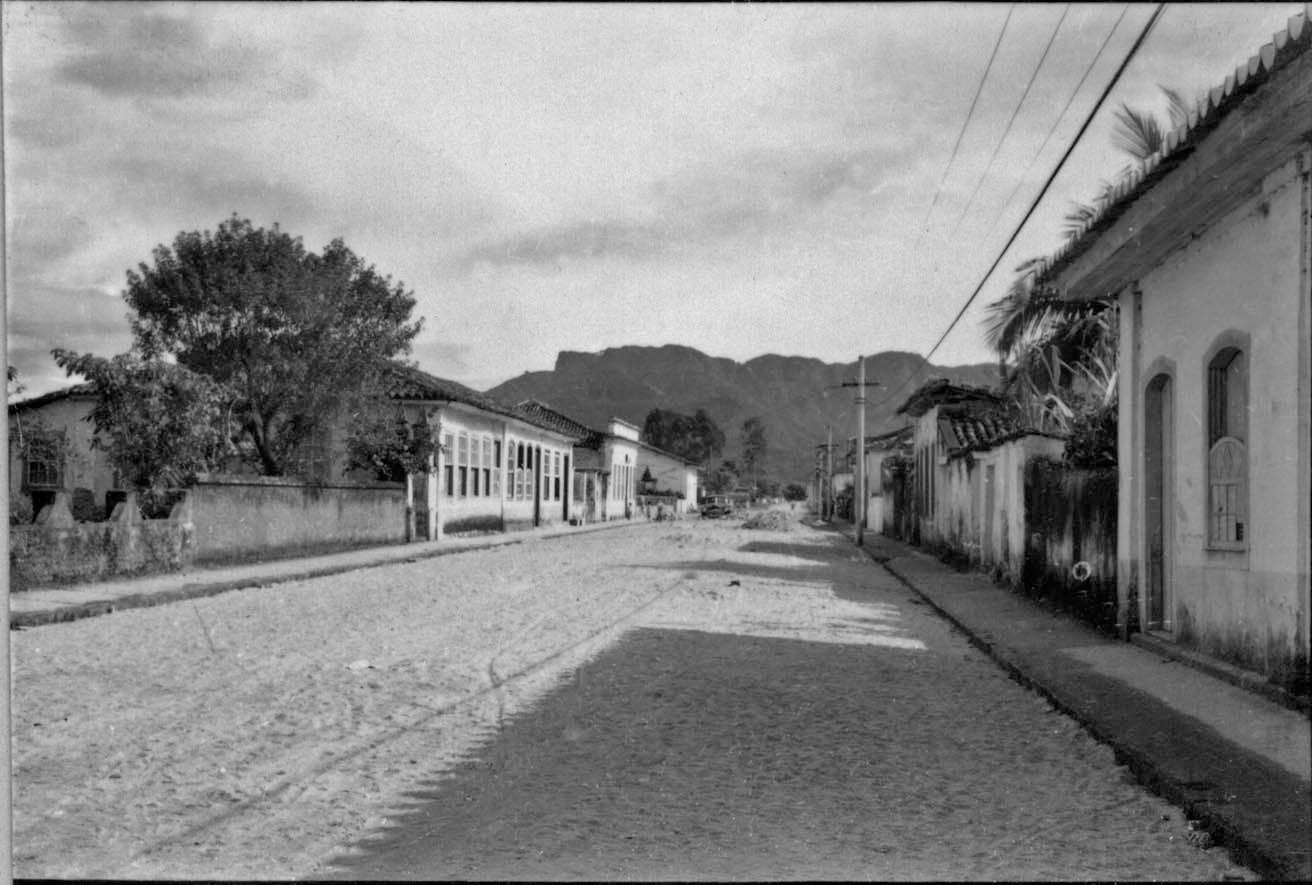
In 1957 Ubatuba was a place you reached on purpose. The old colonial port on the north coast of São Paulo state had been founded around 1600 on the Tamoio coast and was briefly rich on Paraíba valley coffee in the 1800s. By 1957 it was a municipality of some eight thousand people (7,941 at the 1950 census) spread over 650 square kilometers of beaches, islands and rain forest, and the 1940 count had put only about a thousand of them in the town itself. The one road in climbed over the Serra do Mar from Taubaté: 91 kilometers of dirt and stone, opened in 1933, partly built by convicts from the island prison on Ilha Anchieta, and not asphalted until 1969. An agronomist posted there remembered the trip as “uma aventura,” two buses a day sharing the track with banana trucks. The state had declared Ubatuba an estância balneária, a seaside resort, in 1948, and modern houses had begun to go up along the town beach, but Praia das Toninhas, a few kilometers south, was still “just mountains and beaches” in the late 1950s, according to a woman who walked home across it. The coastal highway that now runs from Rio to Santos was two decades away. Offshore, the Ilha Anchieta prison had closed in 1955, three years after a bloody mutiny, and on April 10, 1957, a Real Aerovias DC-3 bound from Rio to São Paulo lost an engine in rain over the bay and flew into the island’s Pico do Papagaio, killing 26 of the 30 people aboard. That crash, the one aerial catastrophe everyone in Ubatuba remembered from 1957, would return to the story decades later.
Sources: Sinopse Estatística do Município de UbatubaUbatuba, São Paulo: histórico e formação administrativaUbatubaA Rodovia Oswaldo CruzOn Events Possibly Related to the “Brazil Magnesium”Acidentes aéreos no Brasil, 1957: Real Aerovias DC-3 PP-ANX, Ilha Anchieta, 10 de abril de 1957
Recebemos
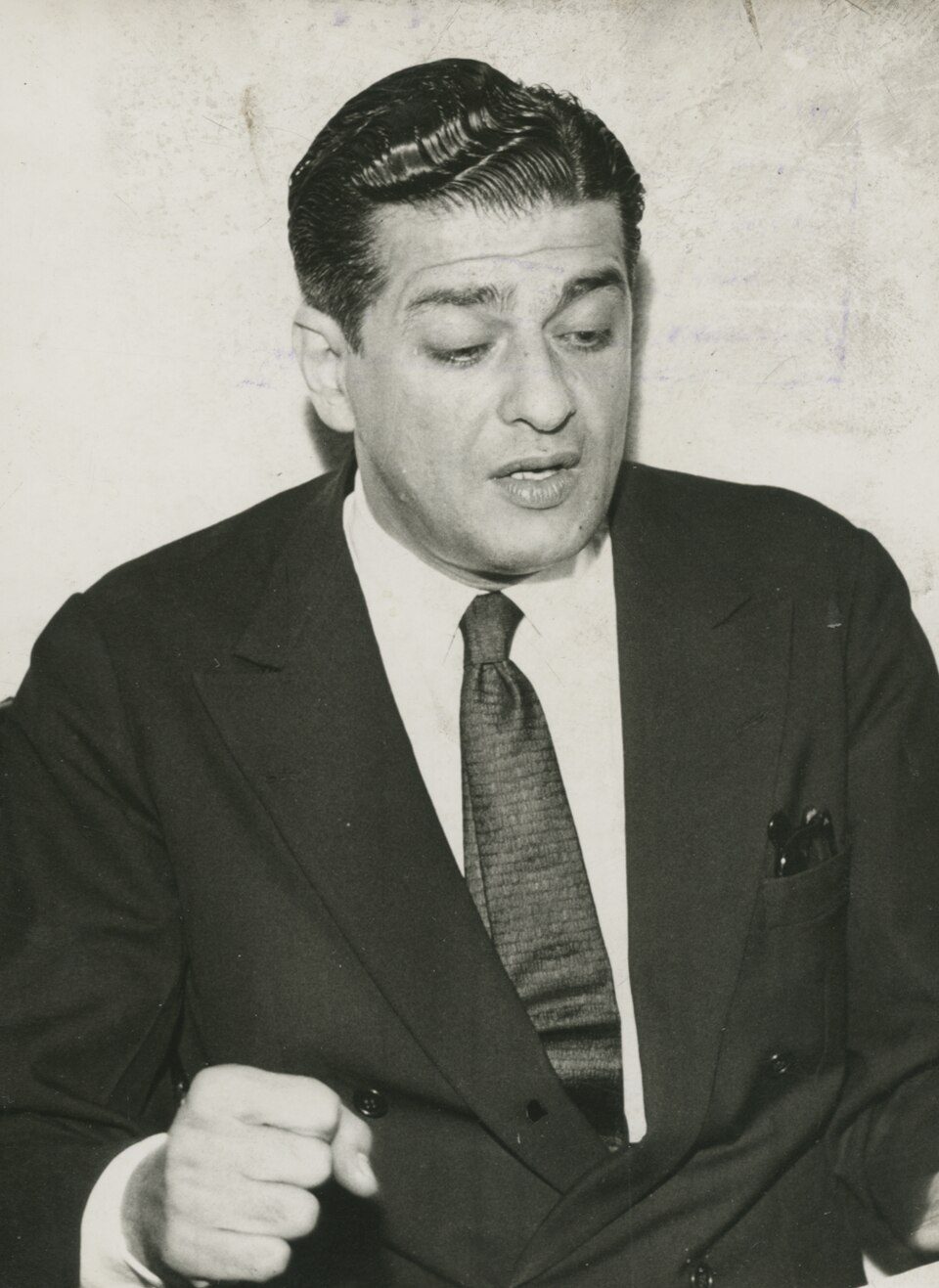
Ibrahim Sued was not a man anyone expected to break a flying-saucer story. The son of Lebanese immigrants, he had started as a freelance photographer and made his name with a single frame in August 1946, the congressman Otávio Mangabeira kissing General Eisenhower’s hand, which ran on the front page of O Globo and set off a crisis in Congress over the image of Brazilian servility. In August 1954 the paper gave him a column, and he announced that it would bring readers the Brazilian “Café Society” first-hand. Tall, green-eyed, cheerfully careless with grammar and foreign languages, he became the best-known society columnist in Brazil and kept the column for more than forty years. On Saturday, September 14, 1957, between the usual items, his column carried a heading that had nothing to do with champagne: “UM FRAGMENTO DE DISCO-VOADOR!” Beneath it Sued wrote one word, “RECEBEMOS,” we received, and printed a letter. “Prezado Sr. Ibrahim Sued,” it began. A faithful reader and admirer wanted to give him “um verdadeiro furo jornalístico,” a real scoop, about flying discs, “se é que acredita nos mesmos,” if he believed in them at all. The writer had not believed either, “até que, alguns dias atrás, perto de Ubatuba, em pescaria com vários amigos, vi um disco-voador!” It had come toward the beach at incredible speed, seemed about to plunge into the water, then rose “a um impulso fantástico.” As the friends watched, astonished, it exploded in flames into thousands of pieces that looked like fireworks, “apesar de ser doze horas, ou seja, meio-dia,” despite its being noon, with a very strong brightness. Most fell into the sea, but many small pieces fell near the beach, and the party gathered “um bom número dêsse material, tão leve que parecia papel,” a good quantity of material so light it seemed like paper. A small sample was enclosed, because the writer did not know whom to trust with an analysis; he had never read of a disc being recovered, unless the military had done so and kept it quiet. He was sending the letter in duplicate, to the newspaper and to Sued’s home. Sued closed the item in a line: from the admirer, signature illegible, he had received “detritos de um metal estranho,” fragments of a strange metal. That was all. The letter named no beach, no date and no witness, and its author was never heard from again.
Sources: Um fragmento de disco-voador!UFOs: A History, 1957: August–September, Supplemental NotesIbrahim Sued e o novo colunismo socialIbrahim Sued morre no Rio aos 72 anos
Three pieces on a table
One reader who did not take the item as a joke, or at least could not leave it alone, was Olavo Teixeira Fontes, a 33-year-old gastroenterologist at Rio’s National School of Medicine and the Brazilian representative of the Aerial Phenomena Research Organization, APRO, the civilian group run from Alamogordo, New Mexico, by Coral and Jim Lorenzen. Fontes had been writing up Brazilian sightings for APRO for years; within months he would be examining the farmer Antônio Villas Boas and sending the Lorenzens the strangest abduction story of the decade. “My first thought was the whole thing could be a joke or well planned hoax,” he wrote. He telephoned Sued the same day and was in his apartment four hours later. On the table lay “three small pieces of dull gray solid substance that appeared to be a metal of some sort,” their surfaces rough and apparently heavily oxidized, one of them “shot through with almost microscopic cracks, always longitudinal,” with a fissure running two thirds of its length, as if the piece had been torn from something larger. Patches of a fine whitish powder clung to all three like the ash on burned charcoal and could be scraped off with a fingernail. Sued had taken the stuff for lead because of its color, until he picked it up: it was lighter than aluminum, “almost as light as paper.” The columnist told Fontes he knew nothing about flying saucers, did not believe in them and was not curious about the samples, and let him take them, asking only to hear if anything unusual turned up. Fontes took only what was on the table. The duplicate letter, with its own enclosure, had gone to the O Globo office, and nobody ever retrieved it, an oversight later investigators would call unfortunate: of the original haul, three thumbnail-sized lumps are all that ever reached a laboratory. Fontes reasoned about his unknown correspondent the way a physician reasons about a patient. The letter was short on detail, which in his experience marked honest reports rather than hoaxes; the writer did not sound like a saucer enthusiast, since he had never heard of fragments being found; a publicity seeker would have called a press conference instead of mailing the evidence away to a gossip columnist. He kept the pieces for seven days, turning them over, before deciding where to send them.
Sources: A Report on the Investigation of Magnesium Samples from a UFO Explosion over the Sea in the Ubatuba Region of BrazilComposition Analysis of the Brazil MagnesiumOlavo Teixeira Fontes (in memoriam)UFOs: A History, 1958: January–February
Bulletin no. 15 001
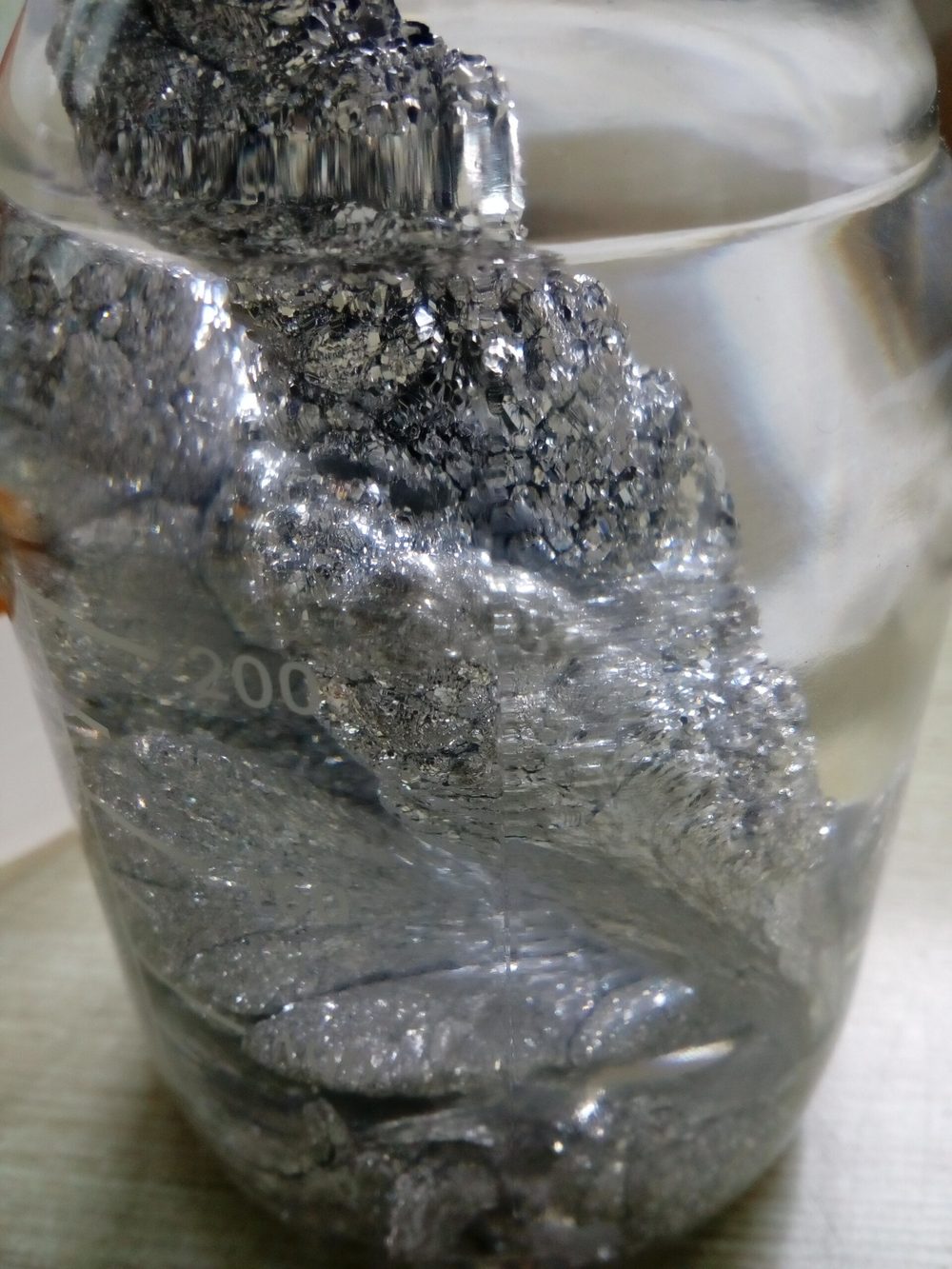
The laboratory Fontes chose was the best the Brazilian state had: the Laboratório da Produção Mineral of the National Department of Mineral Production in the Ministry of Agriculture, the official assay office for ores, metals and alloys. A friend introduced him to its chief chemist, Fritz Feigl, the Vienna-born inventor of spot-test analysis who had fled to Brazil in 1940. Feigl was busy with plastics and handed the pieces to an assistant, David Goldscheim, who thought they looked like meteorite fragments. “They are too light to be fragments of a meteorite,” Feigl objected; a lightweight metal, but not aluminum. A chip went into a test tube with phosphomolybdic acid and a few drops of hydrochloric acid; when the tube was warmed, bubbles rose and the liquid turned blue. Metal. The pieces were registered as “of unknown origin,” one of them was designated Sample 1 and broken up, and two chips of about 0.6 grams each went to the spectrographic section. Bulletin no. 15 001, dated September 24, 1957, protocol 571/57, provenance “Ubatuba – São Paulo,” sender “Dr. Olavo Fontes,” was signed by the chemist Luisa Maria A. Barbosa: “A análise espetrográfica revelou a presença de magnésio (Mg) em alta concentração e ausência de qualquer outro elemento metálico.” Magnesium, and no other metallic element. Fontes wanted more. On September 30 he spent an hour with Barbosa asking for the line data from her plate; she told him he had no authority to appraise her work and that a chemist would have been satisfied. She did explain the plate, five spectra, the sample on top, a chemically pure magnesium carbonate for comparison, three iron reference spectra, and confirmed that she had seen magnesium lines and nothing else, “not even the so-called ‘trace elements.’” A second spectrogram on October 24 by Elson Teixeira, a fifteen-year veteran of the laboratory with fifty thousand determinations behind him, by then in business but still allowed to use its instruments, went further: the metal was “absolutely pure,” its spectrum identical line for line with the pure salt, and even the manganese, iron, silicon and titanium that usually leak in from the carbon electrodes were absent. The X-ray crystallographers of the same department under Elysiário Távora Filho matched the powder diffraction pattern to the standard card for magnesium, found six faint extra lines that turned out to be magnesium hydroxide from the crust, and concluded the fragments were pieces of a casting; Távora, Fontes noted, would release numbers but refused to put any conclusion about origin in writing. One measurement nagged. A polished chip from the heart of Sample 1 came out, in three separate weighings on a Jolly balance, at a density of 1.866 against 1.741 for ordinary magnesium. A trapped fleck of hydroxide was the likeliest cause, Fontes admitted, but there was a more thrilling possibility: an excess of the heavy isotopes, magnesium-25 and -26, the slightly heavier atoms that make up about a fifth of any earthly sample, which, Fontes reasoned, no refinery on Earth would produce. A mass-spectrographic study, he wrote, could not be made in Brazil “for technical reasons.”
Sources: A Report on the Investigation of Magnesium Samples from a UFO Explosion over the Sea in the Ubatuba Region of BrazilUFOs: A History, 1957: August–September, Supplemental NotesPhysical EvidenceComposition Analysis of the Brazil Magnesium
The Army, the Navy and two men at half past six
Word travelled. On November 4, 1957, Major Roberto Caminha of the Brazilian Army called on Fontes, asked for a piece of the metal and took one away for analysis at the Army’s technological institute; Fontes was told a full investigation would follow and never heard another word. Some months later, by Fontes’s account, Commander J. G. Brandão of the Navy collected what he called the last piece of Sample 1, presumably for the arsenal’s spectrograph; no result came back from him either. Meanwhile João Martins, the O Cruzeiro reporter who with the photographer Ed Keffel had produced the Barra da Tijuca disc pictures of 1952, wrote the story up for the big illustrated weekly on November 16. He and Fontes went down to Ubatuba, in Lorenzen’s telling, to find the fishing party. They did not. The best they got, Coral Lorenzen reported in her postscript, was a fisherman who remembered a group of holidaymakers from an inland town who had talked excitedly of an explosion and shown round pieces of a grey substance. On November 30 Fontes mailed his report to Alamogordo, and before the year was out the surviving pieces followed it north. Then came the visit he would describe, in a letter to the Lorenzens, in the most quoted pages he ever wrote. On the morning of February 14, 1958, Fontes had been allowed into the Navy Ministry to see the Trindade Island photographs, taken four weeks earlier from a Navy ship. At half past six that evening, with his nurse gone home, two men walked into his consulting room and showed Navy intelligence credentials. “You know too much about things you weren’t entitled to know,” one told him. “We don’t like that. Besides, your activities concerning those fragments you possess are very undesirable and might be dangerous to you. We would like to warn you to stop all your investigations connected with those fragments. We request also the samples in your hands to be delivered to us as soon as possible.” Fontes, by his own account, lost his temper and invited them to leave. The tone changed at once; the visit, they said, was unofficial, friendly, an exchange. For two hours they told him that every government knew the discs were craft from another planet, that six had crashed and been recovered, one in the Sahara, three in the United States, one in the British Isles and one in Scandinavia, with crews of dead “little men” between 32 and 46 inches tall, 80 centimeters to a little over a meter, and that the craft ran on rotating electromagnetic fields nobody could reproduce. “They exchanged their information for a small bit of our magnesium,” Fontes wrote. “They got only the sample they wanted.” Whatever one makes of the briefing, which reads today like a digest of the crashed-saucer literature of the early 1950s, Fontes never made clear whether the chip the visitors took was the one he recorded as Brandão’s or another; whatever the Navy took vanished as completely as the Army’s. A month later Fontes wrote to Richard Hall, a young American ufologist whose newsletter Satellite had just folded, that the Ubatuba metal had proved “absolutely pure (100.00 % in Mg),” and begged him to keep it secret: “There are very good reasons for it, as you will understand later.”
Sources: A Report on the Investigation of Magnesium Samples from a UFO Explosion over the Sea in the Ubatuba Region of BrazilFlying Saucers: The Startling Evidence of the Invasion from Outer SpaceUFOs: A History, 1958: January–FebruaryLetter from Olavo T. Fontes to Richard Hall, March 15, 1958On Events Possibly Related to the “Brazil Magnesium”Inventory of Material from the Files of the Late Dr. Olavos T. Fontes
APRO rests its case
In Alamogordo the fragments had a rough start. Soon after they arrived, the Lorenzens handed a portion to an Air Force spectrographic laboratory; the next day the operator reported that he had burned the whole piece in the arc without getting an exposed plate, and asked for another. APRO refused. Through a member who was a theoretical physicist at a national laboratory, later identified as Oak Ridge, they arranged a quieter analysis on September 18, 1958, on a two-meter spectrograph: magnesium, certainly, but with aluminum, silicon and iron somewhere between 100 and 1,000 parts per million, a hundredth to a tenth of one percent, nothing like the Rio plates. A colleague of the Lorenzens wrote that no commercial magnesium alloy looked anything like it and that such metal was “of no conceivable use for mechanical purposes, or for the conduction of electricity.” A flotation test at an Atomic Energy Commission laboratory, evidently the same one, gave a density of 1.7513, ordinary magnesium with a little oxide, and nothing was heard again of the heavy isotopes. For two and a half years APRO kept the whole affair out of its own bulletin. Then, in March 1960, it went public. “The object which exploded above the beach at Ubatuba, Brazil was made of 100% magnesium, which is not within the technology of our times,” the Bulletin declared. “APRO rests its case.” Coral Lorenzen wrote to Major Lawrence Tacker, the Air Force’s UFO spokesman, that APRO held “a portion of an extraterrestrial vehicle which met with disaster in the earth’s atmosphere,” and offered it for examination by scientists acceptable to all sides; the press carried excerpts for three days. Tacker passed the matter to the Aerospace Technical Intelligence Center at Wright-Patterson Air Force Base, and relayed its request that APRO mail “a sample of the material and technical report concerning the Ubatuba Beach case,” adding that a search of the Air Materiel Command’s technical library had “failed to reveal the name of Mr. Ibrahim Sued, Dr. Olavo T. Fontes, or any of the persons mentioned.” APRO would not post its treasure to an office that had just explained a sighting over Biggs Air Force Base in Texas as a meteor, to the Lorenzens’ disgust: “can we entrust our precious bits of pure magnesium to the U.S. mails?” The Lorenzens believed their home telephone was being monitored during those weeks, that an editor in Kansas City had killed the Associated Press version of their release, and that someone had opened Coral’s personnel file at Holloman, where she had held a secret clearance as an Air Force employee. The public shrugged. Lorenzen coined a word for it, “Brinksterism”: people wanted the facts until they were confronted with them. The one company that did get a piece in those years was the obvious one. Dow Chemical of Midland, Michigan, drew its magnesium from seawater, and its metallurgists had looked at the fragments as early as 1958, Roy Craig later learned. In December 1961 R. S. Busk, research director of Dow’s Metal Products Department, sent Coral Lorenzen his analysis of part of Sample 2: calcium 100 parts per million, strontium 30, barium 30, and a couple of parts per million of manganese and copper. Not pure, then, but with an odd pair of passengers.
Sources: Flying Saucers: The Startling Evidence of the Invasion from Outer SpaceComposition Analysis of the Brazil MagnesiumIsotope Ratios and Chemical Analysis of the 1957 Brazilian Ubatuba FragmentPhysical EvidenceThe Physical Evidence StoryThe Midland Fireball: Dow Chemical’s Early Involvement with UFOs
Greenwich +3, fall 1957
When the Air Force hired the University of Colorado in 1966 to settle the UFO question under the physicist Edward Condon, the Lorenzens offered the project their magnesium, and the Ubatuba fragments became the most famous specimen the Condon Committee tested, and the only one it gave a case study of its own. The report disguised the place as “Greenwich +3, Fall 1957,” the way it coded every case, but everyone knew. Roy Craig, the physical chemist who handled it, started with the claim that mattered: was the metal purer than anything made on Earth in 1957? He wrote to Busk at Dow and went to see him; Busk told him the company had been supplying triply sublimed magnesium, metal purified three times over by vaporizing it in vacuum and condensing it again, on request for a quarter of a century, and sent a sample. Then, on February 5, 1968, Craig carried both specimens to a laboratory nobody could accuse of an interest in flying saucers, the Internal Revenue Service’s alcohol and tobacco tax laboratory, where Maynard Pro ran them through neutron activation, in which a sample is bombarded in a reactor until each trace element gives off its own telltale radiation, while Craig watched. A chip was broken from the main fragment, leached in hydrochloric acid until it gleamed, and irradiated. The Brazil metal carried 500 parts per million of zinc against 5 in the Dow sample, 35 of manganese against 4.8, 32 of chromium against 5.9, and two elements Dow’s metal did not contain at all: barium at 160 parts per million and strontium at 500. The report called the magnesium-26 isotope ratio normal. “The claim of unusual purity of the magnesium fragments has been disproved,” Craig wrote. Yet the strontium puzzled him. It was not an impurity magnesium picked up in production, and Busk knew of nobody who added it on purpose. Dow’s own microprobe found it spread evenly through the metal, in solid solution, and its metallographers saw “large, elongated magnesium grains” that had never been worked after solidifying, which made it “doubtful that this sample had been a part of a fabricated metal object.” A search of the Midland laboratory records closed the loop to Craig’s satisfaction: Dow had made experimental magnesium-strontium alloys from 0.1 to 40 percent strontium for years, including, on March 25, 1940, a 700-gram batch with nominally the same strontium content as the Ubatuba piece. Since only a few grams of the stuff existed and earthly technology could have made them, he concluded, the fragments “cannot be used as valid evidence of the extra-terrestrial origin of a vehicle.” Condon’s own summary went further, calling the metal “much less pure than the regular commercial metal” Dow made in 1957, a line Peter Sturrock later faulted, since the comparison sample had been triply sublimed, not commercial. Fontes did not live to read it. He died of cancer on May 9, 1968, a month short of his 44th birthday, three months before the magnesium had its day in Congress and eight before the report was published. APRO had already told its members, in its spring 1968 bulletin, that the American tests “verified” Fontes’s findings. At the House symposium on UFOs of July 29, 1968, James Harder of Berkeley, an APRO consultant, told the committee there was “only one well-authenticated finding” of UFO fragments, in Brazil, read out the Colorado numbers, and declared the metal “of extraordinary purity, certainly far beyond the capacity of fishermen at Ubatuba to produce.” Robert Baker asked whether it could have been made on Earth. Harder conceded that Dow made magnesium purer than this, then pointed to the “very curious” zinc, strontium and barium. Carl Sagan asked whether a magnesium flare had been compared. “It would hardly be 99.9 percent purity,” Harder said.
Sources: Scientific Study of Unidentified Flying Objects, Section III, Chapter 3: Direct Physical EvidenceScientific Study of Unidentified Flying Objects, Case 4: Magnesium Fragment (“Greenwich +3, Fall 1957”)Composition Analysis of the Brazil MagnesiumStatement of Dr. James A. Harder, Symposium on Unidentified Flying Objects, House Committee on Science and Astronautics, July 29, 1968Symposium on Unidentified Flying Objects: General DiscussionOlavo Teixeira Fontes (in memoriam)Ubatuba Case Mentioned in Trade MagazineInventory of Material from the Files of the Late Dr. Olavos T. Fontes
Castings, creep and the man from Fishkill
APRO did not accept the verdict. In 1969 the Lorenzens handed what magnesium they had left to Walter W. Walker, an associate professor of metallurgical engineering at the University of Arizona in Tucson, where APRO had moved, for the first structural rather than chemical study: microhardness, X-ray diffraction, etch pits, grain orientation, and creep tests, which measure how slowly a metal stretches under load when hot. Walker, with a doctoral fellow and a second APRO metallurgy consultant who did not know him, Robert W. Johnson of the Materials Research Corporation in New York, reported that the fragments were “directionally solidified castings,” metal grown with its coarse grains all aligned, a technique Walker said had not been under study in 1957, and that the material resisted high-temperature creep far better than ordinary magnesium. “Nowhere in our present technology is there a use for oriented, cast, coarse-grained metals such as observed in this study,” they wrote; and of Condon’s remark that the piece was unworked and therefore no part of a fabricated object, “the entire foundry industry in the United States might take exception.” APRO’s press release of September 19, 1970, called the Ubatuba magnesium “the only physical evidence known to exist which indicates an extraterrestrial origin for some UFOs.” Metallurgists in Britain were unmoved. Asked by BUFORA to review the work in 1971, K. A. Ridal of British Steel, reviewing the findings with J. Whiteman of Sheffield University, found “nothing unusual” in large columnar grains, “the natural mode of solidification of pure magnesium,” and called it “simply incorrect to deduce that this structure results from any special technology.” John Harney of the Merseyside UFO Bulletin reached a harsher conclusion that June: given the money and expertise lavished on it, the Ubatuba affair “must be regarded as one of the most successful hoaxes in the history of ufology.” The specimens themselves led restless lives. In 1978 or 1979 the Lorenzens lent the very piece the Colorado Project had analyzed to a journalist, Harry Lebelson, who took it to Robert Ogilvie of the metallurgy department at MIT. Ogilvie’s finding, published in OMNI in November 1979, was that the metal matched magnesium welding stock and that its oxide network could only have formed by holding it near melting point in air for a minute or so, which made it “quite possible that the specimen from Brazil was a piece of weld material from an exploding aircraft or a reentering satellite.” In 1984, Ogilvie later told Sturrock, Lebelson telephoned to say someone would collect the specimen on his behalf; a man duly appeared, said he worked at the IBM plant in Fishkill, New York, and left with the magnesium, without a receipt, a name or a check of his credentials. Lebelson denied making any such call. The Condon fragment has not been seen since. When Coral Lorenzen telephoned the ufologist Robert Barrow in May 1987 for help in tracing the missing piece, she was still trying to find out what had happened to it.
Sources: APRO’s New Findings on Ubatuba MagnesiumAPRO press release on the Ubatuba magnesium, September 19, 1970Ubatuba Magnesium: UFO Fragments?The Search for Physical Evidence, Part 3: The Ubatuba MagnesiumComposition Analysis of the Brazil MagnesiumCoral Lorenzen and the Ubatuba UFO Fragments
Sputnik Zero and the Solikamsk sample
The man who gave the magnesium its second scientific life was Peter Sturrock, a Stanford astrophysicist who had become interested in the Condon Report in 1976. With the Lorenzens’ cooperation he sent a piece to Gerald Wasserburg’s meteorite laboratory at Caltech, where Typhoon Lee and D. A. Papanastassiou measured the isotopes, reporting in October 1976, to a precision of four parts in ten thousand: terrestrial magnesium, its light and heavy atoms shifted slightly, as heating would shift them, and nothing more. Sturrock wrote to Jim Lorenzen in January 1977 that the isotopic comparison was indistinguishable from normal magnesium. He kept going. A NASA laboratory at the Johnson Space Center in Houston, offered after the Carter White House asked NASA in 1977 whether it would look at UFO evidence, reported in 1981 that the sample was “essentially pure magnesium,” on an old instrument Ogilvie dismissed with “I’m afraid their system isn’t very good.” Ogilvie himself offered a theory with a certain Cold War charm: a Soviet satellite launched a month before Sputnik had failed to reach orbit and come down off Ubatuba, “Sputnik Zero,” which would explain the interest of the military. Sturrock tested it. A Kharkov researcher assured him no such launch had existed, and in 1999 he obtained 1950s magnesium from the Solikamsk works in the Urals and a scrap of alloy from a MiG; the Solikamsk metal carried no strontium or barium at all, the MiG alloy only traces. In 1986 Jean-Jacques Velasco of the French space agency CNES arranged a secondary-ion mass spectrometry run at the Pierre and Marie Curie University in Paris, which found isotopes within two parts per thousand of normal and, like Colorado, strontium at 700 parts per million, with calcium at 8,500. In 1987 the Lorenzens transferred ownership of the remaining specimens to Sturrock, who gave them new labels, SU-A to SU-J, because APRO had kept no systematic record and nobody could say which chip had been Fontes’s Sample 2 or 3. In 1997 he commissioned the most sensitive analyses yet, time-of-flight secondary-ion spectrometry at Charles Evans and Associates and laser-ablation plasma mass spectrometry at Elemental Research in Vancouver, two techniques that vaporize a speck of the sample and weigh its atoms one element at a time, alongside Dow, Alfa and National Institute of Standards and Technology reference samples and sand Kaufmann obtained for him from two Ubatuba beaches, recorded as Anchieta and Enseada. The results, published in the Journal of Scientific Exploration in 2001, were consistent and slightly strange. In bulk the Brazil pieces held calcium at 3,000 to 5,000 parts per million, strontium at 600 to 900 and barium around 300, all three from magnesium’s own column of the periodic table, with titanium, lithium and boron besides; strontium appeared in none of the reference magnesiums and barium in only one, at 15 parts per million. The isotopes were terrestrial. The surfaces carried a zoo of elements, among them palladium, niobium, yttrium and cobalt, that are hard to explain as beach contamination. Dow’s and Battelle’s magnesium experts told Sturrock the strontium “would have to have been added,” and that nobody in the industry did. His verdict was double-edged: “there is no case for believing that the Brazil magnesium specimens had an extraterrestrial origin. On the other hand, it has not proved possible to identify where the material was produced.” At Sturrock’s request Ibrahim Sued, 28 years on, used his column of August 21, 1985, to ask the writer of the letter to come forward. Nobody did.
Sources: Composition Analysis of the Brazil MagnesiumInventory of Material from the Files of the Late Dr. Olavos T. FontesIsotope Ratios and Chemical Analysis of the 1957 Brazilian Ubatuba Fragment
What Ubatuba remembered
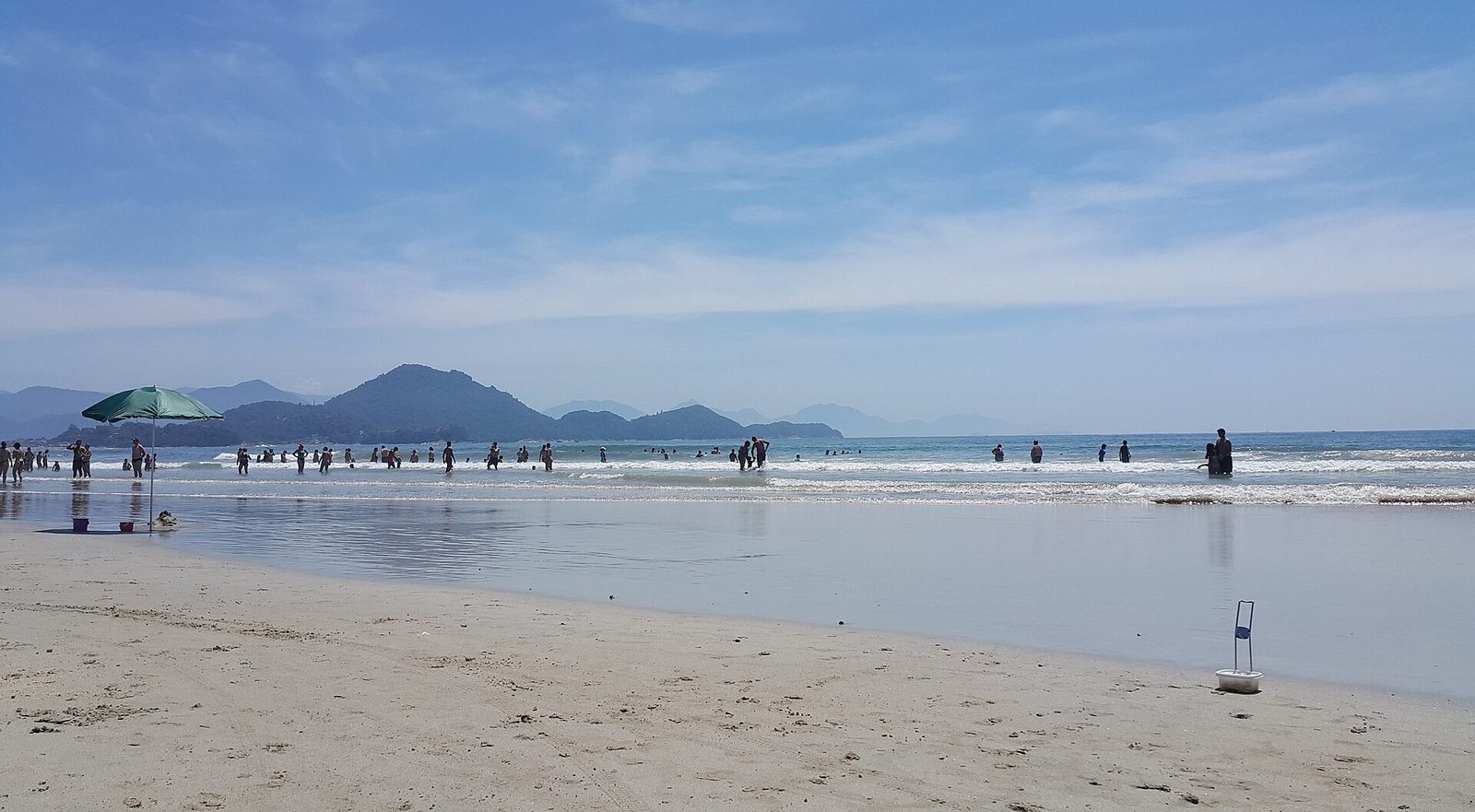
The Colorado Project never sent anyone to Brazil. Sturrock did, with Pierre Kaufmann, a radio astronomer at the Mackenzie Presbyterian University in São Paulo who had translated the letter and was the first investigator to weigh its Portuguese as evidence: the Portuguese was too good for a fisherman, the writer knew Sued’s home address, and O Globo was a Rio paper that “was hardly read outside Rio, and probably not read at all in Ubatuba.” In March 1982 the two visited the town, and Kaufmann returned again and again through 1990, with results he and Sturrock published in 2004. The first thing the hotel staff recalled from 1957 was the Real Aerovias DC-3 on Ilha Anchieta. The other memory the town offered was older. Washington de Oliveira, pharmacist, former mayor and the town’s unofficial historian, had never heard of anything in 1957, but in 1933 or 1934 he and a dentist friend had watched a white object about as bright as a half moon whistle overhead from north to south, vanish behind the hills toward the island, and fifteen or twenty seconds later shake the town with an explosion that rattled his father’s crockery. A fish-shop owner on Enseada beach, Eduardo Graça, had been told by his fisherman uncle that in those same years a strange light-brown “rock,” 20 centimeters across and far too light, had come up in a beach-seine net off the island and been handed to the prison director, who took it to a laboratory in São Paulo. A Harvard meteor specialist consulted by Sturrock was puzzled: a bolide, an exploding fireball meteor, still blazing that low would have to weigh several tons and should have left a crater or a great wave, unless, as the authors suggested, it burst in the air over the island. Only one person claimed to have seen anything in the 1950s. Maria de Lourdes, interviewed in January 1990 and already filmed by a Japanese television crew, said that one moonless night between 1955 and 1959, walking her drunk brother home from Enseada across the deserted sands of Toninhas between two and three in the morning, she had seen a huge, spinning, egg-shaped object “brighter than the sun” descending over the sea toward Anchieta, which turned white, burst in complete silence and showered the bay with glowing debris. Her nephew, a São Paulo doctor, had heard the story from her and from an uncle, who he believed had telephoned the Air Force’s technical center at São José dos Campos, which sent men to collect metal; she said no such call was made. Yet the Air Force thread held up on its own. Brigadier Hugo de Oliveira Piva, who had been at the Centro Técnico de Aeronáutica in 1957, told Kaufmann he clearly recalled samples of unusually pure metal being analyzed there that year, brought in by someone, one other former CTA scientist had some memory of a metal fragment arriving, and a third recalled a piece run through the spectrograph and found to be magnesium. David Goldstein of the Brazilian Academy of Sciences, who had worked at the laboratory in 1957 and was evidently the man Fontes called Goldscheim, remembered Fontes saying he had the pieces from fishermen. And a 72-year-old lifelong resident, who knew nothing of any 1957 event, mentioned that his younger brother had once invented a flying-saucer sighting to impress the engineers building the new road, and been too ashamed to take it back. Kaufmann and Sturrock laid out four possibilities: holidaymakers from the cities who really saw something explode; a Rio visitor who was shown strange metal and attached a story to it; an insider at the CTA who leaked a sample to publicize it; or “a well-staged hoax.” They did not choose.
Sources: On Events Possibly Related to the “Brazil Magnesium”Composition Analysis of the Brazil Magnesium
Five milligrams in a clean room
The newest chapter was written by people who wanted to know, once and for all, what the trace elements had to say. Isotope ratios are the nearest thing to a passport for a lump of metal: the proportions of strontium-86 to strontium-88, or of the barium isotopes, vary within narrow limits on Earth, and material formed elsewhere in the solar system might not match. In 2017 Michael Swords of the Center for UFO Studies, who had gone through Roy Craig’s papers at Texas A&M in 2008, obtained a piece from Sturrock, and Robert Powell of the Scientific Coalition for UAP Studies arranged the tests. Cerium Laboratories in Austin, Texas, an accredited laboratory known in the nanotechnology field, took the job: in a class-1 clean room they stripped 50 angstroms, a few atomic layers, from the surface, dissolved 5.7 milligrams and ran it through a high-resolution plasma mass spectrometer. Four university laboratories then declined to run a verification once they learned what the sample was supposed to be, so the dissolved solution went to a second commercial laboratory, in Cleveland, in 2018. The magnesium came out at about 79.3 percent magnesium-24, 10 percent magnesium-25 and 10.6 to 10.9 percent magnesium-26, against nominal values of 79.0, 10.0 and 11.0; Cleveland’s figures sat on the line along which terrestrial magnesium varies, Austin’s fell off it, which the authors put down to a measurement error. The trace elements were less tidy: both laboratories found isotope distributions outside normal terrestrial values, but they did not agree with each other, and the authors, writing in the Journal of Scientific Exploration in 2022, called the trace-element results “inconclusive.” Going through Craig’s original files in 2008, Swords had also found that the 1968 neutron-activation report had actually returned a magnesium-26 figure of 14.3 percent, well above normal, which the report described as reasonable agreement; a later reviewer traced it to a weighing slip, the weight of the wrong prepared sample, and the corrected figure would be a still less normal 23.1 percent. The 1968 isotope result is best set aside. Every modern measurement agrees on the metal itself: magnesium of about 99.88 percent purity, with strontium, barium, zinc and copper the main passengers. “It is still a mystery,” the 2022 paper concludes, “as to how high purity magnesium with the addition of strontium impurities showed up at a Brazilian newspaper office in 1957.”
Sources: Isotope Ratios and Chemical Analysis of the 1957 Brazilian Ubatuba FragmentAnalysis of the “Ubatuba” Material by Robert PowellComposition Analysis of the Brazil Magnesium
Lighter than aluminum
Few UFO artifacts have travelled as far from their origin as this one. Coral Lorenzen’s books carried Fontes’s report and its “absolutely pure” magnesium to a generation of readers in 1962 and 1966; Harder repeated it to Congress; David Saunders, the Colorado psychologist Condon fired, argued in his 1968 book that the absence of mercury, which a vacuum sublimation would leave behind, meant the metal was pure in the sense that nothing in it was there by accident. Paul Hill, a NASA engineer, built the density of 1.866 into an argument for pure magnesium-26 that outlived every measurement to the contrary. In Brazil the story grew a beach, Toninhas, a date, September 7, a crowd of bathers who saw the disc, soldiers who collected debris, and a local resident who mailed the letter, none of which the letter contains. In 2016 a ufologist from the Santos coast, Edison Boaventura Jr., received four fragments by post from a man who said his father had been an Army soldier involved in the case, and had them tested at a University of São Paulo laboratory; a museum in Victoria, Argentina, displays fragments it attributes to the case. Jacques Vallée, who has worked with Garry Nolan of Stanford on the isotopic forensics of claimed UFO materials, reported in 2018 that one such Argentine specimen attributed to Fontes gave normal magnesium ratios while another, from a sailor, did not; and the Ubatuba fragments became a staple of Nolan’s interviews in the early 2020s, beginning with Lex Fridman’s podcast. The strange thing is that the original question has never been answered. The metal is real, nearly seventy years old at least, and unlike any product anyone has been able to name: purer than scrap, laced with strontium and barium that no reagent would carry, grown in coarse oriented grains that Dow’s people recognized as a casting and a Sheffield metallurgist recognized as magnesium simply doing what magnesium does when it cools. Someone in Rio who read gossip columns and wrote excellent Portuguese put it in two envelopes. Fontes thought the man was either a mischievous hoaxer or someone who had stumbled on history without understanding it, and leaned to the second. Sturrock, after a quarter century, could only say the fragments were not from another world and could not be shown to be from this one. Almost everyone who has held them has lost a piece: to an arc lamp, to the Navy, to the Army, to a stranger from Fishkill.

Sources: Flying Saucers: The Startling Evidence of the Invasion from Outer SpaceUFOs? Yes! Where the Condon Committee Went WrongThe Ubatuba Magnesium and the Isotope RatioThe Search for Physical Evidence, Part 3: The Ubatuba MagnesiumDisco voador explode em praia do Litoral e EUA está investigando o casoA Catalogue of Reported Fragments and Residues Associated with UAP, version 2.3UFO explosion fragments from Ubatuba, Brazil | Garry Nolan and Lex FridmanComposition Analysis of the Brazil MagnesiumUma explosão em Ubatuba
What survives
The physical evidence is a few grams of grey metal, of which pieces were lost to an arc lamp, to the Brazilian Army and Navy and to a stranger at MIT; what remains passed to Stanford in 1987 as specimens SU-A to SU-J, without any record of which had been Fontes’s Sample 2 or 3. Powell and Swords dissolved 5.7 milligrams of one in 2017. The documentary record is better than the custody: the O Globo clipping and the laboratory’s bulletin no. 15 001 survive as photostats from Fontes’s own files, reproduced by Loren Gross; Fontes’s 1957 report, with the translated Barbosa and Teixeira reports and the X-ray tables, was printed in full by Coral Lorenzen; the APRO Bulletins of 1960 and 1970 and the 1970 press release are online; the Condon Report’s chapter and Case 4 give the neutron-activation table; the 1968 congressional transcript records Harder, Baker and Sagan; Sturrock’s 2001 paper tabulates the analyses from 1958 to 1999 and reconstructs the chain of custody; Kaufmann and Sturrock’s 2004 paper preserves the Ubatuba interviews; and the 2022 paper gives the modern isotope ratios with confidence intervals. Craig’s working files are at Texas A&M, Fontes’s at the Sign Historical Group. The things that do not survive are the ones that would settle the case: the duplicate letter and its enclosure at the O Globo office, the Army’s and Navy’s results, the Barbosa and Teixeira plates themselves, and any witness.
Sources: Composition Analysis of the Brazil MagnesiumUFOs: A History, 1957: August–September, Supplemental NotesA Report on the Investigation of Magnesium Samples from a UFO Explosion over the Sea in the Ubatuba Region of BrazilIsotope Ratios and Chemical Analysis of the 1957 Brazilian Ubatuba FragmentInventory of Material from the Files of the Late Dr. Olavos T. Fontes
The contradictions
The purity figures are irreconcilable because they measured different things with different tools: Barbosa and Teixeira saw no impurity lines on a 1957 arc spectrograph compared against a “chemically pure” salt; Oak Ridge in 1958 found aluminum, silicon and iron in the hundreds of parts per million; Dow in 1961 found calcium, strontium and barium; Colorado in 1968 found zinc and strontium at 500 parts per million; the modern consensus is roughly 99.88 percent magnesium. Sturrock pointed out that even Fontes’s own ASTM reference contained 0.1 percent calcium that the Hilger instrument should have detected, and wondered whether the Rio spectrograph was malfunctioning, the analysts were having a bad day, or the laboratory was withholding something. The density runs from 1.866 in Rio to 1.7513 in the United States. The Colorado magnesium-26 result was reported as normal and turns out to have read 14.3 percent; a later check found the laboratory had used the weight of the wrong prepared sample, and the corrected figure would be 23.1 percent, so the 1968 isotope result is simply unusable. The chain of custody contradicts itself: Fontes wrote that he sent a prism cut from Sample 2 to Alamogordo, Sturrock that the remnant of Sample 1 and Samples 2 and 3 all went, APRO that Colorado received “No. 3,” and Patrick Gross that Fontes kept the third piece. Harder told Congress the Colorado piece was flown to California; it went to Washington. Condon’s Case 4 says the letter writer was a fisherman and the pieces fell into shallow water, neither of which the letter says. Fontes dated the column September 14, 1957; later retellings date the letter’s arrival to the 13th; Brazilian retellings have invented event dates of September 7 and 14 and a beach, Toninhas, that first appears in interviews of 1986 and 1990, published in 2004. Fontes’s own report says the Navy commander took his piece “a few months later,” while his famous letter places two Navy intelligence officers in his office on February 14, 1958, trading tales of six crashed saucers for “the sample they wanted”; whether those are the same transaction is a matter of inference. And the only Ubatuba witness to any 1950s explosion described a night-time, silent, egg-shaped object, not a noon disc that exploded like fireworks.
Sources: Composition Analysis of the Brazil MagnesiumIsotope Ratios and Chemical Analysis of the 1957 Brazilian Ubatuba FragmentA Report on the Investigation of Magnesium Samples from a UFO Explosion over the Sea in the Ubatuba Region of BrazilScientific Study of Unidentified Flying Objects, Case 4: Magnesium Fragment (“Greenwich +3, Fall 1957”)Symposium on Unidentified Flying Objects: General DiscussionThe Ubatuba, Brazil, UFO explosion, 1957On Events Possibly Related to the “Brazil Magnesium”UFOs: A History, 1958: January–February
Explanations and objections
The prosaic reading, Craig’s and Harney’s, is that someone obtained a few grams of experimental or laboratory magnesium, possibly a strontium-doped research alloy of the kind Dow had cast since 1940, and sent it to a gossip columnist with a story; the illegible signature, the duplicate letter and the educated Portuguese fit a prank by someone in Sued’s own Rio circle as well as they fit a cautious witness. Against it stand the oddities the sceptics themselves found: strontium and barium that no magnesium maker used, surface traces of palladium and niobium, and the fact that nobody has ever matched the material to a product. Ogilvie’s weld-rod theory, with an exploding aircraft or re-entering satellite as the source, fits the oxide structure but not the composition, and the only 1957 crash Ubatuba remembered was the Real Aerovias DC-3, an aluminum airframe. The Sputnik Zero idea died with the Russian records and the Solikamsk sample. The Air Force technical center at São José dos Campos really does seem to have analyzed unusually pure magnesium in 1957, which supports both the honest version and the leaked-sample version. Walker and Johnson’s directional-solidification argument for an exotic origin was answered by metallurgists who regard columnar grains as what pure magnesium does on cooling. The extraterrestrial reading has always rested on purity, and every usable isotope measurement since, at Caltech, in Paris, at Stanford’s contractors and in the Cleveland laboratory of 2018, has returned terrestrial magnesium. What no explanation yet covers is the whole package at once: an unmatched alloy, a letter that reads true and a beach where nobody saw a thing.
Sources: Scientific Study of Unidentified Flying Objects, Section III, Chapter 3: Direct Physical EvidenceThe Search for Physical Evidence, Part 3: The Ubatuba MagnesiumComposition Analysis of the Brazil MagnesiumOn Events Possibly Related to the “Brazil Magnesium”Ubatuba Magnesium: UFO Fragments?Isotope Ratios and Chemical Analysis of the 1957 Brazilian Ubatuba Fragment
Classification and evidence note
This archive files Ubatuba as a crash report: the entire case is a claim that something exploded and left debris, and the debris is the only part of it anyone has examined. No close-encounter kind is assigned, because the sighting itself is known only from an anonymous letter and was never confirmed by a named witness. The resolution is partly explained: the central claim of the 1957–1960 literature, magnesium purer than anything made on Earth, was disproved by neutron activation in 1968 and by every analysis since, while the origin of the fragments, the identity of the writer and the event on the beach remain unknown. Quotations from the letter are given from the O Globo clipping in Fontes’s files; quotations from the laboratory reports, from Fontes, the Lorenzens, Craig, Harder, Walker, Ogilvie and Sturrock are from the published documents cited. Measurements are reported as each laboratory gave them, in parts per million. The article does not reproduce the clipping or the APRO Bulletin pages as images, since 1957 Brazilian newspaper material and APRO’s copyrighted bulletins are not free to use; the hero and street photographs are IBGE field-survey pictures of Ubatuba taken in 1958.
Sources: UFOs: A History, 1957: August–September, Supplemental NotesScientific Study of Unidentified Flying Objects, Section III, Chapter 3: Direct Physical EvidenceComposition Analysis of the Brazil MagnesiumIsotope Ratios and Chemical Analysis of the 1957 Brazilian Ubatuba Fragment
- 1933–1934
A bright object whistles over Ubatuba toward Ilha Anchieta and an explosion shakes the town; a fisherman later nets a strange, very light “rock” off the island.
- 10 APR 1957
A Real Aerovias DC-3 flying from Rio to São Paulo loses an engine over Ubatuba bay and crashes on Ilha Anchieta, killing 26.
- SEPT 1957 · “A FEW DAYS AGO”
According to the letter, a disc dives toward a beach near Ubatuba at noon, climbs and explodes into thousands of burning fragments.
- 14 SEPT 1957
Ibrahim Sued prints the letter in O Globo under the heading “Um fragmento de disco-voador!”; Olavo Fontes collects three pieces from his apartment that day.
- C. 21 SEPT 1957
After a week, Fontes delivers the pieces to the Mineral Production Laboratory in Rio, where Fritz Feigl’s spot test confirms a metal.
- 24 SEPT 1957
Bulletin no. 15 001: Luisa Maria A. Barbosa reports magnesium “em alta concentração” with no other metallic element.
- 30 SEPT 1957
Fontes spends an hour with Barbosa, who refuses a fuller report but walks him through the plate.
- 24 OCT 1957
Elson Teixeira’s second spectrogram finds the metal “absolutely pure,” without even the electrode contaminants.
- OCT–NOV 1957
X-ray diffraction identifies magnesium and a hydroxide crust; a polished chip gives a density of 1.866.
- 4 NOV 1957
Major Roberto Caminha of the Army takes a sample; its results are never disclosed.
- 16 NOV 1957
João Martins closes a weekly O Cruzeiro series written with Fontes; his search of Ubatuba for witnesses finds none.
- 30 NOV 1957
Fontes sends his report to APRO; the surviving pieces follow to Alamogordo before the year ends.
- LATE 1957 OR EARLY 1958
An Air Force spectrograph operator burns APRO’s first piece without obtaining a plate; Commander J. G. Brandão of the Navy takes the last chip of Sample 1.
- 14 FEB 1958
Two Navy intelligence officers visit Fontes, warn him off the fragments and talk for two hours about six crashed discs.
- 15 MAR 1958
Fontes tells Richard Hall of NICAP the metal is “100.00 % in Mg” and asks him to keep it secret.
- 18 SEPT 1958
A national laboratory, identified later as Oak Ridge, finds aluminum, silicon and iron in the hundreds of parts per million.
- MAR–MAY 1960
APRO goes public: “APRO rests its case.” In April the Air Force asks for a sample; APRO will not mail it.
- 15 DEC 1961
Dow Chemical reports calcium, strontium and barium in Sample 2.
- 5 FEB 1968
Roy Craig watches the neutron activation of a chip at the Internal Revenue Service laboratory in Washington.
- 9 MAY 1968
Olavo Fontes dies of cancer at 43.
- 29 JUL 1968
James Harder presents the magnesium to the House symposium on UFOs; Sagan and Baker question him.
- JAN 1969
The Condon Report: “The claim of unusual purity of the magnesium fragments has been disproved.”
- 19 SEPT 1970
APRO announces Walker and Johnson’s finding of directionally solidified castings.
- JUN 1971
John Harney calls the case “one of the most successful hoaxes in the history of ufology.”
- OCT 1976
Caltech finds the magnesium isotopes terrestrial.
- NOV 1979
OMNI reports Robert Ogilvie’s MIT verdict: possibly weld material from an exploding aircraft or re-entering satellite.
- MAR 1982
Kaufmann and Sturrock begin their inquiries in Ubatuba.
- 1984
A stranger claiming to be from IBM’s Fishkill plant collects the Colorado specimen from MIT; it is never seen again.
- 21 AUG 1985
Sued asks the letter writer to come forward in his column; no one answers.
- 1987
The Lorenzens transfer the remaining specimens to Sturrock.
- JAN 1990
Maria de Lourdes describes a silent night-time explosion over the bay in the late 1950s.
- 1997–2001
Sturrock’s laboratory program; the Journal of Scientific Exploration paper concludes the metal is terrestrial but unmatched.
- 2017–2018
High-resolution isotope analyses in Austin and Cleveland; published in 2022.
Sources & interviews
Um fragmento de disco-voador!Ibrahim Sued · O Globo, Rio de Janeiro, September 14, 1957 · clipping from Olavo Fontes’s files, reproduced in Loren Gross, UFOs: A History, 1957: August–September, Supplemental Notes, p. 21; Portuguese text also in Appendix 1 of Sturrock (2001) · Sign Oral History Project (PDF)A Report on the Investigation of Magnesium Samples from a UFO Explosion over the Sea in the Ubatuba Region of BrazilOlavo T. Fontes, M.D. · report to APRO dated November 30, 1957, printed in Coral Lorenzen, The Great Flying Saucer Hoax (1962) and Flying Saucers: The Startling Evidence of the Invasion from Outer Space (1966) · The Temporal Doorway, via the Wayback MachineFlying Saucers: The Startling Evidence of the Invasion from Outer SpaceCoral E. Lorenzen · Signet, 1966 · chapter 9 reprints Fontes’s report with the Lorenzens’ postscript on the Air Force laboratory and the Brazilian intelligence visit · Internet Archive (lending library)Letter from Olavo T. Fontes to Richard Hall, March 15, 1958NICAP · Fontes announces the “absolutely pure (100.00 % in Mg)” finding and asks that it be kept secretUFOs: A History, 1958: January–FebruaryLoren E. Gross · privately published, 1990s · pp. 53–58 on Fontes’s visit to the Navy Ministry and the two intelligence officers of February 14, 1958 · Sign Oral History Project (PDF)Physical EvidenceThe A.P.R.O. Bulletin, March 1960, pp. 1, 3 · APRO’s first public account of the fragments, with the Brazilian laboratory bulletins · Internet Archive (AFU scan)The Physical Evidence StoryThe A.P.R.O. Bulletin, May 1960, pp. 1–3, 8 · the Lorenzens’ letters to Major Tacker, the ATIC request for a sample, and the “Brinksterism” editorial · Internet Archive (AFU scan)Ubatuba Case Mentioned in Trade MagazineThe A.P.R.O. Bulletin, May–June 1968 · with the obituary of Olavo Fontes, who died on May 9, 1968 · Internet Archive (AFU scan)APRO’s New Findings on Ubatuba MagnesiumThe A.P.R.O. Bulletin, July–August 1970, pp. 1, 5 · Walter W. Walker and Robert W. Johnson’s metallurgical study · Internet Archive (AFU scan)APRO press release on the Ubatuba magnesium, September 19, 1970Aerial Phenomena Research Organization, Tucson · Internet Archive (AFU scan)Scientific Study of Unidentified Flying Objects, Section III, Chapter 3: Direct Physical EvidenceRoy Craig · University of Colorado, 1968 (Bantam, 1969, pp. 94–97) · the neutron-activation results and the Dow Chemical comparison · National Capital Area SkepticsScientific Study of Unidentified Flying Objects, Case 4: Magnesium Fragment (“Greenwich +3, Fall 1957”)Roy Craig · University of Colorado, 1968 (Bantam, 1969, pp. 391–396) · with Dow’s 1951 eight-sublimation analysis and D. R. Beaman’s microprobe report · Sign Historical Group, Project 1947Statement of Dr. James A. Harder, Symposium on Unidentified Flying Objects, House Committee on Science and Astronautics, July 29, 1968US Government Printing Office, 1968 · Harder presents the Ubatuba magnesium to Congress · Sign Historical Group, Project 1947Symposium on Unidentified Flying Objects: General DiscussionHouse Committee on Science and Astronautics, July 29, 1968 · Robert Baker and Carl Sagan question Harder on the magnesium · Sign Historical Group, Project 1947The Search for Physical Evidence, Part 3: The Ubatuba MagnesiumJohn Harney · Merseyside UFO Bulletin, vol. 4, no. 2, June 1971 · Internet ArchiveUbatuba Magnesium: UFO Fragments?A. R. Pace · Journal of Transient Aerial Phenomena (BUFORA), vol. 1, no. 2, March 1980, pp. 41–42 · with the 1971 Sheffield critique of Walker and Johnson and the 1979 MIT findings · Internet ArchiveUbatuba (Brazil) IncidentWalter W. Walker · in Ronald D. Story (ed.), The Encyclopedia of UFOs, Doubleday, 1980, pp. 374–375 · NICAPCoral Lorenzen and the Ubatuba UFO FragmentsRobert Barrow · notes of telephone conversations with Coral Lorenzen, May 6–12, 1987 · NICAPComposition Analysis of the Brazil MagnesiumPeter A. Sturrock · Journal of Scientific Exploration, vol. 15, no. 1, 2001, pp. 69–95 · the full chain of custody, the 1997 laboratory analyses and the isotope results · NICAP (HTML copy)On Events Possibly Related to the “Brazil Magnesium”Pierre Kaufmann and Peter A. Sturrock · Journal of Scientific Exploration, vol. 18, no. 2, 2004, pp. 283–291 · the Ubatuba inquiries of 1982–1990 · Internet Archive Wayback MachineIsotope Ratios and Chemical Analysis of the 1957 Brazilian Ubatuba FragmentRobert M. Powell, Michael D. Swords, Mark Rodeghier and Phyllis Budinger · Journal of Scientific Exploration, vol. 36, no. 1, Spring 2022, pp. 39–48 · CC BY-NCAnalysis of the “Ubatuba” Material by Robert PowellScientific Coalition for UAP Studies · YouTube, May 2020UFO explosion fragments from Ubatuba, Brazil | Garry Nolan and Lex FridmanLex Clips · YouTube, February 2022A Catalogue of Reported Fragments and Residues Associated with UAP, version 2.3Keith Basterfield · November 2018 · Ubatuba entry with Jacques Vallée’s 2016–2018 isotope work on two Argentine specimens · Project 1947Inventory of Material from the Files of the Late Dr. Olavos T. FontesSign Historical Group · the Ubatuba file: Dow, Internal Revenue Service and Colorado correspondence of 1961–1970, Sturrock’s letters of 1977–1978 · Project 1947The Midland Fireball: Dow Chemical’s Early Involvement with UFOsJoel Carpenter · Project 1947 · with Roy Craig’s recollection that Dow had examined the Ubatuba samples before 1968Uma explosão em UbatubaThiago Luiz Ticchetti · Revista UFO, April 1, 2007 · Portuguese retelling with the Brazilian laboratory chain and Walter Bühler’s verdictDisco voador explode em praia do Litoral e EUA está investigando o casoJeferson Marques · Diário do Litoral, Santos, December 29, 2022 · the version that places the explosion on Praia das Toninhas on September 7, 1957The Ubatuba, Brazil, UFO explosion, 1957Patrick Gross · UFOs at Close SightIbrahim Sued e o novo colunismo socialMemória Roberto Marinho, Grupo Globo · September 23, 2022 · Sued’s career from the 1946 Eisenhower photograph to the column he began on August 18, 1954Ibrahim Sued morre no Rio aos 72 anosFernanda da Escóssia · Folha de S.Paulo, October 2, 1995Acidentes aéreos no Brasil, 1957: Real Aerovias DC-3 PP-ANX, Ilha Anchieta, 10 de abril de 1957Desastres Aéreos · the Rio–São Paulo flight that struck the Pico do Papagaio on Anchieta Island, with 26 dead and four survivorsSinopse Estatística do Município de UbatubaInstituto Brasileiro de Geografia e Estatística, Rio de Janeiro, 1948 · the 1940 census and the town’s coordinates and area · IBGE Biblioteca (PDF)Ubatuba, São Paulo: histórico e formação administrativaInstituto Brasileiro de Geografia e Estatística · municipal history sheet (PDF)UbatubaWikipédia, a enciclopédia livre · population by census, the 1948 estância balneária status, the Ilha Anchieta prison (1908–1955) and the Rio–Santos highwayA Rodovia Oswaldo CruzCuriosidades de Ubatuba · the Taubaté–Ubatuba road over the Serra do Mar, opened in 1933 and paved only in 1969UFOs: A History, 1957: August–September, Supplemental NotesLoren E. Gross · Fremont, California, 2003 · pp. 21–23 reproduce the O Globo clipping of September 14, 1957, and the Mineral Production Laboratory’s bulletin of September 24, 1957, from Fontes’s own files · Sign Oral History Project (PDF)Olavo Teixeira Fontes (in memoriam)Biografia dos Ufólogos Brasileiros, SOCEX · April 9, 2006O magnésio de UbatubaJohn Harney, translated · Ceticismo Aberto, January 31, 2002 · the Portuguese edition of the 1971 Merseyside UFO Bulletin articleUFOs? Yes! Where the Condon Committee Went WrongDavid R. Saunders and R. Roger Harkins · Signet, 1968 · chapter on the Ubatuba magnesium · Internet Archive (lending library)The Ubatuba Magnesium and the Isotope RatioPaul R. Hill · Unconventional Flying Objects: A Scientific Analysis, Hampton Roads, 1995, section XVI · via the Wayback MachineSpotted an error, or know a better source? Write to hello@uap.fun.
Connected files
The Saturn over TrindadeThe photographs Fontes was shown at the Navy Ministry on the morning of the intelligence officers’ visit; the Navy’s inquiry into them was run by a Lieutenant Commander José Geraldo Brandão, apparently the J. G. Brandão who took Fontes’s last chip.The Fall on Height 611Another handful of metal fragments from a hillside, analyzed for decades by physicists who could not name their source.The Roswell IncidentFeatherweight debris that would not bend or burn, a decade earlier and a continent away.Sixteen Little Men at AztecThe crashed-saucer stories of the early 1950s that the Navy officers retold to Fontes.The Men in BlackTwo men with credentials, a warning, and a request for the evidence.Jacques ValléeThe researcher whose isotope work with Garry Nolan brought the Ubatuba fragments back into the conversation.Discuss this case
Compare notes with other readers: witness details, sources, and the parts that still do not add up.
Open the discussion