A dry district under a nervous sky
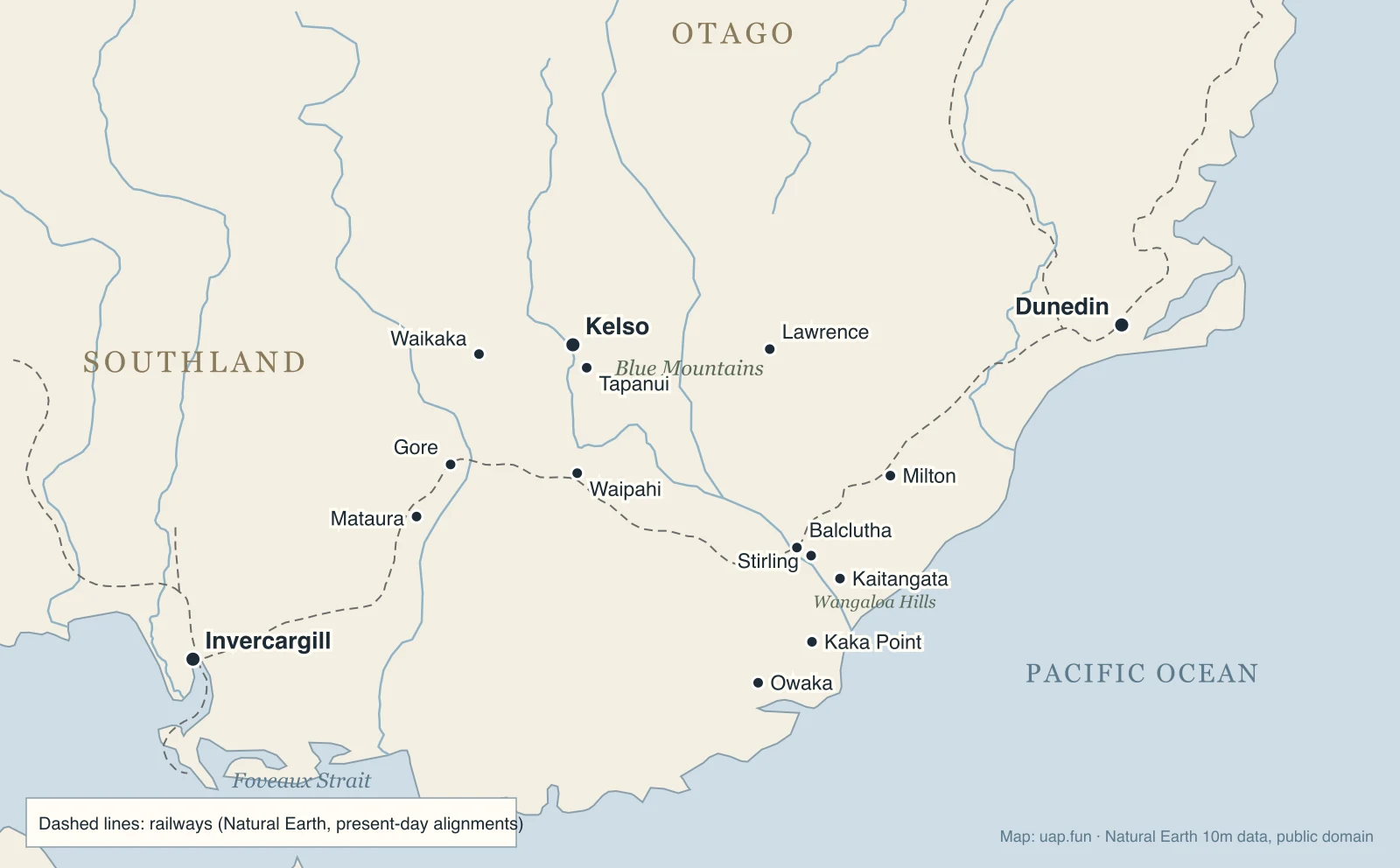
Kelso was a small railway township on the flats of the Pomahaka River in West Otago, six miles north of Tapanui, laid out in 1875 and named for the Scottish home town of one of its first settlers. Its school stood close under a wooded hill, and across the flats to the east rose the long wall of the Blue Mountains, the range the airship would be said to come from and go back to. It lay in the Clutha district, which had voted itself dry at a local-option poll in 1894, a fact every wit in the country would shortly find useful. The winter of 1909 was an anxious one for the Empire’s farthest colony. Britain’s newspapers had spent the spring in a “Dreadnought” panic over German naval building, and on March 22 New Zealand’s premier, Sir Joseph Ward, had telegraphed an offer to pay for a battleship, and if need be two, for the Royal Navy. In May the English counties had been visited by a “phantom airship,” a nocturnal light with a whirring motor that the cables eventually explained as an advertising balloon towed behind a motor car; the Dunedin Evening Star was mocking the “scareships” on July 7, and on July 13 New Zealanders read that a “Dr M. Boyd,” who claimed to have crossed the Irish Sea by night in a secret airship, had confessed to a hoax. Count Zeppelin’s rebuilt airship had just stayed aloft for thirty-eight hours and nearly a thousand miles; Blériot would cross the Channel on July 25. H. G. Wells’s The War in the Air was a year old. A German Government yacht, the Seestern, was weeks overdue on a voyage out of Brisbane, and the German warship Condor sailed from Auckland on July 25 to look for her. Ward himself was in London at the Imperial Defence Conference. Into this sky, on the night of Sunday, July 11, somebody at Stirling looked up.
Sources: Kelso, New ZealandKelsoNotes and Queries: when the Clutha district went dryAeroplane Mad (verse)Naval Crisis and Gift of HMS New ZealandExpanding the Boundary of Moral Panics: The Great New Zealand Zeppelin Scare of 1909The English “scareship” explained: the Boyd hoax and the advertising balloonZeppelin’s Record: Airship Travels Nearly 1000 Miles in 38 HoursThe Otago Witness · leading article on the airship and imperial defenceVessels Overdue: Fears for German Government YachtScareships over Australia, parts I–IV
A light over the Wangaloa Hills
Three residents of Stirling, a settlement beside the Clutha River near Balclutha, were standing near the railway station between half past ten and eleven that Sunday night when a light came into view over the Wangaloa Hills above the coal town of Kaitangata. One of them, a man the Clutha Free Press vouched for as “absolutely unimpeachable,” and whom the Bruce Herald, as Bryan Dickeson found, later identified, “we understand,” as John Boyd of Stirling, walked into the paper’s office on the Monday and told the story that went into print on Tuesday, July 13. “It first came into our view from the east,” he said, “and we thought it was a meteor or a falling star, but the light grew in brilliance. It moved about the hills above Kaitangata, sometimes swooping down from a height of apparently 2000 ft to about 1000 ft and even lower. Then it would turn and make away towards the sea, or would dip completely out of sight behind the hills. It seemed to move with as much ease, and even grace, as a bird on the wing.” The light was white and steady, “with a reflector, just what would be used by an airship driven by an electric motor,” and when it turned they thought they could see a dark body above and below it. After a good half-hour it moved off eastward; ten minutes into his walk home he looked up and found it “high up in the sky and moving off inland in a westerly direction towards the Blue Mountains.” “It was a marvellously mystifying sight.” The witnesses offered to swear an affidavit. The informant’s own theory was that some Dunedin inventor had a workshop “somewhere in the lonely Wangaloa hills, whose steep gullies are traversed only by sheep,” and had been out for a trial run. On July 16 the Otago Daily Times picked the story up under the heading “Supposed Airship”: “Ridicule and rigid cross-examination have failed to shake the theory … ‘If it isn’t a hoax, or an airship, what is it?’ is a question being generally asked.” The Catholic New Zealand Tablet, in Dunedin, treated it as a joke: the sea-serpent and the Tantanoola tiger “must, so to speak, pale their ineffectual fires before the mysterious light,” unless “some wags down Kaitangata way” had hoaxed the Free Press. A rival explanation, that the Stirling men had seen the signalling lamp at Taiaroa Heads lighthouse near Dunedin, drew the Free Press’s scorn: a lamp fifty miles off “conveying the impression of a dark body navigating the air” was “more wildly improbable than the airship theory.” After weighing every explanation it could think of, the paper wrote, “we are constrained to admit ourselves baffled. The story of the three original observers stands uncontradicted and yet uncorroborated.”
Sources: The Mysterious Light: the Stirling witnesses’ account (reprinted from the Clutha Free Press of July 13)A Mysterious Light: Supposed AirshipNotes: the mysterious light over KaitangataThe Airship Mystery: Stories of Mysterious Lights · What Was Seen at KelsoLetters: Robert Grigor on a visitation from another world · “Katiki” on the Taiaroa Heads lampThe Airship: the Clutha Free Press on the heliograph theory · “uncontradicted and yet uncorroborated”The ‘1909 Kelso Airships’ of New Zealand
Noon at the Kelso school
The light had already been seen at Kelso, forty miles inland. On the night of July 14 a young woman named Mary Guinan, walking to a friend’s house, watched what she took for a star travel toward the Blue Mountains and go dim; when she read of Kaitangata two days later “she at once concluded that it was this she had seen.” But the story that turned a curiosity into a national sensation happened in daylight. On Saturday, July 24, Mr Gibson, the Kelso stationmaster, telephoned the Otago Daily Times. At noon on Friday the school children, let out for the dinner hour, had “beheld in the air a strange machine, which they described as shaped like a boat, with what seemed like the figure of a man seated in it.” It had come from the direction of the Blue Mountains, “circled high over the school, and then disappeared in the direction whence it came.” A Mrs James Russell had seen it too. The paper’s Kelso correspondent wired the same day: “There is not the slightest doubt that the airship was seen at Kelso yesterday at noon. I have eye witnesses to prove this. It is cigar or boat shaped, and is pointed at each end.” The children spoke of “a pontoon-shaped part above the boat and a short pole or mast in the centre.” It “flew over and past the school ground, turned round, and went back the way it came. It was flying along very easily, and had no trouble in turning.” At least five people had seen it, “and their statements are all in accord.” One boy had come home in a state of great excitement, and his father, doubting him, told him to sketch what he had seen; the family then compared the sketch with a picture of an airship in the Windsor Magazine, “and, as the sketch compared very well with the picture, the father was convinced.” That detail, printed in good faith as corroboration, would be turned against the children within days. On the Saturday evening the light was back, seen at half past six by people five or six miles northwest of the township, and about nine o’clock by a woman driving in to meet the late train, a Mrs Ferguson, who had seen it the night before and “is positive that it was an airship.” Saturday night, the correspondent noted, was “beautifully clear and moonlight.”
Sources: The Supposed Airship: Seen at KelsoSeen Again at Kelso (from our own correspondent, Kelso, July 26)The Airship Mystery: Stories of Mysterious Lights · What Was Seen at Kelso
Six drawings
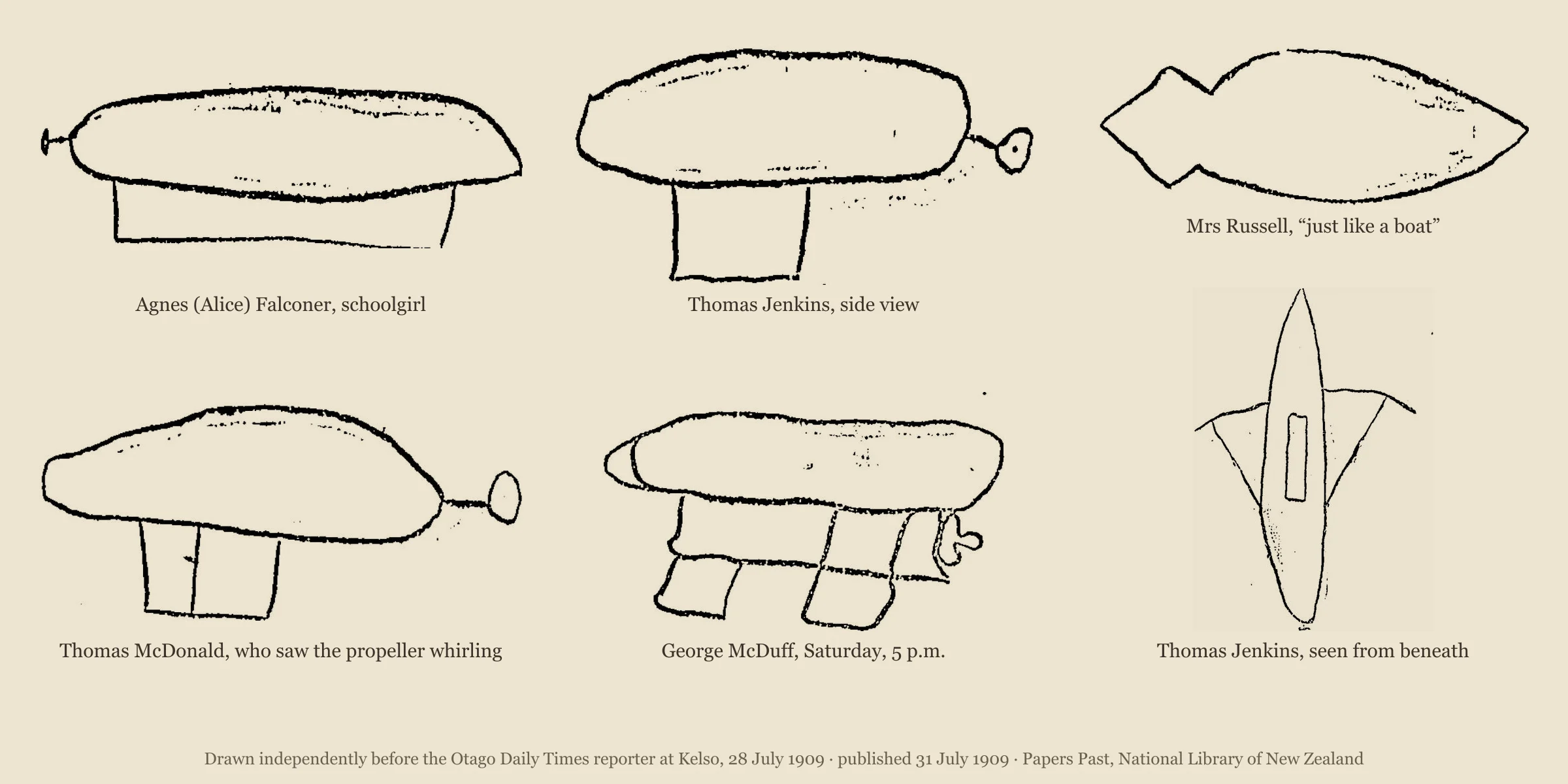
The Otago Daily Times sent a special reporter, who reached Kelso on Wednesday, July 28, and went first to Gibson, who handed him to A. McKinnon, manager of the Wright, Stephenson and Co. stock agency, and McKinnon walked him round the witnesses. “A busy afternoon’s investigation,” he began his dispatch, “utterly dispels any supposition that the reports about the airship are entirely mythical. There is far too much evidence for the belief to be easily dispelled.” At the schoolhouse the children who had seen the ship were “interrogated singly and independently, and were asked to draw an impression of what they had seen. The drawings were done separately, and with no reference whatever from one to another. The result was six drawings, the degree of resemblance and unanimity of which was nothing short of dumbfounding to all sceptics.” None, the boys told him, had drawn an airship before or been interested in airships. Thomas Jenkins had seen it first at twelve o’clock, going home from school: it came over the hill on the east side of the school, “sailed across the plain to the gorge on the other side,” some seven miles off, seemed to drop below the level of the hills into the gorge, hung there a few minutes, then turned, rose and “sailed away towards the Blue Mountains.” He watched it for about ten minutes. As it passed over he saw “supports on each side,” like sails that did not move, “a wheel at the rear revolving very rapidly,” and “a box beneath the body of the ship, but he could not see any man in it. The vessel was entirely black in colour.” He drew it twice, from the side and from beneath, the second drawing, which the reporter said showed “two sails on each side,” being a narrow hull with a triangular wing to left and right. Thomas McDonald had seen it twice, going to and from school; the first time he took it for a bird. “It came from the Blue Mountains, and took two turns over the township,” and after he had been home he saw it going back. “He distinctly saw a propeller at the rear whirling very fast.” Alice Falconer, as the reporter spelled her (the paper’s caption under her drawing would say Agnes), saw it “just going over the hill towards the Blue Mountains. It looked small, and was very high in the air,” going fast; she told her teacher. Her brother Cyril was with the other boys on the school ground when it passed over: “A big wheel was revolving at the rear. He saw this reversed, and the vessel suddenly turned.” He drew an angular shape that seemed to show the ship turning, though it was not among the figures the paper reproduced. Mrs Russell, “evidently the only adult who saw the phenomenon,” had been walking down toward the station about twelve when “a streak of blackness” shot over the hill on her left and came straight at her, then “suddenly turned and swerved away over some trees out of her sight.” She had been ill, and “was very flustered, as she thought the end of the world had come.” It was “just like a boat,” black, within three or four hundred yards of her when it turned; she noticed no wheel, no sails and no mast, and her drawing was a long boat with sharp bows and a tapering stern. George McDuff, who had seen the vessel going north at dusk on the Saturday, about five o’clock, drew the most detailed figure of all; he “had already drawn one to convince his father,” the paper noted, which makes him the boy of the Windsor Magazine story, although that story had its boy seeing the ship at noon on the Friday. On July 31 the paper printed six of the figures: the gas-bags drawn by Falconer, Jenkins and McDonald, Jenkins’s view from beneath, Mrs Russell’s boat and McDuff’s. In the children’s pictures the gas-bag is a long oval, the car hangs beneath like a box, and a little propeller sits on a stalk at one end. By the Thursday the Press Association was wiring that the police and others were searching at Kelso, where the ship “has been seen in that district by scores of reliable people.”
Sources: The Kelso Airship: Cumulative Evidence (from our special reporter, Kelso, July 28)The Airship Mystery: Stories of Mysterious Lights · What Was Seen at KelsoThe Kelso Airship: the six drawingsSeen Again at Kelso (from our own correspondent, Kelso, July 26)The Airship: Police Searching at Kelso
Lights every night
The daylight ship was the centrepiece, but the reporter found that “the evidence as to the mysterious lights is much more abundant.” On the Saturday night Mary Guinan had seen the light again about half past nine, “rising and falling,” until “it flashed brilliantly like a meteor. It seemed to make the sky round about paler.” Her brothers watched it “flashing as though the ship were turning round in circles.” A boy named Russell saw its beam “shone on the hills, making them visible,” and drew a long cigar shape. The witness the reporter rated most highly was a Mrs Ferguson, who had been driving into Kelso a little before nine to meet her mother off the train when she saw it above the Blue Mountains: “The light was very strong and dazzled her eyes so that she could not see at first on looking down how to guide her horse. It was of a reddish colour.” On the way home she stood on Tapanui hill and watched it, and her mother reported seeing it the same night from Waipahi. Nobody the reporter spoke to had heard an engine except Mrs Mayo, whose house stood apart from the township. In bed on the Friday night at half past eleven, “there gradually came to her ear a dull rolling whirring noise. It seemed like a motor or threshing mill.” It was not on the ground. “It drew nearer—a rolling noise like a drum a long way off, not a tap tap, but a dull roll, mixed with which was a squeaking or piercing sound.” She ran onto the verandah; “a great vibrating noise came from the roof,” passing from the south overhead and dying away toward the mountain, and in the morning the horses in the next paddock had been galloping in fright. On the Wednesday evening, while the reporter was in the township, the Rev. Thomas Paulin, the Presbyterian minister, his wife and children watched at a quarter to seven “something like a very brilliant star greatly magnified” travel fast toward Mount Wendon, well above the skyline, then seem to descend and fade until it “went completely out,” with a smaller light at one end; its manner of going “was not that of any star.” From another part of town McKinnon and his family saw a light brighten “by fits and starts” from the northwest, and behind it “a big black body” that “oscillated from side to side as though affected by air currents,” until the light died and the body vanished. The reporter also met the swan theory, that the children had seen “a large flock of black swans flying close together,” and disposed of it with relish: “No explanation is, however, proffered of the whirling propeller … nor is it suggested that a flock of swans would find it necessary to generate electricity as they fly and provide a headlight for night manoeuvres.” Other Kelso people had their own ideas. Ten or twelve Dunedin tradesmen working six miles out had watched “the cigar-shaped balloon with a carriage suspended below” through coloured glasses on the evening of Saturday, July 24, circling two miles off. Thomas Potter of Norwood wrote that on the night of July 31 it passed his house at perhaps eighty feet with “the hum of the propellers … quite plainly heard,” a dazzling white rear light and two red side lights, doing eighteen miles an hour dead against the wind. “Without a doubt we have an airship in our midst, but whether she is of New Zealand or German construction I will leave to an abler man than myself to judge.” By August 9 the Mataura Ensign’s Kelso column reported that nobody who would not talk airship “is considered in a sane frame of mind in Kelso,” and that the little town expected to be known “all over the world as ‘Airshipopolis.’”
Sources: The Airship Mystery: Stories of Mysterious Lights · What Was Seen at KelsoThe Kelso Airship: Cumulative Evidence (from our special reporter, Kelso, July 28)The Airship: Further Evidence from Kelso · the Dunedin tradesmen of July 24 · KaihuAn Observer’s Account: Thomas Potter of Norwood, Kelso, to the Mataura EnsignKelso Items: “Airshipopolis”
From Oamaru to the Bluff
By the last week of July the whole of the southern South Island, from Oamaru in the north to Invercargill in the south, was watching the sky. At Invercargill a light “resembling in shape, as far as could be judged, a fire balloon” was seen on Saturday night, July 24, “rising and falling and gradually moving northward” (the Southland News said from twenty past eleven, the Mataura Ensign’s wire from just after seven), and on the Wednesday night, July 28, some two hundred people in the streets watched a light drift south and vanish. Two cleaners at the railway engine shed, who had sighted it several times on the Sunday night, were convinced it was no star; at five on Monday morning one of them stepped out with a lantern and found “straight above him … a light that looked for all the world, so he says, like what a big Rochester lamp would give. It was low down when he saw it, but shot skywards, and after dipping and swooping from side to side sailed away west.” On Friday, July 30, the Southland News printed two diagrams by children of the North Invercargill school, twenty-three of whom claimed to have seen the ship in daylight; the Press Association, whose telegrams were carrying every sighting to papers across the country, noted drily that “the two diagrams are not a bit alike, and the testimony of the children need not be taken very seriously.” That same afternoon a rumour that a telegram had reached the News announcing the capture of the airship at Waikaka, smashed on landing, with a special train sent from Gore to fetch it in, brought more than a hundred people to the newspaper office. It had no foundation. But Waikaka had its own story: two hands on the night shift of the Syndicate No. 2 gold dredge said that at five that morning “the ship was lowered through the mist and circled round the vicinity, and that two figures were plainly discernible on board. She was carrying lights at both ends. After the visitor’s manoeuvres she shot upwards.” At Gore “several reputable citizens who are only in the habit of indulging in any stronger liquid refreshment than tea at long intervals” saw it on the Wednesday evening, and forty people coming out of West’s Pictures at Mataura saw it at half past ten. On Saturday night, July 31, Mr and Mrs Brand of East Gore watched a light “much brighter than a star” toward the Blue Mountains, crossed at intervals by “what appeared to be two large fans,” for half an hour; at one in the morning Mrs Brand found it “much closer, seeming nearly over the Catholic church,” with a light at each end, and at three o’clock “apparently directly overhead.” In Dunedin, a tramway worker named John McNeill, then out on strike, was woken at two in the morning of July 28 by “a horrible noise … like a ship dragging her anchor up, or the windlass of a steamer working,” went out and saw “something floating up past Knox College,” a dark body with a light at its base; he had not heard of the airship until his wife told him it was in the papers. On the Thursday evening a crowd on the Dundas Street bridge watched a headlight travel north over the Northern Cemetery, and the same night the remains of a toy fire balloon fell in York Place “and were quickly seized by a crowd of youths.” And there were two more daylight sightings. Near Oamaru, a hundred miles north of Kelso, a Kauroo Hill settler named H. D. Bailey, brother of the magistrate, was alerted at eight on the morning of Thursday, July 29, by his restive horses and looked up to see “a shape like a boat, with a flat top, speeding along at something like 30 miles an hour, or more.” And on a weekday morning that week (the Clutha Leader said Tuesday, July 27, the Otago Witness Wednesday) two men working on Lambourne station near the mouth of the Pomahaka, Allan Mitchell and Alexander Riach, watched for some time “a large boat-shaped structure floating in the air,” dipping and rising “with an easy motion,” about two and a half miles off, with “what appeared to be a long pole” on top, before it swerved across the river and went off toward the sea. The Clutha Leader noticed the point: it “corresponds almost exactly with what was seen at Kelso—the only two places at which any mysterious object is reported as having been seen in broad daylight.”
Sources: Invercargill’s Saturday night light (from the Southland News)The Aerial Mystery: 200 people at Invercargill · Oamaru · the Mount Roskill balloonThe Airship: the Southland News’s Seestern theory, the Catlins railwaymen and the Invercargill engine-shed cleanersThe Airship: the North Invercargill schoolchildren and the Waikaka rumourSouthland notes: the Waikaka “smash” rumour and the special trainSeen at Waikaka: the dredge hands and the two figuresThe Airship: Kelso “a myth,” the Gore and Mataura sightings, and the mechanic at Mount NicholasThe Airship at Gore: Mr and Mrs Brand’s three sightingsAn Airship over Dunedin: Mr John McNeill’s accountThe Dunedin sightings: John McNeill, the post office menThe Aerial Mystery: Mr H. D. Bailey at Kauroo Hill · Dunedin sightingsA fire balloon falls in York Place, DunedinThe Airship Seen in Daylight at Lambourne · Mr Grigor’s letterThe Mysterious Lights: Seen in Widely-Separated Districts
The Seestern
Whose airship was it? The first theory was a local inventor. The Mataura Ensign recalled a Dunedin mechanic who had shipped himself and later “a powerful engine and boiler” to Mount Nicholas, an uninhabited spot on Lake Wakatipu, ostensibly to mill flax, though “it was common talk among the railway men at the time” that he meant to experiment with an airship; the Otago Daily Times ran him to earth at his home on the Anderson Bay road, where he admitted to a flying machine he had offered the British Government but said the lake venture really was flax. The second theory surfaced on July 27 in two papers at once. The Dunedin Evening Star asked “Was it made in Germany?” and reported that “those who have put two and two together” held that the Seestern, for which the Condor was “supposed” to be searching, was “in reality off the New Zealand coast” and had set the airship free off the Nuggets, the headland south of Kaka Point; the same day the Invercargill Southland News printed a column story that the light belonged to “an airship sent to reconnoitre by the German yacht Seestern.” Nobody knew where the Seestern was, “and the believers in this theory consider this fact significant.” She had, they held, brought the airship to the New Zealand coast, set it free off the Nuggets, and picked it up again on the Saturday night when it passed out to the southeast. “The pole noticed by the children at Kelso is believed to be a wireless telegraphic receiver,” too weak to send but able to take orders. The Otago Daily Times found the explanation “more ingenious than convincing”: the Seestern was lurking off the coast, “the airship belongs to her, and comes ashore for exercise,” and its interest in Kaka Point, “where it frightened some boys,” must “satisfy the most obstinate doubter.” Its columnist Civis laid out the full doctrine: “that the Seestern and Condor are spy ships; that they possess a Zeppelin; and that, with invasion in view they are exploring the strategic possibilities of Otago, beginning with the Balclutha district.” He had a word, too, for visitors from space: the Government’s first act would be “to apply the reading and writing test, find them wanting, and dismiss the celestial strangers into space again as undesirable immigrants.” That was aimed at Robert Grigor, a Balclutha surveyor, whose letter of July 27 proposed “in all seriousness” a visitation “from another world made by beings so far advanced in intellect and knowledge” that they crossed space in “an airtight cylinder supplied with compressed air from their own atmosphere,” powered and lit by radium. They had arrived near New Zealand and were hovering “to get accustomed to our atmosphere. They see the electric light at Kaitangata and the lights about the Waikaka dredges and Mataura, and they are seen at Kelso and at Invercargill, which is probably the largest town they have as yet been able to discover … Can we do anything for them?” Searchlights might help, and wireless. The weather prophet Clement Wragge, lecturing in Dunedin, wired the Ensign that the lights were due to “local secret airship trials and cosmic luminous dust of meteoric or cometary origin,” adding that many people appeared to have mistaken Venus, Jupiter and Mars “for the lights of an airship.” The Clutha Leader took the apparition, “whether actual or imaginary,” as its cue for a sober leader on German aerial spending and the defenceless Empire. The theory overlooked what the cables had already said: the Seestern, the government yacht of German New Guinea, had been reported seriously overdue between Brisbane and New Britain on July 12, and on July 21 the searchers concluded that “it is believed that she has been blown up.” The Condor came back to Auckland on August 24; her captain thought the yacht had turned turtle with all hands. In June 1911 wreckage supposed to be hers was found on an island in the Great Barrier Reef, far from Otago.
Sources: The Airship: Kelso “a myth,” the Gore and Mataura sightings, and the mechanic at Mount NicholasThe Mount Nicholas mechanic found at Anderson BayExpanding the Boundary of Moral Panics: The Great New Zealand Zeppelin Scare of 1909The Airship: the Southland News’s Seestern theory, the Catlins railwaymen and the Invercargill engine-shed cleanersThe Otago Daily Times · editorial on the airshipPassing Notes (by “Civis”)Letters: Robert Grigor on a visitation from another world · “Katiki” on the Taiaroa Heads lampClement Wragge’s telegram on the mysterious lightsAirships and War (leading article)Vessels Overdue: Fears for German Government YachtMissing Yacht Seestern: An Unsuccessful Search · The Vessel Believed to Have Been Blown UpThe Seestern: the Condor returns · “turned turtle”Missing German Yacht: wreckage found on No. 5 Howick IslandEditorial: the Seestern theory and “a revival in the smuggling trade”
Aerialitis
The sceptics had been there from the start. “No doubt they expect to see something, and what they expect to see they see,” wrote the Clutha Leader on July 30, under the heading “Human Credulity,” and told of three men in a country district who watched “the flashing light, the wave-like motion, now ascending, now descending,” until one of them concluded “in language more forcible than polite that it was Jimmy Smith going round his rabbit traps with a lantern on the hillside.” The Mataura Ensign, which had decided Kelso was “a myth” the day the special reporter’s dispatch appeared, explained on July 31 that an aeroplane’s engines were too noisy and a dirigible too big to hide in a gully: “whatever has been seen it is not an airship. Every child knows that it is comparatively easy to make a fire balloon, and what is more probable than that some wag has sent up these toys of extra size and that imagination has done the rest?” Events were already bearing the Ensign out. Toy fire balloons, coloured paper envelopes twenty feet round lifted by a burning felt pad, were in large demand at the fireworks dealers, and on July 28 one hovered over Mount Roskill in Auckland for the best part of an hour while hundreds of people turned out; Gamages in Christchurch advertised “The Airship Mystery. Exploded by Gamages,” with “Phantoms of the Air, representing Airships, Policemen, Clowns, Birds, Donkeys,” from two and six, and promised that its next big airship “will ascend from the eastern part of Christchurch one evening next week.” At Balclutha on the night of July 30 the mysterious light that glided over the river “with undulating motion” was “nothing more nor less than an ordinary fire balloon, with a kite attached,” launched by jokers who “could restrain their impatience no longer.” Then there was the sky itself. The brilliant red object that drew crowds in Dunedin on the night of July 31 was, an astronomer told the Otago Daily Times, the planet Mars, “now rising bright and red at about 9.30 p.m.” At Nelson two nights later, with Mars approaching its closest to Earth and “scintillating with unusual brilliance,” word that the airship was “contemplating a descent” emptied the theatre where the Citizens’ Band bazaar was in progress; F. G. Gibbs of the Atkinson Observatory “was literally besieged by telephone and caller,” someone tried to break into the observatory, and “many people learnt for the first time in their lives that the whole of the stars apparently move across the sky as does the sun.” It was Mars. On August 3 the Otago Daily Times printed a long letter from the Rev. P. W. Fairclough, a Methodist minister, that papers from Ashburton to Gisborne reprinted. “The airship craze is getting beyond a joke,” he began. “The explanation of the affair is to be sought in psychology,” in the tulip mania, the witch persecutions and the dredging booms: “Such a time of excitement has been brought perilously near by the German scare, the Dreadnought episode, and the conquest of the air. Everything is ripe and ready for a popular delusion. A spark starts the conflagration.” Probably a toy balloon had started it, others remembered lights, some had seen rabbiters’ lanterns, and “it is quite certain that many have seen the fiery red planet Mars.” There was nothing in New Zealand “to reward an aerial spy … Outside of Seacliff,” the lunatic asylum, “there is no motive for a spy ship.” And the Kelso children? “Their sketches all represent the gas-bag ship, and have the propellers fixed to the end of the gas-bag! This is clearly their idea of how it ought to be.” Jenkins had the ship go to a gorge seven miles off and come back over the Blue Mountains: “Say, 20 miles; and he saw the ship for 10 or 11 minutes!” Somebody gave the disease a name, and on August 4 the Press Association was reporting that “Napier had an attack of aerialitis last night.”
Sources: Human Credulity · “Jimmy Smith going round his rabbit traps”The Airship: Kelso “a myth,” the Gore and Mataura sightings, and the mechanic at Mount NicholasConcerning the “Airship” (editorial)Those Mysterious Lights: Airship Theory ExplodedThe Airship Mystery, Exploded by Gamages (advertisement)The Balclutha fire balloon · “The Kelso broad daylight airship mystery is dissipated”The Aerial Lights: Mars over Dunedin · swans over Kelso · ClydeWhat Was It? Mars empties the Citizens’ Band bazaarThe Airship Craze (letter from the Rev. P. W. Fairclough)“Hot-Air” Ships
Three men in a cigar
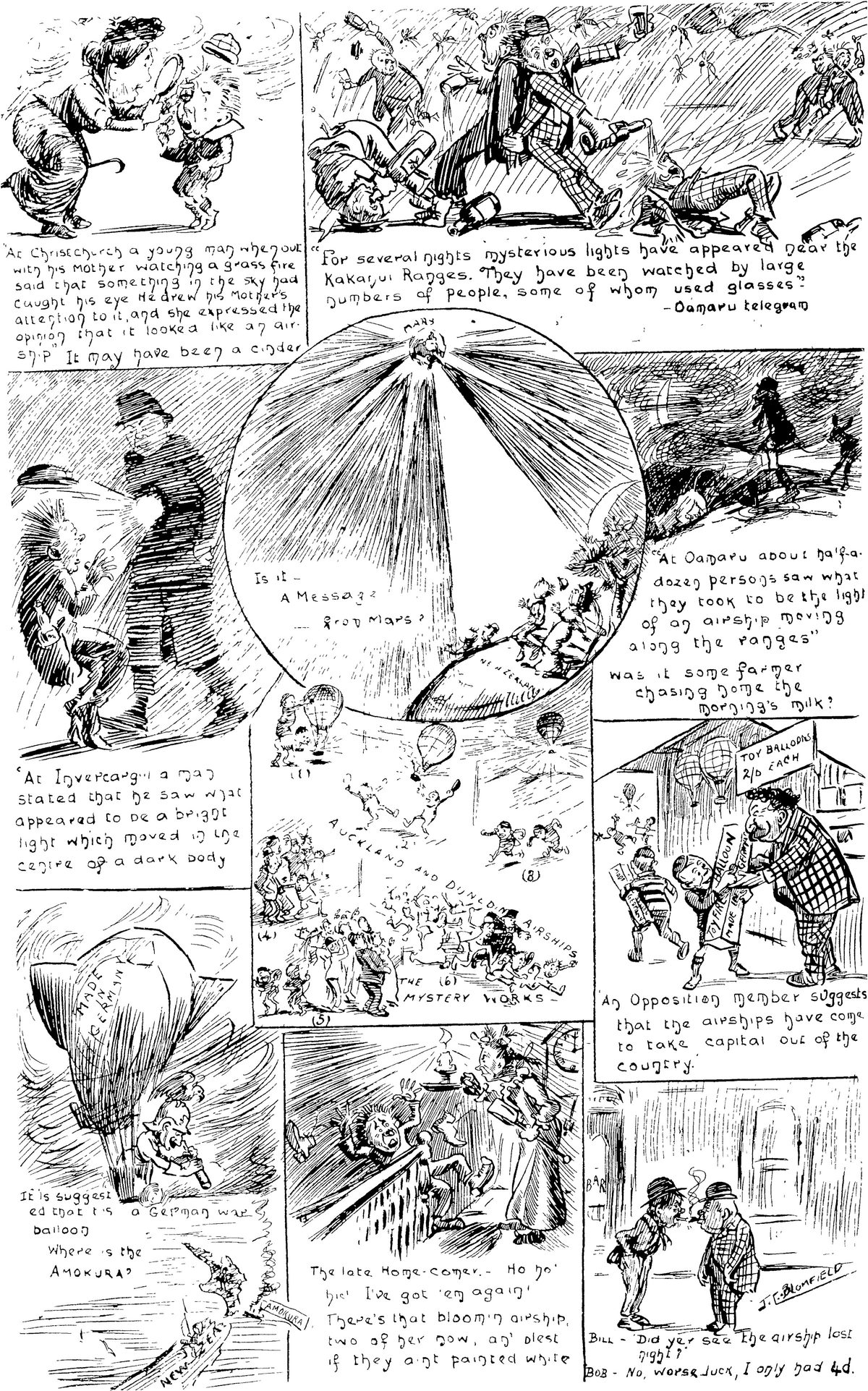
The North Island’s turn produced the wave’s strangest stories and its most inventive hoaxes. A Waipawa man gave the Press Association “a circumstantial but uncorroborated account” of an airship over Kaikora in Hawke’s Bay: “grey colour and torpedo shaped. It contained three men, one of whom shouted at him in a foreign tongue. He watched the machine for some time, and it appeared to be under perfect control. It carried two bright lights.” The Evening Post improved it to “a sort of celestial cigar lighted at both ends. Three men were sitting on it, but not smoking it,” and observed that the witness had “hoarded his horror for a week.” A Wanganui correspondent signing himself “Observer” saw from the town bridge at half past eleven “a large airship flying down the river from Aramoho” at two hundred feet, with “two large wings which made a hissing sound,” doing ninety miles an hour at the least, and added, “Sir, seeing is believing.” A week later Charlie Baker of Taylorville described an egg-shaped thing “about as long as the Wanganui bridge” with a large sail, from which he “distinctly heard voices.” A Masterton man saw one so close “that he could see the passengers playing cards.” At Waihi on August 9 everyone out of doors watched first two lights and then four travel slowly together for four miles; two days later portions of four kite parachutes were picked up on the Tauranga road, “attached together, each carrying a small vessel holding an inflammable substance.” At Stoney Creek near Palmerston North “a schoolmaster and numerous residents” gave circumstantial accounts of an airship crossing the ranges at twenty-five miles an hour, which “turns out tonight to have been a fire balloon sent up by two settlers who are busy collecting accounts of the wonderful things others saw it do.” In Dunedin’s Woodhaugh valley a correspondent watched “undoubtedly the genuine airship,” wavy motion, two small lights above and a large one below, until “whether it was that the small boys ran too fast, whether they came to the end of the string … the majestic airship became suddenly transformed into a ducking kite.” Southland offered physical evidence: a Black Hills farmer found two petrol tins on a hilltop a mile and a half from the nearest road, where no motor car could go, and another farmer found several screw wrenches in a field “in which the aerial explorers must have landed to make repairs.” Advertisers were quick. Woods’ Cycle Depot in Gore solved the mystery as “a messenger from Mars, riding from planet to planet, on a Woods’ Special Express Cycle, with one of their powerful gas lamps in front”; a Balclutha draper promised prices “far more astonishing than Airships”; a Mataura boarding house served “airship broth.” The Free Lance printed J. C. Blomfield’s page of cartoons and a mock demand that Cabinet act, since “people in the south are being frightened to death.” The Auckland Weekly News’s cartoonist wondered whether “an enterprising firm has been running contraband into New Zealand,” and drew two Scotsmen in a patched dirigible loaded with casks of ale, rum and whisky, a joke that landed squarely on dry Clutha. The Auckland Observer had already made the joke in verse: “As Clutha’s a no-license place, you must admit ’tis clear / It isn’t right to say this sight is caused thro’ too much beer.” On August 10 the Evening Post pronounced the scare-ship “wrecked in the pitiless all-sweeping gale of effluxion of time,” the disease “losing some of its virulence in New Zealand,” and the bacillus taking passage to Australia, where within the week a Melbourne clergyman was reporting two revolving lights over the Dandenong Ranges that changed from white to red to blue and moved like machinery.
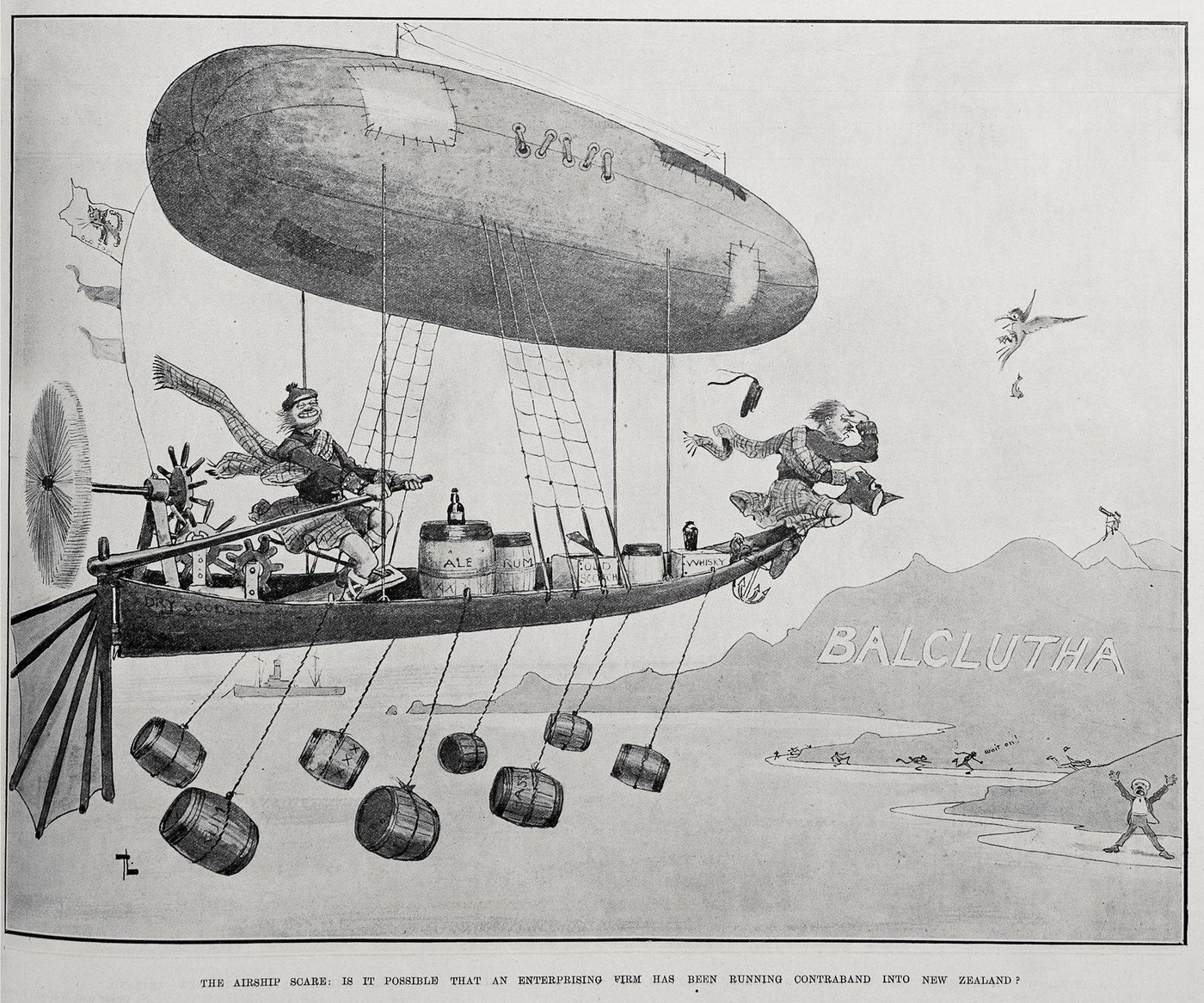
Sources: A Man Who Shouted: the Waipawa accountLights Are Gleaming: “a sort of celestial cigar lighted at both ends”The Airship: a letter from “Observer” and two wild-eyed youthsCharlie Baker’s “regular Zeppelin” over Durie Hill (letter)Masterton’s card-playing passengers and other tall storiesThe Mystery Solved: Woods’ Cycle Depot’s “messenger from Mars” (advertisement) · Brydone and Hokonui lightsThe Balclutha fire balloon · “The Kelso broad daylight airship mystery is dissipated”“Hot-Air” ShipsMuseum Notebook: When the Mystery Airship Came to TownWaihi’s four lights: the kite parachutes foundSettlers Settle It: the Stoney Creek fire balloonThe Woodhaugh “airship” becomes a ducking kite (G. B. Nicholls to the Dunedin Star)Discoveries in Waikaka: petrol tins in the Black Hills and screw wrenches in a fieldThe Air-Ship Mystery: Are Visions About?Tracking Down the Airship Mystery: Full Details by Our Artist (J. C. Blomfield)The Airship Scare: “Is it possible that an enterprising firm has been running contraband into New Zealand?”Aeroplane Mad (verse)The “Scare-Ship” WreckedThe Australian lights: the Rev. B. Cozens over the Dandenongs · Moss ValeScareships over Australia, parts I–IV
Starlings over Gore
The Clutha Leader wrote on August 6 that the airship mystery “is dying hard, but it is dying,” and that it “will go down to posterity as one of the cleverest hoaxes of the dawn of the 20th century”; the Tablet pronounced on August 26 that the craze “died out like an epidemic that has run its course.” The Otago Witness had meanwhile, on August 11, run Will Lawson’s story “The Kelso Pirate,” in which the thousand-ton gyroscope liner Astra, ten days out from San Francisco, is stalked between Christchurch and Dunedin by a trim airship whose green and scarlet rays lock her motors. Then, on the afternoon of Wednesday, September 1, two well-known Gore residents whose “veracity is beyond question” saw an object “of cigar shape, with a car attached to it” manoeuvring “in undulating fashion” toward the Tapanui hills and disappearing over the horizon toward Kelso. The next afternoon, between a quarter to six and six, it came over the hills on the eastern side of the town and “sailed backwards and forwards at a great pace,” seen from different parts of Gore, by the children of a prominent resident who telephoned their father to look out of his office window, and by a party of golfers walking home from the links, who described it “as resembling a large codfish and plunging in its movements.” One golfer thought it a large kite. “Gore is intensely excited,” the Southland Times’s correspondent wired. Within days the same paper had the answer. A Mrs W. Chittock, who farmed on the hills, “had a close view of the cause of the excitement and found that it was repeated flights of starlings, which, prior to the nesting season, were making their temporary homes in a clump of pine trees situated at a place called Holland’s farm.” The flock’s rise and fall accounted for the plunging, and “a long tail dropping from the main body, which looked like a very large net,” was straggling birds. The correspondent went to Holland’s farm and found the pines full of “thousands upon thousands of starlings,” more arriving to roost from miles around. “The birds would rise up in one black mass and circle round in the sky. Their evolutions were wonderful. At first they would look like a dark cloud, then they would assume the shape of a very long strip, darting up into the air and then descending with very great rapidity towards earth.” As for the night lights, the Witness added, “Mars is particularly large and red at present.” A fortnight later the Ensign’s children’s page put the moral in a sentence: “No one says airship in Gore now—starlings!” A child from under the Blue Mountains had written to the Otago Witness’s children’s page, printed on September 1, before the Gore finale, that the starlings came to the family plantation about four every afternoon and made a noise in the trees “that people say it sounds like falling water,” and that she had not seen the airship yet.
Sources: “The ‘airship’ mystery is dying hard, but it is dying”“The phantom airship craze has ceased in New Zealand”On the Airline: The Kelso Pirate (fiction, by Will Lawson)The Airship Again: Gore Intensely ExcitedThe Gore Airship: the starlings at Holland’s farmInvercargill notes: the Gore revival and the starlings“No one says airship in Gore now—starlings!”Letters from the Little Folk: a child under the Blue Mountains on the starlings
The town that drowned
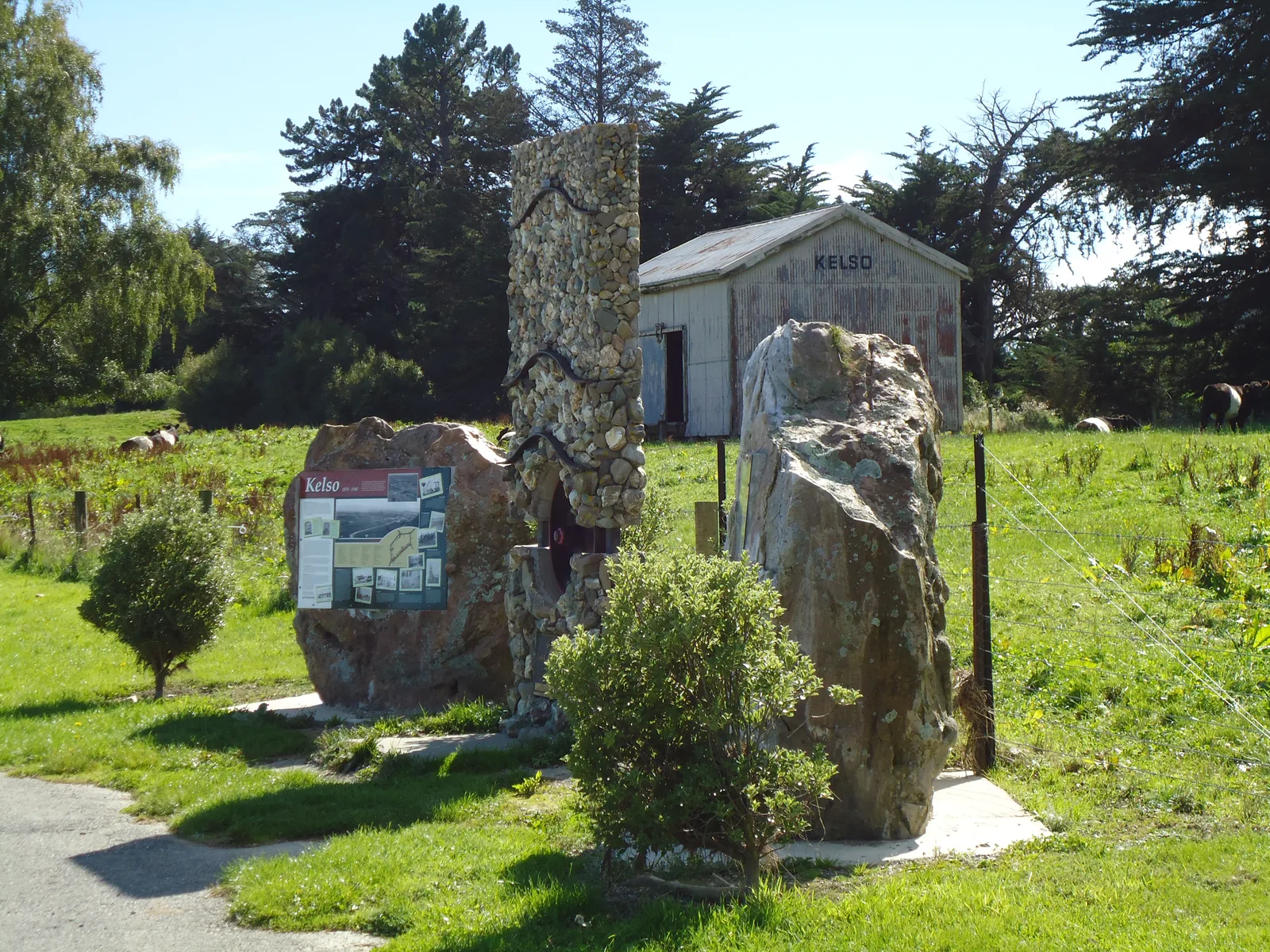
Kelso went back to sheep and the dairy factory. The township was flooded, by one count, three hundred times between 1881 and 1980; the first big one came in 1917. In October 1978 the Pomahaka and its burns put eight feet of water through the town, thirty-eight residents were evacuated, and in January 1980 a second flood, some ten feet deep or more, finished it. Insurers refused to cover the settlement, the first time in New Zealand a whole township had been refused; homes were trucked to Tapanui and Heriot or demolished; the school, the showgrounds and the railway closed. Today a stone memorial marked with the flood levels and an old railway shed stand in pasture where the township was. The airship kept its own strange afterlife. When the Tasman flyers Hood and Moncrieff vanished in January 1928 and people began reporting their aeroplane in the sky, the New Zealand Herald dug out the 1909 craze and retold it, obliging airship, Seestern and all. A saucer club’s quarterly rediscovered it in 1957, a radio documentary interviewed an elderly Waihi witness in 1961, and the Herald’s centenary volume reprinted the wires in 1963, all according to the later researchers’ bibliographies. In 1967 Tony Brunt, convener of the Auckland University UFO Research Group, wrote the story up from the newspaper files as “The New Zealand ‘UFO’ Wave of 1909,” the telling that fixed it in UFO literature, set it beside the American airship wave of 1896 and 1897 and the British scares of 1909 and 1913, and passed on a letter, known only from the Bruce Herald, about an airship with Japanese occupants that had come down at Port Molyneux. Two later witness follow-ups are reported, neither with a traceable source: Brett Holman writes that a journalist in 1966 found four of the children named in the papers, who remembered the excitement but of whom only one remembered seeing anything, and Robert Bartholomew that an Otago Daily Times reporter, about sixty years after the event, found George McDuff farming at Weston in North Otago, where he denied having seen any object and put it down to “imagination, based on what we were reading at the time.” Bartholomew, a sociologist of collective delusions, made the wave a textbook case in 1998, in a New Zealand Skeptic article and in a longer paper for New Zealand Sociology written with Bryan Dickeson that argued the scare should count as a moral panic: anxiety, ambiguity, rumour and a press that printed lights as airships until it learned better, with the autokinetic effect, by which a stationary point of light seems to wander when stared at in the dark, doing the rest. The paper conceded that “only a handful of witnesses specifically reported seeing a Zeppelin,” and Bartholomew, in the Skeptic, noted the one conspicuous difference between 1909 and the age of flying saucers: nobody reported a disc. Witnesses then expected airships, boat-shaped with wings or propellers, “and that is exactly what they reported.” Dickeson himself came to argue the other way. Writing for UFOCUS NZ in 2015, he went back to the earliest southern papers and held that the first witnesses, the Stirling men, the Kelso children and Mrs Russell, showed “more curiosity, interest – even national pride” than fear, that the moral-panic label fits only the later, localised reports, and that “an unknown physical phenomenon initiated the 1909 airship wave, rather than some kind of phobia.” The Clutha Leader had made the narrower point in 1909: two daylight accounts of a boat-shaped body with a pole, four days and some fifteen miles apart, “correspond almost exactly.” The Auckland researcher Murray Bott, who worked through more than a hundred of the 1909 accounts, is quoted by New Zealand Geographic as ruling out Mars because most sightings came before it rose, and dismissing Venus and Jupiter too. Both sides agree on this much: for six weeks in the winter of 1909, from Oamaru to the Bluff, a great many sober people looked up and saw something they could not name.
Sources: Kelso, New ZealandKelsoOld Story Recalled: New Zealand’s “Airship”1909: Coming of the Phantom AirshipThe New Zealand “UFO” Wave of 1909URECAT: Gore (Waikaka dredge), July 30, 1909 · Port Molyneux, July 1909Scareships over Australia, parts I–IVThe Great Zeppelin Scare of 1909Expanding the Boundary of Moral Panics: The Great New Zealand Zeppelin Scare of 1909The ‘1909 Kelso Airships’ of New ZealandCrowded Skies: The UFO Experience in New ZealandMuseum Notebook: When the Mystery Airship Came to TownMysterious flying object observed (100 years ago)
What survives from 1909
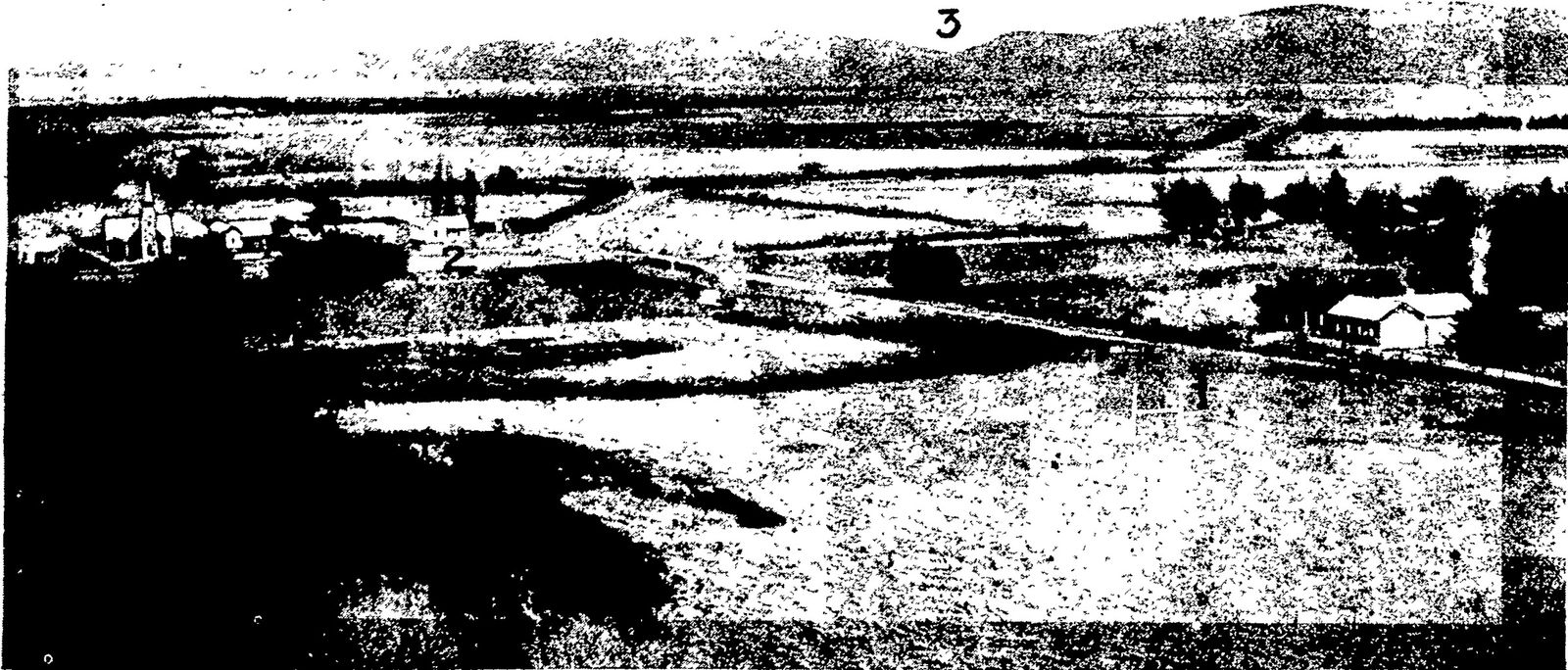
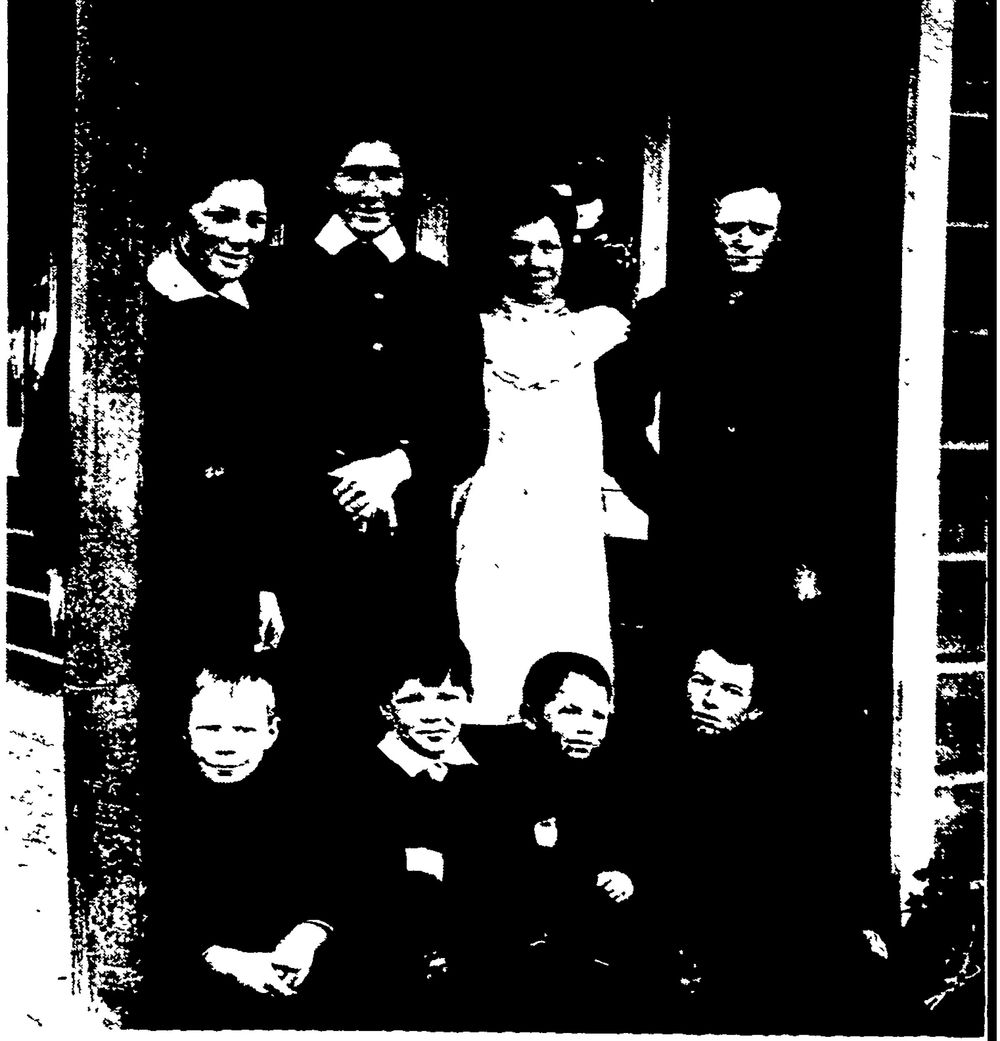
No photograph, wreckage or physical trace of an airship was ever produced; the petrol tins and screw wrenches were reported once and never heard of again. What survives is print, and a great deal of it: the Clutha Free Press account of July 13 as reprinted around the country, the Otago Daily Times’s special reporter’s dispatch of July 29 and its full text in the Otago Witness of August 4, the six drawings printed on July 31, and the Witness’s two photographs, of the daylight witnesses and of the township with positions numbered. Press Association telegrams carried condensed versions of every sighting to a dozen papers a day, which is why the same story appears with different times, heights and names from one town to the next. Several of the papers most often quoted in later accounts could not be searched for this case file: the Clutha Free Press, the Gore Standard, the Tapanui Courier, the Timaru Post and the Geraldine Guardian are not digitised at all, and the Dunedin Evening Star, the Southland Times and the Southland News are not in the text index used here, so they survive in this account only as other papers quoted them. Some details in the retellings, such as a Kaka Point party threatening to “prick the bubble” with a bullet, or a Temuka prank with a candle in a hollowed turnip, which Bartholomew cites to the undigitised Geraldine Guardian, could not be checked against a 1909 text. One small discrepancy sits in the primary record itself: the special reporter’s text names the girl who drew the first figure Alice Falconer, while the caption under her drawing and the Witness’s photograph call her Agnes. The secondary literature adds its own: Bartholomew’s “23 schoolchildren” at Kelso has no 1909 source, the Otago Daily Times saying “at least five persons” and naming four children, and the figure matches the twenty-three North Invercargill children reported a week later, from whom it seems to have migrated; his “tens of thousands” of believers is an estimate, not a count; and the Bartholomew and Dickeson paper counts four sketches where the paper printed six.
Sources: DigitalNZ API: Papers Past newspaper texts, 1909The Kelso Airship: Cumulative Evidence (from our special reporter, Kelso, July 28)The Airship Mystery: Stories of Mysterious Lights · What Was Seen at KelsoThe Kelso Airship: the six drawingsGroup of Those Who Saw the Kelso Airship in Daylight · View of Kelso and Neighbourhood Where the Airship Was SeenThe Airship: the North Invercargill schoolchildren and the Waikaka rumourThe ‘1909 Kelso Airships’ of New ZealandThe Great Zeppelin Scare of 1909Expanding the Boundary of Moral Panics: The Great New Zealand Zeppelin Scare of 1909
Planets, balloons and birds
Much of the wave can be accounted for with the explanations offered at the time. Mars was brightening toward its closest approach to Earth in mid-September 1909 and rose in the east between half past nine and ten each night; the Dunedin crowd of July 31 and the Nelson panic of August 2 were identified as Mars within a day. Venus and Jupiter hung together in the northwestern evening sky through late July, closing to a conjunction on August 11 that itself produced “airship” reports. An ephemeris run for this case file puts Venus, at magnitude minus four, about three degrees above the horizon at a quarter to seven on the evening of July 28, at an azimuth of 292 degrees, which from Kelso is almost exactly the bearing of Mount Wendon; that is the direction in which the Rev. Paulin watched a “very brilliant star greatly magnified” travel, sink and fade out, with Jupiter not far above it as a possible “smaller light.” From East Gore, Mars stood eighteen degrees up in the east-northeast, toward the Blue Mountains, at half past eleven on July 31, had climbed to the northeast by one o’clock and was high in the northern sky by three, the three positions Mrs Brand gave for her ship. Bartholomew and Dickeson suggest the Waikaka dredge hands at five in the morning watched the moon, which the same ephemeris has setting at that hour, eighty-eight per cent full. Not every light fits: nothing bright stood above the Blue Mountains, to the east of Kelso, at nine o’clock when Mrs Ferguson was dazzled, Mars not rising until around half past nine, and Bott’s objection that most reports came before Mars was up stands for the early-evening ones. Toy fire balloons account for a second class of reports, the lights that rose and fell with a “wave-like motion” and drifted downwind; their remains fell in York Place, Dunedin, their kite-and-parachute cousins were picked up at Waihi, and jokers at Balclutha and Stoney Creek owned up. A kite with lanterns explains Woodhaugh. Starlings massing before the nesting season explain the Gore finale. The sociological reading, offered by Fairclough in 1909 and Bartholomew in 1998, needs none of these to be wrong: a population primed by the Dreadnought scare, the English scareship and Blériot was ready to see airships, and in the dark, with no frame of reference, a star will appear to move.
Sources: The Aerial Lights: Mars over Dunedin · swans over Kelso · ClydeWhat Was It? Mars empties the Citizens’ Band bazaarThe Airship Craze (letter from the Rev. P. W. Fairclough)The Balclutha fire balloon · “The Kelso broad daylight airship mystery is dissipated”Waihi’s four lights: the kite parachutes foundThe Woodhaugh “airship” becomes a ducking kite (G. B. Nicholls to the Dunedin Star)The Gore Airship: the starlings at Holland’s farmThe Airship Mystery: Stories of Mysterious Lights · What Was Seen at KelsoThe Airship at Gore: Mr and Mrs Brand’s three sightingsExpanding the Boundary of Moral Panics: The Great New Zealand Zeppelin Scare of 1909The Great Zeppelin Scare of 1909Crowded Skies: The UFO Experience in New Zealand
The daylight witnesses
The explanations run out at the Kelso school. The planets were below or beside the sun at noon; a fire balloon does not fly in daylight without being recognised, circle a township twice and return the way it came. The swan theory has to account for a black object that four named children and an adult, questioned separately, described between them as boat- or cigar-shaped, with a box beneath, a short pole or mast in the first telegram, and a wheel at the rear that one boy saw reverse, and the reporter’s point that nobody explained the propeller still stands. Against this, the six drawings, five by children and one by Mrs Russell, show a textbook dirigible of the kind every illustrated magazine was printing that winter, with the propeller on the gas-bag rather than the car, which is what a child who had seen such pictures would draw; one boy’s father had checked his sketch against a Windsor Magazine illustration, and the Mataura Ensign reported on July 29, before the figures were even printed, that the children’s sketches “are reported to have been made from those published in a recent magazine article”; the father of one of the girls told the Clutha Leader the airship was a myth, and a Tapanui man told the same paper that a hundred people had seen swans flying the same course at the same time. McDuff, the witness who drew the most detailed figure, is said to have told a reporter sixty years later that he had seen nothing. Jenkins’s ship went to a gorge seven miles off and came back, a round trip the Rev. Fairclough costed at twenty miles in ten or eleven minutes, better than a hundred miles an hour and three or four times the speed of any airship of 1909. Mrs Russell, who was close and frightened, saw a plain black boat shape and nothing else. The Lambourne sighting four days later, by two farm workers who watched a boat-shaped body with a pole dip and rise for some time two and a half miles off, is the closest independent daylight match, with Bailey’s flat-topped boat near Oamaru two days later the other, and no reporter seems to have followed it up. The record leaves the Kelso airship where the Free Press left the Stirling light: uncontradicted, and uncorroborated by anything but the people who saw it.
Sources: The Airship Mystery: Stories of Mysterious Lights · What Was Seen at KelsoThe Kelso Airship: the six drawingsSeen Again at Kelso (from our own correspondent, Kelso, July 26)The Airship: Kelso “a myth,” the Gore and Mataura sightings, and the mechanic at Mount NicholasThe Balclutha fire balloon · “The Kelso broad daylight airship mystery is dissipated”The Airship Craze (letter from the Rev. P. W. Fairclough)The Airship Seen in Daylight at Lambourne · Mr Grigor’s letterThe Great Zeppelin Scare of 1909The ‘1909 Kelso Airships’ of New Zealand
- MAR–MAY 1909
The English “scareship” wave: nocturnal lights and whirring motors over the eastern counties, later traced to an advertising balloon. New Zealand papers carry the cables.
- 11 JUL 1909
Three Stirling residents watch a light manoeuvre over the Wangaloa Hills above Kaitangata for half an hour, 10.30 to 11 pm.
- 13 JUL 1909
The Clutha Free Press prints their account, with the witnesses’ offer to swear an affidavit; the Otago Daily Times picks it up on July 16.
- 14 JUL 1909
Mary Guinan sees a travelling light at Kelso, the township’s first sighting.
- 23 JUL 1909
Noon, Friday: Kelso school children and Mrs James Russell watch a black boat-shaped craft circle the township and head for the Blue Mountains. At 11.30 pm Mrs Mayo hears a whirring overhead.
- 24 JUL 1909
The stationmaster telephones the Otago Daily Times. George McDuff sees the vessel at 5 pm; lights are seen at Kelso, Invercargill, Balclutha and by railwaymen at Catlins River on the coast.
- 26 JUL 1909
The Otago Daily Times prints “Seen at Kelso”; the Press Association carries it nationwide.
- 27 JUL 1909
Allan Mitchell and Alexander Riach watch a boat-shaped body with a pole in daylight over Lambourne. The Southland News floats the Seestern theory.
- 28 JUL 1909
The special reporter collects six drawings at Kelso. John McNeill sees a searchlit body over Dunedin at 2 am; the Rev. Paulin and A. McKinnon watch a light fade toward Mount Wendon at 6.45 pm; 200 people watch a light at Invercargill.
- 29 JUL 1909
The reporter’s dispatch, “The Kelso Airship: Cumulative Evidence,” is published. H. D. Bailey sees a boat shape at 8 am near Oamaru; police search at Kelso; Grigor’s letter proposes visitors from another world.
- 30 JUL 1909
Waikaka dredge hands report two figures aboard a ship in the mist at 5 am; a false rumour of its capture draws a crowd to the Southland News. A fire balloon with a kite fools Balclutha.
- 31 JUL 1909
The six drawings are printed. The Otago Daily Times editorial and Civis mock the Seestern theory; Dunedin crowds watch Mars rise; the Brands of Gore watch a light from 11.30 pm to 3 am.
- 2–3 AUG 1909
Mars empties a Nelson bazaar and besieges the observatory. The Rev. Fairclough’s letter, “The Airship Craze,” diagnoses a popular delusion.
- 5 AUG 1909
A Waipawa man reports a grey torpedo with three men, one of whom shouted in a foreign tongue.
- 7–12 AUG 1909
The Free Lance and Auckland Weekly News cartoon the scare; Waihi’s four lights turn out to be kite parachutes; Stoney Creek’s airship is two settlers’ fire balloon; the Evening Post declares the scare-ship wrecked.
- 24 AUG 1909
The Condor returns to Auckland without the Seestern, believed lost with all hands; wreckage thought to be hers is found on the Great Barrier Reef in June 1911.
- 1–2 SEP 1909
Gore’s finale: a cigar with a car toward the Tapanui hills, then a plunging “large codfish” seen by golfers and children.
- 3–4 SEP 1909
Mrs Chittock watches the flock from the hills; a Southland Times correspondent visits Holland’s farm and finds thousands of starlings roosting in the pines. The Christchurch Star reprints the account on September 7.
- 1928
With the Tasman flyers Hood and Moncrieff missing and lights being reported, the New Zealand Herald retells the 1909 craze.
- 1957–1967
A saucer club’s quarterly, a radio documentary and the New Zealand Herald’s centenary volume rediscover the wave; in 1967 Tony Brunt writes “The New Zealand ‘UFO’ Wave of 1909,” the case’s entry into UFO literature.
- 1966–c. 1969
Reported but untraced follow-ups: a journalist finds four of the Kelso children, one of whom remembers seeing anything; George McDuff, farming at Weston, tells an Otago Daily Times reporter it was “imagination, based on what we were reading at the time.”
- 1978–1980
Two floods empty Kelso; the township is abandoned and relocated.
- 1998
Robert Bartholomew’s “The Great Zeppelin Scare of 1909” and, with Bryan Dickeson, “Expanding the Boundary of Moral Panics” set out the collective-delusion reading.
- 2015
Bryan Dickeson’s essay for UFOCUS NZ argues from the earliest southern papers that the first witnesses deserve a fairer hearing.
Sources & interviews
The Mysterious Light: the Stirling witnesses’ account (reprinted from the Clutha Free Press of July 13)Taranaki Daily News · July 22, 1909 · Papers Past, National Library of New ZealandA Mysterious Light: Supposed AirshipOtago Daily Times · July 16, 1909 · Papers PastZeppelin’s Record: Airship Travels Nearly 1000 Miles in 38 HoursMarlborough Express · July 22, 1909 · cable · Papers PastThe English “scareship” explained: the Boyd hoax and the advertising balloonPoverty Bay Herald · July 13, 1909 · cable · Papers PastNotes and Queries: when the Clutha district went dryOtago Witness · September 15, 1909 · “prohibition was first carried in the Clutha district at the local option poll in March 1894” · Papers PastThe Airship: the Clutha Free Press on the heliograph theory · “uncontradicted and yet uncorroborated”Wanganui Herald · July 30, 1909 · Papers PastInvercargill’s Saturday night light (from the Southland News)Star (Christchurch) · July 27, 1909 · Papers PastThe Aerial Mystery: 200 people at Invercargill · Oamaru · the Mount Roskill balloonPoverty Bay Herald · July 29, 1909 · Press Association · Papers PastSouthland notes: the Waikaka “smash” rumour and the special trainOtago Witness · August 4, 1909 · Papers PastA fire balloon falls in York Place, DunedinStar (Christchurch) · July 30, 1909 · Press Association · Papers PastThe Dunedin sightings: John McNeill, the post office menOtago Witness · August 4, 1909 · Papers PastNotes: the mysterious light over KaitangataNew Zealand Tablet · July 22, 1909 · Papers PastThe Supposed Airship: Seen at KelsoOtago Daily Times · July 26, 1909 · Papers PastSeen Again at Kelso (from our own correspondent, Kelso, July 26)Otago Daily Times · July 27, 1909 · Papers PastThe Kelso Airship: Cumulative Evidence (from our special reporter, Kelso, July 28)Otago Daily Times · July 29, 1909 · page 7 · Papers PastThe Kelso Airship: the six drawingsOtago Daily Times · July 31, 1909 · page 10 · figures drawn independently before the paper’s reporter · Papers PastThe Airship Mystery: Stories of Mysterious Lights · What Was Seen at KelsoOtago Witness · August 4, 1909 · the full text of the special reporter’s investigation · Papers PastThe Mysterious Lights: Seen in Widely-Separated DistrictsOtago Witness · August 4, 1909 · Papers PastGroup of Those Who Saw the Kelso Airship in Daylight · View of Kelso and Neighbourhood Where the Airship Was SeenOtago Witness · August 4, 1909 · illustrations page · Papers PastThe Otago Witness · leading article on the airship and imperial defenceOtago Witness · August 4, 1909 · Papers PastThe Airship: the Southland News’s Seestern theory, the Catlins railwaymen and the Invercargill engine-shed cleanersMataura Ensign · July 28, 1909 · Papers PastThe Airship: Kelso “a myth,” the Gore and Mataura sightings, and the mechanic at Mount NicholasMataura Ensign · July 29, 1909 · Papers PastConcerning the “Airship” (editorial)Mataura Ensign · July 31, 1909 · Papers PastThe Airship: Balclutha, Inch Clutha and the Owaka trainClutha Leader · July 27, 1909 · Papers PastHuman Credulity · “Jimmy Smith going round his rabbit traps”Clutha Leader · July 30, 1909 · Papers PastThe Airship Seen in Daylight at Lambourne · Mr Grigor’s letterClutha Leader · July 30, 1909 · Papers PastAirships and War (leading article)Clutha Leader · July 30, 1909 · Papers PastThe Mount Nicholas mechanic found at Anderson BayOtago Witness · August 4, 1909 · Papers PastThe Balclutha fire balloon · “The Kelso broad daylight airship mystery is dissipated”Clutha Leader · August 3, 1909 · Papers Past“The ‘airship’ mystery is dying hard, but it is dying”Clutha Leader · August 6, 1909 · Papers PastAn Airship over Dunedin: Mr John McNeill’s accountStar (Christchurch) · July 29, 1909 · from the paper’s Dunedin correspondent · Papers PastThe Airship: Police Searching at KelsoStar (Christchurch) · July 29, 1909 · Press Association · Papers PastThe Aerial Mystery: Mr H. D. Bailey at Kauroo Hill · Dunedin sightingsOtago Daily Times · July 30, 1909 · Papers PastSeen at Waikaka: the dredge hands and the two figuresTuapeka Times · July 31, 1909 · Press Association, Gore, July 30 · Papers PastThe Airship: the North Invercargill schoolchildren and the Waikaka rumourNelson Evening Mail · July 31, 1909 · Press Association, Invercargill, July 30 · Papers PastThe Otago Daily Times · editorial on the airshipOtago Daily Times · July 31, 1909 · Papers PastPassing Notes (by “Civis”)Otago Daily Times · July 31, 1909 · Papers PastLetters: Robert Grigor on a visitation from another world · “Katiki” on the Taiaroa Heads lampOtago Daily Times · July 29, 1909 · Papers PastClement Wragge’s telegram on the mysterious lightsStar (Christchurch) · July 31, 1909 · Papers PastAeroplane Mad (verse)Observer (Auckland) · July 31, 1909 · Papers PastThe Airship at Gore: Mr and Mrs Brand’s three sightingsMarlborough Express · August 2, 1909 · Press Association, from the Gore Standard · Papers PastThe Aerial Lights: Mars over Dunedin · swans over Kelso · ClydeOtago Daily Times · August 2, 1909 · Papers PastThe Airship Craze (letter from the Rev. P. W. Fairclough)Otago Daily Times · August 3, 1909 · reprinted in at least six other papers that fortnight · Papers PastWhat Was It? Mars empties the Citizens’ Band bazaarNelson Evening Mail · August 3, 1909 · Papers PastA Man Who Shouted: the Waipawa accountMataura Ensign · August 5, 1909 · Press Association · Papers PastLights Are Gleaming: “a sort of celestial cigar lighted at both ends”Evening Post (Wellington) · August 5, 1909 · Papers PastThe Airship: a letter from “Observer” and two wild-eyed youthsWanganui Chronicle · August 5, 1909 · Papers PastCharlie Baker’s “regular Zeppelin” over Durie Hill (letter)Wanganui Chronicle · August 13, 1909 · Papers PastMasterton’s card-playing passengers and other tall storiesNew Zealand Free Lance · August 21, 1909 · Papers PastThe Mystery Solved: Woods’ Cycle Depot’s “messenger from Mars” (advertisement) · Brydone and Hokonui lightsMataura Ensign · August 2, 1909 · Papers PastEditorial: the Seestern theory and “a revival in the smuggling trade”Poverty Bay Herald · August 5, 1909 · Papers PastThe Airship: Further Evidence from Kelso · the Dunedin tradesmen of July 24 · KaihuOtago Daily Times · August 6, 1909 · Papers PastTracking Down the Airship Mystery: Full Details by Our Artist (J. C. Blomfield)New Zealand Free Lance · August 7, 1909 · Papers PastThe Air-Ship Mystery: Are Visions About?New Zealand Free Lance · August 7, 1909 · Papers PastKelso Items: “Airshipopolis”Mataura Ensign · August 9, 1909 · Papers Past“Hot-Air” ShipsEvening Post (Wellington) · August 9, 1909 · Papers PastThe “Scare-Ship” WreckedEvening Post (Wellington) · August 10, 1909 · Papers PastAn Observer’s Account: Thomas Potter of Norwood, Kelso, to the Mataura EnsignTuapeka Times · August 11, 1909 · Papers PastDiscoveries in Waikaka: petrol tins in the Black Hills and screw wrenches in a fieldTuapeka Times · August 11, 1909 · from the Mataura Ensign · Papers PastWaihi’s four lights: the kite parachutes foundWairarapa Daily Times · August 12, 1909 · Papers PastSettlers Settle It: the Stoney Creek fire balloonWest Coast Times · August 11, 1909 · Press Association, Palmerston North · Papers PastThe Woodhaugh “airship” becomes a ducking kite (G. B. Nicholls to the Dunedin Star)Hawera & Normanby Star · August 14, 1909 · Papers PastThe Airship Mystery, Exploded by Gamages (advertisement)Star (Christchurch) · August 3, 1909 · Papers PastSummary for Europe: “the sensation of the month”Otago Daily Times · August 16, 1909 · Papers PastOn the Airline: The Kelso Pirate (fiction, by Will Lawson)Otago Witness · August 11, 1909 · Papers PastThe Airship Scare: “Is it possible that an enterprising firm has been running contraband into New Zealand?”Supplement to the Auckland Weekly News · August 12, 1909 · page 1 · Auckland Libraries Heritage Collections AWNS-19090812-01-02The Seestern: the Condor returns · “turned turtle”Evening Post (Wellington) · August 25, 1909 · Papers Past“The phantom airship craze has ceased in New Zealand”New Zealand Tablet · August 26, 1909 · Papers PastThe Australian lights: the Rev. B. Cozens over the Dandenongs · Moss ValeOtago Daily Times · August 28, 1909 · from the paper’s Melbourne correspondent · Papers PastThe Airship Again: Gore Intensely ExcitedColonist (Nelson) · September 15, 1909 · from the Dunedin Star and the Southland Times · Papers PastThe Gore Airship: the starlings at Holland’s farmStar (Christchurch) · September 7, 1909 · from a Southland Times correspondent · Papers PastInvercargill notes: the Gore revival and the starlingsOtago Witness · September 8, 1909 · Papers PastLetters from the Little Folk: a child under the Blue Mountains on the starlingsOtago Witness · September 1, 1909 · Papers Past“No one says airship in Gore now—starlings!”Mataura Ensign · September 16, 1909 · Papers PastExpanding the Boundary of Moral Panics: The Great New Zealand Zeppelin Scare of 1909Robert E. Bartholomew and Bryan Dickeson · New Zealand Sociology 13(1) · May 1998 · pp. 29–61 · with some fifty footnotes to the Evening Star, Dominion, Southland Times, Timaru Post and other papers not yet digitised · scanned issueThe Great Zeppelin Scare of 1909Robert E. Bartholomew · New Zealand Skeptic · May 1, 1998The New Zealand “UFO” Wave of 1909Tony Brunt · 1967 essay, written as convener of the Auckland University UFO Research Group · reposted by UFOCUS NZ, 2020The ‘1909 Kelso Airships’ of New ZealandBryan Dickeson · 2015 · UFOCUS NZ · with the six drawings and the Otago Witness photographs reproduced1909: Coming of the Phantom AirshipNew Zealand Skeptic · 1990 · reprinting the New Zealand Herald’s 1963 centenary volume 100 Years of NewsCrowded Skies: The UFO Experience in New ZealandVaughan Yarwood · New Zealand Geographic · with Murray Bott’s analysis of more than a hundred 1909 accountsMuseum Notebook: When the Mystery Airship Came to TownScott Flutey, Whanganui Regional Museum · Whanganui Chronicle · November 24, 2018Mysterious flying object observed (100 years ago)Otago Daily Times · July 24, 2009 · reprinting the item of July 26, 1909Old Story Recalled: New Zealand’s “Airship”Manawatu Herald · January 21, 1928 · reprinted from the New Zealand Herald, when searchers for the lost Tasman flyers Hood and Moncrieff were reporting lights in the sky · Papers PastVessels Overdue: Fears for German Government YachtGisborne Times · July 13, 1909 · cable from Brisbane, July 12 · Papers PastMissing Yacht Seestern: An Unsuccessful Search · The Vessel Believed to Have Been Blown UpGisborne Times · July 22, 1909 · Papers PastMissing German Yacht: wreckage found on No. 5 Howick IslandAuckland Star · June 28, 1911 · Papers PastNaval Crisis and Gift of HMS New ZealandNational Museum of the Royal New Zealand Navy · Ward’s cabinet paper of March 20, 1909 and the telegram of March 22Those Mysterious Lights: Airship Theory ExplodedAuckland Star · July 29, 1909 · the Mount Roskill fire balloons, twenty feet round, and the dealer’s “large demand” · Papers PastURECAT: Gore (Waikaka dredge), July 30, 1909 · Port Molyneux, July 1909Patrick Gross · ufologie.patrickgross.org · catalogue entries with 55 transcribed Australasian press items of 1909Scareships over Australia, parts I–IVBrett Holman · Airminded · October 20–27, 2010Kelso, New ZealandWikipedia · citing Jamie MacKenzie, Sophie Bond and Janet Stephenson, “Stories of Kelso,” University of Otago, March 2022KelsoClutha Heritage · Clutha District LibrariesMystery airshipWikipediaDigitalNZ API: Papers Past newspaper texts, 1909National Library of New Zealand · the OCR text of some 670 distinct 1909 articles on the lights, drawn from about 2,800 that mention airships, was retrieved through the API for this case fileSpotted an error, or know a better source? Write to hello@uap.fun.
Connected files
The Airship over SacramentoThirteen years earlier California had its own mystery airship, a swaying light with voices above it and a lawyer promising an inventor who never appeared.The Ghost Fliers of NorrlandAnother wave of phantom aircraft with searchlights blamed on a foreign power, over the snows of northern Sweden, except that there the General Staff ended by saying the planes were real.The Ariel School EncounterEighty-five years later another playground full of children was asked to draw what had landed beside their school, and the drawings became the evidence.The Lubbock LightsA formation of lights over a Texas city that the Air Force, after much argument, put down to birds; Gore got there first with starlings.The Kaikoura LightsNew Zealand’s other famous sky mystery, filmed from an aircraft off the same island’s east coast and argued over by astronomers, squid boats and all.Discuss this case
Compare notes with other readers: witness details, sources, and the parts that still do not add up.
Open the discussion