Two days to California
The airship arrived in California as a rumor before anyone saw it. On the evening of Tuesday, November 17, 1896, the Sacramento Bee carried a telegram from New York announcing that a man had perfected an airship and would ascend that Friday, with one or two friends, from a vacant lot in the city and fly straight to California in two days. The idea was not absurd to Californians. Frederick Marriott, the San Francisco publisher, had flown his steam-driven model Avitor Hermes Jr. a few feet off the ground at a racetrack south of the city in July 1869, then exhibited it at the Mechanics’ Institute Pavilion with scheduled flights until it caught fire. In May Samuel Langley’s large model aeroplane had made headlines with a successful test flight, and on November 1 the Detroit Free Press had promised that a New York inventor would soon build and fly an “aerial torpedo boat.” There had even been a few odd stories already. On Sunday, November 1, a Call reporter on Bolinas Ridge, west of Mount Tamalpais, met an old hunter named Brown who opened with “Do I look like a crazy man?” The morning before, he said, as the fog lifted, he had seen “an airship right up there a couple of hundred feet over them pines,” a large, dark shape with something moving on it. And a lineman of the Postal Telegraph claimed to have seen a strange light near Suisun at about nine on the evening of Sunday, November 15.
Sources: Voices in the SkyFrederick MarriottThe Airship Hysteria of 1896–97Strange Craft of the Sky: Sacramento Men Describe the AirshipClaim They Saw a Flying Airship: Strange Tale of Sacramento Men Not Addicted to Prevarication
“Lift her up quick!”
Between six and seven on Tuesday evening, under heavy cloud with a stiff wind from the southwest, people in the eastern part of Sacramento saw what the Bee called “merely an electric arc lamp propelled by some mysterious force” come out of the east over the housetops. It sailed unevenly toward the southwest, “dropping now nearer the Earth, and now suddenly rising,” roughly along the line of K Street, and drifted well south of K after Fourteenth. The densest knot of witnesses were the men of the electric streetcar company, whose car barn it crossed: they came out and heard, as the Call’s same-night wire put it, “people’s voices singing in a chorus, a rattling song, which gradually died away.” The Bee’s description of the voices was the line everyone reprinted: “not the whispering of angels, not the sepulchral mutterings of evil spirits, but the intelligible words and merry laughter of humans.” Where the light dipped toward the roofs, voices called out, “Lift her up quick! You are making directly for that steeple!” G. C. Snyder, foreman of the car house, watched a white light that “rose and fell and swayed from right to left as if it were being propelled by some motor power,” and said it was not a star or a meteor. Carmen near East Park heard someone above them say, “Well, we ought to get to San Francisco by tomorrow noon.” The Sacramento Daily Record-Union, more cautious, reported “a big ball of fire, like an electric light,” in sight for more than half an hour, and allowed that someone might have sent up an illuminated balloon, “or that a stray meteor was hunting for the rest of the gang.”
Sources: Voices in the SkyClaim They Saw a Flying Airship: Strange Tale of Sacramento Men Not Addicted to PrevaricationWhat Was It? An Apparition Wandering Through the Atmosphere
Scores of eyewitnesses
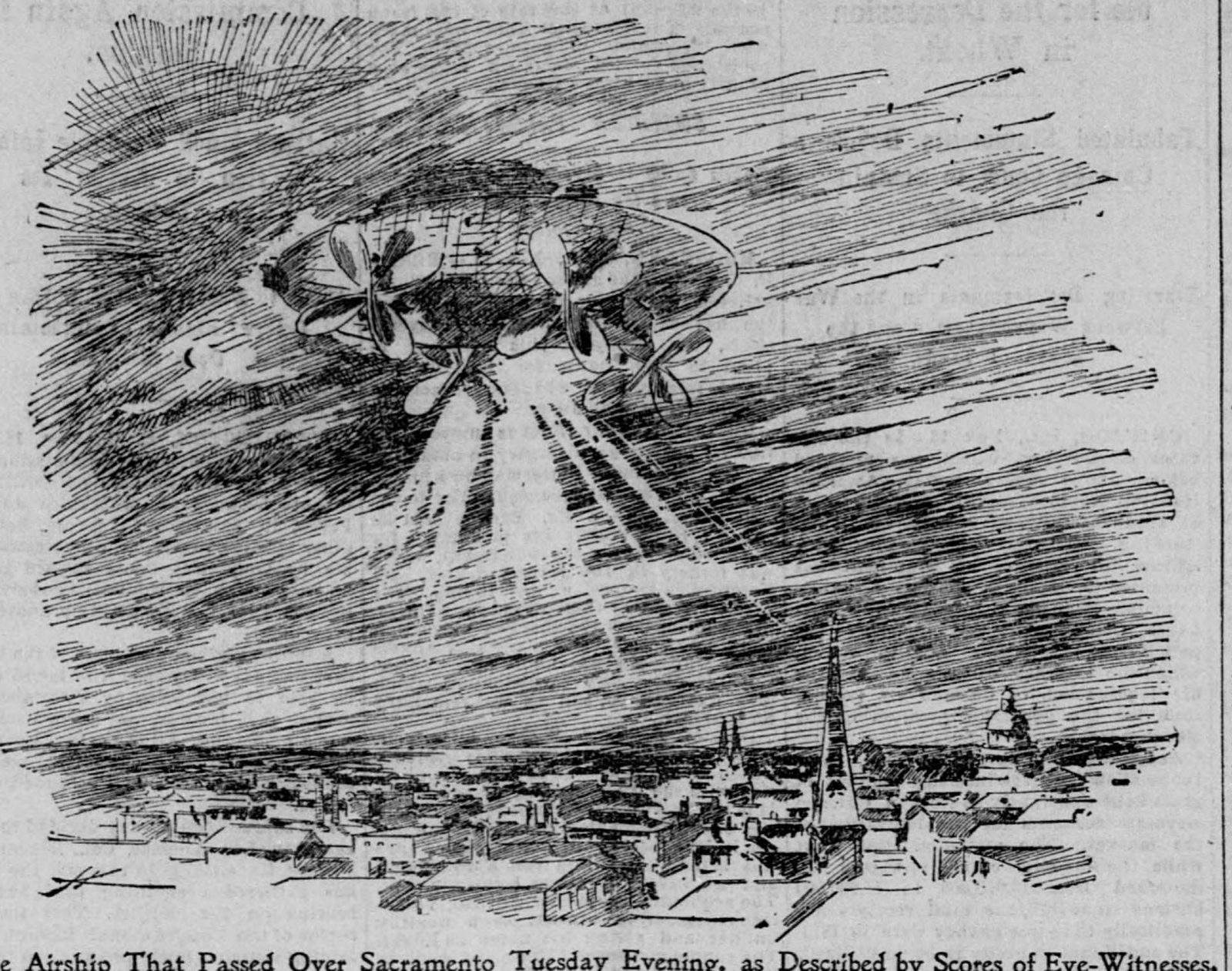
The San Francisco Call made it front-page news on Thursday, November 19, under the headline “Strange Craft of the Sky.” Its Sacramento correspondent claimed personal interviews with “scores of reputable citizens,” and the composite they gave him was an oblong, egg-shaped body “with fan-like wheels on either side, whose rapid revolutions, beating the air, served to propel the vessel directly against the wind,” swaying like a boat forced against a current, with a searchlight “about twice the size of an arc light” slung beneath. R. L. Lowry said he could make out four men working the wheels “much after the fashion of a bicyclist driving his wheel over a boulevard,” and that a bystander had shouted up to ask where they were going; the answer was San Francisco, by midnight, though nobody could name the man who asked. E. Wenzel of Scheld’s Brewery heard the crew “trolling a merry chorus.” David Carl, a horse trainer at Agricultural Park, was apparently the first to see it, low to the ground, and heard a voice say, “We are too low down here; send her up higher,” followed by an argument about altitude. T. P. de Long thought the singing sounded “like the noise produced by a phonograph.” Frank Ross, assistant superintendent of the streetcar system, saw only the light but was “certain that this can by no possibility have been a ‘fake.’” M. T. Shelly glimpsed, when the craft careened, “a cigar-shaped recepticle” with a dark wall above it, and the mayor’s daughter saw a brilliant white light that “certainly was not a meteor.” One onlooker had it all worked out: it was the machine Edison was rumored to have offered the government during the Venezuela crisis, now on trial because relations with Spain were strained.
Sources: Strange Craft of the Sky: Sacramento Men Describe the AirshipInternational UFO Press no. 255: San Francisco Call front pages of November 19–December 1, 1896
“All else is fancy”
Sacramento’s own papers were less sure. The Record-Union’s editorial of November 20, “Air Fancies,” granted that a light had been seen and dismissed the rest, including the four-man crew, the voices, and the San Francisco paper that had printed “a picture of what the so-called air ship looked like”: “The light was seen; all else is fancy or a joke, or imagination and a joke combined.” The San Francisco Chronicle called it “probably one of the greatest hoaxes ... ever sprung on any community,” while admitting it was “hard to account for the evident sincerity of those who claim they saw the machine and heard the voices,” and the next day quoted the astronomer George Davidson calling it the “outcome of a sort of free masonry of liars. Half a dozen fellows have got together, sent up a balloon with some sort of an electric light attachment, and imagination has done the rest.” The Oakland Tribune compared the airship to the sea serpent, which never appeared “when there was any dearth of whiskey,” and the Woodland Mail called it “about the thinnest fake yet set afloat.” The Call kept going. On November 20 it reported people on Sacramento’s outskirts rushing to their windows because their rooms were lit up as if a neighbor’s house were burning, a town where the greeting was now “Have you seen the airship?”, electricians who calculated that such a light needed at least a horsepower, and the Weather Bureau observer, Barwick, who said a meteor on such a night would have been purplish, never the white of an arc lamp.
Sources: Air Fancies (editorial)Airships: Part IThat Peculiar Night Visitant: Many of Sacramento’s Best Citizens Certain It Was an Airship
“Jee, whiz, what’s that?”
On the evening of Friday, November 20, it crossed the bay. A little after five, Selby Yost, a motorman on the Piedmont line and a member of the Oakland Guard, was running late when a small boy in the road at Thirtieth Street cried, “Jee, whiz, what’s that?” The passengers looked up, demanded he stop the car, and climbed out into the road, “the most surprised crowd I ever saw in my life.” “I didn’t like to admit to myself that I had suddenly gone crazy,” Yost said, “but really for a moment I did wonder if my senses had deserted me.” It was, he said, “the most uncanny looking thing I ever saw.” Charles H. Ellis, armorer of Companies A and F, saw it at about half past five near Twenty-fourth Street and New Broadway: it “somewhat resembled a balloon traveling end on, with a bright light ahead, another beneath it, and with what appeared to be wings both before and behind the light,” perhaps a thousand feet up. He had taken the Sacramento report for a joke. “This time, however, I had no alternative. I had to believe what I saw.” Past St. Mary’s College it seemed to descend “as though under perfect control” and made off toward San Francisco. The passengers told the Call that it closely resembled the paper’s Thursday illustration, and on Sunday the Call printed a new drawing of the light over St. Mary’s, adding that it was “exactly like” what the Sacramentans described.
Sources: A Genuine Aerial Ship: So Says the Inventor’s Attorney · Its Lights Seen Last Night · Said to Be an Oroville InventionSaw the Mystic Flying Light: Oakland witnesses of November 20
As lightly as a falling leaf
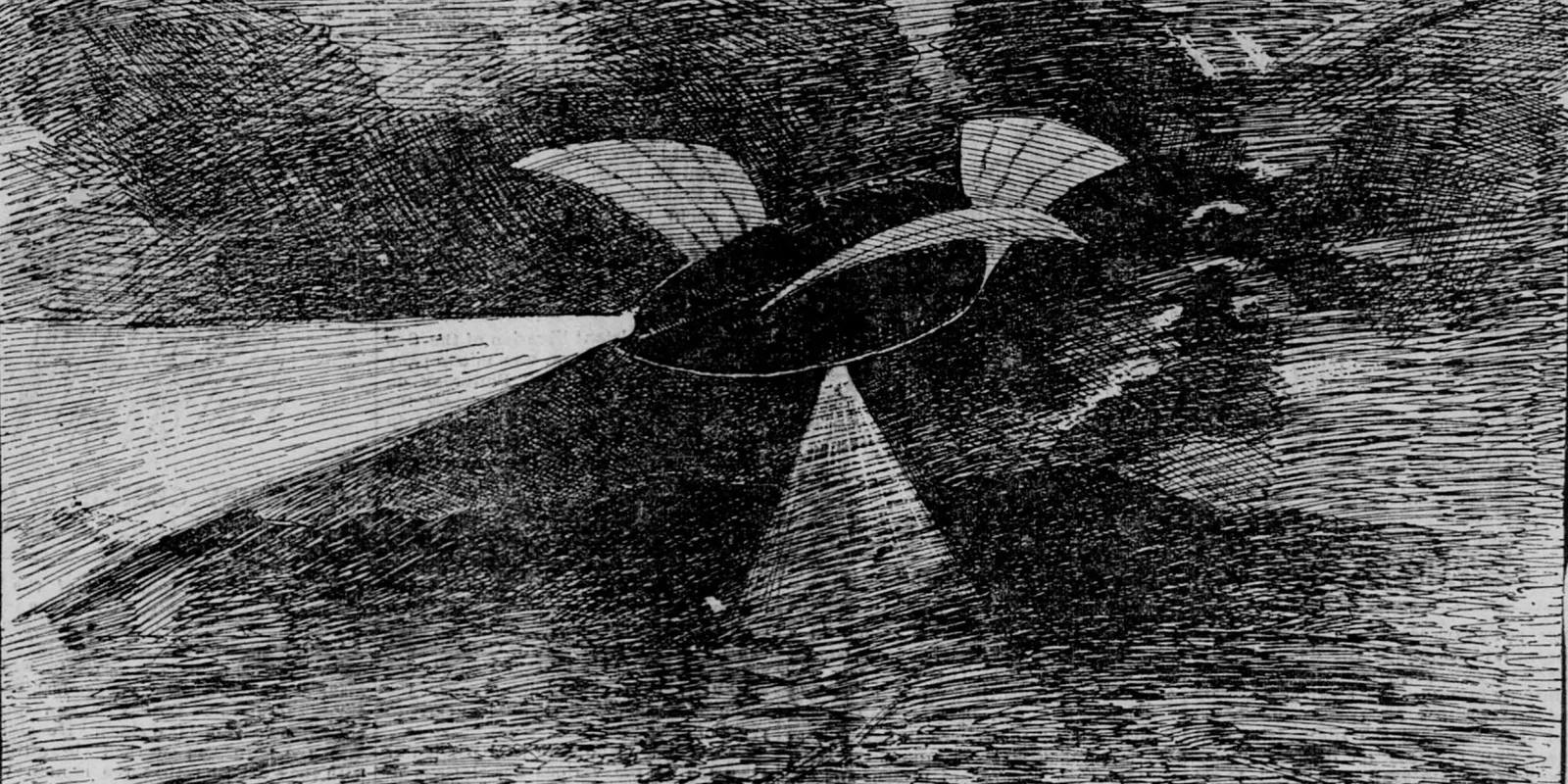
On Saturday night a Chronicle reporter found George D. Collins, a San Francisco lawyer with offices on the second floor of the Crocker Building, at his home in Alameda, and on Sunday, November 22, the paper that had called the whole thing a hoax printed the scoop of the week. “It is perfectly true that there is at last a successful airship in existence,” Collins said, “and that California will have the honor of bringing it before the world.” He was the inventor’s attorney. His client was a very wealthy man who had studied flying machines for fifteen years, had come from Maine seven years before, and had spent at least $100,000; his patent application was in Washington, and he feared it would be stolen from the Patent Office. Then Collins went further. “I saw the machine one night last week at the inventor’s invitation. It is made of metal, is about 150 feet long and is built to carry fifteen persons.” It had “two canvas wings eighteen feet wide and a rudder shaped like a bird’s tail.” The wings flapped slowly as it rose to about ninety feet, it circled, and then “fell straight down, very gracefully, touching the earth as lightly as a falling leaf.” It was his client, he said, whom Sacramento had seen: he had flown from Oroville, in Butte County, run up and down over the Capitol, and landed on this side of the bay, where the machine now lay “guarded by three men.” The ship’s wavelike motion had made the inventor seasick, but in six days he would fly over San Francisco “and cross Market street a dozen times.” He could fly to New York tomorrow if he wanted to. The story went out on the wires and ran across the country, in Boston under the headline “Airship a Fact: A Son of Maine Has Mastered the Secret.”
Sources: A Genuine Aerial Ship: So Says the Inventor’s Attorney · Its Lights Seen Last Night · Said to Be an Oroville InventionUFO Fever in America’s Historical Newspapers: The Mysterious Airships of 1896–97Airships: Part I
“What kind of whisky have you been drinking?”
The same Sunday evening the light came back to Sacramento, this time over downtown, and the Call’s correspondent reported that all one could hear on every side was “airship, airship, airship.” The housetops went black with people and motormen shouted the news from their cars. Jacob Zemansky, “the well-known downtown cigar man,” trained a telescope on it: “If that was not an electric arc light of intense power then I never saw one. Looking at it with the naked eye it seemed to move in a straight line, but seen through the glass it rose and fell like a boat on a gently swelling tide,” with “a dark mass of mistlike substance” above. Colvin Brown, the Chronicle’s Sacramento correspondent and a pronounced skeptic, stood on a street corner with an almanac trying to prove that Venus had left her orbit and was “coquetting with Sacramento,” then went off to find the weather sergeant. Copies of Wednesday’s Call, with the first story, could not be bought “for love or money.” On Monday the Call answered its rival with its own Collins interview, conducted in his Alameda parlor after he had hidden all day from people wanting him to draw the ship, and with a front-page drawing “from descriptions of the inventor’s attorney” under the headline “A Winged Ship in the Sky.” This Collins was chattier and vaguer. The inventor, a fine-looking man of about forty-seven, had visited him half a dozen times before confiding, and when he got as far as the word airship, Collins laughed. “‘What kind of whisky have you been drinking?’ I asked him.” The man drew himself up: “‘I have not been drinking, sir, and when I do it is not whisky.’” Asked whether anyone in his family had been in the lunatic asylum, he replied that everybody thinks an inventor crazy until his invention works, and “then, I suppose, people call him a genius.” Collins now said, as near as he could recollect, that the ship ran on compressed air, which worked the arms and made the light, and in this telling he never claimed to have watched it fly: the Sacramento trip, a few turns over the Capitol and the pass over Oakland were all things the inventor had told him. When a visiting lawyer, R. B. Mitchell, came by suspecting the inventor was hidden in the house, Collins guessed that on any pleasant night he was half a mile up in his machine. “I believe he has gone home, and if he has he certainly flew there.”
Sources: Sacramentans Startled: Thousands View the Great Airship With Wonder · Others Who Saw ItA Winged Ship in the Sky: It Cleaves the Air With Pinions Like a Huge CondorInternational UFO Press no. 255: San Francisco Call front pages of November 19–December 1, 1896
“The statement that I had seen it working at all is false”
By Monday afternoon Collins was retreating. The Bulletin ran the headline “IT IS A FAKE” and quoted him: “I never saw the airship and don’t know anything about it.” The Examiner, Hearst’s paper, had sent a man to Oroville, who reported that “there is no wealthy man living here who came from Maine, or any other state, in the past seven years.” To the Call that evening Collins insisted he had “not a word to take back” of its interview, but that the Chronicle had grossly misrepresented him: “The statement that I had seen it working at all is false.” All he knew was that a man who seemed perfectly sound wanted a patent. The inventor, he now said, was a San Francisco man who had built the machine near Oroville, and he warned that the Chronicle had found “one Dr. Benjamin, I believe” to claim the invention and say he had paid Collins a $500 retainer. “I am as skeptical regarding the actual working of the craft as any one, but am not such a fool as to say that it is an impossibility.” The Chronicle dug up his earlier word of honor that he had seen the ship and remarked that “Mr. Collins was evidently in a trance at the time.” The Call, meanwhile, found allies. Henry W. Bradley of the firm Stanly, Hayes & Bradley let slip, “I know that it landed at 3 o’clock,” then stopped: “You have made me say more than I intended to.” He had expected an invitation to inspect it that day, he said, but it never came. San Francisco’s mayor, Adolph Sutro, said some of his people at Sutro Heights had watched two lights come in from the sea, one beneath “a misty-looking mass,” and that an airship would be no more wonderful than the telegraph, the telephone, the phonograph or the X-ray. And Dr. E. H. Benjamin, tracked down at last, said he knew nothing about any airship, though if he had invented one he would keep quiet until his patents were secured. Yes, Collins was his attorney; yes, he had called on him that very afternoon.
Sources: Close Encounters of the Earliest KindAirships: Part IThe Apparition of the Air: Attorney Collins’ Tale Supported · Dr. Benjamin Disclaims the Invention
Two or three men and the city of Havana
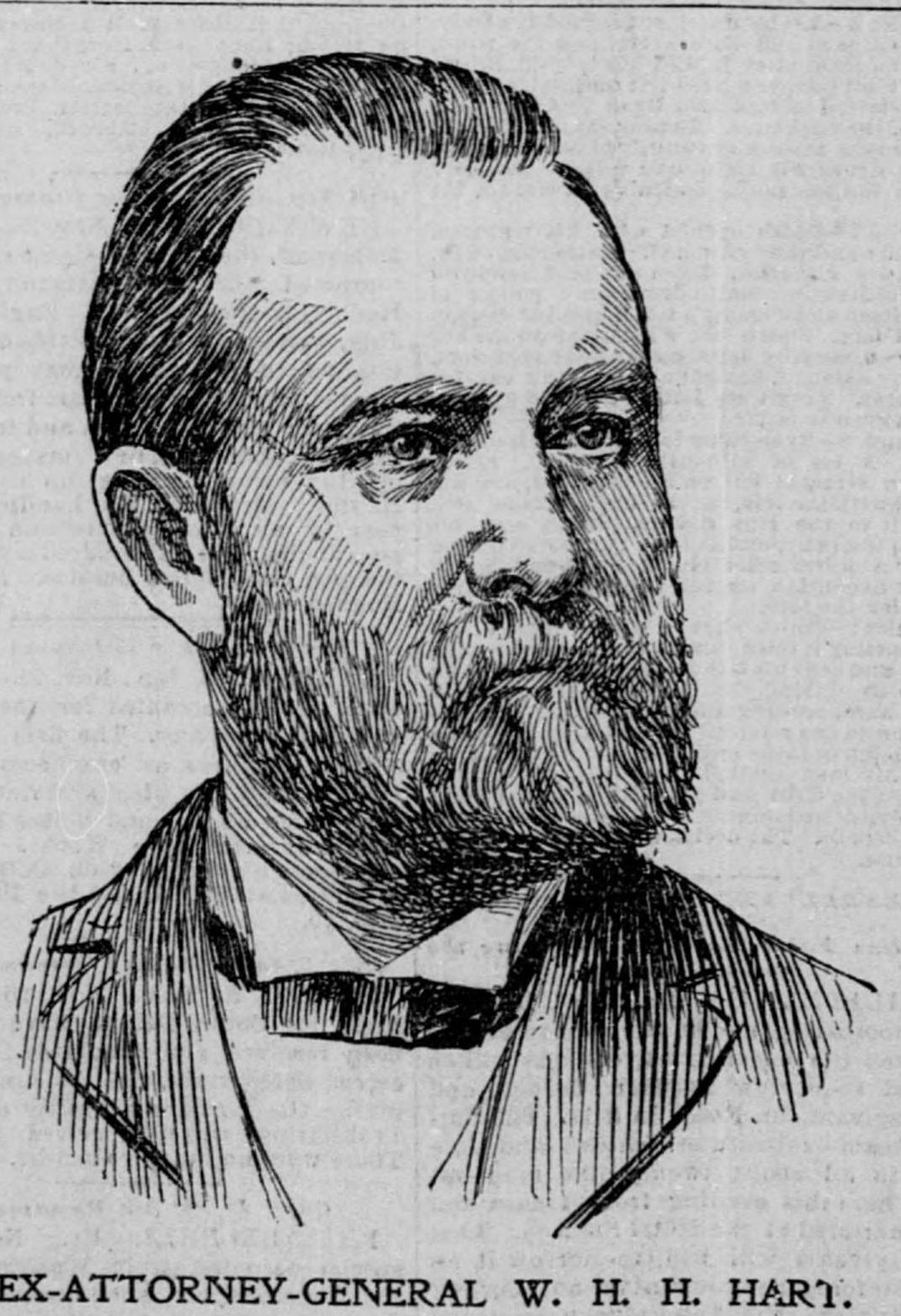
On Wednesday, November 25, the Call announced that the airship had changed lawyers the day before. The inventor, wishing to keep his incognito, felt that “Collins talked not wisely and too much,” and had taken his business a few flights up the Crocker Building to William H. H. Hart, a former attorney general of California, who by his own colorful account had been a Secret Service agent at fourteen and owned the only mine in the world where osmium was found as metal. On Sunday Hart had told the Call, “I have seen the thing in the air myself.” Now the paper reported that he had not seen the California machine at all, and he added, “I don’t expect to see it myself or even get a look at it.” It was the Eastern one he had seen. None of this dampened the most sensational claim of the affair. “There are two inventions and they are very much alike,” he said, one from the East and one from California, and he meant to consolidate them. “I propose to use it wholly for war purposes.” It would carry “four men and 1000 pounds of dynamite,” it would need a bulletproof bottom and must float if it came down at sea, and he would not name the backers: “We don’t want to be arrested as filibusters on the first trial of the machine.” Its destination was the Cuban insurrection against Spain. “From what I know of it, I am quite convinced that two to three men could destroy the city of Havana in forty-eight hours.” The partners could clear five to ten million dollars in five or six months, and “we would rather make $5,000,000 in six months than $100,000 for fifty years.” Its one drawback was that it could not stand still: “it must be kept moving like an arrow.” The same page named a new candidate inventor, a “Dr. Catlin,” assisted by Benjamin and one George Applegate, and an insider with “a little bunch of airship stock in his inside pocket” explained that what Sacramento heard was not singing but the hum of the machinery, and that after the first flight the doctor had landed at three in the morning in a barnyard in one of the bay counties and locked the ship in the barn.
Sources: Mission of the Aerial Ship: Will Probably Be Used to Destroy the City of HavanaSacramentans Startled: Thousands View the Great Airship With Wonder · Others Who Saw ItWilliam H. H. HartThe Airship Scare and War Hysteria
Unfinished store teeth
By Thursday’s paper the dentist had vanished. Benjamin had rented the front room of a lodging house at 633 Ellis Street for two years; on Wednesday the house’s furniture and carpets went under the auctioneer’s hammer, and Benjamin left at about eight in the morning with his effects packed in trunks, saying he would be back at noon. He did not return, and that evening the doorbell had been fastened on the inside. A pretty brunette at the house explained that reporters had been calling day and night, and “some of them have camped upon the front steps until 4 o’clock in the morning.” The auctioneer chipped in: “He has gone to get his airship and take this lady to Europe, where he will marry her.” In the room lay scraps of copper, little cups the size of cane ferrules that looked like percussion caps, and someone suggested they were materiel for the destruction of Havana. “The romance of these little pieces of brass was shattered, however,” the Call reported, when it emerged that Benjamin had been experimenting with continuous bridgework and the cups were “the crowns for rows of artificial grinders.” The auctioneer’s men, told they were holding “unfinished store teeth,” tossed their souvenirs into the street. Dr. Joseph D. Hodgen of the State Board of Dental Examiners said Benjamin came from Maine and was not a regular practicing dentist but spent his time on experiments in dental work; on the 12th or the 17th he had met him on the street with a gripsack, bound for Oroville to see his aunt, and soon afterward read of the lights over the Sacramento Valley. Collins, the Call recalled, had said Benjamin had wealthy relatives near Oroville. Hart, asked whether Benjamin had helped build the machine, said, “I don’t know Dr. Benjamin.” “As I stated before,” he added, “I have not myself seen the machine in action or at rest.” He was confident it worked because it was “very like the one I saw in New Jersey,” which had flown fifteen or twenty rods, and because “I have seen the plans.” As for the public, “we would rather they believed it a thing of fancy.”
Sources: Hart Stands by His Ship · All Sacramento Agape · Dr. Benjamin Disappears · Jokers Make Generous Purchases of Fire BalloonsInternational UFO Press no. 255: San Francisco Call front pages of November 19–December 1, 1896Airships: Part I
Venus over Market Street
Meanwhile the sky had filled. At about six on the evening of Tuesday, November 24, the cry went up on Market Street that the airship’s headlight was visible over the Chutes, and many thousands stopped to stare; on the California Street hill, the Call reported, “the buds and beauties of society in elegant wraps and gallants equipped with lorgnettes” joined them. Professor Davidson got out his telescope and identified the light as Venus, and later in the evening Jupiter drew crowds of its own. At 11:30 that night a lighted balloon rose over the Examiner’s office on Market Street; the Call accused the Examiner, “that ‘Monarch of the Fakers,’” of staging that hoax and another in Oakland the night before. A fireworks company said it had sold more fire balloons in a week than since the Fourth of July, and a Mission Dolores vigilance committee, led by a six-foot-four captain named James Peoples, went up Twin Peaks to hunt the jokers. At Vallejo the searchlights of the Navy monitors Monadnock and Monterey swept the sky looking for “the warship of the air.” And Sacramento kept seeing it. On the calm evening of November 25 a light “fully three times as large” as Venus circled the city, and the Capitol establishment came out to look. E. D. McCabe, Governor Budd’s secretary, who had laughed all week, said it was “certainly produced by electricity or magnesia, and can by no possibility be a star or a meteor.” District Attorney Frank D. Ryan muttered, “And there will be strange sights seen in the heavens. Wars and rumors of wars. I shall certainly attend church to-morrow, for this may be the advent of the millennium,” then laughed: “That thing is too deep for me.” George A. McCalvy, Deputy Secretary of State, who had been ribbing his friend Collins by telephone, conceded that “he laughs best who laughs last.”
Sources: Mission of the Aerial Ship: Will Probably Be Used to Destroy the City of HavanaHart Stands by His Ship · All Sacramento Agape · Dr. Benjamin Disappears · Jokers Make Generous Purchases of Fire BalloonsAirship dispatches from Auburn, Fresno and Vallejo (“Inquisitive Rivals”)
Seven feet tall and divinely beautiful
As the lawyers’ story frayed, the countryside improved on it. The Stockton Daily Independent reported a steamboat captain upriver woken by his frightened cook to see a “cigar-shaped frame” and hear dull thuds in the heavens, and a State Asylum night watchman who timed the ship at 9:45:35 p.m., “within 210 feet of the ground,” smoking at both ends; it proposed paying a sober man to sit on the courthouse dome and watch. On November 27 the Stockton Evening Mail printed the story of Col. H. G. Shaw, a former member of its own staff, who said that on the evening of Wednesday, November 25, driving back from Lodi with a young man named Camille Spooner, his horse stopped with “a snort of terror.” In the road stood three beings “nearly or quite seven feet high and very slender,” covered in something “not hair, neither was it like feathers, but it was as soft as silk,” their noses like “polished ivory.” They did not talk so much as warble, “a monotonous chant, inclined to be guttural,” breathed from bags with nozzles that sounded like “a person blowing up a football,” carried egg-sized lights, and weighed almost nothing when Shaw lifted one by the elbow. They were “more divinely beautiful than anything I ever beheld.” They tried to carry him off, failed, and walked off with a swaying motion, touching the ground only every fifteen feet or so, to a pointed airship a hundred and fifty feet long hovering over the water near Woodbridge. Shaw thought they were Martians sent to collect an earthling, and added that “the stories being told by certain San Francisco attorneys are clumsy fakes.” The Livermore Herald had Rev. John Kirby, a Methodist presiding elder, and Rev. Hugh Copeland seeing a “huge ball of fire” rise from the earth near Knights Ferry on November 22: “if it was not an airship, what was it?” And from San Luis Obispo came William Gordon, a sailor, who said he had been hired at Indio to splice the parted tiller ropes of an eighty-foot metal cigar, invited along, and given the wheel; he steered it by compass, some three thousand feet up, over Los Angeles and Santa Barbara for a swarthy captain who spoke Spanish to his only companion, a woman.
Sources: Feasting on the Fake: San Francisco Has No Monopoly on the AirshipThree Strange Visitors Who Possibly Came From the Planet MarsAirship dispatches: Knights Ferry, Fresno, Selma, San Luis Obispo (“The Woman in It”) · “A Fake of Showmen”Airships: Part I
Shipped to Cuba
Hart kept talking. On November 28 he told the Call his client was a cousin of John Linn, the electrician of the Cuban rebel general Antonio Maceo, that the ship would run on a secret “Fargo storage battery,” and that “he will be at Havana within sixty days.” The client did not want investors, “the only thing that gave me the impression that he might be off his pins.” The next day the Call printed a statement over Hart’s signature: “I have not seen it personally,” but he had seen drawings and diagrams; there were two ships built and a third under way; the inventor was dark-eyed, about five feet seven and 140 pounds, and looked “considerably like” the aerial acrobat Arion, then performing at the Chutes. “Perhaps this may be evidence of insanity. I will admit that this is the first time to my knowledge that anybody had anything in California in which he did not want anybody to invest money.” Sightings went on into December, at Forbestown in the hills above Oroville, where some hundred people saw a light carried at the bow, and at Selma, where a grain merchant saw one like a locomotive headlight. On December 3 a galvanized iron tank shaped like an airship turned up in a gulch near the San Francisco almshouse, planted to advertise a place of amusement. On December 5 the Examiner pronounced that “it has been manifest for weeks that the whole airship story is pure myth.” Hart made his last appearance in the Call on January 16, 1897, with word that his client had taken the ship apart and shipped it to Cuba by way of New Orleans and Key West. Collins is harder to follow. A San Francisco attorney named George D. Collins was indicted for bigamy in 1905, fled to Victoria, was brought back, convicted of perjury and sentenced in 1906 to fourteen years, and, after losing his appeals, worked in the San Quentin jute mill from 1909 until his release in 1918. Same name, same profession, same city, same decade: he may well be the airship lawyer, but no account found so far makes the connection.
Sources: Nearing Solution: Hart on the inventor, John Linn and the Fargo storage battery · San Jose sightingsThree Airships, Says Hart: Over His Signature the Attorney Tells of His ClientAir Ship at ForbestownAirship dispatches: Knights Ferry, Fresno, Selma, San Luis Obispo (“The Woman in It”) · “A Fake of Showmen”The Airship Hysteria of 1896–97Airships: Part IGeorge D. Collins, the Brilliant Attorney who Committed Bigamy and Perjury, 1905
From Hastings to Aurora
California recovered by the end of the year, but in February 1897 the airship turned up over Hastings, Nebraska, and by April it was being seen across the Midwest and Texas, by crowds of thousands in Chicago, in a wave that repeated the California script almost beat for beat: lights at night, a secret inventor, crews who stopped to chat, and a ship loaded with dynamite bound for Cuba. It also produced the tall tales that outlived it, the Dallas Morning News dispatch of an airship that hit Judge Proctor’s windmill at Aurora, Texas, and left a dead pilot “not an inhabitant of this world,” a story later shown to have been concocted by the paper’s local correspondent, and the Kansas rancher Alexander Hamilton’s heifer lassoed by an airship, a liars’-club tall tale about which Hamilton told a Missouri editor within weeks, “I lied about it.” Then it was forgotten. Charles Fort dug it out in 1923, and after 1947 the ufologists claimed it. Edward Ruppelt of Project Blue Book spoke by phone in 1952 with a retired Chronicle employee who had been a copy boy in 1896 and said that he, the editor and the news staff had all seen “the ship,” and had told no one for fear of being thought crazy. In UFOs: Operation Trojan Horse (1970), John Keel decided the inventor Collins and Hart dealt with was an “ultraterrestrial,” one of a hidden order of beings careful “to sow inconsistencies in their wake.” Jerome Clark concluded that, stripped of the lies and jokes, 1896–97 was “a conventional UFO wave in all particulars”; the sociologist Robert Bartholomew read it as “collective wish-fulfillment” among people who had been told someone had invented the airship. The newspapers kept changing as they were retold. Jim Brandon’s Weird America (1978) made Ellis a businessman who saw “a giant bird with four pods with rotor devices,” words that appear nowhere in the 1896 papers, and Daniel Cohen’s 1981 book turned Walter Malloy, a San Francisco deputy sheriff, into “Walter Mallory, Sacramento’s deputy sheriff.” Ron Genini later totted up the places that reported the ship on November 24 alone and found it would have needed to fly 136 miles an hour, a speed record, he noted, not broken until 1926.
Sources: Mystery airshipAirships: Part IAirships: Part IIThe Airship Hysteria of 1896–97AIRSHIPCAT: Oakland, California, November 20, 1896AIRSHIPCAT: Sacramento, California, November 22, 1896Sacramentans Startled: Thousands View the Great Airship With Wonder · Others Who Saw ItClose Encounters of the Earliest Kind
A story that exists only in newspapers
Everything known about the California airship comes from the press of November and December 1896. There is no official report, no photograph, no diary written at the time, and no witness was interviewed by an investigator until Ruppelt’s single telephone call more than half a century later. The San Francisco Call is digitized by the Library of Congress, and the California State Library’s copies of its front pages for November 19 to December 1, with their drawings, were scanned for International UFO Press. The Sacramento Bee and Record-Union stories of November 18, 20 and 23 are known here through Patrick Gross’s careful transcriptions. The Chronicle and the Examiner, the other two combatants, are not freely digitized; their key lines survive in reprints, in the wire versions, in the Call’s angry replies and in quotations by Clark, Genini and Bartholomew. Much of what the Chronicle and the Examiner actually printed about Collins, Benjamin and Bradley is therefore secondhand.
Sources: Strange Craft of the Sky: Sacramento Men Describe the AirshipInternational UFO Press no. 255: San Francisco Call front pages of November 19–December 1, 1896A Genuine Aerial Ship: So Says the Inventor’s Attorney · Its Lights Seen Last Night · Said to Be an Oroville InventionAirships: Part IUFO Fever in America’s Historical Newspapers: The Mysterious Airships of 1896–97
What the witnesses agree on
Strip away the voices, wheels and wings and the Sacramento accounts converge on a single brilliant white light, compared again and again to an arc lamp, crossing from the east or northeast toward the southwest over about half an hour on November 17, swaying and rising and falling, under low cloud with the wind against it. Frank Ross and the car-barn foreman Snyder said plainly that they could not make out any form, and the mayor’s daughter described only a brilliant white light. The details of the craft came from a few people and grew in the telling. The Call’s first drawing, published on November 19, was a composite from witnesses, and the Oakland passengers on November 20 compared what they saw to that drawing; the hero drawing of November 23 was made from the descriptions of a lawyer who soon denied having seen anything. The voices are the strangest element and the hardest to weigh: they were reported by several streetcar men in different parts of town on the first night, but the most specific exchange, the shouted question about the ship’s destination, reached the Call through Lowry from a questioner nobody could name.
Sources: Strange Craft of the Sky: Sacramento Men Describe the AirshipVoices in the SkySaw the Mystic Flying Light: Oakland witnesses of November 20A Winged Ship in the Sky: It Cleaves the Air With Pinions Like a Huge CondorSacramentans Startled: Thousands View the Great Airship With Wonder · Others Who Saw It
The lawyers’ contradictions
Collins gave at least three incompatible accounts within forty-eight hours. To the Chronicle on November 21 he had watched the machine rise, circle and land; to the Call on November 22 the inventor had merely told him about it, the motive power had changed from nothing visible to compressed air, and the inventor was from Oroville; to the evening papers and the Call on November 23 he had never seen it, the inventor was a San Francisco man, and the Chronicle had misquoted him. Hart retreated just as fast: “I have seen the thing in the air myself” on November 22; by November 24 he did not “expect to see it myself or even get a look at it”; the next day, “As I stated before, I have not myself seen the machine in action or at rest”; and “I have not seen it personally” over his own signature on November 29. The machine went from 150 feet long with canvas wings to an aluminum cylinder with wings, then to a craft hung from a gas balloon, and from compressed air to storage batteries to “gas and electricity.” No inventor was ever produced; the candidates named in the papers were an unnamed Oroville millionaire, an unnamed San Francisco man, Dr. E. H. Benjamin, who denied it, a “Dr. Catlin” who never appeared, and Hart’s dark-eyed cousin of Maceo’s electrician. Jerome Clark’s judgment is the safest: “All that is clear… is that someone was lying.”
Sources: A Genuine Aerial Ship: So Says the Inventor’s Attorney · Its Lights Seen Last Night · Said to Be an Oroville InventionA Winged Ship in the Sky: It Cleaves the Air With Pinions Like a Huge CondorThe Apparition of the Air: Attorney Collins’ Tale Supported · Dr. Benjamin Disclaims the InventionSacramentans Startled: Thousands View the Great Airship With Wonder · Others Who Saw ItHart Stands by His Ship · All Sacramento Agape · Dr. Benjamin Disappears · Jokers Make Generous Purchases of Fire BalloonsThree Airships, Says Hart: Over His Signature the Attorney Tells of His ClientAirships: Part I
Planets, balloons and practical jokers
Some of the lights can be identified with confidence. The Call itself, the airship’s champion, conceded that the Market Street crowds of November 24 were watching Venus, as Davidson confirmed by telescope, and that Jupiter fooled thousands more later that night. Fire balloons were demonstrably in the air: the Call reported hot-air toy balloons on Market Street, one with a Japanese lantern over Nob Hill, a lighted balloon over the Examiner’s office and record sales by a fireworks company, and the Stockton papers recorded practical jokers sending up hot-air balloons as a “take-off” on the airship. Hoaxes went further, from a planted iron tank near the almshouse to Shaw’s Martians, printed by the paper he had worked for. None of this obviously accounts for the first night in Sacramento, which came before any sighting had been printed, against the wind, under cloud, and lasted half an hour; the skeptics of the day blamed a balloon with an electric light, and the Record-Union noted that sending up hot-air or gas balloons was “not uncommon as an amusement.” Bartholomew’s view, that the Bee’s telegram of that very evening primed people to see an airship in whatever crossed the sky, fits the timing but cannot be tested now.
Sources: Mission of the Aerial Ship: Will Probably Be Used to Destroy the City of HavanaHart Stands by His Ship · All Sacramento Agape · Dr. Benjamin Disappears · Jokers Make Generous Purchases of Fire BalloonsThree Strange Visitors Who Possibly Came From the Planet MarsAirship dispatches: Knights Ferry, Fresno, Selma, San Luis Obispo (“The Woman in It”) · “A Fake of Showmen”Air Fancies (editorial)The Airship Hysteria of 1896–97Close Encounters of the Earliest Kind
How the story got garbled
Later books have added details the 1896 papers never contained. Brandon’s 1978 “giant bird with four pods with rotor devices” is not in the Call’s or the Record-Union’s text of Ellis’s statement, and one online transcription of the Call’s Oakland story splices Yost’s closing words onto Ellis. Daniel Cohen moved the San Francisco deputy sheriff Walter Malloy to Sacramento and respelled him Mallory, and dated District Attorney Ryan’s millennium remark to November 22, though the Call printed it for the sighting of November 25. The Bee’s “not the whispering of angels” has been credited to the Call, which reprinted it with credit to the Bee. The lawyer who told the Call “I know that it landed at 3 o’clock” was Henry W. Bradley of Stanly, Hayes & Bradley; Clark’s history, describing a separate Examiner interview in which Bradley said Collins had watched the ship rise from a barn, calls him Frederick. The Avitor of 1869 flew a few feet off the ground, not, as one history has it, a mile. Even the familiar illustration is often misdated: the Sacramento drawing ran on Thursday, November 19, not on the 17th, as some reproductions say.
Sources: AIRSHIPCAT: Oakland, California, November 20, 1896AIRSHIPCAT: Sacramento, California, November 22, 1896Hart Stands by His Ship · All Sacramento Agape · Dr. Benjamin Disappears · Jokers Make Generous Purchases of Fire BalloonsStrange Craft of the Sky: Sacramento Men Describe the AirshipThe Apparition of the Air: Attorney Collins’ Tale Supported · Dr. Benjamin Disclaims the InventionAirships: Part IFrederick MarriottClose Encounters of the Earliest Kind
- 1 NOV 1896
A Call reporter meets the old hunter Brown on Bolinas Ridge, who says he saw an airship over the pines the morning before.
- 15 NOV 1896 · ABOUT 9 PM
A Postal Telegraph lineman reports a strange light near Suisun.
- 17 NOV 1896 · EVENING
The Sacramento Bee prints a New York telegram: a man will fly an airship to California in two days.
- 17 NOV 1896 · 6–7 PM
A brilliant light crosses Sacramento from the east toward the southwest; streetcar men hear singing and voices calling to lift her up.
- 18 NOV 1896
The Bee’s “Voices in the Sky,” the Record-Union’s “What Was It?” and a short wire story in the Call.
- 19 NOV 1896
The Call’s front page, “Strange Craft of the Sky,” with the first drawing of the airship over Sacramento.
- 20 NOV 1896
The Record-Union’s editorial “Air Fancies”; about 5 p.m. a Piedmont streetcar stops in Oakland so its passengers can watch a light pass over.
- 21 NOV 1896 · NIGHT
The Chronicle interviews George D. Collins at his home in Alameda.
- 22 NOV 1896
The Chronicle prints Collins’s claim to have seen his client’s airship fly; that evening the light returns over downtown Sacramento and is reported at Oakland, San Francisco, San Jose and Knights Ferry.
- 23 NOV 1896
The Call’s “A Winged Ship in the Sky” with Collins’s drawing; the Bulletin headlines “IT IS A FAKE,” and Collins denies having seen the machine.
- 24 NOV 1896
Mayor Sutro’s statement and Dr. Benjamin’s denial in the Call; at 6 p.m. thousands on Market Street watch Venus, and at 11:30 a lighted balloon rises over the Examiner’s office.
- 25 NOV 1896
The Call announces W. H. H. Hart as the inventor’s new lawyer, promising the ship will destroy Havana; that evening the light circles Sacramento before the Capitol’s officials, and Col. Shaw meets his Martians near Lodi.
- 26 NOV 1896
The Call reports that Benjamin has left Ellis Street and not come back; Hart repeats that he has not seen the machine.
- 27 NOV 1896
The Stockton Evening Mail prints Shaw’s “Three Strange Visitors.”
- 29 NOV 1896
Hart’s signed statement in the Call: three airships, a cousin of Maceo’s electrician, and an inventor who wants no investors.
- 3 DEC 1896
An iron tank shaped like an airship, planted as an advertisement, is found near the San Francisco almshouse.
- 5 DEC 1896
The Examiner declares “the whole airship story is pure myth.”
- 16 JAN 1897
Hart’s last word in the Call: the ship has been dismantled and shipped to Cuba.
- 1 FEB 1897
An airship is reported over Hastings, Nebraska, opening the Midwestern wave.
- APRIL 1897
The wave peaks across the Midwest and Texas, with the Aurora crash and Alexander Hamilton’s heifer among its tall tales.
- 1952
Edward Ruppelt speaks by phone with a retired Chronicle man, a copy boy in 1896, who says the newsroom saw “the ship.”
- 1981
Daniel Cohen’s The Great Airship Mystery: A UFO of the 1890s.
- 1990–1991
Robert Bartholomew calls the wave an airship hysteria; Jerome Clark calls it a conventional UFO wave.
Sources & interviews
Voices in the SkyThe Sacramento Bee (evening) · November 18, 1896 · from Lucius Farish’s file, transcription by Patrick GrossWhat Was It? An Apparition Wandering Through the AtmosphereSacramento Daily Record-Union · November 18, 1896 · page 4 · transcription by Patrick GrossClaim They Saw a Flying Airship: Strange Tale of Sacramento Men Not Addicted to PrevaricationThe San Francisco Call · November 18, 1896 · page 3 · Chronicling America, Library of CongressStrange Craft of the Sky: Sacramento Men Describe the AirshipThe San Francisco Call · November 19, 1896 · page 1, with the drawing “The Airship That Passed Over Sacramento Tuesday Evening” · Chronicling America, Library of CongressThat Peculiar Night Visitant: Many of Sacramento’s Best Citizens Certain It Was an AirshipThe San Francisco Call · November 20, 1896 · page 1 · Chronicling America, Library of CongressAir Fancies (editorial)Sacramento Daily Record-Union · November 20, 1896 · page 2 · transcription by Patrick GrossSaw the Mystic Flying Light: Oakland witnesses of November 20The San Francisco Call · November 22, 1896 · page 13, with the drawing of the light over St. Mary’s College · Chronicling America, Library of CongressA Genuine Aerial Ship: So Says the Inventor’s Attorney · Its Lights Seen Last Night · Said to Be an Oroville InventionSacramento Daily Record-Union · November 23, 1896 · page 2 · reprinting the San Francisco Chronicle’s Collins interview of November 22 and the Call’s Oakland story · transcription by Patrick GrossA Winged Ship in the Sky: It Cleaves the Air With Pinions Like a Huge CondorThe San Francisco Call · November 23, 1896 · page 1, with the drawing “Drawn From Descriptions of the Inventor’s Attorney, George D. Collins” · Chronicling America, Library of CongressSacramentans Startled: Thousands View the Great Airship With Wonder · Others Who Saw ItThe San Francisco Call · November 23, 1896 · page 2 · Chronicling America, Library of CongressThe Apparition of the Air: Attorney Collins’ Tale Supported · Dr. Benjamin Disclaims the InventionThe San Francisco Call · November 24, 1896 · page 1 · Chronicling America, Library of CongressMission of the Aerial Ship: Will Probably Be Used to Destroy the City of HavanaThe San Francisco Call · November 25, 1896 · page 1 · Chronicling America, Library of CongressHart Stands by His Ship · All Sacramento Agape · Dr. Benjamin Disappears · Jokers Make Generous Purchases of Fire BalloonsThe San Francisco Call · November 26, 1896 · page 1, with the portrait “Ex-Attorney-General W. H. H. Hart” · Chronicling America, Library of CongressAirship dispatches from Auburn, Fresno and Vallejo (“Inquisitive Rivals”)The San Francisco Call · November 26, 1896 · page 2 · Chronicling America, Library of CongressFeasting on the Fake: San Francisco Has No Monopoly on the AirshipStockton Daily Independent · November 26, 1896 · transcription by Patrick GrossThree Strange Visitors Who Possibly Came From the Planet MarsStockton Evening Mail · November 27, 1896 · page 1 · Col. H. G. Shaw’s account · transcription by Patrick GrossNearing Solution: Hart on the inventor, John Linn and the Fargo storage battery · San Jose sightingsThe San Francisco Call · November 28, 1896 · page 1 · Chronicling America, Library of CongressThree Airships, Says Hart: Over His Signature the Attorney Tells of His ClientThe San Francisco Call · November 29, 1896 · page 1 · Chronicling America, Library of CongressAir Ship at ForbestownOroville Daily Register · December 3, 1896 · transcription by Patrick GrossAirship dispatches: Knights Ferry, Fresno, Selma, San Luis Obispo (“The Woman in It”) · “A Fake of Showmen”The San Francisco Call · December 5, 1896 · page 2 · Chronicling America, Library of CongressInternational UFO Press no. 255: San Francisco Call front pages of November 19–December 1, 1896Scans of the California State Library’s copies of the Call, with library stamps · Internet ArchiveUFO Fever in America’s Historical Newspapers: The Mysterious Airships of 1896–97Readex blog · quoting the wire versions of the Chronicle story and the Bismarck Daily Tribune of November 24, 1896Airships: Part IJerome Clark · International UFO Reporter 16(1) · January/February 1991 · adapted from The Emergence of a Phenomenon · via the Internet ArchiveAirships: Part IIJerome Clark · International UFO Reporter 16(2) · March/April 1991 · via the Internet ArchiveThe Airship Scare and War HysteriaSteven A. Arts · International UFO Reporter 15(1) · January/February 1990 · via the Internet ArchiveThe Airship Hysteria of 1896–97Robert E. Bartholomew · Skeptical Inquirer 14(2) · Winter 1990 · pp. 171–181 · via the Internet ArchiveClose Encounters of the Earliest KindRon Genini · American Heritage · 2005AIRSHIPCAT: Oakland, California, November 20, 1896Patrick Gross · UFOs at close sight · case page comparing the Call’s text with later books, including Jim Brandon’s Weird America (1978)AIRSHIPCAT: Sacramento, California, November 22, 1896Patrick Gross · UFOs at close sight · case page with quotations from Daniel Cohen’s The Great Airship Mystery (1981)William H. H. HartWikipedia · the sixteenth Attorney General of California, 1891–1895George D. Collins, the Brilliant Attorney who Committed Bigamy and Perjury, 1905Thomas Duke, Celebrated Criminal Cases of America (1910), reprinted by HistoricalCrimeDetective.com · on a San Francisco attorney of that name convicted of perjury in 1906Frederick MarriottWikipedia · the San Francisco publisher behind the 1869 Avitor Hermes Jr.Mystery airshipWikipedia · overview of the 1896–1897 waves and later theoriesSpotted an error, or know a better source? Write to hello@uap.fun.
Connected files
The Night Los Angeles Shot at the SkyForty-five years later, another California city crowded its rooftops to watch lights in a searchlit sky, and argued afterward about what was really up there.The Ghost Fliers of NorrlandAnother wave of phantom aircraft with searchlights, blamed on a secret pilot nobody could find, this time over the snows of northern Sweden.The Rocket in Lake KölmjärvFifty years on, Scandinavia saw cigar-shaped craft and blamed a foreign power’s secret technology, just as Californians had credited a secret inventor.Nine Objects over Mount RainierThe sighting that gave the modern era its flying saucers and sent historians back to the 1896 airship as its forerunner.John KeelIn Operation Trojan Horse he argued that the inventor Collins and Hart represented was an “ultraterrestrial” sowing deliberate nonsense.Discuss this case
Compare notes with other readers: witness details, sources, and the parts that still do not add up.
Open the discussion