Meteors, micrometeorites and no iced tea
On the night of Saturday, August 25, 1951, three men from the faculty of Texas Technological College sat in chairs in the back yard of Dr. W. I. Robinson, a geologist, at 2612 Twenty-fourth Street in Lubbock. With him were Dr. A. G. Oberg, a professor of chemical engineering, and Professor W. L. Ducker, head of the petroleum engineering department. They had been talking about stars and planets and were watching for meteors, part of a study of micrometeorites that Robinson was running for the college. At 9:10 p.m. Ducker saw something coming. What crossed the sky, he told the Lubbock Morning Avalanche, looked like a “string of beads,” racing in a crescent “from the northeast to the southwest at an ‘incredible speed.’” The individual objects were indistinct but “gave off a glow, apparently reflected light, possibly from the city below.” Oberg guessed there were fifty of them, while admitting it was “extremely difficult to get an accurate estimate.” About three minutes later a second group went over in the same semicircle, bulge forward, and the three men got a chance to check what they had seen. Each of them reckoned the formation crossed the sky in three seconds. At a mile up, that meant about 1,800 miles an hour; at 50,000 feet, nearer 18,000. Since they had felt no shock waves, Ducker reasoned that the formation must have been in the stratosphere. He also wanted it on the record that while the three met often for discussions, at “no time was anything stronger than ice tea” served, and that on this occasion “Dr. Robinson forgot to provide iced tea.”
Sources: Project Blue Book case file: Lubbock, Texas, August–November 1951 (filed as “1951-09 Orange, Va.”)Have We Visitors from Space?
Operation Beads
Ducker telephoned the Avalanche that night. The managing editor, Jay Harris, later told an Air Force investigator that he “at first was not interested,” until Ducker argued that a story might bring out other witnesses. Harris agreed on condition that he could use Ducker’s name. Ducker hesitated, ended the call, and rang back a few minutes later: the names could run, his and his two colleagues’, once the college’s public relations people approved. On Sunday, August 26, the story ran under the headline “Strange Objects Seen Over City.” “Frankly, we were astonished,” Ducker was quoted as saying. “And if I had not had confirming witnesses at the time I feel sure I should have said nothing about what I saw, for it is incredible to believe they are of terrestrial origin and even more incredible to believe they are from beyond the earth.” The Civil Aeronautics office at the municipal airport and Reese Air Force Base both said nothing of theirs had been flying. The paper added that J. Russell Heitman, head of Tech’s journalism department, had seen a similar flight several nights earlier. On Monday four more people came forward to say they had seen the same thing at 9:10 on Saturday: Mrs. Earl Medlock, Mrs. R. A. Rogers, Mrs. F. A. Rogers and Carl Hemminger, an associate professor of German. “Operation Beads,” the Avalanche announced, had been confirmed.
Sources: Project Blue Book case file: Lubbock, Texas, August–November 1951 (filed as “1951-09 Orange, Va.”)
A wing over Copper Avenue
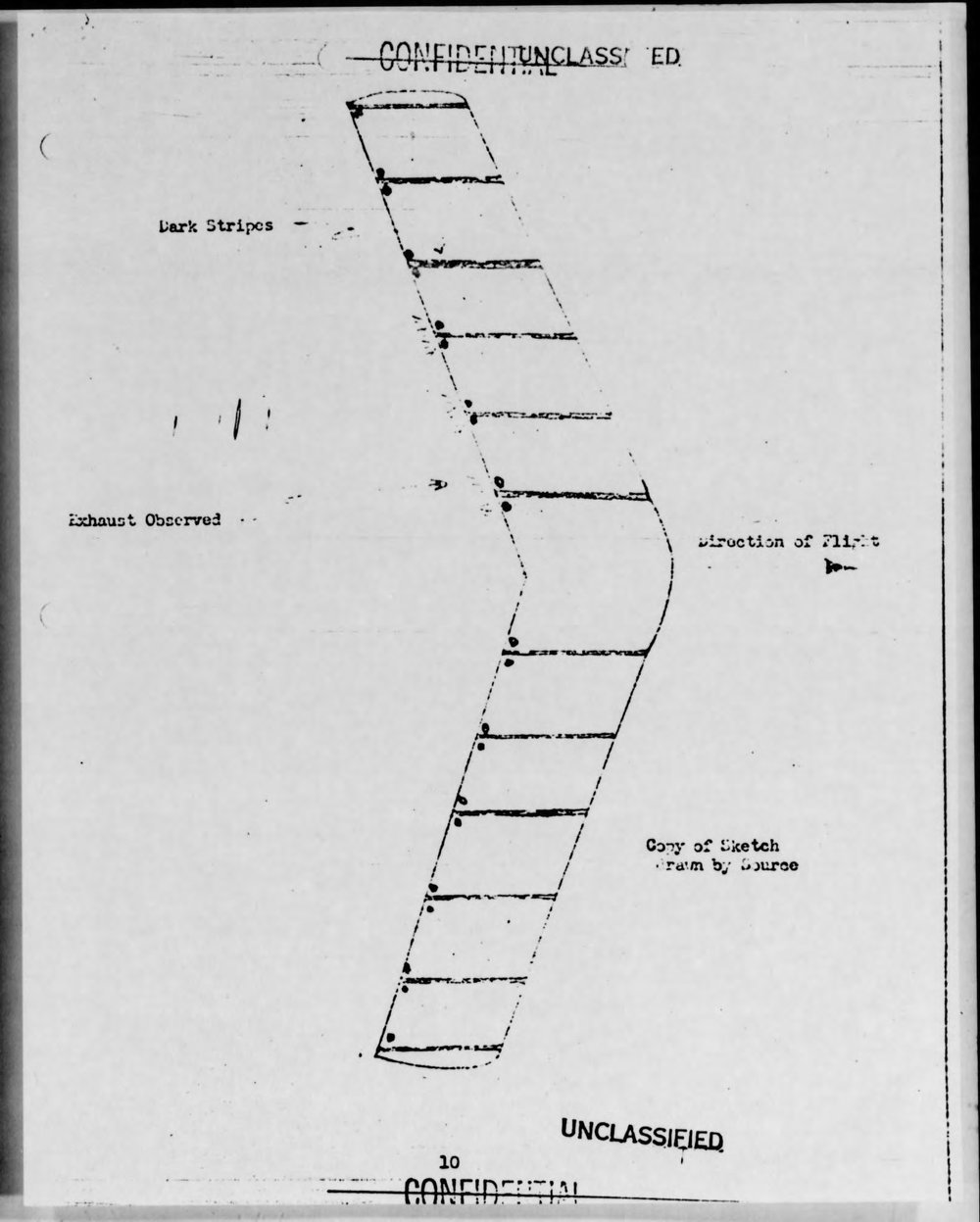
That same Saturday night, in a trailer park at 4212 East Copper Avenue in Albuquerque, H. R. Young, a night-shift security guard for the Sandia Corporation at Sandia Base who held a “Q” clearance, was standing outside his trailer with his wife, waiting for his ride to work. At 9:58 p.m. Mountain time something came over from the north on a heading of about 160 degrees, at what they guessed was 800 to 1,000 feet. As Young described it to the agent of the Office of Special Investigations who took the report, it was like the Northrop flying wing, the B-49: no fuselage, wings swept back about 15 degrees with no taper, one and a half to two times the size of a B-36. The lights of Central Avenue reflected off its underside. One of the two statements signed on August 26 describes it as “like a spread V,” says “there was no sound of motors or jets in fact there was no sound at all that I could hear,” and puts “soft white lights” on the rear edge, “located in pairs with not less than six of these on each side of center,” “very different from motor or jet exhausts as seen at night.” Dark stripes ran under the wings from front to back, ending between each pair of lights. The other statement called the silence “the most outstanding feature of this observation.” The first teletype made the lights “brilliant mercury white.” Kirtland’s check turned up only a transient B-25 that had landed at 9:07 and left at 10:19, and no radar return. The 34th Air Division forwarded the report with a shrug: it “might be considered significant but for the fact that its sighting can be substantiated by only two witnesses and no other evidence.” Nobody yet linked it with Lubbock, where the professors’ first flight had passed at 9:10 Central time, an hour and forty-eight minutes before the Youngs looked up.
Sources: Project Blue Book case file: Albuquerque, New Mexico, August 25, 1951Project Grudge Status Report No. 1, November 30, 1951 · Appendices I–VProject Grudge Status Report No. 2, December 31, 1951 · Appendices I–IV
The boy at the window
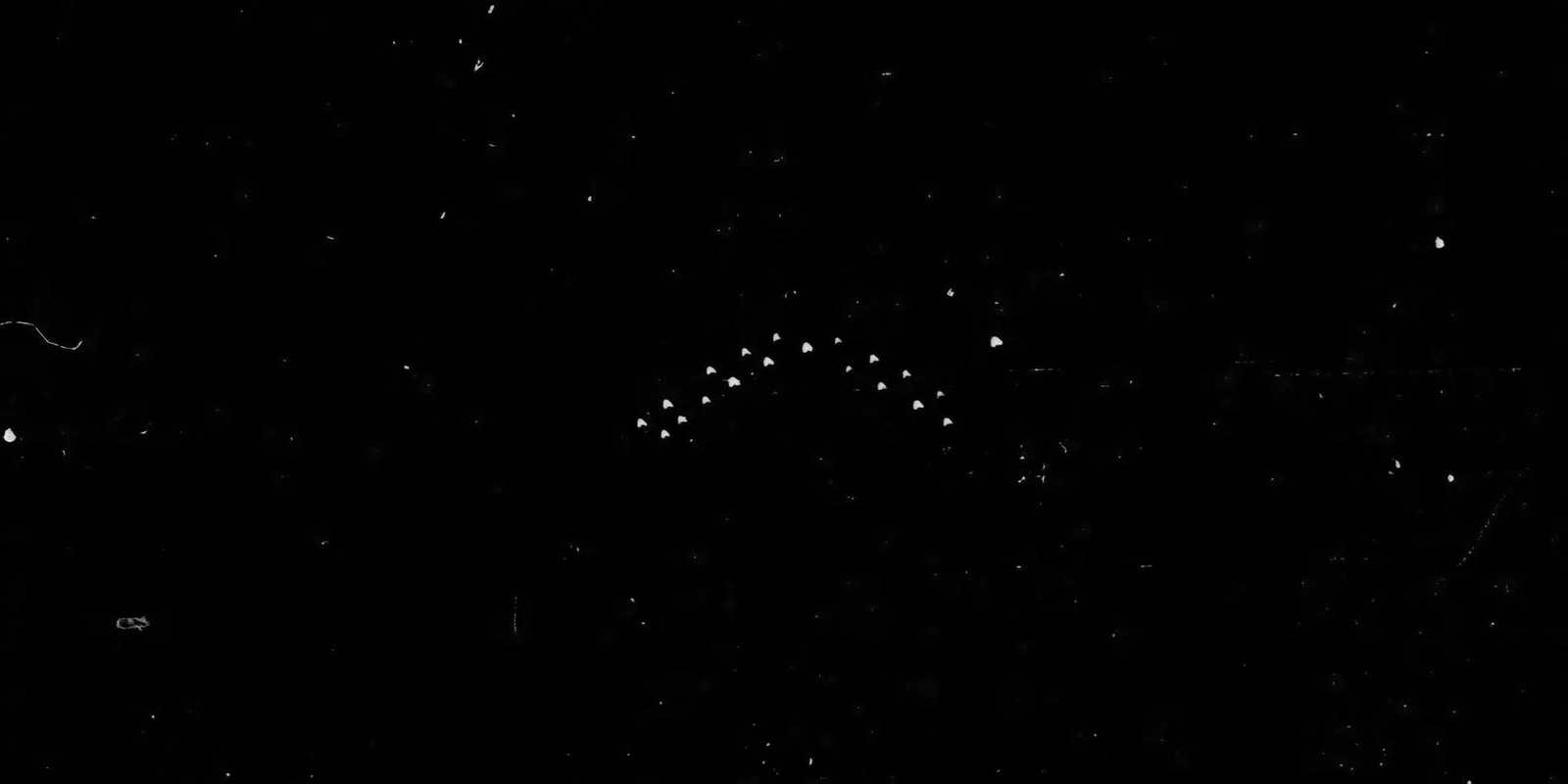
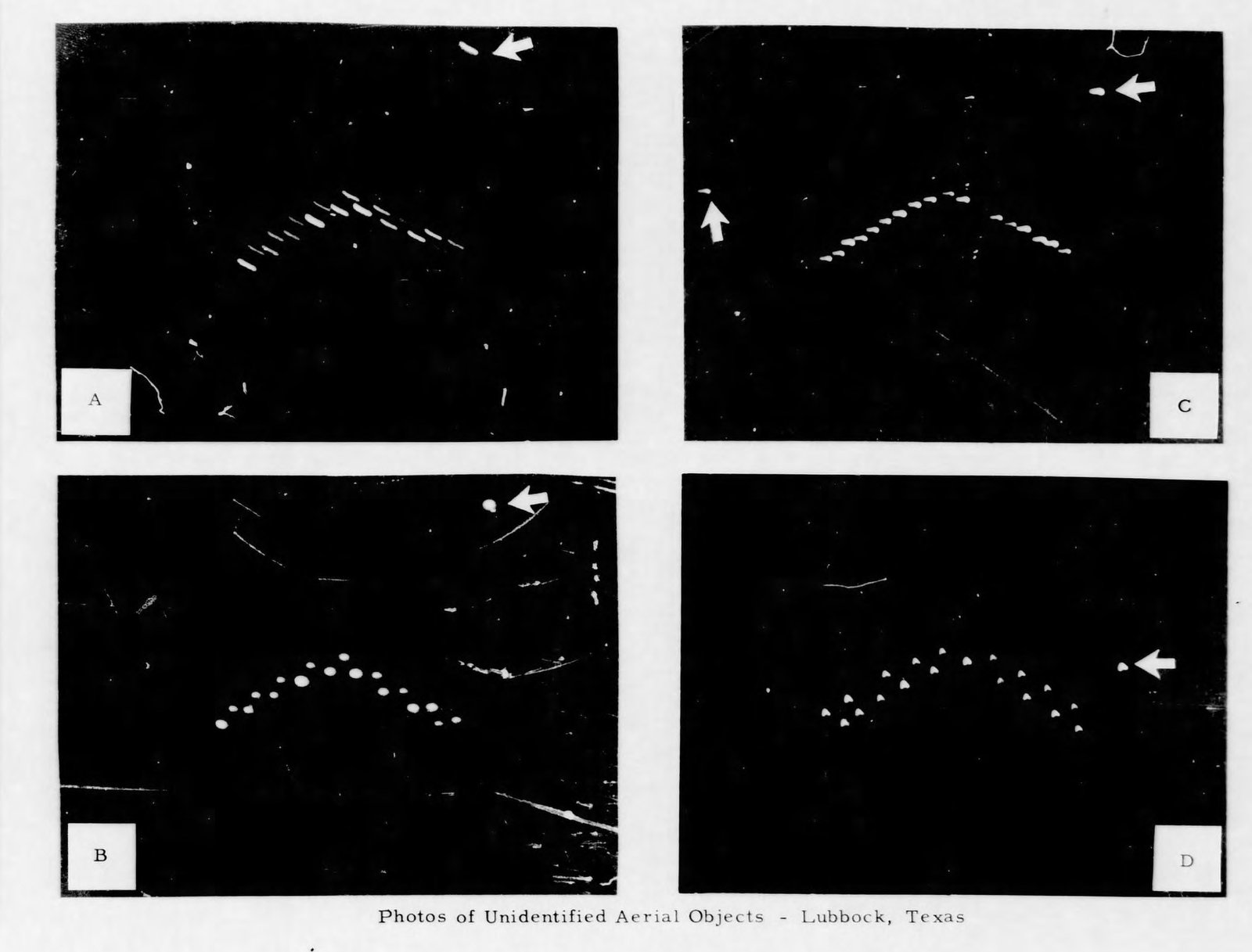
Five nights later, on Thursday, August 30, Carl Hart Jr., an eighteen-year-old Texas Tech freshman, was lying in bed at his family’s house at 2332 Nineteenth Street. “We didn’t have central air conditioning,” he told the researcher Kevin Randle in 1993. “I slept with the windows open, and I liked to sleep with my head stuck out the window — and there they were.” At about 11:30 p.m., by the account he gave the Office of Special Investigations, a formation passed over the house. “Being a camera ‘bug,’” he fetched his Kodak 35, a rangefinder camera, and went out into the back yard, where a line of trees blocked the view to the north and the house the view to the south. At about 11:32 a second formation came over and he took two pictures; at about 11:34 a third, and he took three more. He had experimented with photographing stars and knew he needed all the light he could get, so he “opened it up,” as Lieutenant Edward Ruppelt wrote in his notes, f/3.5 at a tenth of a second, the “fastest” combination the camera had, and swung it along with the lights. The objects, he said, “had a brilliance like reflected light but did not glitter”; they were white and did not twinkle like stars but had “a glow comparable to the moon,” eighteen or twenty of them in a rough V, gone in three or four seconds. He thought the objects kept shifting position within the formation, though he was “not too certain of that fact.” He was “emphatic” that there had been no noise, no exhaust and nothing to show what drove them. The agent who interviewed him recorded a blond crew cut, five feet eleven, 155 pounds, and “a very intelligent young man, very interested in photography, which is a hobby.” Overhead, Hart later said, the lights had looked like a U. On the negatives they made a V.
Sources: Project Blue Book case file: Matador, Texas, August 31, 1951Carl Hart and the Lubbock LightsProject Blue Book case file: Lubbock, Texas, August–November 1951 (filed as “1951-09 Orange, Va.”)Opinion Divided Over Reports of Objects Seen in Lubbock SkiesProject Grudge Status Report No. 2, December 31, 1951 · Appendices I–IV
“The best in the business”
Hart had seen the lights as so dim that he was sure he had caught nothing, and he waited until morning to develop the roll with a friend who ran a photo-finishing studio. The friend, who did work for the Avalanche, called the paper. Harris and his head photographer, William Hams, looked the negatives over, “dubious about using them because of the possibility of a hoax,” then examined them carefully and decided to run them. Harris, by his own account, “raised hell” with Hart on the phone and threatened to “run him out of town” if the pictures were fake. Hart answered that they were of something flying over Lubbock and that if the paper was afraid to use them, he didn’t care. He was paid between $7.50 and $10. When Harris decided to put the photographs on the wire, he read Hart the riot act again, and Hart stuck to his story. The negatives went to the Associated Press in Fort Worth to be checked. Life looked at the pictures too and passed, because, Harris said, it already had many photos of “flying saucers.” Hams, meanwhile, climbed onto the roof of the Avalanche building with a 4-by-5 Speed Graphic and a flashbulb in a concentrating reflector, the rig he used for night football. A ragged V of birds flew over, dimly visible under the city’s sodium-vapor street lights; he shot them and got images too weak to print, and the next night the same. He concluded that whatever Hart had photographed was many times brighter than birds. Harris told the Air Force that if Hart was a fake, “he is the best in the business and wasting his time in college.” Hart never copyrighted the pictures. “My advice from a friend and professional journalist at the time was that if [I] copyright them, somebody’s going to think [I] faked them and [was] trying to make money out of them,” he told Randle.
Sources: Project Blue Book case file: Lubbock, Texas, August–November 1951 (filed as “1951-09 Orange, Va.”)The Report on Unidentified Flying ObjectsCarl Hart and the Lubbock Lights
A yellow pear at Matador
At 12:45 the next afternoon, Friday, August 31, Mrs. Tom Tilson, her daughter Mrs. M. G. Bethard, whose husband had recently sailed for Korea, and five-year-old Noilene Bethard were driving on the highway a mile and a half north of Matador, about seventy miles northeast of Lubbock, when something crossed in front of their car. The Avalanche called it a “noiseless aircraft, flying at low altitude without aid of propellers and wings,” “shaped somewhat like a helicopter,” with a door or porthole in its gleaming side. When investigators from Reese and the OSI went out in September, the description sharpened: an aluminum or silver object “like a yellow pear shaped tomato,” moving small end forward, drifting east at about the height of the derrick at Bob’s Oil Well, a Matador landmark the agents measured at roughly 120 feet with its sign, and about the size of the town’s railroad freight shed, which they measured at 48 by 23 feet, “or perhaps larger.” Mrs. Bethard said it moved at less than the take-off speed of a Cub. Then it began to climb in a tight circle and was gone, in a few seconds by the OSI account and a few minutes by the newspaper’s. Interviewed later in Lawton, Oklahoma, the daughter said it seemed to be taking off or landing near a strip used by crop dusters, and that a highway repair gang had reportedly seen it later the same day following a small creek. The Air Force record card is blunt: “Duration much too short for a balloon. Disappearance too quickly. Case unidentified.”
Sources: ‘Strange Aircraft’ Seen at MatadorProject Blue Book case file: Matador, Texas, August 31, 1951Project Grudge Status Report No. 1, November 30, 1951 · Appendices I–VThe Report on Unidentified Flying Objects
Birds or beasts or ballyhoo
By the weekend Hart’s V was in the Avalanche, and on Saturday night, September 1, Kenneth May wrote, “skeptics made Lubbock look like a huge picnic ground” as hundreds of people sat outside looking up. The telephones started ringing as soon as it was dark. Mack Forrester of Thirty-fifth Street saw two flights at about 11:45 and was sure “they weren’t birds. They were too fast for aircraft.” W. S. Bledsoe, the chief engineer of radio station KFYO, saw “southbound birds of some sort. I could see the wings flapping.” Mrs. Stephen Matyl’s party on the Plainview highway could not agree among themselves, though they heard “a slight whooshing sound,” which made her only the second or third person to report any noise at all. A caller from Amherst Street was convinced the things were flying around the world about every hour and twenty minutes. A farmer, T. E. Snider, had watched from the Westerner Drive-In and said, “I saw something like people have been seeing, and it was definitely ducks.” Dr. J. C. Cross, head of Tech’s biology department, looked at Hart’s photograph and said the dots “definitely was not caused by birds.” Ducker, too, remained sure that what he had seen “definitely was not birds.” “Anyone trained in scientific observation won’t go half cocked on anything like that,” he said, adding that it was “outside the realm of consideration that two flights of birds would be in precisely the same formation.” He allowed that “some folks have seen some sort of birds formation and thought it to be the same thing we saw.” May summed up: “Birds or beasts or ballyhoo, it’s better than a comic book.”
Sources: Opinion Divided Over Reports of Objects Seen in Lubbock Skies‘Lubbock Lights’ have lost luster since celebrated UFO ‘sightings’ one night in ’51Project Blue Book case file: Lubbock, Texas, August–November 1951 (filed as “1951-09 Orange, Va.”)
The flight at 12:17
That same Saturday the three professors met again in Robinson’s garden, joined by E. R. Heineman, a mathematician, and Dr. E. F. George, director of the college’s seismological observatory, who had spent years in Alaska studying the aurora. At about 9:20 a flight came over, like the earlier ones but more irregularly grouped, with distinct individual objects. The professors’ signed statement counts two flights that night; the OSI account quoted by Jerome Clark has four more crossing from north to south through the evening. Then, at 12:17 a.m. on September 2, came what the professors later called the most unusual flight of all. It passed directly overhead, very low, and every member of the group saw it. In their signed report, an irregularly shaped yellow light appeared at the rear; “the formation included dark diffuse areas, and the arc itself quivered or pulsated in the direction of its travel.” One observer saw “a group of individually distinct yellow flames, approximately twelve or fifteen in number, traveling at an extremely high velocity,” each the apparent size of a foot-wide object thirty or forty feet away, “and in violent agitation.” Another saw twelve to fifteen pale objects “in the shape of a quadrant of a circle, producing a pale yellow blinking light, and moving noiselessly.” “The startling characteristics of this one flight,” they wrote, “made calm observation difficult to impossible.” On another evening, perhaps September 5, two more colleagues, Grayson Mead and John Brand, sat out with them. Mead later remembered lights “about the size of a dinner plate,” “greenish-blue, slightly fluorescent,” a dozen or fifteen moving “exactly together,” so that no one could say whether they were separate objects or “just one object with these different portholes of light.” He was a hunter, he said, and knew of no bird that could pass so fast and so close without being heard: “There was absolutely no sound to this at all — not a sound!” What it left them with was “an extremely eerie feeling.”
Sources: Project Blue Book case file: Lubbock, Texas, August–November 1951 (filed as “1951-09 Orange, Va.”)Lubbock Lights
Twelve official sightings and “Horror”
The professors went at the problem methodically. They timed the flights with stopwatches and measured angles with protractors, and settled on an angular speed of very nearly 30 degrees a second. They counted only sightings witnessed by at least two of their group, “twelve ‘official sightings,’” although they admitted many other reputable people had seen the lights. The flights seemed to keep a rough schedule, beginning about 9:20 and recurring every hour and ten minutes until three had passed, and the watchers had a name for the first one of the evening: “the 9:20.” They tried twice to triangulate the lights from the ends of a measured base line, eleven miles long the first time, with homemade angle-measuring devices and radios. On the first night neither party saw anything, although two of their wives saw the lights from town; on the second, one party thought it saw an object, “very low over the city of Lubbock,” but got no measurement. Only reluctantly, telling the Air Force the stories were absurd, did they mention two other incidents. The wife of one professor, described as a very calm woman, had once run into the house at dusk, very excited, saying a huge flying wing had passed silently over. And one evening, while they waited for the 9:20, a group of yellowish lights crossed the yard very low with a “wiggling” motion that upset one of the scientists so much that they called it “Horror.” They dropped it because no neighbor had seen it and it was too low. By the time Ruppelt arrived they had dropped the inquiry. No one from the Air Force had come, and they had concluded that the lights were “some kind of a new weapon belonging to the U.S.” and that they “would only be prying into something that was none of their business.”
Sources: Project Blue Book case file: Lubbock, Texas, August–November 1951 (filed as “1951-09 Orange, Va.”)Project Grudge Status Report No. 1, November 30, 1951 · Appendices I–VProject Grudge Status Report No. 2, December 31, 1951 · Appendices I–IV
Questions from Dayton
The Air Force had in fact been slow. On September 7 the OSI’s Fort Worth district sent clippings to Washington with the note that “no further action is being taken at this time.” Then a teletype from Air Materiel Command classified the matter secret and asked Reese to investigate. On September 17 Special Agent Howard N. Bossert and Lieutenant John A. Farley called on Charles Guy, publisher of the Avalanche, who “without any questions” helped them gather the paper’s stories; on September 18 Farley interviewed Mrs. Tilson at Matador; on September 20 he and Bossert sat with Hart at his house, took the four negatives he could still find and photographed the young man himself. At the Air Technical Intelligence Center in Dayton someone drew up ten questions for the field. Did the professors make any measurements? Were ducks seen in daytime? And number nine: “What is possibility of hoax started by college professors?” Perhaps they had wanted to run a mass hysteria experiment: “Since they are supposedly qualified, their statements would go over big. Maybe they planted the photos.” On October 10 Lieutenant Henry Metscher set the Lubbock beads, Hart’s V and the Albuquerque chevron side by side and concluded that the photographs “agree with the description of pairs of lights” on the wing. ATIC asked Strategic Air Command whether any B-36 had been over Albuquerque, Lubbock or Matador at the times in question. The answer was “NEGATIVE,” and none of Northrop’s flying wing bombers had been flying either.
Sources: Project Blue Book case file: Lubbock, Texas, August–November 1951 (filed as “1951-09 Orange, Va.”)Project Blue Book case file: Matador, Texas, August 31, 1951Project Blue Book case file: Albuquerque, New Mexico, August 25, 1951
Lieutenant Ruppelt goes to Lubbock
Lieutenant Edward J. Ruppelt, who was rebuilding the Air Force’s dormant UFO project, Grudge, arrived on November 6 and stayed three days. With Bossert he took Hart through the night again in his back yard: the lights had come up about 30 degrees above the horizon, just over a treetop to the north-northeast, and set about 30 degrees up in the south-southeast, an arc of about 120 degrees, which Hart’s re-enactment, timed on a wristwatch, crossed in four seconds. That was 30 degrees a second, the professors’ figure. Ruppelt, an amateur photographer for fourteen years, found every detail “accurate and very logical.” Hart was visibly nervous with an OSI agent and an officer from Wright-Patterson in his house, but his story “could not be ‘picked apart’ because it was entirely logical.” On the morning of November 8 Ruppelt and Captain E. S. Parker drove to Brownfield, where the back files of the Brownfield News turned up one report unlike the rest. Joe Bryant, a retired man of about sixty-five, had been sitting in his back yard with his wife on the night of August 25 when groups of lights, “kind of a glow, a little bigger than a star,” passed over, not in a V. A third group circled the house lower down, and he could see that they were birds; one of them called, and he knew the call of a plover. That afternoon a federal game warden in Lubbock told them that plovers fly at night in groups usually no bigger than five or six, had been seen around Lubbock lately “although not in great numbers,” and he doubted they were the culprits. Ducks perhaps, but not geese, which honk as they go. That evening, at Robinson’s house, the professors told their story and said they were “rather firmly convinced” the lights were not birds. Meteors were falling that week. Two were reported as crashed aircraft, B-25s went out searching, and Tech people brought back material that might turn out to be ash from the cotton gins; if so, the college’s chemists said, it would be high in potassium.
Sources: Project Blue Book case file: Lubbock, Texas, August–November 1951 (filed as “1951-09 Orange, Va.”)The Report on Unidentified Flying ObjectsLubbock Lights
What the laboratory saw
Back in Dayton the negatives went to the Photographic Reconnaissance Laboratory at Wright Field, then headed by Colonel George W. Goddard. Its physicists plotted every spot on three frames and found roughly twenty in a flat V, in two rows on three negatives and a single row on the fourth. Their test report, dated November 29, 1951, found “relative movement within the formation of spots, so that they are not lights on a fixed object”: one row held close to a precise V, while the other seemed to pass from above it, through it, to below. At a mile, the formation would have been 310 feet across, give or take 30. No stars registered at all, so the lights had acted on the film more strongly than any star; if the pictures were genuine, Grudge noted at the end of December, a light that looked dim to the eye had been “highly actinic.” The pattern of brightness proved “conclusively” that all three frames showed the same group of spots. Goddard’s verdict, on December 3, was that “it is not possible at this time to confirm or deny the authenticity of these negatives as a record of unknown objects against either a starlit or overcast sky.” Grudge’s first status report mentioned “two discrepancies” in the photographs, never specified; the OSI questioned Hart privately again on December 2, got a short written statement that he had taken the pictures on August 30, and closed its file. In Albuquerque, on November 10, the Youngs were shown the photographs and said the formation of lights “appeared similar” to what they had seen; Young sketched a wing around them. In March 1952 ATIC returned Hart’s four negatives with thanks.
Sources: Project Blue Book case file: Lubbock, Texas, August–November 1951 (filed as “1951-09 Orange, Va.”)Project Grudge Status Report No. 1, November 30, 1951 · Appendices I–VProject Grudge Status Report No. 2, December 31, 1951 · Appendices I–IVProject Blue Book case file: Albuquerque, New Mexico, August 25, 1951
A mother craft and its brood
The Avalanche had sat on a story for months at the Air Force’s request, its 2009 retrospective says, and on April 4, 1952, it ran it: “‘Flying Whatsits’ Seen as Possible ‘Space Visitors.’” Three days later Life, the magazine that had passed on Hart’s pictures the previous September, ran them across pages 80 and 81 as “Incident 1” of “Have We Visitors from Space?” The pictures, Life wrote, showed eighteen to twenty luminous objects “more intense than the planet Venus,” and in several, off to one side, “a larger luminosity is visible — like a mother craft hovering near its aerial brood.” The Air Force, it said, “after the closest examination, has found nothing fraudulent about Hart’s pictures. The lights are much too bright to be reflections, and therefore must be bodies containing sources of light.” That June the Harvard astronomer Donald Menzel answered in Look: the lights were mirages of distant street lamps in a temperature inversion, which “appear to fly in formation — the Lubbock Light phenomenon,” and he printed a laboratory photograph beside one of Hart’s. In Lubbock, George said, “I don’t believe that what I saw was a reflection from street lights.” Ducker was more careful. The group had never claimed to know what they saw, only that they saw something, and “to determine what something is you have to get your hands on that something itself.” Everything seen is either radiated light, like a star, or reflected light, like the moon, he said: “I would say there is a 50 per cent chance that what we saw was by reflected light.” But, the Tech men insisted, “what we saw definitely was not ducks.”
Sources: ‘Lubbock Lights’ have lost luster since celebrated UFO ‘sightings’ one night in ’51Have We Visitors from Space?Scientist at Texas Tech Denies ‘Lubbock Lights’ Were Caused by Reflection of City Street Lamps
The chapter Ruppelt wrote
In 1956 Ruppelt, by then out of the Air Force, published The Report on Unidentified Flying Objects, with a long chapter titled “The Lubbock Lights, Unabridged.” It is the version most people know, and it differs from the 1951 file at almost every turn. In the book the Albuquerque couple sit in their back yard “about dusk,” and the professors see their lights at 9:20, “just twenty minutes after the Albuquerque sighting,” so that a 900-mile-an-hour wing could have flown from one to the other; in the file the Youngs stood outside waiting for a ride at 9:58 Mountain time, after Lubbock, not before. The book has four professors in the yard that first night, George among them; the newspaper, the OSI and the professors’ own statement have three. Hart’s pictures move to August 31, the date Grudge’s own status reports had also used, although the OSI, the photo lab and the Avalanche all put them on the night of the 30th. Ruppelt’s wire to Albuquerque brings back an answer the next day, “Observers immediately said that this is what they saw”; the documents show a letter of October 30 and a viewing on November 10. The Larson radar track happens “just after midnight” and is written off as weather, when Grudge recorded it at 8:36 in the morning and blamed possible interference. Joe Bryant of Brownfield, sixty-five, whose glow was unlike the Lubbock descriptions, becomes an old gentleman of about eighty in Lamesa, full of range wars and stagecoaches, whose sighting is “identical to what the professors described” and whose bird actually said “Plover.” The game warden who doubted plovers now reports “more than the usual number of plovers in the area that fall.” The professor’s wife and her undated flying wing are gone. In their place is a retired rancher Ruppelt met by chance on the plane home, whose wife had come in from the clothesline “as white as the sheets she was carrying” about ten minutes before the professors’ first sighting, having seen “an airplane without a body” with pairs of bluish lights on its back edge. That story cannot be checked against the file: by the book’s own account, Ruppelt finished his report before he left Lubbock. As Jerome Clark pointed out, Bryant’s plovers became an important clue only in the rewritten version.
Sources: The Report on Unidentified Flying ObjectsProject Blue Book case file: Lubbock, Texas, August–November 1951 (filed as “1951-09 Orange, Va.”)Project Blue Book case file: Albuquerque, New Mexico, August 25, 1951Project Grudge Status Report No. 1, November 30, 1951 · Appendices I–VLubbock Lights
Moths, plovers, ducks
The book ended the case on a riddle. Officially, Ruppelt wrote, every sighting but the radar track was an unknown, and the photographs “were never proven to be a hoax but neither were they proven to be genuine.” Yet the professors’ lights had since been “positively identified as a very commonplace and easily explainable natural phenomenon” by a scientist who had spent months with “complete instrumentation” and who had been promised anonymity. In the revised edition of 1960, the year he died of a heart attack at thirty-seven, Ruppelt named the answer: “night flying moths reflecting the bluish-green light of a nearby row of mercury vapor street lights.” Forty years later the researchers Michael Hall and Wendy Connors, working from Ruppelt’s papers, reported that the scientist was Ducker himself, who after much experiment had concluded the lights were plover, and that nothing in Ruppelt’s notes explains the moths. Project Blue Book’s own final card says that in 1959 J. Allen Hynek was told by a Tech professor that his extensive study had shown they were “definitely birds,” and settles on birds lit from below by street lights, probably ducks, since plovers seldom fly in groups of more than six or seven. Hart’s skill at panning, it adds, suggests the lights were slower than estimated. The photographs never got a separate verdict. In 1977 Ground Saucer Watch, a Phoenix group, ran computer tests and called them “a formation of extraordinary flying objects,” while Menzel and Ernest Taves wrote that “some of the Lubbock photographs may have been hoaxes.” Hart, who said the professors “felt like I had stolen their glory,” never heard an official version. Asked by Randle in 1993 whether he believed in flying saucers, he said, “I don’t particularly disbelieve.” Asked whether he knew what the lights were, he said, “I really don’t.” By the 1970s, the Texas Tech archivist Monte Monroe has said, the witnesses had almost entirely stopped giving interviews.
Sources: The Report on Unidentified Flying ObjectsPart of the reason we’re named Lubbock Lights honors ‘51 UFO mystery; here’s the story of how answer died with investigatorReview of Hall and Connors, Captain Edward J. Ruppelt: Summer of the Saucers – 1952Project Blue Book case file: Lubbock, Texas, August–November 1951 (filed as “1951-09 Orange, Va.”)‘Lubbock Lights’ have lost luster since celebrated UFO ‘sightings’ one night in ’51Carl Hart and the Lubbock LightsThe Unsolved Mystery of the Lubbock Lights UFO Sightings
The file under the wrong name
The core of the case is a 118-page Project Blue Book file that the National Archives microfilm indexes not under Lubbock but under “1951-09 Orange, Va.” It holds photostats of the Avalanche stories of August 26, August 28, September 1, 2 and 6, the OSI spot report of September 7, Ruppelt’s trip report of November 6–9, the statement signed by Ducker, Robinson, Oberg and George and forwarded from Reese on November 21, the OSI’s closing report on Hart of December 5, the Wright Field photo-lab test report with its hand-plotted charts, and the undated final evaluation that cites Hynek’s 1959 conversation. Smaller files under Lubbock, Matador and Albuquerque hold the four prints, the OSI report on the Hart interview and the Albuquerque statements and sketches, and Grudge’s status reports of November and December 1951 summarize the case. Names are blacked out throughout, and the OCR of the microfilm is rough, but the documents are contemporary and agree with each other on most details that later retellings changed.
Sources: Project Blue Book case file: Lubbock, Texas, August–November 1951 (filed as “1951-09 Orange, Va.”)Project Blue Book case file: Lubbock, Texas, August 30, 1951 · 4 photosProject Blue Book case file: Matador, Texas, August 31, 1951Project Blue Book case file: Albuquerque, New Mexico, August 25, 1951Project Grudge Status Report No. 1, November 30, 1951 · Appendices I–VProject Grudge Status Report No. 2, December 31, 1951 · Appendices I–IV
What the professors measured, and what they could not
The Tech group’s data are better than most sighting reports: angular speed timed with stopwatches and protractors at about 30 degrees a second, a flight path usually north to south, two or three flights a night roughly seventy minutes apart, no sound, and a rule that a sighting counted only with two witnesses. What they never got was a distance. The base-line attempts failed because the lights did not appear when the teams were in place, an astronomer’s triangulation from three lay witnesses gave 2,000 to 3,000 feet but was discarded, and the clouds were never close enough to the lights to compare. Without altitude, every speed and size quoted at the time, from Ducker’s 18,000 miles an hour to Blue Book’s 60 miles an hour at 163 feet, is an assumption. Even their descriptions disagree: the signed statement has bluish-green scintillating points as dim as moonlit cirrus, while Ruppelt’s notes say the men “could not agree on the color except that it was yellowish to white” and that all agreed the lights seemed to have their own source.
Sources: Project Blue Book case file: Lubbock, Texas, August–November 1951 (filed as “1951-09 Orange, Va.”)Project Grudge Status Report No. 1, November 30, 1951 · Appendices I–V
Five negatives, four survivors
Hart’s photographs are the only physical evidence. Five exposures were made; one negative was lost before the Air Force borrowed the rest, and by then the four survivors were scratched and dirty from handling. The laboratory confirmed real photographic images, not retouching, found spots brighter than any star and moving relative to each other, and said it could neither confirm nor deny that the negatives recorded unknown objects in a night sky. It recommended tests of how much blur an experienced photographer panning at night would produce; there is no record that they were made. Ruppelt’s own attempt with a matching camera produced only two badly blurred shots in four seconds, and the professors doubted the pictures showed what they had seen: their lights were dim and usually unordered, Hart’s were bright and in a neat V. Against that, Hart’s account never changed under repeated questioning, Harris, the AP and the Air Force all looked for a hoax and found none, and no one has shown how the pictures could have been faked. The original negatives were returned to Hart in March 1952.
Sources: Project Blue Book case file: Lubbock, Texas, August–November 1951 (filed as “1951-09 Orange, Va.”)Project Grudge Status Report No. 2, December 31, 1951 · Appendices I–IVThe Report on Unidentified Flying ObjectsCarl Hart and the Lubbock Lights
The Albuquerque link
The connection that excited Ruppelt rests on two things: the Youngs’ description of paired soft lights on the trailing edge of a silent wing, and their statement on November 10, after seeing Hart’s prints, that the lights “appeared similar.” The timing does not help. The wing passed Albuquerque at 9:58 p.m. Mountain time, an hour and forty-eight minutes after the professors’ first flight, so the book’s eastbound wing reaching Lubbock in fifteen minutes is impossible on the file’s own times. The Youngs were shown the photographs more than two months after the fact, and the file does not say how the question was put to them. The only Lubbock wing in the documents is the professor’s wife’s, undated and never formally reported, because she thought she had seen an illusion. No other Albuquerque witness, airway controller or radar saw anything that night.
Sources: Project Blue Book case file: Albuquerque, New Mexico, August 25, 1951Project Grudge Status Report No. 2, December 31, 1951 · Appendices I–IVProject Blue Book case file: Lubbock, Texas, August–November 1951 (filed as “1951-09 Orange, Va.”)The Report on Unidentified Flying Objects
Birds: the case for and against
Birds were proposed within hours, and the file contains real evidence for them: Bryant’s plovers circling his house in Brownfield on the first night, Snider’s ducks, Bledsoe’s flapping wings, Hams’s ragged V lit by the street lights, and the professors’ wives seeing lights from town on nights when the men out on the base line saw nothing, as low birds would be seen only nearby. Against them, the game warden doubted plovers and said they flew in groups of five or six, the professors, Mead and at least one experienced duck hunter insisted that what they saw was too fast, silent and orderly for birds, and Hams’s birds were far too faint to photograph. Blue Book’s final answer, ducks or plovers under street lights, came eight years later and rests mainly on a secondhand report of one professor’s private study; Ruppelt’s moths are documented nowhere in his own papers, according to Hall and Connors. Neither explanation addresses Hart’s photographs directly.
Sources: Project Blue Book case file: Lubbock, Texas, August–November 1951 (filed as “1951-09 Orange, Va.”)Opinion Divided Over Reports of Objects Seen in Lubbock Skies‘Lubbock Lights’ have lost luster since celebrated UFO ‘sightings’ one night in ’51Review of Hall and Connors, Captain Edward J. Ruppelt: Summer of the Saucers – 1952The Report on Unidentified Flying Objects
- ABOUT 20–24 AUG 1951
J. Russell Heitman, head of Texas Tech’s journalism department, sees a flight of objects over Lubbock “several nights” before the professors.
- 25 AUG 1951 · 9:10 PM CST
Ducker, Oberg and Robinson, watching for meteors in Robinson’s back yard, see a crescent “string of beads” cross the sky; a second flight follows about three minutes later.
- 25 AUG 1951 · EVENING
In Brownfield, Joe Bryant and his wife watch groups of glowing lights; a third group circles the house and he hears the call of a plover.
- 25 AUG 1951 · 9:58 PM MST
In Albuquerque, H. R. Young and his wife see a silent wing one and a half times the size of a B-36 with paired soft lights on its trailing edge.
- 26 AUG 1951
The Avalanche runs “Strange Objects Seen Over City.” At 8:36 a.m. Pacific time, radars at Larson AFB, Washington, track a target at 950 mph for six minutes.
- 27 AUG 1951
Four more Lubbock witnesses confirm the Saturday flight; “Operation Beads” is in the paper the next morning.
- 30 AUG 1951 · ABOUT 11:30 PM
Carl Hart Jr. sees a formation from his bed, takes his Kodak 35 into the back yard, and makes five exposures of two more flights.
- 31 AUG 1951
Hart’s film is developed and taken to the Avalanche. At 12:45 p.m. two women and a child near Matador see a silent pear-shaped craft climb away in a tight circle.
- 1 SEP 1951
Hundreds of Lubbock residents sit outside to watch. Heineman and George join the professors, who see two flights by their signed statement, five by the OSI’s account.
- 2 SEP 1951 · 12:17 AM
The professors’ “most unusual flight”: a low, quivering arc of yellow lights “in violent agitation.” Kenneth May’s story and Hart’s photograph run that day.
- 5 SEP 1951
The Tech group, now including six Ph.D.s, watches three flights; one passes over a cloud.
- 7 SEP 1951
The OSI sends clippings to Washington and notes that no further action is being taken.
- 17–20 SEP 1951
OSI agent Howard Bossert and Lieutenant John Farley meet the Avalanche’s publisher, interview Mrs. Tilson at Matador, and collect four negatives from Hart.
- 10 OCT 1951
Lieutenant Henry Metscher links the Lubbock lights and Hart’s photographs with the Albuquerque wing.
- 6–9 NOV 1951
Ruppelt visits Lubbock: Hart re-enacts his photographs, Bryant tells of plovers, a game warden doubts them, and the professors give their account.
- 10 NOV 1951
In Albuquerque the Youngs are shown Hart’s photographs and say the lights “appeared similar.”
- 29 NOV – 3 DEC 1951
The Wright Field photo lab reports relative motion among the lights and says it cannot confirm or deny the negatives.
- 2–5 DEC 1951
The OSI questions Hart again, finds nothing new, and closes its file.
- 7 APR 1952
Life prints Hart’s photographs as “Incident 1” of “Have We Visitors from Space?”
- JUNE 1952
Donald Menzel calls the lights mirages of street lamps in Look; George and Ducker disagree in the Avalanche.
- 1956
Ruppelt publishes “The Lubbock Lights, Unabridged,” announcing that an anonymous scientist has solved the professors’ sightings.
- 1959
A Texas Tech professor tells J. Allen Hynek his study showed the lights were birds; Blue Book settles on birds lit by street lights.
- 1960
Ruppelt’s revised edition says the lights were moths; he dies the same year.
- 1977
Ground Saucer Watch endorses Hart’s photographs; Menzel and Taves suggest some may be hoaxes.
Sources & interviews
Project Blue Book case file: Lubbock, Texas, August–November 1951 (filed as “1951-09 Orange, Va.”)U.S. Air Force · Project Grudge/Blue Book · National Archives microfilm, via Wikimedia Commons · 118 pages: Avalanche clippings, OSI spot report, Ruppelt’s trip report of November 6–9, 1951, the professors’ signed statement, the photo-lab test report and the final evaluationProject Blue Book case file: Lubbock, Texas, August 30, 1951 · 4 photosU.S. Air Force · Project Blue Book · National Archives microfilm, via Wikimedia Commons · Carl Hart Jr.’s prints, OSI inclosures 7–10Project Blue Book case file: Albuquerque, New Mexico, August 25, 1951U.S. Air Force · Project Blue Book · 33 pages: OSI Kirtland spot report, the two witness statements of August 26, 1951, sketches, and the OSI report of November 14, 1951 · via Wikimedia CommonsProject Blue Book case file: Matador, Texas, August 31, 1951U.S. Air Force · Project Blue Book · includes OSI District 23 report by Special Agent Howard N. Bossert, October 8, 1951, on the Hart interview · via Wikimedia CommonsProject Grudge Status Report No. 1, November 30, 1951 · Appendices I–VAir Technical Intelligence Center · Wright-Patterson AFB · transcription by Patrick GrossProject Grudge Status Report No. 2, December 31, 1951 · Appendices I–IVAir Technical Intelligence Center · Wright-Patterson AFB · transcription by Patrick Gross‘Strange Aircraft’ Seen at MatadorLubbock Morning Avalanche · September 1, 1951 · transcription by Patrick GrossOpinion Divided Over Reports of Objects Seen in Lubbock SkiesKenneth May · Lubbock Morning Avalanche · September 2, 1951 · with the Hart photograph · transcription by Patrick GrossScientist at Texas Tech Denies ‘Lubbock Lights’ Were Caused by Reflection of City Street LampsKenneth May · Lubbock Morning Avalanche · June 3, 1952 · reprinted in UFO Newsclipping Service no. 485 (December 2009) · via the Internet ArchiveHave We Visitors from Space?H. B. Darrach Jr. and Robert Ginna · Life 32(14) · April 7, 1952 · pp. 80–96 · via Google Books and the Internet ArchiveThe Report on Unidentified Flying ObjectsEdward J. Ruppelt · Doubleday, 1956; revised edition 1960 · chapter 8, “The Lubbock Lights, Unabridged” · Project Gutenberg ebook #17346Carl Hart and the Lubbock LightsKevin D. Randle · International UFO Reporter 18(5) · September/October 1993 · pp. 16–19 · via the Internet ArchiveLubbock LightsJerome Clark · The UFO Book: Encyclopedia of the Extraterrestrial · Visible Ink, 1998 · via the Internet ArchiveReview of Hall and Connors, Captain Edward J. Ruppelt: Summer of the Saucers – 1952Christopher D. Allan · Magonia Supplement 36 · June 30, 2001 · via the Internet Archive‘Lubbock Lights’ have lost luster since celebrated UFO ‘sightings’ one night in ’51Doug Hensley · Lubbock Avalanche-Journal · March 1, 2009 · reprinted in UFO Newsclipping Service no. 477 · via the Internet ArchivePart of the reason we’re named Lubbock Lights honors ‘51 UFO mystery; here’s the story of how answer died with investigatorJames Clark · LubbockLights.com · October 31, 2024The Unsolved Mystery of the Lubbock Lights UFO SightingsHadley Meares · History.com · August 24, 2018, updated May 28, 2025Spotted an error, or know a better source? Write to hello@uap.fun.
Connected files
Inside Project Blue BookThe case that, in Ruppelt’s words, “plunged the Air Force, and me, into the UFO mystery on a grand scale,” and whose final card still reads birds under street lights.J. Allen HynekThe astronomer whose 1959 call to a Texas Tech professor produced the “definitely birds” on which the Air Force closed the case.The Levelland NightSix years later and about 27 miles west, cars stalled on the roads around Levelland, and Ruppelt wrote that he read the reports with “a tug of nostalgia.”The Washington FlapThe next summer’s great wave, when Ruppelt, by then head of Blue Book, chased radar targets over the capital instead of lights over Texas.Nine Objects over Mount RainierThe first great “formation” sighting, which Life retold beside Hart’s photographs in the same April 1952 article.The Death of Captain MantellAnother early Air Force case whose official answer changed over the years, from Venus to a secret balloon.Discuss this case
Compare notes with other readers: witness details, sources, and the parts that still do not add up.
Open the discussion