The yard light that rose
In 1968 the prairie north and northwest of Minot Air Force Base was a nuclear landscape. The 91st Strategic Missile Wing kept 150 Minuteman missiles in silos scattered across the wheat country in flights of ten, each flight run from an underground capsule beneath a Launch Control Facility and guarded at the surface by a Flight Security Controller and a two-man Security Alert Team. For weeks before October 24, SSgt. William Smith Jr., the security controller at Oscar-1, twenty-eight miles north of the base, had been watching lights that drifted east and west, stopped, climbed a little and reversed. He reported them and was told to keep them under observation. In a 2001 interview he remembered a “dull reddish white” glow and lights that “were just not doing things we thought aircraft should be doing this time of the morning.” At 2:15 a.m. on October 24, a two-man camper team, A1C R. McDowell and A1C W. Johnson, radioed him from what was apparently the Oscar-6 launch facility, where a targeting team was working on a missile with its warhead exposed: there was a strange light near their post. Smith later recalled that they saw a glowing object go down by some trees not far away, and that the targeting team’s captain decided it was not worth staying out, closed the silo and went back to base. At 2:30 Smith saw the light himself, about ten miles to the south and fifteen degrees above the horizon. At the same moment, two airmen of the 91st Missile Maintenance Squadron, A1C Robert O’Connor and A1C Lloyd Isley, were driving a gravel road toward the November-7 launch facility for routine maintenance. Five miles short of the site they noticed a light low in the east. “It appeared to be between two farmer yard lights, which were a little smaller,” O’Connor wrote on his Air Force questionnaire, “then the object grew brighter moving S.E.” Interviewed in 2005, he described what he had taken for a farmer’s yard light rising and running parallel to the truck, almost on the ground and lighting it up; once it was moving, he said, the yard light “wasn’t there [any] more.” On his form he wrote that the object “seemed to be observing us,” and that when they stopped and turned out their headlights, it seemed to stop as well. They radioed the base and were told no aircraft or helicopters were up. The two men were unarmed. O’Connor remembered Isley climbing into the back of the truck for an axe, “just in case there were some little green men or something.” Plotting the sightings later, the researcher Thomas Tulien found that Smith’s bearing and the maintenance team’s both pointed to the same spot, near Oscar-6.
Sources: BackgroundNarrative of UFO Events at Minot AFB on 24 October 1968 · 1. Ground-visual UFO Observations (2:15–3:44)Interviews
A stingray over November-7
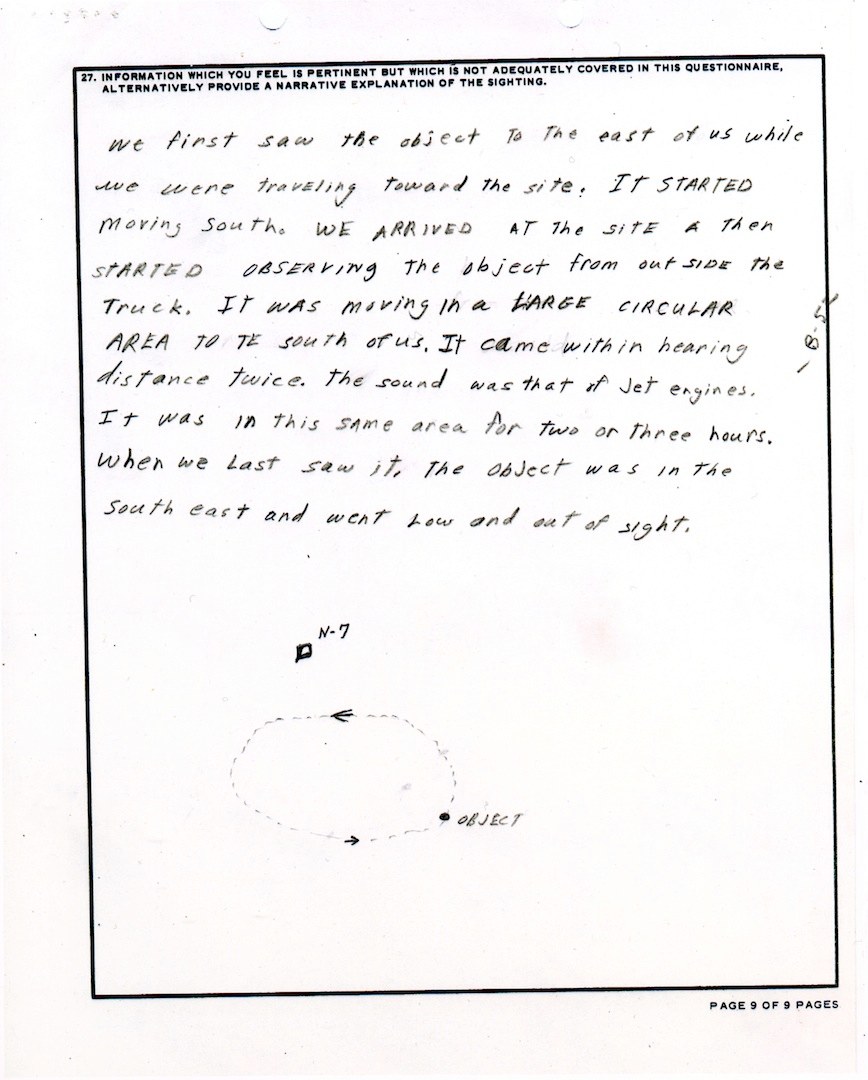
At November-7 the two men parked outside the gate and watched the light circle a large area to the south. Isley wrote that it showed lights on the front “like headlights or landing lights” and a flashing green light toward the middle or rear, that it looked about the size of a KC-135 tanker judging by its lights, and that it “came within hearing distance twice. The sound was that of jet engines.” In 2001 he was less sure, recalling more of a rush of air than an engine. O’Connor saw a “big ball of white-light” that faded to dim green and then dim amber and seemed to take on “the appearance of a stingray fish,” too bright to show any definite shape; once, he estimated, it came within half a mile. Their radio query had been passed to the Base Operations dispatcher, who confirmed nothing was flying, patched the line through to the control tower and the Radar Approach Control, known as RAPCON, and kept O’Connor describing the object for the next two hours, logging what he said. Shortly after 3:00 O’Connor unlocked the gate and went down into the Launch Support Building to phone in. The first entry, at 3:00 a.m., reads: “Object S/E of N-7 moving toward site with brilliant light like the sun. … It’s too brilliant and big for an aircraft.”
Sources: Narrative of UFO Events at Minot AFB on 24 October 1968 · 1. Ground-visual UFO Observations (2:15–3:44)AF Form 117, Sighting of Unidentified Phenomena Questionnaire · A1C Lloyd M. IsleyBase Operations Dispatcher’s log, 0800–1010Z, 24 October 1968
Two of them
O’Connor’s call went to SSgt. James Bond, the security controller at November-1, ten miles north. A1C Joseph Jablonski, on Bond’s alert team, remembered O’Connor’s voice sounding close to hysterical; from outside the facility he could see a bright light above N-7’s security lights, “alternating all kinds of pretty colors.” At 3:08 Bond reported to Wing Security Control, and the news spread to neighboring flights. Jablonski and A1C Gregory Adams collected their weapons and set off for N-7, and on the road, Jablonski wrote, “another object exactly the same appeared out of the East” and sped toward the first before vanishing. At 3:20 the wing security controller logged a report that Smith, at Oscar-1, had seen the object separate into two parts that went in opposite directions, returned and passed under each other, and that teams at Juliet and Mike flights described the same thing minutes later. The dispatcher wrote at 3:28: “Two are seen now.” Thirty-seven years on, Jablonski added something he admitted he might not have put in his report: more than ten small lights streaming off the bright object, maneuvering like shooting stars that were not shooting stars. Adams saw them too, he said, “but he didn’t want to see them.” When the pair reached N-7 around 3:30 the gates were open and the maintenance men, as Jablonski remembered it, were all shouting “Shoot it!”
Sources: Narrative of UFO Events at Minot AFB on 24 October 1968 · 1. Ground-visual UFO Observations (2:15–3:44)Wing Security Controller’s summary and witness listBase Operations Dispatcher’s log, 0800–1010Z, 24 October 1968Interviews
“Somebody is seeing flying saucers again”
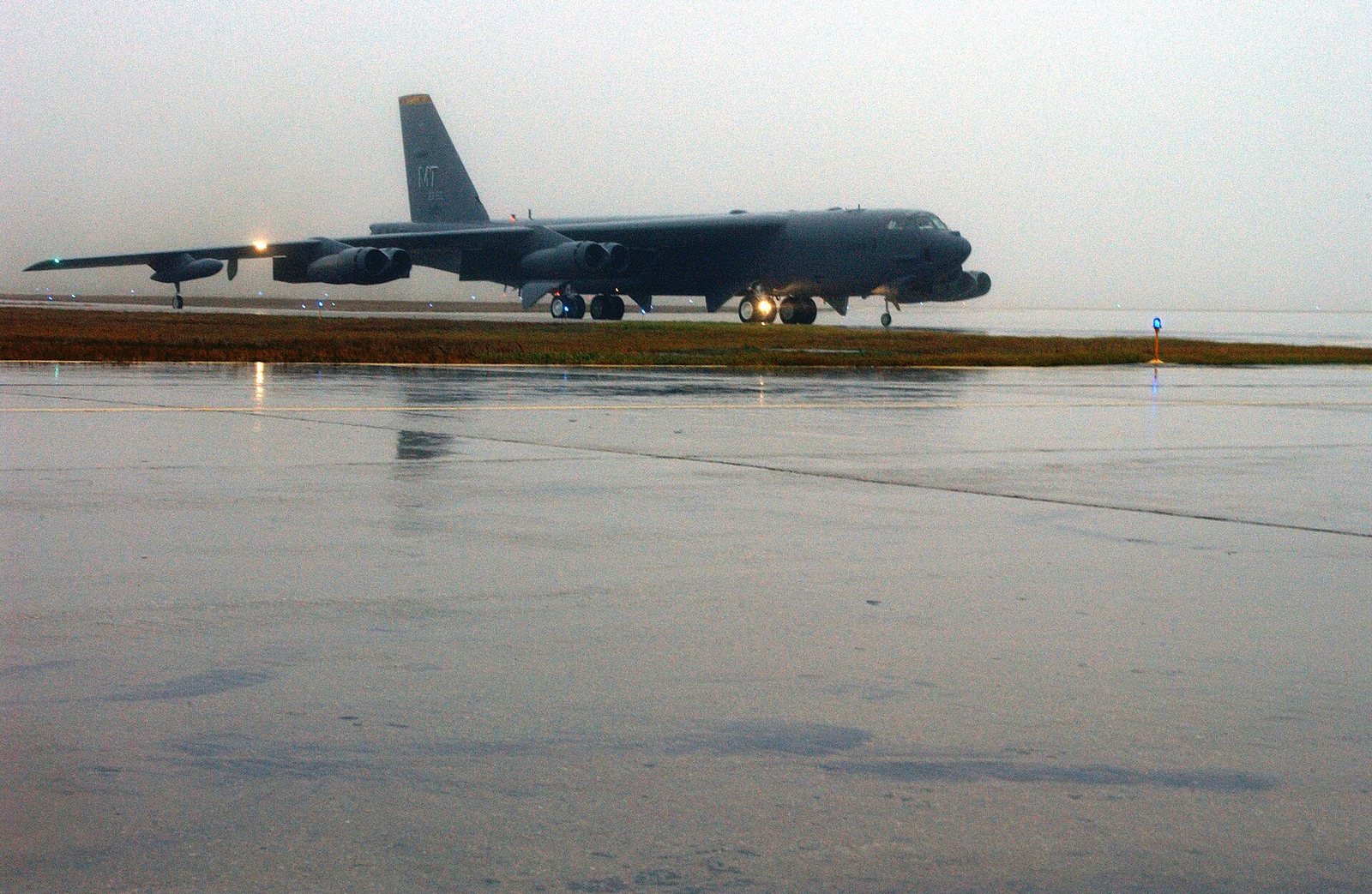
Overhead, a B-52H of the 5th Bomb Wing, call sign JAG 31, was finishing a training mission of about ten hours with practice approaches over Minot. The aircraft commander, Capt. Don Cagle, had a job interview with Delta Air Lines in Atlanta later that morning and had already missed one a month earlier because of a surprise readiness inspection; according to Tulien, when the UFO search began he retired to the bunk and left the flying to his co-pilot, Capt. Bradford Runyon, and Maj. James Partin, a pilot from another crew whom Cagle was evaluating. The rest of the crew were the radar navigator, Maj. Charles Richey, and the navigator, Capt. Patrick McCaslin, in the compartment below the flight deck, the electronic warfare officer, Capt. Thomas Goduto, and the gunner, TSgt. Arlie Judd. At 3:45 a.m., by the corrected clock, as JAG 31 climbed out toward a navigation fix thirty-five nautical miles northwest, a RAPCON controller asked them to look toward their one o’clock “and see if you see any orange glows out there,” adding: “Somebody is seeing flying saucers again.” Seven minutes later the controller said the base weather radar was painting the UFO three miles off their one o’clock. Runyon answered that there was nothing on the airborne radar and that he was in “some pretty thick haze” and could not see out.
Sources: Narrative of UFO Events at Minot AFB on 24 October 1968 · 2. B-52 Air-radar UFO Observation (3:44–4:02)Transcript of tape for 24 Oct 68 from 0830 to 0915Basic Reporting Data · SUBJ: UFO REPORT
Two miles in one sweep
McCaslin had Richey switch the bomb-navigation radar to its close-in “Station Keep” mode, the 360-degree picture used for formation flying and lining up behind a tanker, and turn on the radarscope camera, which shot one frame per three-second sweep. McCaslin recalled a weak return on one sweep and then a very strong one about three miles off the right wing, “as big or bigger than a KC-135.” As the bomber made a 180-degree turn at the fix, the echo stayed three miles away, swinging around to end up off the left wing; he reckoned it must have moved six to eight miles to keep its station, and when his interviewer suggested he was implying intelligence, he agreed: “Yeah, I guess I am.” Then, as the B-52 descended, the echo jumped from three miles to one between two sweeps and settled in what McCaslin called “perfect formation.” Runyon remembered Richey’s voice going shrill enough that for a second he thought they were about to collide. At that moment the bomber’s transmission to RAPCON broke off mid-sentence. On the ground, controllers called again and again, asked JAG 31 to squawk ident, then to squawk mayday if it had any trouble besides the radio. No mayday came. Three weeks earlier a Minot B-52 had crashed on approach, killing four crewmen.
Sources: Narrative of UFO Events at Minot AFB on 24 October 1968 · 2. B-52 Air-radar UFO Observation (3:44–4:02)Transcript of tape for 24 Oct 68 from 0830 to 0915Basic Reporting Data · SUBJ: UFO REPORTInterviews
“He stayed with us ’til about 10”
The echo rode along off the left wing as the bomber descended; Lt. Col. Arthur Werlich, the base officer who investigated, put the point where it left at about fourteen nautical miles out on the 296 radial, at roughly 9,000 feet. McCaslin thought it had dropped out of the beam and recorded its ground position in the bomb-nav computer. Then the radios came back. “Our UFO was off to our left there when we started penetration,” Runyon reported, and a moment later: “He was about 1½ miles off our left wing at 35 miles when we started in and he stayed with us ’til about 10.” The controller wondered whether that could have been the cause of their radio trouble. “I don’t know,” Runyon replied, “but that’s exactly when they started.” At November-7, meanwhile, the light the men had watched for an hour sank toward the trees and disappeared just as the bomber appeared in the west-southwest with its landing lights on. Jablonski noted the difference: the B-52’s engines “could be easily heard while the UFO made no sounds to be heard at about the same distance.” JAG 31 went around at 4:06 and stayed in the pattern at about 1,500 feet above the ground. At 4:13 the controller asked if they were seeing any more UFOs. “Negative on radar, we can’t see anything visually,” came the answer; the missile sites, the controller said, could no longer see anything either. What happened next is not in the transcript. Runyon remembered a voice on the radio: “General such-and-such wants you to go back around and overfly the object.” Where the order came from has never been established; Tulien suggests it was patched through from SAC or passed to Goduto on the high-frequency radio. McCaslin recalled that the pilots agreed on condition that they would make one visual pass and then land, and that it was “the tensest part of it, going over this thing at low altitude.” After 4:21 the transcript loses its time codes, and the conversations on the downwind leg are missing.
Sources: Narrative of UFO Events at Minot AFB on 24 October 1968 · 2. B-52 Air-radar UFO Observation (3:44–4:02)Narrative of UFO Events at Minot AFB on 24 October 1968 · 3. B-52 and the Ground Observers at N-7Transcript of tape for 24 Oct 68 from 0830 to 0915Basic Reporting Data · SUBJ: UFO REPORTNarrative of UFO Events at Minot AFB on 24 October 1968 · 4. B-52 Air-visual UFO Observations (4:24–4:28)Interviews
A miniature sun on the ground
Partin, flying from the left seat (Werlich’s report put the instructor pilot in the right), filled out the only aircrew questionnaire in the Blue Book file. Between 4:30 and 4:35 by the cockpit clock, he wrote, he saw an “unusually bright light I had never seen at night in this area,” like “a miniature sun placed on the ground below the aircraft”: on the downwind leg, “a bright orange ball of light at my one o’clock position,” perhaps fifteen miles off, stationary on or just above the ground. He turned onto the base leg about a mile south of it, above it, and it did not move. Interviewed in 2001, he added that it was oblong, with what looked like lit windows around it, and much larger than the houses below, which looked “about the size of dice.” Runyon, in the right seat, looked up from his checklists to find them already alongside it, and watched it through the pilot’s window for perhaps ten seconds as Partin banked almost over it. In 2000 and 2005 he described a dark rectangle in a dull red glow that he first took for an open barn loft, then “a metallic cylinder, sort of like stainless steel or shiny aluminum,” and at its far end a crescent that seemed solid and translucent at once, lighting the cylinder almost like daylight; inside what he took for a cabin he glimpsed colored lights, perhaps green and yellow. Once more the radios failed, and the controllers told him the transmission had died “in mid-word, not mid-sentence.” Down in the navigators’ compartment McCaslin heard an expletive from the flight deck and was invited up to look; unstrapped, with no parachute, he declined. “To quote our former 41st President, ‘Didn’t seem prudent.’” The bomber landed at 4:40, and when the crew walked into the building, McCaslin recalled, people were already waiting for the radarscope film instead of letting him hand it in as usual.
Sources: Narrative of UFO Events at Minot AFB on 24 October 1968 · 4. B-52 Air-visual UFO Observations (4:24–4:28)AF Form 117, Sighting of Unidentified Phenomena Questionnaire · Maj. James A. PartinInterviews
The open hatch at Oscar-7
At 4:49, nine minutes after the landing, the outer and inner security alarms went off together at Oscar-7, twenty-four miles north of the base. Outer-zone alarms tripped on animals and drifting snow; both zones at once was another matter. Smith sent his alert team, A1C Donald Bajgiar and A1C Vennedall, and O’Connor and Isley, driving home past the site around five, saw its security lights on and a hatch standing open just as the team pulled up. Werlich’s report gives the findings: the padlock on the chain-link fence open and the gate standing open; inside, a horizontal door unsecured and left open and the combination dial turned off its setting; “NO TRACKS, PRINTS OR IMPRESSIONS WERE FOUND.” A week later Werlich told Blue Book that anyone who could open the padlock “wouldn’t be a prankster from the farm areas,” that three similar intrusions in the previous two or three years had all been traced to Air Police, that ninety-nine chances out of a hundred a human intruder had a key, and that it was “not a serious offence.” Blue Book’s Lt. Carmon Marano replied that they had no evidence the UFO events had caused it. Smith, in 2001, remembered a lieutenant telling him later that he had found low-level radiation in the gravel parking area inside the fence, “a large circular pattern”; no document mentions it, though Werlich did tell Blue Book he wanted to go out to the site with a Geiger counter.
Sources: Narrative of UFO Events at Minot AFB on 24 October 1968 · 5. Oscar-7 Launch Facility Break-in (4:49)Basic Reporting Data · SUBJ: UFO REPORTMemo for the Record · Telephone conversation of 31 Oct 68, Col Werlich – Lt MaranoInterviews
Green lights in the west
The night was not over for the men on the ground. At 4:40 the dispatcher logged that N-7 had picked up the object again three miles west of the site, stationary and seemingly on the ground, its lights going from bright orange to white to green. It vanished, reappeared, moved, and at 5:10 hung green and motionless about fifty feet off the ground, some five miles to the west. Jablonski, trying to steady Adams on the drive back to November-1, joked about the television series The Invaders. Their last sighting was at 5:18 in the west-southwest: the object, stationary, went from orange-red to white to green, “and the green light started to diminish slowly till no longer seen.” At November-1 Bond watched it until 5:34. It “appeared to land,” he wrote, and after about fifteen minutes faded away. When his team came in, he recalled, everyone was talked out. “They were awful quiet.” McCaslin went home and woke his wife, Sammy: “You’re never going to believe what I saw tonight.” He fell asleep; she stayed up the rest of the night looking out, wondering what was out there.
Sources: Narrative of UFO Events at Minot AFB on 24 October 1968 · 6. Final Ground-visual UFO Observations (4:26–5:34)Base Operations Dispatcher’s log, 0800–1010Z, 24 October 1968Narrative of UFO Events at Minot AFB on 24 October 1968 · 4. B-52 Air-visual UFO Observations (4:24–4:28)
“There in black and white”
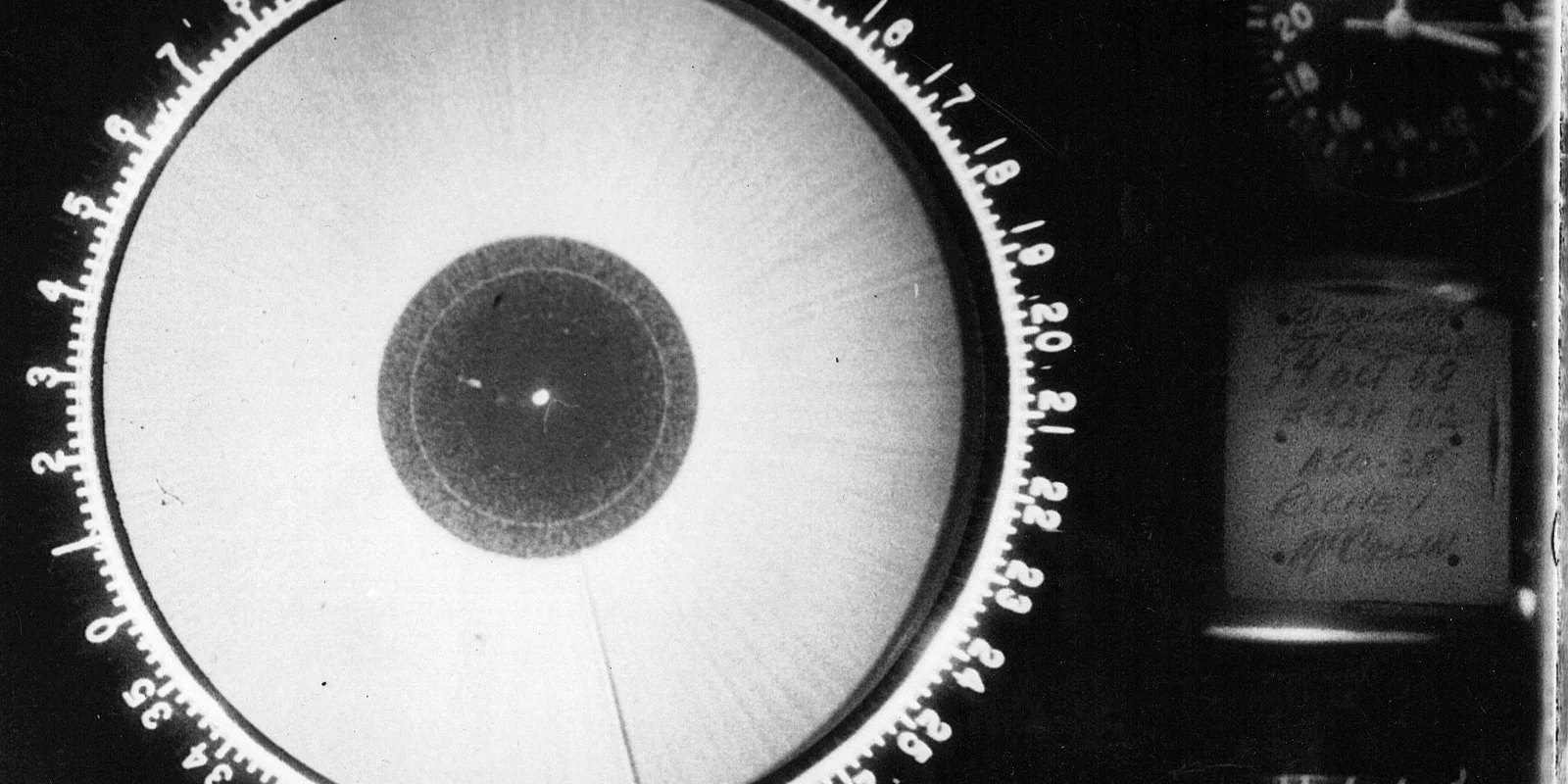
At 7:30 that morning SSgt. Richard Clark, an analyst in the 5th Bomb Wing’s intelligence office whose usual work was updating the wing’s bombing information in case of war with Russia, was told to drop everything and analyze the radarscope film. From fourteen frames he estimated a minimum average speed of about 3,900 miles per hour, and by early afternoon his report confirmed the crew’s account. He ordered two sets of 8-by-10 prints, one for the report and one for his desk. Told someone was coming from Washington and asked whether he was sure, he answered, as he recalled in 2003, “it’s there in black and white, there’s nothing else that it can be.” Later that morning Runyon, Richey, McCaslin, Goduto and Judd were called to the office of Brig. Gen. Ralph Holland, commander of the 810th Strategic Aerospace Division and the senior officer at Minot. Partin was not there, and Cagle was on his way to Atlanta. Runyon recalled that nobody asked what he had seen; instead Holland told them what had happened on the ground. Holland himself, interviewed in 2005, remembered a good crew, reliable people, and a radar navigator who told him he had “a radarscope photo solid of that return.” The answer from higher headquarters, he said, was that it was no UFO, and to go back to work.
Sources: Investigation of UFO Events at Minot AFB on 24 October 1968 · 2. Strategic Air Command InvestigationsInterview with Brig. Gen. Ralph Holland (USAF, ret.), 2005Interviews
“To get this thing simmered down”
Werlich, the base operations chief, was also Minot’s Blue Book officer, and this was his first UFO investigation. That afternoon he asked SAC headquarters for technical help and was told only to follow the regulation, so at about 4:30 he phoned Project Blue Book at Wright-Patterson. His account that day had the echo appear on the bomber’s right, cross to the left at about 3,000 miles per hour and stay off the left wing for some twenty miles while both transmitters failed. His formal report four days later moved the first detection to the left and dropped the speed. Then SAC took a close interest. On October 28 a colonel from SAC operations phoned Blue Book twice about its procedures; on the 29th Col. H. V. Pullen, for SAC’s intelligence chief, asked Lt. Col. Hector Quintanilla for a quick preliminary report. Quintanilla said he was “pretty sure” the return was an internal radar malfunction or an anomalous blip from the temperature inversion, and that he had sent nobody to Minot because “I only have four people on my staff” and the case “didn’t appear [too] unusual.” According to Blue Book’s memo, Pullen wanted the report “to get this thing simmered down” and asked Quintanilla to “hit a little heavy on what happened to other aircraft on occasions like this.” On November 1 Mr. Goff, an FTD man “quite familiar with air-borne radars,” suggested an ionized air plasma similar to ball lightning, and the same day, before the raw data had arrived, Quintanilla telexed SAC that the UFO was “MOST PROBABLY A PLASMA OF THE BALL-LIGHTNING CLASS.” SAC replied on November 7 that its commander and staff were “extremely interested.”
Sources: Memo for the Record · UFO Observation, Minot AFB, North Dakota, 24 October 1968Basic Reporting Data · SUBJ: UFO REPORTInvestigation of UFO Events at Minot AFB on 24 October 1968 · 4. Project Blue Book InvestigationMemo for the Record · talk with Mr. Goff, TDPA, on airborne radarTeletype, Lt. Col. Quintanilla to Col. Pullen, SSO SAC · 012014Z November 1968Teletype, SSO SAC to FTD · 071540Z November 1968Narrative of UFO Events at Minot AFB on 24 October 1968 · 2. B-52 Air-radar UFO Observation (3:44–4:02)
Sirius, Vega and a ball of plasma
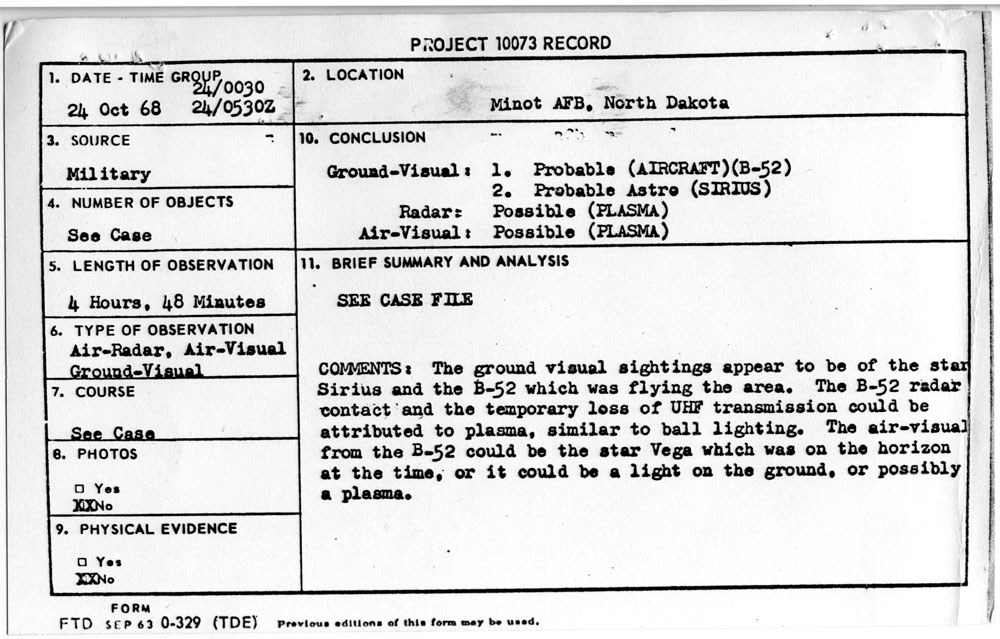
Quintanilla’s final letter of November 13, 1968, settled the case in four sentences. The ground sightings “appear to be of the star Sirius and the B-52 which was flying in the area.” The radar contact and the loss of UHF transmission “could be attributed to a plasma similar to ball lightning.” What Partin saw “could be the star Vega which was on the horizon at the time, or it could be a light on the ground, or possibly a plasma.” And the break-in at Oscar-7 “does not seem to be related to UFOs in any way.” No further investigation was contemplated. Attachments argued that Sirius, low in the southeast and flashing blue, red, white and green through the inversion, explained the guards’ colored lights, and that the bomber’s high-altitude practice maneuvers coincided with the first sightings. Werlich had told Marano much the same about the ground witnesses, that “almost 80 per cent were looking at the B-52,” but he could not account for the light the pilots flew over: there were farm fields there, and nothing that would produce that kind of light. For its 1968 statistics Blue Book filed the case as identified, by radar analysis, as plasma.
Sources: UFO Observation, 24 October 1968Project 10073 Record · Minot AFB, 24 Oct 68Memo for the Record · Telephone conversation of 31 Oct 68, Col Werlich – Lt MaranoInvestigation of UFO Events at Minot AFB on 24 October 1968 · 6. Project Blue Book Evaluation
A lid that kept moving
The strangest part of the Minot legend, a missile silo opened from above, grew over the decades. The documents record an open padlock, an open gate, an unsecured hatch and a turned combination dial. The earliest civilian account, a December 1969 letter to NICAP from the Minneapolis engineer William McNeff, whose brother-in-law turned out to be Clark, said that at one silo the outer and innermost alarms had gone off but the middle alarm, on the big concrete lid itself, had not, and that nothing was visibly disturbed. Runyon’s memory of the Holland briefing, recorded more than thirty years later, was much more dramatic: the first Air Police team sent out had not reported in, the second found them unconscious or coming to with the paint burned off their vehicle, and “the 20-ton concrete lid had been moved from the top of one of our Minuteman missiles.” McCaslin remembered only that the general had spoken sympathetically of two Air Policemen with something hovering over their truck. Clark had heard that three silos went off. By 2008 McNeff was telling the Grand Forks Herald that two airmen had passed out and that “the lid was completely off the silo and lying on the grass.” Holland would have none of it: “no lid ever went anyplace,” he said in 2005. If a lid had moved, SAC “would’ve been down there in two seconds,” and Runyon, he thought, seemed to be remembering things he had picked up afterwards. Werlich’s daughter Melody had her own version, from a late-night call to the family home: a frantic young missileer told her father that something like a hotel lit up and turned on its side was hanging over the missile site.
Sources: Narrative of UFO Events at Minot AFB on 24 October 1968 · 5. Oscar-7 Launch Facility Break-in (4:49)Basic Reporting Data · SUBJ: UFO REPORTLetter to NICAP on the Minot sighting, December 3, 1969Investigation of UFO Events at Minot AFB on 24 October 1968 · 2. Strategic Air Command Investigations‘I didn’t know what this thing was’Interview with Brig. Gen. Ralph Holland (USAF, ret.), 2005Interviews with Arthur Werlich’s daughters, February 2001
Thirty-two years later
For three decades the case lay in Blue Book’s microfilmed files, and in a NICAP folder where McNeff’s letter and its photo copies went unnoticed. In February 2000 Runyon, still without an explanation, filled out a questionnaire for the J. Allen Hynek Center for UFO Studies. The Sign Oral History Project, led by Thomas Tulien with James Klotz, tracked down the crew and the guards and interviewed them between 2000 and 2005; Richey had died in 1995. Clark’s print set, far sharper than Blue Book’s microfilm copies, came to them through McNeff. The British radar analyst Martin Shough worked through meteors, precipitation, lightning, ball lightning, aurora, birds, satellites, interference, jamming and anomalous propagation in 2006 and concluded that “no convincing explanation of the unidentified echoes is found.” The French astronomer Claude Poher, founder of France’s official UFO office, measured the frames, placed the bomber at 8,865 feet and 18.8 nautical miles out at the last one, and speculated that a sheath of ionized air around the object could have absorbed the bomber’s UHF transmissions while letting its transponder through. Tulien’s narrative and investigation, published in 2011, are the fullest account of the night. On the fortieth anniversary McCaslin, who had become a high school science teacher in Texas, told the Grand Forks Herald he did not know whether the thing came from outer space or inner space, and dismissed Vega with a word the paper declined to print. “How could it be a star,” he asked, “if you’re looking at the ground?”
Sources: InterviewsAnomalous Echoes Captured by a B-52 Airborne Radarscope Camera: A Preliminary ReportAnalysis of Radar and Air-Visual UFO Observations on 24 October 1968 at Minot Air Force Base, North Dakota, USALetter to NICAP on the Minot sighting, December 3, 1969‘I didn’t know what this thing was’Narrative of UFO Events at Minot AFB on 24 October 1968 · 3. B-52 and the Ground Observers at N-7
A thin file for a crowded night
Project Blue Book’s case file, preserved on National Archives microfilm, runs to 145 pages: Werlich’s teletyped Basic Reporting Data, telephone memos, two maps, the wing security controller’s witness list, the Base Operations dispatcher’s log, a three-page transcript of the RAPCON tapes, seven AF Form 117 questionnaires and thirteen 8-by-10 radarscope prints in very poor copies. The gaps are as telling as the contents. Werlich’s report mentioned nine more military witnesses without naming them, saying only one was in a position to contribute anything pertinent, and only seven people filled out questionnaires. Partin’s is the only one from the aircrew; none of the regular crew completed one. The camper and targeting teams at Oscar-6 and the guards at Juliet and Mike flights, who reported the object splitting in two, were never questioned, and the final report concedes that no detailed information was submitted for eight named witnesses. Blue Book’s staff of four never went to Minot. Its final report was padded with an index card from an unrelated 1968 radar-visual case at Eielson, Alaska, perhaps, Tulien suggests, as the comparison SAC had asked for, and a technical excerpt on visual illusions, and the case card records “Photos: No.”
Sources: Documentation: the Project Blue Book case file, Minot AFB, 24 October 1968UFO Observation, 24 October 1968Project 10073 Record · Minot AFB, 24 Oct 68Investigation of UFO Events at Minot AFB on 24 October 1968 · 4. Project Blue Book Investigation
Fourteen frames of radar film
The radarscope photographs are the case’s hard core. Clark’s set has fourteen frames, numbered 771 to 784; Blue Book’s file has thirteen. Thirteen of them show the B-52’s radar in its close-range, all-round mode with a heading marker, a clock and a handwritten data card reading “24 Oct 68,” “B-52H 012,” “ASQ-38,” “Richey” and “McCaslin.” Shough measured an echo about 1.6 nautical miles ahead and to the right in frame 771, behind the right wing in 772, a bright double echo about a mile off the left wing in 773, and a single compact echo in the same place in 776 to 778. He judged that no ordinary target or radar artifact fitted: his best mundane candidate, second-trip echoes from distant terrain combined with ghost echoes, was about thirty degrees off in bearing, and he rejected it himself. The frames cover well under a minute near the end of the encounter, though; Werlich said Richey started the camera only toward the end, when a pilot suggested it, and Clark remembered many more frames than survive. The crew’s accounts of the earlier jump from three miles to one rest on memory and the radio transcript, not on film.
Sources: B-52 Radarscope PhotographsAnomalous Echoes Captured by a B-52 Airborne Radarscope Camera: A Preliminary ReportInvestigation of UFO Events at Minot AFB on 24 October 1968 · 2. Strategic Air Command InvestigationsMemo for the Record · Telephone conversation of 31 Oct 68, Col Werlich – Lt Marano
Clocks and stories that disagree
Times in the record do not line up. The RAPCON transcript runs about ten minutes early for its first entries, the radarscope camera clock about six minutes fast, and Blue Book’s own sequence puts the bomber’s first pass at 3:35 and Partin’s sighting at 4:35, where Tulien places it at about 4:24 to 4:28. Isley’s questionnaire starts his sighting at 12:30 a.m., two hours before O’Connor’s, and the final report noted the conflict without explaining it. Werlich’s accounts shifted: on October 24 the echo appeared on the right at 3,000 miles per hour; on October 28 it appeared on the left with no speed given; his formal report said nobody aboard saw the object while the echo was close, yet three days later he told Blue Book that “they had it visually all the way down.” Runyon put the object out his left window, while Partin placed it at one o’clock and wrote that he first saw it northeast of the base. And at 4:26, while the crew remembered flying over it, the dispatcher logged that the B-52 went around again with “negative contact.”
Sources: Narrative of UFO Events at Minot AFB on 24 October 1968 · 2. B-52 Air-radar UFO Observation (3:44–4:02)Narrative of UFO Events at Minot AFB on 24 October 1968 · 4. B-52 Air-visual UFO Observations (4:24–4:28)UFO Observation, 24 October 1968Memo for the Record · UFO Observation, Minot AFB, North Dakota, 24 October 1968Basic Reporting Data · SUBJ: UFO REPORTMemo for the Record · Telephone conversation of 31 Oct 68, Col Werlich – Lt MaranoBase Operations Dispatcher’s log, 0800–1010Z, 24 October 1968
Testing the official answers
Each part of Blue Book’s verdict has a plausible core and a weak point. The bomber really was flying practice maneuvers over the area when the first lights appeared, and later came in with its landing lights on, so some ground observers must have watched it; Werlich himself put the figure at 80 percent. Sirius, the brightest star in the sky, was about twenty-four degrees up in the south-southeast at 4 a.m. and can flash vivid colors through haze. But Smith described the sky as completely overcast, and no star circles a launch facility, splits in two or settles to the ground in the west. Vega, according to Blue Book’s own table, was at the horizon in the north-northwest, off to the right of a bomber heading west-northwest, while the crew flew over a light below them. Ball lightning, Tulien points out, is a short-lived thing the size of a grapefruit associated with thunderstorms; this echo kept pace with a bomber for some ten minutes, descending from about 20,000 to 9,000 feet, on a cool, misty October night with no thunderstorms and twenty-five miles of visibility at the bomber’s altitude. The skeptic Michael Shermer, asked about the case in 2008, called the radar contact interesting but proof of nothing, and wondered whether one branch of the military had simply not told another what it was doing.
Sources: UFO Observation, 24 October 1968Memo for the Record · Telephone conversation of 31 Oct 68, Col Werlich – Lt MaranoInvestigation of UFO Events at Minot AFB on 24 October 1968 · 6. Project Blue Book Evaluation‘I didn’t know what this thing was’
Memories that grew
Most of the vivid detail comes from interviews recorded thirty-two to thirty-seven years later, and it can be measured against what the same people wrote in 1968. Partin’s questionnaire describes “a bright orange ball of light”; the lit windows appear only in 2001. Runyon’s metal cylinder and translucent crescent were first described in 2000, and General Holland believed he had absorbed things afterward. Jablonski’s swarm of small lights is absent from his 1968 form, by his own admission. The radiation ring at Oscar-7 rests on Smith’s single recollection, the burned vehicle and unconscious guards on Runyon’s memory of a briefing, and the open silo lid on stories that contradict the documents. The wing security summary itself inflated O’Connor’s report into an object “directly overhead” and has Bond’s team following the object to within half a mile of a landing, which Bond flatly denied in 2005. What remains firm is the documented core: multiple ground witnesses in separate places, a radio transcript with a mid-sentence blackout, a bomber crew’s report relayed in real time, and photographs of a radar echo off the left wing.
Sources: AF Form 117, Sighting of Unidentified Phenomena Questionnaire · Maj. James A. PartinNarrative of UFO Events at Minot AFB on 24 October 1968 · 4. B-52 Air-visual UFO Observations (4:24–4:28)Interview with Brig. Gen. Ralph Holland (USAF, ret.), 2005Narrative of UFO Events at Minot AFB on 24 October 1968 · 1. Ground-visual UFO Observations (2:15–3:44)Narrative of UFO Events at Minot AFB on 24 October 1968 · 5. Oscar-7 Launch Facility Break-in (4:49)Wing Security Controller’s summary and witness listInvestigation of UFO Events at Minot AFB on 24 October 1968 · 2. Strategic Air Command Investigations
- SEPTEMBER–OCTOBER 1968
SSgt. William Smith at Oscar-1 reports lights moving back and forth over the missile field and is told to keep them under observation.
- 4 OCT 1968
A Minot B-52H crashes on approach to the base, killing four crewmen.
- 24 OCT 1968 · 2:15 AM
A camper team at Oscar-6 reports a strange light near the site; a targeting team working on an exposed warhead closes the silo and leaves.
- 2:30 AM
Smith sees the glowing object to the south; driving to November-7, O’Connor and Isley watch a light rise from beside a yard light and pace their truck.
- ABOUT 3:00 AM
At N-7 the maintenance men watch the light circle to the south; the dispatcher patches their phone line to the tower and RAPCON and starts a log.
- 3:08 AM
SSgt. James Bond at November-1 reports to Wing Security Control; Jablonski and Adams head for N-7 and see a second object.
- 3:20–3:28 AM
Guards at Oscar, Juliet and Mike flights report the object splitting in two; the dispatcher logs “Two are seen now.”
- 3:45 AM
RAPCON asks the B-52 JAG 31 to look for “orange glows”: “Somebody is seeing flying saucers again.”
- 3:52 AM
The controller reports the base weather radar painting the UFO three miles off the bomber; Runyon, in haze, sees nothing.
- ABOUT 3:53 AM
McCaslin sees a strong echo three miles off the right wing; it holds station through a 180-degree turn.
- 3:58 AM
The echo jumps from three miles to one between sweeps; the bomber’s transmission cuts off mid-sentence and RAPCON calls for a mayday squawk.
- 4:02 AM
The radios return: the echo stayed off the left wing from 35 miles out to about 10. The N-7 light disappears as the bomber comes into view.
- 4:13 AM
JAG 31 reports nothing on radar or visually; an order attributed to a general sends it around to overfly the object.
- ABOUT 4:24–4:35 AM
Partin sees a “bright orange ball of light” on or near the ground; Runyon sees a lit cylinder and crescent as they pass over it, and the radios fail again.
- 4:40 AM
The B-52 lands and the radarscope film is collected; N-7 reports the object again, stationary three miles west.
- 4:49 AM
Outer and inner alarms sound at Oscar-7; the alert team finds the gate padlock open and a hatch open, with no tracks.
- 5:18–5:34 AM
Jablonski and Adams last see a green light fade in the west-southwest; Bond watches it appear to land and fade by 5:34.
- 24 OCT 1968 · MORNING
SSgt. Richard Clark analyzes the radarscope film; Brig. Gen. Ralph Holland meets the crew. Lt. Col. Arthur Werlich phones Blue Book that afternoon.
- 28–29 OCT 1968
Werlich sends his Basic Reporting Data; SAC asks Blue Book for a preliminary report “to get this thing simmered down.”
- 1 NOV 1968
Quintanilla telexes SAC that the UFO was “most probably a plasma of the ball-lightning class.”
- 13 NOV 1968
Blue Book’s final report attributes the sightings to Sirius, the B-52, plasma and possibly Vega, and ends the investigation.
- 3 DEC 1969
William McNeff writes to NICAP with copies of Clark’s radarscope prints; the letter sits in the files unnoticed.
- FEBRUARY 2000
Runyon fills out a questionnaire for the Center for UFO Studies; that year the Sign Oral History Project begins interviewing the crew and the guards.
- 2005–2006
Claude Poher and Martin Shough publish analyses of the radarscope frames; Shough finds no convincing explanation.
- FEBRUARY 2011
Thomas Tulien publishes his narrative and investigation of the case.
Sources & interviews
BackgroundThomas Tulien · Sign Oral History Project · the 91st Strategic Missile Wing, its 15 launch control facilities and 150 launch facilities, and the 5th Bomb WingNarrative of UFO Events at Minot AFB on 24 October 1968 · 1. Ground-visual UFO Observations (2:15–3:44)Thomas Tulien · Sign Oral History Project · February 2011 · with the AF-117 questionnaires, the dispatcher’s log and witness interviewsNarrative of UFO Events at Minot AFB on 24 October 1968 · 2. B-52 Air-radar UFO Observation (3:44–4:02)Thomas Tulien · Sign Oral History Project · February 2011 · with the RAPCON transcript, Werlich’s reports and crew interviewsNarrative of UFO Events at Minot AFB on 24 October 1968 · 3. B-52 and the Ground Observers at N-7Thomas Tulien · Sign Oral History Project · February 2011Narrative of UFO Events at Minot AFB on 24 October 1968 · 4. B-52 Air-visual UFO Observations (4:24–4:28)Thomas Tulien · Sign Oral History Project · February 2011 · with Partin’s AF-117 and the Runyon, Partin and McCaslin interviewsNarrative of UFO Events at Minot AFB on 24 October 1968 · 5. Oscar-7 Launch Facility Break-in (4:49)Thomas Tulien · Sign Oral History Project · February 2011Narrative of UFO Events at Minot AFB on 24 October 1968 · 6. Final Ground-visual UFO Observations (4:26–5:34)Thomas Tulien · Sign Oral History Project · February 2011Investigation of UFO Events at Minot AFB on 24 October 1968 · 2. Strategic Air Command InvestigationsThomas Tulien · Sign Oral History Project · February 2011 · Clark’s film analysis and the crew’s debriefing by Brig. Gen. Ralph HollandInvestigation of UFO Events at Minot AFB on 24 October 1968 · 4. Project Blue Book InvestigationThomas Tulien · Sign Oral History Project · February 2011 · the telephone memos between Blue Book, Minot and SAC headquartersInvestigation of UFO Events at Minot AFB on 24 October 1968 · 6. Project Blue Book EvaluationThomas Tulien · Sign Oral History Project · February 2011 · the plasma, Sirius and Vega explanations examinedDocumentation: the Project Blue Book case file, Minot AFB, 24 October 1968Sign Oral History Project · index of the 145-page Blue Book file (National Archives microfilm T1206), with scans of each documentProject 10073 Record · Minot AFB, 24 Oct 68Project Blue Book · Foreign Technology Division, U.S. Air Force · case index card · via the Sign Oral History ProjectMemo for the Record · UFO Observation, Minot AFB, North Dakota, 24 October 1968Project Blue Book · Lt. Carmon Marano’s note of Lt. Col. Arthur Werlich’s first telephone report · via the Sign Oral History ProjectBasic Reporting Data · SUBJ: UFO REPORTLt. Col. Arthur J. Werlich, 862nd Combat Support Group, Minot AFB · teletype of October 28, 1968 · via the Sign Oral History ProjectMemo for the Record · Telephone conversation of 31 Oct 68, Col Werlich – Lt MaranoProject Blue Book · November 1, 1968 · seven pages · via the Sign Oral History ProjectMemo for the Record · talk with Mr. Goff, TDPA, on airborne radarProject Blue Book · November 1, 1968 · the first suggestion of an ionized plasma · via the Sign Oral History ProjectWing Security Controller’s summary and witness list91st Strategic Missile Wing · October 1968 · via the Sign Oral History ProjectBase Operations Dispatcher’s log, 0800–1010Z, 24 October 1968Minot AFB Base Operations · via the Sign Oral History ProjectTranscript of tape for 24 Oct 68 from 0830 to 0915Minot AFB Radar Approach Control · conversations with the B-52 JAG 31 · three pages · via the Sign Oral History ProjectAF Form 117, Sighting of Unidentified Phenomena Questionnaire · A1C Lloyd M. Isley91st Missile Maintenance Squadron · October 28, 1968 · Project Blue Book file · via the Sign Oral History ProjectAF Form 117, Sighting of Unidentified Phenomena Questionnaire · Maj. James A. Partin23rd Bomb Squadron, 5th Bomb Wing · October 30, 1968 · the only aircrew questionnaire in the file · via the Sign Oral History ProjectTeletype, Lt. Col. Quintanilla to Col. Pullen, SSO SAC · 012014Z November 1968Foreign Technology Division, Wright-Patterson AFB · the plasma verdict sent before the raw data arrived · via the Sign Oral History ProjectTeletype, SSO SAC to FTD · 071540Z November 1968Strategic Air Command headquarters · “SAC commander and staff are extremely interested” · via the Sign Oral History ProjectUFO Observation, 24 October 1968Lt. Col. Hector Quintanilla Jr., chief, Aerial Phenomena Branch, Foreign Technology Division · November 13, 1968 · Project Blue Book final case report with attachmentsB-52 Radarscope PhotographsSign Oral History Project · the 14 radarscope frames from Sgt. Richard Clark’s 1968 print set, with notes on eachAnomalous Echoes Captured by a B-52 Airborne Radarscope Camera: A Preliminary ReportMartin L. Shough · 2006 · published by the Sign Oral History ProjectAnalysis of Radar and Air-Visual UFO Observations on 24 October 1968 at Minot Air Force Base, North Dakota, USAClaude Poher · August 2005, translated November 2005 · published by the Sign Oral History ProjectLetter to NICAP on the Minot sighting, December 3, 1969William McNeff · handwritten letter with the NICAP worksheet, from the CUFOS–NICAP files · via the Sign Oral History ProjectInterviewsSign Oral History Project · transcripts of interviews with Runyon, McCaslin, Partin, Goduto, Judd, Smith, Bond, Jablonski, O’Connor, Isley, Clark, Holland and Werlich’s daughters, 2000–2005Interview with Brig. Gen. Ralph Holland (USAF, ret.), 2005Sign Oral History Project · interview by Thomas Tulien and James KlotzInterviews with Arthur Werlich’s daughters, February 2001Sign Oral History Project · telephone interviews by James Klotz‘I didn’t know what this thing was’Grand Forks Herald · October 24, 2008 · McCaslin, Bill McNeff and Michael Shermer forty years onSpotted an error, or know a better source? Write to hello@uap.fun.
Connected files
The Lakenheath Radar NightTwelve years earlier over England: radar rooms at American-run bases tracked impossible maneuvers, and an RAF night fighter went up after the target.The Tehran InterceptAnother military crew that lost its UHF radio as it closed on an unknown light, and a Pentagon analyst who called the case a classic.The Green Light over MansfieldFive years later, another military aircrew at night: a red light rushing at an Army Reserve helicopter, and a radio call to the tower that got no answer.Rendlesham ForestU.S. Air Force security men at a Cold War base, strange lights in the woods, and witness accounts that grew in the retelling.Inside Project Blue BookThe four-person office that filed Minot under plasma and Sirius without sending anyone to North Dakota.J. Allen HynekThe Center for UFO Studies he founded was where Brad Runyon finally turned in 2000, still looking for an explanation.Discuss this case
Compare notes with other readers: witness details, sources, and the parts that still do not add up.
Open the discussion