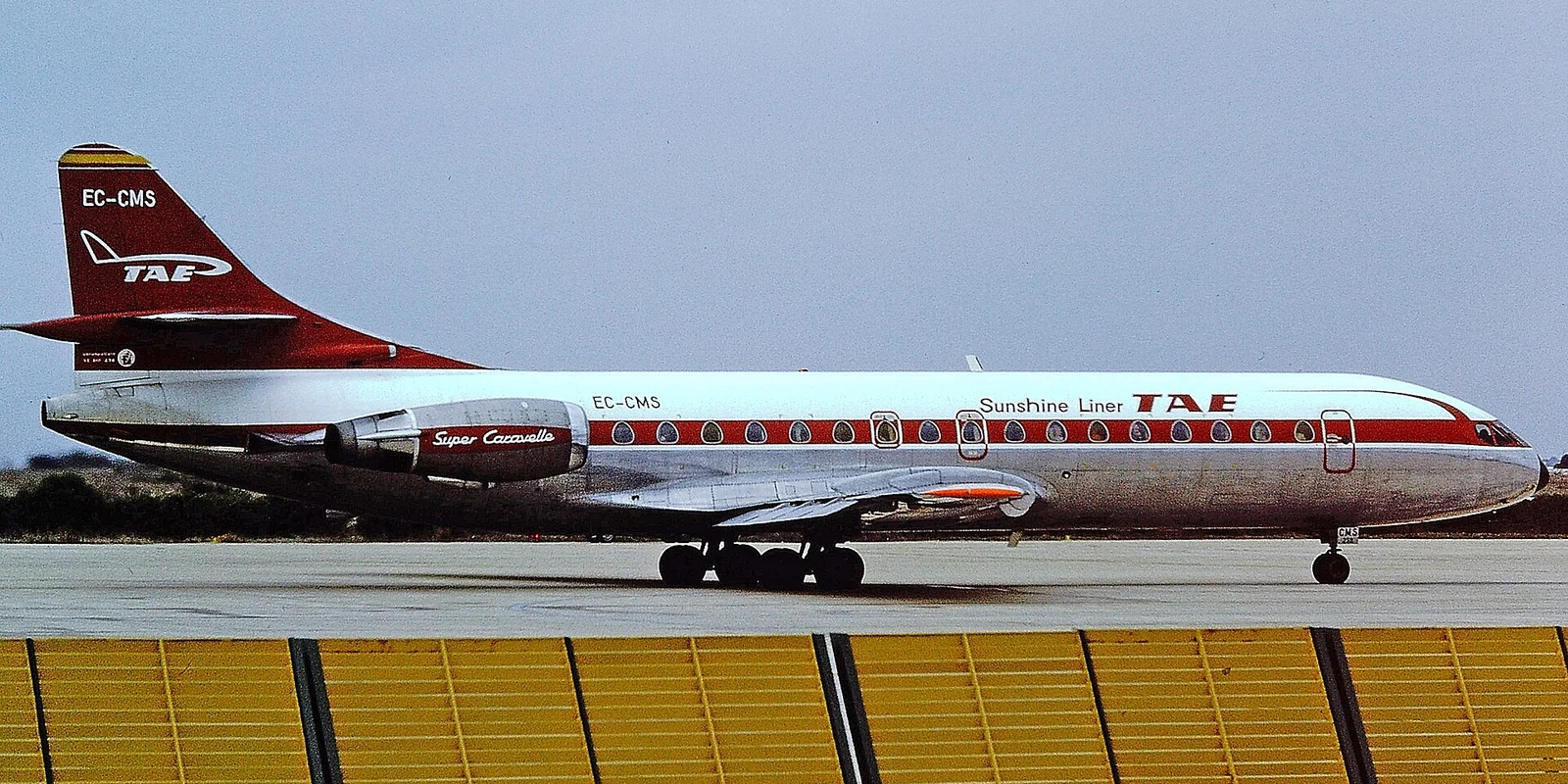
A charter to the sun
Trabajos Aéreos y Enlaces, TAE, was a small Spanish charter airline that flew northern Europeans to the beaches in a handful of French-built Sud Aviation Caravelles, their red tails lettered Sunshine Liner. On Sunday, November 11, 1979, one of them, the Super Caravelle EC-CUM, had collected 109 Austrian and German tourists at Salzburg, hours late, and set off for the Canary Islands by way of Palma de Mallorca, where it took on fuel and a fresh crew. The new commander was Francisco Javier Lerdo de Tejada, thirty-four years old, with some fifteen years and eight thousand hours in his logbook, six of those years in the Air Force and two in the rescue service, according to the biography J. J. Benítez later collected; beside him sat the copilot José Ramón Zuazu and the flight engineer Francisco Javier Rodríguez, with a third pilot, Luis de Luque, riding along to pick up another aircraft in the islands. Flight JK-297 lifted off from Palma at 21:47 GMT, Greenwich Mean Time, the clock the tapes and the file keep, 10:47 p.m. by Spanish watches, into a night the Air Force would later describe as one of extraordinary clarity: a strong high-pressure system, calm winds, hardly a cloud, and a sky so clean that a fighter pilot over Valencia would say he could see the lights of Madrid, 300 kilometers away. Spain was four years out of the Franco dictatorship and in the middle of what the newspapers were calling a UFO fever. It was also a day past the end of CRISEX-79, a large Spanish-American naval exercise off Almería that had brought the carrier USS Nimitz into the western Mediterranean. An hour before take-off, something else had begun: the rescue center in Madrid had told Valencia tower that a distress beacon was transmitting on 121.5 megahertz, the emergency frequency, somewhere off the coast. No aircraft was missing. Nobody could find it.
Sources: Avistamiento de fenómenos extraños en Valencia, Motril y Madrid: 11, 17 y 28 de noviembre de 1979Declaraciones a ABC del piloto del Caravelle: aterricé en Valencia ante un riesgo real de colisiónCausas del desvío del avión Super-Caravelle de la Compañía TAE. Presentada por don Enrique Múgica HerzogIncidente en ManisesEl caso Manises y las maniobras militaresAterrizaje de emergencia de un avión a causa de un ovni
“Tenemos dos señales, luces rojas”
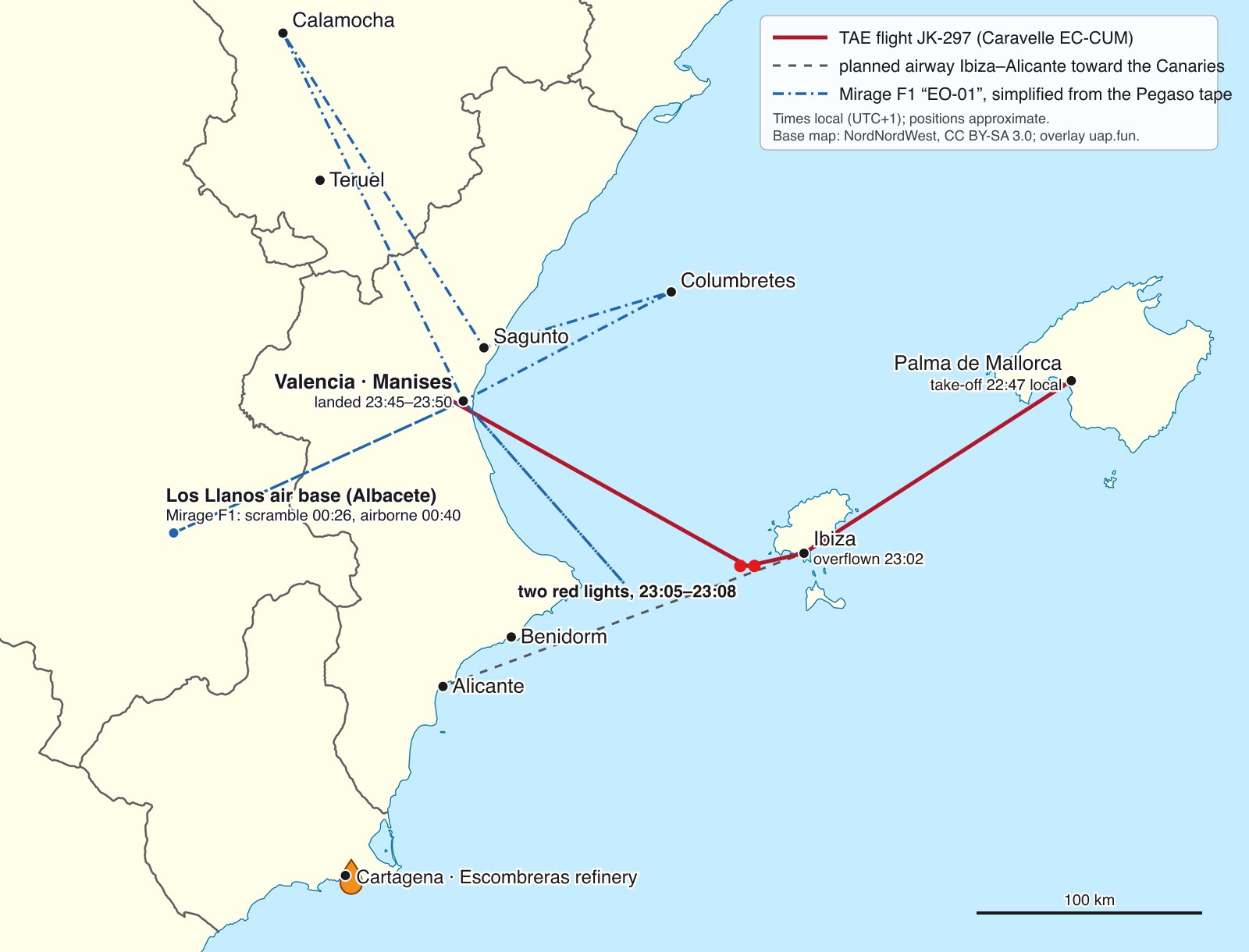
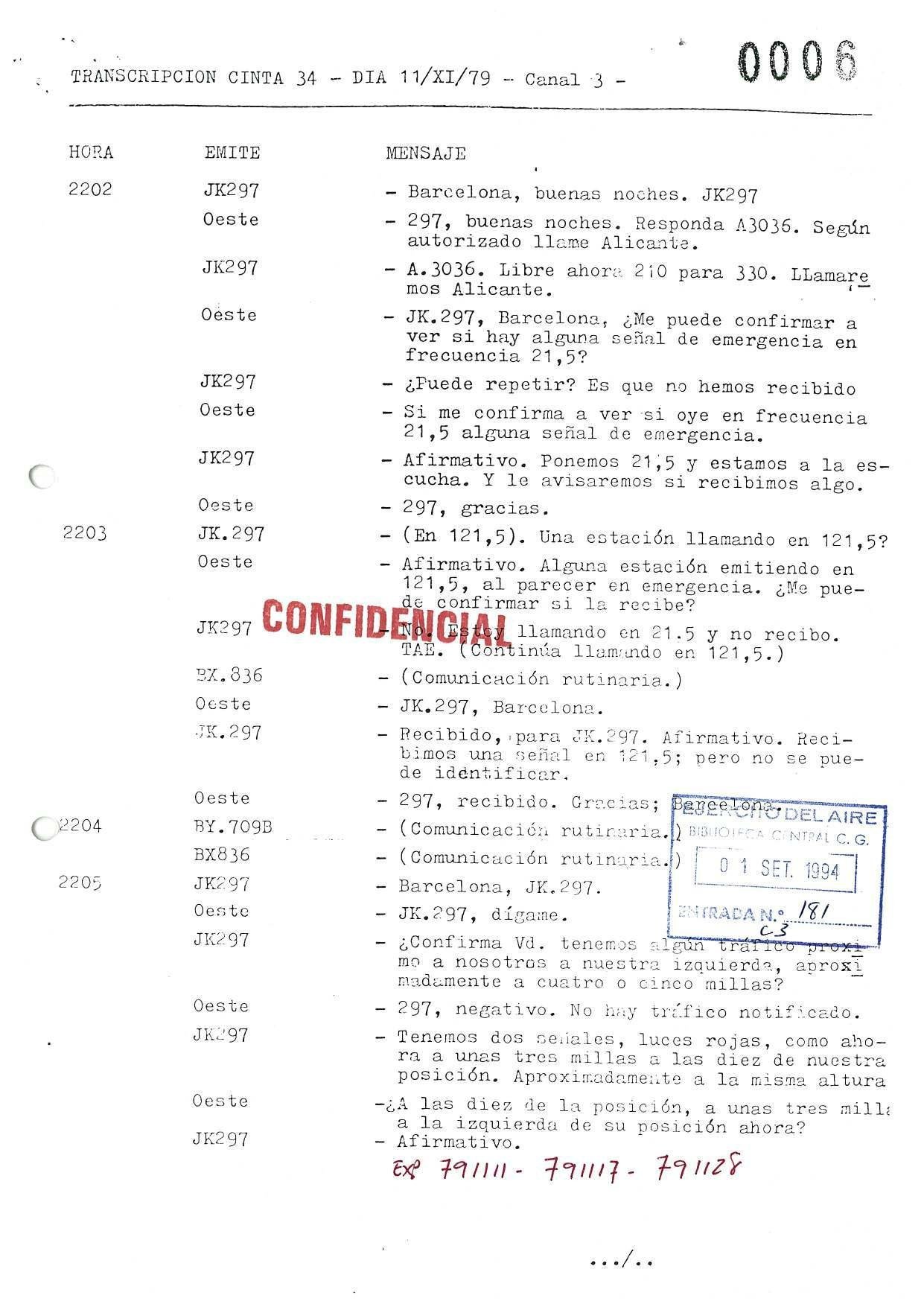
The Air Force file preserves Barcelona Control’s tape 34, channel 3, typed out by the controllers the next morning. At 22:02 GMT, as it crossed the Ibiza radio beacon, a navigation fix, JK-297 checked in and was asked whether it could hear the emergency signal on 121.5. The crew tuned it: a signal, yes, but nothing they could identify. At 22:05 the captain came back with a different question. “Can you confirm we have some traffic near us, on our left, about four or five miles?” “297, negative. No traffic notified.” “We have two signals, red lights, now about three miles at ten o’clock of our position. Approximately at the same altitude,” ten o’clock being the pilot’s shorthand for ahead and to the left. Barcelona had nothing: JK-297 was the only aircraft on the Ibiza–Alicante airway. A controller asked whether the lights were on the sea or in the air; the Caravelle did not answer the question. “The aircraft is a traffic and it’s about at our altitude,” the captain said at 22:06. “We’re passing 250 now. This traffic must be between 23 and 26.” Flight levels are hundreds of feet: the Caravelle was climbing through 25,000 feet and putting the lights between 23,000 and 26,000. Two minutes later: “Affirmative, we have it closer and closer… I can only see two fixed red lights, no flashing.” Barcelona had called Palma: no traffic at flight level 240 or below either. In the same minute: “I have increased the rate of climb through 280, and this traffic climbs much faster than we do and keeps getting closer.” At 22:09 the captain announced, “Pongo rumbo a Valencia,” I am heading for Valencia, and was passed to Barcelona’s Levante sector, the controllers who handle the airspace down the Valencian coast.
Sources: Avistamiento de fenómenos extraños en Valencia, Motril y Madrid: 11, 17 y 28 de noviembre de 1979
The dive
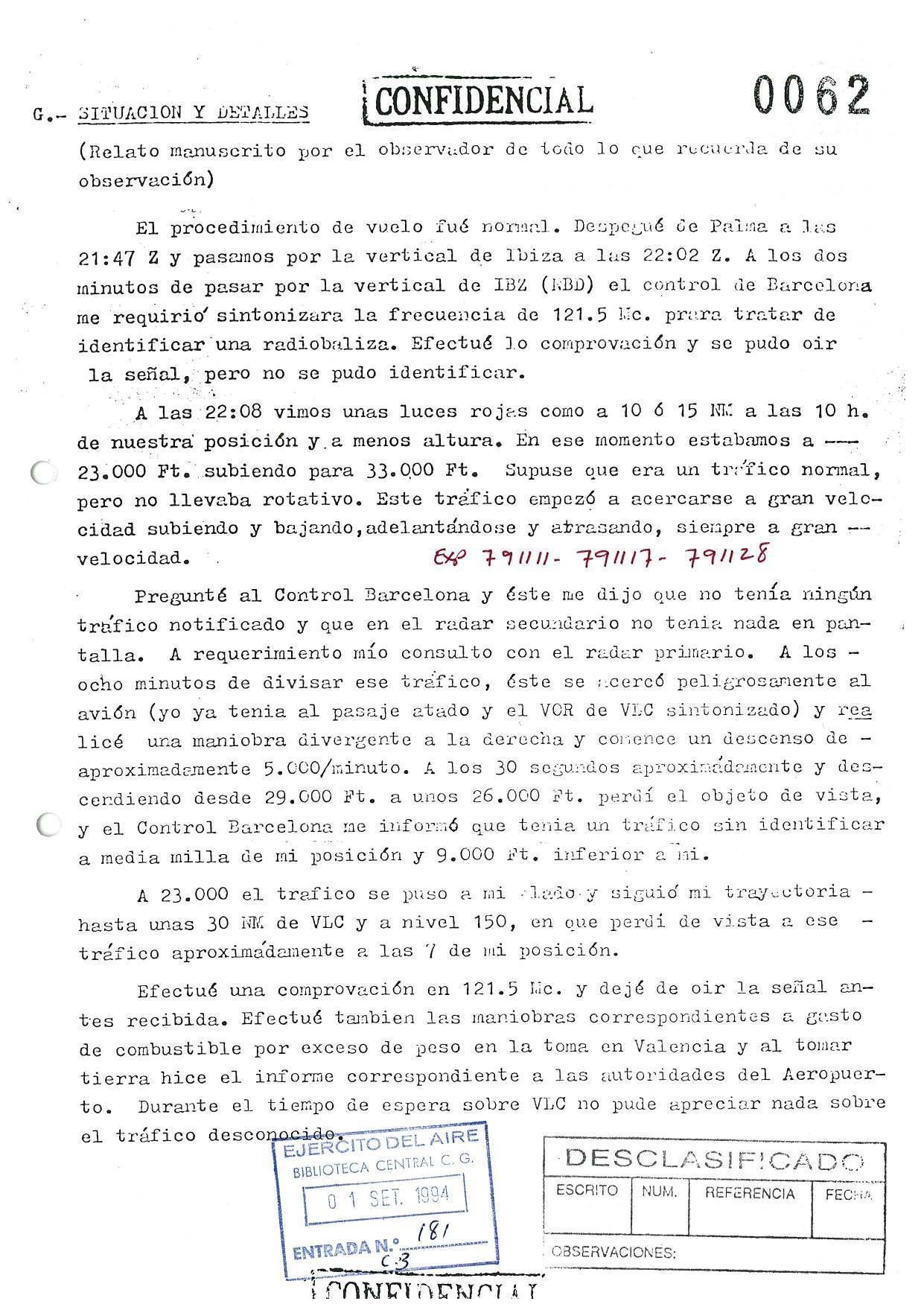
The Levante controller asked the question the night would turn on: “Do you want us to call some Defense interceptor?” The captain’s first answer was about altitude: “Right now I’m at 290. Holding 290. I’m going to Valencia.” The transcriber added a note that has been quoted ever since: “The pilot has raised his voice a great deal, and a certain agitation is noticeable.” Asked again at 22:10, he said: “If possible, yes. For information: the traffic is less than half a mile away and right now it has dropped a lot… it must be about 3,000 feet below us.” Barcelona switched on its primary radar, the kind that needs no transponder: “nothing comes up.” A minute later came the sentence that made the case: “Quiero tomar tierra en Valencia. No me gusta continuar con ese tráfico, que me está siguiendo.” I want to land at Valencia. I don’t like continuing with that traffic, which is following me. A crew from Spantax, another Spanish charter airline, cut in to ask how far he was from Valencia, 65 miles, and to say they could see nothing from where they were. “Two red lights, and it follows us… Two red lights that I now have below, and it follows us.” In the written statement he gave a few days later to the Air Force’s investigating judge, the officer the service appoints to collect evidence on a UFO report, Lerdo de Tejada described the moment he had not narrated on the radio: with the passengers strapped in and the Valencia navigation beacon tuned, the lights “approached the aircraft dangerously” and he “made a diverging maneuver to the right and began a descent of approximately 5,000 feet a minute.” Thirty seconds later, passing from 29,000 to about 26,000 feet, he lost sight of them; at that point, he wrote, control told him of unidentified traffic half a mile away and 9,000 feet below, a message that on the tapes comes only later, from Valencia. At 23,000 feet, he wrote, “the traffic placed itself at my side and followed my trajectory to about 30 nautical miles from Valencia and flight level 150.” Zuazu’s statement matches: two separated red lights coming from south to north, an evasive descending right turn at flight level 290, the object behind and to the left, lost about 30 miles out. Both pilots noted that the unreadable beacon on 121.5 had been audible from before they saw the lights until after they lost them.
Sources: Avistamiento de fenómenos extraños en Valencia, Motril y Madrid: 11, 17 y 28 de noviembre de 1979
Manises
Valencia approach took the Caravelle at 22:16. Manises, Valencia’s airport, shared its runway with an Air Force base, home to the fighter wing Ala 11. The crew asked to hold over the Valencia beacon to burn fuel, since they were too heavy to land, and reported “a kind of beacon transmission, but totally unreadable” still coming through on 121.5, and “on the left… TWO RED LIGHTS coming behind us.” At 22:24, cleared down to 4,000 feet, the captain said the red lights were no longer following; they had lost them two or three minutes earlier. Then the controller passed on something he had just been told: “We checked with the Pegaso military radar and it’s affirmative, it was near you at about 9,000 feet approximately.” “What was it?” “Unknown to them too.” Pegaso was the call sign of the air-defense control center at Torrejón, outside Madrid, which Barcelona had alerted at 22:16. A few minutes later the captain put the word on the tape: “It should be a UFO then, no?” “Must be,” the controller answered, adding that a beacon had been sounding on 121.5 for two and a half hours and nobody had been able to locate it either. The tower logged the landing at 22:45 GMT, 11:45 p.m. local time; the teletypes sent to Madrid the next morning said 22:50. Miguel Morlán, the airport’s acting director and an aeronautical engineer, had been dining in the terminal restaurant when an air-taxi pilot came to tell him a TAE Caravelle was coming in because it had met UFOs and feared a collision. He went down to the apron and met the pilots walking to the terminal “with faces of panic,” as he wrote in his statement: they told him that about ten miles after Ibiza two powerful red lights had come at them from the south, that they had turned for Valencia for fear of a collision, and that the lights had followed them to thirty miles out, always on the left, first level with them, then lower, then level again. The 109 passengers were put up at the Hotel Azafata beside the airport. Not all of them believed a word of it. By the next day, ABC’s Valencia correspondent reported, fifty-eight had signed a letter saying that only a mechanical fault could explain the landing, pointing out the four-hour delay at Salzburg and the crew change at Palma; their spokesman, an Austrian ceramics engineer, insisted he had seen “absolutely nothing.” The Caravelle flew on to the Canaries at a quarter to two the following afternoon.
Sources: Avistamiento de fenómenos extraños en Valencia, Motril y Madrid: 11, 17 y 28 de noviembre de 1979Aterrizaje de emergencia de un avión a causa de un ovniCausas del desvío del avión Super-Caravelle de la Compañía TAE. Presentada por don Enrique Múgica HerzogEl caso Manises y las maniobras militares
Three lights over the airport
When word spread that the TAE flight was coming in, the airport’s night staff went outside to look up. What they saw became the second half of the case. In the judge’s summary, three lights stood out abnormally bright among the stars, and one in particular, east-southeast over the port of Valencia at about twenty degrees above the horizon, flashed green, red and white “without interruption.” Morlán put it at three or four times the size and brightness of Venus, twenty-five degrees up, and fetched binoculars from his office for a better look; he also noted two fainter points to the north and west that “given the great clarity of the night could be stars.” The tower told Pegaso that an object sat on a bearing of 130 degrees from the airport’s beacon, roughly east-southeast, twenty miles out, with red and green lights, apparently motionless about 4,000 feet up; Morlán then told Pegaso of three objects, one over the airport flashing red and green, one over the port flashing white, one toward Sagunto. Civil departures were held. The airport duty officer, the military tower controller, two civilian controllers, a sergeant, a traffic-office technician and the airport concierge all gave statements; the brightest light, they said, rose slowly from about twenty degrees to sixty over roughly two hours while “its intensity diminished until it blended in with the stars.” The concierge added that two passengers had told him they had seen “a light as if playing with the plane.” One episode stood apart. Two controllers with binoculars and a traffic clerk saw what looked like an aircraft’s navigation lights low over the Albufera lagoon, 2,000 or 3,000 feet up, moving south at what they judged to be about 350 knots, a little faster than a fighter leaving the base would fly. They took it for the fighter they knew was coming and switched on the runway lights for it. Pegaso told them the Mirage was far away to the north of the inland village of Calles; the tape later showed it had never been below 20,000 feet.
Sources: Avistamiento de fenómenos extraños en Valencia, Motril y Madrid: 11, 17 y 28 de noviembre de 1979Intervención militar en la noche de Manises
Scramble
At 23:26 GMT the duty officer of the Air Combat Command, having heard from Pegaso and checked with the alert pilot and the duty captain at Manises air base, ordered a scramble. The alert aircraft at Los Llanos, outside Albacete, was a Dassault Mirage F1 of Ala 14, the fighter wing at Los Llanos, call sign EO-01, flown by Captain Fernando Cámara. He was airborne at 23:40, 12:40 a.m. local time, and in radio and radar contact with Pegaso two minutes later. Pegaso’s briefing is on the tape: a TAE Caravelle followed by a strange object had landed at Manises; once it was down, military and civilian staff had seen “three stabilized objects, and possibly one more changing level abruptly” over the runway at about 4,000 feet; two were still in view. “You’ll have to work eyes and radar to the maximum, since Pegaso has no radar contact with anything near Valencia.” The controller ran him through cabin, oxygen, parachute and armament checks, and added, “ánimo que la noche está bonita,” cheer up, it’s a beautiful night. Climbing through 24,000 feet toward the coast, Cámara reported something nobody had planned for: “Right now I’m getting interference on the radio, of the kind the Americans were making the other day, it’s a sort of siren.” A moment later: “The BF is showing me intermittent lock-ons from the right and the nose,” the BF being the Mirage’s radar-warning receiver, which lights when a radar beam sweeps the aircraft. Pegaso confirmed the directions and thought the nose warning might be over Sagunto and the right one over the port of Valencia. “Visually I have nothing,” said Cámara. “Negative, on radar nothing.” “When I press the mike they disappear.” He would say again that it was exactly the interference he had met a few days earlier, during CRISEX-79, when he was sent to find the carrier and flew over it; the command’s report names the ship, the Nimitz, and the date, November 2.
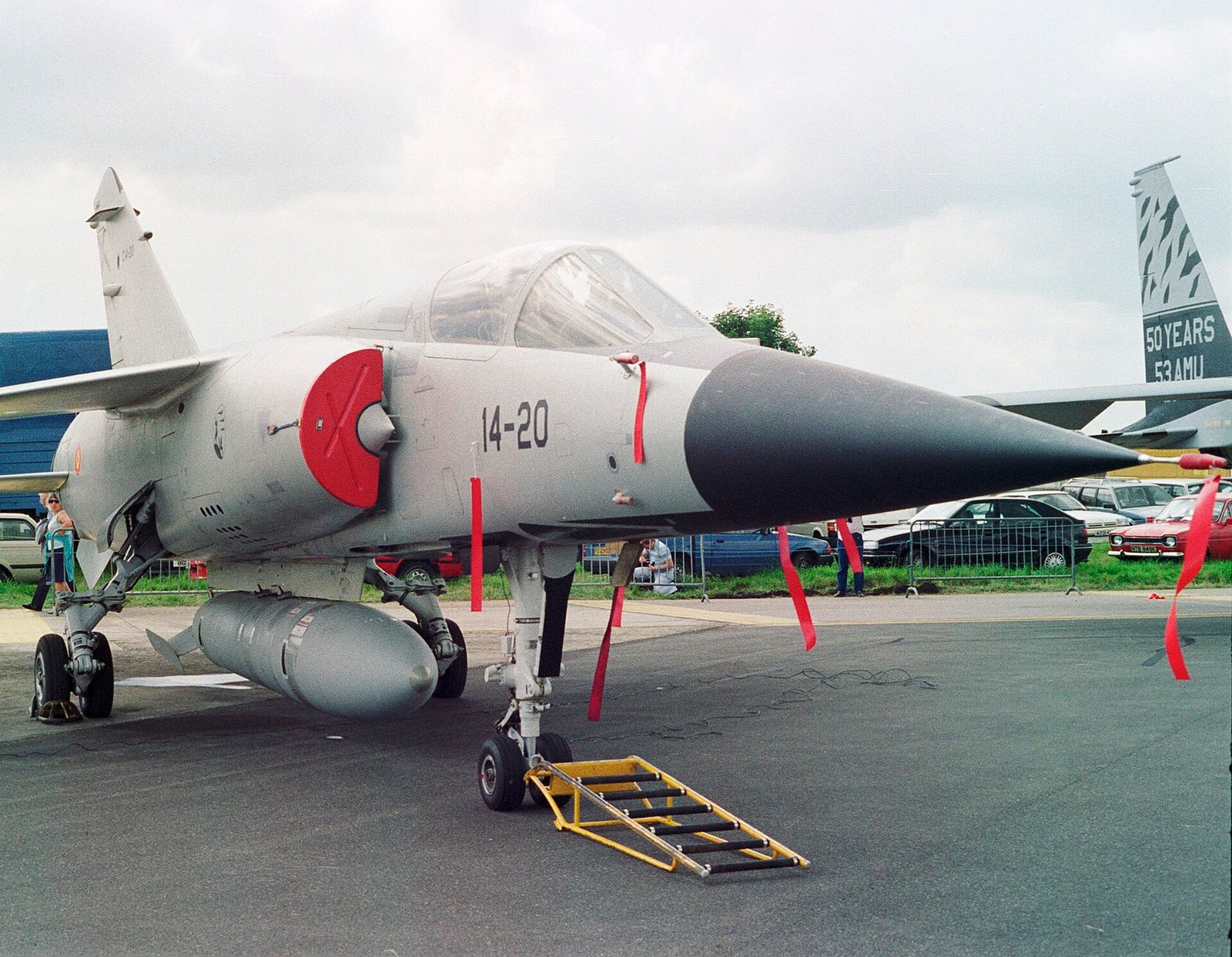
Sources: Avistamiento de fenómenos extraños en Valencia, Motril y Madrid: 11, 17 y 28 de noviembre de 1979De buscar un OVNI a velar por la seguridad de España, 50 años de la llegada del Mirage F1 a Albacete
An hour and a half of chasing lights
The chase on the tape is a long conversation between a pilot who can see lights and a controller who can see only the pilot. At 23:53, at 30,000 feet, Cámara spotted lights at his three o’clock, lower than he was and very far off, “toward Benidorm or thereabouts,” and turned south toward them. “They look very far away, you know?… they’re red, but they seem to be on the water.” With Ibiza perfectly visible on his left, he judged the lights farther than the island; Pegaso put Ibiza at 42 miles. After some 50 miles without closing, he gave up and turned back for Valencia, where the ground still had an object over the base. At midnight GMT, about 40 miles out, he saw it: a light over the airport flashing red, green and white, 2,000 or 3,000 feet above him, which the ground confirmed was the one they were watching. He flew at it on a heading of 340, a little west of north, for more than 70 nautical miles, past Valencia and inland toward Teruel, and it stayed where it was. “I see it always at the same distance… No idea, because it could be 10 or 15 miles and be close and small, or 100 miles and be bigger. Understand?” “Yes, received, it’s logical.” “As it’s such a clear night, so starry, it’s hard to tell what are stars from what… what might be lower.” He switched on the gun camera “in case something comes out… but I doubt it will.” At 00:17 he abandoned that light and was sent to the Valencia–Sagunto–Columbretes triangle, where the interference came and went so strongly that at times he could not understand Pegaso, who could hear the siren on the ground and was taping it. “Now I have a fixed lock-on in my face,” he reported at one point; “it lights up in the face the same as it lights up everywhere.” “Asombroso,” said Pegaso: astonishing. Near Sagunto, heading 080, the warning receiver registered a pulse radar while a white light sat on his nose at an unknown distance. Of another bright white light that “wasn’t there before,” low toward the sea, he said himself: “This time I think it’s a fatter star, or a star.” “With this night you can see all the way to Madrid,” he told Pegaso. “Caramba,” the controller answered, “I’ll raise my arm and wave in case you can see me.” At 00:45, with fuel at the limit, he made a last pass over Manises and the port, saw nothing, and turned for Albacete; on the way home the receiver lit once more, this time from behind. He landed at 01:07 GMT, roughly an hour and a half after take-off; the command’s report logs the sortie at one hour thirty-five minutes, with 900 liters left in the tanks. The gun-camera film, the judge later wrote, showed nothing: the camera had not worked.
Sources: Avistamiento de fenómenos extraños en Valencia, Motril y Madrid: 11, 17 y 28 de noviembre de 1979
Monday morning
By 08:12 GMT on Monday the Valencia air sector had teletyped the regional command that the aircraft “matrícula EC-CUM, compañía TAE, línea JK-297 Palma–Tenerife” had landed at 22:50 the night before “because of the dangerously close presence of an unidentified object,” and that the commander had cancelled his flight pending further information. The story was already out. The captain gave a brief account to the microphones of the Valencia station of RTVE, the state broadcaster; the copilot told reporters of “two red lights that approached us from the sky and went up and down in a non-conventional way,” of a steep descent because “frankly it wasn’t fun,” and of being told at Manises that some radar had picked up a target: “What’s clear is that that contraption had it in for us.” Morlán held a press conference and said the lights had hung over the airport at about 9,000, which ABC printed as meters and El País as feet. The Transport Minister, Salvador Sánchez-Terán, happened to be at Manises that morning to inspect building works and would not discuss military aircraft. El País reported, on official information, that the Caravelle had “detected on radar” an object near Ibiza, that it had landed “toward eleven at night,” and that the lights over the airport had vanished when “four Phantom aircraft from Albacete” flew over, three details the file does not support. By Tuesday ABC’s Alfredo Semprún had the captain on the telephone from Las Palmas, and on Wednesday the story acquired its first-person voice. “If I made an emergency landing at Manises,” Lerdo de Tejada said, “it was solely and exclusively because I saw my aircraft in danger of collision with an unidentified object.” He described two red lights side by side “of such enormous intensity that they hid from view the craft, or whatever it was, on which they must have been mounted,” moving “at a devilish speed, unknown in any conventional aircraft,” stopping instantly a short distance from the Caravelle, “playing with us for nearly ten minutes,” then starting a new collision course that he answered with “a violent break to the right” and a dive from 29,000 to 15,000 feet. Did he think he had seen a flying saucer? “I can’t answer you. If I knew what those saucers look like I’d tell you whether it was one. I only know it was a devilishly fast craft with astonishing maneuverability.” That Wednesday El País reported that everything about the case had been declared materia reservada, classified, under a standing decision of the Joint Chiefs of Staff; the file dates that decision to March 3, 1979. The next day, Thursday, November 15, in a Senate committee, a Canary Islands senator named Federico Padrón Padrón asked the Transport Minister to clarify the forced landing of the intercepted aircraft. Sánchez-Terán replied that the lights had been seen by the pilot or copilot, not the passengers, that their concern was recorded on the control tapes, that the reconnaissance aircraft from Albacete had found nothing, that the civil radars had seen nothing and that a smudge on the defense primary radar was being checked. As “merely a working hypothesis,” he offered that the red lights might have been the aircraft’s own lights reflected in the atmosphere. It was, according to the researcher José Juan Montejo, who found the session record, the first time a UFO was raised in the Spanish parliament.
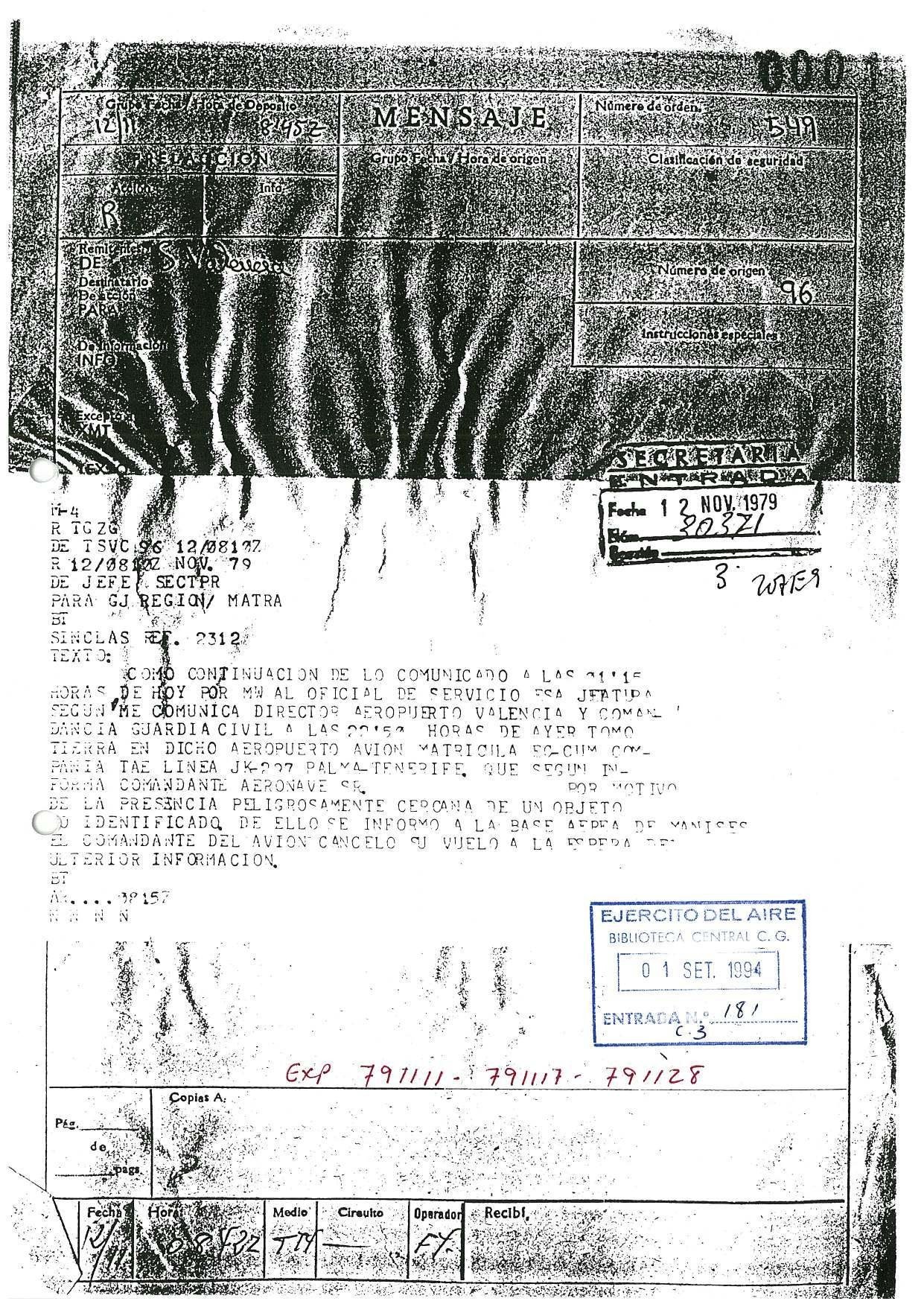
Sources: Avistamiento de fenómenos extraños en Valencia, Motril y Madrid: 11, 17 y 28 de noviembre de 1979Aterrizaje de emergencia de un avión a causa de un ovniDeclaraciones a ABC del piloto del Caravelle: aterricé en Valencia ante un riesgo real de colisiónUn ‘ovni’ forzó el aterrizaje de un Caravelle en ManisesEncuesta oficial sobre el aterrizaje forzoso de ManisesSalvador Sánchez-Terán: el discurso en el Senado del 15 de noviembre de 1979La primera interpelación en el Senado español por un caso OVNI… y no fue la de Múgica
The judge’s report
The Air Force appointed as investigating judge a captain of Ala 11, the wing based at Manises, who had himself been the duty captain that night and had been taken out onto the apron by Pegaso’s request to confirm the light: fixed, about thirty degrees up, radial 130, intensely white and flashing, showing white, red and green through binoculars. He collected the Barcelona, Valencia and Pegaso tapes, the weather report, the American military mission’s answer and thirteen witness statements taken “separately and without personal contact between them,” and signed his report at Manises air base on November 28, 1979. It is a careful document. He split the night into phases and argued that the crew and the ground had probably seen two different things: the captain had told him that the lights seen from the airport “bore no resemblance whatsoever” to the pair of intense, clean red lights he had seen from the cockpit. For the red lights he weighed a reflection of the Caravelle’s own wingtip light on ice crystals, which the captain rejected because of their size and intensity, and “other traffic of unknown origin,” possibly with electronic countermeasures to defeat radar, from which the American fleet was excluded by a letter from the head of the U.S. military mission in Spain. For the lights over the airport he weighed a planet, writing that his own knowledge of astronomy was limited and leaving the decision “to persons of a higher scientific level,” and uncontrolled traffic such as helicopters, none of which had been flying. He noted that the brightest light had moved with the stars and had been recognized by witnesses on later nights, that no radar anywhere had held a contact other than the controlled flights, and that the Mirage’s interference had always come in the Valencia–Sagunto zone where the mysterious beacon had been located; the beacon stopped around 03:30 GMT on the 12th, cause unknown. Then he wrote the sentences the case has lived on. All hypotheses remained open for higher study. Everything rested on the premise of two separate observations; “if it is considered that all the observations correspond to the same aerial phenomenon, the need arises to consider the hypothesis that there really exists a craft of unknown origin propelled by energy also unknown.” And of the low lights over the Albufera that the controllers had mistaken for the fighter, he concluded that their origin could not be determined and that they “confirm the existence of uncontrolled traffic in the zone, of unknown origin.” His superiors were less impressed. The Air Combat Command’s report of November 30 suggested temperature inversions could have produced mirage-like effects; the lieutenant general commanding the Zaragoza region wrote in January 1980 that “there is no proof to admit the presence of UFOs in this case,” that the ground lights could have been an unusually bright planet, a weather balloon or lights reflected by an inversion, and that the crew’s sighting might be the same thing “increased by the uneasiness of the crew, a fact confirmed in the transcript of the conversation with Barcelona Control.” When the French armed-forces attaché asked in December for the conclusions, destined for the French space agency’s department for unidentified aerospace phenomena, an internal note of February 25, 1980 ruled that nothing could be supplied: the matter was classified.
Sources: Avistamiento de fenómenos extraños en Valencia, Motril y Madrid: 11, 17 y 28 de noviembre de 1979
Benítez, Múgica and the classified answer
The journalist J. J. Benítez got to the witnesses first and fastest. His book Incidente en Manises appeared from Plaza & Janés in 1980, and his long piece in the magazine Mundo Desconocido that July, under the cover line “Three UFOs intercepted by a Spanish fighter,” carried a plan of the airport marking where the three lights had hung over the fuel farm and the tower, and a photograph of Morlán on the telephone. In Benítez’s telling, as the deputy Enrique Múgica would relay it to parliament, the object was “about twice the size of a Jumbo,” a Boeing 747, with two powerful red lights at its extremities, came within one or two hundred meters of the Caravelle, was tracked by Pegaso at half a mile, was watched by forty witnesses for two hours, and was chased by the Mirage, which took off around two in the morning, toward Aragon, toward the Columbretes and as far as Mahón on Menorca. On September 26, 1980, the Socialist deputy Enrique Múgica Herzog put almost exactly this account to the government as a parliamentary question, asking what craft had diverted the Caravelle, why three unidentified “traffics” had stayed over Spain for four hours and what had forced a Mirage to scramble. The answer the Air Staff drafted for the minister is in the file, and it is a point-by-point rebuttal of the Benítez version. The pilot had never given a size, only the separation of two lights; the closest distance he declared was half a mile, “and only momentarily”; there were thirteen witnesses in the record, not forty, and they did not agree on the number or position of the lights; the Mirage had never had a consistent radar lock and had chased lights whose position was being relayed from the ground; the photographs a mechanic had taken at Sóller on Mallorca that night, which had found their way into the file, “are not significant at all.” What diverted the Caravelle, the Air Staff concluded, “was not any kind of aircraft, the nature of the object in question being unknown, which may well have been simply an optical illusion.” No radar had seen it from the ground or the air, “which indicates the non-existence of a solid object in the zone.” Nothing had forced the scramble: a telephone call from Valencia about some lights had led the duty officer to send the fighter to check. Since the whole matter was classified, the Air Staff proposed that the minister be given a photocopy of the complete file in case the deputy raised other points. Researchers who have looked have found no public answer to Múgica’s question.
Sources: Intervención militar en la noche de ManisesEspagne: à propos de la caravelle poursuivie par un o.v.n.i.Causas del desvío del avión Super-Caravelle de la Compañía TAE. Presentada por don Enrique Múgica HerzogAvistamiento de fenómenos extraños en Valencia, Motril y Madrid: 11, 17 y 28 de noviembre de 1979El misterio del ovni de Manises: ¿qué eran las ‘luces rojas’ que desafiaron a un caza español?
Declassification and the refinery
The file surfaced in 1994, when the Air Force, prodded by the researcher Vicente-Juan Ballester Olmos and a growing public appetite, began declassifying its UFO expedientes; the Manises file was cleared on August 11, 1994, with the names of every witness inked out, and a thin supplement followed in 1996 after a search for lost paperwork turned up nothing new about Manises. In 2016 the Defense Ministry put the whole collection online under an open license. By then the skeptical case had a champion. Juan Antonio Fernández Peris, a Valencian agricultural engineer who spent nearly two decades on the case, won the 1999 prize of the Fundación Anomalía, a Spanish UFO research foundation in Santander, for a study published in 2000 as El expediente Manises. His thesis takes the night apart. The crew, he argued, “probably confused the flames of the flare stacks of the Escombreras refinery, next to Cartagena, with the red lights that caused their alarm”: the direction matched, the angular separation of the two red lights matched the real distance between the stacks, and a strong surface temperature inversion that night had lifted and distorted the flames into a superior mirage, the kind that hoists distant objects above the horizon, so that a pair of fires some 180 kilometers away seemed to hang at the airliner’s altitude and keep pace with it. The commander, he wrote, was under severe personal strain and “his anxiety or panic attack at the controls was in large part what motivated the emergency landing.” At Manises, staff “confused several stars with ‘unknown luminous objects’, the star Sirius being the largest light and the one that raised most expectation”; the base duty captain had, after all, telephoned Madrid at 1:45 by the Air Staff’s telephone log to say the object followed the stars and was probably a planet. Captain Cámara “saw nothing but distant, ill-defined lights that he never reached, their true nature probably stellar,” and his siren interference and radar warnings were electronic-warfare emissions from the helicopter carrier Iwo Jima of the U.S. Navy’s Sixth Fleet, its Mediterranean force, which was near the Columbretes that night on high alert during the Iran hostage crisis and docked at Valencia the next day. Repsol later confirmed to the researcher David Cuevas that the refinery was running normally that night. Defenders of the sighting answered in kind. José Manuel García Bautista and Rafael Cabello flew the route in a simulator and argued that the Escombreras stacks, about 150 meters tall, are screened from the north by ridges of 270 to 430 meters, that two flames 200 meters apart cannot be resolved by the eye at 180 kilometers, and that the Murcia weather center had no record of an inversion, a silence the file’s own weather report shares, as the Zaragoza general had noted in 1980; Miguel Ángel Ruiz pointed out that the Barcelona tape has the traffic climbing, “sube,” not merely moving. Cámara, asked about the refinery, has been blunt: “I know Escombreras very well, I have seen its flames from the air hundreds of times. Whoever makes these conjectures has never flown an aircraft, nor knows what it is to be in the air. I know very well what I saw. Besides, that light was heading toward Zaragoza and not toward Escombreras.”
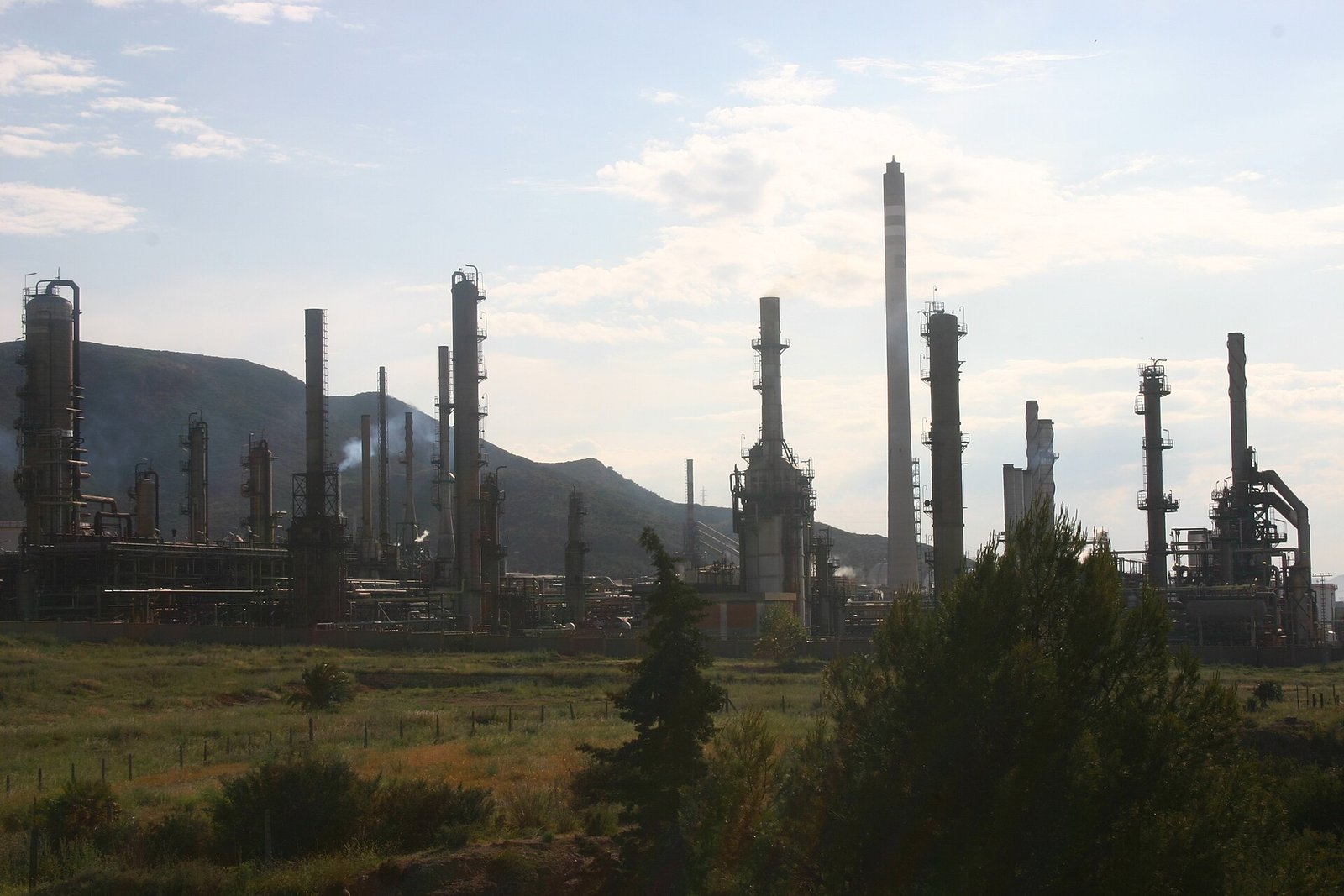
Sources: Los expedientes OVNI desclasificados – OnlineEl expediente Manises. 11 de noviembre de 1979: el día que un OVNI hizo aterrizar el vuelo TAE JK-297¡Aterriza como puedas! (resumen de El expediente Manises)Entre ufólogos, escépticos y chimeneasCaso Manises: más de 20 años de polémica‘El Expediente Manises’: un análisis críticoIncidente ovni de ManisesAvistamiento de fenómenos extraños en Valencia, Motril y Madrid: 11, 17 y 28 de noviembre de 1979
The pilot who kept talking
Two pilots carried the night, and they have had very different afterlives. Francisco Javier Lerdo de Tejada gave his radio and newspaper interviews in November 1979, spoke to Benítez, and then, as far as the record shows, said nothing more in public; no later interview has been found, and the anniversary programs do not feature him. Fernando Cámara, who rose to colonel before retiring, has told the story for forty years, and it has grown in the telling. On the 1979 tape there is no shape, no speed beyond the airspeeds Pegaso read off, no object that moves when he moves. In a 2015 radio interview he described a great red light static over Manises that, when he reached it at about a thousand kilometers an hour, “went from being static to flying in front of me at the same speed,” and said, “I was aware that this object was detecting me, because my aircraft’s threat systems went off. But I could only see it with my eyes”; he chased it toward Zaragoza, then found over Sagunto “a white disc, very different from the other light,” which he followed toward Menorca until fuel ran low. In later tellings the sound barrier is crossed, the object gives no infrared return to his missiles’ seekers and no echo “in any radar mode,” the warning receiver indicates a continuous-wave radar of the kind that guides anti-aircraft missiles, and the Sagunto light becomes a truncated cone, “an inverted cup without a base,” or a large transparent dome. In December 2019 he appeared on the fortieth-anniversary edition of Cuarto Milenio, Spain’s long-running mystery program, in the uniform he had worn in 1979. “The technology that object used was not normal or known,” he said in an interview an Albacete paper reprinted in 2025, when the Mirage F1 marked fifty years since its arrival at Los Llanos; it had been “the first and only time in my career that I had to scramble to hunt a UFO.” The gun camera has its own lore: in Benítez’s 1980 article an unnamed colonel said that when the pilot tried to film, the equipment jammed. The believers have Cámara; the skeptics have the tape. The case has become Spain’s best-known UFO story, retold on television, radio and podcasts and invoked whenever a Spanish pilot reports lights. What endures is simpler than any of the retellings: a professional crew that abandoned a flight rather than share the sky with two red lights, a controller who said “Asombroso,” and a file that recorded all of it and explained none of it.
Sources: El piloto que persiguió un OVNIDe buscar un OVNI a velar por la seguridad de España, 50 años de la llegada del Mirage F1 a AlbaceteEl Caso Manises: una persecución OVNI provocó el aterrizaje de emergencia de un avión en ValenciaEl enigma del Ovni de Manises: el día que un caza militar persiguió unas luces misteriosas sobre el cielo de ValenciaIntervención militar en la noche de ManisesCaso Manises: así cuenta un testigo lo ocurridoAvistamiento de fenómenos extraños en Valencia, Motril y Madrid: 11, 17 y 28 de noviembre de 1979
What the file holds
The core record is file 791111/791117/791128 of the Air Operations Command, which bundles the Valencia case with two later scrambles that month, over Motril on November 17 and Madrid on November 28, because all three involved Air Combat Command units. Its 142 numbered documents include the teletypes of November 12, the Barcelona Control daily log and tape transcript, the Pegaso director’s report, the U.S. military mission’s letter of November 15, the Air Staff duty officer’s telephone log, the judge’s report with the Valencia approach and Pegaso tapes, the weather report, thirteen witness statements on the standard form, two unreadable photocopies of the Mallorca photographs, the regional general’s “personal interpretation,” the French attaché’s request and refusal, the Air Combat Command’s report of November 30, press cuttings and the Múgica question with the Air Staff’s draft answer. Every name is blacked out; the ranks, years of service and professions remain, and the press cuttings bound into the file supply the names anyway. Ballester Olmos found a page of the Manises file missing from the first scan in 2016; the library supplied it the following year. The 1996 supplement adds nothing about the Caravelle or the Mirage. The original tapes were attached to the archive copy and have not been published; no written statement from the Mirage pilot is in the file, so his account that night survives there only in the Pegaso transcript and the two command reports built from it.
Sources: Avistamiento de fenómenos extraños en Valencia, Motril y Madrid: 11, 17 y 28 de noviembre de 1979Avistamiento de fenómenos extraños en Valencia, Motril y Madrid: 11, 17 y 28 de noviembre de 1979 (bis)Los expedientes OVNI desclasificados – OnlineUn ‘ovni’ forzó el aterrizaje de un Caravelle en Manises
The radar question
The lore says the UFO was tracked by military radar. The file says less. Pegaso’s own report states that its surveillance radar recorded the Caravelle’s track and nothing else near it; asked for height and number, EVA 5, the Escuadrón de Vigilancia Aérea or air-surveillance radar squadron on the Aitana massif above Benidorm, reported that its height-finder “managed to distinguish up to FIVE” returns at 9,000 to 11,000 feet while the Caravelle was at 15,000, losing them at the coastline in ground clutter. That is the whole documentary basis for the “affirmative” the Valencia controller passed to the cockpit, for the “four objects at half a mile” the Pegaso commander described to Morlán by telephone, and for the Pegaso tracking Benítez attributed to confidential sources. The judge recorded that the duty controller told him verbally that only one contact, the Caravelle’s, had ever been on the screen, and that the extra returns were an impression gained when the operator applied the discriminator, a filter meant to sort real targets from clutter, “probably owing to the prevailing agitation, or the controller not expressing himself well.” The Alert and Control Wing wrote on December 3 that nothing other than the aircraft had been seen near the Caravelle and that the one contact passed to the Mirage, near Sagunto, vanished at once among the fixed echoes that “normally appear and disappear on our consoles.” The Air Staff told the minister in 1980 that the echoes were momentary, that only the Caravelle’s trace was recorded, and that they were “simply false fixed echoes.” Barcelona’s primary radar saw nothing when switched on; the Valencia ground-controlled approach radar, started up when the fighter took off, saw nothing; the Mirage’s radar saw nothing in any mode or scale. An airliner’s weather radar is not built to find other aircraft, so the “detected on radar” of the first El País report has nothing to rest on. Against this stands the controller’s live remark on the tape and the fact that the EVA 5 returns were reported in real time, before anyone knew what story they would be asked to carry.
Sources: Avistamiento de fenómenos extraños en Valencia, Motril y Madrid: 11, 17 y 28 de noviembre de 1979Causas del desvío del avión Super-Caravelle de la Compañía TAE. Presentada por don Enrique Múgica HerzogEl caso Manises y las maniobras militares
Sirens, lock-ons and a beacon
The Mirage’s instruments are the strangest part of the file and the easiest to overstate. What the tape records are two things: siren-like radio interference, heard and recorded at Pegaso as well as in the cockpit, that came and went as Cámara entered and left the Valencia–Sagunto–Columbretes area and also appeared near Teruel and on the way home; and intermittent and occasionally steady indications on the radar-warning receiver, from the nose, the right, all around, and finally from the tail on the way home to Albacete. The Air Combat Command counted “radar lock-ons in the interceptor on three occasions.” None coincided with a visible object closing in; the receiver cannot say what is transmitting, only that something is. The pilot himself, that night, attributed the interference to the Americans. The judge tied the two anomalies together: the interference came where the 121.5 beacon had been located, and the beacon fell silent at 03:30 unexplained. The U.S. mission said no Sixth Fleet aircraft had been airborne and no carrier was near; the judge noted all the same that the helicopter carrier Iwo Jima docked at Valencia the next day. The Valencian researchers’ first theory, in January 1980, was that the red lights themselves were a Sixth Fleet fighter escorting the Caravelle to the edge of Spanish waters; Fernández Peris later moved the fleet from the red lights to the electronics. In 2021 Ballester Olmos, Fernández Peris and two colleagues argued that the beacon, the one element everybody agrees was real and unexplained, deserves to be the starting point, and asked whether a second emergency beacon in French waters might account for it.
Sources: Avistamiento de fenómenos extraños en Valencia, Motril y Madrid: 11, 17 y 28 de noviembre de 1979El ovni de Manises pudo ser un caza norteamericano¡Aterriza como puedas! (resumen de El expediente Manises)Las balizas del 11 de noviembre de 1979
How the story grew
The tape, the pilots’ statements, the first interviews and the later books tell the night at different sizes. On the tape the lights are first three miles off, then “less than half a mile”; in the captain’s written statement they first appear at 10 or 15 miles, at 22:08 rather than 22:05, and he says he cannot tell whether they belong to one large object or two in formation; he never gives a size. In ABC two days later they are of “enormous intensity,” stop instantly, play with the aircraft for ten minutes and provoke a dive from 29,000 to 15,000 feet; in his statement for the judge the dive is a 5,000-feet-a-minute descent from 29,000 to about 26,000, after which the traffic flies alongside down to flight level 150. By 1980, in Benítez, it is twice the size of a Jumbo and one or two hundred meters away. The landing is at 22:45 or 22:50 GMT in the file, “toward eleven” in El País; the scramble is at 23:26 GMT in the file, “toward two in the morning” in Benítez and Múgica, and “23:26 hours” in Cámara’s recent interviews, which drop the Z that marks a time as GMT and so make it local. El País had four Phantoms; the file has one Mirage. The destination is Tenerife on the teletype and Las Palmas in the press. The red lights seen from the cockpit were steady and red; the lights seen from the ground flashed red, green and white; later summaries merge them into “lights changing color between red, white and green” approaching the aircraft. The Mallorca photographs taken by a Sóller mechanic in the small hours, after he saw two orange lights the size of a peseta coin rise and vanish behind a ridge in about twenty seconds, were bound into the file as witness 13, dismissed by the Air Staff as showing “only a light over the horizon,” and called by Ballester Olmos “a false UFO sighting that tried to hook itself onto” the famous one; two Air Force officers collected the negatives, and the photographer spent years trying to get them back. Each layer has its defenders.
Sources: Avistamiento de fenómenos extraños en Valencia, Motril y Madrid: 11, 17 y 28 de noviembre de 1979Declaraciones a ABC del piloto del Caravelle: aterricé en Valencia ante un riesgo real de colisiónCausas del desvío del avión Super-Caravelle de la Compañía TAE. Presentada por don Enrique Múgica HerzogUn ‘ovni’ forzó el aterrizaje de un Caravelle en ManisesTreinta años del ‘caso Manises’, un fenómeno OVNI que asombró al mundoLa fotografía de Sóller: un ejemplo de la sinrazón¡Aterriza como puedas! (resumen de El expediente Manises)El enigma del Ovni de Manises: el día que un caza militar persiguió unas luces misteriosas sobre el cielo de Valencia
Classification and evidence note
This archive files Manises as an aviation encounter: an airline crew of two pilots and a flight engineer, with a third pilot riding along, reported unidentified lights pacing their aircraft and diverted because of them, a military interceptor was launched and reported instrument anomalies, and both events were recorded in real time on air-traffic and air-defense tapes that survive. No close-encounter classification applies; the nearest distance reported was about half a nautical mile. The physical evidence is thin: no radar track other than momentary height-finder returns later written off as clutter, no usable photograph, no gun-camera film, no debris, no trace. The testimonial evidence is strong in quality and weak in agreement: experienced pilots, controllers and an aeronautical engineer running the airport, describing lights whose distance none of them could judge, on a night the file itself calls extraordinary for visibility. The Air Force’s investigating judge left every hypothesis open, including a craft of unknown origin; his superiors preferred a planet, an inversion and an anxious crew; the Air Staff’s draft answer for parliament called it possibly an optical illusion; the most thorough civilian study names a refinery, Sirius and an American warship. None of these has persuaded Cámara, Lerdo de Tejada never answered them in public, and none has been disproved. What remains documented beyond dispute is that on November 11, 1979, an airline captain told Barcelona Control he would not continue with that traffic following him, and that for the next three hours the Spanish air-defense system looked for it and could not find it.
Sources: Avistamiento de fenómenos extraños en Valencia, Motril y Madrid: 11, 17 y 28 de noviembre de 1979¡Aterriza como puedas! (resumen de El expediente Manises)Causas del desvío del avión Super-Caravelle de la Compañía TAE. Presentada por don Enrique Múgica Herzog
- 1–10 NOV 1979
The Spanish-American exercise CRISEX-79 runs off Almería with the carrier USS Nimitz; on November 2 Captain Cámara meets siren-like radio interference while flying over the carrier.
- 11 NOV 1979 · 20:45 GMT
The rescue center in Madrid tells Valencia tower that an unidentified distress beacon is transmitting on 121.5 MHz off the coast.
- 11 NOV 1979 · 21:47 GMT
TAE flight JK-297, Caravelle EC-CUM, takes off from Palma for the Canary Islands with 109 passengers.
- 11 NOV 1979 · 22:05 GMT
Three minutes after crossing Ibiza, the captain reports “dos señales, luces rojas,” two signals, red lights, three miles off at ten o’clock, at his altitude. Barcelona has no traffic.
- 11 NOV 1979 · 22:08–22:11 GMT
The lights climb faster than the Caravelle and close to less than half a mile; the captain dives, turns for Valencia and says he will not continue with that traffic following him.
- 11 NOV 1979 · 22:16 GMT
Barcelona alerts Pegaso, the air-defense center at Torrejón; the air-surveillance radar squadron on Aitana reports up to five momentary height-finder returns below the airliner.
- 11 NOV 1979 · 22:24 GMT
Descending toward Manises, the crew reports the red lights no longer following. The Valencia controller relays Pegaso’s “afirmativo.”
- 11 NOV 1979 · 22:45–22:50 GMT
The Caravelle lands at Manises. Airport staff outside see three bright lights, one flashing red, green and white over the port.
- 11 NOV 1979 · 23:26 GMT
The Air Combat Command duty officer orders a scramble; Mirage F1 EO-01 is airborne from Los Llanos at 23:40.
- 11 NOV 1979 · 23:49 GMT
Cámara reports siren-like radio interference “of the kind the Americans were making the other day” and intermittent radar-warning indications.
- 12 NOV 1979 · 00:00–00:17 GMT
Over Valencia, the Mirage flies more than 70 miles toward a flashing light that never changes its apparent distance, then abandons it.
- 12 NOV 1979 · 00:45 GMT
A final pass over Manises and the port shows nothing, and the Mirage turns for Albacete.
- 12 NOV 1979 · 01:45
By the Air Staff’s telephone log, the duty captain at Manises reports that the object follows the stars and is probably a planet.
- 12 NOV 1979 · 01:07 GMT
EO-01 lands at Albacete with 900 liters of fuel after a sortie the command logs at 1 h 35 min. The beacon on 121.5 falls silent around 03:30.
- 12 NOV 1979
The Valencia air sector teletypes Madrid; the crew speak to RNE and the press; fifty-eight passengers sign a letter blaming a mechanical fault.
- 14 NOV 1979
ABC publishes the captain’s interview: “Aterricé en Valencia ante un riesgo real de colisión,” I landed at Valencia facing a real risk of collision. El País reports the matter is classified.
- 15 NOV 1979
Senator Federico Padrón Padrón raises the landing in a Senate committee; the Transport Minister suggests a reflection of the aircraft’s own lights as a working hypothesis. The U.S. mission says no Sixth Fleet aircraft was airborne.
- 28 NOV 1979
The investigating judge signs his report at Manises air base, leaving every hypothesis open, including “una nave de procedencia desconocida,” a craft of unknown origin.
- 23 JAN 1980
The lieutenant general commanding the Zaragoza region writes that there is no proof of UFOs: a planet, a balloon or an inversion, plus an uneasy crew.
- 25 FEB 1980
An internal Air Force note rules that the French attaché’s request for the conclusions, destined for the French space agency, cannot be met: the matter is classified.
- JUL 1980
J. J. Benítez’s Mundo Desconocido article “Intervención militar en la noche de Manises” appears; his book Incidente en Manises is published the same year.
- 26 SEP 1980
Deputy Enrique Múgica Herzog tables a parliamentary question; the Air Staff’s draft answer calls the lights possibly “una ilusión óptica,” an optical illusion.
- 11 AUG 1994
The Air Force declassifies the Manises file; it reaches the Air Force central library on September 1.
- 1999–2000
Fernández Peris wins the Fundación Anomalía prize and publishes El expediente Manises: refinery flares, Sirius and Sixth Fleet jamming.
- 22 SEP 2016
The Defense Ministry publishes the declassified UFO files online under a CC BY 4.0 license.
- 22 DEC 2019
Cuarto Milenio marks the fortieth anniversary with Cámara in his 1979 uniform.
- JAN 2021
Ballester Olmos, Plana, Servera and Fernández Peris publish “Las balizas del 11 de noviembre de 1979,” the beacons of November 11, 1979, on the unexplained distress signal.
Sources & interviews
Avistamiento de fenómenos extraños en Valencia, Motril y Madrid: 11, 17 y 28 de noviembre de 1979Mando Operativo Aéreo, Estado Mayor, Sección de Inteligencia, Ejército del Aire · file 791111/791117/791128, 142 numbered documents on 147 pages as declassified, with the Barcelona, Valencia and Pegaso tape transcripts, thirteen witness statements and the investigating judge’s report of November 28, 1979 · declassified August 11, 1994 · Biblioteca Virtual de Defensa, record 38287, CC BY 4.0Avistamiento de fenómenos extraños en Valencia, Motril y Madrid: 11, 17 y 28 de noviembre de 1979 (bis)Mando Operativo Aéreo, Ejército del Aire · 11-page supplement with the July 1994 search for lost paperwork and the November 28, 1979 Madrid scramble · declassified November 20, 1996 · Biblioteca Virtual de Defensa, record 38290, CC BY 4.0Causas del desvío del avión Super-Caravelle de la Compañía TAE. Presentada por don Enrique Múgica HerzogBoletín Oficial de las Cortes Generales, Congreso de los Diputados, Serie E, no. 378-I · October 14, 1980, pp. 847–849 · the oral question of September 26, 1980Un ‘ovni’ forzó el aterrizaje de un Caravelle en ManisesJaime Millás · El País · November 13, 1979 · the first national report, with the ‘four Phantoms’ and an 11 p.m. landing that the file does not supportEncuesta oficial sobre el aterrizaje forzoso de ManisesEl País · November 14, 1979 · UFO information declared ‘materia reservada’ by the Joint Chiefs of StaffEl ovni de Manises pudo ser un caza norteamericanoJaime Millás · El País · January 25, 1980 · the Valencian researchers’ Sixth Fleet hypothesis after the CRISEX-79 exerciseAterrizaje de emergencia de un avión a causa de un ovniABC (Madrid) · November 13, 1979, p. 53 · the Valencia correspondent, with the copilot’s account, the passengers’ protest letter and the airport director’s press conferenceDeclaraciones a ABC del piloto del Caravelle: aterricé en Valencia ante un riesgo real de colisiónAlfredo Semprún Guillén · ABC (Madrid) · November 14, 1979, p. 4 · the commander’s telephone interview from Las PalmasFiebre de ovnis en la región valencianaABC (Madrid) · November 15, 1979, p. 48 · Efe dispatch relaying the Valencia daily Levante¡Aterriza como puedas! (resumen de El expediente Manises)Juan Antonio Fernández Peris · Cuadernos de Ufología nos. 25–26, Fundación Anomalía, 2000 · the author’s own summary of his book, reproduced on the Expediente Manises blogEl expediente Manises. 11 de noviembre de 1979: el día que un OVNI hizo aterrizar el vuelo TAE JK-297Juan Antonio Fernández Peris · Fundación Anomalía, Santander, 2000, 210 pp. · Biblioteca Camille Flammarion no. 1, winner of the foundation’s 1999 Ricardo Caruncho prizeLos expedientes OVNI desclasificados – OnlineVicente-Juan Ballester Olmos · Biblioteca Virtual de Defensa, record 42382, 2017 · how the 1992–1999 declassification happened and what went online in 2016Las balizas del 11 de noviembre de 1979Vicente-Juan Ballester Olmos, Joan Plana, Jaime Servera and Juan Antonio Fernández Peris · FOTOCAT blog, January 2021 · on the emergency beacon heard that nightCaso Manises: más de 20 años de polémicaJosé Manuel García Bautista and Rafael Cabello Herrero · Sevilla, May 2000 · a flight-simulator reconstruction against the refinery explanation · Informe OVNI‘El Expediente Manises’: un análisis críticoMiguel Ángel Ruiz · Informe OVNI · 2009 · seven objections to Fernández Peris, with the file’s document numbersEntre ufólogos, escépticos y chimeneasDavid Cuevas · El Ojo Crítico no. 63, 2009 · with Repsol’s confirmation that the Escombreras refinery was running that night · reproduced on the Expediente Manises blogEl caso Manises y las maniobras militaresFrancisco Máñez · Expediente Manises blog, 2013 · the CRISEX-79 exercise, the Nimitz and the Iwo Jima, with the Valencia control tapeSalvador Sánchez-Terán: el discurso en el Senado del 15 de noviembre de 1979Transcription of the Transport Minister’s answer to Senator Federico Padrón Padrón in the Senate’s public works and transport committee · Expediente Manises blogLa primera interpelación en el Senado español por un caso OVNI… y no fue la de MúgicaJosé Juan Montejo · El Ojo Crítico no. 88 · 2019 · the Diario de Sesiones of November 15, 1979El piloto que persiguió un OVNIArturo Blay · Cadena SER, Radio Valencia · October 1, 2015 · interview with Fernando CámaraDe buscar un OVNI a velar por la seguridad de España, 50 años de la llegada del Mirage F1 a AlbaceteEl Digital de Albacete · June 18, 2025 · Ala 14’s Mirage F1 history, 1975–2013, with Cámara’s account of the scrambleEl Caso Manises: una persecución OVNI provocó el aterrizaje de emergencia de un avión en ValenciaCuatro · Cuarto Milenio, season 15, episode 14 · broadcast December 22, 2019, article dated December 23 · fortieth-anniversary program with Fernando Cámara in his 1979 uniformEl enigma del Ovni de Manises: el día que un caza militar persiguió unas luces misteriosas sobre el cielo de ValenciaDiego Servente · Qué! · June 10, 2026 · the retired colonel’s three contacts as he tells them todayEl misterio del ovni de Manises: ¿qué eran las ‘luces rojas’ que desafiaron a un caza español?Manuel P. Villatoro · ABC · November 12, 2020 · forty-first anniversary, with David Cuevas and Manuel CarballalIntervención militar en la noche de ManisesJ. J. Benítez · Mundo Desconocido no. 49 · July 1980, pp. 50–60 · with a plan of Manises airport and the three lights · scanned at the Internet ArchiveEspagne: à propos de la caravelle poursuivie par un o.v.n.i.J. J. Benítez, translated by L. de Troya · Hypothèses Extraterrestres no. 15 · July 1980, pp. 7–8 · with Noël Paulin’s route sketch · Internet ArchiveTreinta años del ‘caso Manises’, un fenómeno OVNI que asombró al mundoÚltima Hora (Palma) · November 15, 2009 · the Sóller photographs and the officers who took the negativesIncidente ovni de ManisesWikipedia (Spanish) · with Cámara’s 1999 reply to the refinery explanationIncidente en ManisesExpediente Manises blog · January 2013 · the crew biographies as J. J. Benítez collected them in 1980La fotografía de Sóller: un ejemplo de la sinrazónVicente-Juan Ballester Olmos · FOTOCAT blog · October 21, 2009 · on the Mallorca photograph attached to the caseCaso Manises: así cuenta un testigo lo ocurridoDMAX España · Extraterrestres: ellos están entre nosotros · YouTube, 10 min · Fernando Cámara on camera, Spanish-languageSpotted an error, or know a better source? Write to hello@uap.fun.
Connected files
The Lights Beside Flight 1628Another airline crew reporting lights pacing their aircraft at night, another argument over what a radar did or did not show, and a captain, Kenju Terauchi, who was grounded for speaking.The Tehran InterceptThree years earlier, interceptors chasing a light reported their instruments failing as they closed; the Mirage’s siren and lock-ons invite the comparison.The Giants of GáldarThe other great Spanish Air Force UFO file, from the same declassified collection, where an investigating judge also left the question open.The Lights beside the Newspaper PlaneEleven months earlier over New Zealand: an aircraft, lights over the sea, radar returns and a mundane explanation, squid boats, that the crew never accepted.The Belgian UFO WaveA decade later, fighters scrambled after lights reported from the ground recorded radar lock-ons that the air force itself later questioned.Discuss this case
Compare notes with other readers: witness details, sources, and the parts that still do not add up.
Open the discussion